
Asphalt Crack Sealing in Aurora, CO
Finding reliable asphalt crack sealing in Aurora, CO starts with comparing contractors based on crack-sealing services, pavement suitability, local service coverage, project costs, qualifications, customer reviews, crack-assessment methods, surface preparation, sealant materials, commercial property experience, scheduling, warranties, and knowledge of Aurora’s climate. Read more ⌄ Read less ⌃
Professional asphalt crack sealing in Aurora, CO helps property owners limit water infiltration, slow crack expansion, protect the pavement structure, reduce pothole formation, and extend asphalt service life through inspection, crack cleaning, surface preparation, flexible sealant application, and final inspection. Reviewing contractor credentials, written estimates, sealant specifications, comparable projects, warranties, and customer feedback is essential when selecting an asphalt crack sealing contractor in Aurora. Asphalt Coatings Company is a commercial asphalt maintenance contractor serving Aurora and Colorado’s Front Range since 1986 with experienced crews, specialized pavement equipment, and CDOT-approved crack-sealing materials. Asphalt Coatings Company provides pavement inspections, crack assessment, crack cleaning and preparation, flexible sealant application, final quality inspections, preventive maintenance, and related asphalt repair services.
Commercial service coverage extends throughout Aurora, including areas such as Original Aurora, Northwest Aurora, Del Mar Parkway, Meadowood, Mission Viejo, and Saddle Rock. Asphalt crack sealing costs in Aurora depend on total linear footage, crack width and depth, pavement condition, cleaning and preparation requirements, material quantity, equipment access, traffic control, and project scheduling. Each crack-sealing project begins with an assessment that determines whether pavement cracks remain suitable for sealing or indicate alligator cracking, base deterioration, pothole formation, or structural failure that requires infrared repair, patching, resurfacing, or replacement. Sealable cracks are cleaned of dirt, vegetation, loose material, and debris before flexible sealant is applied with specialized equipment to create a durable barrier against moisture infiltration. Asphalt Coatings Company recommends proactive treatment of newly developing cracks because untreated openings allow rain, snow, and ice to penetrate the pavement structure and accelerate deterioration.
These services protect parking lots, drive lanes, access roads, loading areas, commercial yards, and industrial pavement for shopping centers, apartment communities, office properties, warehouses, healthcare facilities, schools, and other Aurora commercial properties. Climate-specific crack sealing helps local asphalt accommodate freeze-thaw cycles, snowmelt, moisture infiltration, seasonal temperature fluctuations, heavy traffic, and high-altitude environmental exposure. The benefits of hiring commercial asphalt crack sealing in Aurora, CO are listed below.
- Reduced Water Infiltration: Flexible crack sealant limits rain, snowmelt, and moisture from entering pavement openings and weakening the supporting structure.
- Slower Crack Expansion: Proper preparation and flexible sealing materials accommodate pavement movement while limiting continued deterioration.
- Protected Pavement Base: Sealing eligible cracks reduces moisture-related erosion, settlement, pothole development, and base failure.
- Correct Treatment Selection: Professional assessment separates sealable cracks from alligator cracking and structural deterioration that require more extensive repair.
- Longer Pavement Life: Proactive crack treatment preserves serviceable asphalt and delays more extensive resurfacing or pavement replacement.
- Lower Lifecycle Costs: Preventive crack sealing can reduce future pothole repairs, full-depth patching, milling, and premature resurfacing costs.
- Improved Property Appearance: Sealcoating restores a darker, more uniform pavement surface and provides a clean background for refreshed parking lot markings.
- Improved Pavement Safety: Treating cracks before deterioration develops into potholes and failed pavement helps maintain safer surfaces for vehicles and pedestrians.
- Reduced Property Disruption: Coordinated and phased scheduling helps maintain planned access for customers, tenants, employees, residents, and delivery vehicles.
Aurora Asphalt Paving Reviews
Hiring Asphalt Coatings Company as a commercial asphalt paving contractor in Aurora offers competitive pricing, dependable scheduling, consistent communication, experienced estimators, quality workmanship, and long-term maintenance planning for property managers, HOA boards, business owners, and commercial developers across Colorado.


Featured Clients ACC Has Served
National retailers, grocery chains, travel centers, and dealerships across Colorado trust Asphalt Coatings Company with their commercial pavement.
 Asphalt Coatings Company has delivered commercial asphalt paving and parking lot maintenance for Costco Wholesale in Colorado.
  Asphalt Coatings Company has delivered commercial asphalt paving and parking lot maintenance for Safeway in Colorado.
  Asphalt Coatings Company has delivered commercial asphalt paving and parking lot maintenance for King Soopers in Colorado.
  Asphalt Coatings Company has delivered commercial asphalt paving and parking lot maintenance for Lowe's in Colorado.
  Asphalt Coatings Company has delivered commercial asphalt paving and parking lot maintenance for The Home Depot in Colorado.
  Asphalt Coatings Company has delivered commercial asphalt paving and parking lot maintenance for Target in Colorado.
  Asphalt Coatings Company has delivered commercial asphalt paving and parking lot maintenance for TravelCenters of America in Colorado.
  Asphalt Coatings Company has delivered commercial asphalt paving and parking lot maintenance for CarMax in Colorado.
Crack Sealing Methods by Crack Type in Aurora
Asphalt Coatings Company has sealed commercial pavement across Aurora and Colorado’s Front Range since 1986. The method a crack needs is decided by how the crack formed and whether it is still moving, not by how long the lot is.
Linear and Transverse Crack Sealing in Aurora
Transverse cracks run perpendicular to the direction of paving and open as the asphalt contracts in cold weather. Whether they are routed, filled flush, or simply blown clean and sealed depends on how wide they have opened and how much the crack still moves through the season.
Route & Seal, Overband
Mechanical routing creates a uniform reservoir in the crack, followed by hot-pour rubberized sealant applied in an overband configuration for maximum adhesion on working transverse cracks.
- Carbide-tip router creates a ¾" × ¾" reservoir
- ASTM D6690 Type II hot-pour sealant
- Overband width 2–3" beyond the crack edges
- Designed for working cracks with over 50% movement
- 5–8 year service life on Front Range pavement
Flush-Fill Crack Sealing
Hot-pour rubberized sealant applied flush with the pavement surface for non-working transverse cracks at Aurora commercial properties where an overband is not required.
- Hot air lance cleaning of the crack walls
- ASTM D6690 Type II sealant material
- Flush with the pavement surface, no overband
- Suitable for cracks ¼" to ¾" wide
- Smooth driving surface maintained
Blow & Seal Method
A high-pressure hot air lance cleans narrow hairline cracks, followed by direct sealant application, for early-stage transverse cracking in Aurora parking lots.
- Hot air lance at 2,000°F+ removes debris
- No routing required for narrow cracks
- Direct-pour ASTM D6690 sealant
- Best for hairline cracks under ¼" wide
- The most cost-effective early intervention
Longitudinal Crack Sealing in Aurora
Longitudinal cracks run parallel to the paving direction and usually mark a seam rather than a failure of the mat itself: the joint between paving passes, the edge of an old utility trench, or a crack reflecting upward from a problem in the base. Reading which of the three you have is what decides whether sealing is the right answer at all.
Paving Joint Seam Sealing
Routing and sealing of open paving joints and longitudinal seam cracks that form at the interface between paving passes at Aurora commercial parking lots.
- Router opens the joint to a ¾" × ¾" reservoir
- Hot air lance removes debris and moisture
- ASTM D6690 Type II rubberized sealant
- Prevents water penetration to the base course
- Overband or flush-fill according to crack movement
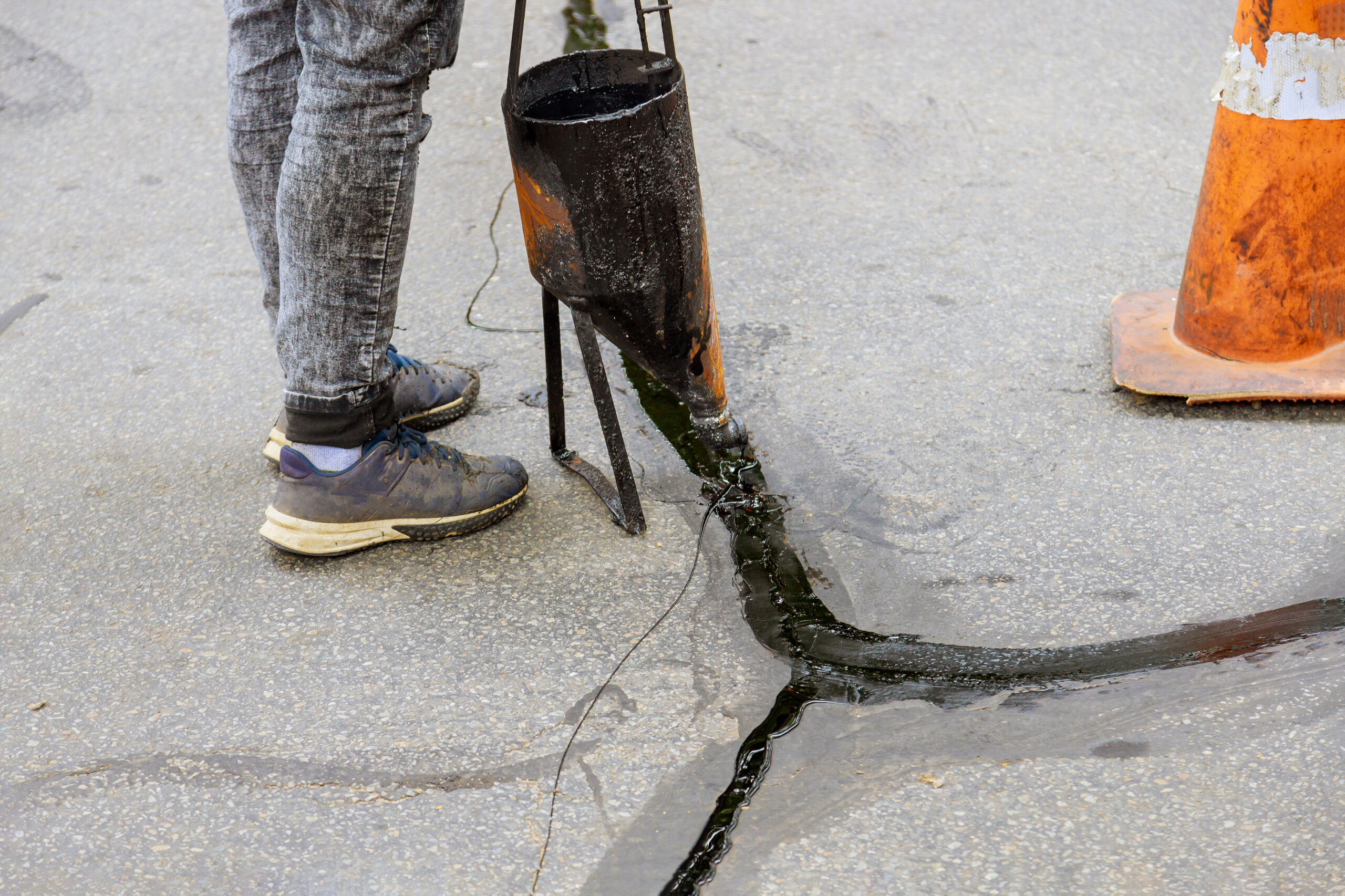
Utility Trench Edge Sealing
Crack sealing along utility trench cuts, where differential settlement creates longitudinal cracks at Aurora commercial properties and parking lots.
- Trench settlement crack treatment
- Route and seal in overband configuration
- Prevents base erosion at the trench interface
- ASTM D6690 sealant for flexibility
- Addresses the root cause of the pavement failure
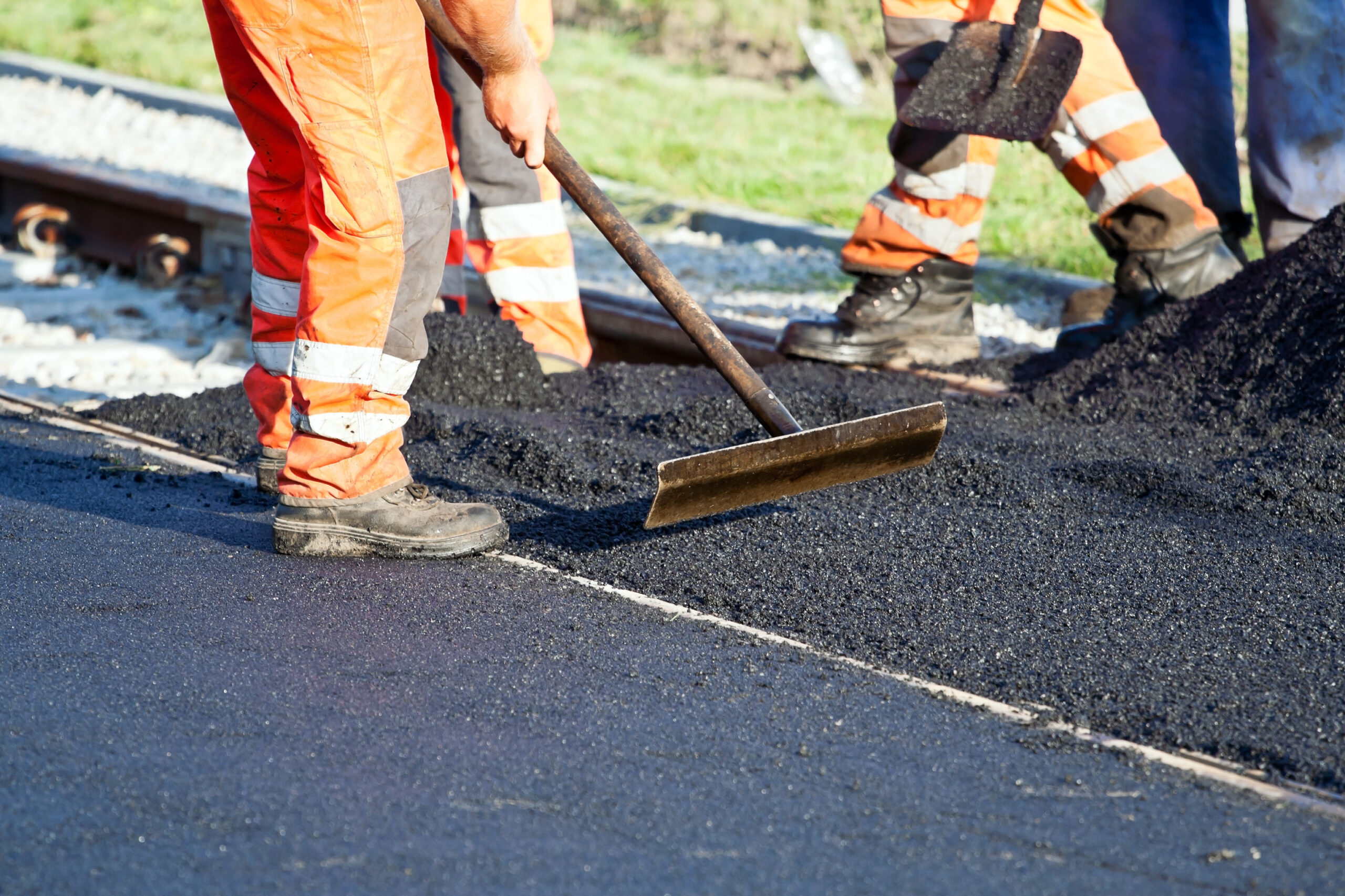
Reflective Crack Sealing
Sealing of longitudinal reflective cracks that propagate upward from underlying base or subgrade failures at Aurora commercial properties.
- Identifies reflective versus surface cracking
- Deep routing for reflective cracks
- High-elongation rubberized sealant
- Overband configuration for active movement
- Overlay recommended where it is widespread
Block Crack Sealing in Aurora
Block cracking is an interconnected rectangular pattern across the surface, and it is a binder problem rather than a load problem. Because it signals oxidation across the whole mat, the decision is rarely just how to seal it but whether sealing, sealcoating, or an overlay is the correct spend at that stage of the pavement's life.
Block Crack Sealing & Sealcoat
Combined crack sealing and sealcoating treatment for early-stage block cracking, restoring binder flexibility and preventing water infiltration at Aurora properties.
- Blow-and-seal for cracks under ½"
- Hot-pour sealant fills the interconnected pattern
- Followed by coal tar or asphalt emulsion sealcoat
- Restores UV protection at 5,471' elevation
- Extends pavement life 5–8 years
Flush-Fill Block Crack Treatment
Systematic flush-fill sealing of block crack patterns to prevent water infiltration while maintaining a smooth driving surface at Aurora commercial parking lots.
- Hot air lance cleaning of the crack network
- ASTM D6690 rubberized sealant
- Flush-fill prevents water reaching the base course
- No overband needed on non-working cracks
- Cost-effective across large crack networks
Block Crack Assessment
We evaluate whether block cracking at your Aurora property warrants crack sealing, sealcoating, or an overlay, based on severity, binder condition, and base integrity.
- Crack pattern severity mapping
- Binder oxidation assessment
- Core sample where base integrity is in question
- Seal versus overlay recommendation
- Cost comparison in a written proposal
Qualifications Behind Every Aurora Paving Project
Asphalt Coatings Company has paved commercial property across Colorado since 1986. Our crews seal cracks with Colorado Department of Transportation approved materials, and our concrete teams build parking surfaces to ADA accessibility standards on every commercial property we pave.
 Yelp Reviewed Rated by verified customers on Yelp
 5-Star Rated Top-rated on Google Reviews
 Buyer's Guide Featured in the local contractor buyer's guide
 AAMD Member Apartment Association of Metro Denver
 Licensed & Insured Current documentation available on request
Why Asphalt Cracks in Aurora’s Climate
Cracking on an Aurora commercial lot is driven by four forces working on the same surface: thermal movement at 5,471 feet, the freeze-thaw cycle that widens whatever the thermal movement opened, ultraviolet radiation hardening the binder, and hail striking a surface already made brittle by the other three. Each produces a recognisable pattern, and Asphalt Coatings Company matches the sealing response to the pattern rather than to the footage.
Thermal Contraction Cracking at High Elevation
Aurora’s 5,471-foot elevation produces wide diurnal temperature swings, and pavement surface temperatures can move a great deal in a single day through spring and autumn. That rapid thermal cycling creates tensile stresses exceeding the asphalt binder’s ability to flex, producing transverse cracks running perpendicular to the flow of traffic.
Route and seal with ASTM D6690 Type II rubberized sealant in an overband configuration for working cracks.
Freeze-Thaw Water Damage Cycle
Water enters unsealed cracks, freezes through Aurora’s winter lows, expands by 9%, and widens the crack. When it thaws, more water enters the now-wider opening. Every cycle across a Front Range winter pushes the crack wider and forces water deeper into the aggregate base.
Early-season crack sealing that prevents the freeze-thaw widening cycle from starting at all.
UV Oxidation & Binder Hardening
At 5,471 feet Aurora receives appreciably more ultraviolet radiation than sea-level locations. UV oxidises the asphalt binder, leaving it brittle and unable to flex with temperature change. Oxidised binder produces block cracking: interconnected rectangular crack networks spread across the pavement surface.
Flush-fill crack sealing followed by sealcoating, restoring UV protection and binder flexibility together.
Hailstorm Impact Damage
Aurora sits in the Front Range hail belt, among the most hail-prone corridors in North America. Large hailstones strike aged, oxidised asphalt and dislodge aggregate from the binder matrix, producing surface ravelling that accelerates how quickly new cracks form.
Post-hailstorm crack sealing that closes the new water pathways before they reach the base.
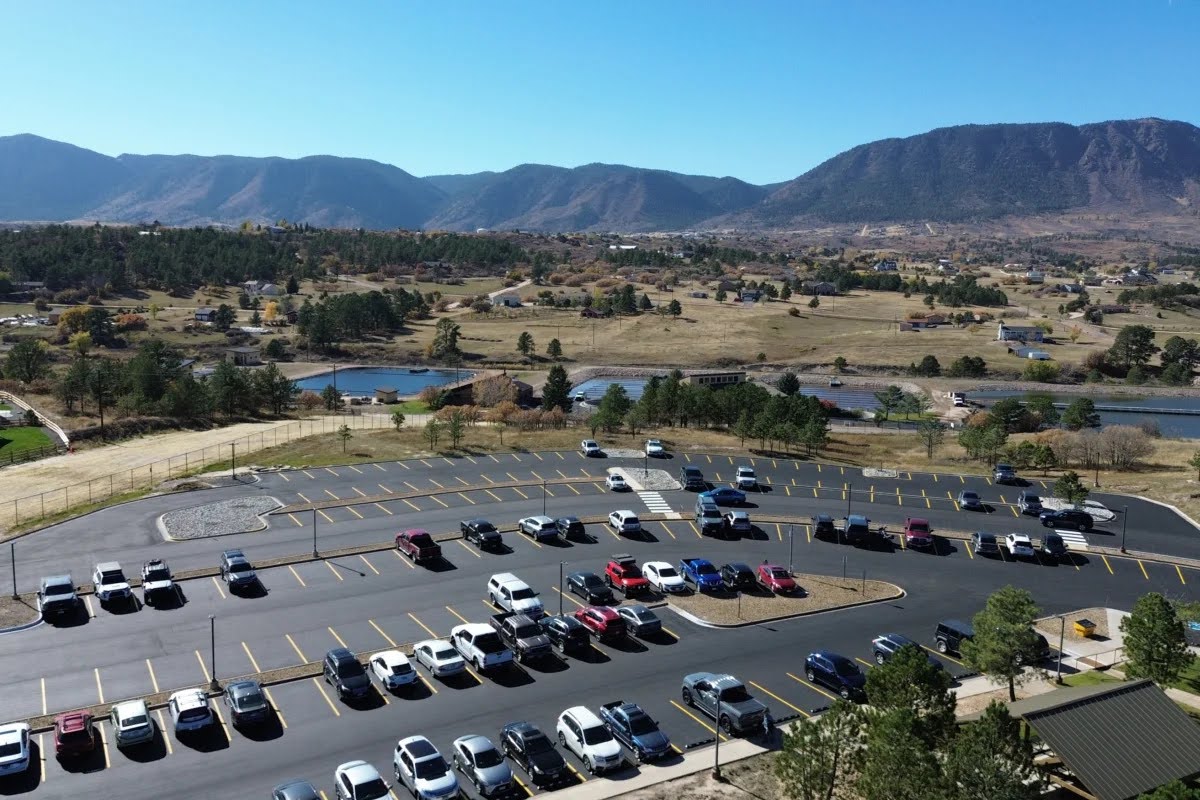
Crack Sealing & Maintenance Completed in the Aurora Metro Area
Asphalt Coatings Company has crack-sealed and maintained commercial pavement throughout the Aurora metro area since 1986. Sealing is usually the smallest line on a maintenance scope and the one that determines how large the rest of the scope becomes in five years.
Crack Sealing Methods Compared for Aurora
Six sealing methods get quoted on Aurora commercial pavement, and the cheapest one is only the cheapest if it suits the crack in front of it. Asphalt Coatings Company selects the method on crack width, whether the crack is still moving through the season, and what condition the binder and base are in. A hairline crack blown clean and sealed early costs a fraction of a routed overband, while an overband applied to a working crack is what keeps it sealed through a Front Range winter instead of splitting open by spring.
| Sealing Method | Best For | Relative Cost | Service Life |
|---|---|---|---|
| Blow-and-Seal | Hairline cracks under ¼" wide | Lowest of the six | 3–5 years |
| Flush-Fill | Non-working cracks ¼" to ¾" wide | Low | 4–6 years |
| Route & Seal (Flush) | Non-working cracks needing a uniform reservoir | Moderate | 5–7 years |
| Route & Seal (Overband) | Working cracks with active thermal movement | Higher | 5–8 years |
| Edge Repair & Seal | Edge deterioration where the base is exposed | Varies with severity | 7–10 years |
| Crack Seal + Sealcoat | Block cracking with binder oxidation | Priced as a combined scope | 5–8 years |
Commercial Pavement ACC Has Built in Colorado
Asphalt Coatings Company has paved, milled, repaired and maintained commercial pavement across Colorado's Front Range since 1986. Our in-house crews complete every phase from subgrade preparation through final striping, and the company handles projects up to 1,500 parking spaces.


Professional Crack Sealing in Aurora Trusted by Commercial Property Managers
A pothole is the final stage of untreated cracking, not an isolated event. Contact Asphalt Coatings Company for a free evaluation and a written scope that measures the linear footage, separates sealable cracking from structural failure, and states the price.
Advantages of Hiring ACC for Crack Sealing in Aurora
Crack sealing is the cheapest pavement service to buy and the easiest to buy badly, because a poor seal and a good one look the same until the following spring. Asphalt Coatings Company has sealed Front Range commercial pavement from an Aurora address since 1986.
Routed and Cleaned First
Every crack is routed to a consistent reservoir and cleaned before sealant goes in. Sealant bonds to clean crack walls, and material poured into a dirty crack lifts out in the first season.
Hot-Applied Sealant
We use hot-applied sealant that flexes with temperature rather than a cold filler that hardens. The pavement moves through Aurora’s summer-to-winter swing, and the seal has to move with it.
Sealable Cracking Separated From Structural
We identify which cracking should be sealed and which indicates the base has failed. Sealing a lattice pattern spends money on a section that needs rebuilding, and we say so instead of billing for it.
Timed Ahead of Winter
Crack sealing works best before winter arrives, because sealing keeps water out of the base ahead of the freeze cycle that widens cracks. We book the window rather than fitting the work in whenever there is a gap.
Coordinated With Sealcoating and Repair
Where a sealcoat or patching is planned, the sealing happens first and in the same mobilisation, so the protective coat goes over a closed surface instead of an open water path.
Based in Aurora Since 1986
Our yard sits at 16275 E 2nd Ave in Aurora. Crack sealing is weather-sensitive and season-sensitive work, and staging from inside the city means we can hold a pre-winter schedule when the window is narrow.
How ACC Delivers Crack Sealing in Aurora
From your first call to the final walkthrough, a crack sealing project with Asphalt Coatings Company follows five steps designed to measure the work accurately, separate sealable cracking from structural failure, and get the sealant in before winter.
Free Pavement Assessment
We map the crack patterns across your Aurora property, classify each crack by type and movement, and measure width and depth to select the correct sealing method.
Method Selection
We recommend blow-and-seal, flush-fill, or route-and-seal in an overband or flush configuration, based on the crack classification and your budget priorities.
Detailed Proposal
You receive a written scope with linear footage, the sealing method for each crack type, ASTM material specifications, and itemized pricing.
Professional Execution
Our crews route, clean with a hot air lance, and apply ASTM D6690 Type II rubberized sealant at the proper 380–410°F application temperature, with traffic control in place.
Quality Verification
We verify sealant adhesion, fill level, and overband dimensions across every treated crack before the property reopens to traffic.
Property Types ACC Serves with Crack Sealing in Aurora
Cracking patterns differ by property because loading and layout differ. A distribution yard cracks at its joints and dock approaches, an HOA road cracks thermally end to end, and a school lot cracks where nothing drives at all. Select a property type to see how we approach it.
HOA Communities
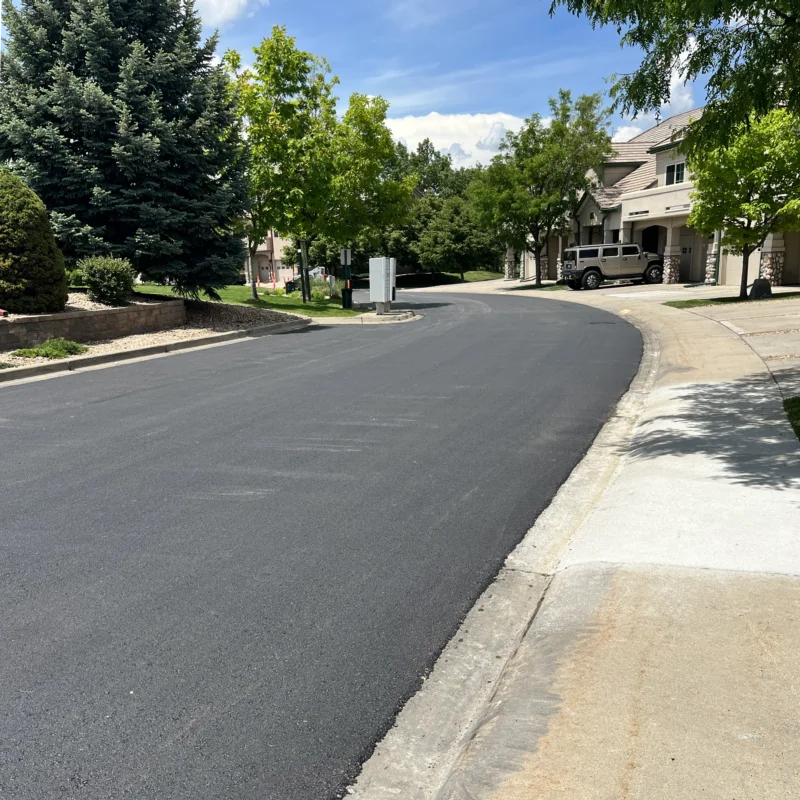
HOA internal roadways are long, thermally exposed, and lightly trafficked, which produces regular transverse cracking across their whole length. Sealing on an annual cycle is the most cost-effective line an association can carry, because it postpones the resurfacing that dominates a reserve study.
Asphalt Coatings Company measures linear footage across the community, seals on a rolling schedule as residents keep access, and documents the work so the board can show what was done and what it prevented.
Retail Centers
Retail lots crack at construction joints, around refuse enclosure approaches, and along the drive aisles that take every vehicle on site. Left open, those cracks feed water directly into the base beneath the busiest part of the property.
ACC seals storefront areas by zone so customers keep reaching the doors, and we coordinate crack sealing with the sealcoat cycle so both treatments can happen in one mobilisation.
Office Parks
Office lots show thermal and block cracking well before they show structural failure, because the outer parking rows carry little traffic and simply age. Sealing at the right stage is what keeps the property in maintenance territory rather than resurfacing territory.
Asphalt Coatings Company works one bay or drive aisle at a time so employees keep their spaces and visitors keep a clear route to reception.
Industrial & Distribution
Warehouse and distribution yards crack along paving joints and at dock approaches where loaded axle traffic concentrates. Water entering those fractures reaches the base under precisely the areas that are hardest to isolate from operation.
ACC seals sound crack cycles before oxidation progresses, and we flag any dock approach where the cracking has already progressed beyond sealing into milling or surface failure.
Schools & Universities
School properties hand a contractor a predictable empty window. Asphalt Coatings Company schedules crack sealing into breaks and summer so bus loops, pickup lanes, and staff parking are sealed and cured before term resumes.
Because much of a school lot sits unused through the day, block and thermal cracking continues even under low annual traffic. An annual sealing inspection keeps those areas from ageing into resurfacing.
Churches & Nonprofits
Institutional lots see concentrated weekly peaks and long quiet intervals between them, which makes most crack-sealing work easy to complete without interrupting anything. ACC uses the quieter periods as a full-lot work window every time the congregation needs it.
Crack sealing is also the line most likely to fit a nonprofit budget in a year when resurfacing cannot, and it is the first treatment that protects the surface until resurfacing is affordable.
Healthcare Facilities
Healthcare campuses cannot close an emergency route or a patient drop-off zone, so sealing is phased tightly and completed section by section with every access route preserved.
Aurora's Anschutz Medical Campus area concentrates this property type, where narrow work windows make a fast, well-prepared sealing programme more valuable than on a nine-to-five site.
Municipal & Government
Public properties bring specification and documentation requirements private sites do not. Asphalt Coatings Company measures and documents the sealed footage so the completed work stands up to inspection and public record.
Operating from an Aurora address since 1986 keeps us familiar with local permitting requirements, which shortens the lead time between an approved scope and a crew on site.
Hotels & Hospitality
Hospitality lots are never empty, so crack sealing has to move in small sections that release quickly. Asphalt Coatings Company seals arrival lanes, valet routes, and service access in sequence, and each section carries traffic again once the material has set.
Turning traffic at the porte-cochère opens joints faster than the open parking field does, which makes that approach worth sealing on a tighter interval than the rest of the property.
Auto Dealerships
Cracks read badly on a lot photographed for every inventory listing, and they widen fastest in the display rows where vehicles sit in one position through Aurora's freeze-thaw winters. ACC seals the display area first and works around customer and service parking.
Sealing is scheduled around inventory movement so rows reopen in sequence, and the sealed joints are cut and filled to a clean line because that finish appears in every photograph taken on the lot.
Get Started with Crack Sealing in Aurora
Serving Aurora & the Front Range with Commercial Asphalt Paving
Aurora is Colorado's third-largest city, and its commercial pavement carries a workload most Front Range municipalities never see. Freight moves through the I-70, I-225, and E-470 corridors on its way to and from Denver International Airport, filling the northern and eastern edges of the city with distribution centres, truck yards, and loading docks where loaded semi-trailer axles concentrate weight on a few square feet of surface at a time.
Read more Read less
Commercial asphalt conditions vary throughout Aurora based on traffic volume, drainage, pavement age, soil movement, freeze-thaw exposure, and the type of property using the surface. Asphalt Coatings Company evaluates those conditions before recommending paving, milling, resurfacing, patching, crack sealing, sealcoating, drainage correction, or full-depth reconstruction.
ACC serves commercial properties throughout Aurora and the broader Front Range, including retail centres, office parks, industrial sites, distribution facilities, apartment and HOA communities, healthcare campuses, schools, hotels, municipal properties, and new commercial developments.
Frequently Asked Questions About Crack Sealing in Aurora
Answers to common questions from Aurora property managers, businesses, and HOA boards about crack sealing, timing before winter, and which cracks are worth sealing at all.
Should I be concerned about cracks in my asphalt?
Yes. Cracks are common on commercial asphalt, but ignoring them is what makes them expensive. Even a small crack lets water seep beneath the surface, eroding the base and setting up a much larger repair down the line. Inspecting the lot regularly and filling cracks as they appear prevents further damage and prolongs the life of the pavement.
What is the difference between crack sealing and crack filling?
Sealing means routing the crack to a clean reservoir and placing hot-applied sealant that flexes with temperature. Filling usually means pouring material into the crack as found. The preparation and the material are what decide whether the treatment survives more than a season.
Why do cracks form in the first place?
Thermal contraction is the most common cause. Aurora asphalt expands through summer heat and shrinks through winter cold, and that repeated movement opens linear cracks running parallel or perpendicular to the paving direction. Joints, ageing binder, and edge or structural failure produce the rest.
What happens if cracks are left unsealed?
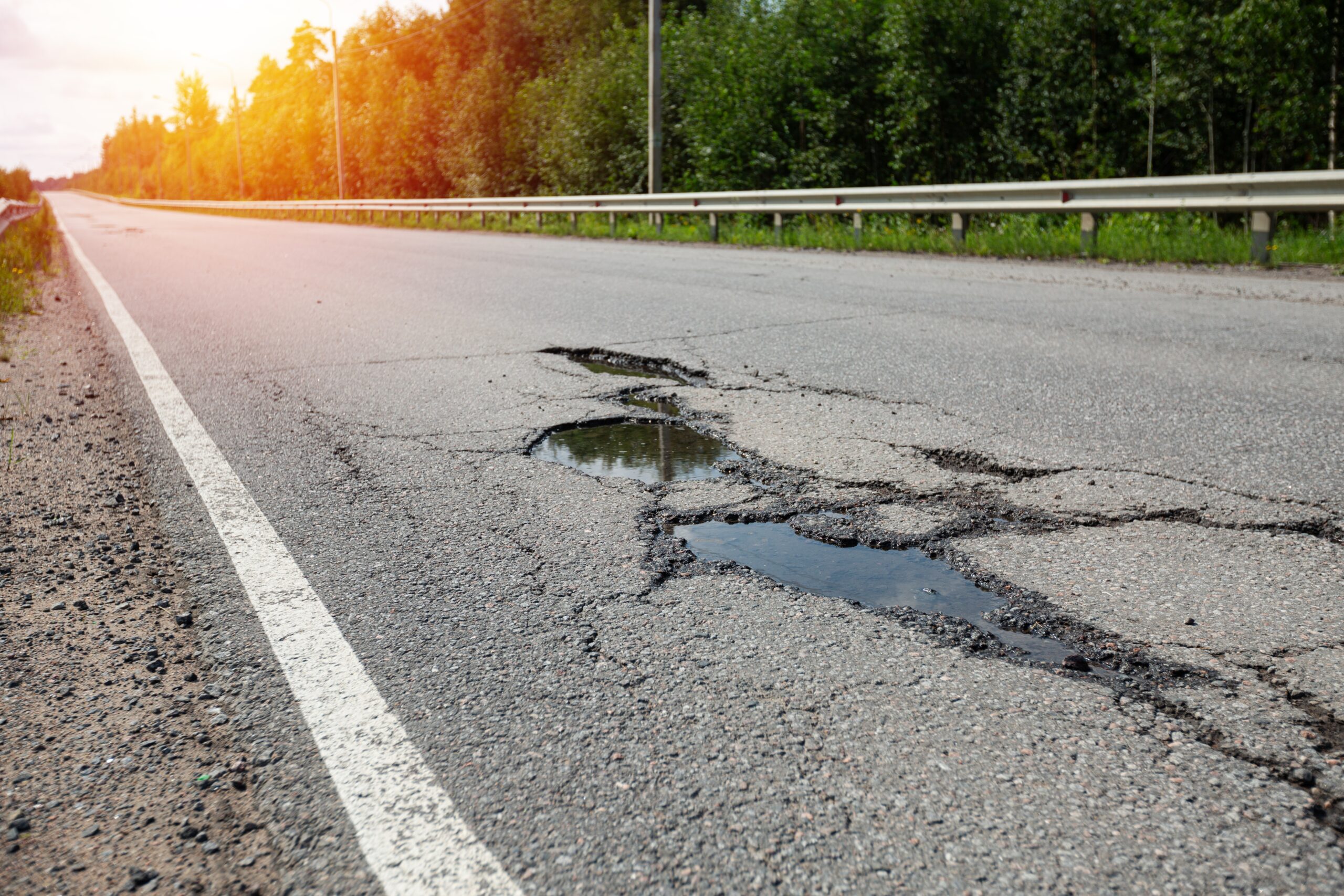
Water enters the crack, saturates the base material, and freeze-thaw cycling opens voids beneath the surface. Traffic then collapses the unsupported asphalt into the void. A pothole is the final stage of untreated cracking rather than an isolated event.
Does crack sealing look tidy when finished?
Sealed cracks are visible as black lines across the surface, which is normal and expected. Where appearance matters, sealcoating after the sealing has set brings the whole surface to a uniform finish.
When is the best time to schedule crack sealing?
Before winter, while cracks are open. Sealing closes the water path into the base ahead of the freeze cycle that widens cracks, and addressing small cracks as they appear prevents them expanding and weakening the pavement.
How often should crack sealing be done?
Annually is the practical answer for most commercial properties, because new cracks open every season. Catching them while they are hairline is the point at which the intervention costs the least it ever will.
Can crack sealing be done in cold weather?
Cold and damp conditions work against the bond, because the crack has to be dry and the sealant needs the right conditions to set. Our team closely monitors weather forecasts and will keep you updated on any necessary schedule adjustments to ensure a quality finish.
Should crack sealing happen before or after sealcoating?
Before. Sealer is not a crack filler, so the cracks are routed and sealed first and the protective coat goes over a closed surface. Where both are scoped, we complete them in the same mobilisation.
How long does the work take?
Crack sealing moves quickly compared with other pavement work, and it is priced and scheduled by linear footage rather than area. Most commercial lots are completed in a phased sequence that keeps the property fully operational.
How soon can traffic drive over sealed cracks?
Sealant needs a short period to set before it takes traffic, and the window depends on temperature and the material used. We state the specific interval before the crew leaves the site.
What does interconnected lattice cracking indicate?
That pattern generally signals base failure rather than surface cracking, which puts it outside what sealing can fix. Sealant poured into a lattice covers the symptom, and the failure returns because the structure underneath was never rebuilt.
Are there cracks that should not be sealed?
Yes. Alligator cracking indicates base failure and needs full-depth patching or resurfacing. Very wide, ravelled, or edge-broken cracks are usually a patching scope rather than a sealing scope, because there is no sound wall left for sealant to bond to.
Can crack sealing fix a pothole?
No. A pothole needs saw-cut removal to clean edges, base repair and recompaction, then a hot mix asphalt patch compacted to specification. Sealing works on cracks before they reach that stage.
What is reflective cracking?
It is cracking in an older pavement layer propagating upward through an overlay placed on top of it. The old pattern reappears through the new surface in the same lines. Sealing manages it; milling is what removes it.
My cracks have plants growing in them. Does that change anything?
It means water has been sitting in the crack for some time and the roots have widened it. The vegetation and roots are removed as part of preparation, and the crack is dried before sealant goes in.
How do you decide what to seal on a large property?
We assess and map the cracking during the free assessment, measure the sealable linear footage, and identify separately any areas whose pattern indicates structural failure. Both go into the written scope so you can see the split.
How much does crack sealing cost in Aurora?
We do not publish a rate, because a number quoted without seeing the property is a guess rather than a price. Cost depends on total linear footage, crack width and depth, routing and cleaning required, vegetation removal, sealant quantities, access, and whether the work is combined with sealcoating or patching. Every project starts with a free on-site assessment and a written scope with itemized pricing.
Can maintenance reduce long-term cost?
Yes. Keeping water out of the base is precisely what prevents the structural failures that force reconstruction, and sealing is how you keep it out. Putting the work on a schedule also converts unpredictable emergency repairs into a cost you can budget years in advance.
Is crack sealing worth it on an old lot?
It depends on what the cracking pattern shows. On a surface that is ageing but structurally sound, sealing buys years. On a lot already showing lattice cracking across large areas, the money is better spent on the reconstruction those sections need.
What does a maintenance program include?
The point of a program is that the work is scheduled rather than triggered by a failure. A multi-year contract typically covers annual pothole repair, crack sealing, and repeat sealcoat applications across its term, built around the annual bank and city inspections a property already answers to.
Is an assessment free?
Yes. A project manager walks the property, measures the crack footage, and returns a written scope at no cost and with no obligation.
Do you provide itemized pricing?
Yes. Pricing is itemized against measured linear footage rather than estimated, and the scope carries the recommended treatment, the timeline, and maintenance plan options, so an owner, a board, or a lender can see exactly what is being approved.
How can I protect my asphalt?
Regular maintenance is what protects it: sealcoating, filling cracks, and keeping debris off the surface. Sealcoating every 2–3 years shields asphalt from the water, oil, and UV rays that make it wear out faster, and sealing small cracks as they appear keeps them from expanding and weakening the pavement. Keeping heavy loads to a minimum and draining water off the surface rather than letting it stand adds further life.
How often should a commercial lot be sealcoated?
Every two to three years, which protects the asphalt from water, oil, and UV rays. Holding that interval keeps the binder from oxidising to the point where aggregate starts loosening from the surface.
Why does standing water matter so much?
Water standing on a lot saturates the base beneath it, and a saturated base loses the strength that supports the surface. Correcting drainage so water does not pond is one of the most effective ways to extend the life of the asphalt, which is why it goes on the scope alongside the sealing.
How long does a commercial asphalt lot last?
Base strength, asphalt thickness, surface drainage, and maintenance history all set the number. The two maintenance practices that most reliably extend it are sealcoating on a two to three year cycle and sealing cracks as soon as they appear.
What happens after the work is finished?
We walk the sealed lot with you, confirm the footage against the approved scope, and set the interval for the next application so the cycle holds.
Why should I choose Asphalt Coatings Company?
Quality, reliability, and customer satisfaction are what the company runs on. Experienced in-house crews and a full fleet of equipment let us control every aspect of a sealing project, from scheduling to execution, without relying on subcontractors, which keeps us flexible, consistent, and inside the agreed timeline and budget. Tailored maintenance programs keep the interval from slipping, and our customer service stays responsive throughout.
Do you use subcontractors?
No. Routing and sealing is done by our own crews with our own equipment, which is how we hold the preparation standard that decides whether a seal lasts.
How long have you been in business?
We have been operating since 1986, which is more than 40 years of commercial pavement work in Colorado.
Are you licensed and insured?
Yes. We hold current licensing and insurance and will supply documentation on request, which is what most property managers and boards want on file before a crew is booked.
Are you actually based in Aurora?
Yes. We work from 16275 E 2nd Ave, Aurora, CO 80011, on (720) 526-3240. Sealing crews and equipment stage from that yard, which matters when a pre-winter window is short.
Why does Aurora's climate open so many cracks?
Aurora sits at 5,471 feet and swings widely between summer heat and winter cold, which drives the thermal expansion and contraction that opens linear cracking. Seasonal freeze-thaw cycling then forces water into every crack that has not been sealed, and the expansive clay subgrade beneath much of the metro area moves with the seasons on top of that.
Do you work with HOA communities in Aurora?
Yes. HOA internal roadways are a regular part of our work. We measure linear footage across the community, seal on a rolling schedule so residents keep access, and document the work for the board's records and reserve planning.
Hire a Proven Commercial Crack Sealing Contractor in Aurora
Asphalt Coatings Company provides commercial crack sealing, routing and cleaning, hot-applied sealant, joint and edge sealing, and annual maintenance programs for businesses, HOAs, property managers, and commercial properties throughout Aurora, CO. With in-house crews and a yard inside the city, we hold the pre-winter window that makes sealing worth doing.
Asphalt Coatings Company
Name: Asphalt Coatings Company
Address: 16275 E 2nd Ave, Aurora, CO 80011, United States
Phone: +1 720-526-3240
Working Hours:
- Monday: 7:30 AM – 5:00 PM
- Tuesday: 7:30 AM – 5:00 PM
- Wednesday: 7:30 AM – 5:00 PM
- Thursday: 7:30 AM – 5:00 PM
- Friday: 7:30 AM – 5:00 PM
- Saturday: 7:30 AM – 5:00 PM
- Sunday: Closed