Dumpster pads and fire lanes are high-stress pavement zones that deteriorate faster than standard parking areas because they endure concentrated heavy loads, chemical exposure, and extreme mechanical forces that conventional parking lot designs were never engineered to handle.
We cover what makes these zones structurally different from parking lots, the specific forces that destroy them, how environmental factors compound the damage, why standard designs fall short, and how to prevent and address premature failure.
Dumpster pads absorb repeated garbage truck axle loads, sustained point pressure from loaded containers, and chemical attack from hydraulic fluid and waste leachate. Poor drainage around enclosures traps moisture against already weakened pavement, accelerating structural breakdown into alligator cracking and deep rutting.
Fire lanes face a different but equally destructive pattern. Emergency apparatus weighing 75,000 pounds or more delivers sudden, extreme loads to pavement that sits dormant between events. Stabilizer outriggers concentrate massive point loads onto less than a square foot of surface, and tight turning radii generate shear forces that displace the asphalt surface layer.
Freeze-thaw cycles and high-altitude UV radiation compound both failure modes by infiltrating existing cracks with expanding ice and oxidizing binder until it becomes brittle. These environmental forces turn minor stress fractures into full structural failures.
Standard parking lot pavement sections, subbase depths, and material specifications cannot absorb these forces. Thicker asphalt sections, reinforced concrete, engineered drainage, and proactive maintenance (including sealcoating and crack sealing) are essential to preventing the repeated repair cycle that drains commercial property budgets.
What Makes Dumpster Pads and Fire Lanes Different From Standard Parking Lots?
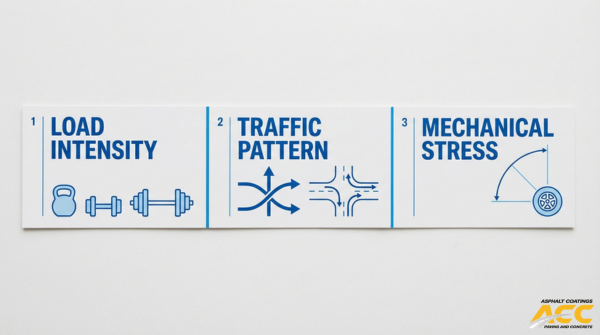
Dumpster pads and fire lanes differ from standard parking lots in load intensity, traffic behavior, and mechanical stress concentration. The following subsections break down load types, traffic patterns, and turning and braking forces.
What Types of Loads Do Dumpster Pads Bear Compared to Parking Areas?
The types of loads dumpster pads bear compared to parking areas are concentrated, repetitive heavy loads rather than distributed passenger vehicle traffic. Standard parking lots support cars weighing 3,000 to 5,000 pounds across four tires. Dumpster pads, by contrast, must absorb the full weight of loaded garbage trucks with axle loads reaching 18,000 pounds per axle. Beyond rolling loads, dumpsters impose sustained static point loads on a fixed footprint, compressing the same pavement area week after week. This combination of heavy axle weight and prolonged stationary pressure creates fatigue conditions that standard parking lot designs simply are not engineered to withstand.
How Does Traffic Pattern Differ on Fire Lanes Versus Parking Lots?
Traffic pattern differs on fire lanes versus parking lots in both frequency and intensity of use. Parking lots experience steady, distributed traffic from passenger vehicles moving at low speeds across a wide surface area. Fire lanes, however, remain largely unused for extended periods, then suddenly bear the full weight of emergency apparatus that can exceed 75,000 pounds. This infrequent but extreme loading prevents the gradual, predictable wear that parking surfaces accommodate. Instead, fire lane pavement endures sudden high-stress events concentrated along narrow access paths and tight turning radii, accelerating localized damage far beyond what evenly distributed parking traffic produces.
Why Does Turning and Braking Stress Affect These Areas More?
Turning and braking stress affects these areas more because heavy vehicles generate intense horizontal shear forces at the pavement surface during low-speed maneuvers. Garbage trucks pivot on dumpster pads while lifting containers, and fire apparatus execute tight turns within constrained lane widths. According to Pavement Interactive, slippage cracking occurs as a result of low-strength asphalt mix in the surface layer or poor bond between surface and underlying layers, often caused by the braking or turning wheels of heavy vehicles. These lateral forces peel the surface course away from the base, a failure mode rarely triggered by the lighter, straighter travel paths of passenger cars in standard parking lots.
Understanding these structural differences clarifies why standard designs fall short for high-stress zones.
What Are the Main Causes of Dumpster Pad Deterioration?
The main causes of dumpster pad deterioration are excessive vehicle weight, chemical exposure from leaks, concentrated point loads, and poor drainage. Each factor attacks the pavement structure in a distinct way.
How Do Garbage Truck Weights Destroy Asphalt Dumpster Pads?
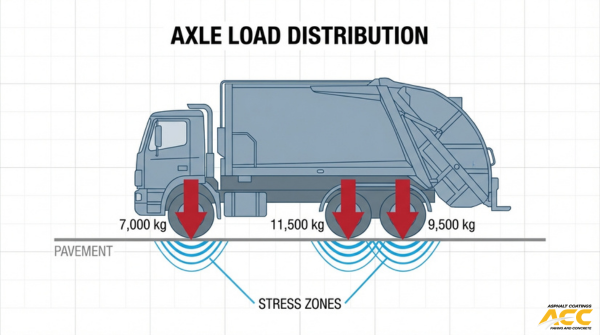
Garbage truck weights destroy asphalt dumpster pads by delivering repeated heavy axle loads that far exceed what standard parking lot pavement is designed to handle. According to the Colorado Asphalt Pavement Association, the steering axle of a typical garbage truck carries 12,000 pounds, while the remaining 36,000 pounds distributes across two rear axles at 18,000 pounds each. These loads arrive on a fixed weekly schedule, concentrating fatigue damage along the same narrow path every time. Standard parking areas rarely experience anything close to 18,000-pound axle loads, which is why dumpster approaches crack and rut while adjacent lots remain intact.
How Do Hydraulic Fluid and Waste Leaks Break Down Pavement?
Hydraulic fluid and waste leaks break down pavement by chemically dissolving the asphalt binder that holds aggregate together. Garbage trucks frequently drip hydraulic oil during compaction cycles, and dumpsters themselves leak organic waste liquids between pickups. A 2023 study published in Construction and Building Materials found that the adhesion capacity of asphalt binder corroded by engine oil is significantly reduced, leading to decreased structural integrity. Once the binder weakens, loose aggregate ravels from the surface, creating potholes that trap more fluid and accelerate the cycle. This chemical attack is unique to dumpster pads; standard parking stalls rarely face sustained petroleum or organic exposure.
Why Do Dumpster Pads Suffer From Standing Point Loads?
Dumpster pads suffer from standing point loads because loaded dumpsters concentrate thousands of pounds onto small steel feet or caster wheels that remain stationary for days. Unlike moving traffic that distributes force across a rolling contact patch, a full dumpster applies constant downward pressure on the same few square inches of pavement. Modern heavy trucks use radial tires inflated to at least 100 psi, according to the Asphalt Pavement Association of Oregon, and dumpster feet can exceed even that contact stress. Over time, these fixed-position loads create permanent depressions and surface indentations that collect water and worsen deterioration.
How Does Poor Drainage Around Dumpster Enclosures Cause Failure?
Poor drainage around dumpster enclosures causes failure by allowing water to pool against pavement that is already weakened by heavy loads and chemical exposure. Dumpster enclosure walls and curbing often trap runoff, and municipal codes frequently prohibit connecting enclosure drains to storm systems, as noted in the City of Escondido’s dumpster enclosure guidelines. Trapped moisture infiltrates cracks and saturates the subbase, stripping the bond between asphalt layers. Repeated traffic loading on this saturated structure produces alligator cracking, which the Federal Highway Administration defines as interconnecting jagged cracks caused by fatigue failure of the asphalt surface under repeated loading. This pattern signals structural inadequacy that sealcoating alone cannot resolve.
With deterioration mechanisms identified, understanding how fire lanes face their own distinct failure patterns reveals why these zones also demand specialized design.
What Are the Main Causes of Fire Lane Pavement Failure?
The main causes of fire lane pavement failure are extreme vehicle weight, concentrated point loads, infrequent but intense use, and tight turning movements. The following subsections cover how each factor breaks down fire lane surfaces.
How Do Heavy Emergency Vehicles Damage Fire Lane Surfaces?
Heavy emergency vehicles damage fire lane surfaces by applying loads that far exceed standard pavement design thresholds. The International Code Council requires fire apparatus access roads to support vehicles weighing at least 75,000 pounds. When a fire truck deploys stabilizer outriggers, a point load as great as 45,000 pounds concentrates on roughly 0.97 square feet of pavement, producing approximately 322 psi of surface pressure, according to data published by GraniteCrete. Standard parking lot asphalt is not engineered for this kind of concentrated force. These loads crush aggregate, compress the binder layer, and initiate depressions that trap water and accelerate further breakdown. For most commercial properties, this single variable causes more structural damage than years of normal passenger vehicle traffic.
Why Does Infrequent but Extreme Loading Accelerate Cracking?
Infrequent but extreme loading accelerates cracking because fire lanes rarely experience the gradual stress conditioning that high-traffic roads receive. Pavement designed for light daily use develops micro-damage patterns that self-distribute over time. A sudden 75,000-pound load, arriving without that conditioning, overwhelms the asphalt’s fatigue resistance in a single event. Each emergency response introduces peak stress followed by long dormant periods, preventing the incremental wear that pavement engineers account for in standard traffic models. This cycle of shock loading and rest produces top-down cracking that penetrates faster than fatigue cracking on busier surfaces, making fire lanes structurally vulnerable despite their low overall traffic volume — a pattern also observed in high-traffic facility pavement.
How Do Tight Turning Radii Cause Rutting in Fire Lanes?
Tight turning radii cause rutting in fire lanes because heavy apparatus pivot on a small contact patch, concentrating shear forces into a narrow arc of pavement. Fire trucks require wide turning paths, yet building layouts often constrain lanes to minimum-radius curves. When a loaded rear axle tracks through a tight turn, lateral tire scrubbing generates horizontal shear stress that displaces the asphalt surface layer. This mechanical action pushes binder mix outward, creating ruts along the inside edge and raised ridges on the outside. Over multiple emergency responses, these deformations compound, weakening bond between surface and base layers. Properly designed turning geometry and reinforced pavement sections at curve points reduce this specific failure mode significantly.
With these mechanical stresses identified, environmental factors add another layer of deterioration.
How Do Freeze-Thaw Cycles and UV Exposure Compound the Damage?
Freeze-thaw cycles and UV exposure compound the damage on dumpster pads and fire lanes by attacking pavement that is already weakened by heavy loads and chemical exposure. These two environmental forces accelerate deterioration in distinct ways.
How Does Water Infiltration During Freeze-Thaw Worsen Weak Spots?
Water infiltration during freeze-thaw worsens weak spots by expanding within existing cracks and voids, progressively breaking apart the pavement structure from within. When water enters micro-cracks caused by heavy truck loading, it freezes and expands, widening those cracks with each cycle. According to Tensar, freeze-thaw cycles cause damage to the asphalt binder, reducing stiffness, compressive strength, and fatigue performance, especially in northern climates with high water infiltration. Dumpster pads and fire lanes are particularly vulnerable because their surfaces already contain stress fractures from point loads and turning movements. Each seasonal cycle drives moisture deeper into the subbase, compounding structural failure that standard parking areas rarely experience.
Why Does High-Altitude UV Accelerate Oxidation on Stressed Pavement?
High-altitude UV accelerates oxidation on stressed pavement because thinner atmosphere at elevation allows more ultraviolet radiation to reach the asphalt surface. UV radiation breaks down the lighter oil fractions in asphalt binder, causing it to become brittle and lose flexibility. On dumpster pads and fire lanes, this oxidation process is especially damaging. Pavement already weakened by heavy loads and chemical exposure loses its ability to flex under stress, making surface cracks propagate faster. The combination of UV-hardened binder and repeated mechanical loading creates a cycle where neither force alone would cause failure, but together they shorten pavement life dramatically. Proactive surface treatments can slow this oxidation before it reaches the structural layers below. Regular crack sealing helps protect the hardened surface from moisture intrusion and further UV attack.
Why Does Standard Parking Lot Design Fail for These High-Stress Zones?
Standard parking lot design fails for these high-stress zones because it is engineered for passenger vehicles, not the concentrated, repetitive loads that dumpster pads and fire lanes endure. Below, we cover asphalt thickness, subbase preparation, and when concrete is the better specification.
Is a Thicker Asphalt Section Needed for Dumpster Pads and Fire Lanes?
Yes, a thicker asphalt section is needed for dumpster pads and fire lanes. Standard parking lot pavement is typically designed around passenger car loads, which generate minimal structural stress. Dumpster pads and fire lanes, by contrast, must accommodate axle loads many times greater.
According to the Transportation Research Board, the damaging effects of any axle load are expressed as equivalent 18,000-lb single axles (ESALs), the standard reference for pavement design. A single garbage truck pass can equal dozens of passenger car ESALs, and fire apparatus loads push well beyond that threshold. Without a proportionally thicker asphalt section, fatigue cracking begins far sooner than the pavement’s intended design life. For most commercial properties, specifying a heavier-duty cross-section in these zones from the start costs far less than repeated patching. In these cases, partnering with a provider that offers commercial asphalt repair services for high-stress zones can restore structural integrity and extend service life beyond patching alone.
Why Does Subbase Preparation Matter More in Heavy-Load Areas?
Subbase preparation matters more in heavy-load areas because the subbase distributes concentrated forces across a wider footprint before they reach the subgrade soil. When the subbase is too thin or poorly compacted, heavy axle loads compress the underlying soil unevenly, creating depressions, rutting, and eventual structural failure in the asphalt surface above.
Adequate compaction and proper aggregate depth prevent this differential settlement. In dumpster pad and fire lane applications, where loads can exceed 75,000 pounds, even small voids or moisture pockets in the subbase amplify damage exponentially. Skipping geotechnical evaluation or using the same subbase specification as standard parking stalls is one of the most common, and costly, design shortcuts property managers encounter.
When Should Concrete Be Specified Instead of Asphalt?
Concrete should be specified instead of asphalt when static point loads, chemical exposure, or extreme axle weights exceed what even a heavy-duty asphalt section can sustain. Dumpster pads are a prime candidate; the combination of prolonged weight from loaded containers, hydraulic fluid drips, and waste leachate degrades asphalt binder far faster than concrete surfaces.
Fire lanes that must support outrigger loads or apparatus exceeding 75,000 pounds also benefit from reinforced concrete. While concrete carries a higher upfront cost, its rigid structure resists rutting and deformation under sustained pressure in ways flexible asphalt cannot match. For property managers weighing long-term budgets, concrete in these targeted zones often eliminates the cycle of repeated asphalt repairs. Recognizing these warning signs early helps protect the investment further. For dumpster pads already showing signs of structural fatigue, prompt commercial concrete repair addresses the underlying damage before it spreads.
What Are the Warning Signs That a Dumpster Pad or Fire Lane Is Failing?
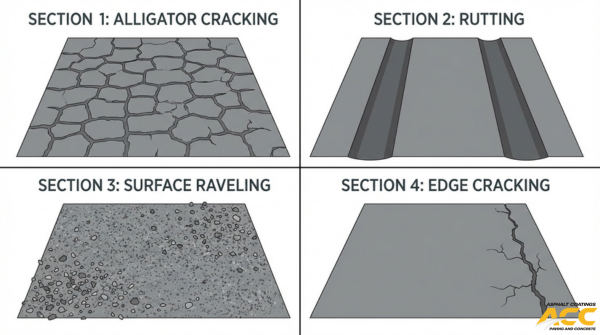
The warning signs that a dumpster pad or fire lane is failing include alligator cracking, deep rutting, surface depressions, chemical staining with soft spots, and edge deterioration along curb lines. Recognizing these indicators early prevents costly full-depth replacement.
- Alligator cracking forms as interconnected, jagged patterns across the surface, signaling fatigue failure from repeated heavy loading. According to the Federal Highway Administration, alligator cracking is caused by the fatigue failure of asphalt concrete under repeated traffic loading, indicating structural inadequacy.
- Rutting and depressions appear where garbage trucks park or fire apparatus stages, creating channels that trap water and accelerate base erosion.
- Surface raveling and loose aggregate indicate binder breakdown from chemical exposure or oxidation, leaving the pavement texture rough and porous.
- Oil-stained soft spots around dumpster enclosures show where hydraulic fluid or waste leachate has chemically degraded the asphalt binder.
- Edge cracking along curb lines reveals subbase failure where heavy vehicles repeatedly mount or turn near containment walls.
Any combination of these symptoms signals that the pavement section was either underdesigned for its actual load demands or has exceeded its serviceable lifespan. For property managers, the most reliable approach is scheduling a professional assessment at the first sign of alligator cracking or persistent ponding, rather than waiting for complete structural failure.
With early detection guiding the response, the next step is building a maintenance plan that prevents these failures from recurring.
How Can Property Managers Prevent Premature Failure in These Areas?
Property managers can prevent premature failure in dumpster pads and fire lanes through proactive sealcoating, scheduled maintenance, and timely crack sealing. These three strategies address the root causes of accelerated deterioration in high-stress zones.
How Does Proactive Sealcoating Extend the Life of Fire Lanes?
Proactive sealcoating extends the life of fire lanes by creating a protective barrier against UV oxidation, moisture infiltration, and surface wear from heavy emergency vehicles. This barrier preserves the asphalt binder’s flexibility, preventing the brittleness that leads to cracking under extreme loads.
According to Pave It Forward LLC, preventive maintenance for commercial asphalt typically costs three times less than reactive repairs, with sealcoating being among the most cost-effective methods to extend pavement life. For fire lanes that endure infrequent but punishing loads, sealcoating every two to three years is one of the highest-return investments a property manager can make. Without it, the surface ages faster between emergency vehicle visits, leaving pavement vulnerable when those extreme forces arrive.
What Maintenance Schedule Keeps Dumpster Pads From Deteriorating?
The maintenance schedule that keeps dumpster pads from deteriorating includes seasonal inspections, prompt spot repairs, and regular surface treatments timed around the heaviest use periods.
A practical schedule includes:
- Quarterly inspections to identify new cracks, depressions, or chemical staining from hydraulic fluid and waste leaks.
- Annual crack sealing before winter to prevent water infiltration ahead of freeze-thaw cycles.
- Sealcoating every two to three years to restore surface integrity and resist chemical breakdown.
- Immediate patching whenever depressions or potholes form, since garbage trucks concentrate load on the same spots weekly.
Waiting until visible structural failure appears typically means the subbase has already been compromised, making repairs far more expensive.
Why Is Crack Sealing More Urgent on High-Stress Pavement?
Crack sealing is more urgent on high-stress pavement because cracks in these areas grow faster and cause deeper structural damage than identical cracks in standard parking zones. According to the National Asphalt Pavement Association, top-down cracks in asphalt are primarily caused by high tire pressures, excessive tire loads, high surface temperatures, and aging binder; all conditions that define dumpster pads and fire lanes.
Once a crack opens, moisture penetrates the subbase and accelerates deterioration with each heavy load cycle. A U.S. Department of Transportation study found that crack sealing treatment can extend asphalt service life by up to 3.6 years by protecting the structure from moisture damage. On high-stress surfaces, that window between crack formation and structural failure is significantly shorter, making early intervention essential.
Scheduling professional crack sealing at the first sign of surface cracking is the most effective way to close that window on dumpster pads and fire lanes. With a proactive maintenance plan in place, the next step is ensuring the right materials and construction methods support these high-demand areas long term.
How Should You Address Failing Dumpster Pads and Fire Lanes With Commercial Paving and Concrete Services?
You should address failing dumpster pads and fire lanes by specifying heavy-duty materials and proper drainage engineered for these high-stress zones. The following sections cover how professional paving and concrete services solve these problems and summarize the key reasons behind accelerated deterioration.
Can Asphalt Coatings Company’s Paving and Concrete Expertise Solve Dumpster Pad and Fire Lane Problems?
Yes, Asphalt Coatings Company can solve dumpster pad and fire lane problems through specialized commercial paving and concrete services built on 39 years of Colorado Front Range experience. Asphalt Coatings Company performs subgrade preparation, concrete flatwork installation, asphalt paving, crack sealing, and sealcoating with in-house crews. For dumpster enclosures supporting roll-off containers and compactors, Waste Management specifications call for concrete 8 inches thick with a 3000 psi minimum mix, reinforced with #4 rebar on 16-inch centers. Asphalt Coatings Company builds to these standards while also ensuring enclosure drains remain separated from storm drain systems to prevent leachate discharge. From initial grading through final striping, this single-source approach eliminates the coordination gaps that often let high-stress zones deteriorate prematurely.
What Are the Key Takeaways About Why Dumpster Pads and Fire Lanes Fail Faster Than Parking Areas?
The key takeaways about why dumpster pads and fire lanes fail faster than parking areas center on three compounding factors:
- Extreme concentrated loads. Garbage trucks, fire apparatus, and stabilizer outriggers impose forces far beyond what standard parking lot designs accommodate.
- Chemical and environmental attack. Hydraulic fluid leaks, waste leachate, freeze-thaw cycles, and high-altitude UV oxidation degrade binder integrity in areas already weakened by heavy use.
- Inadequate original specifications. Standard asphalt depths, insufficient subbase compaction, and poor drainage treat these zones like ordinary parking stalls, guaranteeing premature cracking, rutting, and structural failure.
Proactive maintenance, including timely crack sealing, sealcoating, and proper drainage management, costs significantly less than reactive repairs and extends pavement service life. When deterioration advances beyond surface treatments, full-depth reconstruction with reinforced concrete or heavy-duty asphalt sections is the most reliable long-term solution. Addressing these areas with the right materials and engineering from the start prevents the costly cycle of repeated failure.