A commercial asphalt overlay is a new layer of asphalt placed directly over existing pavement to restore surface integrity without removing the original structure. This rehabilitation method preserves the underlying base, reduces project scope, and delivers measurable cost and performance advantages for commercial properties.
This guide covers overlay fundamentals and eligibility requirements, cost comparisons across project sizes, decision criteria for overlay versus full replacement, expected lifespan under varying conditions, and climate-specific performance factors.
Overlays qualify for pavements with a Pavement Condition Index between 41 and 70, where the base remains structurally sound but surface deterioration demands intervention. Waiting too long pushes pavement past the overlay window entirely.
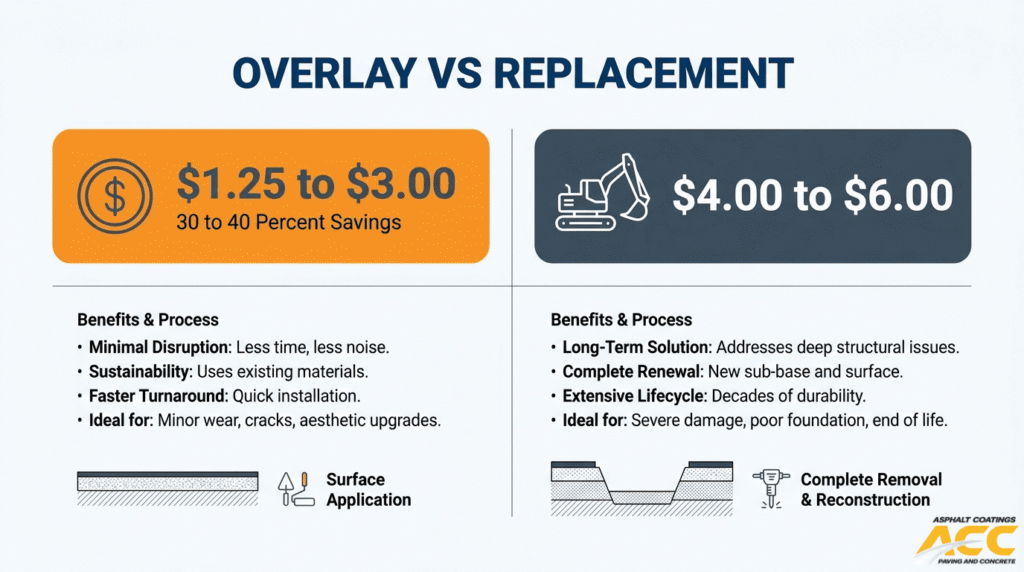
Cost savings reach 30 to 40 percent compared to full-depth replacement, with per-square-foot pricing ranging from $1.25 to $3.00 depending on lot size and thickness requirements. Compressed timelines and phased installation keep commercial operations running during construction.
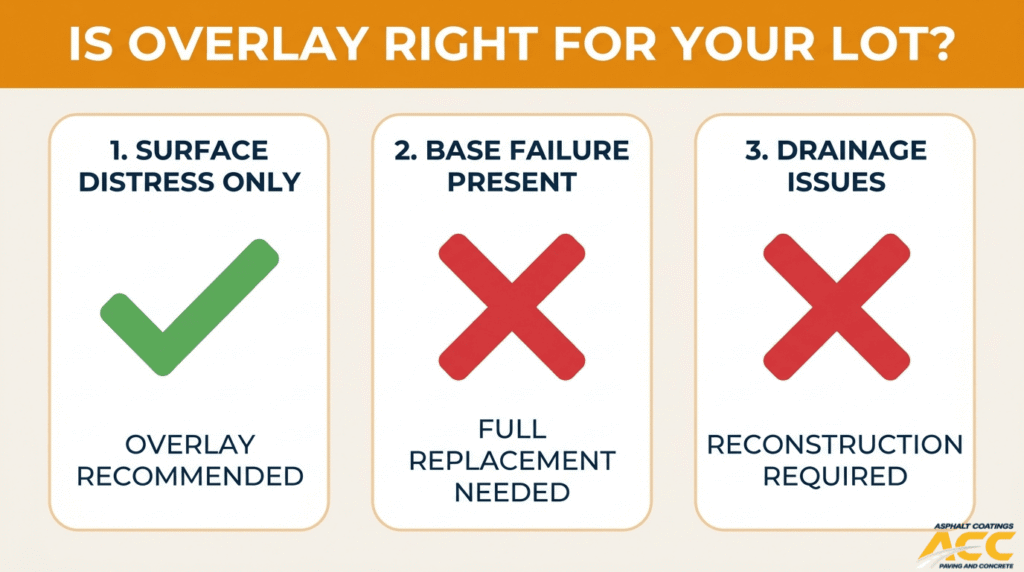
When surface distresses like cracking and oxidation are present without base failure, overlays deliver 10+ years of service life on low-distress surfaces. Base failures, subgrade settlement, or drainage problems disqualify a lot from overlay consideration.
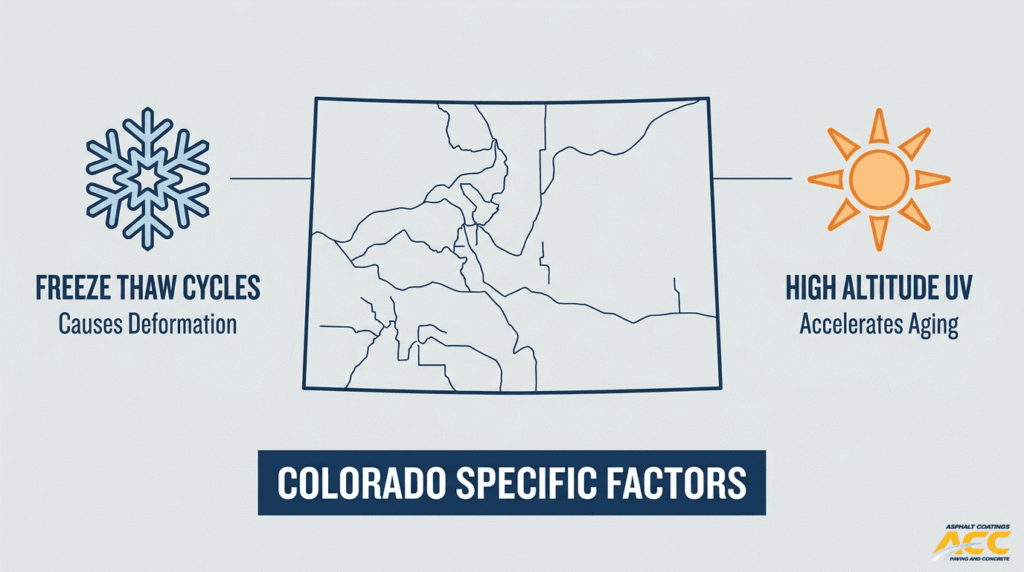
Freeze-thaw cycles cause irreversible deformation in asphalt structures, while high-altitude UV radiation accelerates binder oxidation. Both factors shorten overlay lifespan without proactive maintenance and proper material selection.
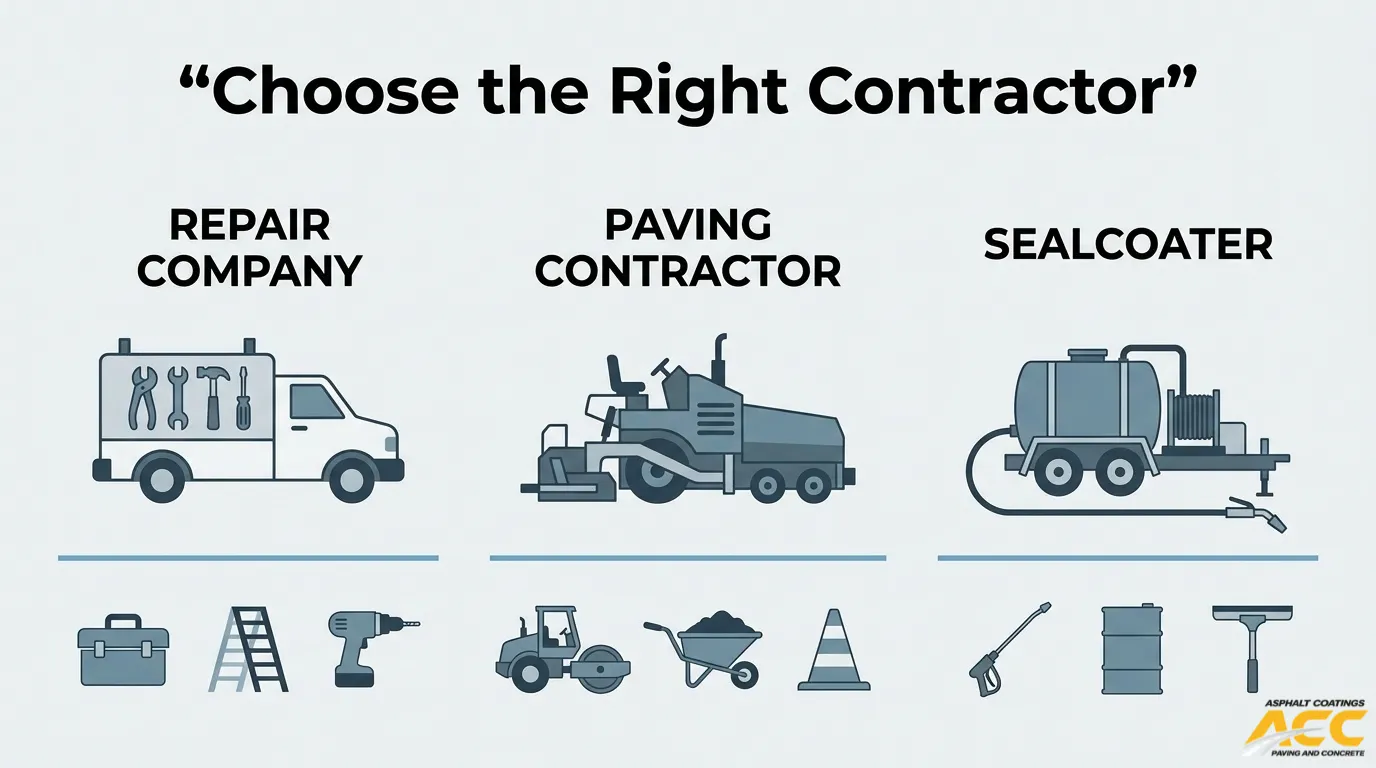
Candidacy evaluation, installation sequencing, and contractor selection each influence whether an overlay investment performs as expected or fails prematurely.
What Is a Commercial Asphalt Overlay?
A commercial asphalt overlay is a new layer of asphalt placed directly over existing pavement to restore surface integrity without removing the original structure. The sections below explain how overlays differ from full replacement and what pavement condition qualifies.
How Does an Asphalt Overlay Differ from Full-Depth Replacement?
An asphalt overlay differs from full-depth replacement by adding new material on top of existing pavement rather than excavating and rebuilding the entire pavement structure. The Federal Highway Administration defines a thin asphalt overlay as a dense-graded, small nominal maximum aggregate size (NMAS) mixture placed at less than 1.5 inches thick using conventional production and placement operations.
Full-depth replacement removes all asphalt layers and base material before reconstructing from the subgrade up. Overlays preserve the existing base, which significantly reduces material, labor, and disposal costs. A forensic study of four pavement sections in Georgia, published in Case Studies in Construction Materials, found that full-depth reclamation with stabilized bases can allow for thinner, less expensive asphalt overlays while maintaining structural performance. This finding highlights why overlays suit pavements with sound subsurface conditions; when the base remains structurally adequate, adding surface material achieves comparable results at a fraction of the investment.
What Condition Must Existing Pavement Be in for an Overlay?
The existing pavement must have a Pavement Condition Index (PCI) score between 41 and 70 to be a candidate for an overlay, according to El Paso County, Colorado’s pavement management data. Pavements scoring above 70 typically need only preventive maintenance, while those below 41 often require full reconstruction due to base failures.
Within that 41–70 range, the surface should be free of widespread structural distresses such as deep alligator cracking or subgrade settlement. Minor surface cracking and moderate oxidation are acceptable because the overlay seals and reinforces these areas. Timing matters considerably; as Tim Aschenbrener of the FHWA Office of Preconstruction, Construction, and Pavements states, “timely and well-designed overlay applications are consistently cost-effective because less subsurface work is required.” Waiting too long allows deterioration to penetrate beyond the surface, eliminating the overlay option entirely.
Understanding pavement condition thresholds helps property managers determine whether an overlay delivers lasting value or merely delays inevitable reconstruction.
What Are the Key Benefits of Asphalt Overlay for Commercial Properties?
The key benefits of asphalt overlay for commercial properties include reduced project cost, minimal business disruption, extended pavement lifespan, improved surface safety, and environmental advantages over full removal.
How Does an Overlay Reduce Total Project Cost?
An overlay reduces total project cost by eliminating the need for full-depth demolition, hauling, and base reconstruction. Because the existing pavement serves as the structural foundation, material requirements and labor hours decrease significantly. Tim Aschenbrener of the FHWA Office of Preconstruction, Construction, and Pavements states that “timely and well-designed overlay applications are consistently cost-effective because less subsurface work is required.” For most commercial property managers, this makes overlay the highest-value option when surface conditions qualify.
How Does an Overlay Minimize Business Disruption and Downtime?
An overlay minimizes business disruption and downtime by requiring significantly less construction activity than full replacement. The process avoids excavation, base regrading, and extended staging periods. New asphalt overlays for commercial projects typically require a minimum of 72 hours of curing time before resuming heavy traffic, though some areas may need more time depending on layer thickness. Compared to full reconstruction projects that can shut down parking areas for weeks, this compressed timeline keeps tenants, customers, and delivery routes operational far sooner.
How Does an Overlay Extend Pavement Lifespan?
An overlay extends pavement lifespan by adding a fresh wear course that absorbs traffic loads and seals the underlying structure from moisture infiltration. A study by Auburn University found that 58% of preservation asphalt overlays had a significant impact on slowing deterioration rates and extending overall pavement life. This protective layer delays the progression of oxidation and cracking that would otherwise require costlier structural intervention within a few years.
How Does an Overlay Improve Surface Safety and Appearance?
An overlay improves surface safety and appearance by replacing a worn, cracked surface with a smooth, uniform layer of fresh asphalt. The new surface eliminates trip hazards, fills minor depressions, and restores proper drainage slope. For commercial properties, improved curb appeal directly supports tenant satisfaction and customer perception. A well-maintained parking lot signals professionalism, which is particularly valuable for retail centers, healthcare facilities, and office parks where first impressions influence business.
How Does an Overlay Offer Environmental Advantages Over Removal?
An overlay offers environmental advantages over removal by preserving the existing pavement in place, which eliminates demolition waste and reduces material consumption. A life-cycle model developed at the University of Michigan estimates that environmental impacts from overlay systems are primarily driven by material production and distribution, not site demolition. By keeping the old surface intact as a structural base, overlay projects generate less landfill waste and require fewer truck trips for hauling debris.
Understanding these benefits provides the foundation for evaluating whether overlay investment aligns with your property’s condition and budget.
How Much Does a Commercial Asphalt Overlay Cost?
A commercial asphalt overlay costs significantly less than full-depth replacement, with savings varying by project size and scope. The sections below break down pricing for small lots, large lots, and a direct per-square-foot comparison against full replacement.
How Much Does an Overlay Cost for a Small Commercial Parking Lot?
An overlay for a small commercial parking lot typically ranges from $1.50 to $3.00 per square foot, depending on existing surface condition, thickness requirements, and site accessibility. For a lot between 5,000 and 15,000 square feet, total project costs generally fall between $7,500 and $45,000.
Several factors influence pricing at this scale:
- Minimal mobilization costs due to smaller equipment needs.
- Less material volume, which keeps aggregate and binder expenses lower.
- Shorter project timelines that reduce labor hours.
Small lots with minor surface cracking and stable bases tend to land on the lower end of this range. For property managers overseeing office parks or smaller retail spaces, overlay pricing at this scale makes it one of the most budget-friendly pavement rehabilitation options available.
How Much Does an Overlay Cost for a Large Retail or Industrial Lot?
An overlay for a large retail or industrial lot typically costs between $1.25 and $2.75 per square foot. Per-square-foot rates decrease at scale because equipment mobilization and setup costs spread across greater area.
For lots ranging from 50,000 to 200,000 square feet, total project budgets generally fall between $62,500 and $550,000. Key cost drivers at this scale include:
- Thickness requirements for heavy truck and trailer traffic.
- Milling or surface preparation across larger areas.
- Phased installation to maintain partial business access during paving.
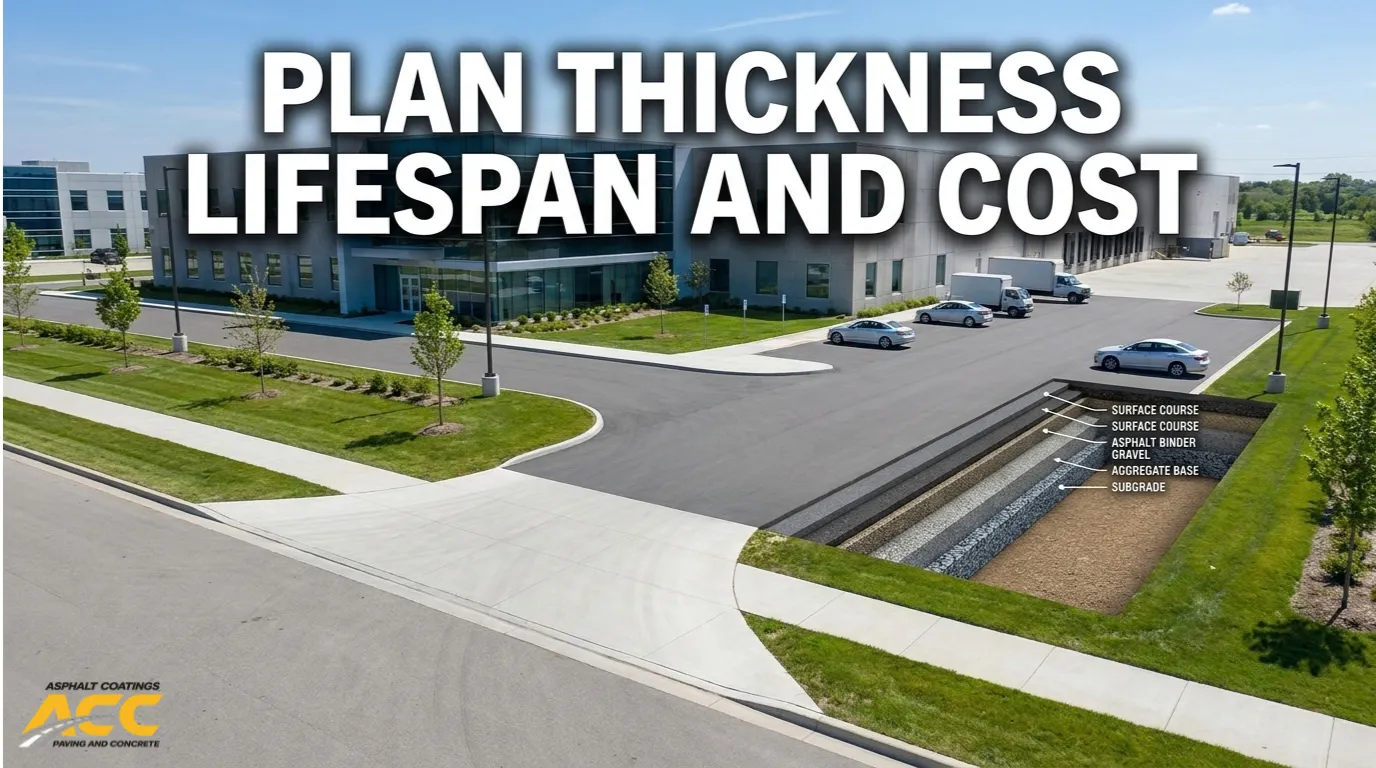
Industrial lots handling distribution traffic often require thicker lifts, pushing costs toward the higher end. Investing in proper thickness upfront prevents premature failure and avoids costly re-overlay cycles.
How Does Overlay Cost Compare to Full Replacement Per Square Foot?
Overlay cost compares favorably to full replacement, often delivering 30 to 40 percent savings. According to NYSDOT data reported by the Federal Highway Administration, cold asphalt recycling techniques provide initial cost savings of 30 to 40 percent over conventional rehabilitation methods.
| Factor | Asphalt Overlay | Full Replacement |
| Cost per sq ft | $1.25 to $3.00 | $4.00 to $8.00 |
| Project duration | 1 to 3 days | 5 to 14 days |
| Business disruption | Minimal, phased | Extensive closure |
| Base work required | None to minor | Full excavation |
When the existing base remains structurally sound, overlay eliminates excavation, hauling, and disposal expenses that drive full replacement costs higher. Understanding these cost dynamics helps determine whether overlay or replacement delivers better long-term value for your property.
When Is an Asphalt Overlay Worth It Versus Full Replacement?
An asphalt overlay is worth it when distresses remain at the surface level and the base structure is intact. Full replacement becomes necessary when deeper structural problems exist. The following scenarios clarify the decision.
Is an Overlay Worth It When Only Surface Distresses Are Present?
An overlay is worth it when only surface distresses are present. Minor to moderate cracking, oxidation, and shallow raveling respond well to a new asphalt layer because the underlying base remains structurally sound.
According to the Federal Highway Administration, a thin asphalt overlay can effectively seal all minor and moderate surface cracks and prevent moisture damage when compacted to voids less than 10 percent, with hydraulic conductivity less than 125 x 10⁻⁵ cm/sec. When applied to a good, low-distress surface, an overlay is expected to last more than 10 years.
For most commercial property managers, this represents the ideal intervention window. Addressing surface deterioration before it penetrates the base layer delivers the highest return on investment with the least operational disruption.
Is an Overlay Worth It When Base Failures or Subgrade Issues Exist?
An overlay is not worth it when base failures or subgrade issues exist. Problems such as alligator cracking, deep rutting, or soft spots indicate structural compromise beneath the surface layer. Placing new asphalt over a failed base traps the problem; reflective cracking typically appears within one to two seasons.
Signs that require full replacement include:
- Widespread alligator cracking spanning large pavement areas
- Standing water caused by subgrade settlement
- Pavement sections that deflect under heavy vehicle loads
- Repeated patch failures in the same location
Full-depth reclamation or complete removal addresses the root cause. Overlaying compromised structure wastes material and accelerates deterioration of the new surface.
Is an Overlay Worth It When Drainage or Grade Changes Are Needed?
An overlay is not worth it when drainage or grade changes are needed. Adding asphalt thickness alters existing surface elevations, which can redirect water flow toward buildings, disrupt ADA-compliant slopes, or create ponding in new locations.
Situations requiring full replacement or mill-and-pave approaches include:
- Lots with inadequate slope toward storm drains
- Properties requiring new catch basin elevations
- Surfaces where an added layer would violate the ADA maximum slope of 1:48
When grade corrections are part of the project scope, milling the existing surface first or reconstructing targeted sections ensures proper drainage while maintaining compliance. An overlay alone cannot solve elevation-dependent problems.
Understanding when overlay applies sets the stage for evaluating how long that investment will perform.
How Long Does a Commercial Asphalt Overlay Last?
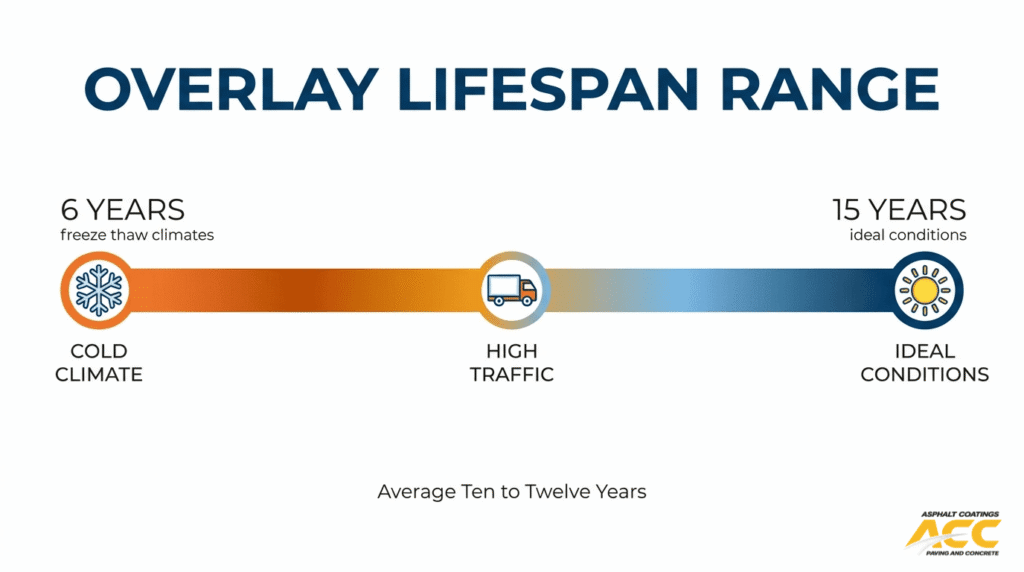
A commercial asphalt overlay lasts between 6 and 15 years depending on climate exposure and traffic volume. Freeze-thaw conditions and heavy commercial use are the two primary factors that shorten or extend this range.
How Long Does an Overlay Last in Freeze-Thaw Climates?
An overlay in freeze-thaw climates typically lasts toward the lower end of its expected lifespan, often 6 to 10 years without proactive maintenance. According to a study published through the National Institutes of Health (PMC), frequent freeze-thaw cycles in high-altitude areas cause irreversible plastic deformation in asphalt pavement structures, leading to decreased static strength and reduced fatigue life as frost damage increases.
This degradation pattern makes preventive sealcoating and crack sealing especially critical for properties in Colorado and similar high-altitude regions. Without these interventions, water infiltration during thaw periods accelerates subsurface damage far faster than in temperate climates.
How Long Does an Overlay Last on High-Traffic Commercial Surfaces?
An overlay on high-traffic commercial surfaces typically lasts 8 to 12 years when properly designed for the anticipated load. Distribution centers, shopping centers, and industrial complexes subject pavement to repeated heavy axle loads that compress and fatigue the asphalt binder more rapidly than standard passenger vehicle traffic.
Key factors that influence longevity on high-traffic surfaces include:
- Overlay thickness relative to expected axle loads.
- Quality of the existing base structure beneath the overlay.
- Frequency of preventive maintenance, such as sealcoating and crack repair.
- Proper drainage design that prevents water from weakening the bond between layers.
For most commercial property managers, scheduling condition assessments every two to three years after installation catches early distress before it compounds into costly structural failure.
What Factors Determine Whether Your Lot Is a Candidate for Overlay?
Several factors determine whether your lot is a candidate for overlay, including existing pavement thickness, the type and severity of surface distress, and site-specific drainage or accessibility requirements.
Does Existing Pavement Thickness Affect Overlay Eligibility?
Existing pavement thickness directly affects overlay eligibility. A lot needs sufficient structural depth in its current asphalt layer to support the additional material without compromising the base or subgrade beneath it. Pavements that have been milled repeatedly or were initially installed too thin may lack the structural capacity for a successful overlay. According to El Paso County, Colorado, asphalt overlays are typically reserved for pavements with a Pavement Condition Index (PCI) score between 41 and 70, a range that assumes adequate remaining structural integrity. If thickness falls below the minimum threshold for your traffic load, full-depth reconstruction becomes the more reliable path.
How Do Alligator Cracking and Potholes Impact Candidacy?
Alligator cracking and potholes impact candidacy by signaling potential base layer failure rather than surface-only distress. Alligator cracking, characterized by interconnected fracture patterns resembling scales, typically indicates fatigue in the pavement structure itself. Potholes develop when these cracks allow moisture to penetrate and erode the subgrade. Simply placing an overlay over these conditions traps the underlying problems, and reflective cracking often returns within one to two seasons. Isolated areas of alligator cracking can sometimes be excavated and patched before overlaying, but widespread base failure across the lot usually disqualifies it from overlay consideration entirely.
Do Drainage Patterns and ADA Compliance Affect the Decision?
Drainage patterns and ADA compliance both affect the decision to overlay a commercial lot. Adding 1.5 inches of asphalt changes surface elevations, which can redirect water flow toward buildings, utility access points, or low spots that previously drained properly. The U.S. Access Board requires accessible parking spaces and adjacent access aisles to maintain a maximum slope of 1:48 (2.08%) in any direction. An overlay that raises grade unevenly may push existing ramps or parking areas out of compliance. These factors make a pre-overlay site evaluation essential for avoiding costly corrective work after paving.
With candidacy factors assessed, understanding how regional climate conditions affect long-term overlay performance completes the evaluation.
How Does Climate Affect Asphalt Overlay Performance?
Climate affects asphalt overlay performance by accelerating material degradation through temperature extremes, moisture infiltration, and solar radiation. The following subsections address freeze-thaw cycle damage and high-altitude UV exposure.
How Do Freeze-Thaw Cycles Impact Overlay Durability?
Freeze-thaw cycles impact overlay durability by causing irreversible plastic deformation in asphalt pavement structures. According to research published through the National Institutes of Health, frequent freeze-thaw cycles in high-altitude areas lead to decreased static strength and reduced fatigue life as frost damage accumulates.
This degradation occurs when moisture penetrates surface voids, expands during freezing, and contracts upon thawing. Each cycle progressively weakens the internal bond structure of the overlay. For commercial properties in regions experiencing dozens of annual freeze-thaw events, selecting mix designs with lower air void content and polymer-modified binders can significantly extend service life.
How Does UV Exposure at High Altitude Affect Overlay Longevity?
UV exposure at high altitude affects overlay longevity by accelerating oxidation and hardening of the asphalt binder. Research published in Construction and Building Materials found that UV radiation energy in high-altitude regions can reach 372 MJ/m², significantly impacting thermal and UV oxidation degradation of asphalt mixtures.
This intense solar exposure breaks down the maltene fraction in asphalt binder, making the surface brittle and prone to cracking. Overlays in elevated regions age faster than those at lower elevations receiving identical traffic loads. Proactive sealcoating and selecting UV-resistant binder formulations help counteract this accelerated deterioration.
Understanding climate impacts helps property managers select the right installation approach and maintenance schedule.
What Is the Overlay Installation Process for Commercial Properties?
The overlay installation process for commercial properties follows a structured sequence designed to maximize adhesion, compaction, and long-term surface performance.
- Site assessment and pavement evaluation. Crews inspect the existing surface for structural defects, drainage patterns, and compliance requirements. Pavements with a Pavement Condition Index (PCI) score between 41 and 70 are typically suitable for overlay, according to El Paso County, Colorado data.
- Surface preparation. Workers clean the existing pavement, remove loose debris, and repair localized failures such as potholes or severely deteriorated areas. Milling may be performed to establish proper grade and improve bonding.
- Tack coat application. A thin layer of asphalt emulsion is applied to bond the new overlay to the existing surface, ensuring the two layers act as a unified structure.
- Asphalt placement. Paving crews lay the new hot-mix asphalt overlay using conventional production and placement equipment, controlling thickness and temperature for uniform coverage.
- Compaction. Rollers compact the fresh asphalt to reduce air voids and increase density, which directly affects durability and moisture resistance.
- Striping and ADA compliance. Once cured, parking lot striping, accessible space markings, and any required ADA slope corrections are completed.
For most commercial properties, this process is substantially faster than full-depth removal because the existing base remains intact. Proper sequencing of each phase prevents costly rework and keeps disruption to a minimum, which is one of the most overlooked advantages of choosing overlay over reconstruction.
How Should You Approach Asphalt Overlay with a Colorado-Experienced Commercial Paving Contractor?
You should approach asphalt overlay by partnering with a contractor that understands Colorado’s freeze-thaw cycles, high-altitude UV exposure, and commercial scheduling demands. The following covers project execution and key takeaways.
Can Asphalt Coatings Company’s In-House Crews Handle Your Commercial Overlay Project?
Yes, Asphalt Coatings Company’s in-house crews can handle your commercial overlay project from start to finish. Since 1986, Asphalt Coatings Company has maintained dedicated crews specializing in mill and pave services, asphalt installation, subgrade preparation, and ADA-compliant concrete work across Colorado’s Front Range. This single-source approach eliminates subcontractor coordination delays that commonly disrupt commercial operations.
New asphalt overlays for commercial projects typically require a minimum of 72 hours of curing time before resuming heavy traffic, with some areas needing longer depending on layer thickness. Asphalt Coatings Company phases overlay installations to keep portions of parking lots operational during curing, minimizing revenue loss for property managers and retail tenants. For most commercial clients, this phased execution paired with Colorado-specific material selection makes in-house crews the most dependable path to a successful overlay.
What Are the Key Takeaways About Commercial Asphalt Overlay Benefits and Value?
The key takeaways about commercial asphalt overlay benefits and value are:
- Asphalt overlay costs 30 to 40 percent less than full-depth replacement while restoring surface integrity for 10+ years on low-distress pavements.
- Overlay seals surface cracks, prevents moisture infiltration, and improves skid resistance without requiring base excavation.
- Phased installation keeps commercial properties partially operational, reducing business disruption compared to complete reconstruction.
- Recycling existing pavement conserves landfill space and aligns with evolving federal environmental standards for construction materials.
- Colorado-specific factors like freeze-thaw cycles and UV degradation demand contractor expertise in material selection and timing.
For commercial property managers weighing rehabilitation options, overlay consistently delivers the strongest return when existing pavement structure remains sound. Prioritizing timely intervention over delayed full replacement preserves both budget and pavement life.