Asphalt removal is the complete extraction and reconstruction of a pavement surface from the subgrade up, while resurfacing applies a new asphalt layer over an existing base that remains structurally sound. The right choice depends entirely on what is happening beneath the surface. This guide covers the core differences between each method, the conditions that favor one over the other, how pavement assessment drives the decision, and what commercial property managers need to know before breaking ground.
Removal and resurfacing differ in scope, cost, and timeline. Full removal costs two to three times more and takes weeks rather than days, but it delivers a 20 to 30-year structural life compared to the 10 to 15 years resurfacing provides.
Certain conditions make removal the only viable path. Widespread alligator cracking, chronic drainage failures, repeated overlay breakdowns, and base layer deterioration all indicate that resurfacing will simply mask progressive structural decline. Resurfacing works best when damage stays in the top layer: isolated surface cracks, oxidation, shallow rutting, and age-related wear over a sound base.
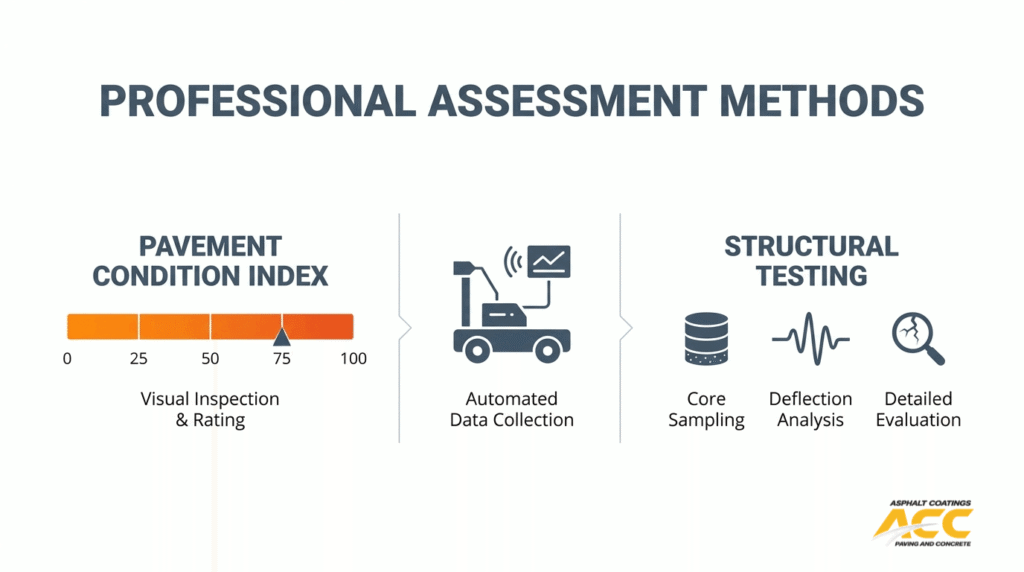
Pavement condition scoring separates informed decisions from expensive guesses. Tools like the Pavement Condition Index and Falling Weight Deflectometer testing reveal whether the base can support an overlay or requires full reconstruction.
Property managers must also weigh tenant disruption, ADA compliance obligations triggered by resurfacing or restriping, and lifecycle cost analysis across a 35-year planning window. A qualified commercial paving contractor evaluates all of these factors together, matching the repair method to the pavement’s actual structural condition rather than defaulting to the cheapest option.
What Is Asphalt Removal?
Asphalt removal is the complete extraction of an existing asphalt surface, including the deteriorated hot mix and, in many cases, the compromised base and subgrade materials beneath it. This process strips the pavement down to its foundation, allowing contractors to rebuild the entire pavement structure from the ground up.
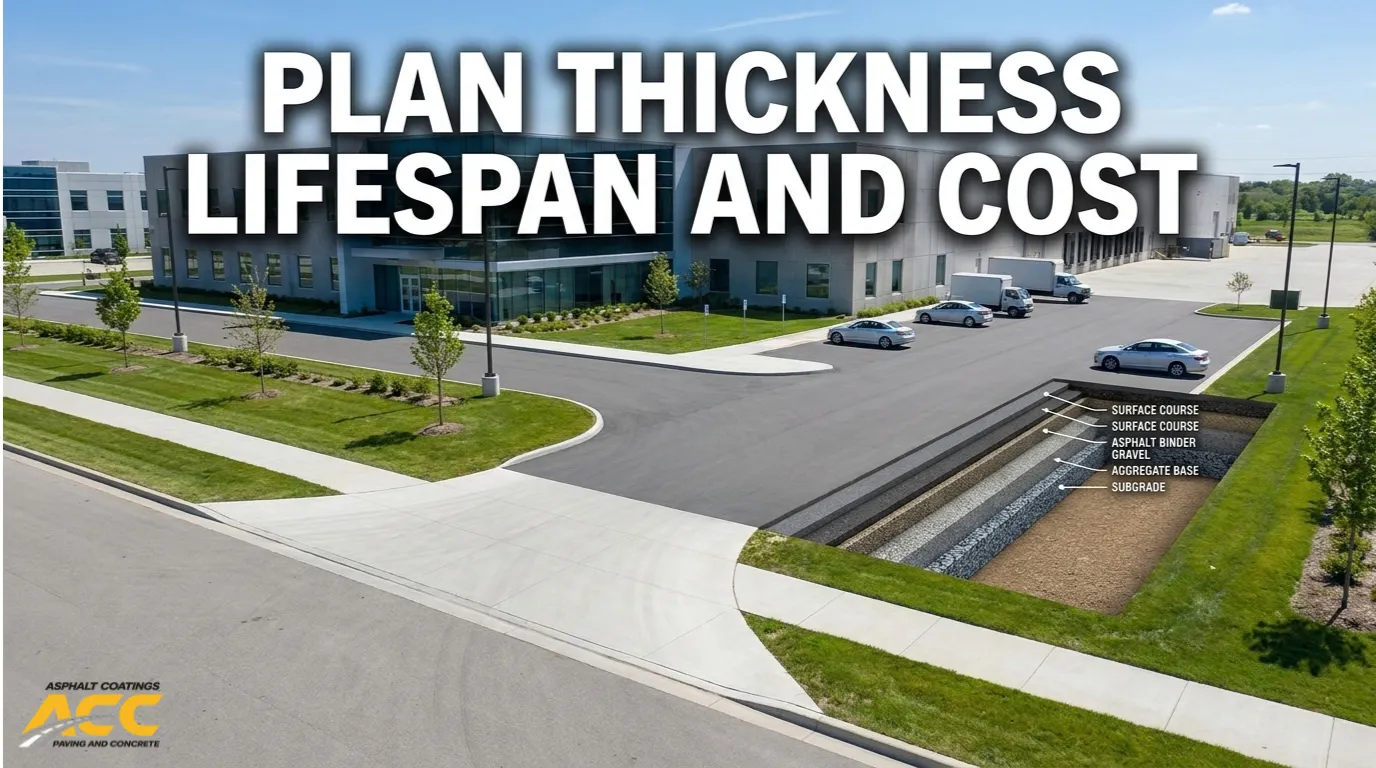
Often called full-depth removal or reconstruction, the method involves milling or sawcutting the old surface, excavating the underlying layers, and hauling away the debris. Once the old material is cleared, crews regrade and compact the subgrade, install fresh aggregate base, and pave new asphalt. The result is a completely new pavement section with restored structural capacity, proper drainage slopes, and a full-length design life. For parking lots with widespread base failure or subgrade instability, removal is typically the only path to a lasting repair.
What Is Asphalt Resurfacing?
Asphalt resurfacing is a rehabilitation technique that applies a new layer of asphalt over an existing pavement surface to restore ride quality and extend service life. According to the Ohio Department of Transportation, this method preserves the existing base structure while addressing surface deterioration. Rather than removing the entire pavement, resurfacing builds upon a structurally sound foundation, making it a cost-effective alternative when the underlying layers remain intact. The Wisconsin Department of Transportation notes that resurfacing typically provides a service life extension of 10 to 15 years. For commercial property managers seeking to maintain parking lot functionality without full reconstruction, this approach balances performance restoration with budget efficiency.
How Does Asphalt Removal Differ From Resurfacing?
Asphalt removal and resurfacing differ in scope, cost, and timeline. Removal involves full demolition and reconstruction, while resurfacing applies a new layer over existing pavement. The sections below compare each factor.
How Do the Processes Differ?
The processes differ in depth and structural impact. Asphalt removal requires excavating the entire pavement surface and base materials, then rebuilding from the subgrade up with new aggregate and asphalt lifts. Resurfacing, by contrast, mills only the top layer and applies fresh asphalt over the existing base.
Key process distinctions include:
- Removal involves hauling away old material, regrading the subgrade, and installing new base layers before paving.
- Resurfacing retains the existing base structure and bonds a new wearing course directly to the milled surface.
- Removal addresses subsurface failures; resurfacing corrects surface-level deterioration only.
For most commercial properties, the condition of the base layer determines which process applies.
How Do the Costs Compare?
The costs compare significantly: full removal and reconstruction typically costs two to three times more than resurfacing due to excavation, hauling, base preparation, and material volume. Resurfacing limits expense to milling and a single new asphalt lift.
However, the lifecycle value shifts this comparison. According to the Wisconsin Department of Transportation, resurfacing typically provides a service life extension of 10 to 15 years, whereas full reconstruction is designed for a 20 to 30-year structural life. When a pavement needs repeated resurfacing every decade, the cumulative cost often exceeds a single reconstruction investment.
Spending more upfront on removal frequently delivers stronger long-term ROI for properties with compromised bases.
How Does the Timeline Differ?
The timeline differs substantially between the two approaches. Resurfacing a commercial parking lot generally takes days, since crews mill and overlay without disturbing the subgrade. Full removal extends the project to one or several weeks depending on lot size, because excavation, grading, compaction, and multi-lift paving each require curing and inspection time.
Factors that influence project duration include:
- Lot square footage and depth of base failure.
- Weather conditions during compaction and paving.
- Permitting requirements for grade changes or layout modifications.
For property managers balancing tenant access against pavement longevity, this timeline trade-off often drives the final decision.
When Is Full Asphalt Removal the Better Choice?
Full asphalt removal is the better choice when underlying pavement problems make resurfacing ineffective. The scenarios below cover severe structural damage, drainage failures, repeated repair cycles, and base layer deterioration.
When Should You Choose Removal for Severe Structural Damage?
You should choose removal for severe structural damage when widespread alligator cracking, deep rutting, or subgrade failure has compromised the pavement’s load-bearing capacity. Alligator cracking is a series of interconnecting cracks caused by fatigue failure under repeated traffic loading, and it signals structural failure of the base or subgrade, according to Michigan Technological University’s pavement distress classification. Resurfacing over this type of damage simply masks the problem. The new overlay inherits the failing structure beneath it and cracks again within a few seasons. Removing the full pavement depth allows contractors to rebuild the subgrade and base course properly, which is the only path to a lasting repair when structural integrity is already gone.
When Should You Choose Removal for Drainage Problems?
You should choose removal for drainage problems when standing water consistently ponds on the surface despite previous repairs. Ponding occurs when cross slopes fall below the recommended 2.0% minimum grade needed to move water off the pavement. Overlaying new asphalt on a poorly graded surface does not fix the slope; it raises the elevation while preserving the same inadequate drainage geometry. Full removal lets the contractor regrade the subbase, correct slope deficiencies, and install proper drainage infrastructure before paving. For commercial lots that handle heavy traffic and Colorado’s freeze-thaw cycles, ignoring drainage issues accelerates binder stripping and base erosion, turning a surface problem into a structural one.
When Should You Choose Removal for Repeated Failures?
You should choose removal for repeated failures when the same sections of pavement keep breaking down despite multiple overlays or patches. Recurring distress in the same locations typically indicates a subgrade or base issue that no surface treatment can resolve. Each additional overlay adds weight and thickness without addressing the root cause, compressing the timeline between failures while increasing cumulative costs. A pavement that has been resurfaced two or more times and still exhibits cracking or settling has likely exhausted the benefit of surface-level rehabilitation. At that point, full removal and reconstruction delivers a longer structural life and a lower total cost of ownership over the next two to three decades.
When Should You Choose Removal for Base Layer Deterioration?
You should choose removal for base layer deterioration when testing reveals that the aggregate base or subbase has lost its structural capacity. The Falling Weight Deflectometer is an effective device for evaluating in-service pavement structure, according to the North Carolina Department of Transportation. When deflection readings show the base can no longer distribute loads properly, resurfacing provides no meaningful improvement. Common signs of base failure visible at the surface include localized depressions, heaving, and slab-like movement under heavy vehicles. Full removal allows the deteriorated base material to be excavated, replaced, or stabilized before new asphalt is placed. Addressing the foundation first is what separates a repair that lasts from one that fails prematurely.
When Is Asphalt Resurfacing the Better Choice?
Asphalt resurfacing is the better choice when damage remains limited to the surface layer and the underlying base is structurally sound. The scenarios below cover surface cracking, oxidation, budget constraints, and timeline needs.
When Should You Choose Resurfacing for Surface-Level Cracking?
You should choose resurfacing for surface-level cracking when the cracks are confined to the top layer and do not indicate structural base failure. Hairline cracks, minor longitudinal cracks, and early-stage block cracking respond well to an overlay because the base beneath still provides adequate support.
According to Michigan Technological University, alligator cracking is a series of interconnecting cracks caused by fatigue failure under repeated traffic loading, indicating structural failure of the base or subgrade. If your pavement shows isolated surface cracks rather than this interconnected pattern, resurfacing effectively seals and covers the damage before it progresses deeper.
When Should You Choose Resurfacing for Oxidation and Wear?
You should choose resurfacing for oxidation and wear when the asphalt surface has become brittle, faded, or rough but retains a stable base layer. UV exposure and air gradually harden the binder, causing raveling and a gray, weathered appearance. A 2017 academic study published in ScienceDirect found that climate change factors, such as increased precipitation and temperature fluctuations, can accelerate asphalt binder oxidation, leading to earlier-than-expected raveling and cracking.
Resurfacing addresses this by applying a fresh asphalt layer that restores flexibility and ride quality. For commercial properties experiencing surface deterioration without deeper structural compromise, an overlay is the most practical intervention.
When Should You Choose Resurfacing on a Tight Budget?
You should choose resurfacing on a tight budget when the pavement needs rehabilitation but full removal would exceed available capital. Resurfacing eliminates excavation, hauling, and base reconstruction costs, making it significantly less expensive per square foot than full-depth removal.
According to the Wisconsin Department of Transportation, resurfacing typically provides a service life extension of 10 to 15 years. That lifespan, achieved at a fraction of reconstruction cost, delivers strong value for property managers who need to stretch maintenance budgets across multiple facilities. For most commercial lots with sound bases, resurfacing offers the best cost-to-life ratio available.
When Should You Choose Resurfacing for Minimal Downtime?
You should choose resurfacing for minimal downtime when tenant access, customer traffic, or business operations cannot tolerate an extended closure. Resurfacing requires no excavation or base work, so crews can complete the overlay in days rather than weeks.
In many jurisdictions, a building permit is not required for resurfacing existing parking lots if the work stays below 18 inches above grade and does not alter the existing layout, according to the City of Seattle Department of Construction and Inspections. Reduced permitting and faster installation keep disruption brief, which makes resurfacing ideal for retail centers, healthcare facilities, and other high-traffic commercial properties.
Understanding when resurfacing fits best helps clarify how pavement condition scoring guides the final decision.
How Does Pavement Condition Determine the Right Option?
Pavement condition determines the right option by revealing whether damage is confined to the surface or extends into the base and subgrade. The following subsections cover structural assessment methods, surface damage indicators, and signs of full-depth failure.
How Do You Assess Structural Integrity Before Deciding?
You assess structural integrity before deciding by evaluating the pavement’s load-bearing capacity and identifying distress patterns that reveal subsurface conditions. The Falling Weight Deflectometer measures deflection under simulated traffic loads, indicating whether the base can still support an overlay. Core samples expose layer thickness and moisture intrusion. According to Iowa State University’s Institute for Transportation, the Pavement Condition Index is a numerical rating from 0 to 100, where 0 represents a failed pavement and 100 represents excellent condition. A thorough structural evaluation before committing to either resurfacing or removal prevents costly rework within just a few years.
What Types of Damage Indicate a Sound Base Layer?
The types of damage that indicate a sound base layer are surface-level distresses that have not penetrated into the structural layers below. These include:
- Longitudinal cracking along lane joints caused by thermal contraction rather than load failure.
- Minor raveling where aggregate has loosened from oxidized binder at the surface.
- Shallow rutting under 0.5 inches deep, confined to the wearing course.
- Block cracking from age-related shrinkage of the asphalt binder.
When distress remains in the top one to two inches and deflection testing confirms adequate base support, resurfacing is typically the more cost-effective path forward.
What Types of Damage Signal Full-Depth Failure?
The types of damage that signal full-depth failure are distresses originating in or extending through the base and subgrade layers. According to Michigan Technological University, alligator cracking is a series of interconnecting cracks caused by fatigue failure of the asphalt surface under repeated traffic loading, indicating structural failure of the base or subgrade. Additional indicators include:
- Severe rutting exceeding one inch, suggesting base layer compression or displacement.
- Subgrade pumping, where fine material migrates upward through cracks during wet conditions.
- Widespread depressions or heaving across large pavement sections.
These failures cannot be corrected with an overlay alone; full removal and reconstruction of the base is necessary for a lasting repair. Understanding these failure thresholds helps property managers plan budgets around realistic lifecycle expectations.
How Do Freeze-Thaw Cycles Affect the Decision?
Freeze-thaw cycles affect the decision between asphalt removal and resurfacing by determining how deeply water infiltration has compromised the pavement structure. When water seeps into cracks and freezes, it expands, widening fissures and destabilizing base layers from within.
Resurfacing works when freeze-thaw damage remains confined to the surface, such as minor thermal cracking or shallow raveling. However, repeated seasonal cycling often forces moisture deeper into the aggregate base, where expansion pressure creates voids and undermines structural support. Once subsurface damage reaches this stage, a new overlay simply masks progressive failure underneath.
According to a 2017 academic case study published in ScienceDirect, climate change factors such as increased temperature fluctuations can accelerate the oxidation of asphalt binders, leading to earlier-than-expected raveling and cracking. In cold climates, this compounds freeze-thaw stress significantly.
Full removal becomes the better choice when:
- Core samples reveal saturated or displaced base material beneath the surface.
- Repeated resurfacing attempts have failed within a few seasons.
- Heaving or settlement patterns indicate deep moisture intrusion.
- The pavement shows alligator cracking combined with soft, spongy areas.
For commercial property managers in regions with harsh winters, investing in removal and proper base reconstruction prevents the costly cycle of overlaying pavement that continues deteriorating from below. Understanding long-term lifecycle costs helps clarify which approach delivers better value over time.
How Does Each Option Impact Long-Term Pavement Life?
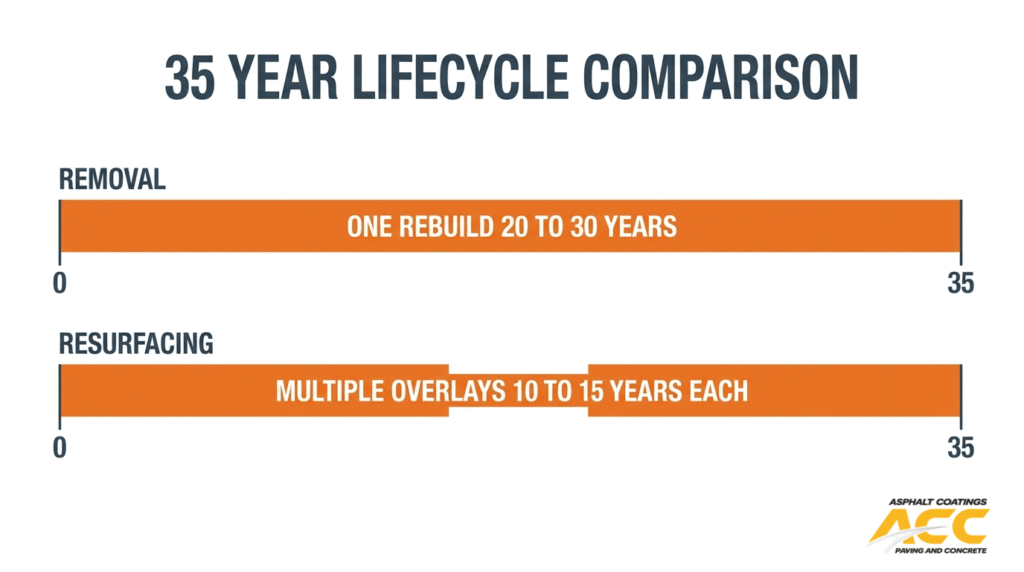
Each option impacts long-term pavement life differently: resurfacing extends service life by 10 to 15 years, while full removal and reconstruction delivers a 20 to 30-year structural life. The Federal Highway Administration’s Life-Cycle Cost Analysis Policy Statement recommends an analysis period of at least 35 years for all pavement projects, including new construction and total reconstruction. This framework reveals that a single reconstruction can cover most of a 35-year analysis window, whereas resurfacing may require two or more applications within the same period. For property managers weighing total cost of ownership, factoring in repeated overlay expenses against one comprehensive rebuild often shifts the long-term value equation toward removal when structural conditions warrant it.
With lifecycle costs clarified, the next step is evaluating operational factors that affect your specific property.
What Should Commercial Property Managers Consider First?
Commercial property managers should consider tenant disruption and regulatory compliance first when choosing between asphalt removal and resurfacing. These two factors directly influence project timing, cost, and legal exposure.
How Does Tenant and Traffic Disruption Factor In?
Tenant and traffic disruption factors in as one of the most immediate operational concerns for commercial property managers. Resurfacing typically requires shorter lane closures and phased work schedules, allowing businesses to remain accessible during construction. Full removal, by contrast, may shut down entire parking sections for days or weeks, directly affecting tenant revenue and customer access.
Phased paving plans can minimize disruption by isolating work zones while keeping the remaining lot open. For high-traffic properties like shopping centers or medical offices, even a few days of restricted access can strain tenant relationships. Scheduling work during off-peak hours or seasonal lulls helps reduce this impact. Proactive tenant communication before and during the project is equally important for maintaining trust.
How Do Local Code and ADA Compliance Requirements Apply?
Local code and ADA compliance requirements apply whenever a parking facility undergoes resurfacing or restriping. According to the U.S. Department of Justice, when a parking facility is restriped or resurfaced, it must provide accessible parking spaces as required by the 2010 ADA Standards for Accessible Design.
Key compliance considerations include:
- Accessible parking spaces must have a firm, stable, slip-resistant surface with a maximum slope of 2.08% in all directions.
- Van-accessible spaces require a minimum vertical clearance of 98 inches.
- Many jurisdictions do not require a building permit for resurfacing if the work stays below 18 inches above grade and does not alter the existing layout.
Overlooking ADA requirements during a resurfacing project is one of the most common and costly mistakes property managers make. Understanding these obligations early in the planning process helps avoid fines, project delays, and potential litigation.
How Can a Commercial Paving Contractor Help You Decide?
A commercial paving contractor can help you decide by evaluating your pavement’s structural condition, drainage performance, and budget to recommend removal or resurfacing. Here is how Asphalt Coatings Company approaches this process and what to remember when making your choice.
Can Asphalt Coatings Company Assess and Pave Your Lot?
Yes, Asphalt Coatings Company can assess and pave your lot. With nearly four decades of commercial paving experience across Colorado’s Front Range, Asphalt Coatings Company evaluates every parking lot for structural integrity, drainage adequacy, and surface condition before recommending a path forward.
When resurfacing is appropriate, Asphalt Coatings Company applies a new asphalt layer over the existing surface to restore ride quality and extend service life. For lots with deeper problems, full-depth reclamation pulverizes the entire asphalt thickness and underlying materials to create a stabilized base for reconstruction. Inadequate drainage that causes ponding can strip asphalt binder from aggregate, so Asphalt Coatings Company also assesses grading and water flow during every evaluation.
According to the National Asphalt Pavement Association, asphalt pavement is 100% recyclable, and more than 99% of removed asphalt is reused in new pavements or other applications. Asphalt Coatings Company incorporates reclaimed asphalt pavement into resurfacing mixtures where feasible, reducing material costs while maintaining performance. This commitment to sustainability, combined with in-house crews handling everything from subgrade preparation to striping, makes Asphalt Coatings Company a single-source partner for the entire project.
What Are the Key Takeaways About Removal vs. Resurfacing?
The key takeaways about removal vs. resurfacing center on matching the repair method to your pavement’s actual condition:
- Resurfacing suits parking lots with sound base layers and surface-level distress, extending service life by 10 to 15 years at a lower upfront cost.
- Full removal and reconstruction is the better investment when structural failure, chronic drainage issues, or repeated patching indicate base layer deterioration.
- Pavement condition assessments, including PCI scoring and structural evaluation, eliminate guesswork and prevent costly misdiagnosis.
- ADA compliance, tenant disruption, and long-term lifecycle costs should factor into every decision alongside surface condition.
Choosing between removal and resurfacing is ultimately a structural decision, not just a budget one. Partnering with an experienced commercial paving contractor ensures the solution fits the problem.