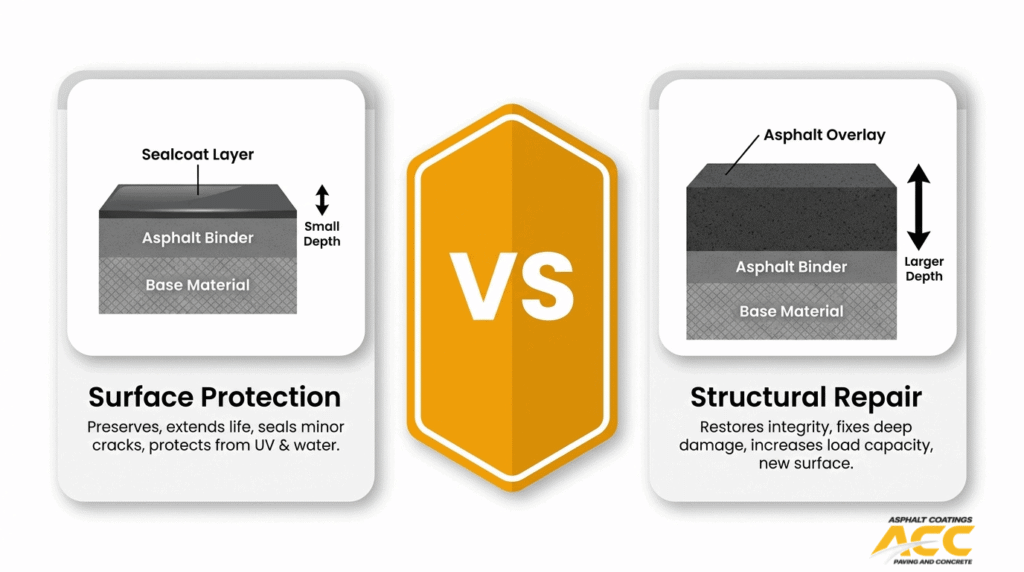
Sealcoating is a surface-level protective coating that shields structurally sound asphalt from UV rays, water, and chemical damage. Asphalt resurfacing is the process of applying a new layer of hot mix asphalt over existing pavement to restore structural integrity. Each treatment serves a distinct role in commercial lot maintenance.
This guide covers when to choose each treatment, cost and longevity comparisons, environmental impact on performance, project downtime, and how both services work together in a unified maintenance plan.
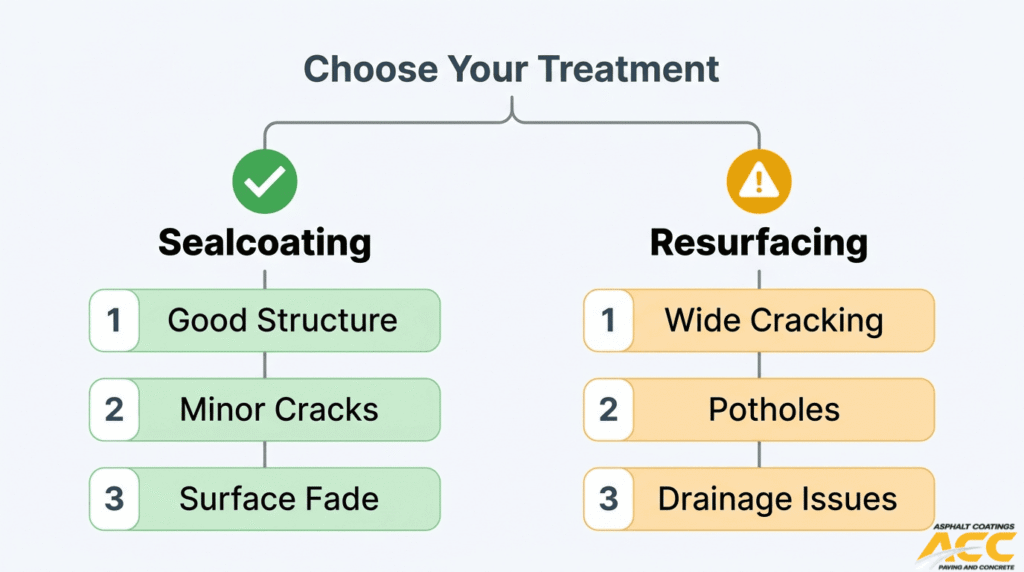
Sealcoating is the right choice when pavement is in good condition but showing early oxidation, fading, or hairline cracks. Applied every 3 to 5 years as part of a preventive schedule, it extends pavement life and delays the need for costly structural repairs.
Resurfacing becomes necessary when damage progresses to widespread alligator cracking, potholes, base failure, or drainage problems that a thin coating cannot correct. Pavement that has aged past the preservation window requires an overlay to restore both surface quality and load-bearing capacity.
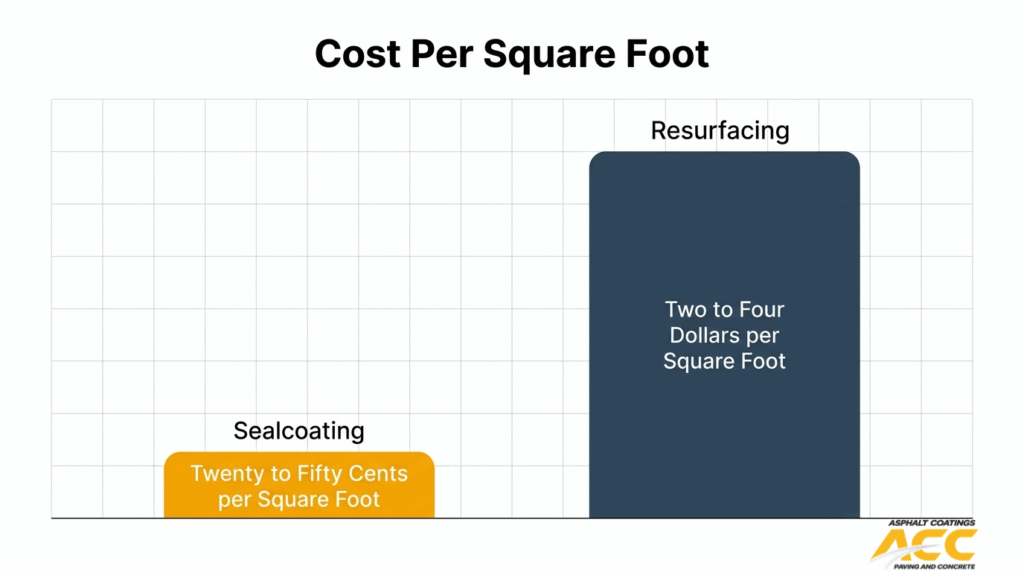
Cost differences are significant: sealcoating runs $0.20 to $0.50 per square foot, while resurfacing ranges from $2.00 to $4.00 per square foot. However, sealcoating requires recurring reapplication, whereas a single overlay provides 10 to 14 years of service life.
Freeze-thaw cycles and high-altitude UV exposure degrade both treatments differently. Sealcoating loses flexibility faster under intense UV due to its thin film, while overlays resist mechanical stress longer but still require timely crack sealing to prevent moisture infiltration.
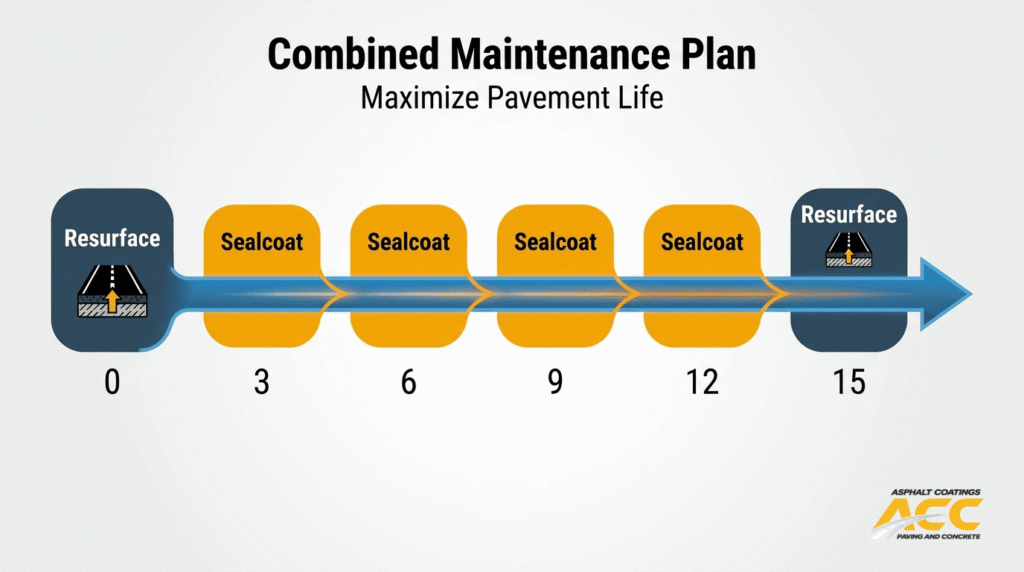
Combining both treatments into one phased maintenance plan delivers the strongest return on investment, with sealcoating protecting each new overlay and periodic resurfacing resetting the pavement’s structural clock when conditions demand it.
What Is Sealcoating for Commercial Parking Lots?
Sealcoating for commercial parking lots is a surface-level maintenance technique that applies a protective layer to prevent damage from UV rays, water penetration, and chemical spills. It preserves structurally sound pavement rather than rebuilding it.
Understanding when sealcoating is appropriate depends on current pavement conditions. According to ASTM International, the Pavement Condition Index (PCI) rates pavement from 0 to 100, where 100 is excellent and 0 is failed. Sealcoating works best on surfaces scoring well above the distress threshold. Lots with a PCI below 40 are generally candidates for major rehabilitation or reconstruction, not surface treatments. For property managers evaluating their lots, this distinction between preservation and repair determines which treatment delivers real value.
What Is Asphalt Resurfacing for Commercial Parking Lots?
Asphalt resurfacing for commercial parking lots is the process of applying a new layer of hot asphalt over an existing pavement structure to restore surface integrity without full-depth reconstruction. This treatment, also called a mill and overlay, addresses structural decline that surface-level maintenance alone cannot correct.
Unlike sealcoating, which applies a thin protective coating, resurfacing replaces the worn driving surface with fresh Hot Mix Asphalt (HMA). HMA is the standard material for commercial parking lot paving, produced at temperatures between 250°F and 300°F according to Wright Construction Inc. The process typically begins with milling, where crews remove the deteriorated top layer to establish a clean bonding surface. New asphalt is then placed, compacted, and graded to restore proper drainage and a smooth profile.
Resurfacing targets lots exhibiting widespread cracking, rutting, or base-level fatigue that sealcoating cannot reverse. It effectively resets the pavement’s service clock while preserving the underlying subgrade, making it a cost-effective alternative to complete tear-out and replacement. For commercial property managers overseeing high-traffic lots, resurfacing also provides an opportunity to correct grading deficiencies and bring accessible parking areas into ADA slope compliance.
This treatment sits in the middle of the pavement maintenance spectrum: more intensive than sealcoating, yet significantly less disruptive and less expensive than full reconstruction. Understanding where resurfacing fits within a broader maintenance plan helps facility managers choose the right intervention at the right time.
When Should You Choose Sealcoating Over Resurfacing?
You should choose sealcoating over resurfacing when your pavement is structurally sound but needs surface-level protection. The scenarios below cover minor wear, scheduled preventive maintenance, and recently paved lots.
When Is Sealcoating the Right Choice for Minor Surface Wear?
Sealcoating is the right choice for minor surface wear when the pavement shows early signs of oxidation, light color fading, or small hairline cracks without structural compromise. These cosmetic issues signal that the asphalt binder is drying out, yet the base remains intact.
Sealcoating restores a uniform, dark finish while sealing the surface against water penetration and UV degradation. If cracks are shallow and isolated, a crack seal followed by sealcoat addresses the damage at a fraction of resurfacing costs. Once wear progresses to widespread alligator cracking or base failure, however, a protective coating alone cannot restore structural integrity.
When Is Sealcoating Ideal for Preventive Maintenance Schedules?
Sealcoating is ideal for preventive maintenance schedules when applied on a recurring cycle before visible distress develops. Scheduling sealcoat applications every three to five years keeps oxidation and moisture intrusion in check, preserving the binder that holds aggregate together.
According to research from Auburn University, preventive maintenance can extend the service life of an 18-year-old pavement structure by an additional 3 to 5 years. That added lifespan delays the far costlier need for resurfacing or reconstruction. For commercial property managers budgeting long-term, a disciplined sealcoating schedule is one of the highest-return maintenance investments available.
When Does Sealcoating Make Sense After a Fresh Paving Job?
Sealcoating makes sense after a fresh paving job once the new asphalt has fully cured, typically 90 days to one year after installation. Applying sealcoat too early traps volatile oils that need to evaporate during the curing process, which can soften the surface and reduce long-term durability.
As AsphaltPro Magazine notes, “it is our job to educate customers on when sealcoating is and is not effective, and to present the various paving options available.” Timing that first sealcoat correctly locks in the pavement’s flexibility and creates a barrier against UV rays and moisture from day one of its protective life. With the right sealcoating timing established, the next consideration is knowing when damage warrants full resurfacing instead.
When Should You Choose Resurfacing Over Sealcoating?
You should choose resurfacing over sealcoating when pavement damage extends beyond the surface layer. The following scenarios explain when an overlay is the better investment.
When Is Resurfacing Necessary for Widespread Cracking and Potholes?
Resurfacing is necessary for widespread cracking and potholes when damage covers large, interconnected areas that sealcoating cannot structurally repair. Alligator cracking, deep potholes, and base-layer failures indicate the existing surface has deteriorated past the point of cosmetic treatment. Sealcoating seals minor surface voids, but it cannot restore structural integrity to pavement that has already fractured through multiple layers. Once cracking becomes widespread rather than isolated, applying a new asphalt overlay addresses the root structural deficiency. Patching individual potholes in a heavily damaged lot often proves temporary; resurfacing delivers a uniform, load-bearing surface across the entire area.
When Does Resurfacing Make More Sense for Aging Pavement?
Resurfacing makes more sense for aging pavement when the surface has dropped below the condition threshold where preservation treatments remain cost-effective. According to the Federal Highway Administration, pavement preservation treatments should be applied when the Pavement Condition Index is between 70 and 100 to maximize return on investment and extend service life. Once pavement ages past that window, sealcoating no longer delivers meaningful protection. As the Asphalt Institute advises, “Asphalt pavements are designed to last for many years, so don’t let a sense of urgency to get the job done quickly allow you to make decisions which could strip years away from the pavement life.” For lots with PCI scores well below 70, an overlay restores both surface quality and structural capacity that no sealer can replicate.
When Should You Resurface to Correct Drainage or Grading Issues?
You should resurface to correct drainage or grading issues when standing water, uneven slopes, or improper pitch direct runoff toward buildings or pedestrian areas. Sealcoating applies a thin protective film that follows existing contours; it cannot change surface grade or redirect water flow. Resurfacing allows contractors to adjust slope angles, reestablish proper crown, and eliminate low spots where ponding accelerates deterioration. Poor drainage also creates ADA compliance risks when standing water blocks accessible routes. For commercial lots where grading deficiencies compound freeze-thaw damage each winter, an overlay corrects the geometry while simultaneously renewing the wearing surface.
With the right treatment selected, understanding cost differences helps finalize budget decisions.
How Much Does Sealcoating Cost Compared to Resurfacing?
Sealcoating costs significantly less than resurfacing on a per-square-foot basis. The sections below break down pricing for each treatment and how lot size influences overall project costs.
How Much Does Sealcoating Cost Per Square Foot for Commercial Lots?
Sealcoating costs between $0.20 and $0.50 per square foot for commercial lots, depending on project complexity and volume. According to a 2024 cost analysis by Pave It Forward, a proactive maintenance plan for a 50,000-square-foot lot costs roughly $55,000 to $80,000 over 15 years, compared to $250,000 to $400,000 for reactive reconstruction. In certain regional markets, basic sealcoating can run as low as $0.15 to $0.25 per square foot. For most commercial property managers, this makes sealcoating one of the most cost-effective pavement investments available when applied on a consistent cycle.
How Much Does Asphalt Resurfacing Cost Per Square Foot for Commercial Lots?
Asphalt resurfacing costs between $2.00 and $4.00 per square foot for commercial applications. According to Strike Force Striping’s pavement lifecycle cost analysis, overlay projects carry this higher price because they involve milling damaged layers and installing new Hot Mix Asphalt. That makes resurfacing roughly 4 to 20 times more expensive per square foot than sealcoating. However, resurfacing addresses structural deterioration that sealcoating cannot fix, so the higher investment is justified when pavement has progressed beyond surface-level wear.
How Does Lot Size Affect Sealcoating vs. Resurfacing Pricing?
Lot size affects sealcoating vs. resurfacing pricing through economies of scale. Larger commercial lots typically receive lower per-square-foot rates for both treatments because mobilization costs, equipment setup, and material delivery are spread across more area. Key pricing factors include:
- Lots under 20,000 square feet often fall at the higher end of per-square-foot ranges due to fixed setup costs.
- Mid-size lots between 20,000 and 75,000 square feet benefit from volume material pricing.
- Large lots exceeding 75,000 square feet can negotiate further discounts, particularly for multi-year maintenance contracts.
For facility managers budgeting long-term, pairing routine sealcoating with planned resurfacing milestones controls costs far better than waiting for failures to dictate spending.
With costs established, understanding how long each treatment lasts determines the true return on investment.
How Long Does Each Treatment Last on a Commercial Lot?
Each treatment lasts a different number of years depending on the application. Sealcoating typically lasts 3 to 5 years, while an asphalt overlay provides 10 to 14 years of service life.
How Long Does a Sealcoat Last on a Commercial Parking Lot?
A sealcoat lasts approximately 3 to 5 years on a commercial parking lot before reapplication is needed. This cycle protects the underlying asphalt from oxidation and water penetration, preserving structural integrity between applications. Factors such as traffic volume, climate exposure, and application quality influence whether a sealcoat reaches the lower or upper end of that range. For high-traffic commercial lots, budgeting for reapplication every three years is a practical approach that prevents costly deterioration from compounding.
How Long Does an Asphalt Overlay Last on a Commercial Parking Lot?
An asphalt overlay lasts approximately 10 to 14 years on a commercial parking lot. According to research from the University of Pittsburgh, an overlay on existing asphalt pavement provides an anticipated service life within this range. Hot Mix Asphalt, the standard material for commercial lot paving, is produced at temperatures between 250°F and 300°F, creating a dense, durable surface layer. Proper subgrade condition and drainage design influence whether an overlay reaches the upper end of its lifespan. This mill and overlay process delivers significantly longer protection than surface treatments alone, making it the preferred pavement preservation strategy for lots with moderate structural damage.
With treatment lifespans established, environmental factors determine how well each option holds up over time.
How Do Freeze-Thaw Cycles and UV Exposure Affect Each Option?
Freeze-thaw cycles and UV exposure degrade sealcoating and resurfacing differently. The subsections below explain how each environmental stressor impacts sealcoated surfaces, resurfaced asphalt, and how high-altitude UV accelerates deterioration.
How Do Freeze-Thaw Cycles Impact Sealcoated Surfaces?
Freeze-thaw cycles impact sealcoated surfaces by forcing moisture into micro-cracks, where it expands upon freezing and contracts during thawing. This repeated expansion and contraction breaks the sealcoat bond with the underlying asphalt. Because sealcoating is a thin protective layer rather than a structural material, it lacks the mass to resist this mechanical stress over many cycles.
Surfaces in regions with frequent temperature swings often show premature peeling, flaking, and exposed aggregate after just one or two winters without reapplication. Timely crack sealing before sealcoating helps reduce moisture infiltration that triggers this damage cycle. For lots exposed to dozens of annual freeze-thaw events, a shorter reapplication schedule is a practical safeguard.
How Do Freeze-Thaw Cycles Impact Resurfaced Asphalt?
Freeze-thaw cycles impact resurfaced asphalt by penetrating the overlay through surface cracks, then expanding as ice within the asphalt matrix. According to a 2022 study published in MDPI, high-altitude areas can encounter more than 120 freeze-thaw cycles per year, which significantly impacts the fracture behavior and durability of asphalt concrete.
A thicker overlay absorbs more stress before cracking reaches the substrate, but repeated cycling still weakens the bond between the new layer and the existing pavement. Key factors that accelerate freeze-thaw damage in overlays include:
- Poor drainage that allows standing water to infiltrate joints.
- Inadequate compaction during installation, which creates internal voids.
- Delayed crack sealing that lets moisture reach the overlay-substrate interface.
Proper subgrade preparation and timely maintenance extend overlay performance even in harsh climates.
How Does High-Altitude UV Exposure Degrade Each Treatment?
High-altitude UV exposure degrades each treatment by oxidizing the asphalt binder, making both sealcoating and resurfaced surfaces brittle over time. A 2025 study published by the National Center for Biotechnology Information found that UV aging followed by thermal-oxygen aging has the greatest impact on deterioration of asphalt mixtures, particularly after 180 hours of exposure.
Sealcoating loses flexibility faster under intense UV because its thin film has less binder volume to sacrifice before becoming brittle. Resurfaced asphalt retains structural integrity longer due to its greater mass, though surface oxidation still causes graying and micro-cracking. For commercial lots at elevation, pairing a UV-resistant sealcoat with a sound overlay underneath offers the strongest defense against both stressors. Understanding these environmental impacts helps property managers plan realistic maintenance budgets and timelines.
How Much Downtime Should You Expect During Each Process?
Downtime during sealcoating and resurfacing differs significantly. The sections below cover typical project timelines for each process.
How Long Does a Commercial Sealcoating Project Take?
A commercial sealcoating project takes one to two days for application, followed by a minimum 24-hour cure period before traffic can resume. According to Rose Paving, traffic can typically return to a sealcoated surface after this 24-hour window, though specific site conditions may extend dry time.
For most commercial lots, this means weekend scheduling can eliminate business disruption entirely. Sealcoating’s short downtime makes it one of the least disruptive maintenance options available to property managers.
How Long Does a Commercial Resurfacing Project Take?
A commercial resurfacing project takes several days to multiple weeks, depending on lot size and complexity. Phased-lot strategies are often used during resurfacing to minimize business disruption, allowing sections of a lot to remain open while others are under construction, as noted by Premier Paving.
This staged approach keeps a portion of parking available throughout the project. Facility managers should plan for longer overall timelines but not necessarily full closures.
For properties where every parking space matters, phased scheduling turns a multi-week project into a manageable inconvenience rather than a revenue-stopping event.
Can You Combine Sealcoating and Resurfacing in One Maintenance Plan?
Yes, you can combine sealcoating and resurfacing in one maintenance plan. Integrating both treatments into a phased schedule maximizes pavement longevity while controlling costs. Resurfacing restores structural integrity when deterioration advances beyond surface-level wear, while sealcoating preserves that new surface against UV oxidation and water penetration on a recurring cycle.
A practical combined approach follows this sequence:
- Resurface when widespread cracking, potholes, or drainage failures demand structural correction.
- Apply sealcoating to the fresh overlay after proper curing to lock in the new surface.
- Repeat sealcoating every 3 to 5 years to shield the overlay from environmental degradation.
- Reassess structural condition periodically using the Pavement Condition Index to time the next overlay.
According to the Pennsylvania Department of Transportation, every $1 invested in pavement preservation can save between $6 and $10 in future reconstruction costs, depending on the timing of the intervention. This return compounds when sealcoating protects an overlay that already restored the lot’s structural capacity.
For most commercial property managers, the combined strategy represents the most cost-effective path. Rather than treating sealcoating and resurfacing as competing options, viewing them as complementary stages within a single lifecycle plan prevents the reactive spending spiral that leads to premature reconstruction.
With a combined plan in place, partnering with the right contractor ensures seamless execution across both services.
How Should You Plan Commercial Lot Maintenance with a Full-Service Asphalt Contractor?
You should plan commercial lot maintenance with a full-service asphalt contractor by partnering with a provider that offers both sealcoating and resurfacing under one roof. The following sections cover Asphalt Coatings Company’s capabilities and the key takeaways for choosing between treatments.
Can Asphalt Coatings Company Handle Both Sealcoating and Resurfacing for Your Commercial Lot?
Yes, Asphalt Coatings Company can handle both sealcoating and resurfacing for your commercial lot. Since 1986, Asphalt Coatings Company has provided full-service asphalt maintenance across Colorado’s Front Range using in-house crews. Sealcoating applies a protective layer to prevent damage from UV rays and water, while resurfacing involves applying a new layer of hot asphalt over an existing pavement structure. Having both services available from one contractor simplifies scheduling, ensures consistent quality, and eliminates coordination between multiple vendors. For property managers balancing budgets with long-term pavement health, this single-source approach means one point of contact handles everything from preventive sealing to structural overlays.
What Are the Key Takeaways About Sealcoating vs. Resurfacing for Commercial Lots?
The key takeaways about sealcoating vs. resurfacing for commercial lots are:
- Sealcoating is a preventive, surface-level treatment best suited for pavement in good structural condition.
- Resurfacing addresses deeper deterioration, including widespread cracking, potholes, and drainage deficiencies.
- Sealcoating costs a fraction of resurfacing but must be reapplied on a recurring cycle to remain effective.
- Resurfacing delivers a longer service life per application and restores structural integrity.
- Combining both treatments in a proactive maintenance plan maximizes pavement longevity while minimizing total lifecycle costs.
For most commercial property managers, the smartest strategy is not choosing one treatment over the other; it is knowing when each intervention is appropriate and working with a contractor who can execute both at the right time.