Traffic type dictates asphalt thickness and mix design by determining the structural depth, binder grade, and aggregate properties a pavement needs to support its actual vehicle loads without premature failure. Every specification, from a 2-inch parking lot surface to an 8-inch industrial lane, traces back to the weight, frequency, and behavior of traffic on that surface.
This guide covers traffic load classification and measurement, thickness requirements across vehicle categories, mix design and aggregate selection, subgrade preparation, and the environmental and operational forces that compound traffic stress.
Engineers quantify traffic damage using the Equivalent Single Axle Load (ESAL) system, which converts varied wheel loads into a single comparable metric. Light-duty pavements serving mostly passenger cars may experience 120,000 ESALs or less, while heavy industrial zones exceed 1 million, and each tier demands a fundamentally different pavement cross-section.
Thickness alone does not ensure performance. The Superpave system ties binder grade and aggregate structure to both climate and traffic severity, so a slow-speed loading dock receives a stiffer, rut-resistant mix while a low-volume office lot uses a standard formulation matched to local temperature extremes.
Subgrade quality underpins the entire structure. Weak soils with low bearing capacity deflect under load regardless of surface thickness, making stabilization and base depth as critical as the asphalt layers above them.
Traffic speed, turning movements, stopping zones, and freeze-thaw cycles each introduce additional stresses that standard straight-line designs overlook. When thickness or mix selection ignores these variables, the result is premature cracking, rutting, and reconstruction costs that far exceed the original investment.
Why Does Traffic Type Matter for Asphalt Pavement Design?
Traffic type matters for asphalt pavement design because the weight, frequency, and speed of vehicles directly determine how thick the pavement must be and which mix formulation will resist failure. The sections below explain how engineers quantify traffic loads, select binder grades, and collect the data that drives these decisions.
A passenger car exerts a fundamentally different force on pavement than a loaded semi-truck. Engineers use the Equivalent Single Axle Load (ESAL) system to translate that difference into a single, comparable metric. According to Pavement Interactive, the most commonly used equivalent load in the U.S. is the 18,000 lb (80 kN) ESAL, which converts damage from wheel loads of various magnitudes and repetitions into damage from one standard load. This standardization allows designers to compare a parking lot serving sedans against an industrial yard handling forklifts on equal terms, then specify thickness and structural layers accordingly.
Without accurate traffic data, even the best materials will underperform. Weigh-in-Motion (WIM) systems collect axle load spectra and vehicle classification data that are far more accurate than simple traffic counts, giving engineers a precise picture of what forces the pavement will absorb over its design life. Once those loads are quantified, the binder itself must match both climate and traffic severity. The Superpave system addresses this through its Performance Grade (PG) specification; binders like PG 64-22 are graded so the first number represents the high pavement design temperature and the second represents the low pavement design temperature, ensuring the asphalt remains flexible in cold conditions and rut-resistant under heavy, slow-moving loads.
Skipping this analysis is one of the most common, and most expensive, mistakes in commercial paving. A surface designed for light passenger traffic will deteriorate rapidly under delivery trucks, while an over-engineered residential lot wastes budget on unnecessary material. Matching pavement structure to actual traffic demands is what separates a 20-year surface from one that cracks within five.
What Traffic Classifications Determine Asphalt Requirements?
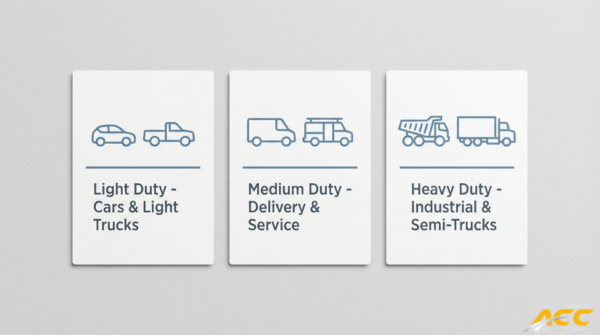
Traffic classifications that determine asphalt requirements fall into three categories: light-duty, medium-duty, and heavy-duty. Each classification defines expected vehicle types, axle loads, and repetition volumes that directly shape thickness and mix decisions.
How Are Light-Duty Traffic Loads Defined?
Light-duty traffic loads are defined as pavement applications exposed primarily to passenger cars, light pickups, and occasional delivery trucks. These surfaces experience the lowest cumulative axle stress. According to the Missouri Asphalt Pavement Association, light-duty pavements typically experience 120,000 ESALs or less, based on a traffic stream of 98 percent passenger vehicles and 2 percent single unit trucks.
Residential access roads, small retail parking lots, and church lots fall into this category. Because individual vehicle weights remain low, the pavement structure can be thinner without risking premature distress. For most commercial property managers, correctly identifying a surface as light-duty prevents unnecessary overbuilding costs.
How Are Medium-Duty Traffic Loads Defined?
Medium-duty traffic loads are defined by a regular mix of passenger vehicles, delivery vans, box trucks, and occasional single-unit trucks that generate moderate cumulative pavement stress. ESAL counts for medium-duty applications generally range from roughly 120,000 to 1 million over the design life.
Shopping centers, office park access drives, and apartment complex main routes commonly fall into this classification. The consistent presence of heavier single-unit vehicles accelerates wear beyond what light-duty designs can handle, requiring thicker asphalt layers and stiffer mix formulations. Overlooking the frequency of delivery and service traffic on these surfaces is one of the most common design mistakes in commercial paving.
How Are Heavy-Duty Traffic Loads Defined?
Heavy-duty traffic loads are defined by frequent semi-trucks, loaded trailers, heavy forklifts, and other vehicles that impose the highest axle stresses on pavement structures. ESAL counts typically exceed 1 million over the design period.
Industrial yards, loading docks, distribution warehouses, and truck terminals require this classification. The standard 18,000 lb equivalent single axle load, the benchmark used across U.S. pavement engineering, becomes the primary design reference at this level. Pavement failure under heavy-duty conditions is rarely gradual; without adequate structural depth, rutting and fatigue cracking can develop within the first few years of service.
Understanding where your project falls across these three tiers is the foundation for specifying the right asphalt thickness and mix design.
How Does Traffic Type Dictate Asphalt Thickness?
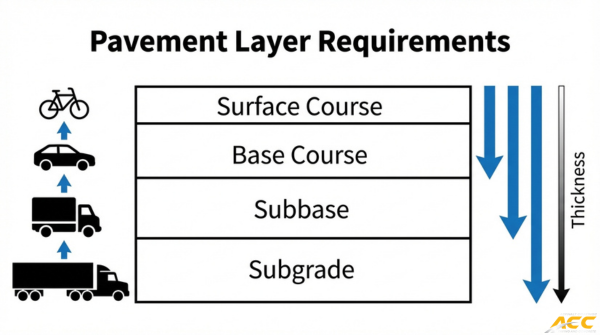
Traffic type dictates asphalt thickness by determining the structural depth needed to support expected wheel loads without premature failure. The following subsections break down thickness requirements for passenger vehicles, delivery zones, heavy trucks, and fire lanes.
How Thick Should Asphalt Be for Passenger Vehicle Parking Lots?
Asphalt for passenger vehicle parking lots should be 2 to 3 inches of hot-mix asphalt over a properly compacted aggregate base. These pavements handle the lightest structural demands of any commercial application.
According to the Missouri Asphalt Pavement Association (MAPA), light-duty pavements experience 120,000 ESALs or less, based on a traffic stream of 98 percent passenger vehicles and 2 percent single-unit trucks. That minimal truck percentage keeps cumulative load damage low, allowing thinner cross-sections.
Even at reduced thickness, subgrade compaction and drainage remain critical. Skipping proper base preparation on a “light-duty” lot is one of the most common mistakes property managers make; it invites premature cracking regardless of surface thickness.
How Thick Should Asphalt Be for Delivery and Service Vehicle Areas?
Asphalt for delivery and service vehicle areas should be 3 to 5 inches over a 6 to 8 inch compacted aggregate base. Box trucks, refuse haulers, and frequent service vehicles generate substantially higher ESALs than passenger cars, even when daily volume seems modest.
Concentrated turning movements at loading docks and dumpster pads intensify stress on the pavement surface. These zones benefit from a thicker intermediate lift that distributes loads before they reach the subgrade. For properties with daily delivery schedules, designing to the upper end of this range is a practical safeguard against early rutting and fatigue cracking.
How Thick Should Asphalt Be for Heavy Truck and Industrial Lanes?
Asphalt for heavy truck and industrial lanes should be 6 to 8 inches over an 8 to 10 inch base layer. Semi-trucks, loaded forklifts, and heavy equipment produce ESALs many times greater than passenger vehicles, demanding the thickest commercial pavement sections.
These specifications apply to industrial yards, loading docks, and distribution warehouse access roads where gross vehicle weights routinely exceed 80,000 pounds. Under-building at this level leads to rapid structural failure, making the upfront investment in proper thickness far less costly than early reconstruction.
How Thick Should Asphalt Be for Fire Lanes and Emergency Access?
Asphalt for fire lanes and emergency access should be a minimum of 4 to 6 inches over a well-compacted base, designed to support fully loaded fire apparatus weighing up to 75,000 pounds. Local fire codes typically govern minimum structural requirements for these lanes.
Because emergency vehicles impose heavy, infrequent loads on pavement that otherwise sees light daily traffic, fire lanes are often under-designed. The pavement must withstand concentrated axle weights from ladder trucks and pumpers without rutting, even after years of minimal use. Matching thickness to the heaviest anticipated apparatus, rather than average daily traffic, is the safest design approach for any commercial property.
How Does Traffic Type Influence Asphalt Mix Design Selection?
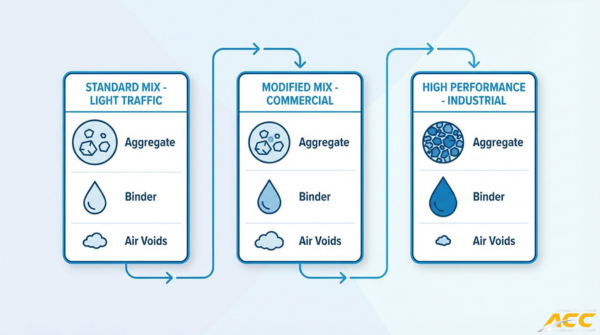
Traffic type influences asphalt mix design selection by determining the binder grade, aggregate structure, and compaction requirements needed to resist the specific loads a pavement will face. The following subsections cover mix recommendations for low-volume passenger, moderate commercial, and heavy industrial traffic.
What Mix Design Works Best for Low-Volume Passenger Traffic?
The mix design that works best for low-volume passenger traffic is a standard Superpave volumetric mix using a climate-appropriate Performance Grade binder. According to the Federal Highway Administration, Superpave volumetric mix design is an improved material selection process that applies to projects with design traffic up to 1 million ESALs. Since residential-style lots and low-traffic commercial areas rarely approach that threshold, a standard Superpave mix with moderate compaction effort handles these loads effectively.
For most passenger-only applications, a PG binder matched to local temperature extremes provides sufficient rut and crack resistance without the cost of premium polymer-modified formulations. Prioritizing correct binder grade over over-engineering the mix keeps budgets realistic for properties like small office parks or church lots.
What Mix Design Works Best for Moderate Commercial Traffic?
The mix design that works best for moderate commercial traffic is a Superpave mix with a stiffer binder grade and tighter aggregate gradation to resist the higher shear stresses from delivery trucks and service vehicles. Moderate commercial sites, such as shopping centers and distribution entrances, generate mixed traffic that accelerates rutting in the wheel paths if the mix lacks adequate internal friction.
Proper asphalt pavement design for commercial properties provides a return on investment through reduced long-term repair costs, improved property value, and a safer experience for customers, as noted by The Pavement Group. Selecting a polymer-modified binder one grade stiffer than climate alone would dictate is often the most cost-effective upgrade for these sites.
What Mix Design Works Best for Heavy Industrial Traffic?
The mix design that works best for heavy industrial traffic is a high-performance Superpave mix engineered with polymer-modified binder, angular coarse aggregates, and elevated compaction effort. Industrial yards, loading docks, and truck terminals subject pavement to concentrated axle loads that demand maximum rut resistance and shear strength.
Key mix characteristics for heavy industrial applications include:
- Polymer-modified PG binder bumped at least one high-temperature grade above the climate specification.
- Coarse, angular aggregates with high Los Angeles abrasion resistance to maintain internal friction under repeated heavy loads.
- Higher design gyration counts during Superpave compaction to simulate the extreme densification these pavements experience in service.
Matching mix stiffness to actual axle loads prevents the premature shoving and rutting that turn into expensive full-depth repairs.
What Role Does Aggregate Selection Play in Traffic-Based Design?
Aggregate selection plays a critical role in traffic-based design because the size, angularity, and gradation of aggregate particles directly determine how well an asphalt mix resists rutting, fatigue cracking, and deformation under repeated loads. The Superpave system, as described by Kansas State University’s Superpave Volumetric Mix Design and Analysis Handbook, uses a Performance Grade (PG) binder specification where binders are graded based on climate and traffic conditions, such as PG 64-22, with the first number representing the high pavement design temperature and the second representing the low pavement design temperature. This grading system works hand-in-hand with aggregate properties to ensure the complete mix performs under site-specific demands.
Traffic volume and vehicle weight dictate minimum aggregate requirements:
- Low-volume passenger areas use rounded or semi-angular aggregates with standard gradation, since lighter loads generate minimal shear stress at the pavement surface.
- Moderate commercial zones require more angular, crushed stone aggregates that interlock under load, resisting the lateral shoving caused by turning delivery trucks and service vehicles.
- Heavy industrial lanes demand fully crushed, high-angularity aggregates with tight gradation control to maintain stone-on-stone contact, preventing permanent deformation under sustained heavy axle loads.
Coarser aggregate gradations generally suit heavy-traffic applications because larger particles distribute load across a wider contact area. Finer gradations, while producing smoother surfaces for lighter traffic, lack the structural skeleton needed where trucks brake, accelerate, or turn repeatedly. Selecting the wrong aggregate blend for the anticipated traffic is one of the most common design oversights, and it often leads to premature rutting that no binder upgrade alone can fix.
Understanding how aggregates interact with traffic loads provides the foundation for specifying subgrade and base layers that must support the entire pavement structure.
How Do Subgrade and Base Layers Change with Traffic Demands?
Subgrade and base layers change with traffic demands by requiring progressively stronger materials, deeper compaction, and thicker aggregate bases as axle loads increase. Light traffic needs basic compaction and moderate base depth, while heavy traffic demands stabilized subgrades and substantially thicker base courses.
What Subgrade Preparation Does Light Traffic Require?
Light traffic subgrade preparation requires standard compaction of native soils to achieve adequate bearing capacity, typically with a moderate-depth aggregate base. For passenger car parking lots and low-volume access roads, the existing soil often needs only proof-rolling, moisture conditioning, and compaction to a uniform density. A 4 to 6 inch granular base course is generally sufficient when the native soil provides reasonable support. Soils with a California Bearing Ratio above 10 can typically support light-duty pavements without chemical stabilization or imported fill. Proper grading to ensure drainage remains essential even for these lighter applications, since trapped moisture weakens any subgrade over time.
What Subgrade Preparation Does Heavy Traffic Require?
Heavy traffic subgrade preparation requires engineered stabilization, thicker aggregate base layers, and rigorous compaction standards to prevent structural failure under repeated high axle loads. According to Iowa State University’s Design Guide for Improved Quality of Roadway Subgrades and Subbases, if a subgrade has a CBR value less than 10, the subbase material will deflect under traffic loadings in the same manner as the subgrade, causing pavement deterioration. Industrial lanes, loading docks, and truck corridors typically need:
- Lime or cement stabilization of weak native soils to raise bearing capacity.
- Aggregate base layers of 8 to 12 inches, depending on soil conditions and expected ESALs.
- Geotextile separation fabrics to prevent fine soil migration into the base course.
- Thorough proof-rolling to identify and correct soft spots before paving.
Investing in proper heavy-traffic subgrade work is one of the most cost-effective decisions a property owner can make; base failures are far more expensive to fix than to prevent. With subgrade strength matched to traffic demands, the pavement structure above can perform as designed over its full service life.
How Does Traffic Speed Affect Asphalt Mix Performance?
Traffic speed affects asphalt mix performance by changing how long each wheel load applies stress to the pavement surface. Slow-moving or stationary vehicles concentrate force over extended periods, increasing the risk of permanent deformation, while fast-moving traffic distributes loads more briefly across the surface.
At low speeds, such as those in parking lots, drive-throughs, and intersection approaches, asphalt experiences sustained loading that allows the binder to deform viscously. This prolonged contact generates rutting and shoving, particularly during high temperatures when the binder softens. Stiffer binder grades and higher-stability mix designs resist this sustained stress more effectively than standard highway mixes.
High-speed corridors present the opposite challenge. Rapid, repeated loading cycles demand mixes with strong fatigue resistance and elastic recovery. The pavement must flex under each load and return to its original shape millions of times without cracking. Polymer-modified binders and well-graded aggregate structures help maintain this resilience under continuous high-speed traffic.
The practical implication for commercial properties is significant. A shopping center entrance where vehicles idle and creep requires a fundamentally different mix than a highway on-ramp where traffic accelerates past 55 mph. Specifying the same mix for both scenarios invites premature failure in one or both locations. Matching binder stiffness and aggregate interlock to the actual operating speed of each pavement zone is one of the most overlooked factors in commercial asphalt design, yet it directly determines whether rutting or fatigue cracking appears first.
With speed-related design factors addressed, turning movements and stopping zones introduce additional forces that further shape pavement requirements.
How Do Turning Movements and Stopping Zones Change Design Needs?
Turning movements and stopping zones change design needs by concentrating mechanical stress in localized areas, requiring stiffer mix designs and reinforced pavement sections. These forces differ fundamentally from straight-line rolling traffic and demand targeted engineering responses.
At intersections, drive-through lanes, loading docks, and parking lot turn aisles, vehicles apply horizontal shear forces to the pavement surface during braking, acceleration, and tight turns. Unlike highway segments where tires roll forward at consistent speeds, these zones experience slow-moving or stationary loads that allow heat to build and asphalt binder to deform under sustained pressure.
Pavement engineers address these conditions through several design modifications:
- Stiffer binder grades resist softening under prolonged contact, reducing rut depth in areas where vehicles idle or creep through turns.
- Higher-stability mix designs with angular, crushed aggregates interlock more effectively to resist the lateral shoving forces that rounded or natural aggregates cannot withstand.
- Increased asphalt thickness in turning radii and stop-and-go zones compensates for the amplified stress compared to free-flowing travel lanes.
- Polymer-modified binders improve elasticity and high-temperature performance, particularly where buses, delivery trucks, or waste haulers repeatedly brake and accelerate.
Rutting and shoving are the most common failures in these areas. When a standard highway-grade mix is placed at an intersection or loading dock approach, the pavement often develops depressions in wheel paths and lateral displacement at stop bars within just a few seasons. For commercial properties with frequent truck deliveries, this accelerated damage compounds maintenance costs significantly. Properties with concentrated waste hauler and delivery activity on dumpster pads and fire lanes experience these failures even sooner, making it critical to understand why these zones deteriorate faster.
Designing for turning movements and stopping zones separately from mainline pavement sections is one of the most effective ways to extend overall pavement life. Treating an entire parking lot or roadway as a single uniform design overlooks the reality that stress varies dramatically across different zones.
Understanding how localized stress concentrations affect pavement integrity helps clarify what happens when overall thickness or mix design fails to match actual traffic demands.
What Happens When Asphalt Thickness or Mix Design Is Wrong?
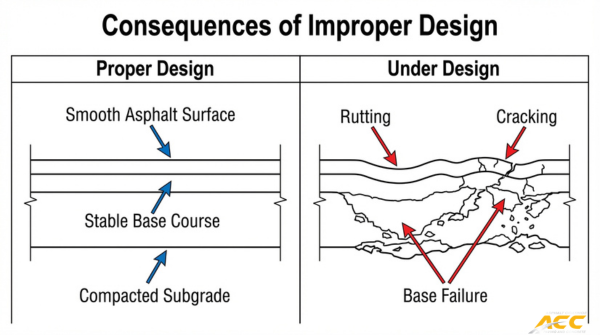
Incorrect asphalt thickness or mix design leads to premature pavement failure, costly repairs, and unsafe surfaces. The consequences depend on whether the pavement section is under-designed or built with the wrong mix formulation.
What Failures Occur from Under-Designed Pavement Sections?
Failures from under-designed pavement sections include early-onset cracking, rutting, base failure, and accelerated structural deterioration. When asphalt thickness falls short of what traffic loads demand, the pavement cannot distribute wheel forces adequately, and stress concentrates in the base and subgrade layers.
Common failure modes include:
- Fatigue cracking (alligator cracking) from repeated load cycles the thin section cannot absorb.
- Rutting and depressions in wheel paths where insufficient depth allows permanent deformation.
- Subgrade pumping, where moisture migrates upward through a compromised base under heavy loads.
- Potholes that form as surface cracks allow water infiltration and freeze-thaw damage.
According to a projection published in MDPI’s Sustainability Journal, the United States needs an annual expenditure of $101 billion from 2008 to 2028 to sustain highways; failure to meet this investment leads to significant pavement deterioration and compounding costs. Managing these risks locally, professional commercial crack sealing services provide a targeted solution that halts water intrusion and prevents small surface cracks from developing into structural failures. Under-designed sections accelerate this cycle because they require full reconstruction rather than simple overlays, often doubling or tripling the original project cost.
What Failures Occur from Mismatched Mix Design?
Failures from mismatched mix design occur when the asphalt mixture’s binder grade, aggregate gradation, or volumetric properties do not align with the actual traffic loading conditions. A mix designed for light passenger vehicles will deform under heavy truck axles, while an overly stiff mix in a low-traffic area can crack from thermal stress rather than traffic.
Specific consequences include:
- Shoving and corrugation at intersections where a soft binder cannot resist slow, heavy loads.
- Thermal cracking in mixes that are too rigid for the climate and traffic speed combination.
- Stripping, where poor aggregate-binder adhesion causes the mix to disintegrate under repeated wheel passes.
The 18,000 lb (80 kN) equivalent single axle load, known as the ESAL, converts damage from various wheel loads into a standard measure, according to Pavement Interactive. When mix designers ignore ESAL projections, the resulting pavement lacks the internal structure to resist the actual forces applied to it. Matching mix properties to real traffic data is one of the most cost-effective decisions in any paving project.
With failure consequences clearly defined, understanding how to assess current and future traffic prevents these outcomes from the start.
How Do Freeze-Thaw Cycles Compound Traffic Stress on Asphalt?
Freeze-thaw cycles compound traffic stress on asphalt by accelerating crack propagation and weakening the pavement structure from within. Water infiltrates small surface cracks, freezes and expands, then thaws and leaves voids. Repeated traffic loads force more water into these enlarged openings, and each subsequent freeze cycle widens the damage further.
This cycle creates a compounding effect. Cracks that would remain stable under traffic alone grow rapidly when freeze-thaw action is present. Potholes form as the base loses support beneath fractured surface layers, and rutting intensifies where heavy axle loads push weakened asphalt into subsurface voids.
Pavement designed without accounting for this interaction fails prematurely. Key factors that worsen the damage include:
- Inadequate binder grade: A binder that lacks low-temperature flexibility cracks more readily during freezing, giving water additional entry points.
- Insufficient thickness: Thin pavement sections transfer more stress to moisture-saturated base layers, accelerating structural failure.
- Poor drainage: Standing water increases the volume of moisture available for freeze expansion within the pavement structure.
- High truck traffic: Heavy axle loads pump water deeper into cracks through hydraulic pressure, feeding the freeze-thaw mechanism.
The Superpave Performance Grade (PG) binder system addresses this directly. According to Kansas State University’s Superpave handbook, PG binders are graded by climate and traffic conditions; the low-temperature number (such as the -22 in PG 64-22) indicates the minimum pavement design temperature the binder can withstand without cracking.
For regions with severe winters, selecting a binder with the correct low-temperature grade is as critical as designing for traffic volume. Pairing climate-appropriate binder selection with adequate structural thickness gives pavement the resilience to handle both forces simultaneously. Understanding how traffic assessment shapes the full design process ensures these environmental factors are addressed from the start.
How Do You Assess Current and Future Traffic for a Paving Project?
You assess current and future traffic for a paving project by combining vehicle counts, axle load data, and growth projections to calculate the total load your pavement must support over its design life. According to the Federal Highway Administration, Weigh-in-Motion (WIM) systems collect axle load spectra and vehicle classification data that are more accurate than simple traffic counts, making them a critical tool for pavement design inputs.
Beyond raw counts, effective assessment requires categorizing vehicles by class, estimating daily and seasonal volume fluctuations, and projecting how traffic patterns may shift over a 20-year horizon. Planned developments, zoning changes, and tenant mix all influence future demand. For commercial properties, underestimating growth often leads to premature pavement failure and costly reconstruction that far exceeds the price of designing for heavier loads upfront. Factoring in both present conditions and anticipated changes produces an accurate ESAL calculation, which directly determines the thickness and mix design your project requires.
How Should You Approach Traffic-Based Asphalt Design for Commercial Properties?
You should approach traffic-based asphalt design for commercial properties by matching pavement thickness, mix selection, and subgrade preparation to actual vehicle loads. The following sections cover how professional expertise ensures the right design and the key takeaways from this guide.
Can Commercial Asphalt Paving Expertise Help Match Thickness and Mix to Your Traffic?
Yes, commercial asphalt paving expertise can help match thickness and mix to your traffic by combining site-specific load analysis with proven design standards. Professionals assess vehicle classifications, turning patterns, and anticipated ESALs before recommending a pavement structure. This process eliminates guesswork that leads to under-built or over-engineered sections.
Asphalt Coatings Company brings 39 years of Colorado-focused commercial paving experience to this process. Asphalt Coatings Company provides subgrade preparation, mix specification, and full-depth installation with in-house crews, ensuring every layer aligns with your property’s actual traffic demands. According to The Pavement Group, proper asphalt pavement design for commercial properties provides a return on investment through reduced long-term repair costs, improved property value, and a safer experience for customers.
For property managers handling everything from passenger car parking to heavy truck loading docks, partnering with a contractor who understands traffic-based design principles is one of the most cost-effective decisions available.
What Are the Key Takeaways About How Traffic Type Dictates Asphalt Thickness and Mix Design?
The key takeaways about how traffic type dictates asphalt thickness and mix design center on three principles: heavier loads require thicker sections, mix design must match anticipated stress, and subgrade quality underpins everything above it.
- Light-duty areas serving mostly passenger vehicles need less asphalt depth, while heavy-duty zones handling semi-trucks and forklifts demand 6 to 8 inches of asphalt over a substantial base.
- Mix selection through systems like Superpave ties binder grade and aggregate structure directly to traffic volume and climate conditions.
- Subgrade soils with low bearing capacity will cause premature failure regardless of surface thickness.
- Accurate traffic assessment using tools like ESAL calculations and Weigh-in-Motion data prevents both under-design and unnecessary spending.
Every commercial paving decision flows from understanding what vehicles will use the surface, how often, and under what conditions. Getting this analysis right at the start protects pavement longevity and delivers measurable returns.