Phased parking lot repaving is a project management approach that divides a commercial lot into sequential work zones, allowing each section to be paved while the rest stays open for customers, tenants, and daily traffic.
This guide covers phased planning and seasonal scheduling, communication and parking management during construction, paving methods and project timelines, cost expectations, and long-term quality assurance.
Phased planning starts with dividing the lot by pavement condition, traffic patterns, and natural boundaries like drive aisles and building entries. Sequencing each phase so at least one entrance and exit lane remains open at all times keeps traffic flowing safely throughout the project. In Colorado, scheduling phases during spring or early summer locks in the stable temperatures hot mix asphalt needs for proper compaction.
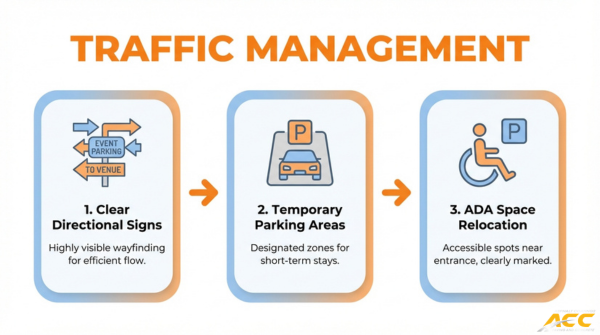
Clear communication separates smooth projects from chaotic ones. Pre-project notices with phased timelines go to tenants weeks in advance, while daily visitors rely on high-contrast directional signage and barricades placed at every decision point. ADA-accessible spaces must be relocated to fully compliant temporary locations during each phase.
Paving method selection directly controls how much disruption each phase creates. Mill-and-overlay resurfaces existing pavement without excavation, often reopening sections the same day. Infrared repair handles isolated damage in minutes. Night or weekend scheduling shifts all heavy work outside business hours entirely.
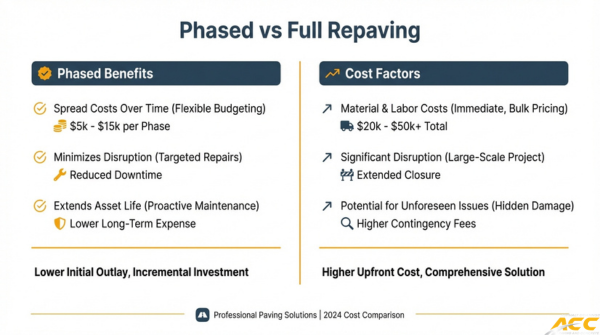
Phased projects cost slightly more than single-mobilization work due to repeated crew setup, but they eliminate the revenue loss a full shutdown creates. Proper subgrade preparation, tight longitudinal joint construction, and a unified sealcoat application after the final phase ensure all sections perform as one continuous surface for years.
Why Is Phased Parking Lot Repaving Essential for Commercial Properties?
Phased parking lot repaving is essential for commercial properties because it allows full asphalt rehabilitation without closing the business to customers, tenants, or daily traffic. Rather than shutting down an entire lot for weeks, a phased approach divides the project into manageable sections completed sequentially. This keeps parking available, maintains revenue flow, and reduces the operational disruption that property managers consistently rank among their top concerns.
Commercial paving projects demand careful coordination between contractor crews, tenant schedules, and traffic patterns. For properties like shopping centers, office parks, and healthcare facilities, even a single day of full closure can translate into measurable revenue loss and tenant frustration. Phased repaving solves this by treating each section as an independent work zone while the rest of the lot remains functional.
The scale of this challenge is significant. According to Mordor Intelligence, the asphalt pavers market is valued at USD 3.23 billion as of 2026, reflecting the widespread demand for services like asphalt resurfacing, parking lot rehabilitation, and commercial paving across the industry. With that level of investment flowing into pavement infrastructure, the expectation for minimal business disruption during construction has never been higher.
For most commercial property managers, phased repaving is not just a convenience; it is the only realistic option. A full shutdown rarely aligns with lease obligations, customer expectations, or the operational realities of a busy commercial site. Structuring the project in phases puts control back in the property manager’s hands, allowing each stage to be scheduled around peak hours, seasonal demand, and tenant needs.
The sections ahead break down exactly how to plan, schedule, communicate, and execute a phased repaving project, covering everything from section sequencing and traffic management to paving methods and cost considerations.
What Does a Phased Parking Lot Repaving Plan Look Like?
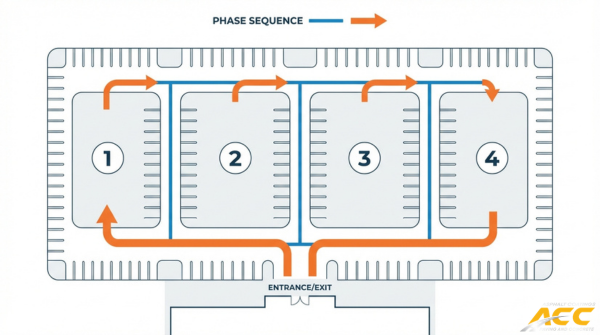
A phased parking lot repaving plan divides the project into sequential sections, allowing each zone to be paved while the rest of the lot stays open. The key components include section division, phase sequencing, and advance scheduling.
How Do You Divide a Parking Lot Into Workable Sections?
You divide a parking lot into workable sections by assessing lot layout, traffic patterns, and structural condition. The most common approach groups areas by similar pavement distress levels so crews can apply consistent repair methods within each zone. Key factors for section division include:
- Natural boundaries such as drive aisles, medians, and building entries.
- Pavement condition severity, grouping the worst areas into early phases.
- Proximity to tenant entrances and high-traffic customer zones.
- Utility access points that may require coordination with underground infrastructure.
Each section should be large enough for efficient paving equipment operation but small enough to keep the majority of parking spaces available throughout construction.
How Do You Sequence Phases to Maintain Traffic Flow?
You sequence phases to maintain traffic flow by prioritizing sections that allow continuous access to entrances, exits, and major drive lanes. According to research published by the IEOM Society International, dividing a work site into phased segments minimized construction’s effect on facility occupants; at least one entrance and exit lane remained open at all times, marked with posted signs and directional arrows to reduce confusion.
Effective sequencing follows a practical order:
- Start with sections farthest from primary building entrances.
- Alternate between opposite sides of the lot to balance available parking.
- Complete high-visibility areas during off-peak hours or weekends when possible.
This staggered approach keeps customers and tenants moving safely while each phase progresses.
How Far in Advance Should You Plan Each Phase?
You should plan each phase at least 30 to 60 days in advance, though complex properties benefit from 90-day lead times. Early planning allows time to coordinate contractor scheduling, secure materials, notify tenants, and arrange temporary parking solutions. Critical advance-planning steps include:
- Conducting a pavement assessment to prioritize which sections need immediate attention.
- Aligning the project calendar with seasonal paving windows and business cycles.
- Building contingency days into each phase for weather delays or unexpected subgrade issues.
For properties with multiple tenants or high daily traffic, longer planning horizons reduce last-minute disruptions. Proactive scheduling ultimately determines whether a phased project runs smoothly or creates avoidable conflicts.
With a clear phased plan established, choosing the right season to begin becomes the next critical decision.
When Is the Best Time to Schedule a Parking Lot Repaving Project?
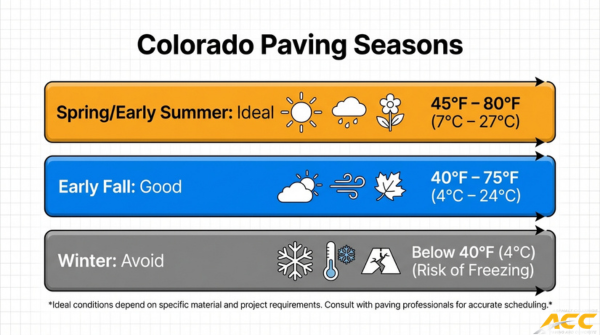
The best time to schedule a parking lot repaving project is during warm, stable weather when asphalt can be placed and compacted properly. Spring, early summer, and early fall offer the strongest paving windows in Colorado.
What Makes Spring or Early Summer Ideal for Repaving in Colorado?
Spring or early summer is ideal for repaving in Colorado because rising temperatures consistently meet the minimum thresholds hot mix asphalt requires for proper compaction and bonding. According to the Colorado Department of Transportation’s 2023 specifications, hot mix asphalt must be placed only when both air and surface temperatures meet minimum requirements, starting at 60°F for thin surface lifts and 45°F for layers three inches or thicker. Colorado’s Front Range reliably reaches these temperatures by mid-April through June, giving contractors long, predictable workdays. This season also precedes the intense afternoon thunderstorms common in July and August, reducing weather-related delays. For commercial property managers planning phased work, scheduling the first phase in spring maximizes the number of usable weeks before monsoon season compresses timelines.
How Do Fall Weather Windows Affect Repaving Timelines?
Fall weather windows affect repaving timelines by compressing available workdays as temperatures decline and daylight shortens. September and early October typically offer surface temperatures above CDOT’s minimum placement thresholds, but the margin narrows each week. Crews must start earlier in the morning and often finish before late-afternoon temperature drops, which shortens daily production. Early snowfall, common along Colorado’s Front Range by late October, can halt a phase mid-schedule. For phased projects, this means fewer contingency days if weather causes delays. Property managers who begin in fall should build buffer time into each phase and prioritize critical sections first, so unexpected early-season freezes do not leave high-traffic areas incomplete.
Why Should You Avoid Scheduling Repaving During Peak Freeze-Thaw Months?
You should avoid scheduling repaving during peak freeze-thaw months because asphalt placed in fluctuating temperatures fails to compact and cure correctly. In Colorado, November through March brings daily temperature swings that repeatedly freeze and thaw moisture within freshly laid pavement, weakening the bond between layers. This leads to premature cracking and raveling within the first season. Understanding how freeze-thaw cycles cause premature cracking and raveling is key to preventing potholes before they form.
Beyond material performance, resurfacing costs averaging $2 to $7 per square foot, as reported by the American Society of Professional Estimators, represent a significant investment that poor winter placement can waste entirely. Crews also face safety risks on frozen subgrades. Scheduling phased repaving outside these months protects both the pavement’s longevity and the project budget.
With seasonal timing established, clear communication keeps tenants and customers informed as each phase begins.
How Do You Keep Customers and Tenants Informed During Repaving?
You keep customers and tenants informed during repaving by combining advance written notices, on-site signage, and tailored notification timelines for different stakeholder groups. The following subsections cover pre-project communication plans, active wayfinding signage, and notification timing.
What Should a Pre-Project Communication Plan Include?
A pre-project communication plan should include a written timeline, key contact information, and clear descriptions of how each phase will affect parking and access. Property managers should distribute notices at least two to three weeks before work begins, specifying which sections close on which dates.
Essential elements of an effective plan:
- Phased schedule with start and end dates for each section.
- Alternate parking locations and rerouted entry points.
- A single point of contact for questions or concerns.
- Updates via email, posted flyers, and digital channels as phases progress.
Setting expectations early prevents confusion once equipment arrives on site, and in my experience, properties that issue even one detailed advance notice see far fewer tenant complaints than those that rely on day-of announcements.
How Do You Use Signage and Wayfinding During Active Paving?
You use signage and wayfinding during active paving by placing high-visibility markers, directional arrows, and barricades that guide drivers and pedestrians around closed sections. According to the U.S. Access Board, effective signage for parking facilities must include high-contrast lettering and standardized symbols to ensure clear visibility for all users, including those with visual impairments.
Key signage practices include:
- Placing directional arrows at every decision point where drivers choose a path.
- Using bright, reflective barricades to separate work zones from open traffic lanes.
- Posting temporary ADA-compliant signs near relocated accessible spaces.
- Updating sign placement daily as phases shift to new sections.
Consistent wayfinding reduces driver hesitation and keeps traffic flowing safely through operational areas of the lot.
When Should You Notify Tenants Versus Daily Visitors?
You should notify tenants weeks in advance and daily visitors at the point of arrival. Tenants need early, detailed communication because repaving directly affects their operations, lease obligations, and employee parking. Daily visitors, by contrast, respond best to clear on-site signage encountered as they enter the property.
Recommended notification timing:
- Tenants receive written notice two to three weeks before their section is affected.
- Follow-up reminders go to tenants 48 hours before each phase begins.
- Daily visitors rely on entrance signage, cones, and flaggers placed on the day of active work.
Tailoring the notification method to each audience ensures tenants can plan ahead while visitors navigate smoothly. With communication strategies in place, managing actual parking availability becomes the next priority.
How Do You Manage Parking Availability While Sections Are Being Paved?
You manage parking availability during paving by rerouting traffic to open sections, arranging temporary overflow parking, and relocating ADA-accessible spaces to compliant locations. The approach varies by property type.
How Can You Reroute Traffic to Open Sections Safely?
You can reroute traffic to open sections safely by maintaining at least one entrance and exit lane at all times, marked with posted signs and directional arrows. A 2023 IEOM Society International case study found that dividing the work site into phases and keeping clearly marked lanes open minimized confusion and maintained steady traffic flow for facility occupants.
Temporary barricades, cones, and flaggers at transition points keep vehicles separated from active paving zones. Rerouting works best when the phased layout creates a logical one-way loop, so drivers intuitively follow the path without second-guessing.
What Temporary Parking Arrangements Work for Retail Properties?
Temporary parking arrangements that work for retail properties include:
- Designating overflow lots on adjacent gravel or grass areas with temporary gravel surfaces.
- Partnering with neighboring businesses to share underused parking during off-peak hours.
- Scheduling paving phases during low-traffic weekday mornings to reduce the number of displaced spaces.
- Placing clear wayfinding signage at every turn so customers reach open sections without frustration.
Retail properties depend on foot traffic, so the goal is keeping the closest available spaces within a short, well-lit walk of main entrances. Even a brief period of customer confusion can cost sales, making visible signage non-negotiable.
What Temporary Parking Arrangements Work for Office Parks?
Temporary parking arrangements that work for office parks include assigning employees to designated open sections on a rotating schedule aligned with each paving phase. Unlike retail sites, office parks benefit from predictable daily headcounts.
Effective strategies for office park properties are:
- Issuing phase-specific parking maps to tenants before each stage begins.
- Staggering shift arrival times so displaced sections absorb demand gradually.
- Reserving visitor parking nearest building entrances while routing employees to secondary lots.
Office tenants tolerate longer walks more readily than retail customers, so relocating employee parking farther from buildings is a practical trade-off that keeps visitor access convenient.
How Do You Handle ADA-Accessible Parking During Construction?
You handle ADA-accessible parking during construction by relocating compliant spaces to a temporary location that meets federal dimensional and slope standards. According to the U.S. Department of Justice, car-accessible spaces must be at least 96 inches wide with a 60-inch access aisle and no more than a 2.08% slope in all directions.
These requirements apply to temporary spaces just as strictly as permanent ones. Place relocated ADA spaces on the shortest accessible route to building entrances, and install temporary signage with the International Symbol of Accessibility. Failing to maintain compliant accessible parking at every phase exposes the property to ADA violations, regardless of construction status.
With parking logistics addressed, the next step is choosing paving methods that minimize operational disruption.
What Paving Methods Minimize Disruption to Daily Operations?
Paving methods that minimize disruption to daily operations include mill-and-overlay, infrared asphalt repair, and off-hours scheduling. Each approach targets a different scenario while keeping businesses accessible.
How Does Mill-and-Overlay Reduce Downtime Compared to Full-Depth Removal?
Mill-and-overlay reduces downtime compared to full-depth removal by resurfacing the existing pavement rather than excavating and rebuilding the entire structure. The process mills the damaged top layer, then applies fresh hot mix asphalt directly over the prepared surface.
According to the National Asphalt Pavement Association, milling and overlay projects are completed faster than full-depth reconstruction, minimizing labor costs and reducing downtime, a crucial factor for businesses that must remain open. Because the subbase stays intact, each section can often be reopened the same day. For commercial properties where every hour of closure costs revenue, this speed advantage makes mill-and-overlay the most practical choice for surface-level deterioration.
Can Infrared Asphalt Repair Address Localized Damage Faster?
Yes, infrared asphalt repair can address localized damage faster than conventional methods. This technique uses infrared heating panels to soften the existing asphalt in a targeted area, allowing crews to rake, add new material, and recompact without cutting or removing large sections.
The result is a seamless, thermally bonded patch that blends with the surrounding pavement. Because the repair zone is typically small, often just a few square feet, adjacent parking spaces remain open throughout the process. Infrared repair works especially well for potholes, utility cuts, and isolated cracks that do not warrant resurfacing an entire section. When damage is scattered rather than widespread, this method keeps disruption contained to the specific problem spots.
How Does Night or Weekend Paving Keep Business Hours Unaffected?
Night or weekend paving keeps business hours unaffected by shifting all heavy equipment operation, milling, and asphalt placement to times when the property has little or no traffic. Crews mobilize after closing time or on weekend mornings, complete a defined section, and allow adequate cure time before the next business day.
This approach is particularly effective for retail centers and office parks where daytime access is non-negotiable. Coordination with the paving contractor on crew availability, noise ordinances, and lighting requirements is essential for smooth execution. Off-hours scheduling pairs well with phased plans, ensuring each completed section is fully cured and striped before customers arrive.
With the right paving method selected, project timelines become the next factor to plan around.
How Long Does Each Phase of a Commercial Repaving Project Take?
Each phase of a commercial repaving project takes anywhere from one to two days for small retail lots up to several weeks for large shopping centers. Phase duration depends on lot size, paving method, and site conditions.
How Long Does a Small Retail Lot Phase Typically Take?
A small retail lot phase typically takes one to two days per section. Mill-and-overlay work on lots under 20,000 square feet can often be completed within a single extended work shift, with curing time adding a few additional hours before the area reopens to traffic. Full-depth removal on the same footprint may extend a phase to two or three days. For properties managers scheduling around business operations, these compressed timelines make phased repaving practical even for high-traffic retail locations.
How Long Does a Large Shopping Center Phase Typically Take?
A large shopping center phase typically takes one to three weeks per section, depending on the scope. Shopping centers with 100,000 square feet or more of pavement require longer mobilization, heavier equipment staging, and more complex traffic rerouting between active storefronts. According to the American Society of Professional Estimators, asphalt parking lot resurfacing ranges from $2 to $7 per square foot, with larger projects often costing less per unit area due to economies of scale. That cost efficiency means contractors can deploy bigger crews on expansive lots, which helps offset the longer per-phase timeline. Scheduling these phases during off-peak retail periods further compresses active disruption.
What Factors Can Delay a Scheduled Paving Phase?
The factors that can delay a scheduled paving phase include:
- Weather interruptions: Rain, freezing temperatures, or sudden cold fronts halt asphalt placement because hot mix requires minimum surface temperatures for proper compaction.
- Subgrade issues: Soft spots, hidden utilities, or poor drainage discovered during milling can force unplanned subbase repairs.
- Supply chain disruptions: Delayed delivery of hot mix asphalt or materials shortages extend the project timeline.
- Permit and inspection holds: Municipal approval delays or failed inspections require rework before the next phase begins.
- Tenant or traffic conflicts: Last-minute changes to business schedules or delivery windows may force phase rescheduling.
Proactive site assessments and flexible scheduling buffers help minimize these risks. With cost and timeline expectations set, the next step is understanding what phased repaving costs look like in practice.
What Should You Expect for Costs When Repaving in Phases?
You should expect phased repaving to cost slightly more overall than a single continuous project, though it preserves revenue by keeping your business open throughout construction. Key cost factors include project scale, method selection, and mobilization frequency.
Asphalt parking lot resurfacing costs range from $2 to $7 per square foot, according to the American Society of Professional Estimators. Larger projects typically fall toward the lower end of that range because economies of scale reduce the per-unit price. Phased projects, by contrast, often lose some of that efficiency since crews mobilize and demobilize multiple times rather than once.
Several factors influence the total cost of a phased approach:
- Mobilization charges per phase: Each time a crew returns to your site, equipment transport and setup costs recur.
- Project square footage: Smaller phases mean higher per-square-foot rates compared to completing the same area in one mobilization.
- Paving method selected: Mill-and-overlay is less expensive per phase than full-depth removal, and it completes faster.
- Subgrade condition: Sections with poor drainage or base failure require additional preparation that increases individual phase costs.
- Seasonal timing: Scheduling during Colorado’s peak paving season can affect crew availability and pricing.
The trade-off is straightforward. Phased repaving adds modest mobilization and joint-construction costs, but it eliminates the revenue loss a full shutdown creates. For most commercial properties, lost daily revenue during a complete closure far exceeds the incremental expense of splitting work into phases. This makes phased paving strategies for multi-tenant properties one of the most financially sound strategies for managers who need to protect tenant relationships and customer access while investing in long-term pavement performance.
With cost expectations established, maintaining quality across those separate phases ensures the investment delivers its full lifespan.
How Do You Ensure Quality and Longevity on a Phased Repaving Job?
You ensure quality and longevity on a phased repaving job by focusing on subgrade preparation, joint construction, and post-paving protection. These three factors determine whether phased sections perform as a unified surface.
Why Does Proper Subgrade Preparation Matter Between Phases?
Proper subgrade preparation matters between phases because each section’s structural integrity depends on the base beneath it. When phases are completed weeks or months apart, the exposed subgrade in upcoming sections faces moisture infiltration, erosion, and soil shifting. Compacting and grading the subgrade immediately before each phase ensures uniform load-bearing capacity across the entire lot. Skipping this step creates weak zones where new asphalt meets previously paved sections, leading to premature cracking and settling. For commercial properties with heavy truck traffic, even minor inconsistencies in base density compound over time, making thorough preparation between phases non-negotiable.
How Do You Create Seamless Joints Between Phased Sections?
You create seamless joints between phased sections by using proper longitudinal joint construction techniques during each paving stage. According to Pavement Interactive, improperly constructed longitudinal joints can cause premature deterioration of multilane HMA pavements in the form of cracking and raveling. Achieving tight, well-compacted joints requires overlapping the hot mat slightly onto the previously cooled section, then rolling the joint while the material is still workable. Notched wedge joints and echelon paving are two proven methods that improve density at the seam. Because phased projects inherently create more joints than single-stage paving, each transition point demands extra attention during compaction to match the density of the surrounding mat. Coordinating the final sealcoat application across all phases ensures that every joint and transition point receives uniform protection against water and UV damage.
What Role Does Sealcoating Play After Repaving Is Complete?
Sealcoating plays a protective role after repaving is complete by sealing the asphalt surface against UV degradation, water penetration, and chemical exposure from oil and fuel. Fresh asphalt is most vulnerable during its first few years, and a properly timed sealcoating protects commercial parking lots by locking in flexibility while preventing oxidation. For phased projects, sealcoating the entire lot after the final phase unifies the appearance of sections paved at different times, eliminating visible color differences. This also seals every joint and transition point created during the phased process. Most commercial properties benefit from reapplying sealcoat every two to three years, extending the pavement’s functional lifespan well beyond a decade.
With quality construction practices established, the right paving contractor makes phased execution seamless.
How Does a Commercial Paving Contractor Help You Stay Open During Repaving?
A commercial paving contractor helps you stay open during repaving by coordinating phased schedules, managing traffic flow, and deploying experienced crews that understand operational continuity. The sections below cover in-house crew management and key takeaways for keeping your business running.
Can Asphalt Coatings Company’s In-House Crews Manage Phased Repaving for Your Property?
Yes, Asphalt Coatings Company’s in-house crews can manage phased repaving for your property. Because Asphalt Coatings Company employs its own paving, milling, sealcoating, and striping teams rather than relying on subcontractors, every phase stays under unified project management. This single-source structure eliminates scheduling gaps between trades and keeps each section on deadline.
According to a 2023 study published in Emerald Facilities, property managers weigh ROI at 0.3309 and maintenance at 0.2768 when evaluating project priorities. Asphalt Coatings Company aligns with both concerns by phasing work to protect daily revenue while maintaining pavement integrity across Colorado’s Front Range.
What Are the Key Takeaways About Repaving a Parking Lot Without Shutting Down Your Business?
The key takeaways about repaving a parking lot without shutting down your business center on proactive planning, phased execution, and clear communication. The most actionable lessons from this guide include:
- Divide the lot into manageable sections so at least one entrance and exit remain open at all times.
- Schedule repaving during optimal weather windows, following Colorado Department of Transportation temperature specifications for hot mix asphalt placement.
- Communicate timelines to tenants and daily visitors through high-contrast signage and advance notices.
- Choose methods like mill-and-overlay for faster completion in high-traffic zones.
- Maintain ADA-accessible parking throughout every construction phase.
- Partner with a contractor whose in-house crews control scheduling without subcontractor delays.
Phased repaving protects both revenue and pavement longevity when the right contractor manages the process from start to finish.