Phased asphalt paving is a construction approach that divides a multi-tenant parking lot into sequenced work zones, resurfacing one section at a time so the property stays operational throughout the project.
This guide covers pre-construction evaluation, property-specific phase design, seasonal scheduling, tenant access and communication, phase transition quality, cost structure, and long-term maintenance planning.
Successful phased projects start with three pre-construction evaluations: pavement condition assessments that identify which zones need immediate work, tenant lease language that defines access guarantees and allowable disruption windows, and traffic pattern analysis that shapes phase boundaries around peak circulation routes.
Phase design varies by property type. Shopping centers work outward from low-traffic perimeter zones toward anchor storefronts, office parks segment by building cluster and occupancy schedule, industrial complexes separate heavy-load dock areas from employee parking, and mixed-use sites layer retail, office, and residential schedules to avoid overlapping disruptions.
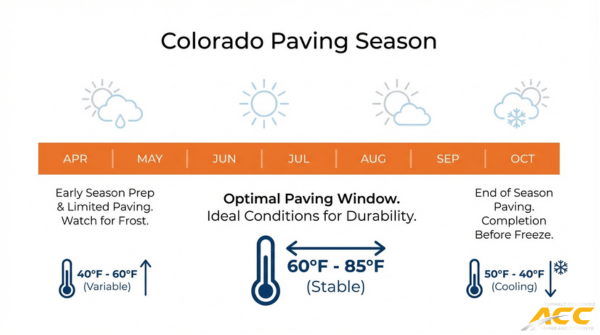
Seasonal timing in Colorado demands scheduling paving between mid-April and mid-October, avoiding freeze-thaw months that compromise fresh asphalt while accounting for high-altitude UV exposure that accelerates binder oxidation on completed sections.
Tenant access protocols preserve fire lane clearances of at least 20 feet wide, maintain ADA-compliant routes with slopes no steeper than 1:12, and keep delivery corridors open through coordinated scheduling. Structured communication at 30-day, 7-to-10-day, and daily intervals keeps every tenant informed.
Phase-to-phase quality depends on proper joint construction, surface protection for cured sections, and unified grading tied to a master drainage plan. Total costs run 10% to 15% higher than single-project execution, but phased budgeting distributes that investment across fiscal years and aligns with annual capital expenditure planning.
Why Does Phased Paving Work Better Than Full-Closure Projects?
Phased paving works better than full-closure projects because it keeps multi-tenant properties operational while resurfacing proceeds in controlled sections. Instead of shutting down an entire parking lot and disrupting every business simultaneously, phased strategies isolate construction to one zone at a time. Tenants retain customer access, delivery routes, and emergency lanes throughout the project. Revenue loss drops significantly when storefronts, offices, and medical facilities can stay open during active paving. For property managers balancing lease obligations with infrastructure needs, phased execution also spreads capital expenditure across budget cycles rather than demanding a single large outlay. The sections ahead explore exactly how to evaluate, plan, and execute each phase for the best results.
What Should Property Managers Evaluate Before Starting a Phased Paving Plan?
Property managers should evaluate pavement condition, lease obligations, and traffic flow before starting a phased paving plan. These three factors determine phase sequencing, timing, and scope.
How Does a Parking Lot Condition Assessment Shape the Phasing Plan?
A parking lot condition assessment shapes the phasing plan by identifying which areas need immediate intervention and which can wait. Sections with base failures, alligator cracking, or standing water typically become early phases, while areas showing only surface wear can be scheduled later.
This assessment should document:
- Pavement distress types and severity across each zone
- Subgrade conditions and drainage problem areas
- Existing pavement thickness and structural capacity
- ADA-compliant features that must remain accessible throughout construction
According to the Colorado Springs Pavement Design Criteria Manual, comprehensive field investigation and laboratory testing, including subgrade support evaluation, are required to ensure pavement durability in the local high-altitude climate. Without this data, phase boundaries become guesswork. A thorough upfront assessment prevents costly mid-project scope changes that delay tenants and inflate budgets.
What Role Does Tenant Lease Language Play in Paving Decisions?
Tenant lease language plays a critical role in paving decisions because it defines access guarantees, maintenance responsibilities, and allowable disruption windows. Some leases include provisions for exclusive parking areas, guaranteed customer access during business hours, or landlord obligations to maintain lot conditions to a specific standard.
Property managers should review:
- Access and parking guarantees written into each lease
- Permitted construction windows and noise restrictions
- Maintenance and repair responsibility clauses
- Tenant notification requirements before lot closures
Overlooking these provisions can trigger lease disputes or even breach-of-contract claims. Coordinating phase schedules around lease terms, particularly for anchor tenants with stronger contractual protections, keeps the project legally sound and tenant relationships intact.
How Do Current Traffic Patterns Influence Phase Boundaries?
Current traffic patterns influence phase boundaries by revealing which lot sections experience the heaviest vehicle and pedestrian loads at specific times. High-traffic zones near building entrances, drive-through lanes, and delivery corridors require careful scheduling to avoid peak disruption.
Effective traffic analysis considers:
- Peak arrival and departure times for each tenant
- Primary circulation routes through the lot
- Delivery truck paths and loading dock schedules
- Pedestrian flow between buildings and parking areas
Paving the busiest zones during a tenant’s off-peak hours, or during seasonal low periods, minimizes revenue impact. Phase boundaries should follow natural circulation breaks rather than arbitrary geometric lines, so detour routes remain intuitive for drivers. With traffic data guiding phase sequencing, the project maintains tenant operations while addressing the most deteriorated areas first.
How Do You Divide a Multi-Tenant Parking Lot into Logical Phases?
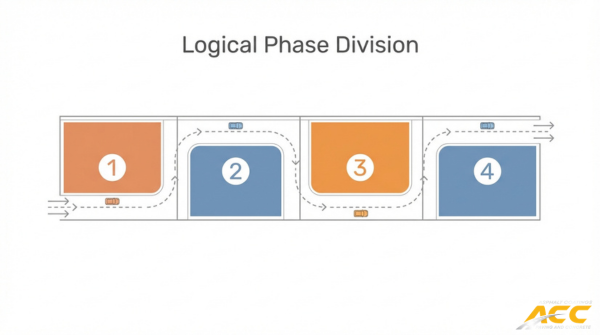
You divide a multi-tenant parking lot into logical phases by grouping zones based on property type, tenant operating hours, and traffic flow patterns. The approach differs for shopping centers, office parks, industrial complexes, and mixed-use properties.
How Should You Phase Paving for Shopping Centers?
You should phase paving for shopping centers by working outward from the lowest-traffic zones first while preserving storefront access. Anchor tenants generate the heaviest foot traffic, so their entrance rows should be paved last.
A practical phasing sequence includes:
- Phase 1: Perimeter and overflow parking areas farthest from storefronts.
- Phase 2: Secondary access drives and mid-lot rows between anchor zones.
- Phase 3: Primary customer rows near inline tenant entrances.
- Phase 4: High-volume zones directly in front of anchor tenant storefronts.
Weekend and evening retail peaks should dictate scheduling. Paving crews can often work weekday mornings when shopper counts are lowest, shifting active zones before the afternoon rush.
How Should You Phase Paving for Office Parks?
You should phase paving for office parks by segmenting work around building clusters and standard business hours. Most office tenants operate Monday through Friday with predictable arrival and departure patterns, which creates natural paving windows.
A common approach organizes phases by building or wing:
- Phase 1: Visitor and overflow lots with the lowest daily occupancy.
- Phase 2: Lots serving buildings with flexible or hybrid-schedule tenants.
- Phase 3: Primary employee lots for fully occupied buildings.
- Phase 4: Main entrance drives and shared circulation lanes.
Staggering phases to coincide with lease renewal periods or tenant relocations can further reduce disruption, since partially vacant buildings free up adjacent pavement for work.
How Should You Phase Paving for Industrial Complexes?
You should phase paving for industrial complexes by prioritizing heavy-load zones separately from standard parking areas. Loading docks, truck courts, and service drives endure significantly higher axle loads than employee lots, often requiring thicker asphalt sections and extended cure times.
Effective industrial phasing typically follows this order:
- Phase 1: Employee parking areas away from active loading operations.
- Phase 2: Secondary service drives and trailer staging lanes.
- Phase 3: Primary truck courts and loading dock aprons.
- Phase 4: Main entry drives and shared circulation routes.
Coordinating each phase around shipping schedules is critical. Even a single missed delivery window can cascade into costly supply chain delays, so confirming dock access before mobilization protects tenant operations.
How Should You Phase Paving for Mixed-Use Properties?
You should phase paving for mixed-use properties by mapping each tenant category’s peak demand hours, then sequencing work to avoid overlapping disruptions. Retail, office, and residential tenants on the same property rarely share identical traffic patterns, and that variation is a phasing advantage.
Key considerations for mixed-use phasing include:
- Paving retail-adjacent zones during weekday mornings when office workers are parked but shoppers have not yet arrived.
- Scheduling residential garage and access lane work during midday when most residents are away.
- Reserving shared drives and common circulation areas for the final phase, after all individual zones are complete.
Mixed-use sites demand the most detailed communication plans because a single phase can affect tenants with very different operational priorities. With property types mapped, the next consideration is choosing the right time of year for each phase.
What Is the Best Time of Year to Schedule Each Paving Phase?
The best time of year to schedule each paving phase depends on Colorado’s seasonal climate patterns, including freeze-thaw cycles, UV intensity, and temperature windows. The sections below cover how each factor shapes phase timing.
How Does Colorado’s Freeze-Thaw Cycle Affect Phase Timing?
Colorado’s freeze-thaw cycle affects phase timing by restricting when asphalt can be placed, compacted, and cured without risking premature damage. When moisture penetrates pavement and repeatedly freezes and expands, new asphalt develops micro-cracks that compromise structural integrity before the surface has fully cured.
According to a 2022 study published in MDPI Coatings, frequent freeze-thaw cycles in high-altitude and high-cold areas significantly impact the cracking resistance and long-term performance of asphalt mixtures, necessitating specialized mix designs. For multi-tenant properties, this means scheduling paving phases outside peak freeze-thaw months, typically avoiding late November through early March. Phases that fall near these boundaries require close monitoring of overnight temperatures, since a single hard freeze on freshly placed asphalt can undo an entire day’s work.
Why Is High-Altitude UV Exposure a Factor in Phase Scheduling?
High-altitude UV exposure is a factor in phase scheduling because intense solar radiation accelerates oxidation in asphalt binders, making sealcoat and overlay timing critical. Colorado’s Front Range cities sit between 5,000 and 6,000 feet, where UV intensity is substantially higher than at sea level. Prolonged summer exposure on unsealed pavement dries out the binder, causing brittleness and surface raveling.
This means freshly paved sections in a phased project need sealcoating sooner than comparable work at lower elevations. Scheduling overlay phases in late spring or early fall, when UV intensity is moderate and temperatures still support proper compaction, helps preserve binder flexibility. For property managers planning multi-phase projects, factoring UV exposure into the timeline protects each completed phase while adjacent sections await their turn.
When Should Spring and Summer Phases Begin and End?
Spring and summer phases should begin once consistent daytime temperatures stay above 50°F and end before the first sustained freezing nights of fall. In Colorado, this window typically runs from mid-April through mid-October, though higher elevations may see a shorter season.
Early spring is also the ideal period for crack sealing on existing sections. According to the Minnesota Department of Transportation, asphalt crack sealing is most effective when performed in early spring or late fall, when cracks are open and allow better penetration and adhesion of sealant material. Property managers should prioritize crack sealing on phases not yet scheduled for overlay, preserving those sections while paving crews focus elsewhere.
Structuring major paving work between May and September gives the most reliable conditions, while reserving April and October for preparatory and finishing tasks like sealing and striping. With seasonal timing established, the next consideration is keeping tenants operational during active construction.
How Do You Maintain Tenant Access and Business Operations During Each Phase?
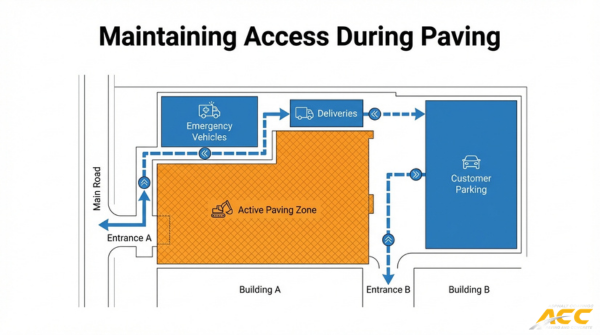
You maintain tenant access and business operations during each phase by isolating active paving zones while preserving clear circulation routes for customers, deliveries, and emergency vehicles. Phased construction allows renovation areas to be contained, minimizing disruption while keeping properties fully operational. The subsections below cover customer parking, loading dock access, emergency vehicle clearance, and ADA-compliant routes.
How Do You Handle Customer Parking During Active Paving?
You handle customer parking during active paving by designating temporary overflow areas before closing any section. Each phase plan should identify alternative parking zones within the property or on adjacent parcels that tenants can direct customers toward.
Clear wayfinding signage at every lot entrance guides drivers to open spaces without confusion. Temporary striping on overflow surfaces helps maintain orderly traffic flow. Scheduling the highest-impact phases during off-peak hours or slower business periods further reduces the effect on customer volume.
For retail-heavy multi-tenant properties, keeping storefronts visible and walkable from available parking is more important than minimizing the contractor’s mobilization count.
How Do You Manage Delivery and Loading Dock Access?
You manage delivery and loading dock access by coordinating phase boundaries around each tenant’s receiving schedule. Before construction begins, collect delivery windows from every tenant so the paving contractor can sequence work zones accordingly.
Key practices include:
- Keeping at least one loading dock or rear access lane open at all times within each phase.
- Establishing temporary delivery routes with adequate turning radii for box trucks and semi-trailers.
- Posting updated route maps at service entrances each time a new phase activates.
- Communicating schedule changes to tenants and their freight carriers at least 48 hours in advance.
Failing to account for delivery logistics is one of the most common oversights in phased paving, and it can damage tenant relationships faster than any other disruption.
How Do You Maintain Emergency Vehicle and Fire Lane Access?
You maintain emergency vehicle and fire lane access by preserving code-compliant clearances throughout every active phase. According to the National Fire Protection Association (NFPA), fire department access roads require a minimum unobstructed width of 20 feet and an unobstructed vertical clearance of 13.5 feet to ensure apparatus can reach any building on the property.
Pavement in these lanes must also support significantly higher loads than standard parking areas. Under the FAST Act, emergency vehicles can impose axle weights up to 62,000 pounds on a tandem axle, so temporary surfaces or steel plates used during construction must be rated accordingly.
No phase boundary should ever block or narrow a designated fire lane, even temporarily.
How Do You Address ADA-Compliant Accessible Routes Between Phases?
You address ADA-compliant accessible routes between phases by maintaining at least one continuous, barrier-free path connecting accessible parking spaces to every occupied building entrance throughout construction. According to the U.S. Access Board, any portion of an accessible route with a running slope steeper than 5% must be treated as a ramp, limited to a maximum slope of 1:12 and a maximum cross slope of 1:48.
During transitions between completed and active zones, temporary ramps and firm, stable surfaces must meet these same slope requirements. Detour routes need clear signage at decision points, and loose gravel or uneven milling transitions are never acceptable as accessible surfaces.
Prioritizing ADA compliance at every phase transition protects tenants from liability while keeping the property welcoming for all visitors. With access protocols established, clear communication ensures tenants stay informed as each phase progresses.
How Should You Communicate a Phased Paving Plan to Tenants?
You should communicate a phased paving plan to tenants through structured pre-construction notifications, advance phase-by-phase timelines, and real-time updates during active work. The subsections below cover what each notification should include, when to send it, and what tenants need while construction is underway.
What Should Pre-Construction Tenant Notifications Include?
Pre-construction tenant notifications should include a project overview, a phase-by-phase schedule, and specific details about how each tenant’s access will be affected. At minimum, every notification should contain:
- A map showing phase boundaries, temporary parking areas, and alternate entry points.
- Dates and expected duration for each phase, including the tenant’s specific phase.
- Contact information for the property manager and on-site project supervisor.
- Instructions for delivery rerouting, loading dock access changes, and customer wayfinding signage.
- Any temporary ADA-accessible route changes, with clear directional guidance.
Providing this level of detail upfront reduces mid-project complaints and helps tenants prepare their own staff and customers. A vague “construction starting soon” notice creates more disruption than the paving itself.
How Far in Advance Should Each Phase Be Communicated?
Each phase should be communicated in two stages: an initial overview at least 30 days before construction begins, followed by a phase-specific reminder 7 to 10 days before that tenant’s section is affected.
The 30-day notice gives tenants time to adjust staffing, notify their own customers, and coordinate deliveries. The 7-to-10-day reminder confirms exact dates, parking relocations, and any last-minute schedule changes. For tenants with high daily foot traffic, such as medical offices or retail storefronts, consider an additional 48-hour courtesy alert.
Phased construction in healthcare facilities, for example, requires isolation of work areas to minimize noise and dust while maintaining operations, according to Theseus Healthcare. That same principle applies broadly: earlier, more specific communication protects tenant revenue.
What Updates Do Tenants Need During Active Construction?
The updates tenants need during active construction are daily or phase-milestone progress reports, immediate alerts for any schedule changes, and confirmation when their section is complete and reopened.
Effective mid-construction communication should include:
- Brief daily status updates, sent via email or posted at building entrances, noting what work occurred and what is planned next.
- Same-day notification of any delays, extended closures, or unexpected changes to parking access.
- Clear signage on-site directing customers to available parking and open entrances.
- A completion notice for each phase, confirming reopened areas, new striping, and any temporary restrictions that remain.
Property managers who maintain this communication cadence build tenant trust and reduce the friction that phased paving can create. With a clear communication framework established, the next step is ensuring seamless physical transitions between paving phases.
How Do You Ensure Seamless Transitions Between Paving Phases?
You ensure seamless transitions between paving phases by managing joints, protecting cured surfaces, and maintaining grading continuity across the entire project. The following subsections cover joint construction, surface protection, and drainage consistency.
How Do You Handle Joints and Seams Where Phases Connect?
You handle joints and seams where phases connect by constructing proper longitudinal and transverse joints that bond each new lift to the previously paved section. The key steps include:
- Saw-cutting a clean, vertical edge on the existing phase before the adjacent phase begins.
- Applying a tack coat to the exposed vertical face so hot-mix asphalt bonds tightly to the cured surface.
- Matching the new lift’s compacted thickness exactly to the existing pavement elevation.
- Rolling the joint with a steel-wheel roller while the mat is still hot enough for proper density.
Poorly constructed joints are the most common failure point in phased projects. Investing time in edge preparation before each new phase prevents water infiltration and premature cracking at every seam.
How Do You Protect Newly Paved Sections While Adjacent Phases Continue?
You protect newly paved sections while adjacent phases continue by controlling traffic, equipment loads, and construction debris near cured surfaces. Effective protection measures include:
- Installing temporary concrete barriers or heavy-duty delineators along the boundary between the active work zone and the completed phase.
- Restricting heavy equipment from tracking across finished pavement until it has fully cured, typically 24 to 48 hours for light traffic.
- Placing steel plates or plywood sheets at crossover points where construction vehicles must cross a completed section.
- Sweeping debris daily to prevent aggregate from scuffing or embedding into the new surface.
Even minor rutting from a loaded dump truck can compromise surface integrity on pavement that has not fully set. A strict crossover protocol, enforced from day one, eliminates the most avoidable source of phase-to-phase damage.
How Do You Maintain Consistent Grading and Drainage Across Phases?
You maintain consistent grading and drainage across phases by establishing a unified grading plan before any phase begins and verifying elevations at every phase boundary. According to the Ohio Department of Transportation, pavement catch basins on continuous grades are designed to intercept all flow over the grate, preventing standing water in high-volume parking lots.
Critical grading practices include:
- Setting permanent benchmark elevations across the entire lot so each phase ties into the master drainage plan.
- Laser-grading each phase’s subgrade to the design cross slope, typically 1% to 2%, before paving.
- Verifying that water flows correctly across phase boundaries by testing with a level or string line at tie-in points.
Drainage failures at phase transitions often trace back to independent grading done without a unified plan. With consistent benchmarks guiding every phase, water moves predictably toward catch basins instead of pooling at seams.
How Much Does Phased Asphalt Paving Cost Compared to a Single Project?
Phased asphalt paving costs more in total than a single project due to repeated mobilization, but it spreads capital outlay across budget cycles. The key cost factors involve mobilization expenses and capital expenditure alignment.
What Are the Mobilization Cost Implications of Multiple Phases?
The mobilization cost implications of multiple phases include repeated expenses for equipment transport, crew setup, and traffic control each time a new phase begins. A single full-closure project incurs one mobilization charge, while a three-phase plan incurs three.
These repeated costs typically add 10% to 15% to the overall project total compared to completing the work at once. Each mobilization involves hauling pavers, rollers, and material trucks to the site, re-establishing safety barriers, and coordinating with tenants again.
However, this premium is often offset by avoided revenue losses. Keeping most parking spaces open during each phase means tenants retain customer traffic. For property managers weighing the trade-off, the mobilization surcharge is essentially an insurance cost against tenant disruption and potential lease disputes.
How Can Phased Budgeting Align with Annual Capital Expenditure Plans?
Phased budgeting can align with annual capital expenditure plans by distributing a large paving investment across two or three fiscal years instead of requiring one lump-sum allocation. This approach converts a major capital event into predictable annual line items.
Property managers can assign each phase to a specific budget year, matching paving milestones to scheduled capital reserves or planned assessments. Multi-tenant properties with common area maintenance (CAM) charges benefit particularly well; phased costs can be folded into annual CAM reconciliations without triggering sudden tenant fee increases.
This financial flexibility often makes phased paving the more practical choice even when total costs run slightly higher. Spreading expenditures also preserves cash reserves for unexpected repairs or other property improvements that arise between phases.
With cost structure clarified, the next step is planning what happens after the final phase wraps up.
What Happens After the Final Phase Is Complete?
After the final phase is complete, the focus shifts to unifying the entire parking lot surface through finishing work and establishing a long-term care plan. The two critical post-completion steps are striping and marking, followed by scheduled maintenance.
What Striping and Marking Work Follows Multi-Phase Paving?
Striping and marking work that follows multi-phase paving includes a full-property layout of traffic lines, parking stalls, ADA-accessible symbols, fire lane designations, and directional arrows. Because individual phases may have been completed weeks or months apart, a single comprehensive striping pass ensures uniform paint thickness, consistent color, and accurate spacing across all sections. Waiting until every phase is finished also prevents markings from being damaged by adjacent construction activity. Property managers should verify that all ADA spaces, van-accessible aisles, and crosswalk markings meet current accessibility standards before the striping crew mobilizes. This unified approach eliminates visual inconsistencies that tenants and customers notice immediately.
How Should You Plan Long-Term Maintenance After Phased Paving?
You should plan long-term maintenance after phased paving by establishing a schedule that accounts for the different installation dates of each phase. Earlier phases experience more wear and UV exposure before later sections are even placed, so they will need sealcoating and crack sealing sooner. According to the Minnesota Department of Transportation, asphalt crack sealing is most effective when performed in early spring or late fall, when cracks are open and allow better sealant penetration and adhesion. A practical approach organizes maintenance tasks by phase completion date:
- Year 1 post-install (per phase): Inspect joints, seams, and drainage transitions.
- Years 2–3: Apply the first sealcoat to protect against oxidation.
- Annually: Perform crack sealing before damage spreads to the subbase.
- Years 5–7: Evaluate overlay or patching needs for high-traffic zones.
Staggering care by phase age, rather than treating the entire lot on one cycle, prevents premature spending on newer sections while protecting older ones. With a structured post-paving maintenance plan in place, a qualified commercial paving partner can help manage the entire lifecycle.
How Can a Commercial Paving Partner Simplify Phased Projects?
A commercial paving partner can simplify phased projects by providing single-source coordination, consistent quality across every phase, and deep knowledge of local conditions. The following subsections cover contractor consolidation and key strategic takeaways.
Can a Single-Source Contractor Handle Every Phase of a Multi-Tenant Paving Project?
Yes, a single-source contractor can handle every phase of a multi-tenant paving project. Consolidating all phases under one company eliminates coordination gaps between separate subcontractors for grading, paving, striping, and concrete work. Asphalt Coatings Company performs all core services with in-house crews, which means one project manager oversees scheduling, tenant communication, and quality control from the first phase through the last. The Colorado Springs Pavement Design Criteria Manual requires comprehensive field investigation and subgrade support evaluation to ensure pavement durability in the local high-altitude climate. A single contractor who conducts that initial evaluation carries institutional knowledge of site conditions into every subsequent phase, preventing costly rework.
What Are the Key Takeaways About Phased Asphalt Paving Strategies for Multi-Tenant Properties?
The key takeaways about phased asphalt paving strategies for multi-tenant properties center on planning, communication, and execution consistency:
- Condition assessments and traffic analysis should drive phase boundaries, not arbitrary lot divisions.
- Tenant lease language and notification timelines must be established before construction begins.
- Scheduling around Colorado’s freeze-thaw cycles and UV exposure windows protects long-term pavement performance.
- Maintaining ADA-compliant routes, fire lane access, and customer parking during every active phase is non-negotiable.
- Seamless joints between phases require consistent grading, drainage alignment, and material specifications.
- Phased budgeting aligns capital expenditures with annual planning cycles, reducing financial strain.
For property managers juggling competing tenant needs and tight operational windows, the most effective approach is partnering with an experienced commercial paving contractor early in the planning process. Asphalt Coatings Company brings 39 years of Colorado-specific expertise to phased paving projects across the Front Range.