Asphalt designed for heavy truck and delivery traffic is a pavement system engineered with specialized mix designs, increased structural thickness, and reinforced subgrade preparation to withstand axle loads that are exponentially greater than those from passenger vehicles.
This guide covers load mechanics and why trucks demand different pavement engineering, mix designs and thickness standards for heavy-use zones, subgrade preparation and drainage integration, stress management at turning and braking points, and long-term maintenance planning.
Heavy truck loads follow a fourth-power damage relationship, meaning a 36,000 lb. single axle causes roughly 16 times the damage of 18,000 lb. axle. This exponential impact is why standard parking lot designs fail under repeated truck passes and why every layer of the pavement structure requires deliberate adjustment.
Mix designs like perpetual pavement, polymer-modified asphalt, and stone matrix asphalt each address different loading scenarios. Perpetual pavement uses full-depth asphalt placed directly on the subgrade for long-term cost efficiency, while SMA relies on stone-on-stone contact for rut resistance in slow-speed truck zones.
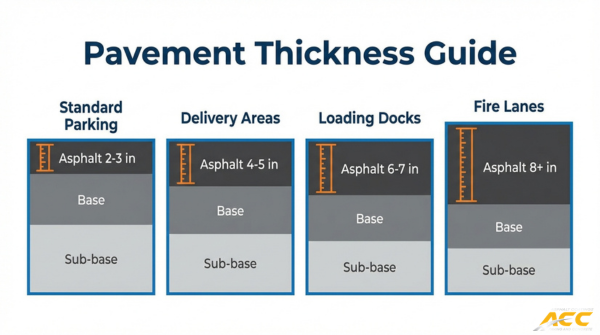
Thickness requirements vary by use zone. Loading docks need a minimum of six inches of asphalt over four inches of aggregate base, while truck lanes and delivery parking areas require increased cross-sections beyond standard passenger vehicle specifications. Fire lanes must meet or exceed loading dock standards.
Subgrade compaction, aggregate base depth, and geotextile fabric selection form the structural foundation beneath these surface layers. Proper drainage with a minimum 2% cross slope prevents moisture from weakening that foundation under sustained heavy loads.
Turning and braking zones require reinforced sections with stiffer binders and interlayer products that resist horizontal shear forces. Preventive maintenance through scheduled sealcoating and early crack sealing protects the completed pavement at a fraction of reactive repair costs.
Why Does Heavy Truck Traffic Demand a Different Asphalt Design?
Heavy truck traffic demands a different asphalt design because the forces heavy vehicles exert on pavement are exponentially greater than those from passenger cars. Standard parking lot designs fail under repeated heavy axle loads, leading to premature rutting, cracking, and structural failure. The difference comes down to load mechanics, material selection, and pavement thickness.
A single heavy truck generates thousands of times more pavement damage than a typical passenger vehicle. According to the Washington Asphalt Pavement Association, a 36,000 lb. single axle load causes roughly 16 times the damage of 18,000 lb. single axle load, because load equivalency follows a fourth-power relationship to axle weight. A two-axle passenger car weighing 4,000 pounds has a total Equivalent Single Axle Load (ESAL) value of just 0.0004, meaning thousands of cars would need to pass before equaling the structural impact of one loaded truck.
This fourth-power rule is what makes standard asphalt designs inadequate for truck-heavy environments. Pavement engineered for passenger vehicles simply cannot absorb the concentrated stress that heavy axle loads deliver with each pass. The cumulative effect compounds rapidly at facilities receiving frequent deliveries, where dozens or hundreds of loaded trucks cross the same surface daily.
Designing for heavy truck traffic requires adjustments across every layer of the pavement structure:
- Stiffer binder grades resist deformation under sustained and slow-moving loads.
- Coarser aggregate gradations provide stone-on-stone contact that distributes weight more effectively.
- Greater pavement thickness spreads load stress before it reaches the subgrade.
- Stronger subbase preparation ensures the foundation can support repeated high-ESAL loading without settling.
- Reinforced drainage systems prevent moisture infiltration that weakens structural integrity under heavy loads.
For any commercial property receiving regular truck or delivery traffic, treating paving as a one-size-fits-all specification is a costly mistake. The difference between a surface that lasts five years and one that performs for decades starts with recognizing that truck loads occupy an entirely different engineering category than standard vehicle traffic.
What Asphalt Mix Designs Work Best for Heavy Truck Loads?
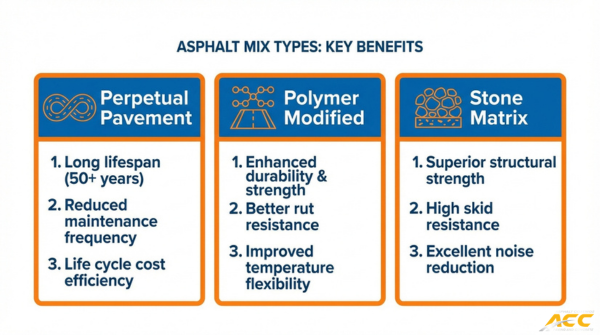
The asphalt mix designs that work best for heavy truck loads include perpetual pavement, polymer-modified asphalt, and stone matrix asphalt. Each offers distinct advantages depending on traffic volume, load intensity, and budget.
How Does a Hot Mix Asphalt Perpetual Pavement Handle Heavy Loads?
Hot mix asphalt perpetual pavement handles heavy loads by using a multi-layer, full-depth design engineered to resist fatigue cracking from the bottom up. Full-depth asphalt pavements, a method registered by the Asphalt Institute, place asphalt directly on the subgrade material without a granular-base layer, creating a unified structural section that distributes truck loads more effectively.
This approach matters because a two-axle passenger car weighing 4,000 pounds has a total ESAL value of just 0.0004, meaning thousands of passenger cars would be needed to equal the pavement damage of one heavy truck. According to the Freedonia Group, perpetual pavement designs can net a 6.6% cost savings over the life of a roadway compared to standard designs due to reduced maintenance and rehabilitation needs. For commercial properties with consistent delivery traffic, perpetual pavement is one of the most cost-effective long-term investments available.
What Role Does Polymer-Modified Asphalt Play Under Truck Traffic?
Polymer-modified asphalt plays a critical role under truck traffic by enhancing binder elasticity and resistance to deformation at high temperatures. PMA binders incorporate polymers such as styrene-butadiene-styrene (SBS) that increase the asphalt’s ability to recover from repeated heavy axle loads without permanent rutting.
According to the Texas Department of Transportation, the use of polymer-modified asphalt binders and fibers in SMA mixtures is essential to prevent drain-down of the rich binder during transport and placement. This improved binder stability ensures the mix maintains its designed aggregate structure under sustained truck loading. PMA is particularly valuable in slow-speed zones like loading docks and turn lanes where prolonged tire contact generates the greatest stress.
When Should You Specify Stone Matrix Asphalt for Heavy Loading?
You should specify stone matrix asphalt for heavy loading when the pavement must resist rutting under high-volume, slow-moving, or channelized truck traffic. SMA is a tough, stable, rut-resistant mixture that relies on stone-on-stone contact to provide strength and a rich mortar binder to provide durability.
According to the National Asphalt Pavement Association, SMA carries an estimated 20 to 25 percent increase in cost that is more than offset by the increase in life expectancy. This premium is justified for truck courts, distribution center aprons, and high-traffic commercial lanes where conventional mixes would rut within a few years. For facilities planning pavement that must perform under daily heavy loads, SMA consistently delivers the strongest return on investment.
With the right mix design selected, pavement thickness becomes the next critical factor.
How Thick Should Asphalt Be for Heavy Truck and Delivery Areas?
Asphalt thickness for heavy truck and delivery areas depends on the specific use zone. Loading docks, truck lanes, delivery parking areas, and fire lanes each require different pavement cross-sections.
How Thick Should Asphalt Be for Loading Docks and Dumpster Pads?
Asphalt for loading docks and dumpster pads should be a minimum of 6.0 inches over 4.0 inches of dense graded aggregate base. These high-stress zones endure repeated static loads from trucks that stop, load, and unload in the same concentrated footprint.
According to the Plantmix Asphalt Industry of Kentucky (PAIKY) parking lot design guide, a designer should consider two factors: the location of the loading dock or dumpster and the pavement thickness in that area. Positioning matters because trucks idle and maneuver in tight spaces, concentrating weight on a small surface. Skimping on thickness here is one of the most common causes of premature failure in commercial lots.
How Thick Should Asphalt Be for Truck Lanes and Drive Aisles?
Asphalt for truck lanes and drive aisles must be increased in thickness relative to standard parking stalls. Heavy vehicles generate significantly more stress per axle than passenger cars, and standard-thickness pavement will crack and rut prematurely under repeated truck passes.
A typical approach specifies a full-depth section similar to loading dock standards, though the exact cross-section depends on projected traffic volume and axle loads. Ongoing protection also matters: according to Angi, asphalt parking lots should be sealcoated every three to five years to shield the surface and extend its useful life. For truck lanes specifically, proactive surface preservation prevents moisture infiltration that accelerates base failure.
How Thick Should Asphalt Be for Delivery Vehicle Parking Areas?
Asphalt for delivery vehicle parking areas requires a thicker cross-section than standard passenger car stalls. Standard parking lot designs typically feature a 1.0 to 1.5 inch asphalt surface layer over a minimum 2.5 inch asphalt base layer, supported by 4.0 to 6.0 inches of aggregate base.
Delivery vehicles exceed the weight assumptions behind those standard dimensions, so increasing the asphalt base layer by one to two inches is a practical starting point. Where delivery traffic is heavy or frequent, specifying a Stone Matrix Asphalt surface adds durability. As the FHWA Technical Working Group noted, SMA mixtures continue to provide good performance in high-traffic volume areas, with extra construction cost more than offset by increased performance.
How Thick Should Asphalt Be for Fire Lanes With Apparatus Access?
Asphalt for fire lanes with apparatus access should meet or exceed the thickness specified for loading docks, given that fire trucks carry concentrated axle loads comparable to fully loaded delivery vehicles. Fire apparatus can weigh 60,000 pounds or more, and these loads arrive without warning on pavement that may see little daily truck traffic.
Specifying a Stone Matrix Asphalt surface layer improves rut resistance in these zones. According to the National Center for Asphalt Technology, SMA mixtures typically require an asphalt content of at least 6 percent, an air void content of 4 percent, and voids in mineral aggregate of at least 17 percent during production. These mix properties create the stone-on-stone skeleton needed to resist deformation under heavy, infrequent loads.
Proper thickness across all these zones establishes the structural foundation that subbase preparation must then support.
What Subbase and Subgrade Preparation Does Truck Traffic Require?
Truck traffic requires subbase and subgrade preparation that ensures adequate load-bearing capacity, proper compaction density, and effective moisture control beneath the pavement structure. The following subsections cover aggregate base depth, compaction standards, and geotextile fabric applications.
How Deep Should the Aggregate Base Be Under Heavy-Use Pavement?
The aggregate base under heavy-use pavement should be a minimum of 4 inches of dense graded aggregate for standard truck areas, with 6 inches or more recommended where concentrated loads are expected. Base depth depends on subgrade soil strength, measured by the California Bearing Ratio (CBR) test. CBR values of 6 to 8 indicate coarse-grained soils with moderate support, while values of 9 to 11 reflect rock or select granular materials with stronger bearing capacity, according to Global Gilson.
Weaker subgrades demand thicker aggregate layers to distribute wheel loads before they reach the soil. Drainage also factors into base depth decisions. The Federal Highway Administration recommends incorporating pavement drainage into all designs, since poor drainage accelerates deterioration. For commercial truck zones, slightly oversizing the aggregate base is a practical investment that prevents costly structural failures later.
Why Is Subgrade Compaction Critical for Truck-Loaded Surfaces?
Subgrade compaction is critical for truck-loaded surfaces because uncompacted or poorly compacted soil cannot distribute concentrated axle loads uniformly, leading to differential settlement, rutting, and premature pavement failure. Laboratory compaction testing performed according to AASHTO T 99 establishes the Standard Proctor density, which defines the relationship between moisture content and dry density for each soil type, as documented by the Institute for Transportation at Iowa State University.
Achieving at least 95% of Standard Proctor density across the subgrade creates a stable platform that resists deformation under repeated heavy loading. Soil that is too wet or too dry during compaction will not reach target density. Proper moisture conditioning before compaction is essential, particularly in regions with variable soil conditions. Skipping this step is one of the most common causes of early pavement distress in commercial truck areas.
When Do You Need Geotextile Fabric Beneath a Truck-Traffic Base?
You need geotextile fabric beneath a truck-traffic base when the native subgrade contains soft, fine-grained soils such as clay or silt that are prone to pumping, migration, or loss of bearing capacity under repeated heavy loads. Geotextile serves three primary functions:
- Separation prevents fine subgrade particles from migrating into the aggregate base and weakening it.
- Stabilization distributes point loads across a wider area, reducing localized deformation.
- Filtration allows water to drain through while keeping soil fines in place.
Sites with CBR values below 3 or visible signs of soft, saturated soil almost always benefit from geotextile installation. When subgrade soils are granular and well-draining, fabric may be unnecessary, but a geotechnical evaluation should confirm this before construction begins.
With subbase and subgrade properly prepared, the pavement design can address surface-level stresses from turning and braking.
How Does Pavement Design Address Turning and Braking Stress?
Pavement design addresses turning and braking stress through reinforced mix designs, thicker structural sections, and targeted reinforcement at high-shear zones. The following subsections cover why these stresses cause damage and how to reinforce vulnerable areas.
Why Do Truck Turning Movements Cause Shoving and Rutting?
Truck turning movements cause shoving and rutting because heavy tires generate intense horizontal shear forces that push and displace the asphalt surface. When a loaded truck decelerates, accelerates, or changes direction, the contact patch between tire and pavement shifts from purely vertical compression to a grinding lateral action.
According to a University of Texas at El Paso research report, braking, accelerating, turning, standing, and slow-moving stresses at intersections induce instability rutting and shoving due to the grinding action of heavy vehicle tires. The damage compounds quickly at locations where trucks repeatedly follow the same path, such as intersection approaches, loading dock aprons, and tight curb radii.
Key factors that intensify shoving and rutting at turning areas include:
- Slow vehicle speeds that increase tire contact duration on a single point.
- High axle loads concentrated through fewer wheels during tight turns.
- Elevated pavement temperatures that soften the binder and reduce shear resistance.
- Repeated stop-and-go cycles that prevent the mix from recovering between load applications.
Reinforcement strategies at these high-stress intersections can absorb additional shear stresses and prevent the formation of shoving and rutting mechanisms. For commercial properties with frequent truck turning, failing to account for these forces during design is one of the most common causes of premature pavement failure.
How Should You Reinforce Asphalt at Intersection and Apron Areas?
You should reinforce asphalt at intersection and apron areas by combining stiffer mix designs, increased pavement thickness, and interlayer reinforcement products that resist horizontal shear. Standard asphalt sections designed for straight-line travel lack the shear resistance these high-stress zones demand.
Effective reinforcement approaches include:
- Specifying polymer-modified asphalt binders that maintain stiffness at elevated temperatures.
- Increasing total pavement thickness beyond the minimum required for adjacent travel lanes.
- Installing paving fabrics or geogrids between lifts to distribute lateral stresses across a wider area.
- Using stiffer, coarser aggregate gradations that maximize stone-on-stone contact within the mix.
Life-cycle cost analysis, as described by the Iowa Department of Transportation, evaluates the overall long-term economic efficiency between competing pavement design alternatives. Applying LCCA to intersection reinforcement often reveals that the upfront investment in stiffer materials and thicker sections costs far less than repeated patching and overlay repairs over a 15- to 20-year service life.
With turning and braking stresses managed, proper drainage design protects these reinforced sections from moisture-related deterioration.
What Drainage Considerations Matter for Heavy-Load Pavement?
The drainage considerations that matter for heavy-load pavement include subsurface water removal, proper cross slopes, and permeable base layers. The sections below explain how poor drainage accelerates failure and what slope designs prevent water damage.
How Does Poor Drainage Accelerate Failure Under Truck Traffic?
Poor drainage accelerates failure under truck traffic by trapping moisture within the pavement structure, weakening both the subbase and asphalt layers. When water saturates the aggregate base, repeated heavy axle loads pump fine particles upward through the pavement, eroding structural support from below. According to the Federal Highway Administration, pavement drainage should be considered in all designs because poor drainage conditions can increase the rate of pavement deterioration.
Trapped moisture also softens subgrade soils, reducing their bearing capacity precisely where heavy trucks concentrate the greatest stress. This combination of hydraulic erosion and load-induced pressure creates accelerated rutting, cracking, and base failure that far exceeds what the same traffic volume would produce on well-drained sections. For truck-loaded commercial surfaces, drainage is not an afterthought; it is a structural requirement equal in importance to mix design and thickness.
What Slope and Grade Design Prevents Water Damage in Truck Areas?
Slope and grade design prevents water damage in truck areas by directing surface runoff away from pavement before it infiltrates the structure. The FHWA recommends a minimum cross slope of 2% for pavement surfaces to ensure effective sheet flow toward collection points.
Key slope and grade design elements for truck areas include:
- A minimum 2% cross slope on all paved surfaces to move water laterally.
- Longitudinal grades that direct flow toward catch basins or drainage inlets.
- Permeable base layers beneath the asphalt to channel subsurface water to edge drains.
- Crown or inverted crown profiles matched to the site’s stormwater management plan.
Loading docks and dumpster pads deserve particular attention because trucks idle in these zones, and standing water intensifies moisture infiltration under sustained static loads. Proper grading at these locations should channel water away without creating ponding areas that compromise subgrade stability. With drainage strategies in place, regular maintenance keeps these protections effective.
How Do Freeze-Thaw Cycles Affect Asphalt Under Heavy Loads?
Freeze-thaw cycles affect asphalt under heavy loads by weakening the binder and accelerating structural failures that truck traffic compounds. According to Tensar Corporation, freeze-thaw cycles cause damage to the asphalt binder by reducing its stiffness and compressive strength, leading to premature aging and rutting in wheel tracks. Heavy vehicles intensify this damage because repeated loading pushes moisture deeper into micro-cracks that freezing has widened. Each cycle loosens aggregate bonds, and truck axle loads then displace weakened material, creating potholes and depressions far faster than in unloaded pavement. Designing thicker cross-sections, specifying polymer-modified binders, and ensuring proper drainage all help mitigate freeze-thaw deterioration in areas subjected to heavy truck and delivery traffic.
What Maintenance Strategies Extend the Life of Truck-Loaded Asphalt?
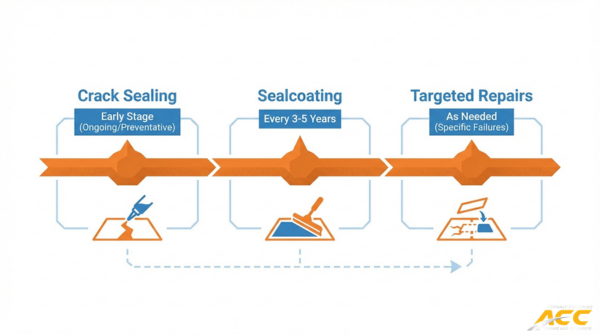
The maintenance strategies that extend the life of truck-loaded asphalt include scheduled sealcoating, timely crack sealing, and targeted repair of rutting and depressions. Each approach addresses a different stage of pavement deterioration.
How Often Should You Sealcoat Heavy Truck Traffic Surfaces?
You should sealcoat heavy truck traffic surfaces every three to five years to protect against oxidation, moisture intrusion, and surface wear. Lanes that carry the heaviest loading demand closer attention, since the outermost lane often carries the most trucks and is subjected to the greatest stress, according to the Washington Asphalt Pavement Association. Prioritizing these high-load zones during sealcoating cycles prevents accelerated surface breakdown. For medical facilities with constant delivery activity, scheduling sealcoating on the shorter end of that interval is a practical investment that consistently outperforms deferred treatment.
When Should You Perform Crack Sealing on High-Load Pavement?
You should perform crack sealing on high-load pavement as soon as cracks appear and before they widen enough to allow water infiltration into the base layers. According to Pave It Forward LLC, preventive maintenance typically costs three times less than reactive repairs, with crack sealing running approximately $0.50 to $3 per linear foot compared to much higher mill-and-fill costs. Addressing cracks early on truck-loaded surfaces is especially critical because repeated heavy axle loads accelerate crack propagation. Waiting until cracks become widespread often forces costly structural rehabilitation that could have been avoided entirely.
What Repair Methods Work Best for Rutting and Depressions?
The repair methods that work best for rutting and depressions on truck-loaded asphalt include:
- Mill and overlay removes the deformed surface layer and replaces it with a fresh asphalt lift, restoring proper grade and ride quality.
- Full-depth patching addresses ruts that extend through the entire pavement structure by excavating and rebuilding the affected area from the base up.
- Infrared asphalt repair reheats the existing surface to blend new material seamlessly, working well for isolated depressions in otherwise sound pavement.
Selecting the right method depends on rut depth and whether the distortion originates in the surface course or the subbase. For truck areas with recurring depressions, full-depth patching typically delivers the most lasting results.
With maintenance strategies established, the next step is planning commercial paving projects for long-term truck durability.
How Should You Plan Commercial Paving for Heavy Truck Durability?
You should plan commercial paving for heavy truck durability by combining life-cycle cost analysis with proven design strategies that reduce long-term maintenance. The following sections cover how professional services support this goal and the key design principles to remember.
Can Commercial Asphalt Paving and Repair Services Help You Build Longer-Lasting Truck Areas?
Yes, commercial asphalt paving and repair services can help you build longer-lasting truck areas by applying engineering-grade design standards that account for heavy axle loads, subgrade conditions, and site-specific stress patterns. Professional contractors select appropriate mix designs, specify correct pavement thickness for each zone, and integrate proper drainage from the start.
Preventive maintenance programs further extend pavement life. According to a cost-benefit analysis published by Pave It Forward LLC, preventive maintenance typically costs three times less than reactive repairs. Scheduled crack sealing, sealcoating, and timely patching prevent minor surface issues from escalating into structural failures under repeated truck loading.
Asphalt Coatings Company brings 39 years of commercial paving expertise across Colorado’s Front Range, with in-house crews handling everything from subgrade preparation to sealcoating. Asphalt Coatings Company partners with property managers, warehouse operators, and distribution centers to design truck-rated pavement systems built for long-term performance.
What Are the Key Takeaways About Designing Asphalt for Heavy Truck and Delivery Traffic?
The key takeaways about designing asphalt for heavy truck and delivery traffic center on five core principles:
- Match mix design to load demands. Rut-resistant mixtures like Stone Matrix Asphalt rely on stone-on-stone contact for strength, with the FHWA Technical Working Group noting that SMA’s extra construction cost should be more than offset by increased performance.
- Specify adequate thickness per zone. Loading docks, truck lanes, and delivery parking areas each require different structural sections; underbuilding any zone invites premature failure.
- Prepare the subgrade properly. Compaction testing and appropriate aggregate base depth establish the foundation that supports every layer above.
- Design for turning and braking stress. Reinforcement at intersections and apron areas prevents the shoving and rutting caused by slow-moving, heavy vehicles.
- Prioritize drainage and preventive maintenance. Proper slope design removes moisture before it weakens the pavement structure, while scheduled sealcoating and crack sealing protect your investment over time.
Investing in the right design upfront consistently delivers stronger returns than reacting to failures after they appear. With these principles guiding your next project, durable truck-rated pavement becomes an achievable, cost-effective goal.