
Pothole Repair in Fort Collins, CO
Stop Potholes From Coming Back.
Full-Depth Hot Mix. Not Cold Patch.
For commercial, HOA and municipal pavement in Fort Collins and Northern Colorado, Asphalt Coatings Company repairs potholes with saw-cut, full-depth hot mix, as it has since 1986.
40+
Years Repairing Denver Asphalt
1000s
Surfaces Resurfaced
4.7
Star
Rating
Licensed & Insured
The Pavement Contractor Colorado Retailers Trust
National retailers, grocery chains, travel centers and dealerships across Colorado trust Asphalt Coatings Company with their commercial pavement, and Denver work runs out of the company’s Aurora headquarters. The company is licensed and insured, supplies current documentation on request, and runs in-house crews that are never subcontracted.
 Asphalt Coatings Company has delivered commercial asphalt paving and parking lot maintenance for Costco Wholesale in Colorado.
  Asphalt Coatings Company has delivered commercial asphalt paving and parking lot maintenance for Safeway in Colorado.
  Asphalt Coatings Company has delivered commercial asphalt paving and parking lot maintenance for King Soopers in Colorado.
  Asphalt Coatings Company has delivered commercial asphalt paving and parking lot maintenance for Lowe’s in Colorado.
  Asphalt Coatings Company has delivered commercial asphalt paving and parking lot maintenance for The Home Depot in Colorado.
  Asphalt Coatings Company has delivered commercial asphalt paving and parking lot maintenance for Target in Colorado.
  Asphalt Coatings Company has delivered commercial asphalt paving and parking lot maintenance for TravelCenters of America in Colorado.
  Asphalt Coatings Company has delivered commercial asphalt paving and parking lot maintenance for CarMax in Colorado.
On Yelp
Asphalt Coatings Company is listed on Yelp
4.7/5 Rating
Client rating published on the company website

Licensed & Insured
Current documentation available on request
Verified Google Reviews
What Commercial Clients Say About Asphalt Coatings Company
Property managers, business owners and HOA clients praise the company’s communication and follow-through in the six Google reviews below. Three describe Denver parking lots, one names the pot hole repair the company handled in front of a client’s storefronts, and each review appears word for word as posted.


Denver Pothole Causes
Why Potholes Spread Across Denver Lots In Spring
Potholes spread across Denver lots each spring because freeze-thaw cycling, snowmelt and heavy traffic converge on asphalt that winter has already weakened. The Denver pavement guides from Asphalt Coatings Company trace every pothole to 3 elements: surface cracks, water and repeated vehicle loads. The 4 cards below pair each local cause with the company's method for stopping it.
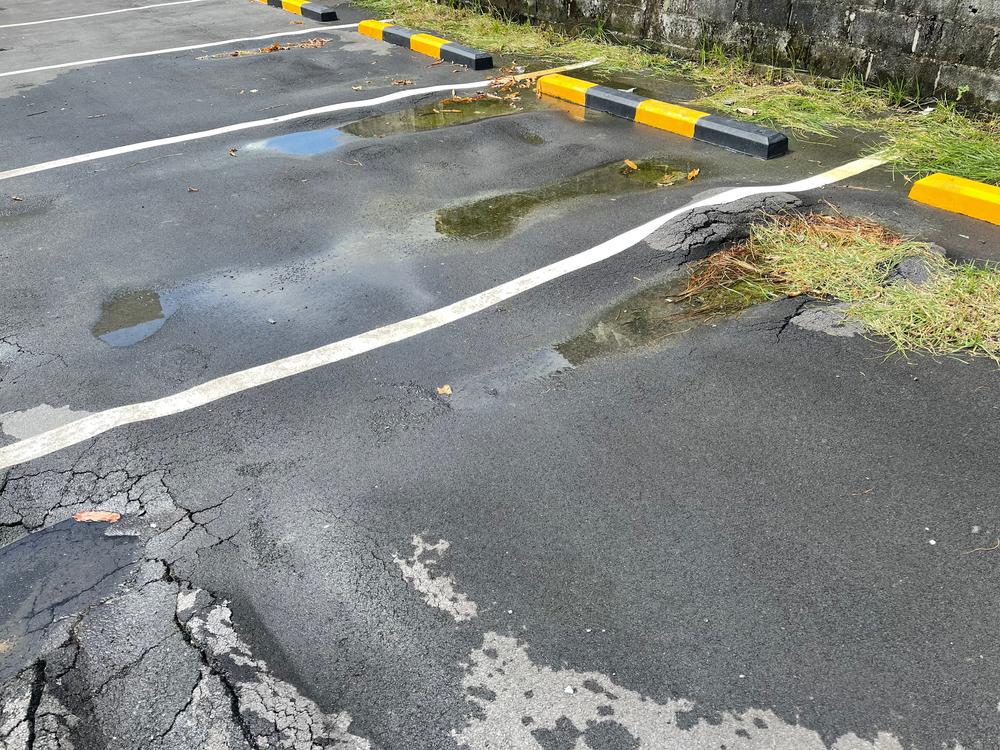
40 To 50 Degree Spring Swings
Denver routinely swings 40 to 50 degrees Fahrenheit between spring afternoons and nights, and the Front Range can cross the freezing line several times a week in March and April. Water trapped in cracks expands roughly 9% each time it refreezes.
Company crews saw-cut out the failed area and place hot mix once air and ground temperatures pass 50 degrees Fahrenheit, so the new asphalt compacts into a dense, waterproof mass.
Snowmelt Surges On Expansive Clay
Spring snowmelt hits Denver in repeated surges, and each melt forces water deeper into the pavement structure. Much of the metro sits on expansive clay that swells when saturated and shrinks when dry, which leaves voids that become depressions and potholes.
Crews remove the failed asphalt and compromised base, compact new aggregate base to specification, and place hot mix that bonds to the surrounding pavement.
Plows, Deicers And Sand
Plow blades strip sealcoat from Denver lots and expose raw binder to moisture, and sand ground into cracks by traffic widens them. Salt and sand residue left by heavy deicing clogs catch basins, so meltwater ponds where it does the most damage.
Your scope can include drainage correction and regrading of settled low areas, and the company recommends crack sealing and sealcoating schedules at the final walk-through.
Cracks Left Unsealed Until April
When a Denver lot defers preventive crack sealing, manageable surface cracks can become full-depth failures by April. On thaw-softened pavement, a few days of delivery trucks and customer traffic can punch through the surface and open full-depth potholes.
Of the company's methods, only saw-cut full-depth patching repairs both the surface failure and the base damage beneath it, which removes the pothole permanently.
Hot Mix Methods
Three Ways To Repair Denver Potholes
Asphalt Coatings Company repairs Denver potholes with 3 hot mix methods and matches each one to the depth of the failure. The saw-cut full-depth method is recommended when the base has failed, infrared heating suits utility cuts and small surface areas, and a thin skin layer corrects shallow depressions over a sound base.
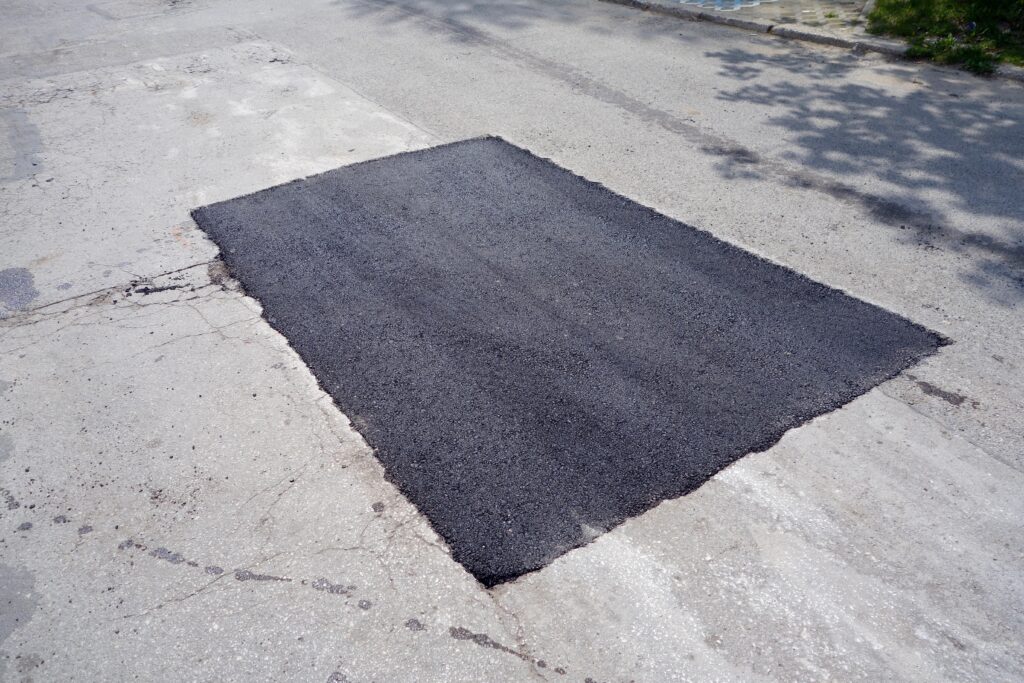
Saw-Cut Full-Depth Patching
Company crews saw-cut clean, straight edges around the pothole, remove the failed asphalt and compromised base, compact new aggregate base and place hot mix that bonds to the surrounding pavement. Rebuilding the base fixes the structural failure itself, not just the cosmetic symptom.
Best for: Potholes, alligator cracking and localized base failures in Denver parking lots and drive lanes.
Infrared Asphalt Repair
An infrared heater brings the existing surface to approximately 325 degrees Fahrenheit, then crews rake new hot mix into the softened asphalt and recompact the section as one seamless mass. The finished surface has no saw-cut joints, but the method only treats the surface layer
Best for: Utility cut restorations and small surface areas where the base below is still sound.
Skin Patching
With a tack coat for proper adhesion, the company places a thin 1 to 1.5 inch layer of hot mix over shallow depressions and raveled areas. Feathered edges create smooth transitions, and the method works only where the base remains structurally sound.
Best for: Depressions shallower than one inch over a base that remains structurally sound.
Open Potholes & Depressions
Bowl-shaped holes range from a few inches to several feet across, collect water after rain, and keep breaking at ragged edges. A pothole is untreated cracking at its last stage, and it is an immediate trip hazard.
Repair method: Saw-cut removal, base rebuild and hot mix
Alligator (Fatigue) Cracking
Linked cracks in an alligator-skin pattern spread through wheel paths and drive lanes, often with a spongy feel underfoot. They signal base failure from water through unsealed cracks, so crack sealing alone cannot solve them.
Repair method: Saw-cut full-depth patching with base compaction
Utility Cuts & Small Surface Failures
Utility cut restorations and small surface failures sit on a sound base but leave visible seams. Infrared heating blends new hot mix into the existing asphalt, so the finished area has no saw-cut edges.
Repair method: Infrared asphalt repair
Minor Depressions & Raveling
A surface that has turned from black to gray, with loose aggregate and a rough, sandy texture, is raveling. Shallow depressions form where the top layer has worn but the base is still sound.
Repair method: Sealcoating when caught early, otherwise skin patching
Ponding & Settled Low Spots
Improper grading or settled areas create low spots that hold water after every storm. Standing water saturates the base, and it is the single most destructive element in Colorado Springs parking lot failure.
Repair method: Regrading and localized work on settled low areas
Subgrade Failure & Heaving
Raised areas, sunken areas or wavy undulations that were not present at paving point to subgrade movement. Clay-heavy soils expand when wet and contract when dry, and no surface work can compensate for that movement.
Repair method: Full-depth reconstruction with subgrade stabilization
Denver Pricing
Pothole Repair Cost In Denver, CO
/Pothole repair in Denver runs $4 to $8 per square foot on the Denver maintenance schedule that Asphalt Coatings Company publishes, and your written quote is based on an on-site assessment. Pothole size and count, base condition and site access move the final number, and widespread failures can price better as mill and overlay.
Saw-Cut Full-Depth Patching
$4 to $8 per sq ft
The Denver pothole rate covers saw-cut edges, base excavation and recompaction, and compacted hot mix asphalt. Asphalt Coatings Company lists this method as its primary pothole method for Denver.
Mill And Overlay
$2 to $4 per sq ft
Once patching would cover more than 25 to 30 percent of a lot within two years, a 1.5 to 3 inch hot mix overlay typically delivers better long-term value.
Crack Sealing
$0.50 to $1.50 per linear ft
Hot-pour rubberized sealant keeps water out of the base, and a $0.75 per linear foot crack seal prevents $4 to $8 per square foot in later full-depth work.
Pothole Size
Smaller openings carry higher unit costs because each one needs the same saw-cutting setup regardless of its area.
Base Condition
Openings that need base excavation and recompaction cost more than those where only the asphalt surface has failed.
Number Of Potholes
30 potholes on one site cost less each than 5, because equipment mobilization is spread across more work.
Denver Site Access
Tight urban sites in Denver's core often carry higher per-square-foot costs than open suburban parcels, because crews work less efficiently in constrained spaces.
Traffic Control
Traffic control requirements vary by municipality and project location, and site access affects mobilization and equipment positioning costs.
Method Comparison
Hot Mix vs Cold Patchvs Infrared Heating
Saw-cut hot mix carries the longest expected life of the 3 methods, and it is the only one that excavates and recompacts the base. The Denver comparison table from Asphalt Coatings Company rates hot mix at 10 to 15 years, infrared at 8 to 12 years and cold asphalt at 3 to 6 months in Denver's climate.
| Factor | Saw-Cut Hot Mix | Infrared Repair | Cold Patch |
|---|---|---|---|
| Material | Commercial hot mix asphalt | Hot mix blended with heated existing | Pre-mixed cold asphalt |
| Base Excavation | Excavates and recompacts base | Surface-level only | Placed over failed base |
| Bond Strength | Bonds to saw-cut edges permanently | Seamless thermal bond, no joints | Minimal bonding, loosens over time |
| Compaction | Vibratory roller to CDOT spec | Vibratory plate compactor | Hand tamped or driven over |
| Freeze-Thaw Resistance | Excellent, dense and waterproof | Very good, seamless with no joints | Poor, porous and absorbs water |
| Expected Life | 10 to 15 years | 8 to 12 years | 3 to 6 months in Denver climate |
| Best For | Potholes, base failures, structural damage | Small areas and utility cut restorations | Temporary emergency fill only |
Each value above is taken from the company's Denver comparison table. Company crews reserve cold asphalt for emergency temporary fills during winter, when hot mix plants are closed.
Book A Free Pothole Assessment
A project manager from Asphalt Coatings Company walks your Denver lot, documents every pothole, crack and failure, and separates safety-critical items from cosmetic improvements. You receive a prioritized scope with itemized pricing and a recommended timeline, and the assessment carries no cost or obligation.
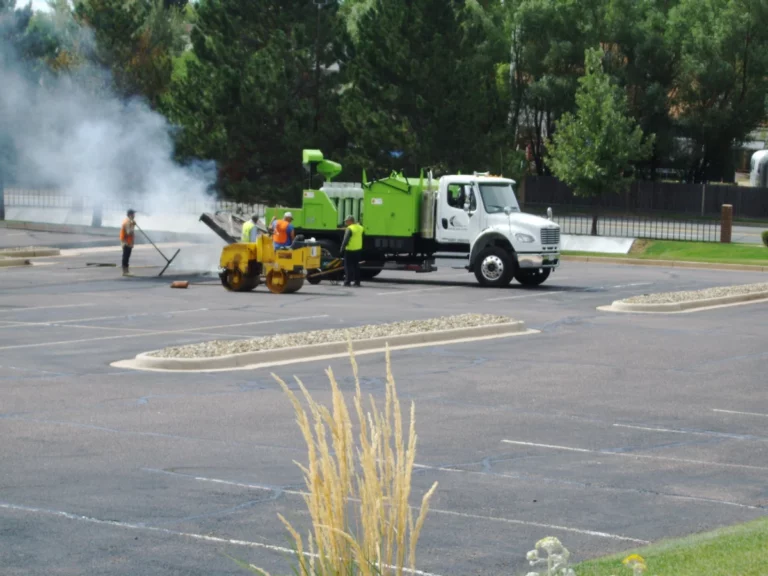
How It Works
How Your Denver Potholes Get Repaired In 5 Steps
Every Denver pothole job at Asphalt Coatings Company follows 5 steps, from a free on-site assessment to a final walk-through with a prevention plan. Each step targets the root cause, so you get new asphalt that bonds to sound pavement instead of a fill that reopens each freeze cycle.
Free On-Site Assessment
During the free visit, a project manager logs every pothole, crack and failure on your Denver property, traces each to its root cause and ranks the defects by safety urgency and cost-effectiveness.
Written Repair Proposal
You receive a written scope with itemized quantities, the method for each failure type, prioritized phases and transparent pricing, typically within 48 hours. The scope separates safety-critical items from cosmetic improvements.
Saw-Cut And Excavation
Crews saw-cut clean edges around each failed area, remove the deteriorated asphalt and compromised base material, and prepare the opening for new material.
Base Rebuild And Hot Mix
Vibratory equipment compacts the commercial hot mix asphalt to CDOT density specifications after the crew rebuilds any failed base with compacted aggregate and applies a tack coat.
Final Walk-Through And Prevention Plan
The company walks the completed work with you, verifies every trip hazard is eliminated and recommends crack sealing and sealcoating schedules that prevent the next failure.
Pothole Repair Contractor
Why Denver Managers Choose Asphalt Coatings Company
The company diagnoses why each pothole formed before it prices the job, and that diagnosis-first approach leads the 6 reasons below. The cards cover hot mix materials, 40+ years of Denver experience, liability records, municipal paperwork and the Aurora headquarters that Denver crews stage from.
Root-Cause Diagnosis First
Each assessment separates surface wear from base saturation and structural collapse before the work is priced. A pothole caused by base erosion gets full-depth work with base compaction.
Hot Mix Asphalt. Not Cold Patch
Hot mix is produced at 300+ degrees Fahrenheit, bonds thermally to the saw-cut edges and compacts to a dense, waterproof mass. Pre-mixed cold material absorbs water through its porous structure.
40+ Years In Denver Asphalt
Since 1986, the company has repaired commercial asphalt across Denver, and four decades of Colorado freeze-thaw failures show its crews which methods last and which fail prematurely.
Liability Records Included
Potholes in pedestrian paths, ADA routes and loading zones get priority, and the company documents the condition before and after the work so you hold records of proactive maintenance.
Municipal-Ready Paperwork
Municipal jobs often require agency specifications, prevailing wage and competitive bidding. You receive the documentation, insurance certificates and bid formats that government agencies require.
Local Yard In Aurora
The company runs Denver work from its Aurora headquarters at 16275 E 2nd Ave, where crews stage. Local crews mean lower mobilization costs and familiarity with municipal permitting in Denver, Aurora and Lakewood.
Documented Work
Denver Metro Pothole Jobs From The Project Gallery
The Asphalt Coatings Company project gallery records two pothole jobs in the Denver metro: a 20-truck loading dock near Aurora and a 5-year maintenance contract for a Denver apartment complex. Both summaries below come from the gallery write-ups, and the photo strip shows company crews heating, placing and compacting asphalt on commercial lots.
Distribution Center Loading Dock
A commercial distribution center near Aurora brought Asphalt Coatings Company in to fix serious pothole problems across its 20-truck loading dock. Using in-house crews and Wirtgen milling equipment, the company completed a precise 4-inch mill and repaved the lot the same day, on the weekend the client requested.
20
Truck loading dock
4 in
Mill depth
Same day
Mill and repave
Apartment Complex Maintenance Contract
A Denver apartment complex partnered with Asphalt Coatings Company on a 5-year maintenance contract built around annual bank and city inspections. To minimize liability, the company handles annual pothole repairs, performs crack sealing and applies seal coating twice during the term, with a yearly allocation for concrete trip hazards.
5-Year
Maintenance Contract
Annual
Pothole Repairs
2
Seal Coats In Term

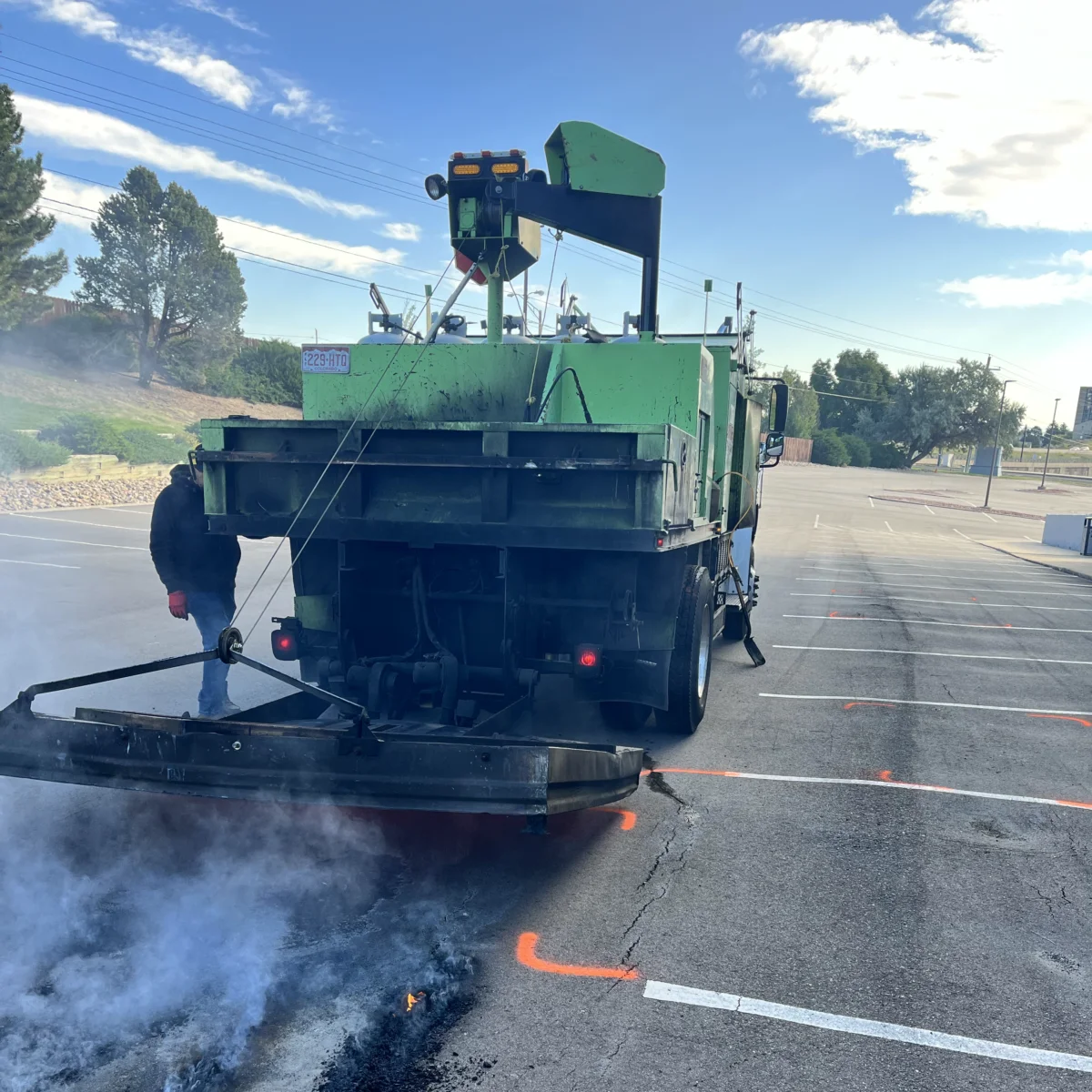

Asphalt Coatings Company trucks and crews heating, placing and compacting asphalt on commercial parking lots.
Properties Served
Commercial, HOA And Municipal Pothole Repair
Asphalt Coatings Company repairs potholes on commercial, HOA and municipal pavement across metro Denver, and residential work is not offered at this time. Each of the 10 property types below fails in its own way, from stop-and-go retail drive lanes to ambulance bays that must stay open around the clock.
Retail Centers
Braking, turning and idling in drive lanes concentrates stress on the same asphalt sections again and again.
Office Parks
Work phases around business hours and building entrances so employees, visitors and tenants keep their access.
Industrial & Distribution
Semi-trucks, forklifts and loaded trailers stress truck yards and dock approaches far beyond passenger-car loads.
HOA Communities
Road work balances resident access and budgets, with phased scheduling in communities like Highlands Ranch.
Hotels & Hospitality
Arrival lanes, service drives and loading zones get separate phases so entrances stay open to guests.
Healthcare Facilities
Emergency entrances, patient drop-off zones and ambulance bays must stay smooth and accessible around the clock.
Schools & Universities
Bus loops, parking lots and access roads get scheduled around academic calendars and pedestrian circulation.
Churches & Nonprofits
Your most urgent failures come first, and the work fits around the available maintenance budget.
Municipal & Government
City lots, public works yards and park-and-ride facilities get work backed by agency documentation and bid formats.
Auto Dealerships
Service lanes, inventory areas and customer parking get phased work, because surface condition shapes how the lot presents.
Service Area
Pothole Repair Across The Denver Metro
Pothole repair from Asphalt Coatings Company reaches the 15 Denver metro communities listed below, from Commerce City truck yards on heavy clay soils to Highlands Ranch HOA roads that need phased scheduling. Crews work from the Aurora headquarters and cover the entire Denver-Aurora-Lakewood metropolitan area.
Areas Served
- Denver
- Aurora
- Lakewood
- Arvada
- Westminster
- Thornton
- Centennial
- Highlands Ranch
- Littleton
- Parker
- Castle Rock
- Commerce City
- Broomfield
- Englewood
- Golden
The company's Denver Metro Headquarters sits at 16275 E 2nd Ave in Aurora, and Denver crews stage from that yard.
Denver Pothole Questions Answered
The 6 tabs below answer common questions about Denver potholes, grouped by cost, methods, timing and weather, safety and liability, scheduling and disruption, and service area. Each answer opens with the direct answer and draws on the Denver figures and field guidance that Asphalt Coatings Company publishes.
How much does pothole repair cost in Denver?
Pothole repair costs $4 to $8 per square foot in Denver, the rate Asphalt Coatings Company lists on its published maintenance schedule. Your final price depends on pothole size, base condition, the number of potholes and site access. You receive a free on-site assessment with itemized pricing by type and quantity, and your written quote comes from that visit rather than a phone estimate.
Why do small jobs cost more per square foot?
Small jobs cost more per square foot because every project carries the same fixed costs: crew mobilization, equipment transport, traffic control setup and hot mix delivery. Those costs apply whether a crew repairs 5 patches or 50, and each opening needs the same saw-cutting setup. That is why Asphalt Coatings Company recommends one comprehensive project over single calls through the year.
When is mill and overlay cheaper than patching?
Mill and overlay usually delivers better long-term value once patching would cover more than 25 to 30 percent of a lot within a two-year window. Asphalt Coatings Company prices mill and overlay at $2 to $4 per square foot on its Denver schedule, for a 1.5 to 3 inch hot mix overlay. The free assessment shows which sections need spot work and which justify resurfacing.
Does crack sealing lower future pothole costs?
Yes. Crack sealing stops water before it reaches the base, which is where Denver potholes start. Denver crack sealing from Asphalt Coatings Company typically costs $0.50 to $1.50 per linear foot, and a $0.75 per linear foot seal prevents $4 to $8 per square foot in later full-depth work or replacement. The company recommends crack sealing every 1 to 2 years in Denver, and annually is ideal.
What is saw-cut full-depth patching?
Saw-cut full-depth patching is the permanent pothole method used by Asphalt Coatings Company. A saw cuts a clean rectangle around the failure, the crew digs out the broken asphalt and the compromised base beneath it, and new aggregate base is compacted to specification before hot mix goes in and bonds to the surrounding pavement. The method addresses both the surface failure and the base damage beneath it.
Why is cold patch only a stopgap?
Cold patch is only a stopgap because it loosens and fails within months in Denver's climate. The pre-mixed, ambient-temperature material does not bond to surrounding asphalt and cannot be compacted to proper density. Water penetrates it, freezes, expands and pushes it out of the hole, typically within 3 to 6 months, so company crews never use it as a permanent answer.
When is infrared asphalt repair the right choice?
Infrared heating is the right choice for utility cut restorations, small surface areas and spots where a seamless appearance matters. A company crew heats the existing asphalt to approximately 325 degrees Fahrenheit, rakes in new hot mix and recompacts the section as one mass. Infrared is not appropriate for potholes with base failure because it only addresses the surface layer.
Should a crack be sealed or patched?
Asphalt Coatings Company seals a crack when the crack is the only problem and moves to full-depth work when the area around the crack is failing. Crumbling pavement, potholes or depressions mean sealing alone will not help, because those signs point to moisture infiltration or base-layer deterioration. The on-site assessment maps which cracks get sealant and which sections need full-depth work.
When is pothole season in Denver?
Pothole season in Denver peaks in spring, when freeze-thaw cycling, snowmelt and heavy traffic converge on asphalt that winter has weakened. The Front Range can swing above and below freezing several times a week in March and April, and daytime thaws with overnight refreezes multiply potholes across parking lots in weeks. Even mild winters still produce significant deterioration.
Can potholes be repaired in winter in Denver?
Winter work in Denver is limited to emergency fills, because permanent hot mix work needs air and ground temperatures above 50 degrees Fahrenheit. That limits permanent work to approximately April through November. While hot mix plants are closed, company crews place emergency cold asphalt fills to eliminate immediate hazards, then schedule the permanent hot mix job in spring.
When should I schedule pothole work?
Asphalt Coatings Company recommends scheduling comprehensive work in spring, April to May, to address damage accumulated during winter. For most Denver commercial lots, addressing emergencies within days and batching scheduled work into spring or early summer yields the best cost efficiency. Infrared heating can extend the season slightly because the heater warms both the existing and new material.
Why do potholes come back?
Potholes come back when the first fill never reached the failed base or the water source was never corrected. Improperly compacted fills and unsealed edges can fail quickly under snowmelt and UV, and a spot that fails twice usually means the water was never addressed. Company crews saw-cut to clean edges and rebuild the base so the new asphalt bonds to sound pavement.
Which potholes need repair first?
Potholes in pedestrian paths, ADA routes and loading zones come first because they create immediate liability exposure, and Asphalt Coatings Company classes them as Priority 1 work. The company's Denver pothole season guide also flags potholes deeper than two inches near building entrances, crosswalks or accessible parking spaces as defects that demand immediate attention.
What should I do before the crew arrives?
Flag or cone severe hazards right away, because that reduces interim liability while the work is scheduled. Record each defect's dimensions, depth and precise location on a lot map. Documented temporary measures such as barricades, warning cones or temporary cold fills show proactive hazard management even when budgets delay permanent work.
Will you get before-and-after records for liability claims?
Yes. Asphalt Coatings Company documents the condition of each area before and after the work, which gives property managers records that demonstrate proactive maintenance in the event of a claim. The final walk-through also verifies that every trip hazard is eliminated, and the written proposal separates safety-critical items from cosmetic improvements.
How fast can potholes on my Denver lot get repaired?
Asphalt Coatings Company typically schedules pothole repairs within 1 to 2 weeks of the initial assessment, depending on season and crew availability. During peak season, May through October, non-emergency work may take 2 to 3 weeks to schedule. Safety-critical potholes get priority scheduling, and the company can mobilize crews within days for urgent situations.
How long does pothole patching take?
Patching 5 to 15 potholes can be completed in 1 day. A comprehensive project that adds crack sealing and sealcoating to 20+ potholes typically takes 3 to 5 days. Hot mix areas can typically accept traffic within 24 hours, and crack sealant can be driven over within 30 minutes of application.
Will my parking lot stay open during the work?
Asphalt Coatings Company can phase the work to maintain parking access, and it coordinates scheduling around your business operations throughout the project. Crews plan around loading schedules, access routes, tenant needs and phased priorities, so the site keeps moving while the work gets done.
Are ongoing pothole maintenance plans available?
Yes. The project gallery from Asphalt Coatings Company shows a 5-year maintenance contract for a Denver apartment complex in which the company handles annual pothole repairs, crack sealing and two seal coats. On a tighter budget the 3 tiers can be staggered, and company guidance puts Priority 1 first, Priority 2 within 3 to 6 months and Priority 3 into annual maintenance spending.
Is residential driveway repair offered?
No. Asphalt Coatings Company specializes exclusively in commercial projects, not residential work, and its quote form lists residential jobs as not offered at this time. The company serves commercial parking lots, HOA communities, apartment complexes, and municipal and government properties across metro Denver.
Which Denver-area cities are served?
Asphalt Coatings Company repairs potholes in 15 Denver metro communities: Denver, Aurora, Lakewood, Arvada, Westminster, Thornton, Centennial, Highlands Ranch, Littleton, Parker, Castle Rock, Commerce City, Broomfield, Englewood and Golden. Crews stage from the Aurora headquarters at 16275 E 2nd Ave, and local crews mean lower mobilization costs.
Is pothole repair available for municipalities?
Yes. Asphalt Coatings Company works for municipal and government agencies across the Denver metro, including city-owned parking facilities, government building lots, public works yards, park-and-ride facilities and public school campuses. The company provides the documentation, insurance certificates and bid formats that government agencies require.
Are pothole estimates free in Denver?
Estimates cost nothing: Asphalt Coatings Company provides free on-site assessments year-round, and the assessment, diagnosis and proposal come with no obligation. Call (720) 526-3240 or submit the quote form to schedule a visit. The company does not quote over the phone, because every property has unique conditions that change the scope.
Related Services
Related Denver Services And Pavement Guides
Related Denver services from Asphalt Coatings Company stop the cracks, UV damage and base failures that turn into potholes. The 5 service pages below cover crack sealing, sealcoating, mill and pave, lot maintenance and full asphalt restoration. The 4 Denver guides explain spring pothole season, inspections and when a crack needs more than sealant.
Guides
Request Your Free Pothole Repair Quote
Tell Asphalt Coatings Company where your Denver lot is failing, and a project manager documents every pothole, diagnoses the cause and delivers an itemized written scope. The assessment is free, carries no obligation and covers commercial, HOA and municipal pavement.