Fort Collins commercial asphalt repair is the process of restoring and maintaining paved surfaces on commercial properties to protect structural integrity, ensure safety, and extend pavement life under Colorado’s demanding climate conditions.
This guide covers common asphalt failure modes, repair and replacement decision-making, available repair methods, protective treatments like crack sealing and sealcoating, cost and longevity factors, weather and scheduling considerations, business disruption strategies, ADA compliance, contractor evaluation, and long-term maintenance planning.
Colorado’s freeze-thaw cycles, rising temperatures, and increasing Front Range precipitation create unique stress on commercial pavement. Potholes, alligator cracking, edge deterioration, and drainage failures each develop through distinct mechanisms that demand specific responses.
Knowing the difference between surface wear and structural distress determines whether a lot needs minor crack sealing or full-depth reclamation. Core samples, distress patterns, and repair frequency all factor into the repair-versus-replacement decision.
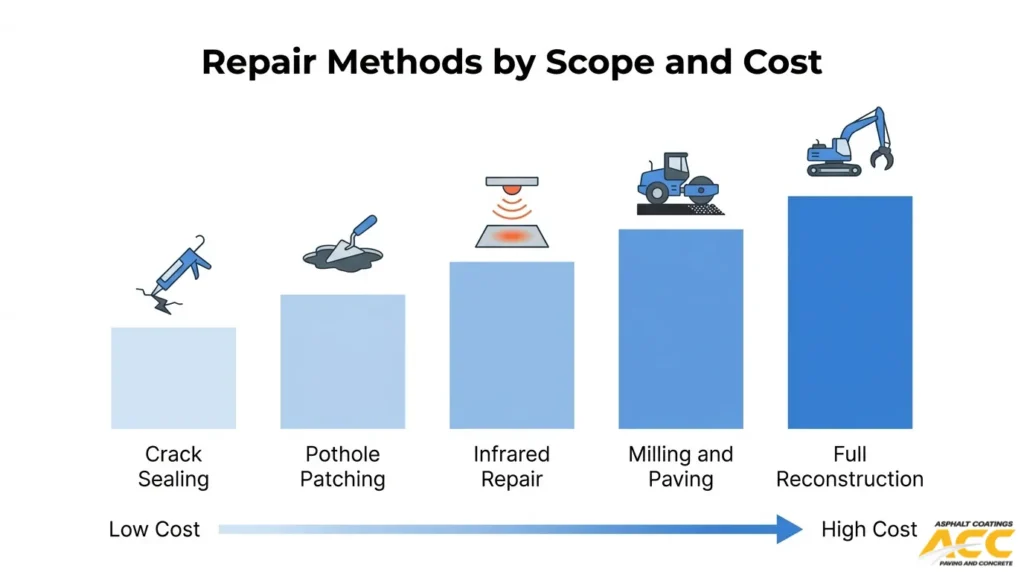
Available methods span a wide range: crack sealing for early-stage fractures, pothole patching for isolated failures, infrared repair for seamless corrections, milling and paving for broad surface restoration, and full reconstruction when the base has failed entirely. Sealcoating adds a protective barrier against UV, moisture, and chemicals but only works on structurally sound surfaces.
Repair costs range from $0.10 per square foot for routine maintenance to $10 or more for major reconstruction, and proactive scheduling consistently reduces long-term expenses. Repair longevity varies from 3 years for basic patches to 15+ years for properly installed overlays.
Seasonal timing, ADA slope and signage requirements, phased work plans, and tenant communication all shape project outcomes. Evaluating contractors on qualifications, in-house crew structure, and detailed proposals protects both quality and budget across every property in a portfolio.
What Are the Most Common Commercial Asphalt Problems in Fort Collins?
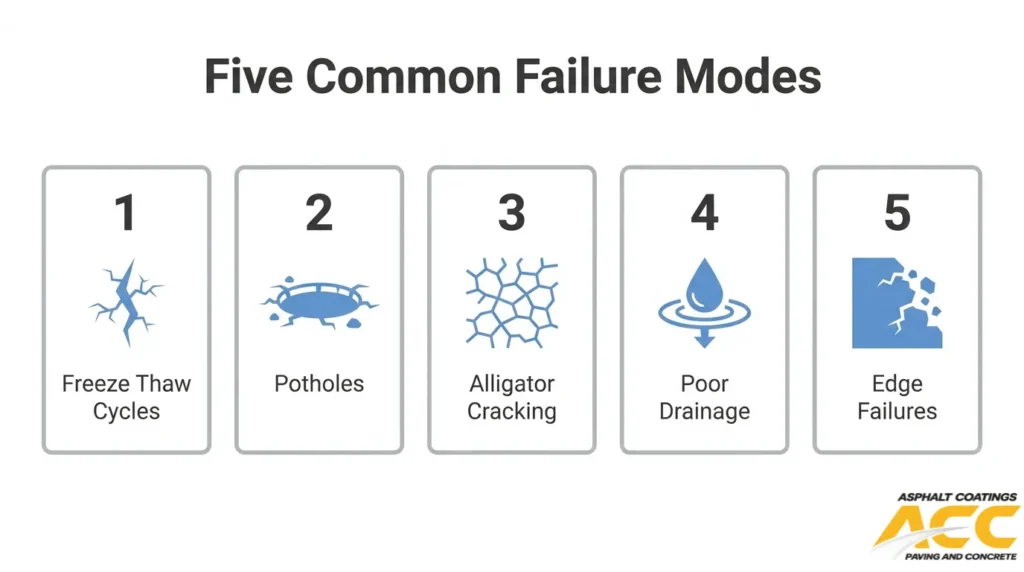
The most common commercial asphalt problems in Fort Collins stem from freeze-thaw cycling, heavy traffic loads, poor drainage, and edge deterioration. Each issue develops differently and demands a specific response.
How Does Colorado’s Freeze–Thaw Cycle Damage Commercial Asphalt?
Colorado’s freeze-thaw cycle damages commercial asphalt by forcing water trapped in small cracks and pores to expand repeatedly as temperatures fluctuate above and below freezing. Each cycle widens existing fractures and weakens the pavement structure from within.
Along the northern Front Range, these transitions can happen dozens of times per season. Moisture enters through hairline surface cracks, freezes overnight, and thaws during the day, progressively breaking apart the binder that holds aggregate together. Over successive winters, what starts as minor surface cracking can develop into base-layer failures.
According to Dunn Company, the most effective way to limit freeze-thaw damage is through proactive pavement maintenance completed before and after winter conditions. For Colorado commercial lots, this means pre-winter crack sealing and post-winter inspections are not optional; they are foundational to pavement longevity.
Why Do Potholes Form in Fort Collins Commercial Parking Lots?
Potholes form in Fort Collins commercial parking lots when subsurface moisture weakens the base layer and repeated vehicle loading breaks away weakened surface material. The process begins with water infiltrating through unsealed cracks.
Fort Collins compounds this problem with its shifting climate patterns. According to the Colorado Climate Center, wintertime precipitation on the northern Front Range has increased by 14% since 1950. More moisture cycling through pavement means accelerated base erosion beneath high-traffic areas. Heavy delivery trucks and turning movements at drive lanes concentrate stress on already compromised sections, punching through the weakened surface. Once a pothole opens, each passing vehicle enlarges it, making early patching critical before small failures become costly structural problems.
What Causes Alligator Cracking and Surface Fatigue in Busy Lots?
Alligator cracking and surface fatigue in busy lots are caused by repeated load stress exceeding the pavement’s structural capacity. The interconnected crack pattern resembles reptile skin, signaling that fatigue has reached the asphalt’s lower layers.
This failure typically originates from one or more underlying conditions:
- Insufficient pavement thickness for the actual traffic volume the lot receives.
- Base layer degradation from moisture intrusion over multiple seasons.
- Oxidation and binder aging that make the surface brittle and less flexible under load.
- Concentrated heavy traffic in drive aisles, loading zones, and dumpster pads.
Unlike surface-only cracking, alligator patterns indicate structural distress. Sealcoating alone cannot fix this issue because the damage extends below the wearing course. In my experience, lots that develop alligator cracking within the first ten years almost always have an undersized base or a drainage problem that was never addressed during construction.
How Do Poor Drainage and Standing Water Lead to Asphalt Failure?
Poor drainage and standing water lead to asphalt failure by saturating the base and subgrade layers, which strips the bond between asphalt binder and aggregate. Prolonged water contact softens the foundation that supports the entire pavement structure.
Common drainage problems in commercial lots include:
- Clogged or undersized catch basins that cannot handle storm volumes.
- Low spots and depressions where water pools after rain or snowmelt.
- Damaged curb lines that redirect water onto the pavement surface instead of away from it.
- Poorly graded transitions between asphalt and concrete elements.
Once standing water persists, the subgrade loses its load-bearing strength. Traffic then pushes the weakened surface downward, accelerating rutting and cracking. Addressing grade issues and maintaining functional drainage infrastructure prevents the kind of progressive failure that eventually requires full-depth reconstruction.
Why Do Parking Lot Edges and Entrances Deteriorate Faster?
Parking lot edges and entrances deteriorate faster because they lack lateral support and absorb concentrated turning stress from vehicles. Unsupported edges are especially vulnerable since there is no adjacent pavement to distribute load.
Entrances compound the problem. Every vehicle entering or exiting applies braking and turning forces to the same narrow zone, creating repetitive shear stress. Delivery trucks and heavy vehicles intensify this wear significantly. Without proper curbing or a thickened edge detail, the asphalt along these transitions crumbles and ravels at a rate far exceeding the lot interior.
Routine edge maintenance and reinforced entrance sections are among the most cost-effective investments a property manager can make. Neglecting these high-stress zones often leads to premature failures that spread inward across the lot.
Understanding these common failure modes helps property managers prioritize the right repair methods at the right time.
How Can You Tell If Your Commercial Asphalt Needs Repair or Replacement?
You can tell if your commercial asphalt needs repair or replacement by watching for progressive surface deterioration, structural distress patterns, and functional failures. The sections below cover early warning signs, deeper structural indicators, end-of-life signals, and the overlay versus replacement decision.
What Early Warning Signs Suggest Your Asphalt Needs Minor Repairs?
Early warning signs that suggest your asphalt needs minor repairs include:
- Hairline surface cracks that have not yet widened or interconnected
- Faded or worn striping that reduces parking lot visibility and traffic flow
- Small depressions or birdbaths where water pools after rain
- Raveling surfaces where loose aggregate scatters across the lot
- Faded or damaged ADA signage, which is especially critical to address quickly
Worn striping and signage failures carry compliance risk beyond aesthetics. According to Safety Decals, incorrect ADA parking signs can lead to fines starting at $75,000 for a first violation under the Americans with Disabilities Act. Catching these surface-level issues early keeps repair costs low and prevents water infiltration that accelerates deeper damage.
When Do Cracks and Rutting Indicate Deeper Structural Issues?
Cracks and rutting indicate deeper structural issues when the distress patterns reflect base failure rather than surface wear. Alligator cracking, characterized by interconnected fractures resembling reptile skin, signals fatigue in the asphalt’s structural layers. Ruts deeper than half an inch along wheel paths suggest the subgrade or base course has compressed or shifted under repeated loading.
Longitudinal cracks running parallel to traffic flow often point to joint failure or inadequate base support. When multiple distress types appear together in the same area, the underlying layers have likely been compromised by moisture intrusion. At that stage, surface repairs alone will not hold, and structural correction becomes necessary.
How Can You Know If Your Asphalt Has Reached the End of Its Life?
You can know if your asphalt has reached the end of its life when widespread failure patterns make localized repairs impractical. Key indicators include:
- Alligator cracking covering more than 25% of the surface area
- Severe rutting and grade changes that affect drainage
- Base material visible through eroded or missing surface layers
- Persistent standing water despite previous drainage corrections
- Repeated patch failures in the same locations within one to two seasons
When repair costs across a lot begin approaching 40% to 50% of full replacement cost, reconstruction typically delivers better long-term value. A pavement that demands constant patching has functionally exhausted its structural capacity.
When Is It Better to Overlay Versus Completely Replace Asphalt?
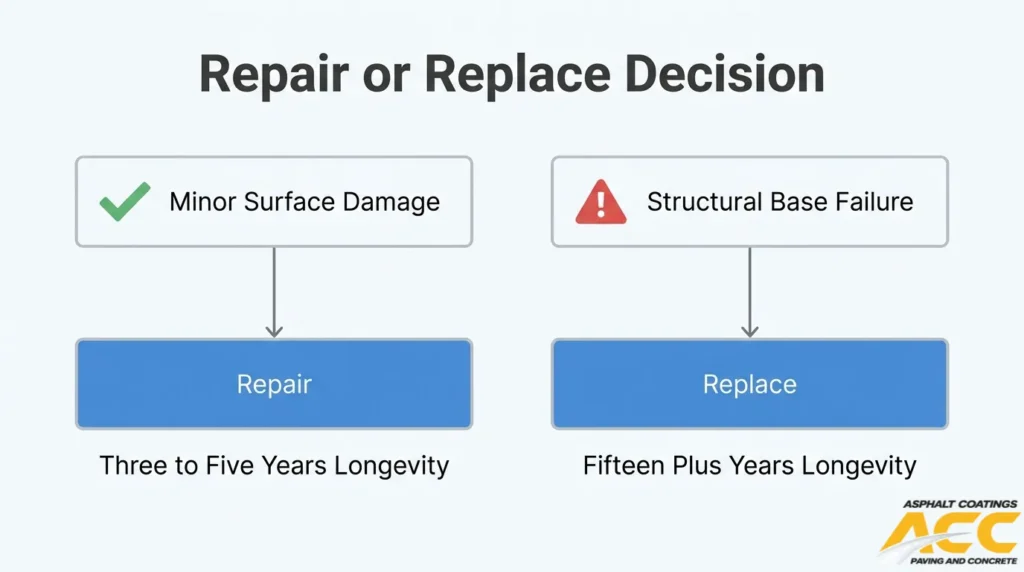
It is better to overlay when the existing base remains structurally sound and surface distress is primarily cosmetic or limited to the top layers. An overlay adds a new asphalt lift directly over the existing surface, restoring rideability and appearance at a fraction of full replacement cost.
Complete replacement is the better choice when the base course or subgrade has failed. Signs that rule out an overlay include deep rutting, widespread alligator cracking, and soft or unstable base material. Overlaying a compromised base traps the existing problems beneath a thin new layer, leading to premature failure.
For property managers weighing the two options, a core sample or pavement evaluation reveals whether the base can support an overlay. Understanding asphalt repair options helps you match the right method to the actual condition.
What Types of Commercial Asphalt Repairs Are Available?
The types of commercial asphalt repairs available range from preventive crack sealing to full-depth reclamation. Each method addresses a specific level of damage, and the sections below cover when to use crack sealing, pothole patching, infrared repair, milling and paving, or complete reconstruction.
When Is Crack Sealing the Right Fix for a Commercial Lot?
Crack sealing is the right fix for a commercial lot when cracks are still narrow, stable, and have not yet compromised the base layer. This preventive method applies heated sealant into individual cracks to block water infiltration before it causes subgrade erosion or pothole formation.
According to a Minnesota Department of Transportation report, crack sealing and crack filling are important preventive maintenance treatments that can minimize water intrusion into underlying pavement layers, supporting a longer service life. For commercial lots with early-stage linear or transverse cracking, sealing remains one of the most cost-effective interventions available. Once cracks widen beyond roughly three-quarters of an inch or show signs of base movement, a more aggressive repair method is typically warranted.
When Should You Choose Pothole Patching for Localized Damage?
You should choose pothole patching for localized damage when isolated depressions or holes appear in otherwise sound pavement. Pothole patching targets specific failure points without disturbing the surrounding asphalt.
This method works best when the subgrade beneath the pothole is still stable. Crews remove loose debris, square the edges, and compact fresh hot-mix asphalt into the cavity. If potholes keep recurring in the same area, that pattern often signals deeper structural failure requiring a more extensive repair. For scattered, individual potholes on a lot that is generally in good condition, patching delivers a fast, budget-friendly solution that restores a safe driving surface.
How Does Infrared Asphalt Repair Work for Commercial Properties?
Infrared asphalt repair works by using infrared heat panels to soften existing asphalt in place, allowing crews to rake, add fresh material, and recompact the area into a seamless, bonded patch. This process recycles the original pavement rather than removing and replacing it.
According to an Academia.edu policy brief, the infrared reclaimer maintains hot-mix asphalt at a workable temperature between 250 and 350°F, with surface heating typically reaching about 320°F during repair. Because the heated area bonds thermally with the surrounding pavement, infrared patches resist water penetration better than cold-applied methods. This technique is especially practical for commercial properties that need quick, low-disruption repairs in high-traffic zones.
When Is Asphalt Skin Patching or Milling and Paving Appropriate?
Asphalt skin patching or milling and paving is appropriate when surface-level deterioration covers a broad area but the base layer remains structurally sound. Skin patching applies a thin asphalt overlay to worn sections, while milling and paving removes the top layer mechanically before placing new hot-mix.
Milling creates a uniform surface profile that promotes proper bonding with the fresh asphalt layer. This approach suits commercial lots showing widespread surface raveling, shallow rutting, or oxidation across large sections. Property managers often find milling and paving strikes the right balance between cost and longevity when full reconstruction is premature. If core samples reveal base failure beneath the surface damage, however, a deeper intervention becomes necessary.
When Do You Need Full-Depth Asphalt Reclamation or Reconstruction?
You need full-depth asphalt reclamation or reconstruction when the pavement base has failed beyond the reach of surface-level repairs. Widespread alligator cracking, persistent standing water, and recurring potholes across the same zones all point to structural compromise.
As described by Asphalt Pro, full-depth reclamation is the process of pulverizing and blending all layers of an asphalt pavement in place, along with part or all of the underlying materials, to create a new base. Reconstruction goes further by fully removing and rebuilding the subgrade. For heavily deteriorated commercial lots, these methods reset the pavement structure entirely, delivering the longest service life of any repair option. Choosing the right approach between repair and reconstruction ultimately depends on a thorough site evaluation.
How Does Crack Sealing Help Protect Commercial Asphalt in Fort Collins?
Crack sealing helps protect commercial asphalt in Fort Collins by blocking water infiltration before freeze-thaw cycles widen damage. The sections below cover which cracks qualify for sealing, when damage has progressed too far, and how often Colorado commercial lots need this service.
What Kinds of Cracks Can Be Successfully Sealed?
The kinds of cracks that can be successfully sealed are linear, non-interconnected cracks that have not yet compromised the pavement’s structural base. These include:
- Longitudinal cracks running parallel to the pavement centerline, typically caused by aging binder or joint failure.
- Transverse cracks running perpendicular to traffic flow, commonly triggered by thermal contraction during cold nights.
- Reflective cracks that telegraph upward from joints or cracks in an underlying layer.
- Edge cracks forming along lot perimeters where support from curbing or shoulders is limited.
Cracks narrower than roughly three-quarters of an inch with stable, firm edges are the strongest candidates. Once properly cleaned and filled with hot-applied sealant, these cracks resist moisture penetration and slow further deterioration. For commercial lots handling daily traffic, sealing these crack types early is one of the most cost-effective ways to extend pavement life. Professional contractors experienced in Colorado’s climate use CDOT-approved materials for crack sealing to ensure repairs withstand the region’s demanding freeze-thaw conditions.
When Is It Too Late to Seal Cracks and You Need a Bigger Repair?
It is too late to seal cracks when the damage extends beyond surface-level fractures into the pavement structure itself. Several conditions signal that sealing alone will not restore performance:
- Alligator cracking (interconnected, pattern cracking) indicates base failure beneath the surface.
- Cracks wider than one inch with crumbling or missing edges cannot hold sealant reliably.
- Significant settling or depression around cracked areas suggests subgrade compromise.
- Multiple crack types converging in one zone often means the pavement section has exhausted its service life.
When these conditions appear, repairs such as skin patching, milling and paving, or full-depth reclamation become necessary. Continuing to seal structurally failed pavement wastes material and delays the correction that the base layer actually requires. A professional evaluation distinguishes cosmetic surface cracks from symptoms of deeper failure, which helps property managers allocate repair budgets accurately.
How Often Should Commercial Lots in Colorado Have Cracks Sealed?
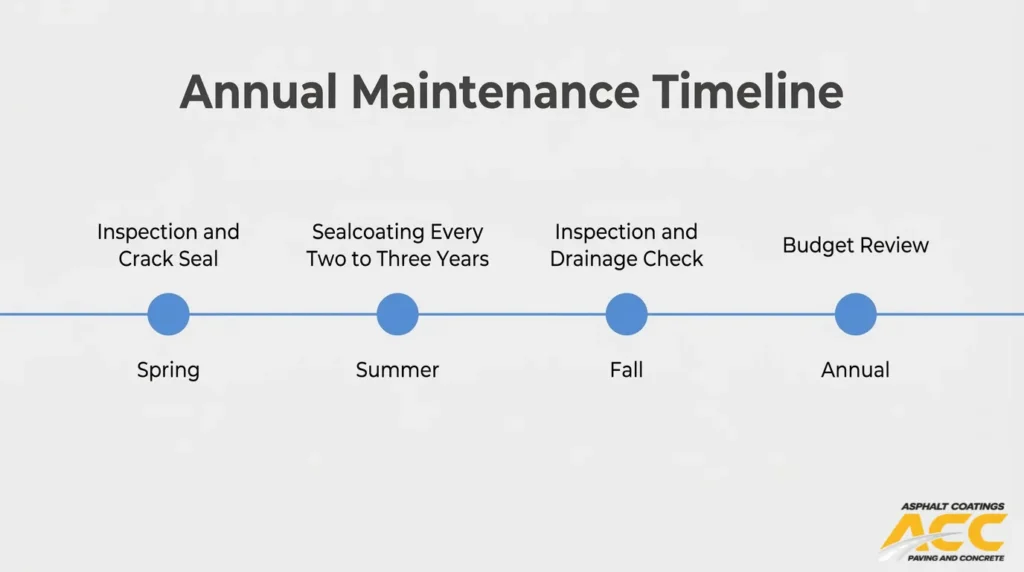
Commercial lots in Colorado should have cracks sealed annually or at minimum every one to two years, depending on traffic volume and exposure. Colorado’s northern Front Range presents particularly aggressive conditions for asphalt. According to the Colorado Climate Center, wintertime precipitation on the northern Front Range has increased by 14% since 1950, intensifying the moisture load that drives freeze-thaw damage each season.
Higher precipitation means more water entering pavement cracks during winter, and each freeze-thaw cycle expands that water by roughly 9%, progressively widening untreated fractures. High-traffic commercial lots in Fort Collins benefit from annual spring inspections followed by prompt sealing of any new cracks discovered after winter. Properties with lighter traffic or newer pavement may extend the interval to every two years, though skipping beyond that window in this climate risks compounding damage that escalates repair costs significantly.
Understanding crack sealing timelines sets the stage for another key protective layer: sealcoating.
What Should Commercial Property Owners Know About Sealcoating?
Commercial property owners should know that sealcoating is a preventive treatment that shields asphalt from UV rays, moisture, and chemical damage. The following sections cover climate-specific protection, scheduling frequency, weather considerations, and sealcoating’s limitations.
How Does Sealcoating Protect Parking Lots in Colorado’s Climate?
Sealcoating protects parking lots in Colorado’s climate by creating a sealed barrier over the asphalt surface that blocks UV radiation, water infiltration, and oil penetration. Colorado’s intense high-altitude sun accelerates oxidation, which dries out asphalt binder and makes surfaces brittle. A properly applied sealcoat slows this process considerably.
Moisture protection matters just as much. When water penetrates unsealed asphalt and freezes, it expands and creates internal pressure that leads to cracking and pothole formation. Sealcoating fills surface voids and reduces the entry points where water can begin this destructive freeze-thaw cycle. It also resists damage from deicing chemicals commonly used across Colorado’s Front Range throughout winter. For properties facing both extreme sun and harsh winters, sealcoating is one of the most cost-effective first lines of defense.
How Often Should a Busy Commercial Lot Be Sealcoated?
A busy commercial lot should be sealcoated every two to three years under normal conditions. High-traffic properties, such as shopping centers and distribution warehouses, may need reapplication closer to the two-year mark because vehicle traffic wears through the coating faster.
Several factors influence the ideal frequency:
- Traffic volume and vehicle weight (heavier trucks accelerate wear).
- Exposure to direct sunlight and UV intensity.
- Frequency of deicing chemical application during winter months.
- Quality of the previous sealcoat application and material used.
Waiting too long between applications allows oxidation and moisture damage to resume, which shortens overall pavement life. For most commercial properties in Colorado, a consistent two-to-three-year cycle strikes the right balance between cost control and surface protection.
When Should You Delay or Reschedule Sealcoating Due to Weather?
You should delay or reschedule sealcoating when temperatures fall below 50°F or rain is expected within 24 hours of application. Sealcoat material requires warm, dry conditions to cure properly; cold temperatures prevent the emulsion from bonding to the asphalt surface.
Key conditions that require postponement include:
- Ambient or surface temperatures below 50°F.
- Rain, heavy dew, or high humidity forecasted within 24 hours.
- Overnight temperatures expected to drop below 50°F before the coating cures.
- Standing water on the pavement surface.
In Colorado, afternoon thunderstorms can develop quickly during summer months, so scheduling early-morning application with adequate cure time is a practical strategy. Applying sealcoat under poor conditions leads to peeling, uneven coverage, and wasted material.
Can Sealcoating Hide Existing Asphalt Damage or Just Protect It?
Sealcoating can protect asphalt from future damage, but it cannot hide or repair existing structural problems. It is a surface-level treatment designed to seal out moisture and UV exposure; it does not fill cracks, level depressions, or restore compromised base layers.
Applying sealcoat over damaged pavement creates a misleading appearance. The surface may look fresh, yet underlying issues like alligator cracking, potholes, and base failure continue to worsen beneath the coating. Proper repair sequence matters: crack sealing, patching, and any structural corrections should always be completed before sealcoating is applied. Skipping this step wastes the sealcoat investment because damaged areas break through the new coating quickly. Think of sealcoating as armor for healthy pavement, not a cosmetic fix for neglected surfaces.
Understanding sealcoating’s role helps property owners plan repairs and protective treatments in the right order, which directly affects long-term costs.
How Much Does Commercial Asphalt Repair Typically Cost?
Commercial asphalt repair typically costs anywhere from $0.10 per square foot for routine maintenance to $10 or more per square foot for major work. The final price depends on damage severity, repair method, site logistics, and maintenance history.
How Do Size and Severity of Damage Affect Repair Pricing?
Size and severity of damage affect repair pricing because larger damaged areas require more material, labor, and equipment time. A few isolated cracks cost far less to address than widespread alligator cracking that signals base failure beneath the surface.
Depth matters as much as square footage. Surface-level distress like minor cracking or shallow raveling can be corrected with relatively inexpensive treatments. Once damage extends through the asphalt layer into the subgrade, however, the repair scope expands significantly. Excavation, base stabilization, and full-depth replacement all add cost. For commercial property managers budgeting across multiple lots, prioritizing repairs by severity ensures the most critical areas receive attention before minor issues escalate into expensive reconstructions.
How Does Repair Type (Crack Fill vs. Patch vs. Overlay) Change Cost?
Repair type changes cost significantly because each method requires different materials, equipment, and labor intensity. According to C. Brooks Paving, routine maintenance runs as low as $0.10 to $0.25 per square foot, while new asphalt installation ranges from $4 to $10 per square foot.
The cost spectrum across common repair types breaks down roughly as follows:
- Crack filling and sealing sits at the lowest end, requiring minimal material and equipment.
- Pothole patching costs more per repair due to saw-cutting, removal, and compaction of new hot-mix asphalt.
- Skin patching and milling involve surface removal equipment, increasing both labor and disposal costs.
- Overlay (resurfacing) adds a new asphalt layer over existing pavement, typically ranging from $0.90 to $4.50 per square foot depending on thickness and preparation.
- Full-depth reclamation or reconstruction represents the highest cost tier, often approaching or exceeding new installation prices.
Choosing the right repair method for the actual condition avoids both underspending and overspending.
How Do Access, Phasing, and Business Hours Impact the Final Price?
Access, phasing, and business hours impact the final price because working around active tenants, traffic flow, and limited staging areas adds complexity that increases labor costs. A straightforward overnight closure of a vacant lot costs less than a phased project requiring traffic control plans and multiple mobilizations across several weekends.
Key factors that drive logistics-related cost increases include:
- Limited access for equipment delivery and material staging in tight commercial sites.
- Phased closures that split work into smaller sections, requiring crews to return multiple times.
- After-hours or weekend scheduling that may carry premium labor rates.
- Traffic control setups including cones, barricades, and flaggers for lots that remain partially open.
Property managers who plan ahead and coordinate tenant communication early can often reduce these logistical premiums by consolidating work phases.
How Can Proactive Maintenance Reduce Long-Term Asphalt Costs?
Proactive maintenance reduces long-term asphalt costs by addressing minor damage before it escalates into expensive structural failures. According to Brixco, routine asphalt maintenance costs far less than full pavement replacement because preventative services can be planned in advance, avoiding emergency repairs.
The math is straightforward. Sealcoating and crack sealing at $0.10 to $0.25 per square foot every few years is dramatically cheaper than a full overlay or reconstruction at $4 to $10 per square foot. A scheduled maintenance program spreads costs predictably across annual budgets rather than creating sudden capital expenses. For commercial properties with high traffic volumes, this approach also minimizes tenant disruption and liability exposure from deteriorating surfaces.
Investing in a maintenance plan consistently delivers the best return on pavement investment over a parking lot’s full lifecycle.
How Long Do Commercial Asphalt Repairs Last in Fort Collins Conditions?
Commercial asphalt repairs in Fort Collins last anywhere from 3 years for basic patches to 15+ years for overlays, depending on repair type, traffic load, and maintenance. Fort Collins climate conditions accelerate wear uniquely; according to a Climatewise report, average temperatures in the city have risen 2–4°F over the last century, causing more precipitation to fall as rain instead of snow. This shift increases moisture exposure year-round, which directly affects repair longevity across every method.
How Long Should Professional Crack Sealing Typically Last?
Professional crack sealing typically lasts 3 to 5 years on commercial properties when applied correctly with hot-pour, rubberized sealant. In Fort Collins, where freeze-thaw cycles occur frequently throughout winter and early spring, sealed cracks face repeated expansion and contraction stress. Sealant flexibility degrades faster under intense UV exposure at Colorado’s elevation, which can shorten lifespan by a year or more on south-facing lot sections. Routing cracks before sealing improves adhesion and extends performance closer to the 5-year mark. Properties with heavy truck traffic may see shorter intervals because constant loading widens sealed joints over time.
How Durable Are Pothole Patches Under Heavy Commercial Traffic?
Pothole patches under heavy commercial traffic typically last 2 to 5 years, with durability depending on patch method and base condition. Cold-mix patches applied as temporary fixes often fail within one season under loaded delivery trucks and constant turning movements. Hot-mix patches with proper compaction perform significantly better, especially when the damaged subgrade is excavated and replaced before patching. For high-traffic areas like loading docks and drive-through lanes, full-depth patches that address the aggregate base deliver the longest service life. Skipping base repair is the most common reason commercial patches fail prematurely, regardless of surface material quality.
How Long Can You Expect an Overlay to Perform in Colorado?
An overlay in Colorado can perform for 10 to 15 years when installed over structurally sound existing pavement. Overlay longevity depends heavily on the condition of the underlying surface; reflective cracking from the old pavement below is the primary failure mode. Applying a fabric interlayer before the overlay helps delay crack migration and adds 2 to 3 years of service life. Colorado’s temperature swings, which can exceed 40°F in a single day along the Front Range, stress overlay bonds more aggressively than milder climates. Proper milling of the existing surface before overlay installation creates the mechanical bond needed for long-term adhesion in these conditions.
What Maintenance Extends the Life of Completed Asphalt Repairs?
Maintenance that extends the life of completed asphalt repairs includes sealcoating, routine crack sealing, drainage upkeep, and scheduled inspections. These practices protect repair investments in specific ways:
- Sealcoating every 2 to 3 years shields patched areas and overlays from UV oxidation and moisture infiltration.
- Re-sealing new cracks within 6 months of appearance prevents water from reaching repaired subgrade layers.
- Clearing catch basins and maintaining lot drainage stops standing water from undermining patch edges.
- Biannual inspections, ideally in spring and fall, catch early deterioration before it spreads to adjacent pavement.
Neglecting even one of these steps can cut a repair’s effective lifespan in half. With Fort Collins conditions shifting toward more rain events, consistent drainage maintenance has become especially critical for protecting completed work.
How Do Weather and Seasonality in Northern Colorado Affect Asphalt Work?
Weather and seasonality in Northern Colorado affect asphalt work by dictating when repairs can be scheduled, how materials cure, and whether emergency fixes hold. The following sections cover ideal timing, required conditions, storm impacts, and cold-weather options.
What Is the Best Time of Year to Schedule Asphalt Repairs?
The best time of year to schedule asphalt repairs in Northern Colorado is late spring through early fall, roughly May through October. During these months, ambient temperatures consistently stay above the minimums hot-mix asphalt needs for proper compaction and bonding.
Fort Collins summers offer long, warm days that give crews reliable working windows and allow fresh asphalt to cool gradually. Early fall is particularly productive because temperatures are moderate, humidity is low, and most summer storm activity has subsided. Scheduling repairs during this window also avoids the freeze-thaw cycles that dominate Colorado winters and compromise fresh repair integrity. For property managers planning large-scope projects, booking contractors in late winter secures preferred dates before the busy season fills up.
What Temperatures and Conditions Are Needed for Quality Repairs?
The temperatures and conditions needed for quality asphalt repairs include ambient air temperatures of at least 50°F and rising, dry pavement surfaces, and low wind speeds. Hot-mix asphalt requires these conditions to compact properly and achieve the density that prevents premature failure.
Ground temperature matters as much as air temperature. A cold subgrade pulls heat from fresh asphalt too quickly, preventing adequate compaction. Ideally, surface temperatures should reach 50°F or higher before placement begins. Dry conditions are equally critical; moisture trapped beneath a new layer creates adhesion failures that lead to delamination within months. Low humidity and calm winds help the material cool at a controlled rate, which produces a denser, more durable finished surface.
How Do Sudden Storms or Temperature Swings Affect Cure Times?
Sudden storms or temperature swings affect cure times by disrupting the controlled cooling process that asphalt needs to reach full strength. In Northern Colorado, afternoon thunderstorms can roll in with little warning during summer months, and overnight temperatures can drop 30°F or more in spring and fall.
Rain hitting freshly placed asphalt washes away fine particles at the surface and can trap moisture beneath the top layer. Rapid temperature drops cause the outer surface to harden while the interior remains soft, creating an uneven bond. Both scenarios extend the time a repaired area must stay closed to traffic. Experienced crews monitor forecasts closely and plan pours for morning hours when conditions are most stable, building buffer time before afternoon weather shifts arrive. Established Colorado contractors with in-house crews can adjust scheduling and deployment quickly when weather windows shift, maintaining quality standards without the delays that subcontracted labor often introduces.
Can Emergency Asphalt Repairs Be Done in Cold or Wet Weather?
Yes, emergency asphalt repairs can be done in cold or wet weather, though the materials and methods differ from standard warm-season work. Cold-mix asphalt and specialized polymer-modified patching compounds are designed to perform at lower temperatures, making them suitable for temporary fixes when immediate hazards like deep potholes threaten vehicle safety or liability.
These cold-weather patches are functional stopgaps, not permanent solutions. According to All Purpose Paving, water seeps into small cracks and pores, and as temperatures drop below freezing, it expands by about 9% as it turns to ice, creating pressure within the pavement structure. This freeze-thaw action means temporary patches placed in winter will likely need replacement once warm-season conditions return. Addressing emergencies promptly still prevents further deterioration, even if a permanent repair must follow in spring.
Understanding seasonal constraints helps property managers plan repairs that last and budget for the unexpected.
How Can You Minimize Business Disruption During Asphalt Repairs?
You can minimize business disruption during asphalt repairs by phasing work strategically, managing parking and traffic flow, communicating schedules clearly, and timing projects during off-peak hours. The following sections cover each approach.
How Should You Phase Work for Busy Shopping Centers and Offices?
You should phase work for busy shopping centers and offices by dividing the project into smaller sections completed sequentially. This approach keeps a portion of the lot open at all times, so tenants retain customer access throughout the process.
Effective phasing strategies include:
- Splitting the lot into quadrants or zones, completing one before moving equipment to the next.
- Prioritizing high-traffic entrances and fire lanes first so they reopen quickly.
- Coordinating phase timing around peak business hours for anchor tenants.
- Allowing each completed zone to cure fully before reopening it to vehicles.
For properties with multiple tenants, phasing plans should account for delivery schedules and loading dock access. A well-structured phasing plan often makes the difference between a minor inconvenience and a genuine revenue loss for tenants.
What Parking and Traffic Control Plans Keep Tenants Happy?
Parking and traffic control plans keep tenants happy by maintaining safe, clearly marked access to storefronts and building entrances throughout the project. Temporary signage, cones, and barricades should redirect vehicles and pedestrians without confusion.
Key elements of an effective plan include:
- Designating temporary parking areas with clear directional signage.
- Assigning flaggers or traffic control personnel during heavy equipment operation.
- Maintaining ADA-accessible routes and parking stalls at all times.
- Keeping fire lanes and emergency vehicle access unobstructed.
Even a short period without visible wayfinding can frustrate customers enough that they leave. Investing in professional traffic control pays for itself by protecting tenant revenue during the repair window.
How Can You Communicate Repair Schedules to Tenants and Customers?
You can communicate repair schedules to tenants and customers by providing advance written notice, posting visible on-site signage, and sending progress updates as work proceeds.
Best practices for communication include:
- Distributing a written timeline to all tenants at least two weeks before work begins.
- Posting signage at lot entrances explaining dates, affected areas, and alternate parking.
- Providing a direct contact person for questions or scheduling conflicts.
- Sending brief email or text updates when phases shift or timelines change.
Proactive communication sets expectations and reduces complaints. When tenants feel informed, they cooperate with temporary inconveniences far more willingly than when repairs appear without warning.
When Is It Better to Schedule Work at Night or on Weekends?
It is better to schedule work at night or on weekends when daytime repairs would block critical access or significantly reduce customer traffic. According to D.B. Krieg, scheduling work during slower periods, weekends, or after hours is the most effective way to reduce the impact of pavement maintenance on tenants and customers.
Night and weekend scheduling works best for:
- Retail centers where weekday foot traffic drives the majority of tenant revenue.
- Medical offices and urgent care facilities that cannot lose daytime parking.
- Office parks where weekend lots sit largely empty.
Off-hours work may carry a modest cost premium for lighting and crew scheduling, but that expense is typically far less than the revenue tenants would lose from restricted daytime access. Understanding your property’s traffic patterns helps determine which approach delivers the best balance of cost and convenience.
What Safety and ADA Compliance Issues Relate to Asphalt Repair?
Safety and ADA compliance issues related to asphalt repair include accessible parking dimensions, slope limits, striping requirements, and signage standards. The following subsections cover how repairs improve access routes, when to reconfigure stalls, how drainage affects compliance, and what markings are required after lot work.
How Can Asphalt Repairs Improve ADA Parking and Access Routes?
Asphalt repairs improve ADA parking and access routes by correcting surface irregularities, restoring proper slopes, and ensuring dimensional compliance across accessible spaces. Settled or heaved pavement frequently pushes slopes beyond legal thresholds, and resurfacing or patching brings these areas back into specification.
According to the U.S. Department of Justice, car accessible spaces must have no more than a 2.08% slope in all directions and measure at least 96 inches wide with an access aisle at least 60 inches wide. Additionally, the U.S. Access Board requires that at least one of every six accessible spaces be van-sized.
Targeted repairs to trip hazards along access routes, curb ramps, and loading zones eliminate liability risks while keeping facilities welcoming for all visitors.
When Should You Repaint or Reconfigure Accessible Parking Stalls?
You should repaint or reconfigure accessible parking stalls whenever lot repairs alter the surface, change stall dimensions, or visibly fade existing markings. Overlays, patching, and milling remove painted lines entirely, making restriping mandatory before the lot reopens.
Reconfiguration is also necessary when a property changes use or adds square footage, since the total number of required accessible spaces scales with overall parking count. Faded symbols and worn boundary lines reduce visibility for drivers and expose property owners to compliance complaints. Repainting immediately after repairs, rather than deferring it, is the most practical way to stay compliant without scheduling a second mobilization.
How Do Slope and Drainage Changes Affect ADA Compliance?
Slope and drainage changes affect ADA compliance by altering cross-slopes, running slopes, and surface water flow across accessible routes and parking areas. Even minor grading adjustments during resurfacing can push a previously compliant space beyond the 2.08% maximum slope.
Drainage improvements that redirect water through accessible paths or create low points in stall areas introduce ponding, which makes wheelchair navigation difficult and accelerates surface deterioration. Before any grading or drainage work begins, measuring existing slopes with a digital level establishes a baseline. Contractors should verify post-repair grades against ADA thresholds at every accessible space, not just spot-check a few. Overlooking this step is one of the most common, and most expensive, compliance failures in commercial lot rehabilitation.
What Striping and Signage Are Required After Lot Repairs?
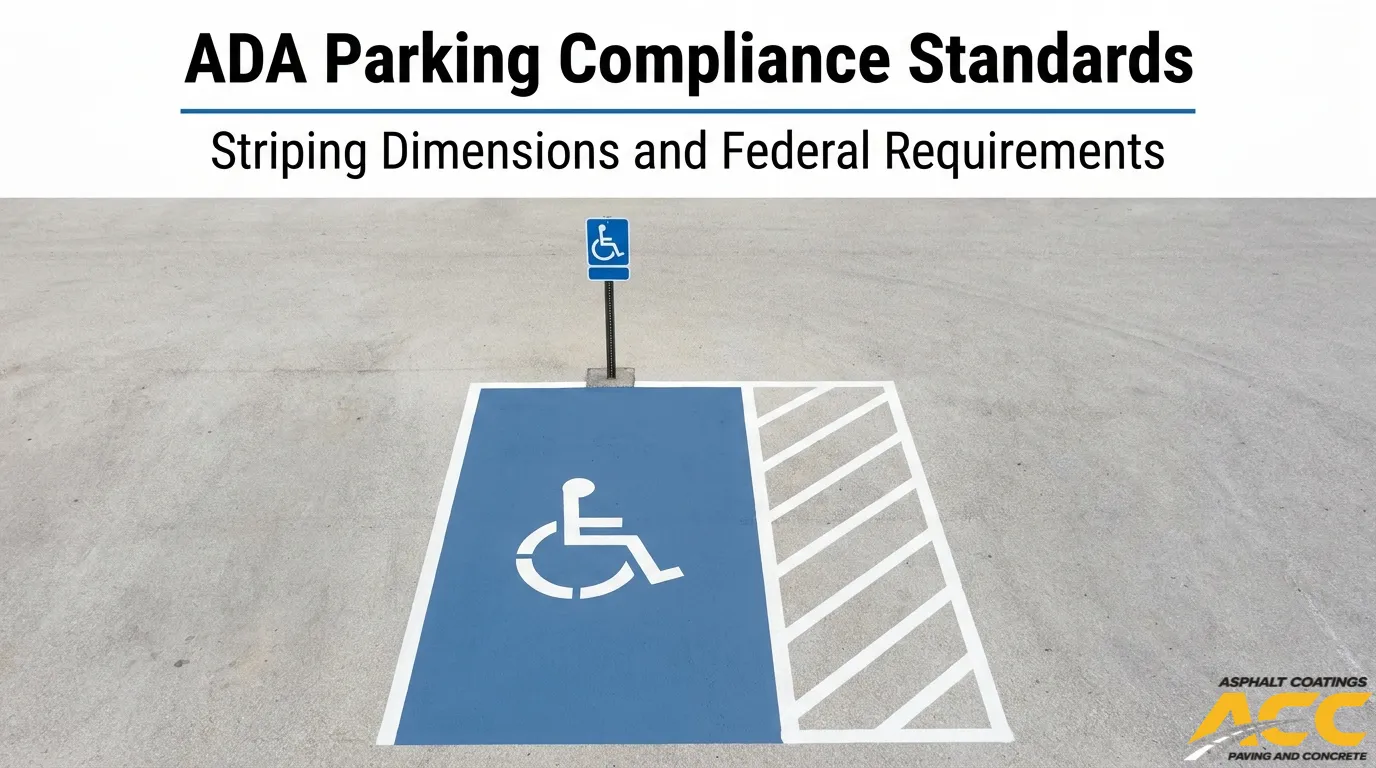
The striping and signage required after lot repairs include the International Symbol of Accessibility on each stall, “Van Accessible” designations where applicable, vertical signage mounted at a height visible even when a vehicle is parked, and clearly painted access aisles with diagonal hatch marks. Fines for incorrect ADA parking signage can start at $75,000 for a first violation under the Americans with Disabilities Act.
Essential post-repair striping and signage elements include:
- Access aisles marked with contrasting diagonal hatching.
- Ground-level wheelchair symbols in each accessible stall.
- Vertical signs with the accessibility symbol, mounted at the required height.
- “Van Accessible” labels on the appropriate number of spaces.
- Directional arrows guiding traffic toward accessible entrances.
Completing striping and signage immediately after paving work ensures no gap in compliance between repair completion and lot reopening. With compliance confirmed, property managers can shift focus to selecting the right contractor for ongoing maintenance.
How Should You Evaluate a Commercial Asphalt Contractor in Fort Collins?
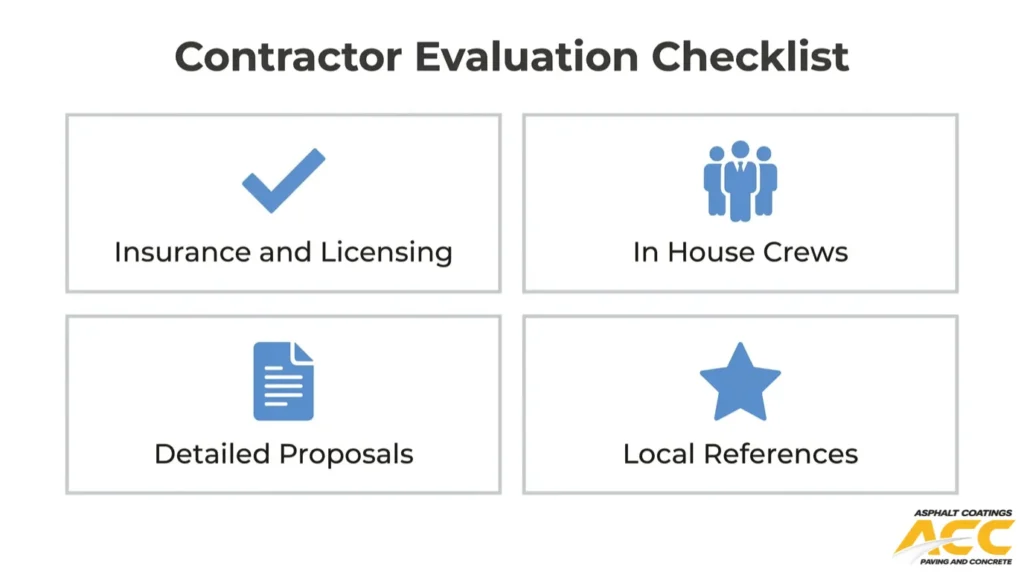
You should evaluate a commercial asphalt contractor in Fort Collins by verifying qualifications, reviewing crew structure, comparing detailed proposals, and checking local references. The following sections cover each evaluation step.
What Qualifications and Insurance Should a Contractor Provide?
The qualifications and insurance a contractor should provide include a valid Colorado contractor’s license, general liability coverage, workers’ compensation insurance, and proof of commercial auto insurance. Ask for certificates of insurance naming your property as additionally insured before any work begins.
A contractor with decades of regional experience understands Fort Collins soil conditions, drainage patterns, and freeze-thaw demands in ways that newer firms simply cannot. Beyond basic licensing, look for familiarity with CDOT-approved materials and ADA compliance standards, since commercial lots carry stricter regulatory requirements than residential driveways. Any contractor unwilling to share documentation upfront is not worth your time.
Why Do In-House Crews Often Deliver Better Quality and Consistency?
In-house crews often deliver better quality and consistency because a single company controls hiring, training, equipment, and on-site supervision throughout every project phase. When a contractor subcontracts paving, grading, or striping to separate firms, accountability fragments and communication gaps multiply.
Benefits of in-house crews include:
- Uniform training standards that produce consistent compaction, grading, and finish quality across every job.
- Direct supervision by the same project manager from subgrade preparation through final striping.
- Faster problem resolution, since the crew answering to one employer can adjust materials or scheduling without third-party delays.
- Greater equipment availability, reducing wait times for specialized machinery like milling or infrared units.
For property managers overseeing multiple facilities, this single-source structure simplifies vendor management considerably.
What Should Be Included in a Detailed Commercial Asphalt Proposal?
A detailed commercial asphalt proposal should include site location specifications, service descriptions, materials to be used, and warranty information. These essential scope details ensure both parties agree on deliverables before work begins.
Beyond those fundamentals, look for the following in every proposal:
- A clear project timeline with start dates, phase milestones, and estimated completion.
- Itemized pricing that separates material costs, labor, equipment, and any traffic control or phasing fees.
- ADA compliance provisions specifying accessible parking stall counts, slope corrections, and signage updates.
- A defined warranty period stating what is covered and for how long.
Proposals lacking itemized breakdowns make it difficult to compare bids accurately. The most detailed proposal usually reflects the most thorough contractor.
How Can You Check References and Past Projects in Your Area?
You can check references and past projects in your area by requesting a list of completed commercial properties in Fort Collins and Northern Colorado, then contacting those property managers directly. Ask about timeline adherence, communication quality, crew professionalism, and how the contractor handled unexpected issues.
Visit completed projects in person when possible. Walk the lot and inspect seam quality, drainage flow, striping precision, and surface uniformity. Online reviews offer supplementary insight, but direct conversations with property managers who manage similar facilities provide the most relevant feedback. A contractor confident in past work will share references without hesitation.
Knowing how to vet a contractor prepares you for the next step: building a long-term maintenance plan.
What Should Your Long-Term Parking Lot Maintenance Plan Include?
Your long-term parking lot maintenance plan should include scheduled inspections, routine cleaning, drainage upkeep, a repair prioritization strategy, and an annual budget for asphalt and concrete work. The following subsections break down each component.
How Often Should You Inspect a Commercial Lot for New Damage?
You should inspect a commercial lot for new damage at least twice per year, ideally in early spring and late fall. Spring inspections reveal winter’s toll from freeze-thaw cycling, while fall walkthroughs catch issues before snow and ice make them worse.
High-traffic areas like entrances, drive lanes, and loading zones deserve monthly visual checks. The most cost-effective pavement management approach, according to Health Facilities Management, targets a pavement condition rating in the satisfactory range of 71 to 85 on the PCI scale. Maintaining that target requires catching cracks, settling, and drainage failures before they compound. A simple inspection log with photos and dates creates an actionable repair history that prevents small problems from becoming major capital expenses.
What Routine Cleaning and Drainage Maintenance Protect Asphalt?
Routine cleaning and drainage maintenance protect asphalt by preventing water from pooling on or penetrating the pavement surface. Standing water is the single most destructive force acting on commercial asphalt over time.
Effective routine maintenance includes:
- Sweeping debris from the surface monthly to keep drain inlets clear.
- Flushing catch basins and storm drains at least twice annually.
- Removing vegetation growth along curb lines and expansion joints.
- Clearing snow and ice promptly to reduce prolonged moisture exposure.
When drainage structures clog, water backs up across the lot and accelerates base erosion beneath the asphalt. For property managers overseeing Colorado lots, where wintertime precipitation on the northern Front Range has increased significantly, keeping drainage systems functional is not optional; it is foundational to pavement longevity.
How Should You Prioritize Repairs Across Multiple Properties?
You should prioritize repairs across multiple properties by ranking each site based on pavement condition, safety risk, and business impact. Not every lot needs the same level of attention at the same time.
A practical prioritization framework includes:
- Safety-critical repairs first: Potholes, ADA compliance deficiencies, and trip hazards take top priority.
- High-traffic properties second: Lots serving retail centers or healthcare facilities degrade faster and affect more people daily.
- Preventive treatments third: Crack sealing and sealcoating on lots still in good condition protect your strongest assets.
- Cosmetic updates last: Restriping and signage refreshes matter, but only after structural integrity is secured.
Scheduling work during slower business periods minimizes disruption to tenants and customers. This phased approach spreads costs across fiscal years while keeping every property above minimum condition thresholds.
How Can You Budget Annually for Asphalt and Concrete Upkeep?
You can budget annually for asphalt and concrete upkeep by allocating a per-square-foot maintenance reserve based on each property’s age, condition, and expected service cycle. Routine maintenance typically runs $0.10 to $0.25 per square foot annually, according to C. Brooks Paving, while neglected lots requiring resurfacing or reconstruction can cost several dollars per square foot.
A sound annual budgeting approach includes:
- Establishing a baseline cost per square foot for each property using recent inspection data.
- Setting aside funds for predictable preventive work like crack sealing and sealcoating.
- Reserving a contingency of 10 to 15 percent for unexpected repairs after severe weather events.
- Reviewing and adjusting allocations each year based on updated condition assessments.
Preventive spending is always cheaper than reactive spending. Property managers who fund small annual maintenance line items avoid the budget shock of emergency full-depth repairs, which is particularly important across multi-property portfolios where deferred maintenance compounds quickly.
With a structured maintenance plan in place, partnering with the right local contractor ensures consistent execution.
How Should You Approach Fort Collins Commercial Asphalt Repair With a Local Expert?
You should approach Fort Collins commercial asphalt repair by partnering with a contractor who understands local climate challenges, offers comprehensive services, and prioritizes long-term pavement performance over quick fixes.
Can Asphalt Coatings Company Help With Commercial Asphalt Repair and Maintenance Needs?
Yes, Asphalt Coatings Company can help with commercial asphalt repair and maintenance needs across Fort Collins and Colorado’s Front Range. Since 1986, Asphalt Coatings Company has served Colorado’s Front Range with comprehensive asphalt and concrete services for commercial properties, including paving, patching, crack sealing, sealcoating, mill and pave services, striping, and ADA-compliant concrete work. In-house crews handle every phase of a project, eliminating the inconsistency that comes with subcontracted labor.
This single-source approach matters because maintenance costs scale dramatically when neglected. According to C. Brooks Paving, commercial paving typically costs $4 to $10 per square foot for new installation, while routine maintenance runs as low as $0.10 to $0.25 per square foot. Investing in preventive care through a dedicated local partner keeps properties safe and budgets predictable.
What Are the Key Takeaways About Fort Collins Commercial Asphalt Repair We Covered?
The key takeaways about Fort Collins commercial asphalt repair center on proactive maintenance, informed decision-making, and local expertise:
- Colorado’s freeze-thaw cycles and rising temperatures create unique stress on commercial pavement, making climate-adapted repair strategies essential.
- Identifying damage early, from hairline cracks to drainage failures, prevents small issues from escalating into costly reconstruction.
- Repair options range from crack sealing and patching to overlays and full-depth reclamation, each suited to specific damage levels.
- Sealcoating and routine crack sealing extend pavement life when performed on a consistent schedule.
- ADA compliance requires precise slope measurements, correct stall dimensions, and proper signage after every repair.
- Phased scheduling and clear tenant communication minimize business disruption during active projects.
- Choosing a contractor with verifiable qualifications, detailed proposals, and in-house crews protects both quality and budget.
For property managers ready to protect their pavement investment, Asphalt Coatings Company brings 39 years of Colorado-specific expertise and full-service capabilities to keep Fort Collins commercial lots performing for years.