Fort Collins weather impacts asphalt through a combination of freeze-thaw cycling, extreme seasonal temperatures, moisture infiltration, and high-altitude UV radiation that compound each other to accelerate pavement deterioration far faster than in lower-elevation or milder climates.
This guide covers Fort Collins’ unique climate stressors and how they damage pavement, the specific distress signs property managers should monitor, preventive maintenance and seasonal timing strategies, asphalt design and construction decisions for Colorado conditions, and repair-versus-replacement planning for weather-damaged surfaces.
Fort Collins sits at 5,000 feet elevation, where winter lows drop to 18°F and summer highs reach 89°F. That 70-degree seasonal range forces asphalt through constant expansion and contraction, while 51.4 inches of average annual snowfall introduces moisture that expands roughly 9% when it freezes inside cracks. Each freeze-thaw cycle widens existing damage and weakens the pavement base from within.
UV exposure at this altitude runs 20% to 30% higher than at sea level, oxidizing the asphalt binder and increasing its stiffness by up to 40%. When combined with summer heat, the oxidation rate doubles for every 18°F increase in surface temperature. Deicing salts applied during winter further degrade binder-aggregate adhesion, compounding the structural loss.
Property managers can counter these forces through sealcoating every two to three years, annual crack sealing timed to spring and fall temperature windows, and proper drainage design that prevents ponding. When damage progresses beyond surface treatments, understanding whether crack sealing, mill-and-overlay, or full reconstruction fits the situation prevents wasted spending on the wrong repair tier.
How Does Fort Collins’ Climate Uniquely Affect Asphalt Pavement?
Fort Collins’ climate uniquely affects asphalt pavement through a combination of extreme temperature swings, intense high-altitude UV radiation, heavy seasonal snowfall, and repeated freeze-thaw cycles. These forces work together in ways that accelerate deterioration far beyond what pavement experiences at lower elevations or in milder climates.
Fort Collins sits at approximately 5,000 feet elevation, where annual temperatures range from winter lows of 18°F in February to summer highs reaching 85-89°F in July and August, according to the National Centers for Environmental Information (NOAA). That 70-degree seasonal spread forces asphalt through constant expansion and contraction cycles. With roughly 300 days of sunshine per year, UV exposure compounds the problem by oxidizing the asphalt binder, making it stiffer and more crack-prone. Meanwhile, 51.4 inches of average annual snowfall introduces moisture that penetrates the pavement surface.
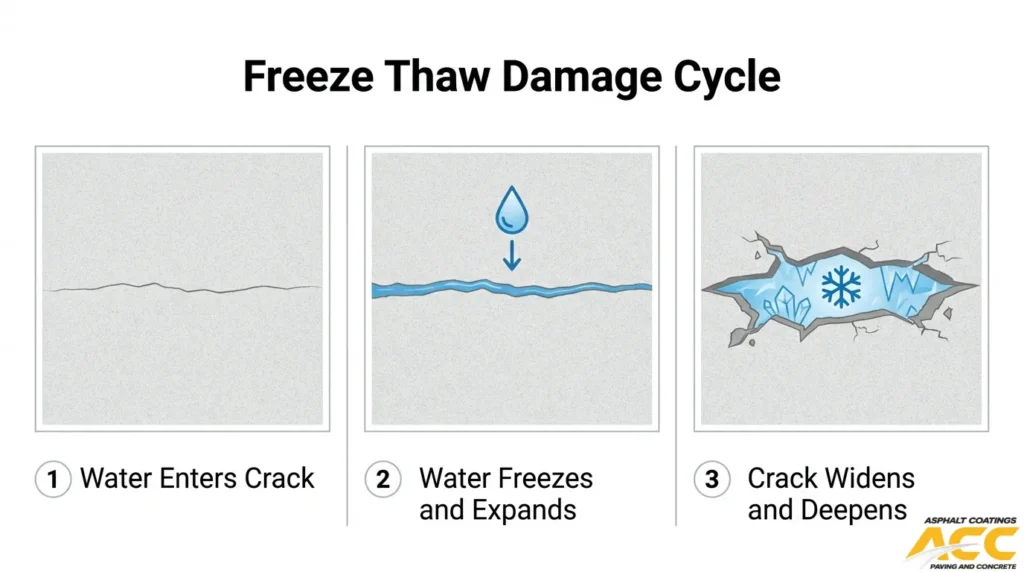
What makes this climate particularly punishing is how these stressors overlap. Water infiltrates small cracks during snowmelt, expands approximately 9% when it refreezes overnight, and widens those cracks with each cycle. The following day, intense sunshine heats the darkened surface, accelerating oxidation in the freshly exposed binder. Deicing salts applied during winter further weaken the bond between asphalt binder and aggregate. No single factor causes rapid failure on its own; the convergence of freeze-thaw cycling, UV degradation, moisture intrusion, and chemical exposure creates a compounding deterioration pattern unique to Colorado’s Front Range.
For commercial property managers, understanding this interplay is essential. The sections ahead break down each climate factor individually, covering freeze-thaw damage mechanisms, seasonal temperature extremes, moisture and snow impacts, and high-altitude UV exposure.
How Do Freeze–Thaw Cycles In Fort Collins Damage Asphalt?
Freeze–thaw cycles in Fort Collins damage asphalt by allowing water to infiltrate cracks, expand as ice, and progressively break apart the pavement structure. The subsections below cover how this process leads to cracking and alligatoring, accelerates pothole formation, and affects new versus aged pavement differently.
How Do Repeated Freeze–Thaw Cycles Lead To Cracking And Alligatoring?
Repeated freeze–thaw cycles lead to cracking and alligatoring by forcing water deeper into the pavement with each expansion and contraction event. Water expands approximately 9% when it freezes, exerting destructive tensile stresses on the asphalt structure. Each cycle widens existing micro-cracks, and over successive winters, isolated cracks interconnect into the characteristic chicken-wire pattern known as alligator cracking. Once alligatoring appears, it signals that the base layer beneath the surface has begun to fail structurally. Fort Collins properties that lack proper drainage or sealcoating are especially vulnerable, since moisture sits longer in the pavement and amplifies each cycle’s damage.
How Do Freeze–Thaw Cycles Accelerate Pothole Formation In Parking Lots?
Freeze–thaw cycles accelerate pothole formation in parking lots by weakening the base layer until the surface collapses under traffic loads. Water enters through unsealed cracks, freezes and expands overnight, then thaws and leaves voids beneath the asphalt surface. According to Rose Paving, heavy traffic creates repeated pressure on the pavement surface and base layers, with braking, turning, and acceleration concentrating stress at entrances and drive lanes that show accelerated wear. When these high-stress zones overlap with freeze–thaw weakened base material, the surface breaks apart rapidly. For commercial lots, even a single winter of deferred crack sealing can convert hairline fractures into potholes requiring full-depth patching.
How Do Freeze–Thaw Cycles Affect Newly Placed Asphalt Versus Older Pavement?
Freeze-thaw cycles affect newly placed asphalt versus older pavement in distinctly different ways. Fresh asphalt contains flexible, unoxidized binder that absorbs thermal stress more effectively. According to FHWA research on asphalt oxidative aging, oxidized binder becomes stiffer and accumulates thermal stresses much more quickly and at higher temperatures than freshly placed binder. This means older pavement cracks sooner during temperature drops. However, new asphalt is not immune; it requires adequate curing time and proper density before freeze-thaw exposure. Aged surfaces also face compounded risk from deicing salts, since older asphalt-aggregate bonds show greater susceptibility to chloride salt damage despite stronger initial adhesion.
Understanding these damage mechanisms is the foundation for choosing the right seasonal maintenance strategy.
How Do Seasonal Temperature Extremes In Fort Collins Impact Asphalt Performance?
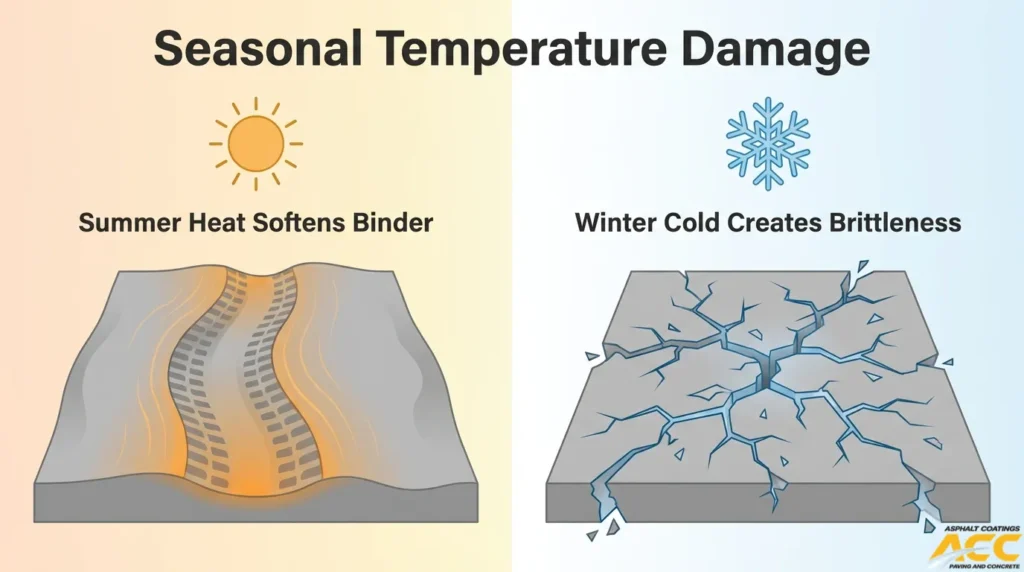
Seasonal temperature extremes in Fort Collins impact asphalt performance by softening pavement in summer heat, making it brittle in winter cold, and creating fatigue stress during rapid spring and fall swings. Each season presents distinct risks.
How Do Hot Summer Temperatures Cause Asphalt Softening And Rutting?
Hot summer temperatures cause asphalt softening and rutting by heating the binder beyond its stable range, allowing it to deform under traffic loads. Fort Collins summer highs reach 85 to 89°F, and dark pavement surfaces absorb even more heat, pushing internal temperatures well above ambient air readings. When asphalt softens, heavy vehicles compress the surface into permanent wheel path depressions.
Prior chemical exposure compounds the problem. According to a 2024 NCBI study, chloride salt erosion reduces penetration and ductility in both base asphalt and SBS-modified binders while raising the softening point, weakening asphalt-aggregate adhesion through primarily physical effects. Pavement that endured winter deicing treatments enters summer already compromised, making it more susceptible to rutting under sustained heat. Polymer-modified mixes offer improved resistance, though even these benefit from proactive sealcoating before peak temperatures arrive.
How Do Cold Winter Temperatures Make Asphalt More Brittle And Prone To Cracks?
Cold winter temperatures make asphalt more brittle and prone to cracks by causing the binder to stiffen and contract, generating internal tensile stresses that exceed the pavement’s flexibility. Fort Collins winter lows drop to 18°F in February, pushing conventional asphalt well into its brittle failure range.
According to the Federal Highway Administration, transverse cracking runs perpendicular to the pavement centerline and is usually a type of thermal cracking caused by asphalt brittleness and contraction in cold temperatures, with block cracking forming interconnected rectangular patterns as the distress progresses. These cracks allow moisture infiltration that accelerates freeze-thaw damage.
Cold conditions also restrict repair timing. Colorado Department of Transportation standards require minimum 45 to 60°F surface and air temperatures for hot mix asphalt placement, depending on layer thickness. For property managers, this means winter cracking often cannot be addressed with permanent repairs until spring, making fall crack sealing an essential preventive step.
How Do Rapid Temperature Swings In Spring And Fall Stress Asphalt Surfaces?
Rapid temperature swings in spring and fall stress asphalt surfaces by forcing repeated expansion and contraction cycles within short timeframes. Fort Collins routinely experiences 40 to 50°F daily temperature shifts during transitional seasons, subjecting pavement to thermal fatigue that neither sustained heat nor sustained cold alone produces.
This cycling loosens aggregate bonds progressively. Each contraction opens micro-cracks; each expansion shifts debris into those gaps, preventing full closure. Over successive cycles, surface distresses such as raveling, block cracking, and edge deterioration develop faster than they would in more stable climates. For commercial properties, transitional seasons are often the most revealing, as damage that accumulated over winter becomes visible once ice and snow recede.
Understanding how each season uniquely degrades pavement helps property managers time inspections and maintenance around Fort Collins’ most damaging weather windows.
How Does Moisture, Snow, And Ice In Fort Collins Contribute To Asphalt Deterioration?
Moisture, snow, and ice in Fort Collins contribute to asphalt deterioration through water infiltration, mechanical surface damage, and chemical degradation. The following sections cover standing water breakdown, snow removal equipment damage, and deicing salt effects.
How Does Standing Water In Low Spots Break Down Asphalt Over Time?
Standing water in low spots breaks down asphalt over time by seeping through surface cracks into the pavement base, weakening the foundation and accelerating structural failure. Ponding typically occurs when the surface has low spots, the lot was not graded correctly, or the pavement has settled unevenly over years of use. Once water reaches the subgrade, it softens the supporting material and creates voids beneath the surface layer.
During winter, trapped moisture freezes and expands, widening existing cracks and creating new ones from within the pavement structure. Each freeze-thaw cycle compounds this damage. For property managers, even small depressions that hold water after rain or snowmelt should be treated as early warning signs of progressive deterioration that will only worsen without correction.
How Does Snow And Ice Removal Equipment Damage Asphalt Surfaces?
Snow and ice removal equipment damages asphalt surfaces through direct mechanical contact that scrapes, gouges, and chips the pavement. Steel plow blades set too low catch raised edges, crack joints, and strip away the top layer of aggregate. Repeated passes over the same areas compound this wear, particularly at transitions between concrete curbing and asphalt.
According to the Asphalt Institute, pavement surfaces should maintain a transverse slope between 1.5% and 3.0% to promote proper drainage and prevent water ponding that leads to infiltration and freeze-thaw damage. When plowing operations degrade surface texture and flatten this designed slope profile, water collects instead of draining. Rubber-edged blades and proper blade height adjustments significantly reduce this type of mechanical damage while still clearing snow effectively.
How Do Deicing Salts And Chemicals Influence Asphalt Longevity?
Deicing salts and chemicals influence asphalt longevity by weakening the bond between asphalt binder and aggregate particles, reducing overall pavement durability. According to a study published by the National Center for Biotechnology Information, chloride salt erosion reduces penetration and ductility in both base asphalt and SBS-modified binders, raises the softening point, and weakens asphalt-aggregate adhesion through primarily physical effects.
Salt crystals also alter aggregate surface roughness, diminishing the pavement’s anti-sliding properties over time. As chloride ions migrate deeper into the pavement structure, they cause asphalt film peeling and progressive adhesion loss. This chemical degradation works alongside freeze-thaw cycling and mechanical wear, compounding the rate of deterioration. Limiting salt application to the minimum effective quantity and using alternative deicers where possible helps preserve pavement integrity over multiple winter seasons.
Understanding how moisture, ice, and chemicals degrade asphalt highlights why UV exposure creates additional aging challenges.
How Does High-Altitude UV Exposure Around Fort Collins Affect Asphalt?
High-altitude UV exposure around Fort Collins affects asphalt by accelerating oxidation, increasing binder stiffness, and causing premature fading and brittleness. The sections below cover how UV radiation oxidizes asphalt, how it compounds with heat and moisture, and how to spot UV damage early.
How Does Increased UV Radiation Oxidize And Fade Asphalt?
Increased UV radiation oxidizes and fades asphalt by breaking down the binder’s flexible compounds, causing the surface to stiffen, turn gray, and lose its ability to absorb stress. Fort Collins sits at approximately 5,000 feet, where UV intensity is roughly 10% higher than at sea level. That persistent exposure strips volatile oils from the asphalt binder through photo-oxidation, leaving it rigid and prone to cracking.
According to a study published in the MDPI Materials Journal, UV exposure increases stiffness by 35 to 40% in unaged polymer-modified asphalt binder and 12 to 17% in short-term aged binder. With roughly 300 days of sunshine each year in Fort Collins, even well-formulated mixes face relentless degradation. For commercial properties, this makes proactive surface protection far more cost-effective than reactive repairs after oxidation has already compromised structural integrity.
How Does UV Exposure Interact With Temperature And Moisture To Age Asphalt Faster?
UV exposure interacts with temperature and moisture to age asphalt faster by creating a compounding cycle where each stressor amplifies the others. UV radiation weakens the binder’s chemical bonds, high summer temperatures accelerate that chemical breakdown, and moisture infiltrates the resulting micro-cracks to cause further deterioration from within.
According to Asphalt Magazine, the oxidation rate in thin asphalt films doubles for every 10°C (18°F) increase in temperature. During a Fort Collins summer, surface temperatures can far exceed air temperature, meaning UV-weakened pavement oxidizes at dramatically accelerated rates on hot afternoons. When fall moisture then enters those oxidation-induced cracks, freeze-thaw cycles exploit the damage. Polymer-modified binders offer some resistance to this combined assault, but no mix design eliminates the need for timely surface protection in Colorado’s high-altitude conditions.
How Can Property Managers Recognize UV-Related Asphalt Aging Early?
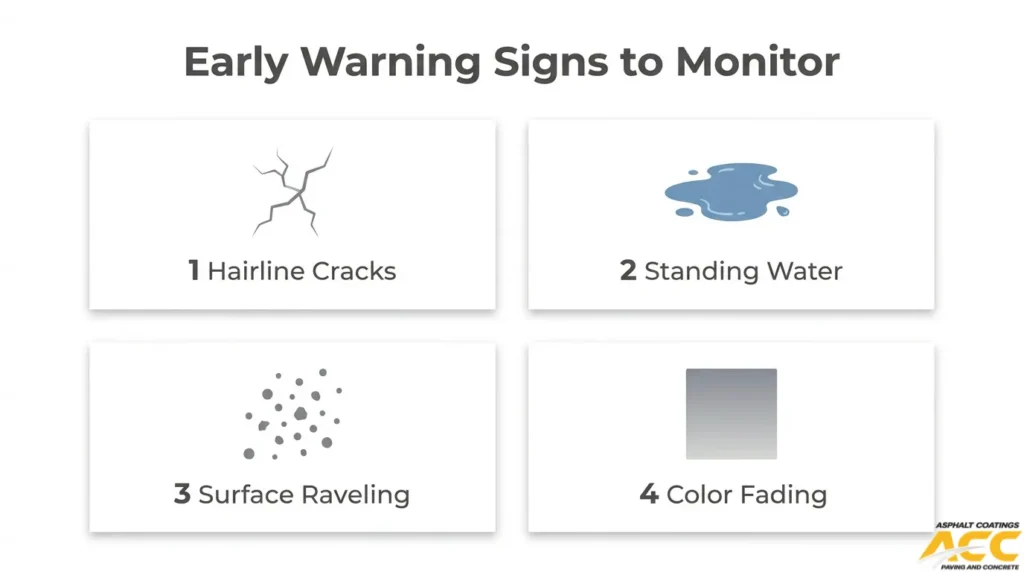
Property managers can recognize UV-related asphalt aging early by watching for specific surface changes that precede structural failure. Key early warning signs include:
- Color shift from deep black to gray: Fresh asphalt darkens with rich binder oils; a uniformly faded, chalky gray surface indicates UV oxidation has begun depleting those oils.
- Surface raveling: Small aggregate particles loosening from the pavement surface signal that the binder can no longer hold the mix together.
- Fine hairline cracking: Networks of shallow surface cracks, distinct from deeper structural cracking, appear as the oxidized binder loses flexibility.
- Brittle texture underfoot: Walking across oxidized pavement often feels noticeably harder and less resilient than a healthy surface.
Catching these signs while the binder retains some flexibility makes sealcoating effective; waiting until cracks deepen typically requires more invasive repairs.
Understanding how UV compounds with other weather stressors helps clarify which commercial properties face the greatest overall risk.
Which Commercial Properties Around Fort Collins Are Most Vulnerable To Weather-Related Asphalt Damage?
The commercial properties around Fort Collins most vulnerable to weather-related asphalt damage are large shopping centers, apartment and HOA complexes, and healthcare and industrial facilities. Each faces distinct challenges based on traffic volume, drainage design, and deicing exposure.
How Do Large Shopping Center Parking Lots Experience Weather Wear Differently?
Large shopping center parking lots experience weather wear differently because of their expansive surface area and concentrated traffic patterns. Thousands of vehicles cycling through entrances, drive lanes, and turning areas create repeated stress on the same pavement sections daily. That constant loading compounds the effects of freeze-thaw cycling, since water infiltrates stressed pavement faster and causes accelerated cracking in high-traffic zones.
Drainage compounds the problem. Vast, flat expanses make proper water runoff difficult, and even slight grading imperfections create low spots where snowmelt ponds. Shopping centers also receive heavy deicing salt applications throughout winter to maintain customer safety, which weakens asphalt-aggregate adhesion over time. For retail properties, prioritizing entrance and drive lane repairs before full-lot maintenance often delivers the best return.
How Do Apartment And HOA Parking Areas Suffer From Fort Collins Weather?
Apartment and HOA parking areas suffer from Fort Collins weather through a combination of constant vehicle presence and limited maintenance budgets. Unlike retail lots that empty overnight, multifamily parking areas hold parked vehicles around the clock. This prevents thorough snow removal and allows moisture to pool beneath and around vehicles, accelerating freeze-thaw damage in localized spots.
Fort Collins averages 51.4 inches of annual snowfall, according to the National Weather Service, meaning these properties endure months of repeated plowing that scuffs surfaces and chips edges. HOA budget cycles often delay necessary crack sealing or sealcoating, allowing small distresses to compound into costly structural failures. Proactive scheduling that aligns maintenance with spring weather windows prevents this escalation.
How Do Healthcare And Industrial Facilities Face Unique Asphalt Weathering Challenges?
Healthcare and industrial facilities face unique asphalt weathering challenges because of heavy vehicle loads, chemical exposure, and strict accessibility requirements. Delivery trucks, ambulances, and heavy equipment concentrate far more weight per axle than standard passenger vehicles, accelerating fatigue cracking in loading zones and access drives.
According to BMG Paving, each commercial property type experiences unique asphalt maintenance challenges based on traffic loads, drainage conditions, and maintenance budgets. Healthcare campuses require uninterrupted ADA-compliant access year-round, limiting when repairs can occur. Industrial yards often involve fuel or chemical spills that soften binder. Polymer-modified asphalt binders offer greater resistance to both chloride salt erosion and freeze-thaw stripping, making them a practical upgrade for these high-demand facilities.
Understanding property-specific vulnerabilities helps determine the right maintenance approach and material choices.
What Weather-Related Asphalt Problems Should Fort Collins Property Managers Watch For?
Weather-related asphalt problems Fort Collins property managers should watch for include cracking from freeze-thaw cycles, drainage failures after storms, and surface raveling from UV exposure. The sections below cover how to spot each issue early.
How Can You Spot Early Weather-Related Cracking Before It Spreads?
You can spot early weather-related cracking by inspecting pavement surfaces for hairline fractures, particularly along edges, joints, and high-traffic zones after winter and spring temperature swings. Transverse cracks running perpendicular to traffic flow are a telltale sign of thermal stress, while interconnected patterns resembling alligator skin indicate deeper structural fatigue. According to the Federal Highway Administration, transverse cracking is usually caused by asphalt brittleness and contraction in cold temperatures, with block cracking forming interconnected rectangular patterns as the condition advances.
Small cracks that go unaddressed allow water infiltration, which accelerates deterioration through freeze-thaw expansion. Walk your lot after each seasonal transition and mark any new linear or branching cracks. Catching them at the hairline stage keeps repair costs low and prevents widespread base failure.
How Can You Recognize Drainage And Ponding Issues After Storms Or Snowmelt?
You can recognize drainage and ponding issues by checking your lot for standing water within 24 to 48 hours after a storm or snowmelt event. Persistent puddles, even shallow ones, signal low spots or inadequate slope. According to Rose Paving, standing water on asphalt causes ponding that seeps into the pavement and foundation, causing degradation and instability, typically where the surface has low spots, grading was incorrect, or the pavement has settled over time.
Key warning signs to monitor include:
- Water pooling near drain inlets that should be carrying runoff away.
- Damp or discolored patches that remain long after surrounding areas dry.
- Soft or spongy spots when walked on, indicating saturated base material.
- Sediment lines or debris rings marking where water repeatedly collects.
Addressing drainage deficiencies before they undermine the base layer is far more cost-effective than repairing the structural damage that follows prolonged water exposure.
How Can You Tell When Surface Raveling And Fading Are Becoming A Structural Issue?
You can tell surface raveling and fading are becoming a structural issue when loose aggregate begins appearing on the pavement surface and the color shifts from black to a uniform gray. According to the Federal Highway Administration, raveling progresses from loss of fine aggregate to loss of fine and some coarse aggregate, and finally to loss of coarse aggregate, indicating advanced oxidation and UV aging of the asphalt binder.
Fading alone is cosmetic, but once you notice loose gravel underfoot or small pits where aggregate has dislodged, the binder has lost its ability to hold the mix together. At that stage, water penetrates more easily, and freeze-thaw cycles accelerate the breakdown. For most commercial lots, if raveling has progressed beyond fine aggregate loss, sealcoating alone will not restore structural integrity; more involved repairs become necessary. Commercial asphalt contractors serving Colorado’s Front Range typically offer comprehensive services from crack sealing through full reconstruction, allowing property managers to address each deterioration stage with the appropriate solution. Asphalt Coatings Company, with 39 years of experience in the region, provides this full spectrum of commercial paving and maintenance services with in-house crews across Denver, Colorado Springs, Fort Collins, and surrounding areas.
Identifying these three problem categories early gives property managers a clear framework for prioritizing maintenance before weather compounds the damage.
What Preventive Maintenance Steps Help Protect Asphalt From Fort Collins Weather?
Preventive maintenance steps that help protect asphalt from Fort Collins weather include scheduled sealcoating, timely crack sealing, and routine surface cleaning. Because Colorado’s elevation exposes pavement to 20% to 30% more UV radiation than lower elevations, according to Boulder Community Health, these measures are especially critical for commercial properties along the Front Range.
How Often Should You Sealcoat Commercial Asphalt In Fort Collins’ Climate?
You should sealcoat commercial asphalt in Fort Collins’ climate every two to three years. High-altitude sun exposure and freeze-thaw cycling degrade the binder faster than in milder regions, so consistent reapplication is essential.
Key sealcoating guidelines for Fort Collins properties include:
- Apply sealcoat only when pavement and air temperatures reach at least 50°F with no freezing expected for 24 hours.
- Wait 30 to 90 days after new asphalt placement before the first application.
- Increase frequency for lots with heavy traffic or full southern sun exposure.
According to Maison Bros Paving, sealcoating extends asphalt pavement life by 5 to 10 years on a sound lot. For property managers balancing maintenance budgets, this makes sealcoating one of the highest-return preventive investments available.
When And How Should You Plan Crack Sealing Around Local Weather Patterns?
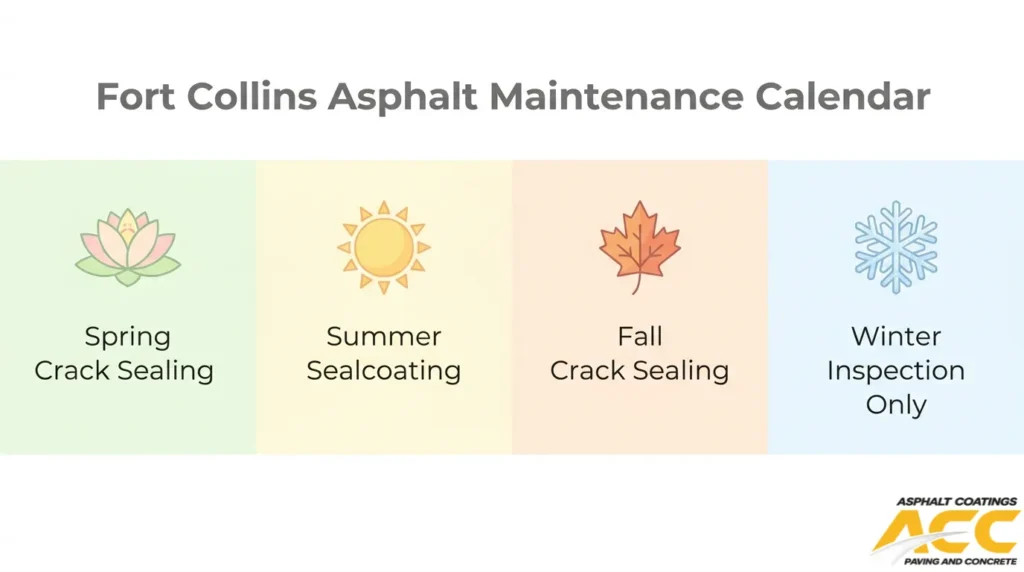
You should plan crack sealing around local weather patterns by targeting spring and fall windows when pavement temperatures consistently exceed 40°F. According to Road Resource, sealant manufacturers typically recommend pavement temperature exceeding 40°F (4.4°C), with crack sealing possible in virtually any outside air temperature as long as the crack is dry and warmed to that threshold.
Practical scheduling considerations include:
- Spring (April through May) and fall (September through October) offer the most reliable temperature windows in Fort Collins.
- Cracks must be completely dry before sealant application, so schedule after several consecutive dry days.
- Address cracks wider than 1/4 inch with hot-applied rubberized sealant for maximum flexibility through winter contraction.
Waiting until summer to seal cracks often means the damage has already compounded through a full freeze-thaw season. Early intervention consistently delivers better long-term results.
How Can Routine Sweeping And Cleaning Reduce Weather-Related Asphalt Damage?
Routine sweeping and cleaning reduce weather-related asphalt damage by removing debris that traps moisture against the pavement surface. Sand, gravel, and organic material left from winter operations or storm runoff hold water in place, accelerating the freeze-thaw infiltration cycle that breaks down binder and aggregate bonds.
A consistent cleaning schedule addresses several risks:
- Removes deicing salt residue that weakens asphalt-aggregate adhesion over time.
- Clears drainage paths so snowmelt and rain flow off the surface instead of ponding in low spots.
- Exposes early distress signs, such as hairline cracks or surface raveling, that might otherwise go unnoticed beneath accumulated debris.
Sweeping is often overlooked because it seems minor compared to sealcoating or crack sealing. In practice, keeping the surface clean is the simplest way to extend the effectiveness of every other maintenance treatment.
With preventive maintenance addressed, the next step is designing asphalt systems built to withstand Fort Collins conditions from the start.
How Should Fort Collins’ Weather Influence Decisions About Asphalt Design And Construction?
Fort Collins’ weather should influence asphalt design and construction through thicker base layers for freeze-thaw protection, UV-resistant mix selections, and drainage optimized for snowmelt and summer storms.
How Should Pavement Thickness And Base Design Account For Freeze–Thaw Cycles?
Pavement thickness and base design should account for freeze-thaw cycles by incorporating deeper aggregate bases, permeable sublayers, and subsurface drainage that prevents moisture from saturating the pavement structure. According to the Federal Highway Administration’s Urban Drainage Design Manual (HEC-22), subsurface drainage systems with permeable base layers are critical for cold regions experiencing seasonal freeze-thaw cycles.
Key design considerations for freeze-thaw resistance include:
- Installing a minimum 6-inch compacted aggregate base to distribute loads above frost-susceptible subgrade soils.
- Specifying permeable base layers that channel trapped moisture away before it freezes and expands.
- Designing subsurface drainage with outlet pipes to move water laterally from beneath the pavement section.
- Increasing asphalt thickness on high-traffic areas where repeated loading compounds freeze-thaw weakening.
Investing in a properly engineered base is the single most cost-effective decision for long-term pavement performance in Fort Collins’ climate.
How Should Asphalt Mixes Be Selected For High-Altitude UV And Temperature Extremes?
Asphalt mixes should be selected for high-altitude UV and temperature extremes by specifying polymer-modified binders that resist both oxidative hardening and thermal cracking. Fort Collins sits at approximately 5,000 feet, where thinner atmosphere allows significantly more ultraviolet radiation to reach pavement surfaces year-round.
Polymer-modified binders, particularly SBS-modified formulations, maintain flexibility across wide temperature ranges. This flexibility prevents the brittleness that causes thermal cracking during winter lows near 18°F while resisting softening during summer highs approaching 89°F. For properties with heavy traffic loads, specifying higher-density mixes further reduces the permeability that accelerates UV and moisture damage together.
How Should Drainage Design Be Optimized For Snowmelt And Intense Summer Storms?
Drainage design should be optimized for snowmelt and intense summer storms by combining proper surface grading with subsurface collection systems that handle both gradual meltwater infiltration and sudden high-volume runoff. Fort Collins averages 51.4 inches of annual snowfall, creating sustained meltwater flows through spring, while intense summer storms can deliver heavy precipitation in short bursts.
Effective drainage optimization requires:
- Maintaining transverse slopes between 1.5% and 3.0% across all paved surfaces to prevent ponding.
- Installing catch basins at low points where snowmelt naturally collects during spring thaw periods.
- Sizing storm drainage capacity for peak summer intensity, not just average annual precipitation.
- Grading perimeter areas to direct runoff away from pavement edges where subgrade erosion begins.
Commercial paving contractors with extensive Colorado experience understand how to integrate proper drainage design with subgrade preparation during new construction or reconstruction projects. Asphalt Coatings Company provides subgrade preparation and grading services as part of comprehensive commercial paving projects throughout the Front Range, ensuring water management is built into the pavement system from the foundation up.
Proper drainage design protects every other investment in the pavement structure, from base integrity to surface longevity.
When Is It Better To Repair Versus Replace Weather-Damaged Asphalt In Fort Collins?
It is better to repair weather-damaged asphalt when distress is limited to the surface layer, and better to replace it when damage reaches the base. The right approach depends on crack type, damage extent, and pavement age.
When Is Crack Sealing Enough For Weather-Related Asphalt Cracking?
Crack sealing is enough for weather-related asphalt cracking when cracks are isolated, linear, and confined to the surface layer without signs of base failure. Thermal transverse cracks and minor longitudinal cracks from seasonal contraction respond well to hot-applied rubberized sealant, provided the surrounding pavement remains structurally sound.
According to FHWA research on noninsulated test sections in Quebec, 65 percent of transverse cracking damage occurred in winter, followed by 25.5 percent in spring. This seasonal pattern means Fort Collins property managers should prioritize sealing thermal cracks before they widen through additional freeze-thaw cycles.
Crack sealing is not appropriate when interconnecting alligator-pattern cracking appears. That pattern signals fatigue failure and base deterioration, requiring more than surface treatment. For most commercial lots, addressing isolated weather cracks early with sealant prevents the escalation that eventually demands full replacement.
When Does Weather Damage Justify Mill-And-Overlay Instead Of Patching?
Weather damage justifies mill-and-overlay instead of patching when distress covers large, continuous areas but the base layer remains intact. Widespread surface raveling, interconnected block cracking, or moderate rutting across entire drive lanes or parking sections indicates the surface course has failed while the foundation still provides structural support.
Patching works for isolated potholes or small failed sections. However, when weather-driven deterioration spans 30 percent or more of a parking area’s surface, individual patches create an uneven, patchwork surface that accelerates further water infiltration at seam edges. Mill-and-overlay removes the damaged surface material and replaces it with a fresh asphalt course, restoring both structural integrity and drainage profile in a single operation.
For commercial properties in Fort Collins facing accumulated freeze-thaw and UV damage, mill-and-overlay often delivers the best balance of cost efficiency and longevity.
When Do Weather And Age Make Full-Depth Reconstruction The Best Option?
Weather and age make full-depth reconstruction the best option when the asphalt base has failed and no surface treatment can restore structural capacity. Indicators include widespread alligator cracking with visible pumping of subgrade material, deep rutting exceeding 1.5 inches, and pavement sections that flex or deflect under traffic loads.
Pavements that have endured 20 or more years of Fort Collins freeze-thaw cycles, UV oxidation, and deicing salt exposure typically reach a point where the aggregate base has been compromised by sustained moisture infiltration. At this stage, overlays simply mask the underlying failure and crack through within a few seasons.
Full-depth reconstruction replaces both the asphalt surface and the base, allowing proper subgrade correction, improved drainage design, and modern mix specifications suited to Colorado’s climate. Although the upfront cost is highest, reconstruction eliminates the cycle of repeated repairs on a failing foundation.
Knowing which repair tier fits the damage level helps property managers allocate budgets toward lasting solutions.
How Should Fort Collins’ Seasonal Weather Guide The Timing Of Asphalt Work?
Fort Collins’ seasonal weather should guide asphalt work timing by matching each service to its required temperature and cure conditions. The sections below cover optimal scheduling for paving, sealcoating, and emergency repairs.
When Is The Best Time Of Year To Schedule Paving And Overlays In Fort Collins?
The best time of year to schedule paving and overlays in Fort Collins is late spring through early fall, when air and surface temperatures consistently meet minimum placement thresholds. According to the Colorado Asphalt Pavement Association, hot mix asphalt requires minimum surface and air temperatures of 60°F for top layers under 1.5 inches, 50°F for lifts of 1.5 to 3 inches, and 45°F for lifts of 3 inches or more. Fort Collins summer highs of 85 to 89°F in July and August provide ample compaction time, while shoulder months carry more risk from rapid overnight cooling. For most commercial projects, scheduling between May and September offers the widest margin of safety. Waiting until mid-October or later significantly narrows the compaction window and increases the chance of density failures.
When Should Sealcoating Be Done For Optimal Cure In Local Conditions?
Sealcoating should be done when pavement and air temperatures are at least 50°F and rising, with no freezing temperatures expected for at least 24 hours. According to the Colorado Asphalt Pavement Association, a minimum of 30 to 90 days must elapse between new asphalt placement and seal coat application to allow proper curing of the underlying pavement. In Fort Collins, these conditions align most reliably from late May through September. Scheduling sealcoating during this window gives the emulsion enough warmth and daylight hours to cure fully before overnight temperatures drop. Attempting sealcoating too late in the fall risks incomplete curing, which leaves the coating vulnerable to peeling and moisture penetration through winter.
When Can Emergency Repairs Be Performed Safely In Cold Or Wet Weather?
Emergency repairs can be performed safely in cold or wet weather when the right materials and surface preparation methods are used. Cold-patch asphalt and hot-applied crack sealants allow crews to address potholes and critical failures even during winter months. Sealant manufacturers typically recommend pavement temperatures exceeding 40°F, though some products allow application as low as 35°F, according to Road Resource. The key requirement is that the crack or repair area be dry and warmed to at least 40°F before material is placed. For Fort Collins property managers, this means emergency pothole patching remains feasible through most of winter using cold mix, while crack sealing works best during brief warm spells. Permanent repairs should still be scheduled for warmer months whenever possible.
Understanding seasonal timing helps property managers align asphalt work with Fort Collins’ weather patterns for lasting results.
How Can Sealcoating And Crack Sealing Protect Asphalt From Fort Collins Weather?
Sealcoating and crack sealing protect asphalt from Fort Collins weather by blocking UV radiation, preventing moisture infiltration, and resisting chemical damage from deicing salts. The sections below cover how each treatment works and how to schedule them for local conditions.
How Does Sealcoating Shield Asphalt From UV, Moisture, And Deicing Chemicals?
Sealcoating shields asphalt from UV, moisture, and deicing chemicals by creating a protective barrier over the pavement surface. This layer blocks ultraviolet rays that oxidize and stiffen asphalt binder, a concern amplified at Fort Collins’ 5,000-foot elevation where UV exposure runs significantly higher than at sea level. The seal also prevents water from penetrating the surface, cutting off the moisture pathway that feeds freeze-thaw damage.
Against deicing chemicals, sealcoating is equally valuable. Chloride salts reduce asphalt-aggregate adhesion and weaken ductility when they contact unprotected binder. A properly applied sealcoat keeps those salts on the surface rather than allowing migration into the pavement structure. For properties exposed to heavy winter salt applications, this single treatment preserves both structural integrity and surface texture far longer than leaving asphalt uncoated.
How Does Professional Crack Sealing Limit Freeze–Thaw Damage And Potholes?
Professional crack sealing limits freeze-thaw damage and potholes by filling cracks before water can enter the pavement structure. Water expands approximately 9% when it freezes, according to the National Centers for Environmental Information (NOAA), exerting destructive tensile stresses that widen existing cracks and destabilize base layers. Sealing cracks eliminates this entry point.
Hot-applied rubberized sealant, recommended for cracks wider than 1/4 inch, is heated to 350°F or higher so it flows deep into the crack and maintains flexibility through temperature swings. This flexibility is critical in Fort Collins, where winter lows reach 18°F and summer highs climb above 85°F. Without sealing, small cracks quickly become interconnected networks that allow base erosion and pothole formation.
How Can A Maintenance Schedule For Sealcoating And Crack Sealing Be Tailored To Fort Collins?
A maintenance schedule for sealcoating and crack sealing can be tailored to Fort Collins by aligning application timing with local temperature windows and seasonal weather patterns. According to the Colorado Asphalt Pavement Association, sealer should not be applied unless pavement and air temperatures reach at least 50°F with no freezing expected for 24 hours.
Key scheduling guidelines for Fort Collins include:
- Sealcoat every two to three years, adjusting frequency for sun exposure and traffic volume.
- Perform crack sealing in spring or fall when moderate temperatures allow proper sealant curing.
- Inspect surfaces annually, especially after winter, to catch new cracks before the next freeze-thaw season.
- Wait a minimum of 30 to 90 days after new asphalt placement before applying sealcoat.
Properties that follow this cycle consistently avoid the compounding damage that turns minor surface wear into costly structural failures. With proper drainage and budgeting in place, the next step is understanding how to plan financially for these recurring maintenance needs.
How Can Fort Collins Property Managers Budget And Plan For Weather-Driven Asphalt Maintenance?
Fort Collins property managers can budget and plan for weather-driven asphalt maintenance by using condition assessments, building multi-year capital reserves, and coordinating work across properties. The subsections below cover cost forecasting, capital planning for freeze-thaw cycles, and multi-property coordination.
How Can You Forecast Asphalt Maintenance Costs Based On Local Weather Impacts?
You can forecast asphalt maintenance costs based on local weather impacts by combining regular pavement condition assessments with per-square-foot cost benchmarks. According to ASTM International, the Pavement Condition Index (PCI) measures present pavement condition based on surface distress, indicating structural integrity and operational safety while enabling objective determination of maintenance needs. Annual maintenance for a typical commercial parking lot runs approximately $0.10 per square foot, with full paving projects ranging from $4 to $10 per square foot depending on site conditions and thickness. Property managers who tie PCI scores directly to weather exposure patterns can predict which lots will need crack sealing, sealcoating, or overlay in a given budget cycle. This data-driven approach eliminates reactive spending and turns weather damage into a forecastable line item.
How Can Multi-Year Capital Plans Account For Colorado Freeze–Thaw Cycles?
Multi-year capital plans can account for Colorado freeze-thaw cycles by scheduling preventive treatments on rotating intervals aligned with seasonal degradation patterns. High-traffic commercial lots typically require sealcoating every two to three years, annual crack sealing, and yearly inspections to stay ahead of freeze-thaw damage. Structuring a three-to-five-year capital plan around these intervals lets managers spread costs predictably rather than absorbing large emergency repairs after a harsh winter. Each spring assessment should inform the following fiscal year’s budget, with reserves allocated for accelerated deterioration when snowfall or temperature swings exceed historical norms. In my experience, properties that fund preventive maintenance consistently spend far less over a decade than those that defer work until failures demand costly reconstruction.
How Can Coordinating Asphalt Work Across Multiple Properties Reduce Weather-Related Costs?
Coordinating asphalt work across multiple properties reduces weather-related costs by consolidating mobilization, materials, and crew scheduling into fewer project phases. A 2024 study published by the National Center for Biotechnology Information found that chloride salt crystals alter aggregate roughness, reduce anti-sliding properties, and cause asphalt film peeling through ion migration, meaning every property exposed to deicing chemicals faces the same seasonal damage timeline. When managers group sealcoating or crack sealing for several lots into a single contract, they reduce per-property mobilization charges and secure better material pricing. Coordinated scheduling also ensures all properties receive treatment within the optimal spring or fall weather windows, preventing missed seasons that compound damage into the next freeze-thaw cycle.
With a forecasting framework and coordinated plan in place, partnering with an experienced contractor ensures execution stays on schedule.
How Should You Approach Fort Collins Weather Challenges With Commercial Asphalt Services From Asphalt Coatings Company?
You should approach Fort Collins weather challenges by partnering with Asphalt Coatings Company for climate-specific paving, sealcoating, and crack sealing timed to local conditions. The following sections cover how these services address weather impacts and the key takeaways for protecting your pavement.
How Can Asphalt Coatings Company’s Paving, Sealcoating, And Crack Sealing Services Help You Manage Fort Collins Weather Impacts?
Asphalt Coatings Company’s paving, sealcoating, and crack sealing services help you manage Fort Collins weather impacts by addressing the specific threats that 5,000-foot elevation, 51.4 inches of annual snowfall, and approximately 300 days of sunshine create for commercial pavement. Professional commercial asphalt services can help manage Fort Collins weather impacts by addressing the specific threats that 5,000-foot elevation, 51.4 inches of annual snowfall, and approximately 300 days of sunshine create for commercial pavement. At this altitude, UV radiation intensity increases roughly 2% for every 1,000 feet of elevation gain, according to the National Oceanic and Atmospheric Administration (NOAA), accelerating binder oxidation and surface raveling year-round.
Asphalt Coatings Company schedules crack sealing during spring and fall temperature windows when sealant cures properly. For high-traffic commercial lots, the recommended maintenance cadence includes:
- Sealcoating every 2 to 3 years
- Crack sealing annually
- Striping and inspection annually
With decades of Front Range experience, Asphalt Coatings Company uses in-house crews and CDOT-approved materials to ensure every service aligns with Colorado’s narrow seasonal work windows.
What Are The Key Takeaways About How Fort Collins Weather Impacts Asphalt And What To Do About It?
The key takeaways about how Fort Collins weather impacts asphalt are that freeze-thaw cycling, high-altitude UV exposure, heavy snowfall, and extreme temperature swings combine to degrade commercial pavement faster than in lower-elevation regions. Water expands approximately 9% when it freezes, generating destructive tensile stresses that turn small cracks into potholes if left untreated.
Proactive maintenance is the most cost-effective defense. The essential action items include:
- Schedule sealcoating every two to three years when pavement temperatures reach at least 50°F
- Seal cracks annually before winter to block moisture infiltration
- Time paving and overlays within Colorado’s compaction temperature range of 275°F to 175°F, ensuring at least 10 minutes of compaction time
- Budget approximately $0.10 per square foot annually for routine commercial lot maintenance
For Fort Collins property managers, treating asphalt maintenance as a year-round, weather-driven strategy rather than a reactive expense is the single most effective way to extend pavement life and reduce long-term costs. Asphalt Coatings Company builds these climate-specific plans for commercial properties across Colorado’s Front Range.