Commercial asphalt repair pricing in Fort Collins reflects the relationship between repair method, expected service life, and total cost of ownership across a pavement’s full life cycle. Costs range from $0.19 per square foot for sealcoating to $7 per square foot for full-depth paving, with each option delivering a different return based on site conditions and traffic demands.
This guide covers repair cost ranges and pricing variables, repair types and their comparative performance, Colorado climate impacts on pavement durability, preventive maintenance economics, ROI and total cost of ownership evaluation, property-type budget expectations, bid and scope analysis, ADA and concrete coordination, and strategic scheduling.
Repair pricing shifts based on project size, surface condition, material selection, and scheduling constraints like night work or phased access. Small pothole patches cost $2 to $5 per square foot, while mill-and-overlay and full-depth replacement serve progressively worse deterioration at higher price points. Infrared repair offers a cost-effective middle ground for localized damage where the base remains sound.
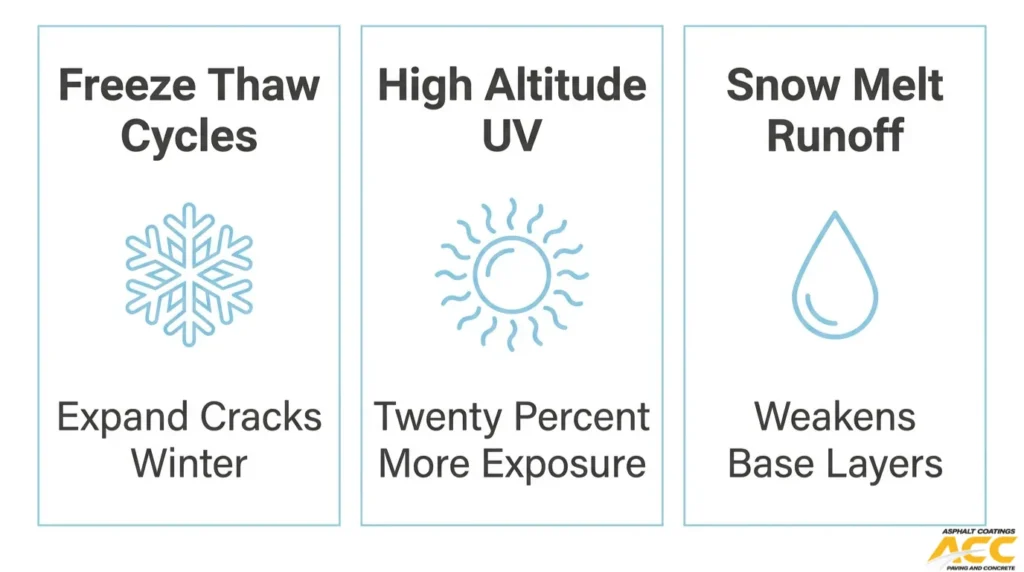
Fort Collins elevation above 5,000 feet intensifies UV exposure by 20% to 30% compared to lower regions, accelerating binder oxidation and compressing maintenance timelines. Freeze-thaw cycles compound this by expanding moisture in cracks each winter, turning minor surface damage into structural failure.
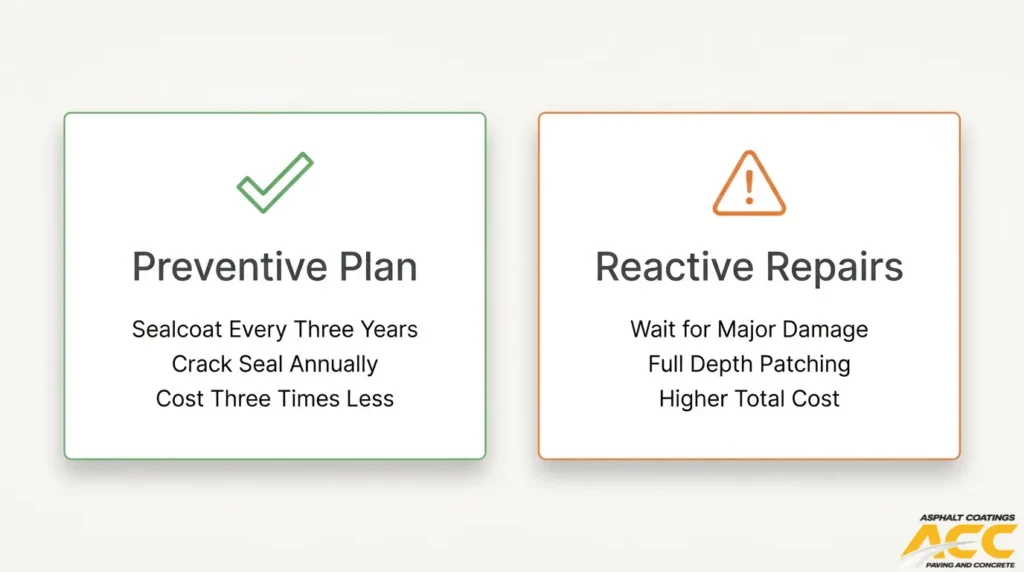
Sealcoating every two to three years and sealing cracks at $0.50 to $3 per linear foot cost a fraction of structural repairs while extending pavement service life by years. Preventive maintenance typically runs three times less than reactive repairs.
Calculating annualized cost per year of service, rather than comparing sticker prices, reveals which repair method delivers the strongest long-term value. Budget expectations, bid comparison methods, ADA compliance triggers, and seasonal scheduling all shape the final investment for retail plazas, multifamily communities, medical offices, and industrial sites.
How Much Does Commercial Asphalt Repair Typically Cost in Fort Collins?
Commercial asphalt repair in Fort Collins typically costs between $1.98 and $7 per square foot, depending on repair type, project size, surface condition, and scheduling requirements. The following sections break down how each factor shifts pricing.
How Does the Cost Per Square Foot Change for Small vs Large Commercial Asphalt Repairs in Fort Collins?
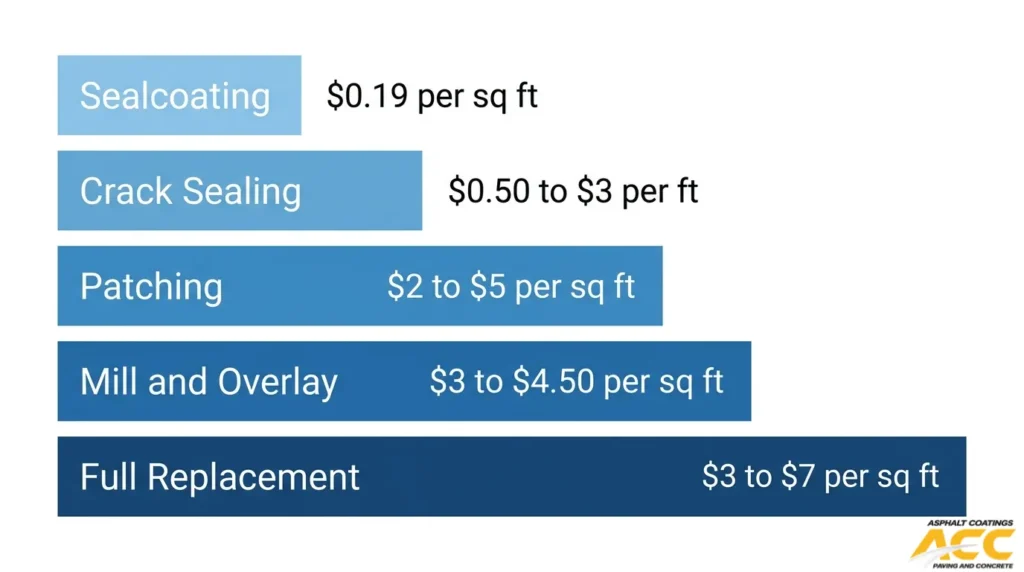
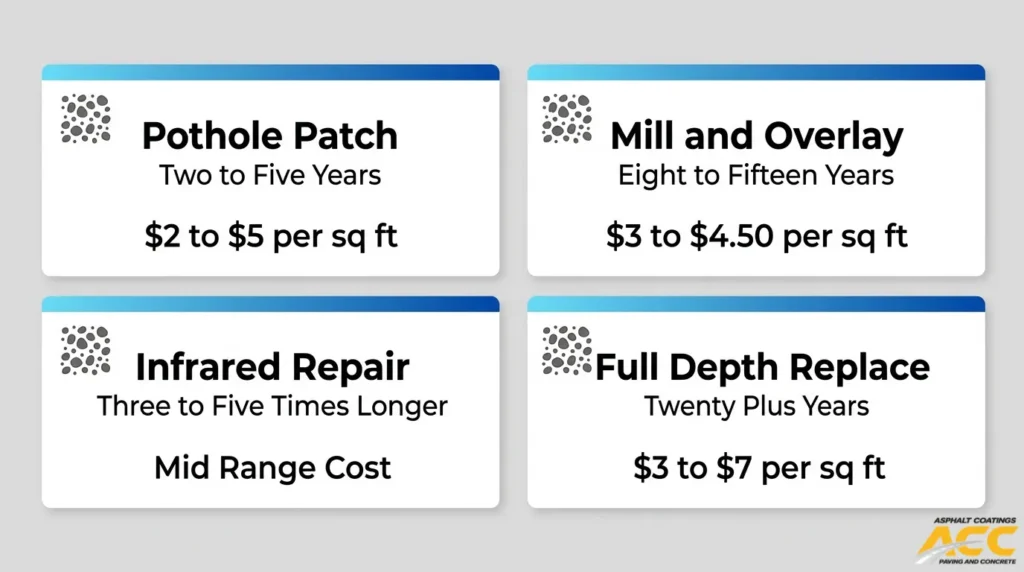
The cost per square foot for small vs large commercial asphalt repairs in Fort Collins changes significantly based on repair scope and economies of scale. Small crack and pothole repairs range from $2 to $5 per square foot, while commercial asphalt patching averages $1.98 to $2.33 per square foot for larger areas. According to The Pavement Group, commercial asphalt paving costs run between $3 to $7 per square foot, with basic resurfacing ranging from $2.50 to $4.50 per square foot.
Preventive treatments cost far less. Commercial sealcoating averages about $0.19 per square foot nationwide. Repairs are often 60 to 80 percent less expensive than full replacement, making early intervention on smaller areas one of the most cost-effective strategies for commercial property managers.
How Do Project Complexity and Existing Surface Conditions Affect Asphalt Repair Pricing in Fort Collins?
Project complexity and existing surface conditions affect asphalt repair pricing in Fort Collins by determining the depth of work, material volume, and preparation required before paving can begin. Surfaces with extensive cracking, base failure, or moisture infiltration demand more intensive repairs than those with superficial wear.
Fort Collins presents specific challenges. A 2024 study published in Construction and Building Materials found that in high-altitude cold regions, asphalt pavement degradation is exacerbated by the combined effects of thermo-oxidative and UV aging. Freeze-thaw cycles compound this damage, expanding cracks each winter season. Moisture infiltrating pavement subsurface layers weakens granular base materials, often requiring full-depth removal rather than a simple overlay.
Properties with poor drainage or neglected maintenance histories should expect higher per-square-foot costs due to this added complexity. Asphalt Coatings Company’s site assessments include drainage evaluation and subgrade analysis to identify these hidden cost factors before bidding, ensuring Fort Collins property managers receive accurate project scoping from the start.
How Do Material Choices and Mix Designs Used in Fort Collins Impact Commercial Asphalt Repair Costs?
Material choices and mix designs used in Fort Collins impact commercial asphalt repair costs by influencing both upfront material expense and long-term performance. Higher-performance mixes formulated for freeze-thaw resistance and heavy traffic loads cost more per ton than standard blends, but they reduce the frequency of future repairs.
ASTM International’s road and paving standards govern the specifications and test methods for material composition, mechanical performance, and application of asphalt pavements. Contractors who follow these standards and select regionally appropriate binder grades deliver repairs better suited to Colorado’s elevation and temperature swings. Choosing a cheaper mix to save on initial cost often backfires; premature failure means paying for the same repair twice.
How Do Night Work, Phased Work, and Business-Access Requirements Influence Commercial Asphalt Repair Pricing?
Night work, phased work, and business-access requirements influence commercial asphalt repair pricing by adding labor premiums, extending project timelines, and increasing logistical complexity. Night shifts typically carry higher hourly rates, and phased schedules require repeated mobilization of crews and equipment across multiple visits.
Maintaining customer access during repairs also constrains how efficiently crews can operate. Sections must be completed and reopened sequentially rather than all at once, which reduces daily output. Multi-layer repairs add further cost; according to Metropolitan Government of Nashville and Davidson specifications, final repairs can require nine inches of binder placed in a minimum of three layers with mechanical compaction. For retail centers and medical offices that cannot close entirely, these scheduling constraints are unavoidable but should be factored into budget expectations early.
Understanding these cost variables prepares property managers to evaluate the specific repair types available for their situation.
What Are the Main Types of Commercial Asphalt Repair and How Do Their Costs Compare?
The main types of commercial asphalt repair are patching, skin patching, full-depth patching, mill-and-overlay, full-depth replacement, and infrared repair. Each method addresses a different level of pavement damage at a different price point. According to the Federal Highway Administration, agencies expect asphalt pavements to last at least 20 years with proper maintenance and preservation treatments.
How Much Does Patching and Pothole Repair Usually Cost for Commercial Lots in Fort Collins?
Patching and pothole repair for commercial lots in Fort Collins typically costs between $2 and $5 per square foot, depending on damage severity, patch depth, and lot accessibility. Small isolated potholes fall toward the lower end, while clusters of failures requiring saw-cutting and compaction push costs higher.
Mobilization fees also factor in; a contractor bringing equipment for a single pothole charges proportionally more per square foot than one addressing multiple patches in a single visit. For properties with scattered damage, bundling repairs into one project visit is almost always the smarter financial move.
How Is Pricing Different for Skin Patching vs Full-Depth Asphalt Patching on Commercial Pavements?
Pricing for skin patching vs full-depth asphalt patching on commercial pavements differs primarily in labor intensity, material volume, and expected service life. Skin patches address surface-level distress only, using a thin overlay of 1 to 2 inches over the existing base. Full-depth patches remove the entire pavement section down to the subgrade and rebuild it with new aggregate base and asphalt lifts.
According to The Surface Masters, full-depth patches have a long life, often outlasting the surrounding pavement, and are usually the most cost-effective technique for addressing deep pavement damage. Skin patching costs less upfront but fails faster when underlying base problems exist, making full-depth the better value for structural distress.
How Are Per-Square-Foot Costs Calculated for Mill-and-Overlay Repairs on Commercial Parking Lots?
Per-square-foot costs for mill-and-overlay repairs on commercial parking lots are calculated by combining milling depth, new asphalt material thickness, equipment mobilization, and traffic control requirements. The milling machine removes the deteriorated surface layer, and a new asphalt lift, typically 1.5 to 2.5 inches thick, is placed over the existing base.
Key variables that shift per-square-foot pricing include:
- Total square footage of the milling area, since larger projects reduce the per-unit mobilization cost.
- Required milling depth, which determines machine time and disposal volume.
- Asphalt mix design specifications suited to the lot’s traffic load.
- Accessibility constraints that limit equipment size or require phased work.
Mill-and-overlay is one of the most practical mid-range solutions for commercial lots with widespread surface cracking but a structurally sound base.
How Is Pricing Structured for Full-Depth Asphalt Replacement on Commercial Properties?
Pricing for full-depth asphalt replacement on commercial properties is structured around demolition, hauling, subgrade preparation, base installation, and multi-lift asphalt paving. This method removes everything down to native soil, making it the most expensive repair option but also the longest-lasting.
Cost components that drive the total price include:
- Demolition and disposal of existing pavement and base material.
- Subgrade grading, compaction, and any necessary soil stabilization.
- Aggregate base thickness, which varies by traffic load and soil conditions.
- Multiple asphalt lifts (binder and surface courses) compacted to specification.
- Drainage corrections, striping, and any ADA-related concrete work.
Full-depth replacement resets the pavement’s service life entirely, which makes it the right choice when the existing base has failed beyond salvageable condition.
How Do Infrared Asphalt Repairs Compare in Cost and Use Cases for Commercial Sites?
Infrared asphalt repairs compare favorably in cost for localized damage because they reheat the existing pavement, blend in new material, and recompact the area into a seamless patch. This process eliminates cold joints, which are the primary failure point in traditional patching.
Infrared repair works best for utility cuts, small potholes, and surface depressions where the surrounding pavement is still structurally sound. It is not suited for base failures or large-area deterioration. According to the Federal Highway Administration, preservation treatments like chip sealing cost roughly 20% of full asphalt replacement per lane mile, illustrating the broader cost advantage of targeted repair methods over total reconstruction.
For commercial property managers weighing these options, understanding each method’s expected lifespan under local conditions is equally important.
How Do Colorado’s Climate and Fort Collins Conditions Affect Asphalt Repair Needs and Pricing?
Colorado’s climate and Fort Collins conditions affect asphalt repair needs and pricing by accelerating pavement deterioration through freeze-thaw cycles, intense UV radiation, and seasonal moisture. These factors increase repair frequency and influence material choices, as covered below.
How Do Freeze-Thaw Cycles in Northern Colorado Drive More Frequent Commercial Asphalt Repairs?
Freeze-thaw cycles in Northern Colorado drive more frequent commercial asphalt repairs by repeatedly expanding and contracting moisture trapped within pavement cracks. Water seeps into small surface fissures, freezes overnight, expands, then thaws during the day. This cycle widens cracks into potholes and destabilizes the subgrade over a single winter season.
Northern Colorado’s elevation compounds the problem. Because much of the state sits at 5,000 feet or higher, temperature swings between day and night are more extreme than at lower elevations, intensifying the freeze-thaw effect. Commercial parking lots with heavy traffic see compounding damage as vehicles stress already-weakened surfaces. For property managers, this means budgeting for more frequent patching and crack sealing compared to milder climates. Proactive repairs before winter remain the most cost-effective strategy for limiting structural damage.
How Does High-Altitude UV Exposure Around Fort Collins Shorten Asphalt Lifespan and Influence Repair Choices?
High-altitude UV exposure around Fort Collins shortens asphalt lifespan by accelerating binder oxidation, which stiffens and embrittles the pavement surface. Oxidized asphalt loses flexibility, making it far more susceptible to fatigue cracking under normal traffic loads.
According to Boulder Community Health, Colorado residents at 5,000 feet or higher may experience 20% to 30% more UV exposure than those at lower elevations. That elevated radiation breaks down asphalt binder chemistry faster than in lower-altitude regions. The practical consequence is a compressed maintenance timeline; surfaces that might last years elsewhere need sealcoating sooner in Fort Collins to block UV penetration. This reality makes protective treatments like sealcoating not optional but essential for preserving pavement integrity and avoiding premature, costly repairs.
How Does Drainage and Snow-Melt Runoff Around Commercial Properties Affect Asphalt Deterioration and Cost?
Drainage and snow-melt runoff around commercial properties affect asphalt deterioration and cost by introducing sustained moisture into the pavement structure. According to Asphalt Washington, HMA pavements can fail because of subgrade support deterioration as a result of excessive moisture or other water-related problems.
Fort Collins properties face significant spring runoff as accumulated snow melts rapidly. When drainage systems are inadequate, standing water saturates the aggregate base beneath the asphalt surface. This weakened subgrade leads to depressions, alligator cracking, and eventual structural failure that requires full-depth repair rather than simple surface patching. Investing in proper grading, catch basins, and drainage infrastructure during initial construction or major repairs substantially reduces long-term costs. Neglecting drainage is one of the most common reasons commercial pavements fail years ahead of their expected service life.
With climate factors clearly shaping repair timelines, understanding how long each repair type actually lasts in these conditions helps property managers plan effectively.
How Long Do Different Commercial Asphalt Repairs Last in Fort Collins Conditions?
Different commercial asphalt repairs last anywhere from 2 to 25+ years in Fort Collins conditions, depending on repair type, traffic load, and drainage quality. The following sections break down expected lifespans for pothole patches, mill-and-overlay projects, full-depth replacements, and how traffic volume shifts those timelines.
How Long Does a Typical Pothole or Patch Repair Last in a Fort Collins Commercial Parking Lot?
A typical pothole or patch repair lasts 2 to 5 years in a Fort Collins commercial parking lot when performed using conventional cold-patch or throw-and-roll methods. Fort Collins freeze-thaw cycling and high-altitude UV exposure accelerate the breakdown of surface patches, particularly where edges separate from surrounding pavement.
Infrared patching significantly extends that window. According to Foothills Paving, properly executed infrared asphalt repairs typically last 3 to 5 times longer than conventional patching methods. The infrared process reheats existing asphalt and fuses new material into it, creating a seamless bond that eliminates the surface separation responsible for most patch failures.
For high-traffic commercial lots, infrared patching is often the smarter investment despite the higher upfront cost per square foot, because fewer repeat repairs translate to lower annualized maintenance spending.
What Lifespan Can You Expect from a Mill-and-Overlay on a Fort Collins Commercial Property?
You can expect a mill-and-overlay on a Fort Collins commercial property to last 8 to 15 years with proper maintenance. This range depends on traffic volume, drainage conditions, and whether preventative treatments like sealcoating are applied on schedule.
Mill-and-overlay removes the deteriorated surface layer and replaces it with 1.5 to 2.5 inches of fresh asphalt, restoring structural integrity without disturbing the stable base underneath. In Colorado’s high-altitude environment, however, accelerated UV oxidation stiffens the new binder faster than at lower elevations. Regular sealcoating every 2 to 3 years protects against this degradation and pushes the overlay toward the upper end of its service life. Properties that skip preventative maintenance often see overlay failure closer to the 8-year mark.
How Long Should Full-Depth Asphalt Replacement Last in Northern Colorado’s Freeze-Thaw Climate?
Full-depth asphalt replacement should last 20 to 25 years or more in Northern Colorado’s freeze-thaw climate when the subgrade, drainage, and mix design are properly engineered. According to Asphalt Magazine, adequate drainage of the pavement structure is considered the most important element in ensuring long-term pavement performance.
Without functional drainage, water saturates the subgrade during spring snowmelt and fall rain cycles. Repeated freezing then expands trapped moisture, cracking the pavement from below. Even a properly installed full-depth section can lose decades of service life if drainage is neglected.
Full-depth replacement is the highest upfront investment, but it also delivers the lowest annualized cost when drainage infrastructure is designed correctly from the start.
How Does Traffic Type and Volume Affect the Lifespan of Commercial Asphalt Repairs in Fort Collins?
Traffic type and volume directly reduce the lifespan of commercial asphalt repairs in Fort Collins. Heavy vehicles cause disproportionately more damage than passenger cars because pavement deterioration increases faster than the load itself.
Key traffic factors that shorten repair lifespan include:
- Delivery trucks and fleet vehicles concentrate weight through fewer axles, creating intense surface pressure that accelerates rutting and cracking.
- High daily traffic counts compound wear; according to the Nebraska Department of Transportation, asphalt pavements typically serve sites with fewer than 2,000 vehicles per day, while higher volumes often require more durable pavement designs.
- Turning movements in parking lots and loading areas create shear stress that standard-thickness patches cannot withstand long term.
Properties with regular truck traffic, such as distribution warehouses or shopping centers with frequent deliveries, should specify thicker asphalt sections and higher-grade binder for any repair to achieve the expected service life.
Understanding repair longevity makes it easier to evaluate which option delivers the best return per dollar spent.
How Do Preventative Services Like Sealcoating and Crack Sealing Impact Long-Term Repair Costs?
Preventative services like sealcoating and crack sealing reduce long-term repair costs by addressing surface deterioration before it reaches the structural layers of commercial pavement. The sections below cover optimal sealcoating frequency, how crack sealing prevents expensive structural damage, and how preventative pricing compares to major repairs over time.
How Often Should Commercial Parking Lots in Fort Collins Be Sealcoated to Control Life-Cycle Costs?
Commercial parking lots in Fort Collins should be sealcoated every two to three years to control life-cycle costs effectively. Sealcoating protective layers applied on this schedule cost $0.15 to $0.30 per square foot and shield asphalt from oxidation and UV damage, according to PLS of Florida. Fort Collins sits above 5,000 feet in elevation, where UV intensity accelerates binder degradation faster than at lower altitudes. That heightened exposure makes consistent reapplication essential rather than optional. Skipping even one cycle allows oxidation to penetrate the surface, leading to cracking that demands far more expensive structural repairs. For most commercial properties, budgeting sealcoating on a two-to-three-year rotation is the single most cost-effective line item in a pavement maintenance plan.
How Does Routine Crack Sealing Reduce the Need for Costly Structural Asphalt Repairs?
Routine crack sealing reduces the need for costly structural asphalt repairs by blocking water infiltration at the earliest stage of pavement failure. When surface cracks go untreated, moisture penetrates the asphalt layers, weakens the subgrade, and accelerates deterioration through freeze-thaw expansion. According to Pavement Preservation, the Federal Highway Administration recommends crack sealing for asphalt and concrete pavements as an effective preventive maintenance treatment. Sealing cracks while they remain narrow prevents them from widening into alligator cracking or base failures that require full-depth patching or replacement. Preventive maintenance typically costs three times less than reactive repairs, making crack sealing one of the highest-return line items in any commercial pavement budget. Property managers who delay crack sealing often find that a $1 per linear foot treatment escalates into repairs costing several dollars per square foot.
How Do Sealcoating and Crack Sealing Pricing Compare to Major Repair or Replacement Costs Over Time?
Sealcoating and crack sealing pricing is dramatically lower than major repair or replacement costs over time. Sealcoating averages roughly $0.19 per square foot nationwide, and crack sealing ranges from $0.50 to $3 per linear foot. By contrast, commercial asphalt paving runs $3 to $7 per square foot, and even basic resurfacing costs $2.50 to $4.50 per square foot. The cost difference becomes clearer over a full pavement life cycle:
- Sealcoating every two to three years at $0.15 to $0.30 per square foot preserves the existing surface and delays major intervention.
- Crack sealing at $0.50 to $3 per linear foot prevents water damage that leads to base failure.
- Repairs for cracks and potholes cost $2 to $5 per square foot once preventative windows close.
- Full replacement at $3 to $7 per square foot represents the highest single expenditure in pavement management.
Investing in preventative services consistently keeps pavement in the maintenance zone rather than the reconstruction zone. Understanding these cost thresholds helps property managers evaluate the total return on each repair option.
How Do You Evaluate the ROI and Total Cost of Ownership for Commercial Asphalt Repairs?
You evaluate the ROI and total cost of ownership for commercial asphalt repairs by comparing upfront costs against service life, annualized expenses, and indirect value factors. The subsections below cover short-term savings versus long-term replacement value, annualized cost calculations, and how safety and tenant experience influence repair decisions.
How Can Property Managers Compare Short-Term Repair Savings vs Long-Term Replacement Value?
Property managers can compare short-term repair savings vs long-term replacement value by weighing the lower upfront cost of patching or overlays against the extended lifespan and reduced maintenance frequency that full replacement provides. A repair costing 60 to 80 percent less than replacement looks attractive in year one, but repeated repairs compound over a decade.
According to GoCity Wide, a well-kept parking lot enhances overall curb appeal and contributes significantly to property value and tenant satisfaction. This means the comparison is never purely about material costs. Deferred replacement that leads to visible deterioration can erode lease rates and tenant retention, offsetting whatever was saved on repairs. The most reliable approach is calculating total spend across the full ownership horizon, not just the next budget cycle.
How Do You Calculate Annualized Cost Per Year of Service for Different Asphalt Repair Options?
You calculate annualized cost per year of service by dividing the total project cost (including mobilization, materials, and any business-disruption expenses) by the expected number of service years that repair will deliver. This produces a comparable dollar-per-year figure across different repair methods.
According to the Federal Highway Administration, extended pavement service life from preservation treatments ranges from 3 to 23 years based on data from 13 projects. That wide range makes annualized cost especially useful: a $15,000 overlay lasting 12 years costs roughly $1,250 per year, while a $4,000 patch lasting 3 years costs about $1,333 per year. The cheaper option upfront can be the more expensive option per year of service. For property managers weighing multiple repair strategies, this single metric cuts through misleading sticker-price comparisons.
How Do Safety, Liability, and Tenant Experience Factor Into the Value of Higher-Quality Asphalt Repairs?
Safety, liability, and tenant experience factor into the value of higher-quality asphalt repairs by reducing risk exposure and protecting revenue streams that go beyond the pavement itself. Potholes, uneven surfaces, and crumbling edges create trip-and-fall hazards that can lead to costly premises liability claims.
Higher-quality repairs also affect day-to-day perception. Tenants, customers, and employees form immediate impressions from parking lot condition; cracked or neglected surfaces signal deferred maintenance throughout the property. Properties with smooth, well-maintained pavement tend to attract stronger tenant interest and support higher occupancy rates. From a liability standpoint, documented investment in quality repairs strengthens a property manager’s defense if an incident occurs, demonstrating reasonable care. These indirect returns often exceed the price difference between a budget patch and a properly engineered repair.
Understanding total cost of ownership positions property managers to make data-driven decisions when selecting a repair contractor and scope.
What Budget Ranges Should Different Commercial Properties in Fort Collins Expect for Asphalt Work?
Budget ranges for commercial asphalt work in Fort Collins vary by property type, traffic volume, and pavement condition. Shopping centers, apartments, medical offices, and industrial sites each carry distinct repair priorities and cost expectations.
What Asphalt Repair Budgets Are Typical for Shopping Centers and Retail Plazas in Fort Collins?
Asphalt repair budgets typical for shopping centers and retail plazas in Fort Collins generally rank among the highest for commercial properties due to large parking lot square footage and constant customer traffic. High-visibility entrances and fire lanes often need mill-and-overlay work, which adds a layer of new asphalt 1.5 to 2.5 inches thick over existing pavement, according to KV Engineering. Retail property managers should budget for a combination of targeted patching in high-wear zones and periodic sealcoating across the full lot. Phasing repairs by section helps spread costs without closing large portions of customer parking at once.
What Are Common Asphalt Repair Cost Ranges for Apartment and Multifamily Communities?
Common asphalt repair cost ranges for apartment and multifamily communities typically fall in a moderate tier, driven by smaller lot areas but consistent daily vehicle and pedestrian use. Budget priorities for these properties include:
- Pothole patching and crack sealing along drive aisles where residents turn frequently.
- Sealcoating every two to three years to protect against UV oxidation and moisture intrusion.
- ADA-compliant path and ramp maintenance near building entrances.
Multifamily managers benefit from annual pavement inspections that catch small failures before they escalate into structural repairs. Spreading preventive treatments across budget cycles keeps year-over-year costs predictable rather than reactive.
How Do Medical Offices and Healthcare Facilities Typically Budget for Parking Lot Asphalt Repairs?
Medical offices and healthcare facilities typically budget for parking lot asphalt repairs with an emphasis on safety, ADA compliance, and minimal patient disruption. Smooth, well-marked surfaces are non-negotiable in settings where patients with limited mobility rely on accessible routes daily. Budget line items for these properties usually include:
- Full-depth patching of trip hazards near entrances and walkways.
- Striping and ADA signage updates coordinated with asphalt repairs.
- Night or weekend scheduling to avoid disrupting clinic hours.
Healthcare properties that defer pavement repairs risk both liability exposure and negative patient impressions, making proactive budgeting essential.
How Do Industrial and Fleet-Heavy Commercial Sites in Fort Collins Tend to Budget for Pavement Work?
Industrial and fleet-heavy commercial sites in Fort Collins tend to budget for pavement work at the highest per-square-foot tier because heavy truck axle loads accelerate deterioration far beyond what standard asphalt endures. Loading docks, truck courts, and fleet staging areas require thicker asphalt sections and full-depth repairs more frequently than lighter-use properties. According to The Pavement Group, pavement condition directly influences property valuation and market perception, with cracked or uneven surfaces signaling neglect and lowering a property’s worth. Industrial property managers should prioritize structural repairs in high-load zones first, then layer in sealcoating for lower-traffic perimeter areas.
Understanding property-specific budget expectations helps managers plan realistic repair timelines alongside qualified contractors.
How Do Bids, Estimates, and Scope Definitions Affect Commercial Asphalt Repair Pricing?
Bids, estimates, and scope definitions affect commercial asphalt repair pricing by determining what work is included, how costs are measured, and where hidden expenses can emerge. The following sections cover proposal essentials, bid comparison methods, and common exclusions that trigger change orders.
What Should Be Included in a Detailed Commercial Asphalt Repair Proposal in Fort Collins?
A detailed commercial asphalt repair proposal in Fort Collins should include itemized line items for every phase of work, from mobilization and traffic control through final striping. Key elements to look for in a complete proposal include:
- Square footage or tonnage quantities for each repair area
- Repair method specified per location, such as full-depth patching, mill and overlay, or crack sealing
- Material specifications, including asphalt mix design and binder grade
- Subgrade preparation and drainage corrections, if applicable
- ADA compliance work itemized separately
- Project timeline with start date, phase durations, and completion milestones
- Warranty terms stating coverage period and conditions
Vague lump-sum proposals without unit pricing make it nearly impossible to verify value or compare contractors fairly.
How Can You Compare Competing Asphalt Repair Bids on an Apples-to-Apples Basis?
You can compare competing asphalt repair bids on an apples-to-apples basis by normalizing each proposal to the same unit costs, scope items, and material standards. Start by confirming every bid references identical repair areas and square footage totals. Then verify that each contractor specifies the same repair methods, compaction requirements, and asphalt thickness. According to ASTM International, standardized road and paving standards provide the specifications and test methods pertinent to material, mechanical, and performance requirements for asphalt pavements. Bids that omit material specs or list generic “asphalt repair” without method details are not directly comparable. Stripping out mobilization, traffic control, and striping as separate line items reveals where true cost differences lie.
Which Scope Items or Exclusions Commonly Lead to Change Orders and Surprise Costs?
The scope items or exclusions that commonly lead to change orders and surprise costs fall into a few predictable categories:
- Subgrade failures: Proposals that exclude base repair leave property managers liable when soft spots or saturated soils appear after milling.
- Drainage corrections: Regrading or adding catch basins is frequently omitted from initial bids but becomes necessary once water pooling is exposed.
- ADA upgrades: Ramp and accessible route modifications triggered by the scope of pavement alterations are often excluded.
- Utility adjustments: Raising manholes, valve boxes, or irrigation heads to match new pavement elevation adds unplanned cost.
- Striping and signage: Some bids exclude final parking lot striping, treating it as a separate contract.
The most expensive change orders stem from subsurface conditions no one assessed before bidding. Requiring a pre-bid site inspection with core samples or ground-penetrating radar reduces this risk significantly. With scope clearly defined, the next step is understanding how ADA and concrete requirements layer additional costs onto asphalt projects.
How Do ADA Compliance and Concrete Work Influence Overall Asphalt Repair Budgets?
ADA compliance and concrete work influence overall asphalt repair budgets by adding required scope items that extend beyond the asphalt surface itself. The subsections below cover ADA ramp pricing impacts, concrete curb and flatwork interactions, and cost savings from coordinating both trades together.
How Do ADA Ramp and Accessible Route Upgrades Affect Total Asphalt Project Pricing?
ADA ramp and accessible route upgrades affect total asphalt project pricing by triggering mandatory accessibility improvements whenever primary function areas are altered. According to the U.S. Access Board, at least one accessible route must connect site arrival points, including accessible parking, passenger loading zones, public sidewalks, and transit stops, to facility entrances.
This requirement means a straightforward asphalt resurfacing project can expand in scope to include new ramp construction, detectable warning surfaces, and compliant slope grading. The U.S. Access Board also specifies that accessible path-of-travel costs are capped at 20% of the total cost of alterations to the primary function area before they are considered “disproportionate.” Property managers should factor this threshold into initial budgets, because unexpected ADA additions are one of the most common sources of cost overruns on commercial paving projects.
How Do Concrete Curbs, Gutters, and Flatwork Repairs Interact with Asphalt Repair Costs?
Concrete curbs, gutters, and flatwork repairs interact with asphalt repair costs by creating dependent work sequences that affect scheduling, material staging, and final grading. Damaged curb lines must be removed and repoured before new asphalt can be placed against them; otherwise, the asphalt edge lacks structural confinement and deteriorates prematurely.
Gutter repairs similarly dictate drainage flow paths that influence asphalt grading elevations. Sidewalk flatwork adjacent to parking areas often requires simultaneous replacement to maintain flush transitions and ADA-compliant cross slopes. Municipal pavement repair specifications commonly require a one-year warranty following final acceptance, as noted in Metropolitan Government of Nashville and Davidson standards. Overlooking concrete deficiencies during an asphalt project frequently leads to return trips and added mobilization charges that inflate the total budget.
How Can Coordinating Asphalt and Concrete Work Together Save Money on Commercial Sites?
Coordinating asphalt and concrete work together saves money on commercial sites by consolidating mobilization costs, reducing redundant saw-cutting, and eliminating the need for temporary transitions between old and new surfaces. When both trades share a single project timeline, equipment such as excavators, compactors, and dump trucks serves double duty across tasks.
Joint scheduling also prevents the common scenario where freshly poured concrete curbs are damaged by asphalt equipment arriving weeks later on a separate contract. Phased but coordinated scoping allows property managers to negotiate volume-based pricing across both scopes. For most commercial properties, bundling asphalt and concrete into one project scope reduces total cost by avoiding duplicate mobilization fees, which often represent one of the largest line items on smaller repair contracts. Asphalt Coatings Company offers both asphalt paving and concrete services with in-house crews, allowing Fort Collins property managers to coordinate all pavement-related work through a single contractor and eliminate the scheduling complexity of managing multiple trades.
Understanding how ADA and concrete requirements shape your paving budget prepares you to plan and schedule repairs strategically.
How Should Commercial Property Managers Plan and Schedule Asphalt Repairs for Best Value?
Commercial property managers should plan asphalt repairs by targeting the right season, phasing large projects across budget cycles, and coordinating work to minimize tenant disruption. The following sections cover seasonal timing, multi-year phasing, and access management strategies.
When Is the Best Season in Fort Collins to Schedule Commercial Asphalt Repairs for Quality and Cost?
The best season in Fort Collins to schedule commercial asphalt repairs for quality and cost is late spring through early fall, when temperatures consistently stay between 50°F and 85°F. According to Expert Asphalt Inc., spring and early fall are typically the sweet spots for scheduling asphalt paving, with spring temperatures usually ranging between 50°F and 80°F, providing ideal conditions for asphalt application.
Booking during these windows allows proper compaction and curing before winter freeze-thaw cycles begin. Property managers who schedule during peak demand months may face longer lead times, so reserving a contractor in early spring often secures better crew availability and pricing flexibility.
How Can Phased Asphalt Repair Plans Help Large Properties Spread Costs Over Several Years?
Phased asphalt repair plans help large properties spread costs over several years by breaking a full-scope project into prioritized stages aligned with annual budgets. Rather than funding a complete parking lot overhaul in one capital expenditure cycle, property managers can address the most deteriorated zones first and schedule remaining sections in subsequent years.
This approach preserves cash flow while still improving pavement condition incrementally. Prioritizing high-traffic entrances and ADA routes in early phases protects both safety and property value. Properties with clean, functional pavement attract more interest and command higher prices in the market, so even partial improvements deliver measurable returns between phases.
How Can You Minimize Business Disruption and Maintain Parking Access During Asphalt Repairs?
You can minimize business disruption and maintain parking access during asphalt repairs by sectioning the lot into work zones and completing repairs in stages. This approach keeps a portion of parking available at all times, allowing tenants and customers to continue normal operations.
Key strategies include:
- Scheduling work during off-peak hours, evenings, or weekends when tenant traffic is lowest.
- Coordinating with tenants in advance so they can communicate temporary parking changes to customers.
- Using clear signage and temporary striping to direct traffic around active work zones.
- Sequencing phases so delivery access and fire lanes remain open throughout the project.
Strong planning on the front end directly protects the tenant satisfaction and curb appeal that well-maintained pavement supports.
How Should You Approach Commercial Asphalt Repair Pricing and Planning With Asphalt Coatings Company?
You should approach commercial asphalt repair pricing and planning with Asphalt Coatings Company by requesting a site-specific assessment that accounts for pavement condition, traffic demands, and Colorado’s climate. The sections below cover how preventive services control costs and the key takeaways from this guide.
How Can Asphalt Coatings Company’s Sealcoating and Crack Sealing Services Help Control Long-Term Repair Costs for Fort Collins Properties?
Asphalt Coatings Company’s sealcoating and crack sealing services help control long-term repair costs by addressing surface deterioration before it escalates into structural failure. According to the Federal Highway Administration, environmental factors cause the oxidation of asphalt binders, making them brittle, with UV rays, rain, and extreme temperatures causing asphalt to fade, crack, and become brittle. Sealcoating applied on a regular cycle blocks these aging mechanisms, while crack sealing at $0.50 to $3 per linear foot prevents water infiltration that leads to subgrade damage.
Asphalt Coatings Company uses CDOT-approved crack sealing materials and performs all work with in-house crews. For properties subject to heavy truck traffic, where standard asphalt can fail quickly through rutting and potholes, combining preventive treatments with proper pavement design is the most cost-effective long-term strategy.
What Are the Key Takeaways About Commercial Asphalt Repair Pricing in Fort Collins: Cost, Lifespan, and Value We Covered?
The key takeaways about commercial asphalt repair pricing in Fort Collins center on three principles: matching the repair type to the damage, investing in preventive maintenance, and planning around Colorado’s climate.
- Commercial asphalt repairs range from $1.98 per square foot for basic patching to $7 per square foot for full paving, making repair selection critical to budget control.
- Preventive services like sealcoating and crack sealing cost a fraction of structural repairs and extend pavement service life significantly.
- Fort Collins freeze-thaw cycles and high-altitude UV exposure accelerate asphalt aging faster than in lower-elevation regions, making proactive scheduling essential.
- ADA compliance, drainage conditions, and traffic volume all influence total project scope and pricing.
- Comparing bids on an apples-to-apples basis, with clear scope definitions, prevents surprise costs and change orders.
Property managers who calculate annualized cost per year of service, rather than focusing on upfront price alone, consistently achieve better long-term value. Asphalt Coatings Company brings 39 years of Colorado-specific expertise to every commercial project, designing solutions built for the conditions Fort Collins properties actually face.