Commercial paving is the construction of durable pavement surfaces for high-traffic properties such as parking lots, loading docks, and access roads. Material choice determines load-bearing capacity, maintenance requirements, lifespan, and total cost of ownership.
This guide covers material types and their properties, performance comparisons for different traffic applications, climate and weather impacts, cost factors and lifespan expectations, maintenance requirements, and drainage compliance.
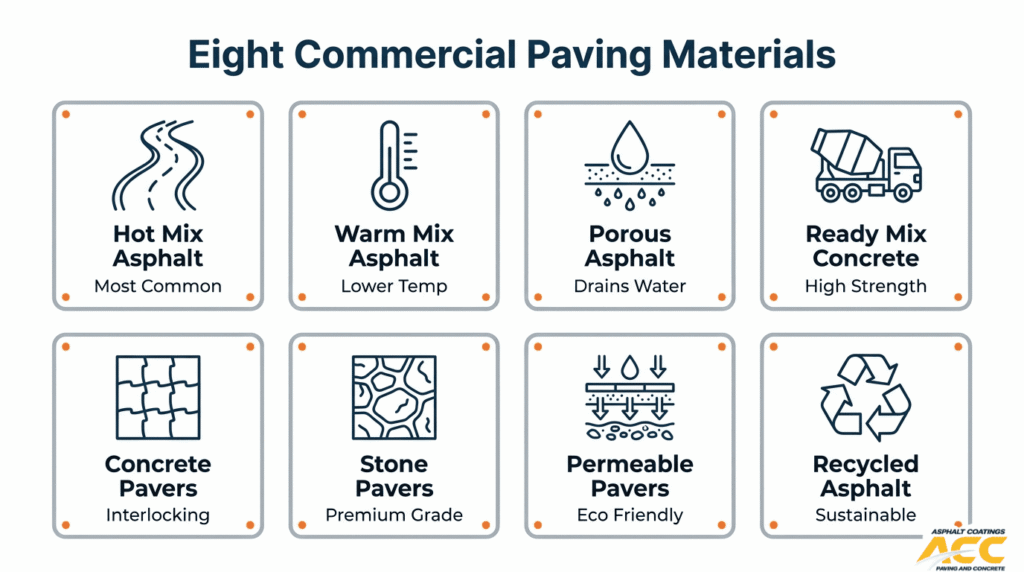
We break down eight distinct materials, including hot-mix asphalt, warm-mix asphalt, porous asphalt, ready-mix concrete, interlocking concrete pavers, natural stone pavers, permeable pavers, and recycled asphalt pavement. Each serves a specific commercial function based on production temperature, compressive strength, and permeability characteristics.
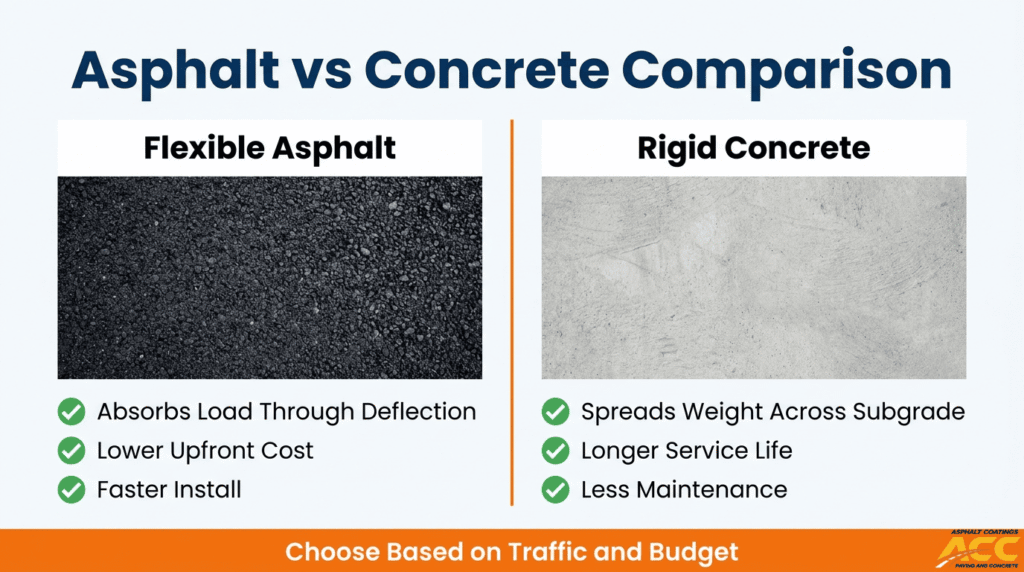
Asphalt and concrete differ fundamentally in structural behavior; flexible asphalt absorbs loads through deflection while rigid concrete spreads weight across a larger subgrade area. We compare both for parking lots, loading docks, and industrial yards so property managers can match material to application.
Climate factors like freeze-thaw cycles, UV oxidation, and thermal expansion degrade each material differently. Porous asphalt outperforms standard asphalt in winter conditions, while concrete resists UV breakdown better than petroleum-based binders.
Cost depends on project scale, subgrade stability, and material selection. Asphalt typically costs 30–50% less upfront than concrete, but lifecycle analysis over 20 to 30 years often shifts the comparison based on maintenance frequency and replacement timing.
Each material follows a distinct maintenance schedule. Asphalt requires sealcoating every two to three years; concrete needs joint resealing every five to seven years; paver systems demand periodic joint sand replenishment. Permeable surfaces also require vacuum sweeping to preserve infiltration capacity and meet stormwater regulations.
What Is Commercial Paving and Why Does Material Choice Matter?
Commercial paving is the process of constructing durable pavement surfaces for high-traffic properties such as parking lots, loading docks, and access roads. Material choice matters because it directly determines a pavement’s load-bearing capacity, maintenance requirements, lifespan, and total cost of ownership.
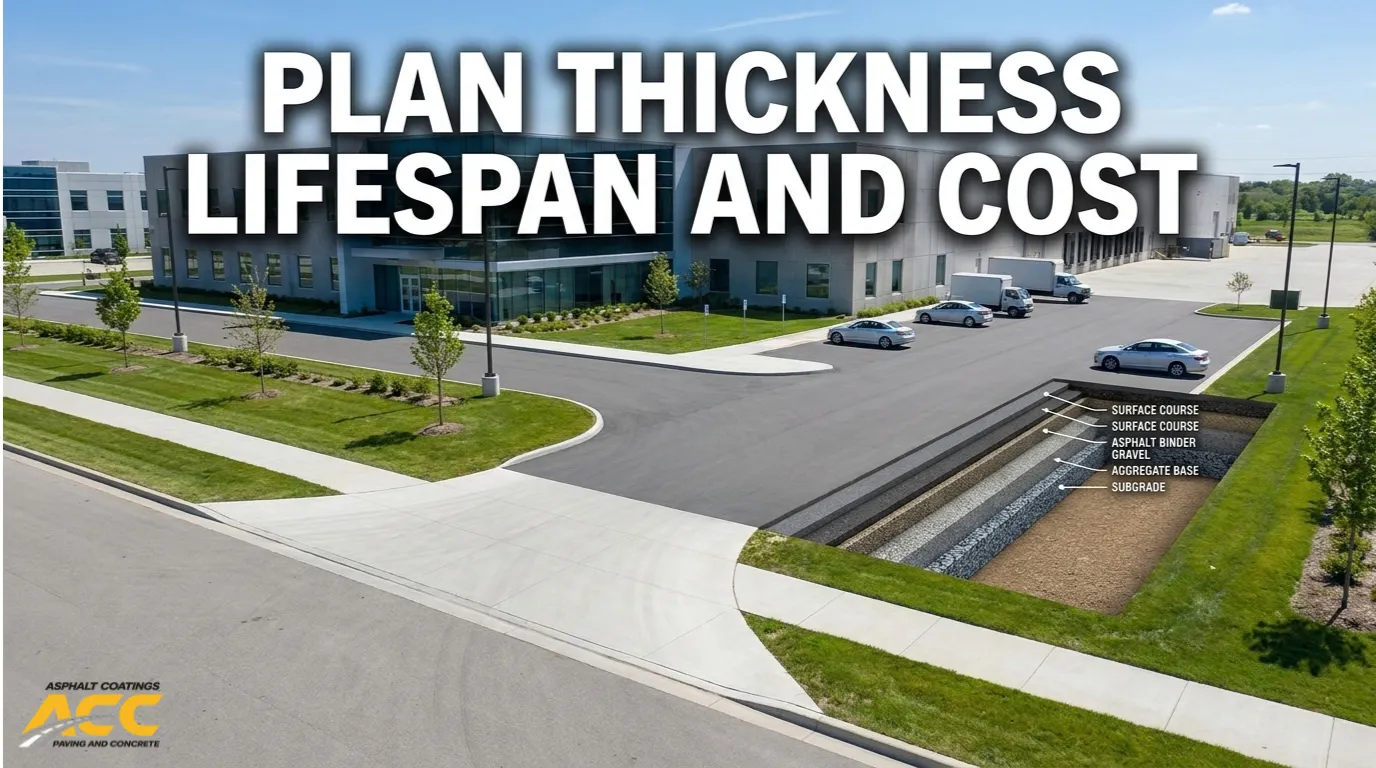
Unlike residential applications, commercial paving is designed for higher traffic volumes, requiring thicker asphalt layers and stronger subbase materials. The selection between flexible pavements like hot-mix asphalt and rigid pavements like ready-mix concrete affects how loads distribute across the subgrade, how the surface responds to weather cycles, and how frequently repairs become necessary.
As civil engineer Richard S. Rollings noted in the Journal of Performance of Constructed Facilities, “no pavement design is any better than the materials that go into it.” This principle underscores why property managers must evaluate factors such as compressive strength, production temperature, recycled content, and maintenance intervals before committing to a paving material. For commercial properties facing constant vehicle loads and environmental stress, the wrong material choice leads to premature failure and costly reconstruction.
What Are the Main Types of Commercial Paving Materials?
The main types of commercial paving materials are hot-mix asphalt, warm-mix asphalt, porous asphalt, ready-mix concrete, interlocking concrete pavers, natural stone pavers, permeable pavers, and recycled asphalt pavement (RAP).
Hot-Mix Asphalt
Hot-mix asphalt (HMA) is the most widely used commercial paving material, produced by combining aggregate with a viscous binding agent at approximately 300–350°F. This high production temperature ensures thorough coating of aggregates and optimal compaction during placement. HMA delivers excellent load-bearing capacity for parking lots, access roads, and industrial yards. According to a 2022 study published in the National Library of Medicine, conventional HMA production temperatures run 10–40°C higher than warm-mix alternatives, confirming the material’s reliance on heat for structural performance. For high-traffic commercial properties, HMA remains the industry standard due to its proven durability and cost-effectiveness.
Warm-Mix Asphalt
Warm-mix asphalt (WMA) is produced at 110–140°C, significantly lower than conventional HMA. Chemical additives, foaming agents, or organic waxes enable compaction at reduced temperatures without sacrificing structural integrity. Lower production heat translates to reduced fuel consumption and fewer emissions at the plant. WMA also extends the paving season because crews can place it in cooler ambient conditions. The material compacts more easily, which can improve density and long-term pavement performance. For commercial projects where environmental compliance or late-season scheduling matters, WMA offers a practical alternative to traditional hot-mix.
Porous Asphalt
Porous asphalt is an open-graded pavement designed to allow rainwater to drain through the surface into an underlying stone reservoir. This design reduces stormwater runoff, recharges groundwater, and minimizes the need for conventional drainage infrastructure. Research from the University of New Hampshire Stormwater Center found that winter maintenance performance for porous asphalt is superior to standard asphalt, with surfaces remaining clear of ice longer. Commercial properties subject to stormwater management regulations benefit most from this material. Porous asphalt requires periodic vacuum sweeping to prevent clogging, but when maintained properly, it performs reliably for decades.
Ready-Mix Concrete
Ready-mix concrete is a rigid pavement material delivered to the job site in a pre-batched, quality-controlled state. Its high compressive strength makes it ideal for loading docks, industrial yards, and areas exposed to heavy static loads. Because concrete distributes weight across a larger area of the subgrade, it resists rutting under concentrated wheel loads better than flexible pavements. The material also reflects more light than asphalt, reducing nighttime lighting costs in parking structures. Ready-mix concrete requires minimal maintenance beyond joint sealing and occasional slab replacement, making it a strong long-term investment for properties with heavy-duty operational demands.
Interlocking Concrete Pavers
Interlocking concrete pavers are modular units that achieve structural capacity through mechanical interlock, meaning individual pavers cannot move independently from their neighbors. This interlock mechanism distributes applied loads across adjacent units, creating a flexible yet strong surface. Pavers suit commercial walkways, plazas, retail entrances, and low-speed vehicle areas. Individual units can be removed and replaced without disturbing the surrounding surface, simplifying utility access and spot repairs. The variety of shapes, colors, and patterns available allows property managers to combine aesthetic appeal with functional performance in high-visibility areas.
Natural Stone Pavers
Natural stone pavers are premium paving units cut from quarried materials such as granite, bluestone, or limestone. According to the Natural Stone Institute, granite pavers must meet ASTM C170 standards for compressive strength, typically requiring a minimum of 19,000 psi (131 MPa). This exceptional strength makes natural stone suitable for upscale commercial entries, courtyards, and pedestrian plazas. Stone pavers resist fading, staining, and surface wear far longer than manufactured alternatives. The higher material and installation cost is offset by decades of service life with minimal maintenance, making them a worthwhile choice for properties prioritizing long-term appearance.
Permeable Pavers
Permeable pavers are modular paving units with widened joints or porous surfaces that allow rain and snowmelt to infiltrate into sub-layers. The U.S. Environmental Protection Agency classifies permeable pavement as a low-impact development practice that reduces runoff and the need for conventional drainage features. These systems typically consist of pavers set over graded aggregate beds that filter and temporarily store water. Permeable pavers work well in commercial parking areas, fire lanes, and overflow lots where stormwater compliance is required. Routine maintenance involves vacuuming joint material to preserve infiltration rates.
Recycled Asphalt (RAP)
Recycled asphalt pavement (RAP) is reclaimed material milled from existing asphalt surfaces and reprocessed into new mixtures. Nationally, RAP is utilized at an average rate of 21.9% in new asphalt mixtures, with approximately 89% of reclaimed material reused in new pavement, according to the National Asphalt Pavement Association. Incorporating RAP reduces raw material demand, lowers project costs, and diverts waste from landfills. The material performs comparably to virgin asphalt when blended at appropriate ratios. For property managers seeking sustainable paving solutions without compromising structural quality, RAP represents one of the most practical options available.
Understanding the full range of materials is the first step; comparing asphalt and concrete head-to-head clarifies which fits your property best.
How Does Asphalt Compare to Concrete for Commercial Properties?
Asphalt compares to concrete for commercial properties through key differences in structural behavior, cost, and maintenance requirements. Asphalt functions as a flexible pavement that absorbs surface loads through deflection, while concrete acts as a rigid pavement that distributes weight across a broader subgrade area. According to the American Concrete Institute’s design guide for concrete parking lots, concrete pavements spread loads over larger areas of the subgrade compared with asphaltic pavements because of their relatively high stiffness.
This structural distinction drives every downstream decision. Asphalt offers lower upfront costs, faster installation, and easier spot repairs. Concrete delivers longer service life and superior load distribution for heavy-duty applications. For most commercial property managers, the choice depends on traffic intensity, budget timeline, and long-term maintenance strategy. Properties with frequent heavy truck traffic often benefit from concrete’s rigidity, while parking areas serving standard vehicle loads perform well with properly maintained asphalt.
Understanding how each material handles stress, temperature shifts, and repair cycles helps property managers align their paving investment with operational demands.
What Are the Best Paving Materials for High-Traffic Areas?
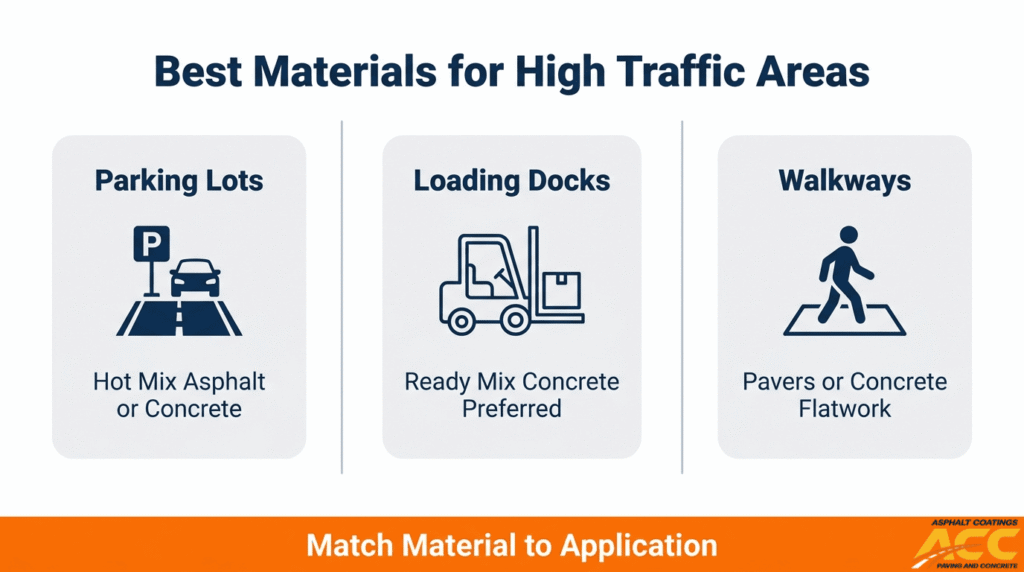
The best paving materials for high-traffic areas include hot-mix asphalt, ready-mix concrete, and interlocking concrete pavers. Each performs differently depending on the application, from parking lots to loading docks to pedestrian walkways.
Which Materials Perform Best in Parking Lots?
The materials that perform best in parking lots are hot-mix asphalt, ready-mix concrete, and interlocking concrete pavers. Hot-mix asphalt delivers smooth surfaces with fast installation timelines, while concrete’s high stiffness spreads loads over larger subgrade areas. Interlocking concrete pavers rely on interlock, defined by the Interlocking Concrete Pavement Institute as “the inability of a paver to move independently from its neighbors,” which is critical to structural performance in vehicular applications.
Material selection also determines stormwater compliance. The EPA requires commercial parking lots to manage stormwater runoff, making permeable options increasingly relevant. As civil engineer Richard S. Rollings noted in the Journal of Performance of Constructed Facilities, “no pavement design is any better than the materials that go into it.” This underscores why specifying the right mix design and subbase for parking lot traffic loads matters more than choosing a material category alone.
Which Materials Hold Up in Loading Docks and Industrial Yards?
The materials that hold up in loading docks and industrial yards are ready-mix concrete and heavy-duty hot-mix asphalt. Concrete’s rigid pavement structure distributes concentrated point loads from forklifts, trailer jacks, and heavy equipment across a wider subgrade area, reducing localized failure. Thicker asphalt sections with reinforced subbase can also perform well, though they require more frequent maintenance under sustained static loads.
For most industrial yards handling repetitive heavy loads in fixed positions, concrete provides superior long-term durability. Asphalt remains practical for areas with moderate truck traffic where flexibility and lower upfront cost are priorities.
Which Materials Work Best for Pedestrian Walkways?
The materials that work best for pedestrian walkways are interlocking concrete pavers, natural stone pavers, and standard concrete flatwork. These rigid surfaces provide stable, ADA-compliant pathways that resist settling under foot traffic.
Key material advantages for walkways include:
- Interlocking concrete pavers offer design versatility and individual unit replacement.
- Natural stone pavers, such as granite, deliver exceptional compressive strength and aesthetic appeal.
- Concrete flatwork provides a cost-effective, uniform surface for high-volume pedestrian areas.
For commercial properties balancing aesthetics with durability, paver systems often justify their higher upfront cost through reduced long-term repair needs and modular maintenance.
With traffic demands addressed, understanding how regional climate conditions interact with these materials further refines the selection process.
How Do Climate and Weather Affect Commercial Paving Selection?
Climate and weather affect commercial paving selection by determining which materials can withstand local environmental stresses without premature failure. The subsections below cover freeze-thaw cycles, UV exposure, and thermal expansion.
How Do Freeze-Thaw Cycles Impact Paving Performance?
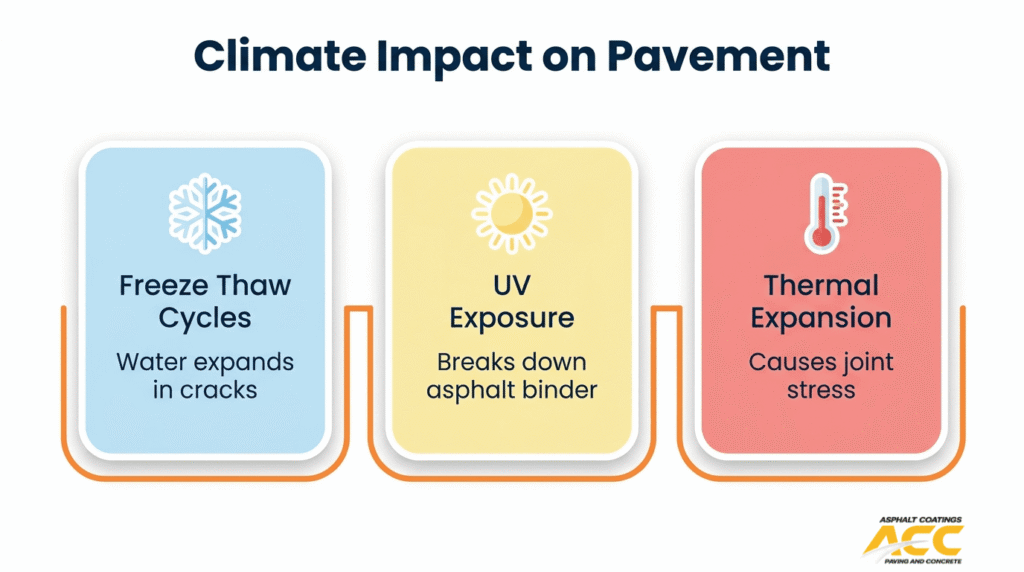
Freeze-thaw cycles impact paving performance by forcing water into surface cracks, where it expands upon freezing and contracts upon thawing, progressively widening fissures and weakening the pavement structure. This repeated mechanical stress accelerates pothole formation in flexible pavements like hot-mix asphalt and can cause scaling in rigid concrete surfaces. Porous asphalt mitigates some freeze-thaw damage because water drains through the surface rather than pooling in cracks. According to research from the University of New Hampshire Stormwater Center, winter maintenance performance for porous asphalt and pervious concrete is superior to standard asphalt, with surfaces remaining clear of ice longer. For properties in regions with harsh winters, selecting materials engineered to manage moisture infiltration is one of the most effective long-term strategies.
How Does High-Altitude UV Exposure Degrade Pavement?
High-altitude UV exposure degrades pavement by breaking down the chemical bonds in asphalt binder, a process called oxidative hardening. As UV radiation intensifies at elevation, the binder loses flexibility faster, turning brittle and developing surface raveling and microcracking. Concrete resists UV degradation better than asphalt because its cement-based composition does not contain petroleum binders susceptible to photochemical breakdown. For asphalt surfaces, sealcoating provides a protective barrier that absorbs UV radiation before it reaches the binder layer. Properties at higher elevations should anticipate shorter maintenance intervals for flexible pavements or consider concrete and interlocking concrete pavers where budget allows.
How Does Thermal Expansion Affect Material Longevity?
Thermal expansion affects material longevity by causing pavement to expand in heat and contract in cold, generating internal stresses that lead to cracking and joint failure over time. Concrete pavement requires control joints spaced at regular intervals to accommodate expansion without buckling. Asphalt, being a flexible pavement, absorbs minor thermal movement but becomes brittle in extreme cold, increasing crack susceptibility. Interlocking concrete pavers handle thermal movement well because individual units shift independently within the sand-set system. In climates with wide daily temperature swings, material selection must account for the coefficient of thermal expansion to prevent premature structural distress.
With climate factors established, the next consideration is how these conditions influence project costs.
What Factors Determine the Cost of Commercial Paving?
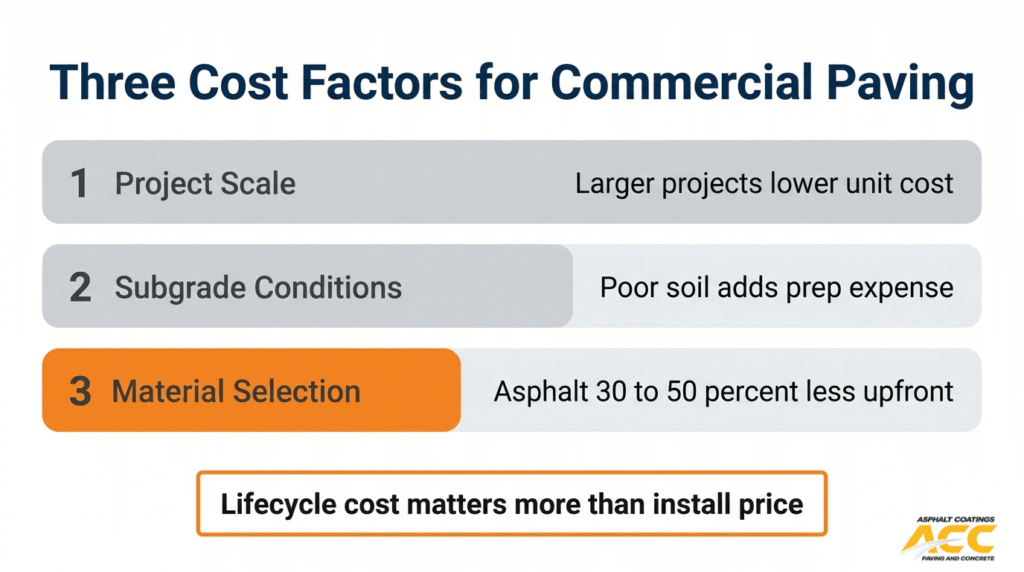
The cost of commercial paving depends on project scale, subgrade conditions, and material selection. Each factor shifts the price per square foot in different ways.
How Does Project Scale Influence Cost Per Square Foot?
Project scale influences cost per square foot through economies of scale: larger projects distribute mobilization, equipment, and labor costs across more surface area, reducing the unit price. Smaller lots carry higher per-square-foot rates because fixed setup costs remain constant regardless of size.
According to Concrete Calculator Pro, asphalt is generally more affordable than concrete, with upfront installation costs typically 30–50% cheaper for most projects in the United States. This gap narrows on very large pours where concrete batch pricing becomes more competitive. For most mid-size commercial parking lots, asphalt’s lower mobilization threshold makes it the more budget-friendly option at scale.
How Do Subgrade Conditions Affect Total Paving Cost?
Subgrade conditions affect total paving cost by dictating how much site preparation is required before any surface material is placed. Poor soils, high water tables, or unstable clay require excavation, import of structural fill, and compaction, all of which add labor, materials, and time.
A stable, well-draining subgrade may need only light grading, while expansive soils common along Colorado’s Front Range can demand full removal and replacement. These hidden costs often represent 20–40% of total project expense. Investing in proper geotechnical assessment before construction prevents costly mid-project surprises and premature pavement failure.
How Does Material Selection Change Long-Term Costs?
Material selection changes long-term costs by determining maintenance frequency, expected lifespan, and eventual replacement expense. A lower upfront price does not always yield the lowest total cost of ownership.
Asphalt requires periodic sealcoating and crack sealing but offers affordable repairs. Concrete costs more initially yet demands less routine maintenance over its service life. Interlocking pavers allow individual unit replacement without full-surface demolition. The best value depends on balancing installation budget against projected maintenance cycles and traffic demands over a 20- to 30-year horizon.
Understanding these cost drivers helps property managers request accurate estimates from qualified contractors.
How Long Does Each Commercial Paving Material Last?
Each commercial paving material lasts a different number of years depending on traffic load, maintenance practices, and environmental exposure. The following subsections cover lifespan expectations for hot-mix asphalt, concrete, interlocking pavers, and porous asphalt.
What Is the Lifespan of Hot-Mix Asphalt Pavement?
The lifespan of hot-mix asphalt pavement is typically 15 to 20 years for commercial applications with proper maintenance. As a flexible pavement, HMA absorbs deflection from heavy loads, though this flexibility also makes it susceptible to rutting and oxidation over time. Timely sealcoating and crack sealing can extend service life well beyond initial projections.
According to the National Asphalt Pavement Association, RAP is utilized at an average rate of 21.9% in new asphalt mixtures, with approximately 89% of RAP reused in new mixes. This recyclability means end-of-life HMA feeds directly into replacement projects, reducing material waste. For property managers planning long-term budgets, HMA offers predictable maintenance intervals that align well with phased capital improvement programs.
What Is the Lifespan of Commercial Concrete Pavement?
The lifespan of commercial concrete pavement is typically 20 to 30 years under normal commercial traffic conditions. Rigid pavement distributes loads across larger areas of the subgrade, which reduces localized stress and slows structural deterioration. Joint sealing and timely spall repair are essential to reaching the upper end of this range.
Concrete’s rigidity makes it particularly well suited for areas with concentrated static loads, such as dumpster pads and loading zones. However, once cracking begins, repairs tend to be more costly and disruptive than comparable asphalt fixes. Factoring in total lifecycle cost rather than upfront price alone often changes the material comparison significantly.
What Is the Lifespan of Interlocking Concrete Pavers?
The lifespan of interlocking concrete pavers is 25 to 50 years when installed on a properly engineered base. Individual units can be removed and replaced without disturbing surrounding pavers, which keeps long-term maintenance costs low. This modular design also simplifies utility access beneath the surface.
Structural performance depends on interlock, which is the inability of a paver to move independently from its neighbors. Maintaining tight joint sand and edge restraints preserves this interlock over decades. For commercial properties that prioritize aesthetics alongside durability, pavers offer exceptional longevity with minimal visual degradation.
What Is the Lifespan of Porous Asphalt Pavement?
The lifespan of porous asphalt pavement is typically 15 to 20 years with routine vacuum sweeping and sediment removal. According to the Federal Highway Administration, porous asphalt pavements with stone reservoirs are a multifunctional low impact development technology that integrates ecological and environmental goals with land development goals.
Regular maintenance prevents clogging of the void structure, which is what sustains both infiltration capacity and structural integrity. When voids remain clear, porous asphalt performs comparably to conventional HMA in load-bearing while simultaneously managing stormwater onsite. This dual function often reduces the need for separate drainage infrastructure, offsetting the higher installation cost over the pavement’s service life.
Understanding material longevity helps property managers align paving choices with maintenance budgets and operational demands.
What Maintenance Does Each Paving Material Require?
Each paving material requires a distinct maintenance approach based on its composition and vulnerability to wear. Asphalt needs periodic sealing and crack repair, concrete demands joint maintenance and surface cleaning, and paver systems require joint sand replenishment and individual unit replacement.
What Maintenance Does Asphalt Pavement Need?
Asphalt pavement needs routine sealcoating, crack sealing, and surface patching to maintain structural integrity. According to the U.S. Army Corps of Engineers, pavement maintenance treatments should be scheduled based on an inventory and a regular program to prevent potholes and extend service life.
A proactive asphalt maintenance plan includes:
- Sealcoating every two to three years to protect against UV oxidation and moisture penetration.
- Crack sealing before winter to prevent water infiltration that accelerates freeze-thaw damage.
- Pothole patching as soon as surface failures appear, preventing subgrade deterioration.
- Periodic restriping to maintain traffic flow and ADA compliance in commercial lots.
For permeable asphalt surfaces, maintenance also involves regular vacuuming to keep void spaces clear and preserve drainage function. Neglecting scheduled maintenance is one of the most common reasons commercial pavements fail prematurely; consistent, calendar-based upkeep consistently outperforms reactive repairs in both cost and longevity.
What Maintenance Does Concrete Pavement Need?
Concrete pavement needs joint sealing, surface cleaning, and periodic slab repair to preserve its rigid structure. Because concrete distributes loads across a wide area, maintenance focuses less on surface wear and more on protecting joints and preventing subsurface moisture damage.
Key concrete maintenance tasks include:
- Joint resealing every five to seven years to block water and incompressible debris from entering expansion joints.
- Surface cleaning with pressure washing to remove oil stains, chemical buildup, and biological growth.
- Spall repair on damaged surface areas before they expose underlying reinforcement.
- Slab leveling (mudjacking or polyurethane injection) when settlement creates uneven surfaces or trip hazards.
Concrete requires fewer maintenance cycles than asphalt overall, but each intervention tends to be more specialized. Ignoring joint deterioration is particularly costly, since it often leads to full slab replacement rather than a simple surface fix.
What Maintenance Do Paver Systems Need?
Paver systems need joint sand replenishment, weed control, and individual unit replacement to maintain interlock and surface stability. The modular design of interlocking concrete pavers and natural stone pavers makes targeted repairs straightforward, since damaged units can be lifted and replaced without disturbing surrounding sections.
Essential paver maintenance tasks include:
- Joint sand replenishment after heavy rain or power washing to maintain interlock between units.
- Weed and moss removal from joints to prevent root growth that displaces pavers.
- Edge restraint inspection to ensure border units remain secure and prevent lateral shifting.
- Individual paver replacement for cracked, chipped, or stained units.
Polymeric sand reduces weed growth and joint erosion compared to standard sand, making it a worthwhile upgrade for high-traffic commercial areas. Paver systems offer the lowest per-repair cost of any commercial paving option because failures stay localized rather than spreading across an entire surface.
With maintenance strategies defined for each material, the next step is understanding how drainage requirements shape paving decisions.
How Do Drainage and Stormwater Requirements Affect Paving?
Drainage and stormwater requirements affect paving by dictating surface grading, material permeability, and runoff management systems that must be integrated into the pavement design. The right material choice determines whether a property meets environmental regulations or faces costly retrofits.
Commercial parking lots and access roads must control where water flows during and after storms. Traditional impervious surfaces, such as hot-mix asphalt and ready-mix concrete, shed nearly all rainfall as surface runoff. This runoff carries pollutants like oil, heavy metals, and sediment into storm drains and local waterways. Municipal stormwater ordinances increasingly require property owners to manage this runoff on-site through detention basins, bioswales, or permeable paving systems.
Permeable pavers, porous asphalt, and pervious concrete offer an alternative approach. According to the U.S. Environmental Protection Agency, permeable pavements allow rain and snowmelt to seep through the surface to underlying layers, reducing runoff and the need for conventional drainage features. This infiltration-based strategy can significantly reduce the size and cost of traditional stormwater infrastructure.
Material selection directly shapes drainage compliance costs:
- Porous asphalt uses an open-graded aggregate structure that channels water into a stone reservoir base, combining structural support with stormwater storage.
- Interlocking concrete pavers with widened joints allow water to pass between units into a prepared aggregate bed beneath.
- Standard asphalt and concrete require engineered surface slopes (typically 1–2%) and catch basin systems to direct runoff to detention or treatment areas.
For property managers weighing options, the trade-off is straightforward. Permeable materials reduce or eliminate the need for separate drainage infrastructure, but they require periodic vacuum sweeping to maintain infiltration rates. Impervious surfaces cost less per square foot to install, yet the added expense of storm drains, detention ponds, and regulatory compliance can close that gap quickly. Factoring drainage into material selection from the start prevents expensive change orders and ensures the finished pavement meets both performance and environmental standards.
With stormwater strategies defined, property managers can evaluate the broader factors that guide material selection.
What Should Property Managers Consider When Choosing Paving?
Property managers should consider traffic volume, maintenance timing, subgrade conditions, climate exposure, and long-term cost when choosing paving. The following factors determine which material delivers the best return on investment for commercial properties.
- Traffic volume and load requirements: Commercial paving requires thicker asphalt layers and stronger subbase materials than residential applications. Parking lots, loading docks, and drive aisles each demand different structural designs based on vehicle weight and frequency.
- Maintenance timing and scheduling: According to a 2009 study published through the American Society of Civil Engineers, the Nebraska Department of Roads reported that about 60% of road deficiencies could be attributed to the timing and selection of maintenance treatments. Proactive scheduling prevents costly failures.
- Climate and environmental exposure: Freeze-thaw cycles, UV degradation, and thermal expansion affect each material differently. The paving material must match the property’s specific environmental stresses.
- Stormwater and drainage compliance: Permeable options like porous asphalt reduce runoff, but conventional materials may require additional drainage infrastructure to meet local regulations.
- Lifecycle cost versus upfront cost: Asphalt offers lower installation costs, while concrete and pavers may reduce long-term maintenance spending. Evaluating total cost of ownership over 20 to 30 years reveals the true value of each option.
For most commercial properties, the single biggest mistake is selecting materials based solely on initial price without accounting for maintenance cycles and environmental demands. A material that costs less upfront but requires frequent intervention often exceeds the total expense of a more durable alternative within a decade.
Understanding these selection criteria prepares property managers to work effectively with a qualified paving contractor.
How Should You Approach Commercial Paving With an Experienced Contractor?
You should approach commercial paving with an experienced contractor by seeking a full-service partner who evaluates site conditions, recommends appropriate materials, and manages long-term maintenance planning.
Can a Full-Service Asphalt and Concrete Contractor Help You Choose the Right Material?
Yes, a full-service asphalt and concrete contractor can help you choose the right material by assessing traffic volume, subgrade conditions, drainage requirements, and budget constraints specific to your property. A contractor offering both asphalt paving and concrete flatwork provides unbiased recommendations based on performance needs rather than limited capabilities.
Asphalt Coatings Company specializes in commercial asphalt paving, concrete installation, sealcoating, and parking lot construction across Colorado’s Front Range. With in-house crews handling everything from subgrade preparation to striping, Asphalt Coatings Company delivers single-source convenience that eliminates coordination gaps between trades. This partnership approach ensures material selection aligns with each property’s unique load demands and environmental exposure.
What Are the Key Takeaways About Commercial Paving Options and Materials?
The key takeaways about commercial paving options and materials are that material selection must match traffic intensity, climate conditions, and maintenance capacity. According to The Pavement Group, commercial paving is designed for higher traffic volumes, requiring thicker asphalt layers and stronger subbase materials compared to residential applications.
Practical conclusions to guide your decision:
- Hot-mix asphalt offers the lowest upfront cost and fastest installation for large parking areas.
- Ready-mix concrete provides superior load distribution for heavy-duty industrial applications.
- Porous asphalt and permeable pavers address stormwater compliance while reducing drainage infrastructure costs.
- Interlocking concrete pavers allow modular repairs without full-surface replacement.
- Recycled asphalt pavement reduces material costs while maintaining structural performance.
- Regular sealcoating every two to three years extends asphalt lifespan significantly.
No single material suits every commercial application. The most durable, cost-effective pavement results from matching material properties to site-specific demands, then committing to a scheduled maintenance program that prevents premature failure.