A post-hailstorm pavement inspection checklist for Denver property managers is a systematic evaluation of parking lot surfaces, drainage infrastructure, and pavement markings conducted after severe hail to identify damage, document conditions for insurance claims, and prioritize repairs before deterioration accelerates.
This guide covers pre-inspection safety protocols, damage identification for asphalt and concrete surfaces, drainage system evaluation, insurance documentation requirements, and repair prioritization strategies.
Denver’s 34 hail days in 2025 and the city’s elevation of 5,280 feet create conditions where fresh hail cracks can escalate into structural failures within weeks. Freeze-thaw cycling forces water into impact fractures repeatedly, while high-altitude UV radiation oxidizes exposed binder faster than at lower elevations. Safe site assessment before any walkthrough is essential; OSHA guidelines require verifying pavement stability before operating vehicles or walking on storm-damaged surfaces.
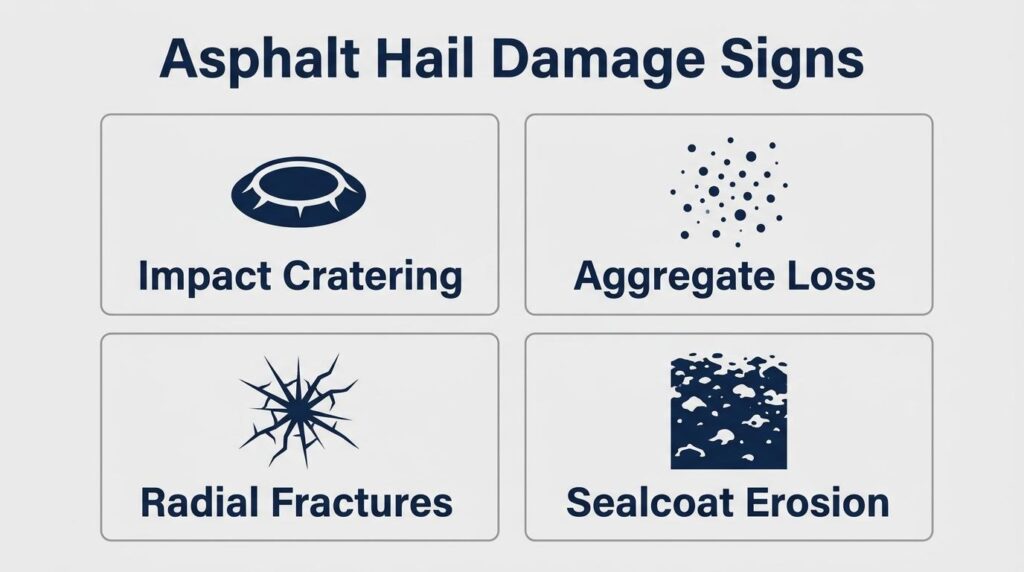
Asphalt parking lots reveal hail damage through impact cratering, aggregate displacement, distinctive radial fracture patterns, and sealcoat erosion. Concrete surfaces show spalling at joints, curb chipping along exposed edges, and expansion joint sealant failure. Pavement markings and striping often sustain chips or complete paint loss that compromise ADA compliance and fire lane visibility. Each indicator requires specific documentation methods.
Drainage systems clogged by hail debris create standing water that accelerates pavement failure and increases slip-and-fall liability. Clearing inlets, catch basins, and channel drains promptly is one of the most cost-effective steps in preventing secondary damage.
Timestamped photos, precise measurements, and pre-storm condition records form the foundation of successful insurance claims, with most Colorado policies requiring submission within 6 to 12 months. Categorizing damage into immediate safety hazards, scheduled maintenance items, and full replacement candidates ensures resources address the highest-risk conditions first.
Why Is Immediate Pavement Inspection Critical After Denver Hailstorms?
Immediate pavement inspection is critical after Denver hailstorms because undetected damage accelerates rapidly through freeze-thaw cycling and creates serious liability exposure. The following sections cover how quickly hail damage escalates and the legal risks property managers face from uninspected surfaces.
How Quickly Can Hail Damage Escalate Through Freeze-Thaw Cycles?
Hail damage can escalate through freeze-thaw cycles within days of an initial storm, as water infiltrates fresh cracks and expands each time temperatures drop below freezing. Denver’s elevation of 5,280 feet produces frequent temperature swings that drive this process aggressively. According to the National Weather Service, Denver’s mean temperature in 2025 was 52.8°F, 1.6°F above normal, altering the intensity of local freeze-thaw patterns.
Pavements in regions with significant winter precipitation can experience approximately 90 freeze-thaw cycles annually. Each cycle widens hail-created fractures, loosens aggregate, and deepens surface deterioration. For property managers, even a 48-hour delay in inspection means moisture has already begun its destructive work inside the pavement structure. This is why post-hail inspections should be treated as time-sensitive, not routine.
What Liability Risks Do Denver Property Managers Face From Uninspected Hail Damage?
Denver property managers face liability risks from uninspected hail damage that include premises liability lawsuits, insurance claim denials, and regulatory non-compliance. Under the Colorado Premises Liability Act (§ 13-21-115), responsibility varies based on whether the injured party is a trespasser, licensee, or invitee, with invitees receiving the highest duty of care.
Key risk factors include:
- Denver experienced 34 hail days in 2025, making undetected surface hazards a recurring exposure.
- The May 30, 2024 Denver–Aurora hailstorm caused an estimated $2.3 billion in insured losses, underscoring the scale of potential damage.
- Colorado landlords and property managers bear responsibility for maintaining safe common areas, including snow and ice removal on pavement surfaces.
- The statute of limitations for property damage breach-of-contract claims in Colorado is three years, meaning delayed discovery does not eliminate legal exposure.
Failing to document and address pavement conditions promptly weakens both insurance claims and legal defenses. With safety hazards now identified, the next step is preparing to inspect storm-damaged surfaces.
What Safety Steps Should You Take Before Inspecting Storm-Damaged Pavement?
The safety steps you should take before inspecting storm-damaged pavement include conducting a preliminary site assessment, checking for standing water and debris hazards, wearing appropriate personal protective equipment, and verifying structural stability of the pavement surface before walking or driving on it.
OSHA guidelines under 29 CFR 1926 require a preliminary worksite inspection to verify stability before operating vehicles over roadways in storm-damaged or flooded areas. For Denver property managers, this means no one should drive maintenance vehicles or heavy equipment across a hail-damaged parking lot until the surface has been visually cleared for sinkholes, undermined subgrade sections, or pooling water that could mask deeper failures.
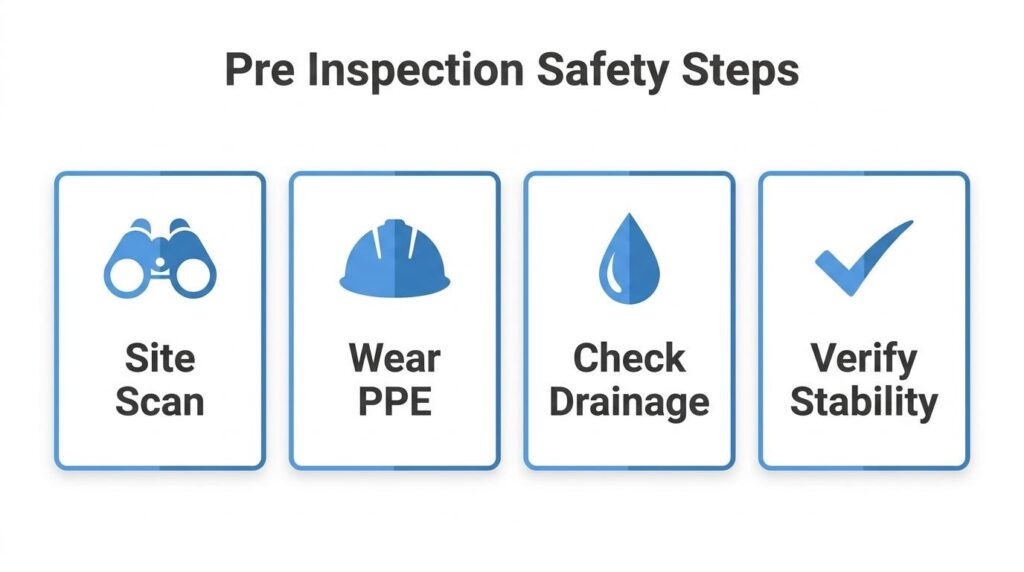
Before stepping onto the site, take these precautions:
- Scan the entire pavement area from a safe vantage point for visible hazards, such as standing water, displaced debris, or downed power lines.
- Wear closed-toe boots with slip-resistant soles, high-visibility vests, and hard hats if overhead hazards exist.
- Check drainage inlets and catch basins visually before approaching; clogged systems can create deceptively deep water pools.
- Avoid walking on pavement sections that appear buckled, sunken, or undermined until a qualified professional confirms structural integrity.
- Restrict vehicle access to inspected, stable routes only.
Skipping this initial safety sweep is one of the most common mistakes property managers make after a major hailstorm. The urgency to assess damage often overrides basic precautions, but a compromised subgrade or hidden washout can turn a routine walkthrough into a serious incident. Once the site is confirmed safe, a systematic damage inspection can begin with the parking lot surface itself.
How Do You Identify Hail Damage on Asphalt Parking Lots?
You identify hail damage on asphalt parking lots by inspecting for impact cratering, displaced aggregate, unusual fracture patterns, and sealcoat erosion. The following subsections cover each indicator.
What Does Hail Impact Cratering Look Like on Asphalt Surfaces?
Hail impact cratering on asphalt surfaces looks like circular or semi-circular depressions where hailstones struck the pavement with enough force to compress or fracture the binder layer. These craters often appear in clustered, random patterns across exposed areas. According to forensic engineering research by Petty (2021), hail damage to asphalt typically exhibits patterning atypical of randomly distributed weathering, characterized by impact markings where granules are immersed into the asphalt matrix.
When inspecting a Denver parking lot, look for soft spots within each depression. Fresh craters may show darker asphalt where the surface seal was punctured, exposing unoxidized binder beneath. Older impacts tend to collect moisture and debris, accelerating deterioration if left unaddressed.
How Do You Spot Hail-Induced Aggregate Displacement?
You spot hail-induced aggregate displacement by scanning the pavement surface for loose stones, exposed binder, and areas where the aggregate matrix has been dislodged from the asphalt. Hailstones strike with concentrated force that pops individual stones free from the binder, leaving pockmarked patches surrounded by scattered gravel.
Run your hand across suspect areas; displaced aggregate feels rough and uneven compared to intact sections. Loose stones often accumulate in low spots or along drainage paths after a storm. Significant aggregate loss weakens the wearing course and exposes the underlying layers to UV degradation and moisture infiltration, both of which accelerate in Denver’s high-altitude climate.
What Fracture Patterns Distinguish Hail Damage From Normal Wear?
Fracture patterns that distinguish hail damage from normal wear include concentrated, radial cracking emanating from distinct impact points rather than the linear, interconnected cracking typical of age-related fatigue. Normal wear produces alligator cracking across broad, load-bearing zones. Hail fractures, by contrast, appear as isolated starbursts or concentric rings clustered in exposed areas.
The directional pattern matters: hail-driven cracks follow no traffic line, while load-related cracking aligns with wheel paths. Documenting these distinctions strengthens insurance claims because adjusters look specifically for impact-origin fractures versus gradual degradation. Photograph each fracture with a ruler for scale and note its location relative to sheltered versus exposed zones.
How Do You Detect Sealcoat or Surface Coating Erosion After Hail?
You detect sealcoat or surface coating erosion after hail by comparing treated surfaces against their original uniform appearance. Hail impacts chip, pit, and thin the sealcoat layer, exposing the gray or brown asphalt beneath the typically black-coated finish. These exposed patches appear as irregular light spots scattered across the lot.
Drag a straight edge across suspect areas to feel for divots the eye might miss. Sealcoat erosion is especially critical to document because it removes the protective barrier against oxidation and water penetration. For Denver property managers, compromised sealcoat before winter means moisture enters the pavement and drives freeze-thaw damage during the colder months.
With hail damage indicators documented, the next step is inspecting concrete surfaces for similar impact signs.
How Do You Identify Hail Damage on Concrete Surfaces?
You identify hail damage on concrete surfaces by inspecting for spalling, chipping, curb deterioration, and expansion joint failures. The following subsections cover specific damage patterns to look for on slabs, curbs, gutters, and joints.
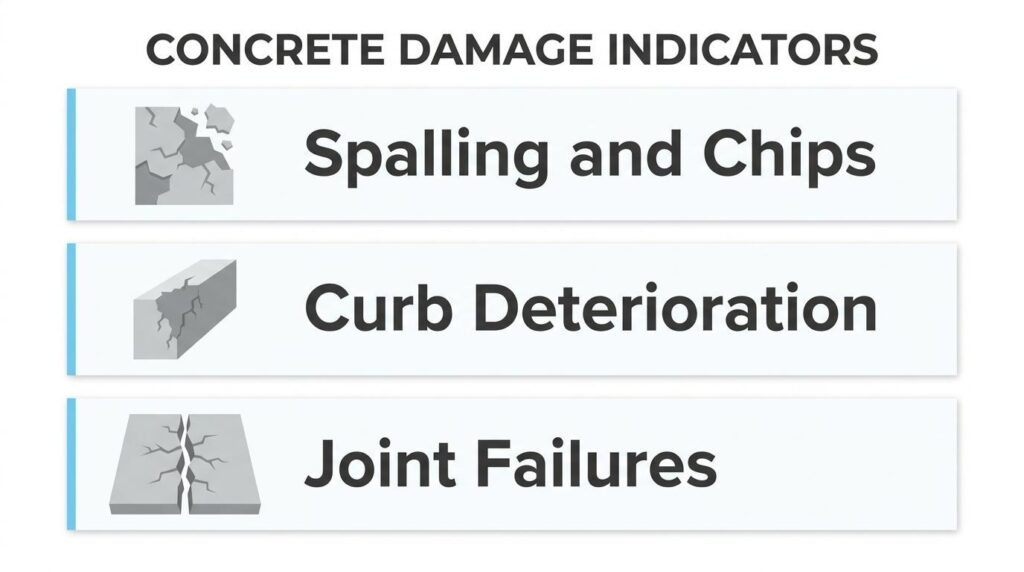
What Spalling or Chipping Patterns Indicate Hail Impact on Concrete?
Spalling or chipping patterns that indicate hail impact on concrete include shallow, roughly circular depressions where surface material has fractured away from the slab. Unlike gradual weathering, hail-caused spalls typically cluster in exposed areas and share a consistent size relative to the hailstone diameter.
Joint areas deserve particular attention. Spalling at joints is often linked to moisture trapped inside the slab that cannot escape, a condition identifiable during close visual inspections. When hail fractures the surface near these joints, trapped water accelerates deterioration during Denver’s freeze-thaw cycles. Look for freshly exposed aggregate surrounded by intact surfaces, as this contrast distinguishes impact damage from age-related scaling.
How Do You Assess Hail Damage to Concrete Curbs and Gutters?
You assess hail damage to concrete curbs and gutters by examining top edges, faces, and gutter flow lines for fresh chips, fractures, and displaced material. Curb tops receive direct hail strikes and often show the most concentrated damage.
Key indicators to document include:
- Fresh, light-colored chips along the curb’s top radius where impacts struck exposed edges.
- Vertical face fractures that extend downward from impact points on the curb crown.
- Gutter channel roughness or debris accumulation from spalled concrete blocking water flow.
- Misalignment between curb sections where impacts may have shifted weakened joints.
Damaged curbs that direct stormwater away from parking areas should be prioritized, since compromised drainage accelerates pavement failure across the entire lot.
What Expansion Joint Damage Should You Look For After Hail?
Expansion joint damage you should look for after hail includes cracked or dislodged sealant, compressed filler material, and chipped concrete edges along joint lines. Hail impacts near joints concentrate force at already-vulnerable transition points between slabs.
Inspect for these specific conditions:
- Sealant that has cracked, lifted, or separated from one or both joint walls.
- Filler material pushed below the slab surface, creating a recessed channel where water collects.
- Concrete edge spalling along the joint lip, exposing the slab interior to moisture infiltration.
Even minor joint damage in Denver’s climate is a serious concern. Water entering compromised joints freezes and expands, widening cracks with each cycle. Addressing joint damage early prevents costly full-slab replacement later.
With concrete damage patterns identified, documenting pavement markings and striping condition completes the surface inspection.
What Pavement Markings and Striping Damage Should You Document?
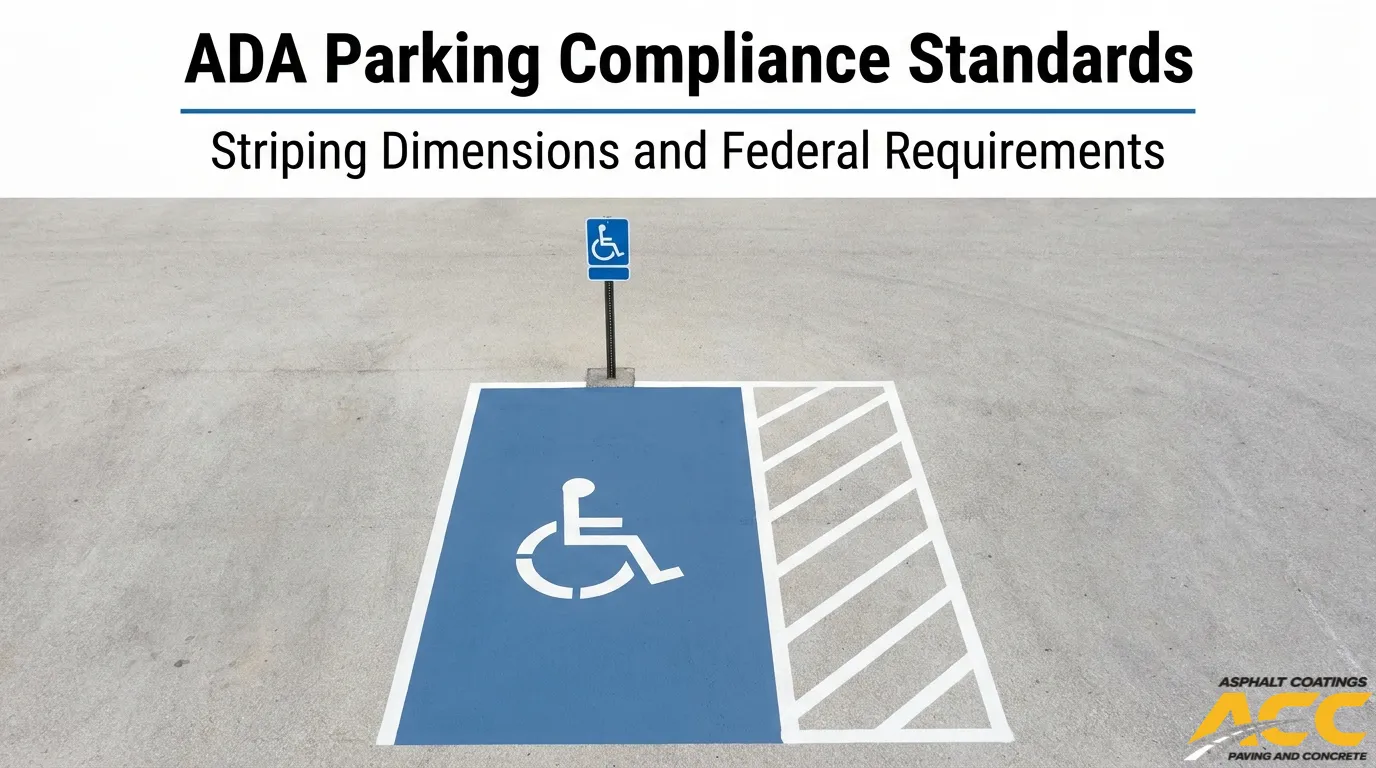
Pavement markings and striping damage you should document includes chipped or gouged paint lines, faded lane markings, displaced thermoplastic striping, and damaged ADA-compliant symbols. Hailstones striking parking lot surfaces at high velocity can chip, crack, or completely strip away painted or thermoplastic markings, leaving directional arrows, crosswalks, fire lanes, and handicap designations illegible.
Document every affected marking with close-up photos showing the extent of paint loss or surface scarring alongside a wider shot for location context. Note which markings affect traffic flow, pedestrian safety, and ADA compliance, since these carry the highest liability risk and repair urgency. Faded or obliterated fire lane markings and accessible parking symbols often require immediate restriping to maintain code compliance. For property managers prioritizing post-storm repairs, marking damage that compromises wayfinding or accessibility should rank alongside structural pavement issues.
With markings assessed, inspecting how hail and debris affected your drainage systems is the next critical step.
How Should You Inspect Drainage Systems After a Denver Hailstorm?
You should inspect drainage systems after a Denver hailstorm by checking every inlet, grate, channel, and catch basin for hail debris accumulation and water flow obstruction. Hailstorms deposit large volumes of ice, loose aggregate, and organic debris across parking lots, and this material migrates directly into drainage infrastructure as it melts. According to research published in the International Journal of Pavement Engineering, debris carried by flood water during intense rainfall can clog pavement drainage systems, leading to surface flooding and potential hydroplaning hazards.
A thorough post-hail drainage inspection should cover:
- Surface grates and inlet covers: Check for hail stones, gravel, and leaf debris wedged into grate openings that restrict water entry.
- Catch basins and collection boxes: Remove accumulated sediment and ice melt residue that settles at the basin floor.
- Channel drains and trench drains: Walk the full length to identify blockages where hail debris has collected at joints or low points.
- Downspout discharge points: Verify that roof drainage terminating at pavement level flows freely without pooling.
- Parking lot slope and grade: Confirm water still sheets toward drainage points; hail impact can displace loose fill near curb lines, altering flow paths.
Standing water on a commercial parking lot after a storm is not just an inconvenience. Pooled water accelerates asphalt deterioration, creates slip-and-fall liability, and signals that drainage capacity has been compromised. Property managers who overlook drainage during their post-hail checklist often discover pavement failures weeks later, when trapped moisture freezes and expands beneath the surface. Clearing drainage systems promptly is one of the most cost-effective steps in preventing secondary storm damage.
With drainage systems verified and cleared, documenting all findings strengthens the insurance claim process that follows.
What Documentation Do Denver Property Managers Need for Insurance Claims?
Denver property managers need timestamped photos, precise measurements, pre-storm condition records, and professional damage assessment reports for insurance claims. The following subsections cover how each documentation type strengthens a hail damage claim.
What Photos and Measurements Strengthen a Hail Damage Claim?
Photos and measurements that strengthen a hail damage claim include close-up images of impact craters with a ruler for scale, wide-angle shots showing damage distribution across the lot, and GPS-tagged or timestamped files that tie evidence to a specific storm date. Measurements should record crater depth, crack width, and affected square footage.
Timing matters as much as image quality. According to JK Roofing, most insurance policies in Colorado require that hail and wind damage claims be filed within 6 to 12 months of the storm date, although some insurers allow up to 24 months. Documenting damage immediately after the event preserves evidence before freeze-thaw cycles or traffic obscure original hail impact marks.
Key photo and measurement priorities include:
- Close-ups of individual hail strikes with a measuring tool visible in the frame.
- Overview photos from multiple angles capturing the full extent of affected areas.
- Depth and width measurements of cracks, spalls, and surface depressions.
- Date, time, and location metadata embedded in each image file.
How Should You Record Pre-Storm Versus Post-Storm Pavement Condition?
You should record pre-storm versus post-storm pavement condition by maintaining a baseline condition log with dated photos, maintenance records, and any prior inspection reports. This before-and-after comparison gives adjusters clear evidence that damage resulted from the hail event, not from pre-existing deterioration.
Baseline documentation is especially important because Colorado’s pavement conditions vary widely. Newly updated 2025 Colorado Department of Transportation performance data showed that 50.6% of the state’s interstate pavement was in good condition, up from 42.8% in 2022. Without a documented starting point, insurers may attribute hail-related cracking or surface loss to normal wear rather than storm impact. Property managers who schedule routine condition assessments, even annually, build a much stronger claims file when severe weather strikes.
When Should You Request a Professional Damage Assessment Report?
You should request a professional damage assessment report when hail damage extends beyond superficial surface marks into structural concerns, such as deep cracking, aggregate loss across large areas, or compromised drainage grades. A qualified paving contractor or engineer provides the technical terminology and objective measurements that insurance adjusters require for higher-value claims.
Professional assessments also help when dispute potential is high. If an insurer questions whether damage is storm-related or pre-existing, a third-party report with core samples, deflection testing data, or photographic evidence carries significantly more weight than an internal maintenance log alone. For Denver properties with aging pavement or prior patching, this independent verification often determines whether a claim is approved or denied.
With documentation secured, the next step is prioritizing which repairs to address first.
How Do You Prioritize Repairs After Completing a Hail Damage Inspection?
You prioritize repairs after completing a hail damage inspection by categorizing damage into three tiers: immediate safety hazards, scheduled maintenance items, and full replacement candidates. The following subsections break down each tier.
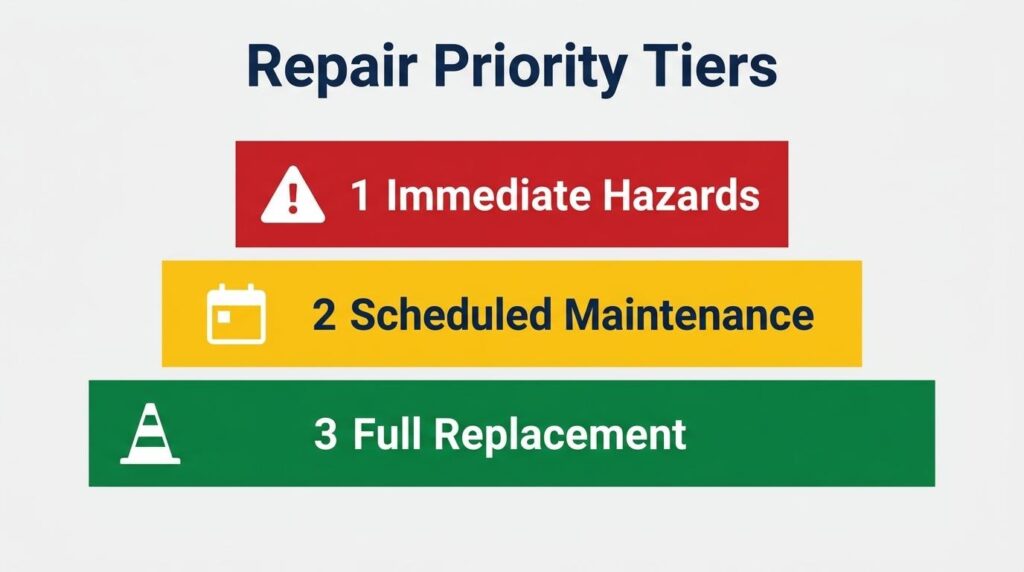
Which Hail-Damaged Areas Pose Immediate Safety Hazards?
Hail-damaged areas that pose immediate safety hazards include any conditions creating trip-and-fall risks or vehicle hazards for pedestrians and drivers. These top-priority items demand same-day or next-day attention:
- Deep impact craters or potholes in high-traffic pedestrian walkways and ADA-accessible routes.
- Loose or displaced aggregate creating unstable walking surfaces near building entrances.
- Spalled concrete curbs or broken gutter sections that redirect stormwater onto walkways.
- Compromised drainage inlets causing standing water and hydroplaning risk in parking lanes.
- Damaged pavement markings obscuring fire lanes, handicap spaces, or directional arrows.
For Denver property managers, any condition that could injure an invitee on the premises should be flagged for emergency repair before addressing cosmetic or structural concerns. Delaying these fixes exposes properties to preventable liability.
Which Damages Can Be Scheduled for Planned Maintenance?
Damages that can be scheduled for planned maintenance are those that do not present immediate safety risks but will worsen without intervention. These typically include:
- Hairline surface cracks from hail impact that have not yet widened or connected.
- Minor sealcoat erosion exposing the asphalt binder but not the aggregate base.
- Shallow cosmetic pitting on concrete flatwork away from pedestrian paths.
- Small joint sealant failures in expansion joints that remain structurally intact.
Scheduling these repairs within a planned maintenance window, ideally before Denver’s next freeze-thaw season, prevents minor damage from escalating into costly structural failures. Addressing them proactively is far more cost-effective than waiting for full deterioration.
When Does Hail Damage Warrant Full Pavement Replacement Over Patching?
Hail damage warrants full pavement replacement over patching when the structural integrity of the pavement has failed beyond what surface-level rehabilitation can restore. According to Kimley-Horn, full-depth reclamation is recommended for high-severity distressed or failed pavements where rehabilitation methods like overlays are insufficient to rejuvenate the structure.
Several conditions signal that patching is no longer viable:
- Interconnected alligator cracking across large pavement sections following hail impact.
- Subgrade compromise where hail-driven water infiltration has destabilized the base layers.
- Repeated patch failures in the same area, indicating deeper structural deficiency.
Environmental factors, including subgrade soil and climate variables, account for approximately 36 percent of total pavement damage. In Denver, expansive soils compound hail-related deterioration significantly. However, regular maintenance and timely repair can extend asphalt service life to 30 or 40 years, making replacement a last resort rather than a default.
With repair priorities established, understanding how Denver’s climate accelerates post-hail deterioration helps property managers plan ahead.
How Does Denver’s Climate Affect Post-Hail Pavement Deterioration?
Denver’s climate accelerates post-hail pavement deterioration through a combination of high-altitude freeze-thaw cycling, intense UV exposure, and rapid temperature swings. These factors turn minor hail damage into major structural failures faster than in lower-elevation cities.
According to Goetz and Boschmann’s Metropolitan Denver (2018), Denver’s elevation of 5,280 feet results in frequent and numerous freeze-thaw cycles that significantly impact pavement deterioration and travel infrastructure. When hail creates surface cracks or dislodges aggregate, water infiltrates these openings. As temperatures oscillate above and below freezing, that trapped moisture expands and contracts repeatedly, widening cracks from the inside out.
High-altitude UV radiation compounds this problem. Denver’s thinner atmosphere filters less ultraviolet light, which oxidizes asphalt binder more aggressively than at sea level. Hail-damaged surfaces, where protective sealcoat has been stripped or fractured, are especially vulnerable to this accelerated oxidation. The binder becomes brittle, loses flexibility, and cracks propagate faster under traffic loads.
Denver’s characteristic rapid temperature shifts also stress pavement through thermal expansion and contraction. A single spring day can swing 40°F or more between morning lows and afternoon highs. For pavement already compromised by hail impact, these thermal cycles fatigue the surface layer and accelerate joint deterioration in concrete sections.
The practical takeaway for property managers is urgency. Hail damage that might remain stable for months in a milder, lower-elevation climate can deteriorate within weeks under Denver’s conditions. Prompt inspection and repair prevent the compounding effect where freeze-thaw, UV degradation, and thermal cycling each amplify the others.
Understanding these climate-driven risks sets the stage for how professional paving services can address hail damage before it compounds.
How Can Professional Commercial Paving Services Restore Hail-Damaged Pavement?
Professional commercial paving services restore hail-damaged pavement by combining expert damage assessment with targeted repair methods, from patching and sealcoating to full-depth reclamation. The sections below cover how in-house crews streamline the process and the key takeaways from this inspection checklist.
Can In-House Asphalt and Concrete Crews Simplify Post-Hail Repairs for Property Managers?
Yes, in-house asphalt and concrete crews can simplify post-hail repairs for property managers by providing a single point of contact for every phase of restoration. Rather than coordinating separate subcontractors for asphalt patching, concrete flatwork, curb and gutter repair, and parking lot striping, a single-source commercial paving contractor handles the full scope under one project timeline.
Professional commercial paving contractors in the Denver and Front Range area can provide dedicated in-house crews covering services that include:
- Asphalt repair, patching, and mill-and-pave for hail-cratered parking lots
- Sealcoating and crack sealing to restore compromised surface coatings
- Concrete flatwork repair and ADA-compliant installations
- Curb, gutter, and sidewalk reconstruction
- Parking lot striping and marking replacement
- Subgrade preparation when hail and freeze-thaw damage extend below the surface
With 39 years of Colorado-specific experience, Asphalt Coatings Company designs each repair plan around the elevation, freeze-thaw exposure, and expansive soil conditions that accelerate deterioration after hailstorms. This single-source approach eliminates scheduling gaps between trades, keeping commercial properties safe and operational faster.
What Are the Key Takeaways From This Post-Hailstorm Pavement Inspection Checklist for Denver Property Managers?
The key takeaways from this post-hailstorm pavement inspection checklist for Denver property managers are:
- Inspect pavement within 24 to 48 hours after a hailstorm to catch damage before freeze-thaw cycles worsen cracks and spalling.
- Follow OSHA safety protocols before walking or driving on storm-damaged surfaces.
- Document all asphalt cratering, aggregate displacement, sealcoat erosion, concrete chipping, and expansion joint failures with timestamped photos and measurements.
- Check drainage systems for hail debris and blockages that cause surface flooding.
- File insurance claims promptly, since most Colorado policies require submission within 6 to 12 months of the storm date.
- Prioritize repairs by safety risk: address trip hazards and structural failures first, then schedule maintenance-level work.
- Leverage pre-storm condition records to strengthen damage claims and guide repair-versus-replacement decisions.
Proactive inspection and timely professional repair protect property value, reduce liability exposure, and extend pavement service life across Denver’s demanding climate. Asphalt Coatings Company partners with commercial property managers throughout Colorado’s Front Range to deliver comprehensive post-hail restoration, from initial assessment through final striping.