Paving for Denver’s warehouse boom along I-70 and I-76 is industrial-grade pavement engineering designed to withstand heavy distribution traffic, extreme climate conditions, and strict regulatory requirements unique to Colorado’s Front Range. This corridor’s rapid growth in e-commerce fulfillment and logistics facilities demands asphalt and concrete solutions far beyond standard commercial paving.
This guide covers corridor market forces driving warehouse demand, the environmental and structural challenges facing industrial pavement, pavement section design for distribution yards, drainage and stormwater compliance, construction timing and lifecycle maintenance, and the regulatory and financial factors that shape every paving decision.
Denver’s I-70/I-76 corridor is absorbing major institutional investment, with submarkets like East I-70, the I-76 logistics corridor, and the DIA/Airport area attracting large-scale tenants and multimillion-dollar facility sales fueled by proximity to BNSF and Union Pacific intermodal hubs.
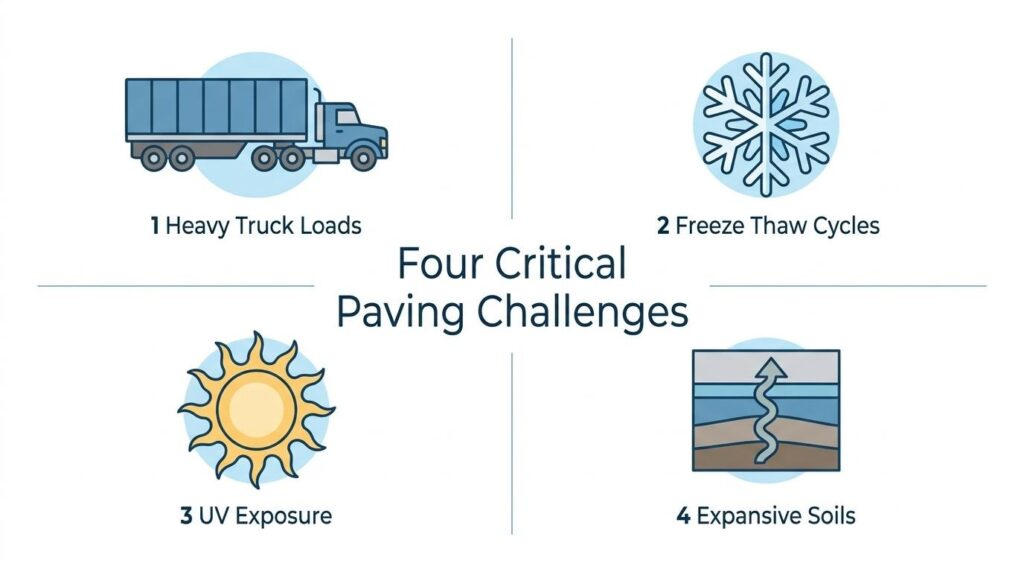
Warehouse pavements in this corridor face a punishing combination of heavy truck loads requiring 13 to 24 inches of total structural thickness, freeze-thaw cycles that exploit every unsealed crack, high-altitude UV radiation that accelerates binder oxidation, and expansive bentonite soils that destabilize subgrades.
Each zone on a distribution site requires a distinct pavement section; loading docks, container staging areas, employee parking, and fire lanes all carry different load profiles and code requirements. Proper drainage with minimum 2% slopes and MS4 stormwater permit compliance protects both pavement integrity and project approvals.
Proactive maintenance through sealcoating, crack sealing within optimal PCI windows, and timely mill and overlay work extends pavement life and directly supports property values in a market where NNN asking rates are climbing and institutional buyers scrutinize site condition.
Why Is the I-70/I-76 Corridor Driving Denver’s Warehouse Growth?
The I-70/I-76 corridor is driving Denver’s warehouse growth because of surging e-commerce fulfillment demand, expanding intermodal rail connectivity, and competitive submarket pricing. The following sections break down the market forces, fastest-growing submarkets, and the role intermodal hubs play in site selection.
What Market Forces Are Fueling Distribution Center Demand?
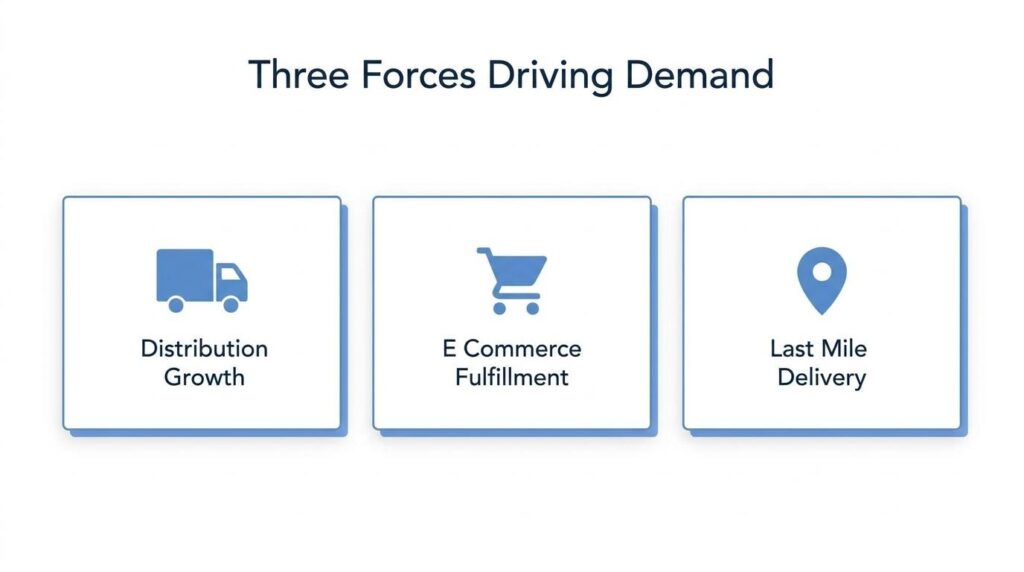
The market forces fueling distribution center demand along the I-70/I-76 corridor include heavy distribution growth, e-commerce fulfillment expansion, and significant investment in last-mile delivery infrastructure. The corridor is being optimized specifically for these freight categories, with capital flowing into intermodal hubs and fulfillment facilities designed for rapid order turnaround.
Stabilizing conditions across Denver’s broader industrial market reinforce this momentum. According to CBRE analysts Jeremy Ballenger, Tyler Carner, and Keiffer Garton, “Denver’s direct vacancy has declined for four consecutive quarters, reflecting a market that is stabilizing and moving past its post-pandemic supply surge.” That stabilization is drawing logistics tenants who need large-footprint facilities with direct highway access.
For developers and property owners along this corridor, the paving implications are substantial. Higher throughput means heavier axle loads, more frequent truck turns, and accelerated pavement wear across truck courts and staging areas.
Which I-70/I-76 Submarket Areas Are Growing the Fastest?
The I-70/I-76 submarket areas growing the fastest are the East I-70 corridor, the I-76 logistics corridor, and the DIA/Airport industrial submarket. Each area reflects different demand drivers:
- East I-70 corridor: The Majestic Commercenter in Aurora, a 1,600-acre master-planned business park established in 1996, anchors this submarket as a major industrial hub. Vacancy here reached 8.6% in Q4 2025, with absorption trailing at negative 160,000 square feet, signaling a market digesting recent speculative supply.
- I-76 corridor: Lovett Industrial sold the Lovett 76 Logistics Center to Trader Joe’s for $69.4 million, marking the fourth-largest industrial sale in Denver for 2025 according to Cushman & Wakefield.
- DIA/Airport submarket: Vacancy remains elevated between 12% and 15% as of early 2026, though large-scale projects like the 5280 Logistics Park’s Target build-to-suit demonstrate ongoing institutional confidence.
These submarkets demand paving solutions engineered for heavy distribution traffic from day one.
How Does Proximity to Intermodal Hubs Shape Site Selection?
Proximity to intermodal hubs shapes site selection by reducing drayage costs and transit times for logistics tenants. Sites within 5 to 10 miles of BNSF and Union Pacific rail facilities or Denver International Airport command premium demand because shorter drayage distances translate directly into lower per-container transportation costs.
BNSF Railway operates the Denver Intermodal Facility at 585 West 53rd Place, providing critical rail connectivity for industrial sites throughout the corridor. Between 2012 and 2016, BNSF and Union Pacific invested more than $783.7 million in maintaining and improving Colorado’s rail infrastructure, according to the U.S. Department of Transportation.
This concentration of freight activity near intermodal hubs creates uniquely demanding conditions for pavement. Distribution yards serving rail-connected tenants experience sustained heavy loads from chassis traffic, container handling equipment, and high-frequency truck movements. Understanding how corridor growth patterns shape site requirements is essential when designing pavement sections that perform under these industrial demands.
What Paving Challenges Do Warehouse Properties Face Along I-70/I-76?
Warehouse properties along I-70/I-76 face paving challenges from heavy truck loads, freeze-thaw cycling, intense UV exposure, and expansive soils. Each factor demands specific design responses to prevent premature failure.
How Do Heavy Truck Loads Affect Pavement Design Requirements?
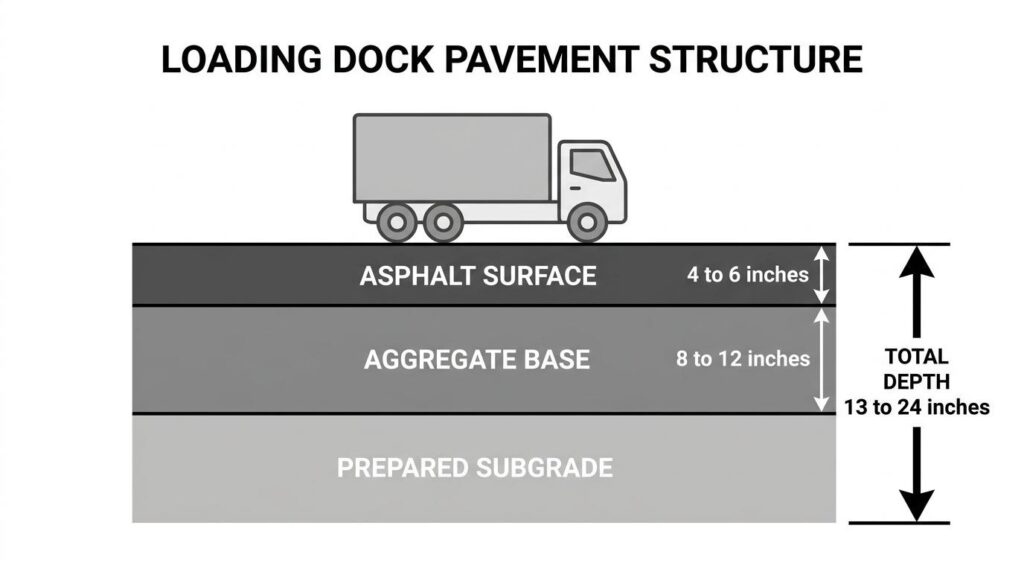
Heavy truck loads affect pavement design requirements by dictating structural thickness, material selection, and subgrade preparation. The Colorado Department of Transportation uses 18,000-pound Equivalent Single Axle Loads (ESALs) as the standard unit for calculating required pavement depth. Distribution yards serving tractor-trailers need substantially thicker sections than standard commercial lots, with total structural thickness for loading dock areas ranging from 13 to 24 inches depending on subgrade strength. Concrete is often specified for dock aprons and dumpster pads where concentrated point loads and shear forces from heavy trailers exceed what asphalt alone can handle. For most corridor facilities, a combination of both materials provides the most cost-effective, long-lasting solution.
How Does Denver’s Freeze-Thaw Cycle Damage Industrial Pavement?
Denver’s freeze-thaw cycle damages industrial pavement by allowing moisture to infiltrate cracks, expand as ice, and progressively break apart the pavement structure from within. According to the City and County of Denver, pavement designs must account for a frost depth of typically 36 inches for footings to prevent frost heave, often requiring specialized subgrade stabilization or thicker aggregate bases. Water that pools in truck courts and loading areas is especially destructive; each freeze event widens existing cracks while creating new ones. Without proper drainage and timely crack sealing, a single winter can accelerate deterioration that would otherwise take years. Prioritizing moisture management is the single most effective defense against freeze-thaw damage in this corridor.
What Role Does High-Altitude UV Exposure Play in Asphalt Aging?
High-altitude UV exposure plays a significant role in asphalt aging by breaking down the binder’s molecular structure faster than at lower elevations. According to a study published in ScienceDirect, intense ultraviolet radiation at high altitudes is a primary factor in asphalt pavement degradation, damaging the internal molecular structure and causing the binder to age and decay. This oxidation makes the surface brittle, leading to cracking and raveling. High-performance polymer-modified asphalt binders and regular sealcoating are recommended to mitigate this accelerated aging. For warehouse properties with large exposed surfaces, proactive sealcoating every few years is far less costly than the structural repairs that unchecked UV damage eventually requires.
How Does Expansive Colorado Soil Impact Subgrade Stability?
Expansive Colorado soil impacts subgrade stability by swelling when wet and shrinking when dry, creating uneven movement beneath the pavement surface. The Colorado Geological Survey identifies bentonite as a highly absorbent clay found throughout the state that expands dramatically with moisture changes, potentially damaging foundations and pavement structures. Along the I-70/I-76 corridor, this soil behavior causes heaving, cracking, and settlement that no surface treatment can fix. Proper subgrade preparation, including moisture conditioning, compaction testing, and sometimes lime or cement stabilization, is essential before any paving begins. Skipping thorough geotechnical evaluation on corridor sites is one of the costliest mistakes a warehouse developer can make.
Understanding these challenges sets the stage for selecting the right pavement sections for distribution yards.
What Asphalt Pavement Sections Work Best for Distribution Yards?
The asphalt pavement sections that work best for distribution yards vary by zone and load type. Each area of a warehouse site demands a different structural design, from heavy-duty dock aprons to lighter employee parking lots.
What Thickness Is Needed for Tractor-Trailer Loading Docks?
The thickness needed for tractor-trailer loading docks typically ranges from 13 to 24 inches of total structural section, depending on subgrade strength and drainage conditions. According to Asphalt Inc., heavy-duty industrial pavement sections for loading docks require this range to withstand repeated axle loads from fully loaded trailers.
Concrete is often recommended for the dock apron itself, where concentrated point loads and turning shear forces from trailer jacks are most severe. Asphalt sections in the surrounding truck court should incorporate:
- A stabilized or compacted aggregate base of 8 to 12 inches minimum.
- A hot-mix asphalt surface course of 4 to 6 inches using polymer-modified binder.
- Proper subgrade preparation to account for Colorado’s expansive soils.
Skimping on base thickness at loading docks is one of the most common and costly mistakes in industrial paving, particularly along the I-70/I-76 corridor where heavy distribution traffic is constant.
What Pavement Section Handles Container Stacking and Staging?
The pavement section that handles container stacking and staging must resist sustained static loads concentrated on small contact points. Container staging areas differ from truck courts because loads remain stationary for extended periods, creating localized stress that accelerates rutting and deformation.
CDOT pavement designs use 18,000-pound Equivalent Single Axle Loads (ESALs) as the standard traffic load unit, but staging zones experience load patterns that exceed typical ESAL calculations. Effective sections for these areas include:
- Thicker aggregate base layers (10 to 14 inches) to distribute point loads across a wider subgrade area.
- Full-depth asphalt sections or concrete pads beneath container footprints.
- Reinforced transitions between staging zones and adjacent truck lanes.
For most Denver distribution yards, a hybrid approach combining concrete pads at fixed stacking positions with heavy-duty asphalt in maneuvering lanes yields the best long-term performance.
What Design Works for High-Turn Employee Parking Areas?
The design that works for high-turn employee parking areas is a standard commercial pavement section with enhanced surface drainage. Employee lots handle lighter axle loads than truck courts, yet the high volume of daily turning movements accelerates surface wear at drive aisles and entry points.
The Colorado Asphalt Pavement Association specifies a minimum slope of 2 percent, or 1/4 inch per foot, for proper drainage in Colorado parking areas. This prevents moisture infiltration that leads to base failure. A typical employee parking section includes:
- 6 to 8 inches of compacted aggregate base.
- 3 to 4 inches of hot-mix asphalt surface.
- Clearly defined drainage grades directing water toward collection inlets.
Investing in proper grading during initial construction prevents premature deterioration that plagues many warehouse employee lots within just a few years of opening.
What Specifications Apply to Fire Lanes and Emergency Access?
The specifications that apply to fire lanes and emergency access are governed by NFPA standards and Denver municipal codes. Fire department access roads require a minimum unobstructed width of 20 feet and a vertical clearance of 13.5 feet per NFPA requirements. In Denver, fire apparatus access roads for aerial apparatus require a minimum width of 26 feet to accommodate stabilizers and rotating ladders.
Structural requirements for fire lanes include:
- Pavement sections rated for fire apparatus loads, typically 60,000 to 80,000 pounds gross vehicle weight.
- Turning radii sufficient for ladder trucks and pumper engines.
- Surface materials capable of supporting outrigger point loads without cracking.
- Clear, code-compliant striping and signage designating no-parking zones.
Fire lane pavement often needs to match or exceed truck court specifications, since apparatus loads rival those of loaded tractor-trailers. With pavement sections defined for each zone, proper drainage design ensures these structures perform across Denver’s demanding climate.
How Should Warehouse Site Paving Address Drainage and Grading?
Warehouse site paving should address drainage and grading through proper slope design, strategically placed inlets, and compliance with local stormwater permits. The following sections cover impervious surface impacts, slope and inlet best practices, and Denver’s MS4 permit requirements.
How Do Large Impervious Footprints Affect Stormwater Runoff?
Large impervious footprints affect stormwater runoff by eliminating natural ground absorption, forcing all precipitation to flow across paved surfaces as sheet runoff. A typical distribution center covering 500,000 square feet or more of roof and truck court generates massive volumes of concentrated runoff during storm events.
This unmanaged flow accelerates pavement erosion, carries petroleum residue and sediment into downstream waterways, and overwhelms existing drainage infrastructure. Without detention or retention strategies, peak discharge rates spike dramatically compared to pre-development conditions. For corridor sites along I-70 and I-76, where multiple large warehouses occupy adjacent parcels, the cumulative effect compounds flooding risk for the entire submarket area.
What Slope and Inlet Designs Prevent Ponding on Truck Courts?
Slope and inlet designs that prevent ponding on truck courts combine minimum cross-slopes with correctly spaced catch basins. According to the Colorado Asphalt Pavement Association, surfaces should maintain a minimum slope of 2 percent, or 1/4 inch per foot, to prevent pavement failures caused by standing water.
Effective truck court drainage typically requires:
- Cross-slopes graded toward trench drains or curb inlets positioned along travel lanes.
- Catch basins spaced at intervals that account for the court’s total contributing area.
- Reinforced concrete aprons at dock doors, where slope transitions must handle both drainage and heavy trailer loads.
- Valley gutters or slotted drains at grade changes between parking areas and maneuvering lanes.
Ponding is one of the most preventable yet costly pavement problems on industrial sites; even minor depressions that hold water accelerate base saturation and structural failure under repeated axle loads.
How Do Denver’s MS4 Stormwater Permits Apply to New Builds?
Denver’s MS4 stormwater permits apply to new builds by requiring developers to implement controls that manage runoff quality and quantity before, during, and after construction. According to the Mile High Flood District, MS4 permit holders in Colorado must implement a Stormwater Management Program to reduce the discharge of pollutants from land-disturbing activities.
For new warehouse projects along I-70 and I-76, this means:
- Submitting a stormwater management plan as part of the site development permit process.
- Installing erosion and sediment controls during grading and paving phases.
- Designing permanent best management practices, such as detention ponds, water quality inlets, or permeable buffer zones.
- Maintaining post-construction stormwater facilities for the life of the property.
Non-compliance can delay certificates of occupancy and trigger enforcement actions, making early coordination with drainage engineers essential. With drainage strategies in place, scheduling paving at the right construction phase protects these investments.
When Should Warehouse Owners Plan Paving During Construction?
Warehouse owners should plan paving early in the construction timeline, coordinating with building shell completion and seasonal weather windows. The following subsections cover phased paving strategies for spec and build-to-suit projects and Denver’s optimal paving season.
How Does Phased Paving Align with Spec and Build-to-Suit Timelines?
Phased paving aligns with spec and build-to-suit timelines by sequencing pavement installation around building shell progress, utility work, and tenant requirements. Spec developments typically pave base courses early to support construction traffic, then apply final surface lifts after the structure is enclosed. Build-to-suit projects, like the Target facility at 5280 Logistics Park developed by Hillwood and Ryan Companies, allow paving schedules to match tenant-specific dock configurations and yard layouts from the start.
For either approach, subgrade preparation should begin once grading and underground utilities are complete. Delaying final paving until heavy construction equipment has left the site prevents premature surface damage and avoids costly repairs before the facility even opens.
What Is Denver’s Ideal Paving Season for Industrial Projects?
Denver’s ideal paving season for industrial projects runs from late April through October, when ground and air temperatures consistently support proper compaction and curing. According to S&S Paving, new asphalt requires ground and air temperatures above 50°F to ensure proper material bonding and durability.
Denver’s semi-arid climate offers a relatively long window compared to other northern markets, though early spring and late fall projects carry risk from overnight freezes. Large-scale industrial pours on distribution yards along the I-70/I-76 corridor benefit most from mid-May through September scheduling, when warm overnight lows allow adequate curing time between lifts. Planning paving phases around this window prevents weather delays that cascade into lease commencement conflicts.
With timing established, a proactive maintenance plan keeps warehouse pavement performing through Denver’s demanding climate cycles.
What Maintenance Extends the Life of Warehouse Pavement?
Maintenance extends the life of warehouse pavement through a proactive cycle of sealcoating, crack sealing, and timely mill and overlay work. Each strategy targets a different stage of pavement deterioration.
How Often Should High-Traffic Truck Courts Be Sealcoated?
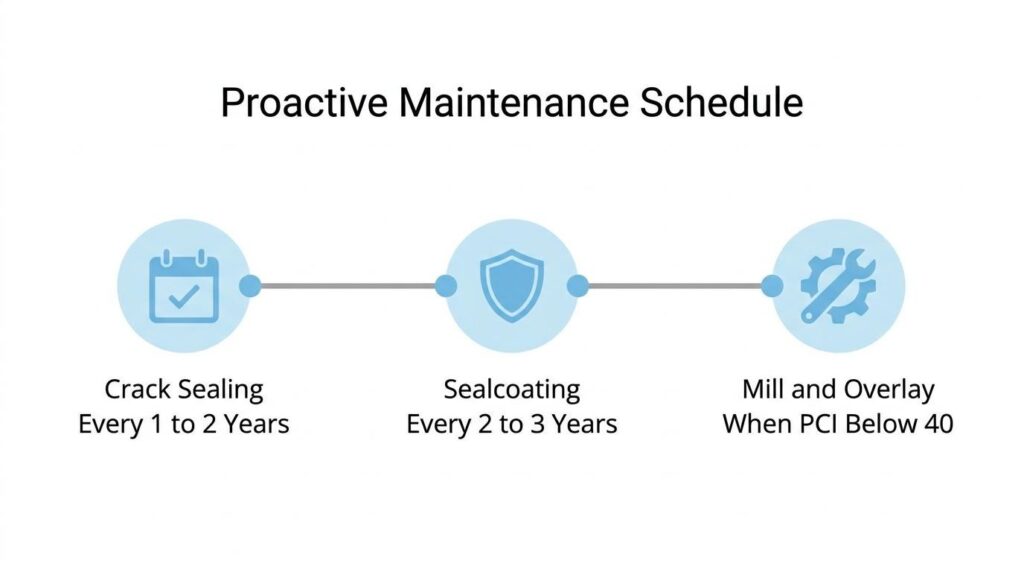
High-traffic truck courts should be sealcoated every two to three years to protect against Denver’s intense high-altitude UV radiation. At elevation, ultraviolet exposure damages asphalt’s internal molecular structure, accelerating binder oxidation and surface brittleness far faster than at lower altitudes. Sealcoating restores a protective barrier that resists this degradation while also repelling moisture from freeze-thaw cycles.
Newly paved truck courts should wait 6 to 12 months before the first application, allowing the asphalt to fully cure. After that initial coat, a consistent two-to-three-year cycle keeps the surface flexible and prevents the micro-cracking that leads to expensive structural failures. For facilities running 24/7 distribution operations, scheduling sealcoat work during Denver’s optimal warm-weather window maximizes cure time and minimizes disruption.
When Does Crack Sealing Prevent Costly Full-Depth Repairs?
Crack sealing prevents costly full-depth repairs when it is applied during the early-to-mid stages of pavement deterioration. According to Slate Canyon Asphalt, Pavement Condition Index scores between 55 and 85 represent the optimal treatment window for crack sealing, while scores below 40 indicate a need for structural repairs.
Moisture infiltration through unsealed cracks is the primary driver of base failure in industrial pavements. Once water reaches the subgrade, Denver’s freeze-thaw cycles expand and contract the moisture, eroding structural support from below. Sealing cracks within the 55-to-85 PCI range blocks this process before damage becomes irreversible. For high-traffic industrial lots, crack sealing should be scheduled every one to two years to stay ahead of deterioration. Waiting until cracks widen beyond a half inch often means the pavement has already crossed into territory requiring full-depth removal and replacement.
What Signs Indicate an Industrial Lot Needs Mill and Overlay?
The signs that indicate an industrial lot needs mill and overlay include:
- Widespread alligator cracking across truck lanes and staging areas
- Rutting deeper than one inch along repetitive wheel paths
- Large interconnected crack patterns that exceed what crack sealing can address
- Persistent ponding where surface deformation has altered drainage grades
- PCI scores falling below 40, signaling structural compromise
When surface distresses cover more than 30% of the pavement area, isolated repairs become less cost-effective than milling and resurfacing. Mill and overlay removes the deteriorated top layer and replaces it with fresh hot-mix asphalt, restoring ride quality, drainage grades, and structural integrity without the cost of full-depth reconstruction.
Catching these warning signs early keeps warehouse operators ahead of the kind of cascading failures that shut down truck courts during peak distribution seasons.
How Do Denver Zoning and ADA Codes Affect Industrial Paving?
Denver zoning and ADA codes affect industrial paving by dictating site layout dimensions, accessible parking slopes, and fire access road widths that directly shape pavement design.
Denver’s regulatory framework for industrial paving involves three overlapping authorities. The City and County of Denver enforces zoning and building codes that govern setbacks, lot coverage, and parking ratios for industrial properties. CDOT establishes pavement standards that influence structural design on state-connected roadways. The Mile High Flood District regulates stormwater management, requiring drainage plans that integrate with pavement grading.
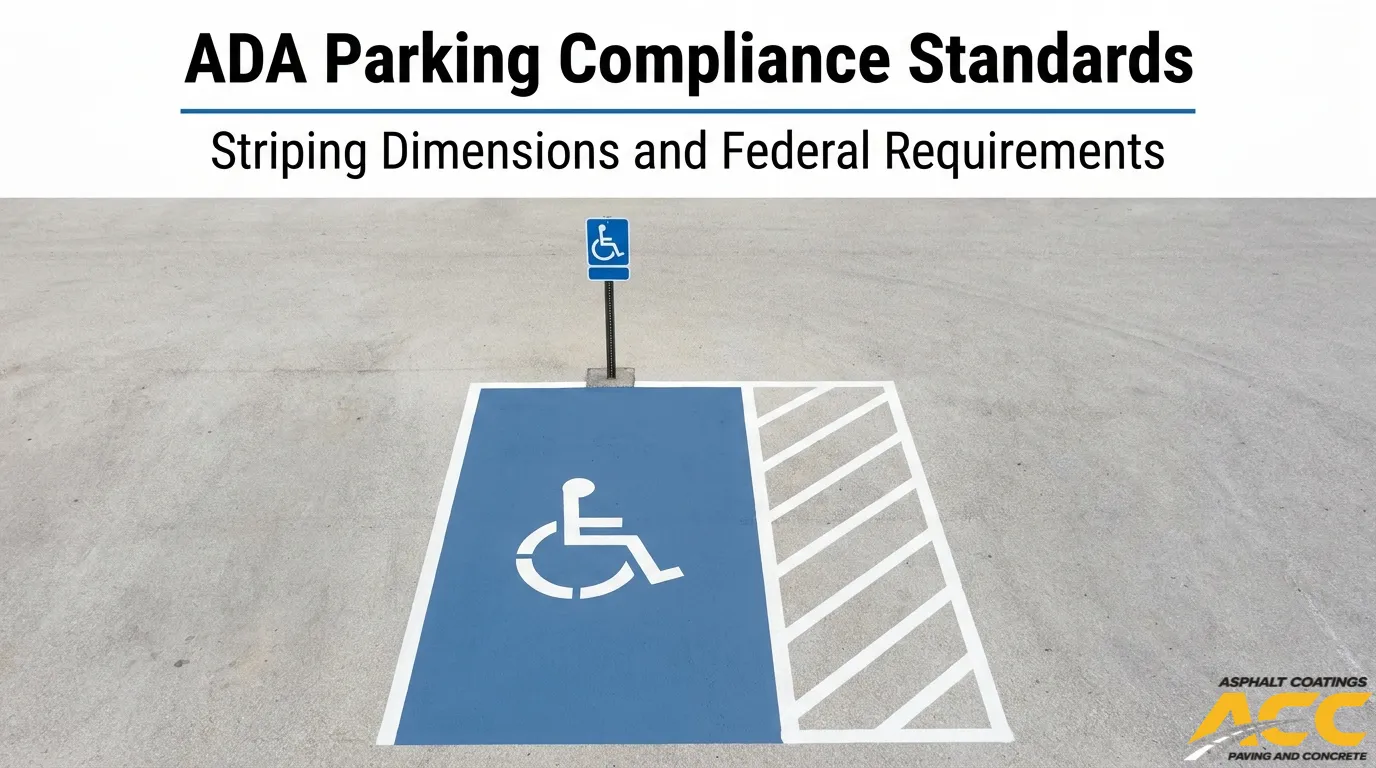
ADA standards require accessible parking spaces to maintain a surface slope no greater than 1:48 (2.08%) in all directions, according to ADA.gov. This slope restriction directly influences grading plans across truck courts and employee lots, since drainage slopes in non-accessible areas typically run steeper to prevent ponding.
Fire access adds another layer of constraint. NFPA standards mandate fire department access roads with a minimum unobstructed width of 20 feet and vertical clearance of 13.5 feet. In Denver, aerial apparatus access roads require a minimum width of 26 feet to accommodate stabilizers and rotating ladders. These requirements consume significant site area and dictate pavement thickness in zones that must support heavy apparatus loads.
Industrial zoning districts along the I-70/I-76 corridor also specify minimum parking counts, landscaping buffers, and impervious surface limits that influence how much pavement a site can include. Overlooking any of these overlapping codes during design often leads to costly rework during permitting. The most efficient approach is integrating zoning, ADA, fire access, and stormwater requirements into a single grading and paving plan from the earliest design phase.
Understanding how code compliance protects property investment connects directly to pavement’s broader financial impact.
How Does Pavement Quality Impact Warehouse Property Value?
Pavement quality impacts warehouse property value by directly influencing tenant retention, lease rates, and buyer perception in a competitive industrial market. Well-maintained asphalt signals operational readiness, while deteriorating surfaces raise red flags during due diligence.
In Denver’s I-70/I-76 corridor, where overall industrial vacancy fell by 20 basis points year-over-year to 11.0% in the fourth quarter of 2025 according to Link Logistics, properties compete on condition as much as location. Average NNN asking rates rose 4.0% to $1.04 per square foot during the same period, meaning even marginal improvements in site presentation translate to measurable revenue gains.
Cracked, ponding, or rutted truck courts suggest deferred maintenance that prospective tenants and investors price into negotiations. Conversely, properties with properly graded pavement, sealed surfaces, and code-compliant striping command stronger offers. The Lovett 76 Logistics Center’s $69.4 million sale to Trader Joe’s along the I-76 corridor illustrates how institutional-grade site conditions support premium valuations.
For warehouse owners weighing capital improvements, pavement upgrades deliver compounding returns:
- Sealcoating and crack sealing extend surface life, reducing long-term replacement costs.
- Proper drainage prevents subgrade erosion that leads to structural failures.
- ADA-compliant parking and clearly marked fire lanes reduce liability exposure.
- Clean, well-maintained lots improve first impressions during property tours.
In a stabilizing Denver industrial market, pavement condition is not cosmetic; it is a financial lever. Owners who invest in preventive maintenance and quality paving position their assets to capture rising rents and attract creditworthy tenants. Neglecting pavement, on the other hand, accelerates depreciation at a time when the corridor’s institutional buyers are scrutinizing every detail.
Understanding how pavement affects value leads naturally to choosing the right paving partner for corridor projects.
How Can Asphalt Coatings Company Support I-70/I-76 Projects?
Asphalt Coatings Company supports I-70/I-76 projects with in-house commercial paving crews, Colorado-specific expertise, and a full range of asphalt and concrete services built for industrial-scale work.
Can In-House Commercial Paving Crews Handle Large-Scale Jobs?
Yes, in-house commercial paving crews can handle large-scale jobs. Asphalt Coatings Company operates dedicated crews across Colorado’s Front Range, eliminating the coordination delays and quality inconsistencies that come with subcontracting. Since 1986, Asphalt Coatings Company has delivered complex commercial projects, including new construction paving, subgrade preparation, mill and pave services, and ADA-compliant concrete work.
For distribution centers along the I-70/I-76 corridor, this single-source approach matters. Warehouse paving involves coordinating heavy-duty pavement sections, drainage grading, dock aprons, fire lanes, and striping within tight construction timelines. Asphalt Coatings Company manages every phase from initial grading through final sealcoat, keeping industrial projects on schedule and within budget.
What Are the Key Takeaways About I-70/I-76 Corridor Paving?
The key takeaways about I-70/I-76 corridor paving center on matching pavement design to the unique demands of Denver’s industrial landscape. Successful warehouse paving requires:
- Heavy-duty pavement sections engineered for tractor-trailer loads and container staging.
- Subgrade stabilization that accounts for Colorado’s expansive soils and frost depth.
- Drainage and grading designs that meet MS4 stormwater permit requirements.
- UV-resistant materials and proactive maintenance schedules suited to high-altitude conditions.
- Compliance with Denver zoning, ADA standards, and fire access road specifications.
Every design decision, from thickness calculations to sealcoat timing, directly influences long-term pavement performance and property value. Warehouse owners who invest in properly engineered paving avoid costly structural repairs and operational disruptions. Asphalt Coatings Company brings 39 years of Colorado-specific expertise to every phase of industrial paving along this corridor.