Hail Alley storm damage to Denver commercial asphalt is the progressive destruction of pavement surfaces and protective sealcoat caused by repeated hailstone impacts, compounded by the Front Range’s unique elevation, UV intensity, and freeze-thaw cycling.
This guide covers Denver’s Hail Alley geography, asphalt and sealcoat vulnerability to hail impact, the types of damage storms produce, environmental factors that accelerate deterioration, and the inspection, cost, and maintenance strategies that protect commercial pavement.
Denver sits at the convergence of Rocky Mountain atmospheric instability and Great Plains moisture, producing three to four catastrophic hailstorms annually. The city’s mile-high elevation allows hailstones to reach the ground larger and more destructive than they would at sea level.
Commercial asphalt becomes increasingly vulnerable as its bituminous binder oxidizes and loses flexibility over time. Hailstones as small as 1.25 inches cause functional surface damage, including pitting and aggregate dislodgment, and aged pavement sustains hidden structural compromise that may not reveal itself for weeks.
Sealcoat fails under hail through fracturing, stripping, and progressive removal that exposes raw binder to the elements. Once breached, Denver’s intense high-altitude UV radiation accelerates oxidation from the surface downward, creating a cycle where each storm worsens the damage from the last.
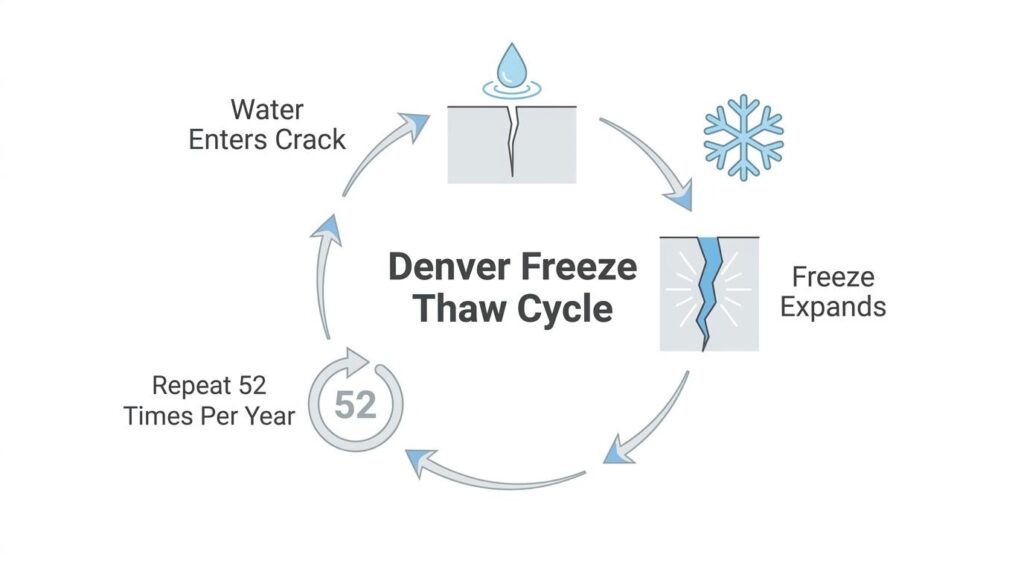
Water infiltration through hail-created cracks reaches the subbase, where an average of 52 freeze-thaw cycles per year along the Front Range repeatedly expands trapped moisture and converts minor fractures into structural failures.
Early detection of warning signs, prompt post-storm inspection, and a preventive maintenance strategy that pairs sealcoating with crack sealing and timely repairs consistently outperform reactive approaches in both cost and pavement longevity.
Why Is Denver Located in Hail Alley?
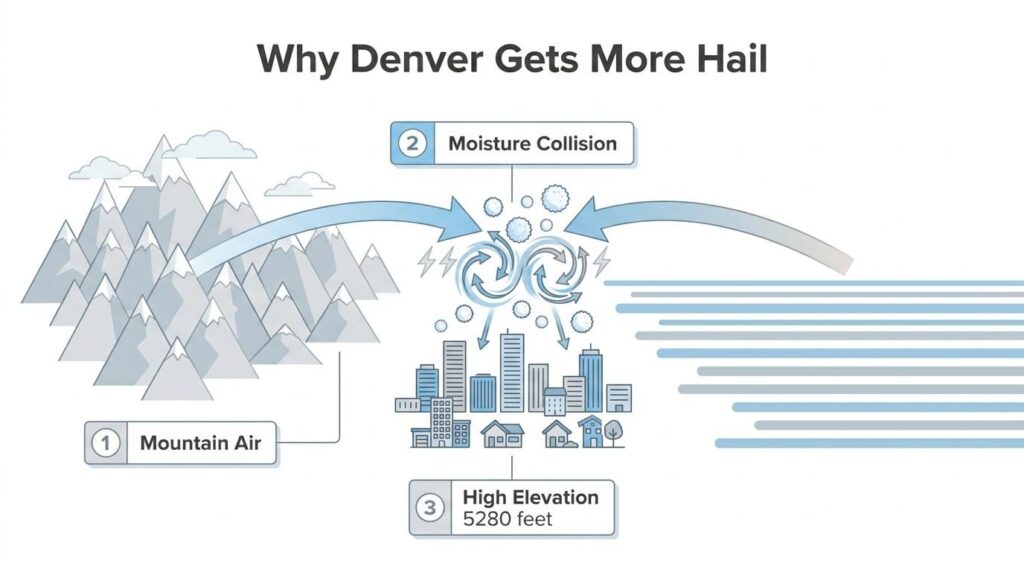
Denver is located in Hail Alley because its Front Range geography creates ideal conditions for severe hailstorm formation. Three key factors converge at this location: mountain-driven atmospheric instability, moisture collision patterns, and high elevation that preserves hailstone size.
According to the Rocky Mountain Insurance Information Association, Colorado’s Front Range sits in the heart of Hail Alley, which receives the highest frequency of large hail in North America and usually experiences three to four catastrophic hailstorms, each causing at least $25 million in insured damage, every year.
The Rocky Mountains, positioned just west of Denver, supply very dry, unstable air aloft that mixes with low-level moisture from the Great Plains. This collision creates the atmospheric instability needed for severe thunderstorms and large hail production. Few other metro areas in the country face this exact combination of orographic lift and moisture convergence.
Denver’s mile-high altitude compounds the problem. Sitting at approximately 5,280 feet above sea level, the city’s high elevation allows hailstones to reach the ground more quickly with less melting than at lower elevations. Hailstones that would shrink significantly during a longer fall through warmer, denser air at sea level arrive at Denver’s surface larger and more destructive.
Elevation also intensifies UV radiation, which increases by approximately 4% to 5% for every 1,000 feet of elevation gain. Denver’s altitude results in roughly 20% to 25% more intense UV exposure than sea-level locations. While UV does not cause hail, it weakens the asphalt binder on commercial pavement surfaces between storms, leaving them more vulnerable when the next hailstorm strikes.
For commercial property managers along Colorado’s Front Range, this geographic reality means hail damage is not a matter of “if” but “when.” Understanding these atmospheric mechanics helps explain why proactive pavement maintenance is so critical in this region.
What Makes Commercial Asphalt Vulnerable to Hail Impact?
Commercial asphalt is vulnerable to hail impact because the bituminous binder becomes brittle over time through oxidation, reducing its ability to absorb kinetic energy without fracturing. Hailstone size, pavement age, and existing distress each influence damage severity.
How Does Hailstone Size Affect Asphalt Surface Damage?
Hailstone size affects asphalt surface damage by determining how much kinetic energy each impact delivers to the pavement. The National Weather Service classifies “severe” hail as 1 inch in diameter (quarter size), while golf ball-sized hailstones at 1.75 inches cause significant property damage.
However, functional damage to asphalt begins at smaller thresholds. According to the International Institute of Building Enclosure Consultants (IIBEC), hail causes functional damage to asphalt surfaces when hailstones measure approximately 1.25 to 1.5 inches in diameter, leading to surface pitting and aggregate dislodgment. For Denver commercial properties, this distinction matters; storms frequently produce hail in that mid-range size that falls below headline severity yet still compromises pavement integrity.
How Does Hail Damage Differ on Aged Versus New Asphalt?
Hail damage differs on aged versus new asphalt primarily in how the binder responds to impact. Fresh asphalt retains flexible bituminous binder that absorbs kinetic energy, while older pavement has oxidized binder that cracks under the same force.
What makes this particularly deceptive is that compromised integrity often hides beneath the surface. As forensic analyst S.E. Petty documents, functional hail damage to asphalt, whether new or weathered, is a documented phenomenon where material integrity is compromised even when immediate failure is not visible. This means aged parking lots in Denver may sustain progressive structural loss that only reveals itself weeks later through accelerated cracking and deterioration.
How Does Existing Pavement Distress Worsen Hail Impact?
Existing pavement distress worsens hail impact by creating weak points where kinetic energy concentrates. Pre-existing cracks, raveling, and surface depressions act as stress concentrators that amplify damage from each hailstone strike.
Research published by MDPI found that a 1-inch diameter hailstone delivers approximately 6.6 joules of kinetic energy per impact, enough to cause functional damage to many pavement materials. When that force hits an already-compromised surface, the result compounds rapidly. Larger hailstones generate significantly greater impact forces as velocity increases, turning minor distress into major failures.
Scheduling a professional pavement inspection soon after a hailstorm creates a stronger record of conditions for insurance documentation before additional weather alters the evidence. Understanding these damage patterns helps property managers assess what types of hail damage actually occur on commercial surfaces.
What Types of Hail Damage Occur on Commercial Asphalt?
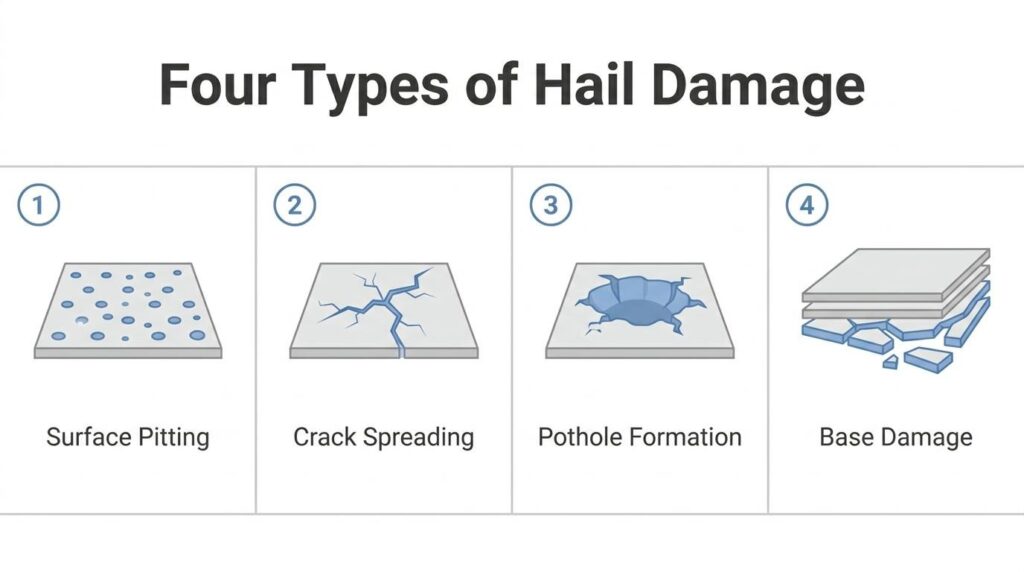
The types of hail damage that occur on commercial asphalt include surface pitting, crack initiation, pothole formation, and structural base compromise. Each damage type escalates in severity depending on hailstone size and storm frequency.
Surface Pitting and Aggregate Dislodgment
Surface pitting and aggregate dislodgment are the most immediate forms of hail damage on commercial asphalt. Hailstones strike the pavement surface and displace loose aggregate particles, leaving small, concave depressions across the lot. According to a 2009 IIBEC technical report, hail causes functional damage to asphalt surfaces when hailstones measure approximately 1.25 to 1.5 inches in diameter, leading to surface pitting and aggregate dislodgment. Once exposed, the underlying binder layer oxidizes rapidly under Denver’s intense high-altitude sun. Even scattered pitting across a parking lot compromises the protective aggregate matrix that shields the binder from UV degradation and traffic wear.
Crack Initiation and Propagation
Crack initiation and propagation occur when hail impact energy exceeds the asphalt binder’s ability to flex without fracturing. Each strike creates micro-fractures in the surface layer. On aged pavement where oxidation has already embrittled the binder, these hairline cracks spread quickly under continued traffic loading. Thermal cycling between Denver’s hot summer days and cool nights widens these fractures further. What begins as nearly invisible stress fractures after a single storm can evolve into interconnected crack networks within one season, especially when multiple Hail Alley storms hit in rapid succession. Crack propagation is often the bridge between cosmetic surface damage and deeper structural failure.
Pothole Formation After Repeated Storms
Pothole formation after repeated storms results from the compounding effect of multiple hail events on already-compromised pavement. Each storm deepens existing pits and widens cracks, allowing water to penetrate beneath the surface layer. When that trapped moisture freezes and expands during Denver’s cold months, it loosens chunks of asphalt from the surrounding material. Subsequent traffic loads then dislodge these weakened sections entirely, creating potholes. For high-traffic commercial lots, this progression accelerates because heavy vehicle loads amplify the stress on fractured pavement. Potholes represent the point where deferred maintenance becomes a safety and liability concern for Denver property managers.
Structural Base Compromise from Large Hailstones
Structural base compromise from large hailstones occurs when golf-ball-sized or larger hail delivers enough kinetic energy to damage not just the surface course but the underlying base layers. According to MDPI research on hailstone impact energy, a 1-inch diameter hailstone generates approximately 6.6 joules per impact, sufficient to cause functional damage to pavement materials. Larger stones deliver proportionally greater force. When repeated impacts fracture through the full asphalt depth, water reaches the aggregate base and subgrade soil. Saturated base material loses load-bearing capacity, causing settlement and structural failure that surface patching alone cannot resolve.
Recognizing these damage types early is critical, since hail also destroys the sealcoat layer that serves as asphalt’s first line of defense.
How Do Hail Alley Storms Destroy Sealcoat Protection?
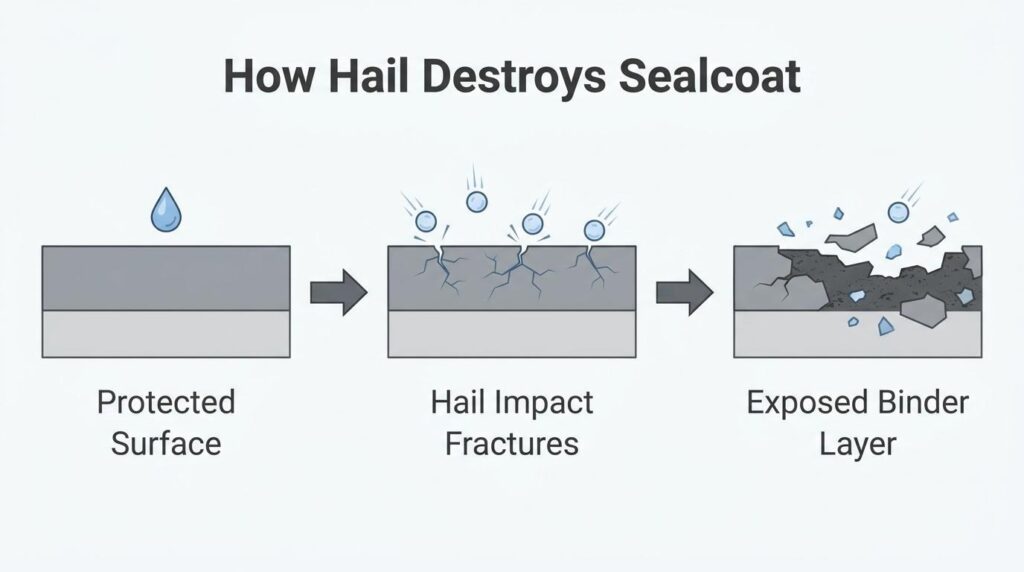
Hail Alley storms destroy sealcoat protection through impact fracturing, surface stripping, and binder exposure. The damage varies depending on whether the sealcoat is freshly applied or fully cured.
How Does Hail Fracture a Freshly Applied Sealcoat Layer?
Hail fractures a freshly applied sealcoat layer by striking the surface before the emulsion has fully bonded to the underlying asphalt. Fresh sealcoat remains pliable for 24 to 48 hours after application, and hailstones hitting during this window punch through the soft film rather than bouncing off. Each impact displaces uncured material, creating small craters that prevent the sealcoat from forming a continuous, watertight membrane. Once fractured at this stage, the damaged areas cannot self-heal. For Denver commercial properties, this makes storm timing a serious consideration when scheduling sealcoat applications during Colorado’s active hail season.
How Does Hail Strip Cured Sealcoat from Asphalt Surfaces?
Hail strips cured sealcoat from asphalt surfaces by generating concentrated impact forces that exceed the bond strength between the dried coating and the pavement below. Even after full curing, sealcoat remains a thin protective film, typically only a few millimeters thick. Repeated strikes from quarter-sized or larger hailstones chip and peel sections away from the substrate.
Denver’s elevation compounds this vulnerability. According to a ScienceDirect study, high-altitude UV radiation accelerates oxidation of the asphalt binder, creating a “gradient aging” phenomenon that weakens the surface and makes it more susceptible to cracking and stripping when struck by hail. This pre-weakened bond between sealcoat and aged binder means storms cause more extensive stripping in Denver than in lower-elevation cities.
How Does Hail Expose the Binder Layer Beneath Sealcoat?
Hail exposes the binder layer beneath sealcoat by progressively removing the protective coating through repeated impacts until raw asphalt is left unshielded. Once surface fractures and stripped patches connect, the underlying bituminous binder sits directly exposed to UV radiation, moisture, and chemical contaminants like oil and deicing agents. Unprotected binder oxidizes rapidly, becoming brittle and losing its ability to hold aggregate in place. This triggers a cycle where each subsequent storm causes accelerating damage to pavement that no longer has its first line of defense.
Understanding how sealcoat fails under hail impact clarifies why post-storm water infiltration poses the next major threat.
Why Does Post-Hail Water Infiltration Accelerate Damage?
Post-hail water infiltration accelerates damage because moisture enters through impact cracks and erodes the pavement structure from within. The following subsections explain how cracks become entry points and how Denver’s freeze-thaw cycles compound the deterioration.
How Do Hail-Created Cracks Allow Moisture Into the Subbase?
Hail-created cracks allow moisture into the subbase by providing direct pathways through the asphalt surface layer. When hailstones fracture the sealcoat and underlying binder, even hairline openings permit rainwater and snowmelt to bypass the pavement’s protective barrier. Once water reaches the aggregate base and subgrade soil, it softens these structural layers and reduces their load-bearing capacity. Traffic loads then compress the weakened subbase unevenly, causing depressions and eventual pothole formation at the surface. For Denver commercial properties, where storm runoff concentrates in parking areas, unrepaired hail cracks can channel significant water volumes into a small area of compromised pavement.
How Do Denver Freeze-Thaw Cycles Compound Hail Damage?
Denver freeze-thaw cycles compound hail damage by repeatedly expanding trapped moisture inside fractures, widening cracks with each cycle. Water that infiltrates hail-created openings freezes at night, expands by approximately 9% in volume, and forces the crack walls apart. When temperatures rise the next day, the ice melts, and the enlarged void accepts even more water. According to a study published in MDPI Applied Sciences, high-altitude environments like the Colorado Front Range experience 33 to 62 natural freeze-thaw cycles per year, with a mean of 52 cycles, which exacerbates existing hail damage by allowing water to infiltrate and expand within fractures. This relentless mechanical weathering transforms minor surface cracks into structural failures across a single winter season.
With water infiltration driving progressive deterioration, recognizing the visible warning signs becomes essential.
What Are the Warning Signs of Hail Damage on a Parking Lot?
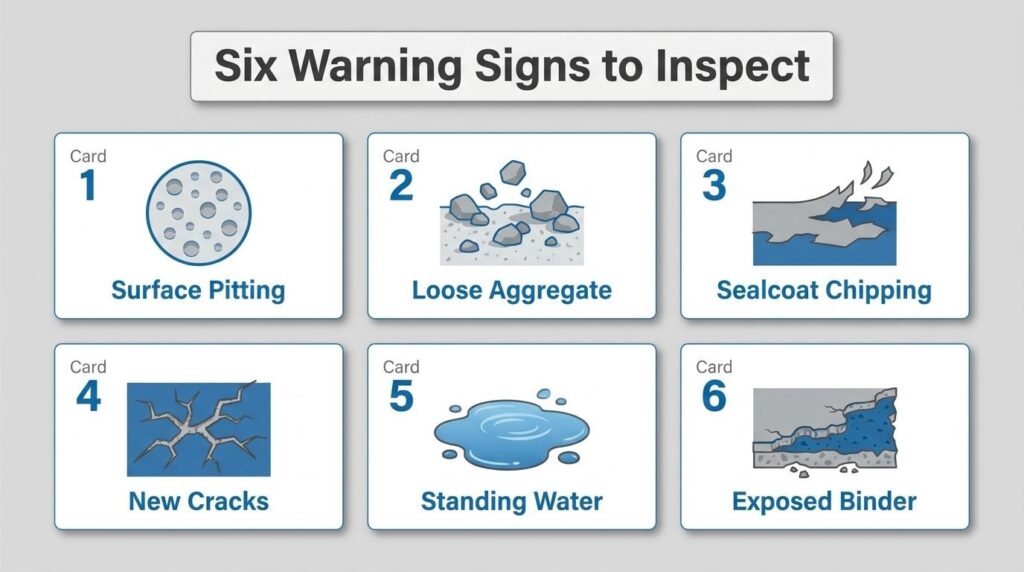
The warning signs of hail damage on a parking lot include surface pitting, loose aggregate, sealcoat chipping, new crack formations, and small depressions across the pavement. Spotting these indicators early prevents costly structural failures.
- Surface pitting and dimpling: Small, round indentations scattered across the asphalt indicate direct hailstone impacts that have compressed or fractured the surface layer.
- Loose or dislodged aggregate: Exposed stones or gravel sitting on top of the pavement suggest hail strikes have broken the bond between the binder and aggregate.
- Sealcoat chipping or flaking: Patches where the protective sealcoat has cracked, peeled, or disappeared entirely reveal that hail has compromised the coating’s integrity.
- Fresh crack patterns: New hairline cracks or spiderweb fracture networks that were not present before the storm signal impact-related stress damage.
- Standing water in shallow depressions: Pooling water in areas that previously drained properly indicates hail has created low spots or disrupted the pavement grade.
- Exposed dark binder beneath sealcoat: Visible black patches where the gray sealcoat surface has been stripped away show the protective barrier is gone.
- Granular debris on the surface: Fine asphalt particles or sealcoat fragments scattered across the lot after a storm confirm material has been dislodged by impact.
Many of these signs are subtle, especially on aged pavement where existing wear can mask fresh damage. According to Intertek, conducting a professional pavement inspection soon after a hailstorm creates a stronger record of conditions for insurance purposes before cleanup efforts or additional weather events alter the evidence. For Denver commercial properties, this urgency is compounded by the region’s frequent freeze-thaw cycles, which can rapidly worsen any hail-created cracks or exposed areas within weeks.
Property managers who know what to look for can act before minor surface damage escalates into expensive structural repairs. Understanding potential costs helps prioritize that response.
How Much Can Hail Damage Cost a Denver Commercial Property?
Hail damage can cost a Denver commercial property thousands in emergency repairs, accelerated pavement failure, and increased insurance expenses. The following sections break down how unrepaired damage shortens pavement lifespan and how repair costs compare to preventive maintenance.
How Much Does Unrepaired Hail Damage Reduce Pavement Lifespan?
Unrepaired hail damage reduces pavement lifespan significantly by allowing surface fractures to worsen through moisture infiltration and freeze-thaw cycling. According to Pave-It, high-traffic commercial asphalt pavement typically lasts 10 to 15 years, compared to 20 to 30 years for residential streets. Storm damage left unaddressed shortens that already compressed timeline even further.
Each hail season compounds the problem. Pitting and cracks from one storm become entry points for water, which expands during Denver’s frequent freeze-thaw cycles and accelerates structural deterioration. Property managers who delay repairs after hailstorms often face full-depth reconstruction years ahead of schedule, a far costlier outcome than timely patching and sealcoating.
How Do Hail Damage Repair Costs Compare to Preventive Maintenance?
Hail damage repair costs consistently exceed preventive maintenance expenses by a wide margin. Emergency patching, crack filling, and potential full-depth asphalt replacement after a major storm can multiply the annual cost of a routine maintenance program that includes sealcoating and crack sealing.
Preventive maintenance preserves the asphalt binder, limits water infiltration, and extends service life. Reactive repairs, by contrast, address damage that has already compromised the pavement structure. Colorado insurers may also consider non-renewing a policy after multiple hail claims over a short period, adding financial risk beyond the repair bill itself. For most Denver commercial properties, investing in scheduled maintenance is the more cost-effective long-term strategy.
With costs quantified, knowing when to inspect after a hailstorm protects both pavement and budget.
When Should You Inspect Commercial Asphalt After a Hailstorm?
You should inspect commercial asphalt as soon as possible after a hailstorm, ideally within 24 to 48 hours. Prompt assessment preserves visible evidence of damage before traffic, cleanup, or subsequent weather events obscure the signs.
According to Intertek, conducting a professional pavement inspection soon after a hailstorm creates a stronger record of conditions for insurance purposes before cleanup efforts or additional weather alter the evidence. Delays of even a few days can allow debris accumulation, vehicle traffic, and standing water to mask surface pitting, hairline cracks, and sealcoat fractures that adjusters need to document.
For Denver commercial properties, timing matters even more. Colorado’s volatile spring and summer weather can send multiple storms through in rapid succession, compounding damage and making it nearly impossible to attribute specific deterioration to a single event. Scheduling a professional assessment quickly also helps property managers meet insurer notification deadlines and supports stronger claim documentation.
Beyond the initial post-storm walkthrough, commercial property managers in Denver should establish a routine inspection schedule that accounts for seasonal hail risk. Key inspection windows include:
- Immediately after any confirmed hailstorm producing stones 1 inch or larger in diameter.
- Within one week of a storm to reassess areas where standing water may have revealed hidden cracks.
- Before the fall sealcoating season to identify all damage requiring repair before winter freeze-thaw cycles begin.
- After spring snowmelt to evaluate whether winter moisture infiltration worsened hail-related cracks or potholes.
A proactive inspection timeline is one of the most cost-effective strategies a property manager can adopt. Catching hail damage early, when it is limited to surface-level pitting or minor sealcoat fractures, keeps repairs manageable and prevents the exponential cost escalation that comes with subbase compromise or full-depth failures.
Understanding when to inspect sets the stage for addressing how Denver’s intense high-altitude UV exposure compounds hail damage over time.
How Does High-Altitude UV Exposure Worsen Hail-Damaged Asphalt?
High-altitude UV exposure worsens hail-damaged asphalt by accelerating oxidation of the exposed binder, turning minor hail impacts into rapid structural deterioration. Denver’s elevation intensifies this effect significantly compared to sea-level cities.
UV radiation intensity increases by approximately 4% to 5% for every 1,000 feet of elevation gain, according to Boulder Community Health. Denver’s mile-high altitude at 5,280 feet results in about 20% to 25% more intense UV exposure than sea-level locations. That elevated radiation bombards asphalt surfaces year-round, but the damage compounds dramatically once hail has breached the protective sealcoat layer.
When hailstones fracture the surface, they expose the bituminous binder beneath. Under normal conditions, sealcoat shields this binder from direct sunlight. Once that barrier is compromised, Denver’s intensified UV rays penetrate directly into the asphalt matrix. This triggers a “gradient aging” phenomenon where the exposed binder oxidizes from the surface downward, becoming increasingly brittle at each layer. The result is a pavement surface that loses flexibility and crack resistance far faster than identical damage at lower elevations would suggest.
For Denver property managers, this creates an urgent timeline. Hail damage that might remain stable for months in a coastal city can deteriorate within weeks along Colorado’s Front Range. Each day of UV exposure after a hailstorm pushes oxidized asphalt closer to cracking, aggregate loss, and eventual base failure. Prompt inspection and repair after hail events is not just maintenance; it is the most effective way to interrupt this cycle before UV-driven degradation turns repairable surface damage into costly structural problems.
Understanding how UV compounds storm damage sets the stage for evaluating whether sealcoating can shield Denver asphalt from future hail.
Can Sealcoating Protect Denver Asphalt from Future Hail Damage?
Sealcoating can protect Denver asphalt from future hail damage by restoring a flexible, impact-absorbing surface layer that shields the brittle binder underneath. Its effectiveness depends on application timing, coating condition, and the severity of incoming storms.
Sealcoating works as a sacrificial barrier. When hailstones strike a properly maintained sealcoat layer, the coating absorbs a portion of the kinetic energy before it reaches the underlying asphalt binder. This is especially critical in Denver, where oxidation progresses faster than in most U.S. cities. According to Boulder Community Health, UV radiation intensity increases approximately 4% to 5% per 1,000 feet of elevation gain, meaning Denver’s mile-high altitude produces roughly 20% to 25% more intense UV exposure than sea-level locations. That accelerated UV bombardment hardens the binder more quickly, making unprotected pavement far more prone to fracturing on impact.
A fresh sealcoat counteracts this cycle by blocking UV penetration and preserving binder flexibility. However, sealcoating is not armor. Large hailstones, particularly those exceeding 1.25 inches in diameter, can still fracture both the sealcoat and the pavement beneath it. The real value lies in reducing cumulative damage: surfaces with intact sealcoat resist the micro-cracking and aggregate dislodgment that turn a single storm into a multi-season deterioration problem.
Timing matters significantly. Sealcoating applied well before hail season gives the coating adequate cure time to reach full hardness and adhesion. Coating over existing hail damage without first repairing cracks and pitting simply seals moisture inside the pavement structure, which accelerates freeze-thaw deterioration rather than preventing it.
For Denver commercial properties facing three to four catastrophic hailstorms annually, sealcoating is best understood as one layer in a broader maintenance strategy. It extends pavement life, reduces per-storm damage severity, and lowers long-term repair costs, but it must be paired with crack sealing, timely repairs, and post-storm inspections to deliver meaningful protection.
Understanding how sealcoating fits into hail preparedness helps property managers plan the right restoration approach after storm damage occurs.
How Should Denver Property Managers Address Hail-Damaged Parking Lots?
Denver property managers should address hail-damaged parking lots through prompt professional inspection, strategic repairs, and preventive sealcoating. The following sections cover restoration services and key takeaways.
Can Commercial Sealcoating and Paving Services Restore Hail-Damaged Asphalt?
Yes, commercial sealcoating and paving services can restore hail-damaged asphalt when the right scope of work matches the damage severity. Minor surface pitting and sealcoat loss often require crack sealing followed by a fresh sealcoat application, while deeper structural compromise calls for mill-and-pave or full-depth patching.
Professional commercial asphalt contractors in the Denver area provide a complete range of restoration services for hail-damaged properties, including:
- Asphalt repair and patching for localized hail damage
- Mill and pave services for widespread surface deterioration
- Sealcoating to restore protective barriers against UV and moisture
- Crack sealing with CDOT-approved materials to prevent water infiltration
- Subgrade preparation when hail and freeze-thaw cycles have compromised the base
Experienced commercial asphalt contractors with decades of Front Range experience design repair strategies around the specific environmental stressors that accelerate pavement failure at high altitude.
What Are the Key Takeaways About Hail Alley Storm Damage to Denver Commercial Asphalt?
The key takeaways about Hail Alley storm damage to Denver commercial asphalt center on geography, elevation, and compounding environmental stress. Colorado’s Front Range sits in the heart of Hail Alley, experiencing three to four catastrophic hailstorms annually, each causing at least $25 million in insured damage, according to the Rocky Mountain Insurance Information Association.
Denver’s mile-high elevation at 5,280 feet compounds the threat in two ways. Hailstones reach the ground faster with less melting, and UV radiation is roughly 20% to 25% more intense than at sea level. Together, these factors accelerate binder oxidation and leave asphalt increasingly brittle between storms. Proactive maintenance is the most reliable defense against this cycle of damage.