Subgrade preparation for Denver commercial lots on swelling clay soils is the process of testing, treating, and stabilizing expansive clay beneath a parking lot or commercial surface so the pavement structure can resist heave, settlement, and cracking over its full service life.
This guide covers clay behavior and identification along the Front Range, the step-by-step subgrade preparation process, soil stabilization and drainage methods, freeze-thaw impacts, common failure modes, and project cost factors.
Denver sits on Pierre Shale and Denver Formation geology, both loaded with montmorillonite and bentonite clays that can swell 10 percent or more when wet, exerting pressures exceeding 20,000 pounds per square foot. Seasonal moisture cycles, from spring snowmelt to summer thunderstorms, repeatedly activate this shrink-swell behavior beneath commercial pavement.
Identifying swell risk starts with geotechnical investigation, lab testing under ASTM D4546, and Atterberg limit analysis. Plasticity Index, swell percentage, and sulfate content determine whether a site needs over-excavation, lime treatment, cement stabilization, or a combination of methods.
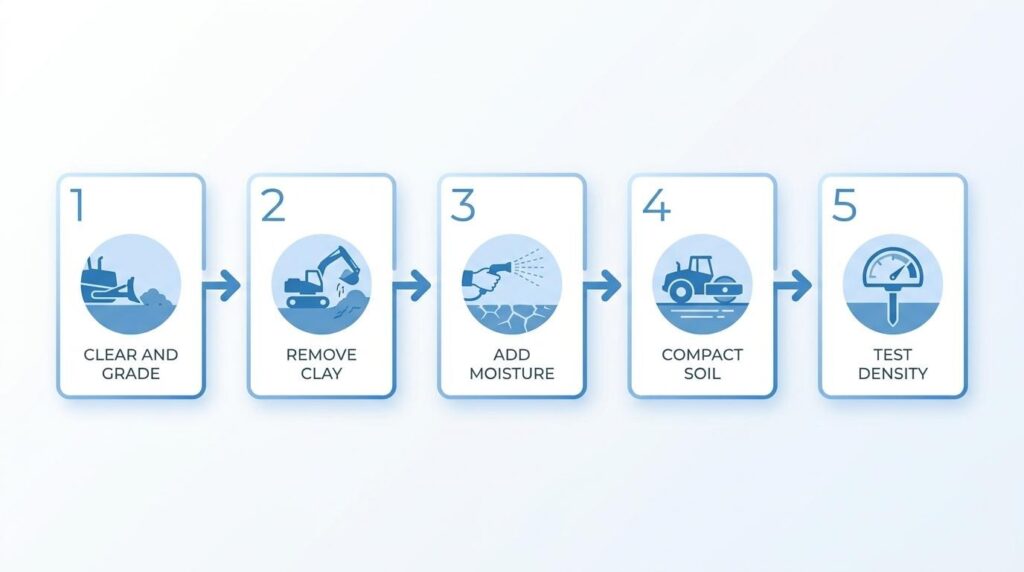
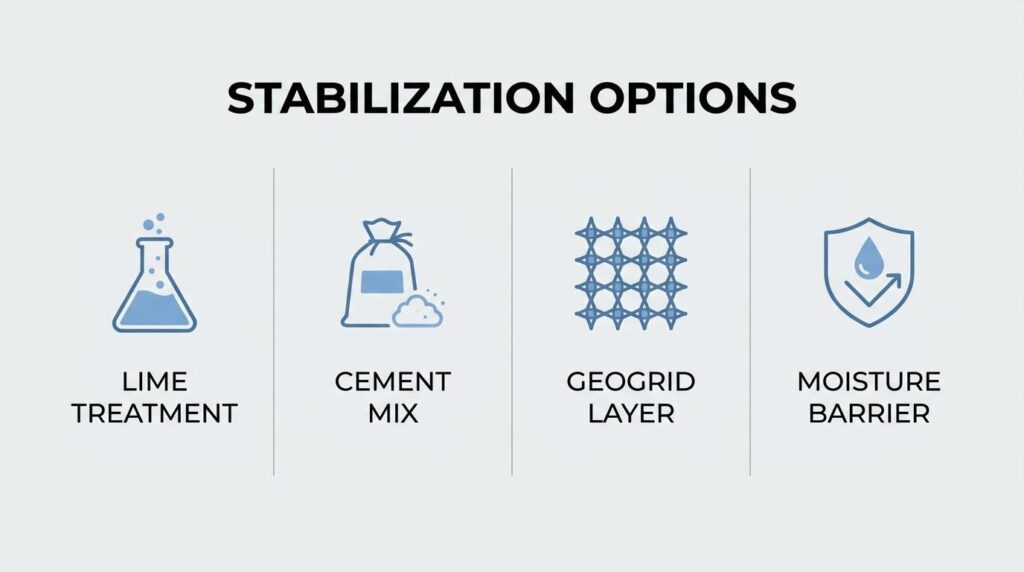
The preparation sequence moves from clearing and rough grading through clay removal, moisture conditioning, compaction with sheepsfoot and pneumatic rollers, and density verification at each lift. Stabilization options include lime treatment for high-plasticity clays, cement-treated subgrade for moderate-plasticity soils, geosynthetic reinforcement, and vertical moisture barriers along the lot perimeter.
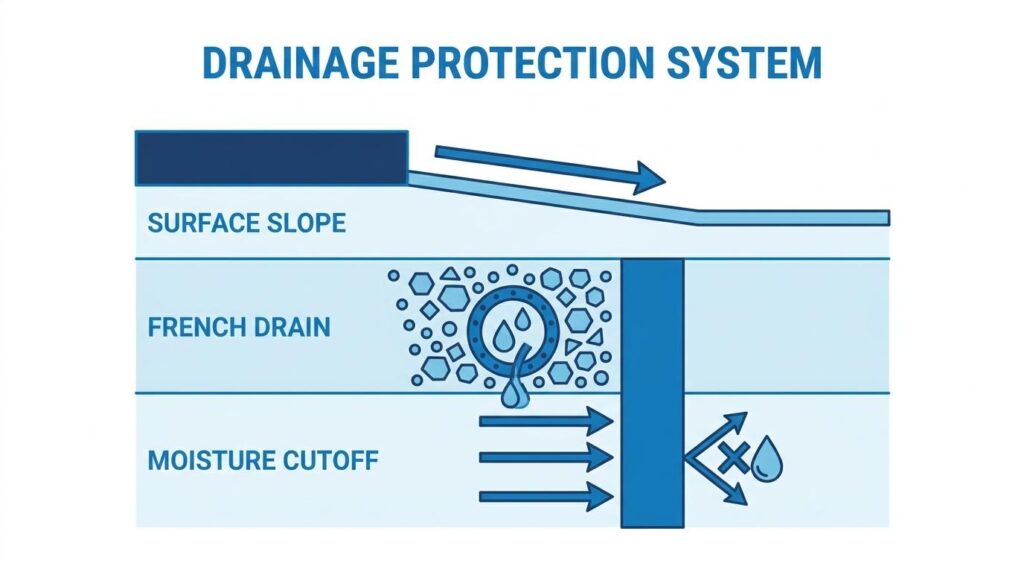
Drainage design and freeze-thaw protection are built into the preparation scope, not treated as separate concerns. Denver’s 36-inch frost line sets the minimum treatment depth, and subsurface French drains paired with positive surface grading keep stabilized clay at consistent moisture levels.
Common failures (differential heave, compaction settlement, and drainage-induced collapse) trace back to skipped testing, inadequate treatment depth, or disconnected drainage planning. Addressing each failure pattern and understanding the cost variables that shape budgets for removal versus stabilization across different site sizes is essential for successful project planning.
Why Does Swelling Clay Soil Matter for Denver Commercial Lots?
Swelling clay soil matters for Denver commercial lots because it expands and contracts with moisture changes, threatening pavement integrity. The sections below cover how local clays behave, what expansion does under parking lots, and how seasonal moisture cycles trigger movement.
How Do Bentonite and Montmorillonite Clays Behave in Denver?
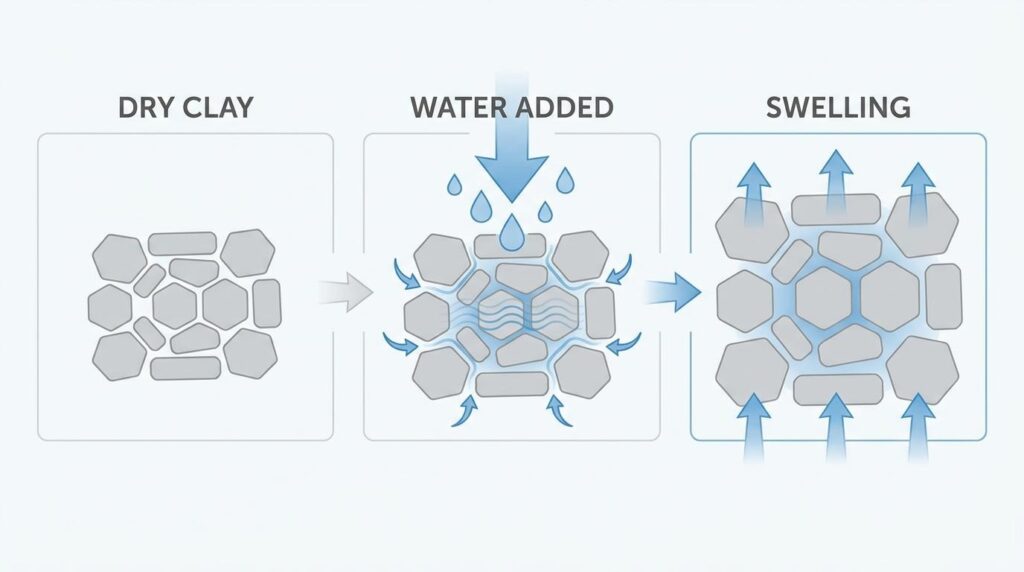
Bentonite and montmorillonite clays in Denver behave as highly expansive minerals that absorb water between their layered crystal structures, causing dramatic volume increases. The Pierre Shale and Denver Formation underlie much of the Front Range, and both contain significant concentrations of these swelling clays. When dry, these minerals shrink and crack; when wet, they swell with enough force to lift slabs and buckle pavement. This shrink-swell cycle makes them particularly destructive beneath commercial lots where consistent surface performance is critical. For any paving project on the Front Range, identifying these clay types early determines every decision that follows in subgrade design.
What Happens When Swelling Clay Expands Under a Parking Lot?
When swelling clay expands under a parking lot, the upward pressure displaces the subgrade, causing differential heave, surface cracking, and structural failure of the asphalt section. Expansion occurs unevenly because moisture infiltrates at different rates across the lot, particularly near edges, utility trenches, and drainage features. This uneven movement creates localized bumps, alligator cracking, and ponding that accelerates further water intrusion. According to the Town of Bennett, Colorado, mitigation measures are required in some Colorado jurisdictions when the subgrade contains swelling soils with a swell potential greater than 2.00 percent under a 200 psf surcharge. Ignoring swell potential during design virtually guarantees premature pavement failure and costly repairs.
How Do Denver’s Seasonal Moisture Cycles Trigger Clay Movement?
Denver’s seasonal moisture cycles trigger clay movement through alternating periods of deep soil drying and rapid rehydration. Winters and early spring bring snowmelt that saturates the upper soil profile, while summer heat and low humidity pull moisture from exposed subgrade. This cyclical wetting and drying activates the shrink-swell behavior of montmorillonite clays, generating repeated stress beneath pavement structures. Late-summer thunderstorms compound the problem by delivering intense rainfall onto already desiccated ground, causing rapid and uneven expansion. Managing this cycle through proper moisture conditioning and drainage control during subgrade preparation is essential for long-term pavement stability on Denver commercial sites.
How Do You Identify Swelling Clay on a Denver Commercial Site?
You identify swelling clay on a Denver commercial site through geotechnical investigation, laboratory swell testing, Atterberg limit analysis, and geologic mapping. The following subsections cover each identification method.
What Does a Geotechnical Soil Investigation Reveal?
A geotechnical soil investigation reveals the type, depth, and behavior of subsurface materials beneath a proposed commercial lot. Engineers drill boreholes, collect undisturbed samples, and log soil stratigraphy to identify clay layers with swell potential. According to the Town of Bennett, Colorado, mitigation measures are required in some Colorado jurisdictions when swelling soils exceed a swell potential greater than 2.00 percent under a 200 psf surcharge. Without this baseline data, selecting the right subgrade treatment is guesswork. For any Denver commercial project on suspected expansive soils, the geotechnical report is the single most important pre-construction document.
How Is Swell Potential Measured in a Lab Test?
Swell potential is measured in a lab test by confining an undisturbed soil sample under a known surcharge load, saturating it, and recording the resulting volume change. ASTM D4546 is the standard test method used for one-dimensional swell measurement. Results vary dramatically depending on clay mineralogy. Claystone samples tested in the Denver area ranged from just 0.03% to 0.68% swell at 1,000 psf inundation load, while bentonite beds in the Pierre Shale swelled 39% to 42% under the same surcharge, as documented in the Clays and Clay Minerals journal. That range underscores why site-specific testing is non-negotiable for commercial lot design.
What Do Plasticity Index and Liquid Limit Tell You?
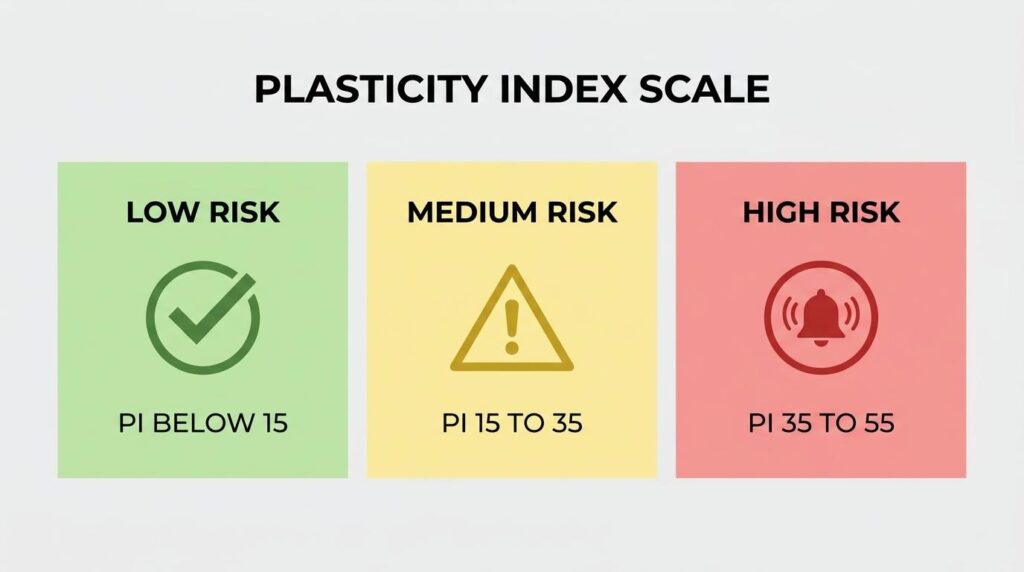
Plasticity Index and liquid limit tell you how much a soil’s moisture content influences its volume change behavior. Liquid limit measures the water content at which soil transitions from a plastic to a liquid state. Plasticity Index, the difference between liquid limit and plastic limit, correlates directly with swell risk. According to EDT Engineers, a Plasticity Index between 35 and 55 indicates high swell potential, reflecting the size, percentage, and type of clay particles in the soil. Together, these Atterberg limits help engineers classify whether a Denver subgrade requires stabilization, removal, or moisture conditioning before paving.
Where Are the Highest-Risk Expansive Soil Zones Along the Front Range?
The highest-risk expansive soil zones along the Front Range correspond to outcrops of the Pierre Shale and Denver Formation. According to a U.S. Geological Survey report, these are the primary geologic units responsible for expansive soil hazards in the region, with the Pierre Shale containing high concentrations of montmorillonite clay. Key risk areas include:
- Southwest Denver metro, where bentonite beds have produced severe structural damage.
- The corridor between Denver and Colorado Springs, where both formations are prevalent near the surface.
- Douglas County and portions of the western suburbs, where steeply dipping bedrock amplifies differential heave.
Colorado Springs municipalities require a stabilized subgrade report when expansive soils are present, and similar protocols apply across Front Range jurisdictions. Knowing which geologic formation underlies a commercial site determines the entire subgrade preparation strategy that follows.
What Are the Steps in Subgrade Preparation for Swelling Clay?
The steps in subgrade preparation for swelling clay include clearing and rough-grading, removing unsuitable material, moisture conditioning, compaction, and verification testing. Each step builds on the previous one to create a stable platform for pavement.
How Is the Existing Grade Cleared and Rough-Graded?
The existing grade is cleared and rough-graded by removing all vegetation, topsoil, debris, and organic material from the construction footprint. Motor graders then shape the exposed surface to approximate design elevations, establishing consistent drainage slopes across the lot.
Rough grading on expansive clay sites demands close attention to surface contours. Even minor low spots can trap moisture and trigger localized swell beneath future pavement sections. Contractors typically cut to within a few inches of final subgrade elevation during this phase, leaving precise adjustments for later lifts. For Denver commercial lots, this initial shaping also accounts for the site’s stormwater management plan, directing sheet flow away from pavement edges where clay is most vulnerable to moisture infiltration.
Experienced contractors coordinate grading with drainage planning from the outset. Asphalt Coatings Company handles subgrade preparation through in-house crews rather than subcontractors, ensuring quality control across every phase of commercial lot development.
What Depth of Unsuitable Clay Should Be Removed and Replaced?
The depth of unsuitable clay that should be removed and replaced depends on swell potential identified in the geotechnical report. For commercial pavement in the Denver area, over-excavation commonly extends to a depth of 2 feet below finished subgrade elevation.
Highly expansive zones may require deeper removal if lab testing reveals significant swell risk. The excavated material is replaced with engineered, non-expansive fill, typically select granular material compacted in controlled lifts. Each lift is moisture-conditioned and tested before the next layer is placed. Choosing the correct removal depth is one of the most consequential decisions in the entire project; underestimating it often leads to differential heave that cracks pavement within the first few seasonal cycles.
How Is Moisture Conditioning Used to Pre-Swell the Subgrade?
Moisture conditioning is used to pre-swell the subgrade by adding controlled amounts of water to expansive clay before compaction. This process intentionally triggers volume change under managed conditions, reducing the soil’s remaining swell potential once pavement is in place.
Water is applied through sprinkler trucks or tillage equipment, then mixed into the upper soil layer and allowed to equalize. The goal is bringing the clay close to its anticipated in-service moisture level so future wetting produces minimal additional movement. On Denver-area commercial sites, this step can take several days depending on clay mineralogy and ambient conditions. Rushing moisture conditioning undermines every subsequent phase, making it arguably the most patience-dependent step in the entire preparation sequence.
What Compaction Methods Work Best on Expansive Clay?
The compaction methods that work best on expansive clay are sheepsfoot rollers and pneumatic-tired rollers, which knead the soil rather than simply pressing it flat. This kneading action breaks up clay clods and produces a more uniform, interlocked structure throughout each lift.
Key compaction considerations for expansive clay include:
- Lift thickness should remain between 6 and 8 inches to ensure energy reaches the full depth.
- Sheepsfoot rollers are preferred for initial passes because their protruding feet penetrate and densify cohesive material effectively.
- Pneumatic-tired rollers provide a smooth, sealed finish on final passes.
- Compaction must occur while moisture content remains within the target range established during conditioning.
Over-compacting dry expansive clay creates a dense layer that swells aggressively when it eventually absorbs water, so moisture control during rolling is critical.
How Do You Verify Subgrade Density and Moisture Content?
Subgrade density and moisture content are verified through field testing performed after each compacted lift. Nuclear density gauges and sand cone tests measure in-place density, while oven-dry or nuclear methods confirm moisture levels.
According to a City and County of Broomfield report on Denver-area pavement projects, subgrade preparation requires over-excavation to a depth of 2 feet, with moisture content adjusted to within 0 to 4 percent of the optimum moisture content. Test results that fall outside this range require reworking the lift before proceeding. Testing frequency typically calls for one test per 2,500 to 5,000 square feet per lift, though high-risk zones may need closer spacing.
With verified subgrade in place, the focus shifts to stabilization methods that further reduce long-term swell risk.
Which Soil Stabilization Methods Work for Denver Expansive Clay?
The soil stabilization methods that work for Denver expansive clay include lime treatment, cement stabilization, geosynthetic reinforcement, and moisture-barrier installation. Each method addresses clay swell through a different mechanism.
How Does Lime Stabilization Reduce Clay Swell Potential?
Lime stabilization reduces clay swell potential by chemically altering the clay mineralogy through a pozzolanic reaction. When quicklime or hydrated lime is mixed into expansive clay, it exchanges calcium ions with the sodium and potassium ions on clay particle surfaces, which reduces the soil’s ability to absorb water and swell.
Soils with a Plasticity Index between 35 and 55 are considered high swell potential candidates, and these respond well to lime treatment. However, according to Mintek Resources, soils containing greater than 3,000 ppm soluble sulfate content should be evaluated for potential expansion, because sulfates can react with lime to cause further swelling rather than reducing it.
Pre-construction sulfate testing is essential before specifying lime on any Denver clay subgrade.
When Is Cement-Treated Subgrade the Right Choice?
Cement-treated subgrade is the right choice when the expansive clay has low to moderate plasticity or when sulfate levels make lime treatment risky. Portland cement binds soil particles into a rigid matrix, increasing bearing capacity and reducing moisture sensitivity.
This method suits commercial lots where heavy traffic loads demand higher unconfined compressive strength than lime alone provides. CDOT Standard Specifications for Road and Bridge Construction 2023 govern the requirements for stabilization work on Colorado projects, and project-specific provisions may supplement these standards for commercial applications.
Cement treatment works best on granular or silty clay soils; highly plastic montmorillonite clays often respond better to lime.
Can Geosynthetic Reinforcement Control Clay Heave?
Yes, geosynthetic reinforcement can control clay heave by distributing differential movement across a wider area, reducing localized stress on the pavement structure. Woven geotextiles and geogrids placed between the subgrade and aggregate base act as separation and reinforcement layers.
While geosynthetics do not chemically alter the clay itself, they bridge weak zones and limit the surface expression of heave. This approach is often combined with chemical stabilization or moisture conditioning for comprehensive protection. Selecting the wrong stabilization method for specific soil conditions can increase material costs and project delays, making geotechnical guidance critical before choosing geosynthetics as a standalone solution.
How Does Moisture-Barrier Installation Protect the Subgrade?
Moisture-barrier installation protects the subgrade by preventing lateral water migration into the treated clay zone beneath the pavement. Vertical barriers, typically constructed from polyethylene membrane or bentonite panels, are placed along the perimeter of the lot to intercept groundwater and surface infiltration.
Expansive soils in Colorado can expand 10 percent or more as clay becomes wet, exerting pressures exceeding 20,000 pounds per square foot on foundations and slabs, according to the Colorado Geological Survey. Moisture barriers maintain consistent soil moisture content within the stabilized subgrade envelope, which is the single most effective way to prevent post-construction heave on commercial lots.
Proper drainage design complements these barriers by directing surface water away from vulnerable subgrade zones.
How Does Drainage Design Prevent Clay Movement Under Pavement?
Drainage design prevents clay movement under pavement by controlling moisture infiltration that triggers swell cycles in expansive subgrades. The following subsections cover subsurface French drains, surface grading strategies, and perimeter moisture cutoffs.
What Role Do Subsurface French Drains Play in Clay Subgrades?
Subsurface French drains play a critical role in clay subgrades by intercepting groundwater before it saturates expansive clay layers beneath the pavement section. A perforated pipe bedded in free-draining aggregate collects migrating moisture and redirects it to discharge points away from the subgrade.
On Denver commercial lots, French drains are typically installed along the pavement edge or within the aggregate base course. This placement intercepts lateral water movement through the soil profile, keeping moisture levels more uniform across the subgrade. Consistent moisture content is essential because even localized wetting of montmorillonite clay can produce differential heave that cracks the surface. For high-risk sites, connecting French drains to the broader storm drainage system outlined in Denver’s drainage design standards ensures reliable outflow capacity during heavy rain events.
How Should Surface Grading Direct Water Away from the Lot?
Surface grading should direct water away from the lot by establishing positive slopes that move runoff toward collection points before it can pond and infiltrate expansive clay. According to the Colorado Geological Survey, surface drainage management and avoiding vegetation next to foundations are critical to prevent irrigation water from entering expansive soils and causing damage.
Effective grading practices for Denver commercial lots include:
- Maintaining a minimum 2% cross-slope across parking areas to prevent ponding.
- Directing all runoff toward engineered inlets, swales, or curb-and-gutter systems.
- Eliminating low spots where standing water could soak into the subgrade over time.
- Keeping landscaped irrigation zones separated from pavement edges by adequate buffer distances.
Even well-stabilized subgrades can fail when surface water is allowed to pool. Proper grading is one of the most cost-effective protective measures available for any expansive clay site.
Why Are Perimeter Moisture Cutoffs Critical on Expansive Sites?
Perimeter moisture cutoffs are critical on expansive sites because they block lateral water migration from surrounding soils into the treated subgrade beneath the pavement. Without these barriers, moisture from adjacent landscaping, slopes, or natural drainage paths can re-wet stabilized clay and reactivate swell potential.
A moisture cutoff typically consists of a vertical impermeable membrane or compacted clay barrier installed along the pavement perimeter, extending below the treated subgrade depth. This creates a defined boundary that isolates the controlled moisture environment underneath the lot from uncontrolled conditions outside it. On Denver’s expansive Pierre Shale formations, where even small moisture changes produce significant volume shifts, perimeter cutoffs are not optional; they are essential to preserving long-term pavement performance.
With drainage strategies in place, ongoing maintenance keeps these protections effective.
How Do Denver’s Freeze-Thaw Cycles Affect Clay Subgrade Performance?
Denver’s freeze-thaw cycles degrade clay subgrade performance by expanding trapped moisture into ice, heaving the surface, and weakening soil structure upon thawing. The sections below cover spring thaw behavior and the required treatment depth below the frost line.
What Happens When Frozen Clay Thaws in Spring?
Frozen clay thaws in spring by releasing ice lenses that had expanded within the soil matrix, leaving behind voids and saturated, weakened material. According to ISE Structural Engineers, freeze-thaw cycles cause water in the soil to expand as it turns to ice, lifting the ground surface and shifting foundations, which can induce long-term strength degradation in highway subgrades.
This process is particularly destructive in Denver’s montmorillonite-rich clays. As ice melts, the clay absorbs excess water, increasing plasticity and reducing bearing capacity. Commercial parking lots built on untreated subgrades often show the effects as localized depressions, cracked pavement, and uneven surfaces that worsen with each seasonal cycle. Proper subgrade preparation before paving is the most reliable way to interrupt this pattern.
How Deep Should Subgrade Treatment Extend Below Frost Line?
Subgrade treatment should extend below the frost line to ensure freeze-thaw activity does not compromise stabilized soil layers. Section 1809.5 of the Denver Building Code establishes the frost line for the City and County of Denver at 36 inches (915 mm) below finished grade.
For commercial lots on expansive clay, treatment depth should account for both frost penetration and swell-active zones. Stabilization that stops above 36 inches leaves untreated soil vulnerable to ice lens formation, which generates uplift pressure beneath the pavement section. Extending lime or cement treatment to at least the full frost depth creates a buffer that resists both heave and post-thaw softening. In practice, many Denver-area geotechnical reports recommend treatment depths that exceed this minimum, especially where high-plasticity clays are present at deeper horizons.
With freeze-thaw risks addressed, understanding common subgrade failures helps prevent costly repairs.
What Are Common Subgrade Failures on Denver Swelling Clay Sites?
Common subgrade failures on Denver swelling clay sites include differential heave, compaction-related settlement, and drainage-induced localized collapse. Each failure mode stems from a distinct cause but produces visible pavement distress.
What Does Differential Heave Look Like in a Commercial Parking Lot?
Differential heave in a commercial parking lot appears as uneven surface elevation changes, cracked asphalt panels, and tilted curb lines where one section of pavement rises while adjacent areas remain stable. Joints between pavement sections separate, and standing water collects in newly formed low spots.
According to a case study published by Nelson Forensics, a structure near Denver experienced differential vertical heave of approximately 5 inches because the original potential vertical rise calculations were significantly underestimated. Expansive bedrock dipping at steep angles compounds this problem; the ASCE Library identified differential heaving of steeply dipping, expansive bedrock as the most likely cause of structural damage to a school building near Denver. For commercial lots, even 1 to 2 inches of differential movement can crack pavement sections and create trip hazards.
How Does Inadequate Compaction Lead to Pavement Settlement?
Inadequate compaction leads to pavement settlement by leaving air voids and loose material within the subgrade that compress under repeated traffic loading. When clay soil is not compacted to the specified density at proper moisture content, the subgrade consolidates unevenly after paving.
Settlement typically appears as:
- Wheel-path rutting along heavy traffic lanes
- Bowl-shaped depressions near dumpster pads or loading docks
- Cracking at transitions between compacted and under-compacted zones
On expansive clay, compaction is particularly critical because both under-compaction and over-compaction at incorrect moisture levels create long-term instability. Achieving target density without accounting for the clay’s optimum moisture range virtually guarantees future settlement.
Why Does Poor Drainage Cause Localized Subgrade Failure?
Poor drainage causes localized subgrade failure because trapped water saturates expansive clay in concentrated areas, triggering isolated swell and softening that the surrounding pavement cannot accommodate. Without proper surface grading or subsurface collection systems, water migrates to low points and infiltrates the subgrade.
The resulting failure pattern is distinct: localized depressions, alligator cracking, and potholes cluster near drain inlets, curb lines, or landscape islands rather than spreading uniformly. On swelling clay, even small volumes of standing water can reactivate dormant clay minerals and produce rapid, localized heave or loss of bearing capacity. Addressing drainage during subgrade preparation, rather than after pavement failure, remains the most cost-effective prevention strategy.
With common failure modes identified, understanding subgrade preparation costs helps Denver property managers budget effectively.
How Much Does Subgrade Preparation Cost on Denver Expansive Clay?
Subgrade preparation cost on Denver expansive clay depends primarily on the method selected and the project’s total area. The following sections break down cost drivers between removal and stabilization, and how site size influences per-square-foot pricing.
What Drives Cost Differences Between Removal and Stabilization?
Cost differences between removal and stabilization are driven by material expenses, equipment requirements, haul distances, and method suitability for the specific clay conditions on site. Full removal requires excavation, trucking, disposal fees, and importing engineered fill, while chemical stabilization demands lime or cement, specialized mixing equipment, and extended curing time.
Choosing the wrong approach compounds these costs significantly. According to Construction Dive, geotextiles or chemical stabilization may not be the cheapest or fastest option and could actually cost more in material costs or lost time if the wrong method is chosen for the specific soil. A thorough geotechnical report that identifies clay mineralogy, sulfate content, and swell potential is the only reliable way to match the method to the site, preventing expensive rework.
For most Denver commercial lots, stabilization offers better long-term value when soil chemistry supports it, though removal remains the safer choice when sulfate levels or extreme swell percentages make chemical treatment unpredictable.
How Does Site Size Affect Per-Square-Foot Subgrade Pricing?
Site size affects per-square-foot subgrade pricing through economies of scale in mobilization, equipment utilization, and material delivery. Larger commercial lots spread fixed costs across more square footage, reducing the unit rate considerably.
Key factors that shift pricing as site area increases include:
- Mobilization costs. Equipment transport and crew setup are fixed regardless of lot size, so smaller sites absorb a higher per-square-foot share.
- Material volume discounts. Bulk orders of engineered fill or lime for larger projects typically carry lower per-ton pricing from suppliers.
- Equipment efficiency. Heavy graders and compactors operate continuously on large sites, while smaller lots involve more repositioning and downtime.
- Haul cycle optimization. Larger excavation volumes justify dedicated truck rotations, cutting idle time between loads.
A 50,000-square-foot commercial lot will generally see meaningfully lower per-square-foot preparation costs than a 10,000-square-foot site requiring the same treatment depth. Property managers planning phased development should consider preparing the full subgrade area at once to capture these savings.
Understanding these cost variables helps commercial property owners budget accurately before paving begins.
How Should You Plan Commercial Paving on Denver Swelling Clay?
You should plan commercial paving on Denver swelling clay by integrating geotechnical findings, subgrade stabilization, and drainage design into a unified construction sequence. The subsections below cover how parking lot construction addresses swelling clay and the key takeaways for subgrade preparation.
Can Denver Commercial Parking Lot Construction Address Swelling Clay?
Yes, Denver commercial parking lot construction can address swelling clay when the project integrates proper geotechnical assessment, subgrade treatment, and drainage planning from the earliest design phase. Treating these elements as separate line items, rather than a coordinated system, is where most commercial lots run into long-term heave and settlement problems.
Denver’s storm drainage design standards require parking lot facilities to streamline the planning and design process of drainage infrastructure, according to the City and County of Denver. This means drainage is not an afterthought; it is a code-driven requirement that must be designed alongside subgrade preparation.
Effective planning sequences these steps:
- Commission a geotechnical investigation before any grading begins.
- Select stabilization or removal methods based on measured swell potential and Plasticity Index results.
- Design subsurface and surface drainage systems that prevent moisture intrusion into treated subgrade layers.
- Specify compaction and moisture conditioning targets in the construction documents.
For commercial property managers, the most common planning mistake is underestimating how aggressively Denver’s swelling clays respond to even minor moisture changes. Building drainage control directly into the paving plan, not as a separate scope, is the single most effective way to protect your investment.
What Are the Key Takeaways About Subgrade Preparation for Denver Commercial Lots on Swelling Clay Soils?
The key takeaways about subgrade preparation for Denver commercial lots on swelling clay soils center on three priorities: testing before building, stabilizing the clay, and controlling moisture permanently.
- Geotechnical testing is non-negotiable. Swell potential, Plasticity Index, and sulfate content must be measured before selecting any treatment method.
- Subgrade preparation methods, including over-excavation, lime stabilization, and moisture conditioning, must match site-specific soil data rather than follow generic specifications.
- Drainage systems protect stabilized subgrades from the moisture fluctuations that trigger clay expansion.
- Freeze-thaw cycles in Denver compound clay movement, making treatment depth and frost line awareness critical design factors.
- Choosing the wrong stabilization method can cost more in materials and lost time than selecting the right approach from the start.
Asphalt Coatings Company brings 39 years of Colorado Front Range experience to commercial paving projects. With in-house crews handling subgrade preparation, grading, and asphalt paving, the company coordinates every phase under one team for Denver commercial properties.