Sealcoating is a preventive surface treatment that shields structurally sound asphalt from UV rays, water, and chemical damage; paving is the installation or replacement of the asphalt structure itself. Choosing between them depends on your lot’s current condition, not preference.
This guide covers how each service works and when it applies, condition assessment methods for identifying maintenance vs. replacement needs, cost and lifespan comparisons, climate and seasonal factors, combined treatment strategies, safety and ADA compliance, and long-term budgeting.
Sealcoating protects existing pavement by blocking oxidation and moisture intrusion. It works best on lots with minor surface wear, requires reapplication every two to three years, and needs warm, dry conditions above 50°F to cure properly.
Paving becomes necessary when structural damage exceeds what surface treatments can fix. Warning signs include alligator cracking, base instability, and more than 25% of the surface needing repair. Properly installed commercial asphalt can last 20 to 30 years with consistent maintenance.
A structured condition evaluation separates lots that need maintenance from those that need reconstruction. Cracking patterns, drainage performance, traffic loads, and pavement age each play a role in that determination.
Colorado’s freeze-thaw cycles, high-altitude UV exposure, and de-icing chemicals accelerate asphalt deterioration faster than in lower-elevation states. Scheduling work from late spring through early fall ensures reliable curing and compaction.
Combining crack sealing, localized patching, and sealcoating in a single mobilization delivers the highest value when damage is mixed. Phasing larger projects across multiple seasons keeps lots partially accessible and spreads capital costs over annual budgets.
What Is Sealcoating for a Commercial Parking Lot and How Does It Work?
Sealcoating for a commercial parking lot is a preventive maintenance treatment that applies a protective layer over existing asphalt to shield it from UV rays, water, oil, and traffic wear. The subsections below cover how sealcoating protects asphalt, recommended frequency, surface condition requirements, expected lifespan, and ideal weather conditions.
What Does Sealcoating Actually Do to Protect Asphalt?
Sealcoating protects asphalt by creating a sealed barrier that blocks UV oxidation, prevents water infiltration, and resists chemical damage from oil and fuel spills. This thin emulsion coat bonds to the existing pavement surface, slowing the deterioration that leads to cracking and raveling.
Spring is an excellent time to inspect and repair asphalt surfaces before applying sealcoat, since moderate temperatures support proper adhesion and curing. The coating also restores a uniform black appearance, improving curb appeal for commercial properties. For property managers weighing maintenance options, sealcoating addresses surface-level degradation without the cost or disruption of repaving.
How Often Should a Commercial Parking Lot Be Sealcoated?
A commercial parking lot should be sealcoated every two to three years. Retail parking lots should be sealcoated every 2 to 3 years, depending on traffic volume and exposure to weather.
Several factors influence the exact interval:
- High-traffic retail lots may need sealcoating closer to every two years.
- Lower-traffic office parks can often extend to three years between applications.
- Lots exposed to heavy truck traffic or frequent chemical spills degrade faster.
After each sealcoating application, commercial parking lots typically require three to seven days before reopening to vehicle traffic. Following the contractor’s curing recommendations and addressing small cracks early between cycles helps maximize the return on each application.
In What Condition Should Asphalt Be Before Sealcoating Is Effective?
Asphalt should be structurally sound with only minor surface wear before sealcoating is effective. Sealcoating is a surface treatment, not a structural repair. It works best on pavement that has light oxidation, hairline cracks, or minor weathering, rather than deep structural failures.
According to SealMaster, asphalt-based sealers remain flexible after curing, expand and contract with pavement movement, resist cracking caused by thermal stress, and offer better performance in freeze-thaw conditions. However, these benefits only apply when the underlying pavement is stable. Surfaces with extensive alligator cracking, base failure, or standing water issues need repair before any sealcoat application. Effective communication with tenants about surface preparation timelines also ensures the process runs smoothly.
How Long Does Sealcoating Typically Last in High-Traffic Lots?
Sealcoating in high-traffic lots typically lasts two to three years before requiring reapplication. Consistent vehicle turning, braking, and heavy loads accelerate surface wear and reduce the coating’s effective lifespan compared to lighter-use areas.
When maintained on a regular cycle, sealcoating can extend overall pavement lifespan by 10 to 20 years by preventing the oxidation and water penetration that cause deeper structural damage. Asphalt Coatings Company uses CDOT-approved materials for all crack sealing and sealcoating work, ensuring maximum protection against Colorado’s harsh freeze-thaw cycles and high-altitude UV exposure. Lots with heavy delivery truck traffic or constant daily use sit at the shorter end of that range. Pairing sealcoating with crack sealing between cycles is one of the most cost-effective strategies for stretching a commercial lot’s service life.
What Weather and Temperature Conditions Are Best for Sealcoating?
The best weather and temperature conditions for sealcoating are warm, dry days with air temperatures consistently above 50 degrees Fahrenheit. Ground temperatures must also be warm enough to support proper curing, and overnight freezing should be unlikely.
Ideal conditions include:
- Air temperatures above 50°F for at least 24 hours after application.
- Dry weather with no rain in the forecast for 24 to 48 hours.
- Ground temperatures warm enough to prevent premature cooling of the sealer.
- Low humidity to allow even evaporation and uniform curing.
Late spring through early fall provides the most reliable window for commercial sealcoating projects. Scheduling outside this range risks poor adhesion and premature failure, which wastes both budget and downtime.
Understanding these application requirements helps clarify what paving demands when sealcoating alone is not enough.
What Is Asphalt Paving and When Is It the Better Choice Than Sealcoating?
Asphalt paving is the process of installing new or replacement asphalt surface material on a commercial parking lot. Paving becomes the better choice when structural damage exceeds what a protective sealcoat can address. The following sections cover key signs that indicate repaving, overlay versus full replacement, expected lifespan, and when mill-and-overlay is the right approach.
What Are the Main Signs Your Asphalt Needs Repaving Instead of Sealcoating?
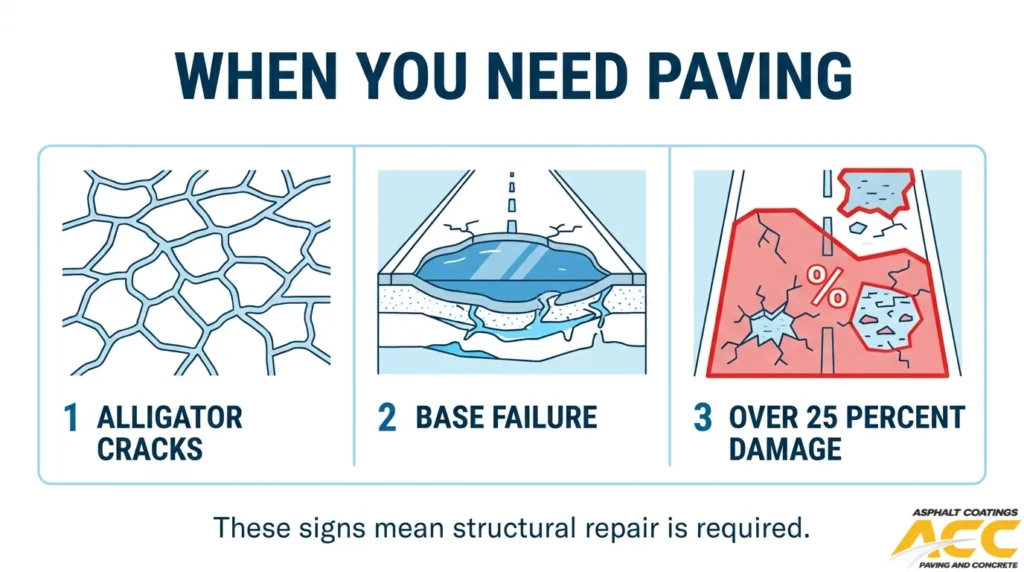
The main signs your asphalt needs repaving instead of sealcoating include widespread alligator cracking, deep structural failures, an unstable base, and surface damage covering more than 25% of the lot. Sealcoating is a surface treatment; it cannot restore pavement that has lost structural integrity. According to S&S Paving and Construction, properly installed pavement can last 20 to 30 years with good maintenance, while rushed or neglected surfaces may fail in just three to four years. When emergency repairs become frequent and reactive closures disrupt operations, the pavement has likely passed the point where sealcoating alone is effective. Repaving restores the full structural capacity that maintenance treatments cannot.
How Does Asphalt Overlay Differ from Full-Depth Replacement?
Asphalt overlay differs from full-depth replacement in scope and structural impact. An overlay applies a new asphalt layer directly over the existing surface, provided the base remains stable and drainage is adequate. Asphalt Coatings Company’s in-house crews evaluate base stability and drainage performance before recommending overlay versus full replacement, providing transparent guidance that prevents unnecessary expense and ensures the chosen solution addresses your lot’s actual structural needs. Because asphalt-based materials bond naturally with existing pavement, overlays can restore ride quality and appearance without excavation. Full-depth replacement, by contrast, removes the entire pavement structure down to the subgrade, rebuilds the base, and installs completely new asphalt. This approach is necessary when the foundation is compromised by base failure, extensive cracking, or poor drainage that an overlay would only mask. For most property managers, choosing between the two comes down to base condition rather than surface appearance alone.
How Long Can You Expect New Commercial Asphalt Paving to Last?
New commercial asphalt paving can last 20 to 30 years when installed correctly and maintained on a consistent schedule. Some well-maintained asphalt surfaces have reached 40 years of service life. Achieving that longevity depends on proper compaction during installation, adequate curing time, and routine preventive maintenance such as sealcoating and crack sealing. Late spring through early fall is generally considered the ideal window for paving projects, since asphalt performs best when temperatures remain consistently warm. Scheduling installation during optimal conditions and following through with regular maintenance is the most reliable path to maximizing pavement lifespan.
When Is Mill-and-Overlay Paving Recommended for Parking Lots?
Mill-and-overlay paving is recommended for parking lots when the existing base is structurally sound but the surface layer shows moderate to severe wear. Milling removes the top layer of deteriorated asphalt to a specified depth, creating a clean bonding surface for the new overlay. This method corrects surface irregularities, restores proper drainage grades, and maintains existing curb heights and manhole elevations. It costs less than full-depth replacement and causes shorter disruption periods, making it practical for active commercial properties. If core samples reveal base instability or subgrade failure, however, milling alone will not solve the underlying problem, and full reconstruction should be considered instead.
Understanding when paving is warranted sets the stage for evaluating whether your lot falls into the maintenance or replacement category.
How Can You Tell If Your Parking Lot Only Needs Maintenance vs. Full Paving?
You can tell if your parking lot only needs maintenance vs. full paving by evaluating surface distress type, severity, and pavement age. The sections below cover which visible signs point to sealcoating, when structural failures demand repaving, how drainage issues factor in, and how age and repair history guide the decision.
What Visible Surface Distress Suggests Sealcoating and Crack Sealing Are Enough?
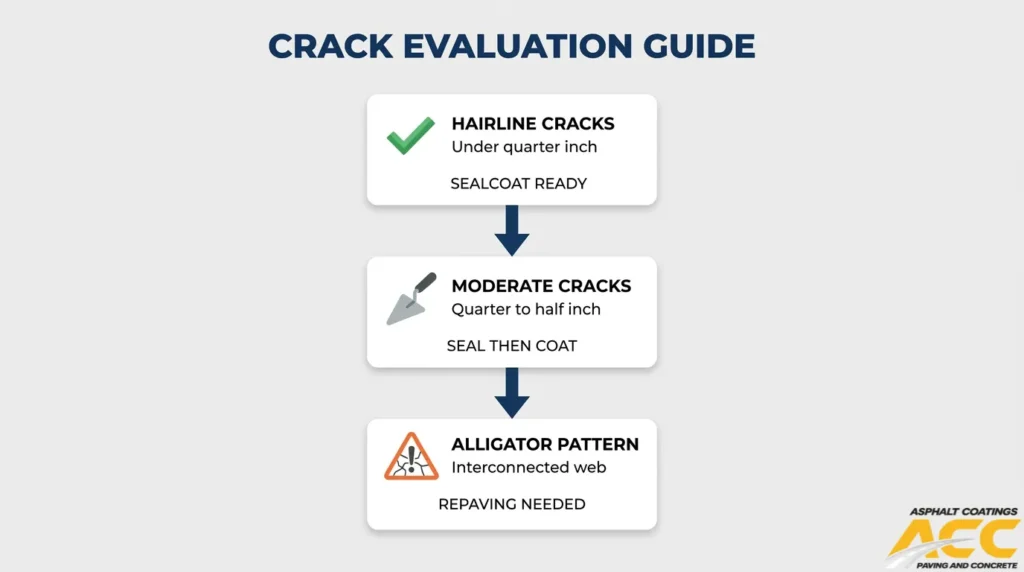
Visible surface distress that suggests sealcoating and crack sealing are enough includes hairline cracks, minor oxidation and color fading, small surface raveling, and isolated linear cracks narrower than a quarter inch. These are cosmetic and surface-level issues where the asphalt base remains structurally sound.
Before any sealcoat application, the surface must be assessed for cracks, stains, and debris. The top layer of asphalt should be thoroughly cleaned to ensure proper adhesion of the new sealcoat and to prevent future cracking and oxidation. If the pavement shows only these shallow distresses and the foundation feels stable underfoot, maintenance-level treatments will restore protection effectively. Once damage reaches the structural layer, however, sealcoating alone cannot reverse it.
When Do Alligator Cracks and Base Failures Mean You Need Paving?
Alligator cracks and base failures mean you need paving when interconnected cracking patterns signal structural fatigue beneath the surface layer. According to the Federal Highway Administration (FHWA), fatigue cracking, also called alligator cracking, is a series of interconnecting cracks caused by fatigue failure of the asphalt surface under repeated traffic loading.
This type of distress indicates the sub-base has weakened or failed. Sealcoating over alligator cracking is ineffective because the damage originates below the surface. Left untreated, alligator cracking eventually results in potholes and full pavement disintegration. Signs that warrant paving include:
- Widespread interconnected crack patterns resembling alligator skin
- Visible base material shifting or pumping through cracks
- Soft, spongy areas where the sub-base has lost structural integrity
- Sections where previous crack sealing has repeatedly failed
When base failure is confirmed, full-depth removal or mill-and-overlay becomes necessary to restore load-bearing capacity.
How Do Potholes, Standing Water, and Rutting Influence the Decision?
Potholes, standing water, and rutting influence the decision by revealing whether damage is localized or systemic. A few isolated potholes in otherwise sound pavement can be patched and sealcoated. Widespread potholes, persistent standing water, and visible wheel-path rutting point to drainage failure or sub-base erosion that requires repaving.
Rutting, fatigue cracking, and low-temperature cracking are the major distresses responsible for asphalt pavement degradation. Standing water accelerates all three because moisture infiltrates cracks and weakens the aggregate base. If water pools consistently in the same areas after rain, the lot’s grading or drainage design likely needs correction, something sealcoating cannot address. For property managers, the practical threshold is clear: if ponding recurs across multiple zones and rutting exceeds half an inch, structural repair or repaving is the appropriate response.
How Do Age and Previous Repairs Affect Whether You Maintain or Repave?
Age and previous repairs affect whether you maintain or repave by indicating how much useful life remains in the pavement structure. Asphalt parking lots typically need replacement within fifteen to twenty years, and lots exceeding that age with recurring patch failures are strong candidates for repaving rather than continued maintenance.
A parking lot with scattered patches covering a small percentage of the surface can still benefit from sealcoating and crack sealing. However, when more than 25% to 30% of the asphalt surface needs repairs, the foundation is unstable, or cracks exceed a quarter inch wide, replacement becomes more cost-effective than layering additional repairs. Each patch introduces a seam that can fail, so heavily patched lots deteriorate faster. The most reliable approach is tracking cumulative repair costs against projected repaving costs over a five-year window to determine the true break-even point.
Understanding these condition thresholds helps property managers compare the actual costs of sealcoating versus paving.
What Are the Key Differences Between Sealcoating and Paving in Cost, Lifespan, and Disruption?
The key differences between sealcoating and paving span upfront investment, long-term return, operational downtime, and visual impact. The following subsections break down cost comparisons, lifespan and ROI, business disruption timelines, and curb appeal differences.
How Do Upfront Costs of Sealcoating Compare to Paving for Commercial Lots?
Upfront costs of sealcoating are significantly lower than paving for commercial lots. Sealcoating a commercial parking lot typically costs a fraction of what full-depth paving or mill-and-overlay work requires, since the process applies a thin protective layer over existing asphalt rather than replacing structural material. For most commercial parking lots, sealcoating every two to three years is the standard recommendation, according to Tru Seal America. That recurring expense, even over a decade, rarely approaches the one-time capital outlay of repaving. However, cost alone should not drive the decision; sealcoating only works on structurally sound pavement. Spending less on surface protection makes sense when the base is intact, but it becomes wasted money on a failing foundation.
How Do Lifespan and Long-Term ROI Compare Between Sealcoating and Paving?
Lifespan and long-term ROI differ substantially between sealcoating and paving. New asphalt paving, when properly installed and maintained, can last 20 to 30 years or more. Sealcoating does not replace pavement; it extends the life of existing asphalt by shielding it from UV oxidation, moisture intrusion, and chemical exposure. Consistent sealcoat applications every two to three years protect the binder that holds aggregate together, delaying the costly need for repaving. The ROI calculation favors sealcoating when pavement is in good structural condition, because the cumulative maintenance spend remains well below a single repaving project. Once structural failures appear, only new paving resets the lifespan clock and delivers full long-term value.
How Much Business Disruption and Downtime Does Each Option Typically Cause?
Business disruption and downtime differ dramatically between sealcoating and paving. Sealcoating generally requires 24 to 48 hours of cure time before traffic can return. Retail centers often benefit from scheduling sealcoat projects during weekends, holidays, or off-hours when foot and vehicle traffic is lowest, minimizing customer inconvenience and allowing full coverage without impacting business operations. Paving projects demand considerably more downtime. Commercial parking lots typically need three to seven days before normal business traffic can resume, and lots serving heavier vehicles may require up to ten days. For property managers weighing both options, that gap in downtime often makes phased sealcoating the preferred maintenance approach when the pavement structure is still sound.
How Do Aesthetics and Curb Appeal Differ Between Sealcoating and New Paving?
Aesthetics and curb appeal differ between sealcoating and new paving primarily in depth of renewal. Sealcoating restores a rich, dark-black finish that makes parking lots look freshly maintained, improving first impressions for customers and tenants. Striping and markings stand out sharply against the uniform dark surface. New paving, by contrast, delivers a completely smooth, defect-free surface that eliminates visible patches, cracks, and uneven areas entirely. While sealcoating refreshes appearance effectively on sound pavement, it cannot hide significant surface distress like rutting or widespread cracking. When a lot’s condition has deteriorated beyond cosmetic repair, only new asphalt provides the clean, professional look that protects property value.
Understanding cost, lifespan, disruption, and appearance trade-offs clarifies which approach fits your lot’s current condition and budget.
How Do Climate and Colorado Weather Conditions Affect Sealcoating vs. Paving Decisions?
Climate and Colorado weather conditions affect sealcoating vs. paving decisions by dictating material performance, application timing, and long-term durability. The subsections below cover freeze-thaw cycles, de-icing chemical damage, optimal seasonal windows, and high-altitude UV exposure.
How Do Freeze–Thaw Cycles Impact Whether You Sealcoat or Repave?
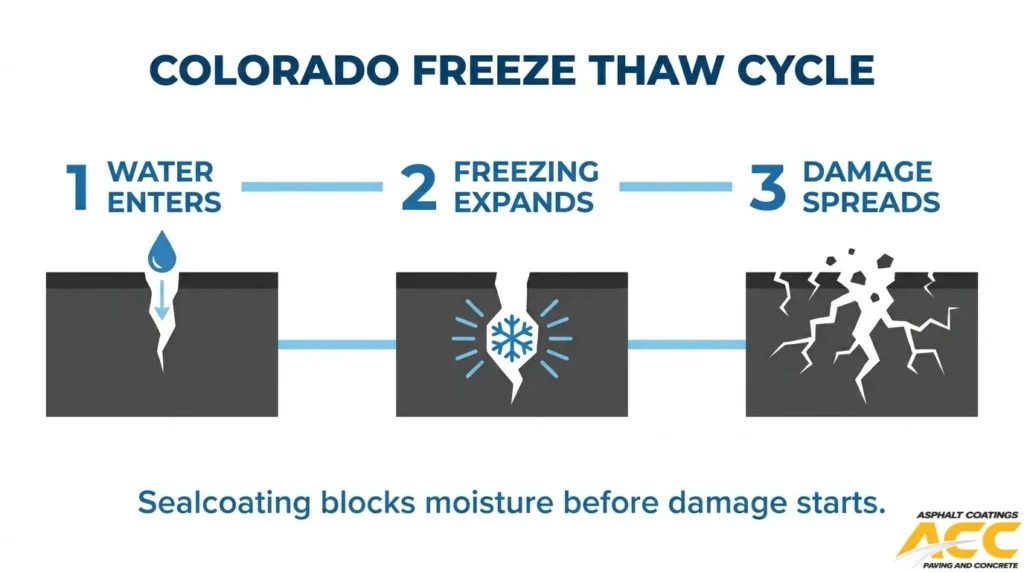
Freeze-thaw cycles impact whether you sealcoat or repave by accelerating crack propagation and base failure in already-damaged asphalt. When water infiltrates small cracks and freezes, it expands, widening fissures with each cycle. Colorado driveways and parking lots face this stressor repeatedly throughout winter and early spring.
If cracking is limited to hairline surface defects, sealcoating creates a waterproof barrier that prevents moisture entry before freeze-thaw damage begins. Once cracks have grown wide enough to reach the sub-base, however, sealcoating cannot restore structural integrity. Repaving becomes the only reliable fix at that stage. Addressing surface deterioration early, before freeze-thaw cycles compound the damage, is one of the most cost-effective decisions a property manager can make.
How Do Snow Removal and De-Icing Chemicals Affect Asphalt Choices?
Snow removal and de-icing chemicals affect asphalt choices by weakening surface binders and accelerating oxidation. Magnesium chloride and rock salt penetrate micro-cracks, dissolving the bonds between aggregate and asphalt binder over successive winters.
For parking lots in good structural condition, routine sealcoating shields the surface from chemical penetration. Asphalt-based sealers remain flexible after curing, resist cracking caused by thermal stress, and offer better performance in freeze-thaw conditions than coal tar alternatives. When chemical exposure has already eroded the surface layer to the point of widespread spalling or base saturation, paving or overlay is the more durable path forward. Selecting a sealer formulated for Colorado’s temperature extremes makes each application cycle far more effective.
In What Seasons in Colorado Is Sealcoating or Paving Most Successful?
Sealcoating or paving in Colorado is most successful from late spring through early fall, when air temperatures remain consistently above 50 degrees and weather conditions stay relatively dry. According to E&K Paving LLC, summer is generally the most reliable season for asphalt paving in Colorado because warmer temperatures and longer daylight hours give crews optimal conditions for installation and curing.
Early fall offers a secondary window. Temperatures often remain warm enough for proper paving while avoiding extreme summer heat and scheduling congestion. Winter is the most difficult season; cold temperatures cause asphalt to cool too quickly during installation, making proper compaction unreliable. Sealcoating follows a similar seasonal pattern, requiring dry conditions and warm ground temperatures to cure correctly.
How Should High-Altitude UV Exposure Influence Maintenance Frequency?
High-altitude UV exposure should influence maintenance frequency by shortening the interval between sealcoating applications. According to a study published in Construction and Building Materials (ScienceDirect), degradation of asphalt pavement surfaces in high-altitude cold regions is exacerbated by intense ultraviolet radiation and substantial temperature variations.
Colorado’s elevation intensifies UV exposure compared to lower-altitude states, oxidizing the asphalt binder faster and causing surfaces to become brittle and gray. For commercial parking lots at higher elevations, applying sealcoat closer to every two years rather than three compensates for this accelerated degradation. Proactive scheduling based on elevation and sun exposure is more reliable than waiting for visible damage to appear.
Understanding how Colorado’s climate shapes every maintenance decision helps property managers choose the right service at the right time.
What Condition-Based Checklist Can Help You Decide Between Sealcoating and Paving?
A condition-based checklist can help you decide between sealcoating and paving by systematically evaluating cracking patterns, surface smoothness, drainage performance, and traffic demands. The following subsections break down each assessment area.
How Should You Evaluate Cracking Patterns and Severity in Your Lot?
You should evaluate cracking patterns and severity in your lot by categorizing each crack type and measuring its width, density, and location. Hairline surface cracks and isolated linear cracks under a quarter inch wide typically respond well to crack sealing followed by sealcoating. When interconnected cracks form a web-like pattern across wheel paths, the damage has likely reached the base layer. At that stage, sealcoating alone cannot restore structural integrity, and paving becomes necessary. Walk the entire lot and map distressed zones so you can compare the percentage of affected area against the total surface. For most property managers, this visual audit reveals whether preventive maintenance or reconstruction is the right path forward.
How Can You Rate Surface Smoothness and Drainage Before Choosing a Fix?
You can rate surface smoothness and drainage before choosing a fix by inspecting grade consistency, ponding locations, and overall ride quality. Walk the lot after rainfall and note any areas where water pools for more than 48 hours. Standing water accelerates base deterioration and signals grade or drainage failures that sealcoating cannot correct. Smooth surfaces with minor oxidation and no ponding are strong sealcoating candidates. Critical questions to ask before hiring an asphalt paving contractor include whether the crew can explain its process for addressing the sub-base and drainage, expertise that comes from years of experience with local soil and weather conditions. If regrading is needed to eliminate ponding, targeted paving repairs or full repaving will deliver longer-lasting results than surface treatments alone.
What Questions About Traffic Loads and Vehicle Types Should You Ask?
The questions about traffic loads and vehicle types you should ask include:
- What is the average daily vehicle count entering and exiting the lot?
- Do delivery trucks, buses, or heavy equipment regularly use the pavement?
- Are there designated fire lanes or loading zones under constant heavy-axle stress?
- How frequently do garbage trucks or snow plows traverse the surface?
Heavy vehicles generate significantly more fatigue stress than passenger cars. Lots that primarily serve standard automobiles can often maintain performance through routine sealcoating cycles. However, lots that regularly handle box trucks, delivery fleets, or transit buses may need thicker asphalt sections or overlays to prevent premature rutting and cracking.
How Can You Use a Simple 1–5 Condition Score to Guide Your Decision?
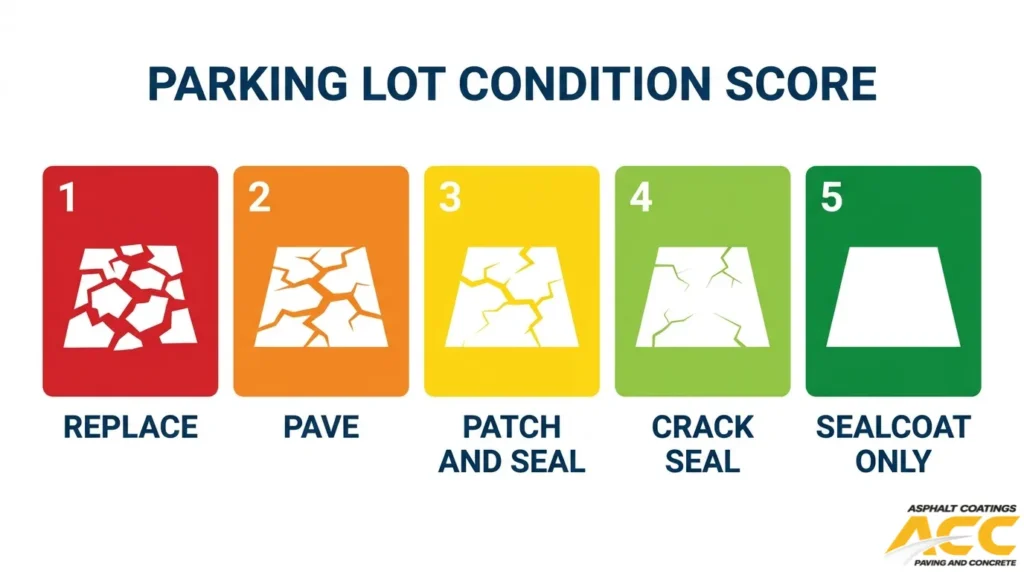
You can use a simple 1 to 5 condition score to guide your decision by rating your lot against clear benchmarks for each level:
- Score 5: Surface is smooth with no visible cracks or fading. Routine sealcoating maintains this condition.
- Score 4: Minor hairline cracks and slight oxidation are present. Crack sealing plus sealcoating is appropriate.
- Score 3: Moderate cracking, early raveling, and minor ponding exist. Localized patching combined with sealcoating can extend useful life.
- Score 2: Widespread alligator cracking, rutting, or base failures cover more than 25% of the surface. Mill-and-overlay paving is recommended.
- Score 1: Severe structural failure with potholes, deep rutting, and unstable sub-base. Full-depth replacement is required.
This simplified scoring framework helps property managers make faster, more consistent maintenance decisions without specialized equipment. Assigning a condition score before requesting contractor bids ensures every proposal addresses the actual severity of your lot’s distress.
When Is It Smart to Combine Sealcoating, Crack Sealing, and Targeted Paving Repairs?
It is smart to combine sealcoating, crack sealing, and targeted paving repairs when your lot has mixed conditions: some areas with minor surface wear and others with localized structural damage. The following subsections cover patching economics, proper sequencing, and phased scheduling.
When Can Localized Patching Plus Sealcoating Extend Lot Life Cost-Effectively?
Localized patching plus sealcoating can extend lot life cost-effectively when structural damage is confined to isolated areas rather than spread across the entire surface. If only a few sections show base failure, potholes, or deep cracking, removing and replacing just those areas eliminates the weak points. Sealcoating the entire lot afterward seals the remaining sound pavement against UV oxidation and moisture intrusion. This bundled approach avoids the expense of full repaving while addressing both cosmetic and structural concerns in a single mobilization. For most commercial lots, this combination is the highest-value option when less than 25% of the surface requires structural repair.
How Should Crack Sealing Be Sequenced with Sealcoating for Best Results?
Crack sealing should be sequenced before sealcoating for best results. Hot-applied crack sealant needs direct contact with clean crack walls to bond properly; applying sealcoat first would create a barrier that prevents adhesion. The correct order is: clean and rout cracks, apply crack sealant, allow full cure, then sealcoat the entire surface. According to the FHWA, materials and workmanship warranties for preventive maintenance treatments such as crack sealing and chip seal coats typically range from 2 to 4 years. Reversing this sequence compromises both the sealant bond and the sealcoat finish. Scheduling both services together reduces equipment mobilization costs and shortens total lot closure time.
When Do You Phase Work Over Several Seasons Instead of Repaving All at Once?
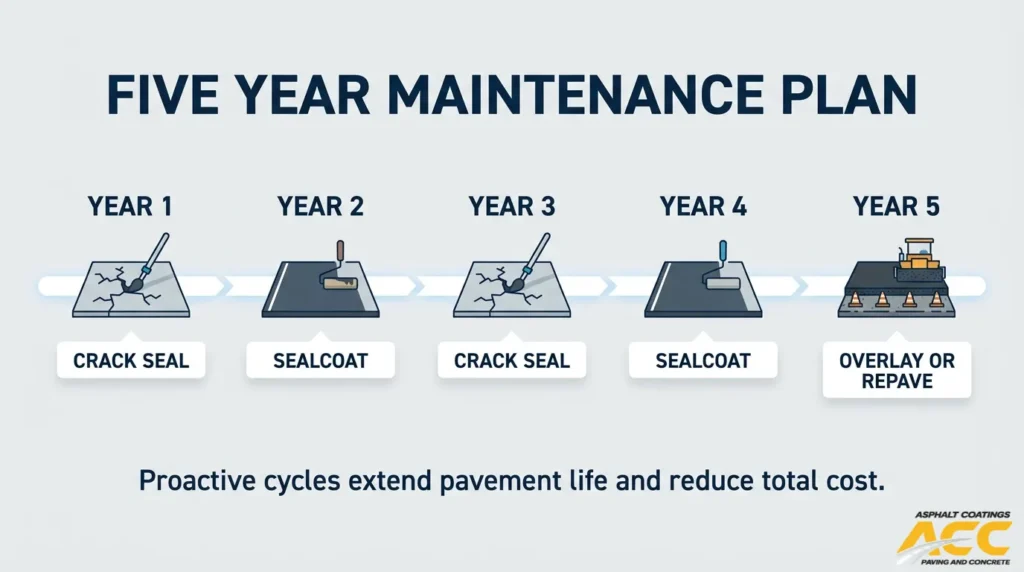
You phase work over several seasons instead of repaving all at once when budget constraints, tenant operations, or lot size make a single-project approach impractical. Capital improvement planning follows a structured, multi-year framework that translates infrastructure needs into annual spend profiles with specific funding sources. For large commercial lots, phased installation keeps part of the lot available while work proceeds. Clearly marking completed sections and arranging backup parking prevents conflicts with tenants and customers. With 39 years of experience managing complex commercial projects across Colorado’s Front Range, Asphalt Coatings Company coordinates phased work to minimize business disruption, partnering with property managers to develop schedules that keep tenants and customers satisfied throughout the process. A common phasing strategy addresses the worst sections with patching and base repair in year one, crack sealing in year two, and a full sealcoat application in year three.
With combined treatments planned, safety and ADA compliance become the next critical factors to evaluate.
How Do Safety, ADA Compliance, and Striping Factor Into Sealcoating vs. Paving?
Safety, ADA compliance, and striping factor into sealcoating vs. paving by determining whether surface treatments alone can restore safe conditions or whether structural regrading and new paving are required. The following sections cover how each element influences the decision.
How Can Sealcoating and Restriping Improve Parking Lot Safety and Flow?
Sealcoating and restriping improve parking lot safety and flow by restoring surface contrast, visibility, and traction. Fresh sealcoat creates a uniform dark surface that makes painted markings easier to see for drivers and pedestrians, especially at night or in wet conditions.
Restriping after sealcoating redefines critical elements:
- Lane directional arrows and traffic flow patterns
- Fire lane boundaries and no-parking zones
- Crosswalk markings for pedestrian safety
- Handicap symbols and loading zone indicators
Faded or missing striping is one of the most common causes of parking lot confusion and minor collisions. Bundling sealcoating with restriping in a single project ensures markings adhere to a clean, sealed surface, which extends their visibility lifespan considerably.
When Do ADA Slope or Layout Issues Require Regrading and New Paving?
ADA slope or layout issues require regrading and new paving when existing surfaces exceed the maximum slopes defined by federal accessibility standards. Sealcoating cannot correct grade or slope problems; it only coats the existing surface profile.
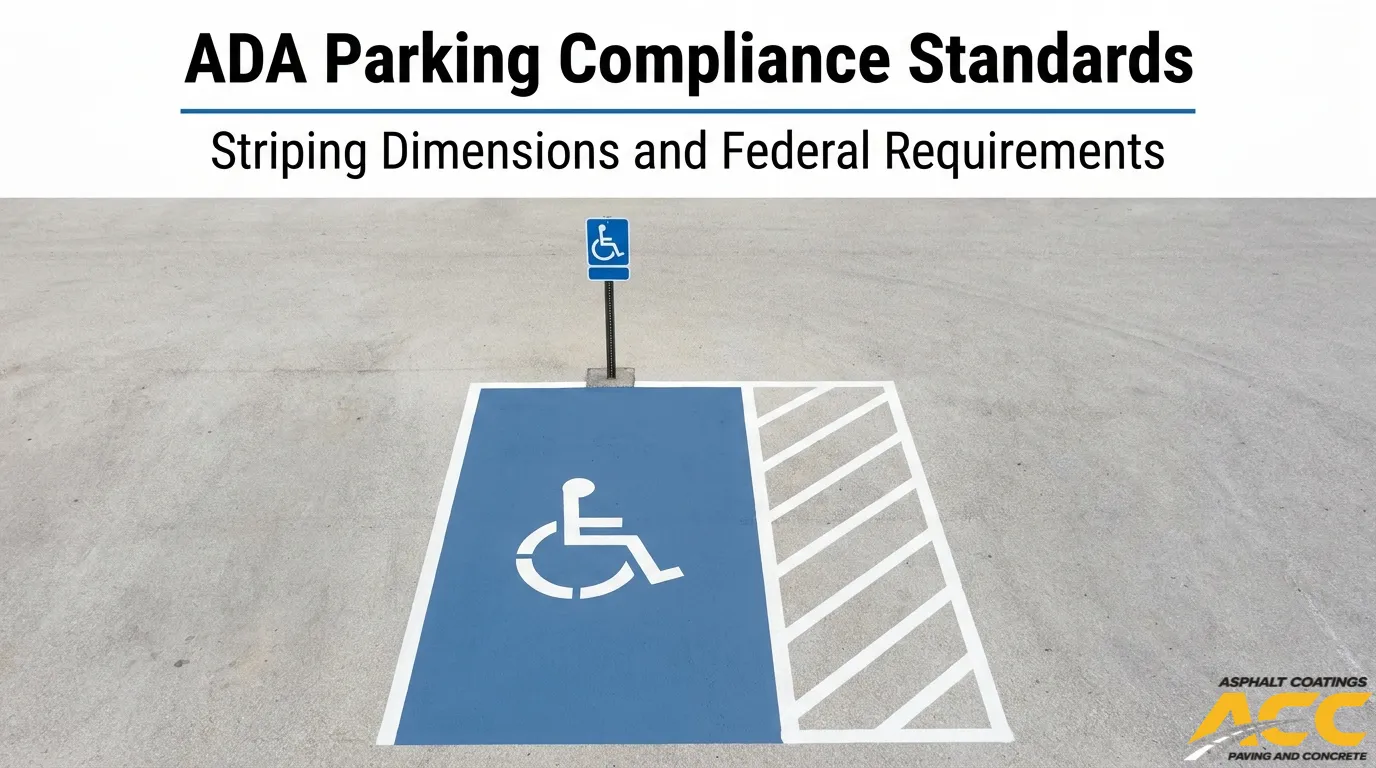
According to ADA.gov, car-accessible parking spaces must be at least 96 inches wide with a 60-inch access aisle, and slopes cannot exceed 1:48 (2.08%) in any direction. The U.S. Access Board further specifies that accessible route running slopes must not be steeper than 1:20, with cross slopes no steeper than 1:48.
When settled pavement, poor original grading, or base failure pushes slopes beyond these thresholds, the only compliant solution is regrading the subbase and installing new asphalt. Property managers who ignore non-compliant slopes risk both ADA violation penalties and serious liability exposure.
How Often Should You Refresh Striping, Symbols, and ADA Markings?
You should refresh striping, symbols, and ADA markings every one to two years for most commercial parking lots, or whenever markings become visibly faded, chipped, or difficult to read. High-traffic lots, particularly retail centers and healthcare facilities, often need annual refreshes due to accelerated wear from vehicle turning and snow removal equipment.
Every sealcoating cycle requires full restriping since the sealant covers existing paint. ADA-specific markings, including the International Symbol of Accessibility, van-accessible signage, and access aisle hash marks, must always meet current federal standards at the time of repainting. Proactively scheduling striping refreshes prevents compliance gaps between sealcoating cycles.
With striping and ADA compliance addressed, the next step is building a budget and timeline for these maintenance priorities.
How Should Commercial Property Managers Budget and Plan for Parking Lot Work?
Commercial property managers should budget for parking lot work by building a multi-year capital plan, vetting contractors thoroughly, and scheduling projects to minimize tenant disruption. The following sections cover capital planning frameworks, contractor warranty questions, and disruption-reduction strategies.
How Can You Build a Multi-Year Capital Plan for Asphalt Maintenance?
You can build a multi-year capital plan for asphalt maintenance by following a structured capital improvement planning process. According to Rimkus Built Environment Solutions, capital improvement planning follows eight sequential phases: asset inventory and condition assessment, project prioritization, financial analysis and funding strategies, multi-year capital budgeting, stakeholder engagement and approval, execution planning and procurement, implementation and construction management, and monitoring and continuous improvement.
The multi-year capital budget translates prioritized projects into annual spend profiles with specific funding sources. For commercial parking lots, this means mapping sealcoating cycles, crack sealing intervals, and eventual repaving needs across a five-to-ten-year horizon. Without this structure, property managers often default to reactive spending, which consistently costs more than planned maintenance.
What Warranty and Service Questions Should You Ask an Asphalt Contractor?
The warranty and service questions you should ask an asphalt contractor include:
- Are you fully licensed, insured, and bonded?
- Can you explain your process for addressing the sub-base and drainage?
- Will the crew remove and haul away deteriorated asphalt, or mill and overlay it?
- What warranty type and duration do you provide?
- Who is responsible if pavement performance fails within the warranty period?
According to the FHWA, the warranty period for long-term performance warranties generally ranges from 10 to 20 years, with the contractor carrying additional responsibility for actual pavement performance. Asking these questions upfront separates qualified contractors from those cutting corners on materials or scope.
How Can You Minimize Tenant and Customer Disruption During Work?
You can minimize tenant and customer disruption during parking lot work by scheduling strategically and phasing the project. Retail centers often benefit from scheduling sealcoat projects during weekends, holidays, or off-hours when foot and vehicle traffic is lowest. This approach allows full coverage without impacting business operations.
Sealcoat demand spikes during peak months, which can limit contractor availability and increase costs. Booking early secures preferred dates and gives your team time to communicate timelines with tenants and customers before work begins. For larger lots, phased installation keeps part of the parking area accessible while work proceeds in designated sections.
Proactive scheduling is one of the most undervalued tools in commercial property management; the cost of tenant frustration and lost foot traffic almost always exceeds the cost of planning ahead.
How Should You Approach Sealcoating vs. Paving Decisions With Asphalt Coatings Company?
You should approach sealcoating vs. paving decisions with Asphalt Coatings Company by requesting a professional surface assessment that evaluates distress type, pavement age, and structural integrity. The following sections cover how Asphalt Coatings Company determines the right service and the key takeaways for your decision.
How Can Asphalt Coatings Company Assess Whether You Need Sealcoating, Crack Sealing, or Paving?
Asphalt Coatings Company assesses whether you need sealcoating, crack sealing, or paving by conducting a thorough on-site evaluation of your pavement’s condition. With 39 years of Colorado-specific experience, Asphalt Coatings Company identifies distress indicators such as rutting, fatigue cracking, and low-temperature cracking, all of which contribute to pavement degradation over time. Before recommending sealcoating, the surface is inspected for cracks, stains, and debris to ensure proper adhesion.
Key factors that guide the recommendation include:
- Asphalt pavement age exceeding 15 to 20 years, which typically signals the need for replacement.
- More than 25% to 30% of the surface requiring repairs or an unstable foundation.
- Cracks wider than a quarter inch, indicating structural failure beyond what sealcoating can address.
- Surface condition suitable for cleaning and resealing when damage remains cosmetic.
According to Allied Asphalt, replacement is warranted when more than 25% to 30% of asphalt pavement needs repairs, the foundation is unstable, the pavement exceeds 20 years of age, or cracks surpass a quarter inch in width. Asphalt Coatings Company uses CDOT-approved crack sealing materials and in-house crews to deliver the precise treatment your lot requires, whether that is preventive sealcoating, targeted crack sealing, or full-depth paving.
What Are the Key Takeaways About Choosing Between Sealcoating and Paving for Your Commercial Parking Lot?
The key takeaways about choosing between sealcoating and paving for your commercial parking lot center on matching the treatment to your pavement’s actual condition.
- Sealcoating protects structurally sound asphalt and is recommended every 3 years for most commercial parking lots.
- Paving is necessary when structural failure, widespread cracking, or base instability makes surface treatments ineffective.
- New commercial paving requires approximately one week before normal business traffic can resume.
- A professional assessment eliminates guesswork and prevents costly misdiagnosis.
According to industry best practices published by SealMaster, sealcoating every 3 years provides adequate pavement protection and maintains attractive curb appeal for commercial properties. For property managers weighing these options, the most reliable path forward starts with an honest condition assessment from a contractor who offers both services. Asphalt Coatings Company provides sealcoating, crack sealing, and full commercial paving across Colorado’s Front Range, ensuring every recommendation is grounded in what your lot actually needs.