A commercial parking lot maintenance budget is a structured annual allocation that covers every service needed to preserve pavement condition, meet compliance standards, and prevent costly emergency repairs across a property’s life cycle.
This guide covers essential budget line items, Fort Collins climate impacts, annual cost estimation by property type, material and design decisions, maintenance scheduling, common budgeting mistakes, multi-year capital planning, safety and ADA compliance, cost-control strategies, and contractor bid evaluation.
Sealcoating, crack sealing, pothole repair, striping, concrete work, drainage maintenance, and overlay reserves each address a distinct failure mode and operate on different renewal cycles. Knowing what to include prevents gaps that lead to reactive spending.
Fort Collins properties face freeze-thaw cycling, high-altitude UV exposure, snow plow abrasion, and shifting subgrade soils that shorten pavement life faster than national averages suggest. Budgets built without climate-specific contingencies routinely fall short after winter.
Per-square-foot estimating, property-type distinctions between retail lots and healthcare facilities, and multi-year phasing strategies convert unpredictable capital spikes into manageable annual expenses. Mix selection, concrete-versus-asphalt trade-offs, and drainage design further shape long-term costs.
Skipping preventive maintenance, relying on emergency-only funding, and accepting one-off bids without a long-term plan are the most common reasons budgets fail. Pavement condition index assessments and rolling capital plans built around warranty timelines prevent these mistakes.
ADA-compliant ramps, accessible stall markings, and trip-hazard mitigation carry mandatory budget weight. Bundling services, scheduling off-peak work, and prioritizing contractors with in-house crews and local Front Range experience keep quality high while controlling costs.
Why Does a Commercial Parking Lot in Fort Collins Need a Dedicated Maintenance Budget?
A commercial parking lot in Fort Collins needs a dedicated maintenance budget because the region’s harsh climate, strict compliance requirements, and the compounding cost of deferred repairs make reactive spending far more expensive than planned investment. The subsections below cover how preventive budgeting protects pavement, how Fort Collins conditions accelerate deterioration, and how liability exposure demands consistent funding.
Fort Collins properties face a unique combination of budget pressures. Heavy freeze-thaw cycling, intense UV exposure at altitude, and expansive soil movement all shorten pavement life faster than in milder climates. Without a structured annual allocation, property managers are forced into emergency capital outlays that can dwarf the cost of routine preventive care. A dedicated budget transforms parking lot maintenance from an unpredictable expense into a manageable, plannable line item.
According to a report from the Minnesota House of Representatives, deferring pavement maintenance may increase costs by over 20% over a five-year period, while every $1 spent on timely maintenance can save $6 to $10 in future rehabilitation expenses. That ratio alone justifies setting funds aside each year rather than waiting for visible failure.
Compliance adds another layer of urgency. The Americans with Disabilities Act mandates that parking lots maintain accessible spaces, ramps, and pathways to specific dimensional and slope standards. Letting striping fade, surfaces crack, or ramps deteriorate does not just create repair costs; it creates legal liability. The National Safety Council reports that tens of thousands of crashes occur in parking lots and garage structures annually, resulting in hundreds of deaths and thousands of injuries. Well-maintained surfaces, clear markings, and proper drainage directly reduce that risk.
For commercial property managers in Fort Collins, a dedicated maintenance budget is not optional overhead. It is the most cost-effective strategy to preserve asset value, maintain safety, and avoid the exponential expense of deferred repairs. The sections that follow break down exactly what to include in that budget and how local conditions shape every line item.
What Line Items Should You Include in a Commercial Parking Lot Maintenance Budget?
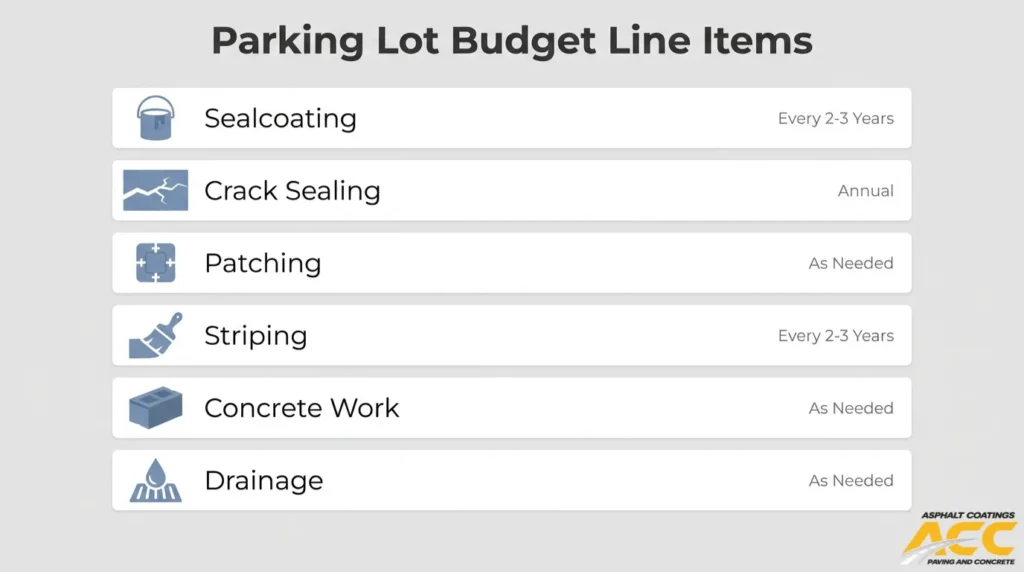
You should include line items for sealcoating, crack sealing, pothole repair, striping, concrete maintenance, drainage repairs, and overlay or replacement reserves. Each category addresses a distinct failure mode and carries its own budgeting cycle.
How Much Should You Budget Annually for Asphalt Sealcoating in Fort Collins?
You should budget for asphalt sealcoating in Fort Collins every two to three years, treating it as a recurring preventive line item rather than a one-time expense. Sealcoating protects asphalt binder from UV degradation, moisture infiltration, and chemical exposure. Professional sealcoating contractors like Asphalt Coatings Company apply CDOT-approved materials using proven application methods that ensure proper adhesion and long-lasting protection across Colorado’s Front Range.
Fort Collins winters intensify this need. According to the Colorado Climate Center at Colorado State University, temperatures in Fort Collins failed to rise above freezing for eight consecutive days in February 2021. Prolonged cold accelerates oxidation of unprotected surfaces, making timely sealcoat applications essential before and after each winter season.
Budget sealcoating as a per-square-foot line item, and schedule applications during warm, dry months when material cures properly.
How Should You Budget for Crack Sealing to Protect Your Parking Lot Investment?
You should budget for crack sealing annually as a standalone preventive line item. Crack sealing prevents water from penetrating the asphalt base layer, where freeze-thaw cycles cause sub-surface failures.
Effective budgeting requires two components:
- Routine annual allocation for sealing new cracks identified during spring inspections.
- Post-winter supplemental funds for addressing cracks that widened or appeared during freeze-thaw months.
Crack sealing costs far less than the structural repairs that follow when water reaches the subgrade. Treating this line item as optional is one of the most common budgeting mistakes commercial property managers make. Commercial property managers throughout Denver, Colorado Springs, and Fort Collins can partner with experienced contractors who use hot-pour crack sealants and CDOT-approved materials to address cracks before they lead to costly structural damage.
What Should You Allocate for Pothole and Asphalt Patch Repairs Each Year?
You should allocate a dedicated annual line item for pothole and asphalt patch repairs, separate from your preventive maintenance budget. Potholes represent active structural failures that worsen rapidly under traffic loads and moisture.
Key budgeting considerations include:
- Lot age and condition, since older surfaces generate more patch needs annually.
- Traffic volume, because heavy commercial vehicles accelerate pothole formation.
- Response time requirements, as delayed patching compounds repair scope and cost.
Setting aside a contingency specifically for reactive patching ensures you can address failures promptly without pulling funds from planned preventive work.
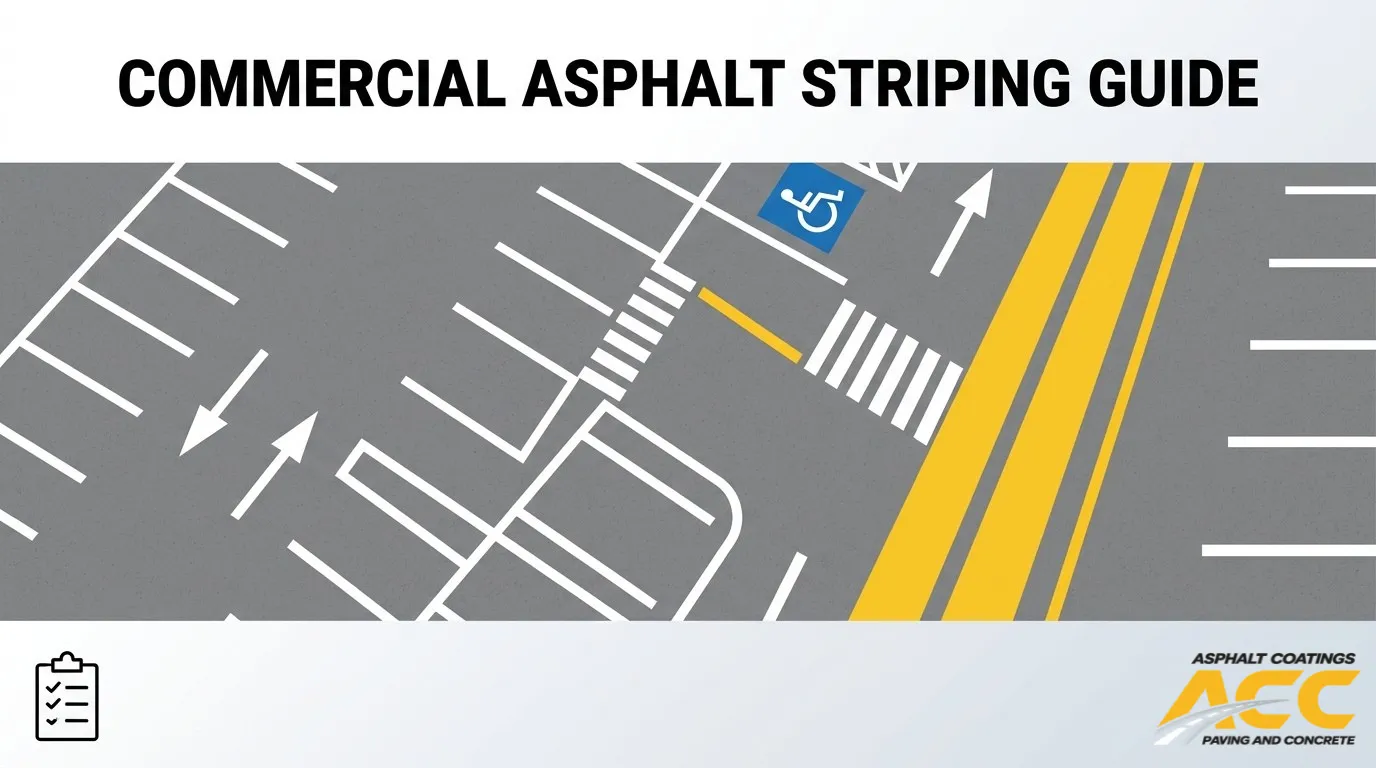
How Do You Budget for Parking Lot Striping, Re-Striping, and ADA Markings?
You budget for parking lot striping, re-striping, and ADA markings by scheduling full re-striping every one to two years, with touch-ups as needed between cycles. Faded lines reduce traffic flow efficiency and create liability exposure.
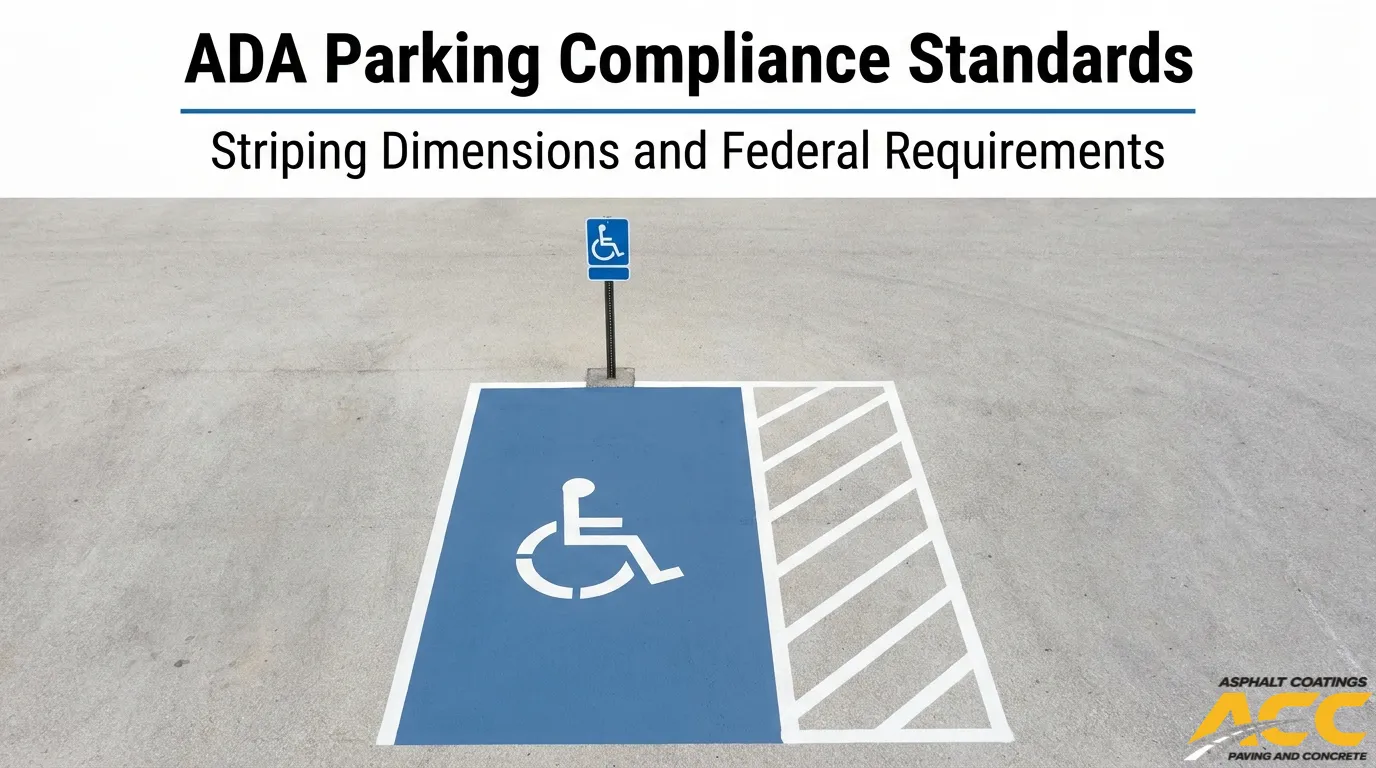
ADA-compliant markings carry specific dimensional requirements. According to the U.S. Department of Justice, accessible parking spaces must be at least 96 inches wide with a 60-inch access aisle and no more than a 2.08% slope in all directions. Non-compliance risks federal penalties, so ADA marking maintenance deserves its own budget sub-line rather than being lumped into general striping.
What Portion of Your Budget Should Cover Concrete Curbs, Sidewalks, and Ramps?
The portion of your budget covering concrete curbs, sidewalks, and ramps should reflect both preventive maintenance and ADA compliance obligations. Concrete elements deteriorate differently than asphalt, requiring separate inspection and repair cycles.
Budget priorities for concrete include:
- Curb and gutter repairs to maintain proper water channeling away from the pavement surface.
- Sidewalk leveling or replacement where settling creates trip hazards exceeding ADA thresholds.
- ADA ramp upgrades to meet current accessibility standards as codes evolve.
Concrete repairs tend to be less frequent but higher in per-unit cost, so allocating a modest annual reserve prevents large unplanned capital draws.
How Should You Budget for Drainage, Catch Basin, and Inlet Repairs in a Lot?
You should budget for drainage, catch basin, and inlet repairs as a dedicated infrastructure line item. Drainage systems protect your entire pavement investment by directing water away from the asphalt surface and subgrade.
Annual budgets should cover:
- Catch basin cleaning at least twice yearly, before and after winter.
- Inlet grate inspection and replacement where corrosion or damage restricts flow.
- Grading corrections in areas where standing water indicates drainage failure.
Neglecting drainage is arguably the most expensive oversight in parking lot budgeting. Standing water accelerates every other form of pavement distress, from cracking to pothole formation to base failure.
When Should You Reserve Funds for Full or Partial Asphalt Overlay or Replacement?
You should reserve funds for full or partial asphalt overlay or replacement when preventive treatments can no longer restore functional pavement performance. This typically becomes necessary when a parking lot reaches 15 to 25 years of age, depending on maintenance history and traffic intensity.
Capital reserve planning for overlay or replacement involves:
- Annual contributions to a dedicated capital reserve fund starting early in the pavement’s life cycle.
- Condition-triggered thresholds that define when patching costs exceed overlay value.
- Phased scheduling that sections the lot into zones for staggered replacement, reducing single-year budget spikes.
Planning for this line item early transforms a budget crisis into a manageable, predictable expense.
How Do Fort Collins’ Climate and Local Conditions Affect Parking Lot Maintenance Costs?
Fort Collins’ climate and local conditions affect parking lot maintenance costs by accelerating pavement deterioration through freeze-thaw cycles, winter operations, intense UV exposure, and reactive soils. Each factor demands specific budget allocations.
How Does the Freeze-Thaw Cycle in Northern Colorado Impact Your Budget Planning?
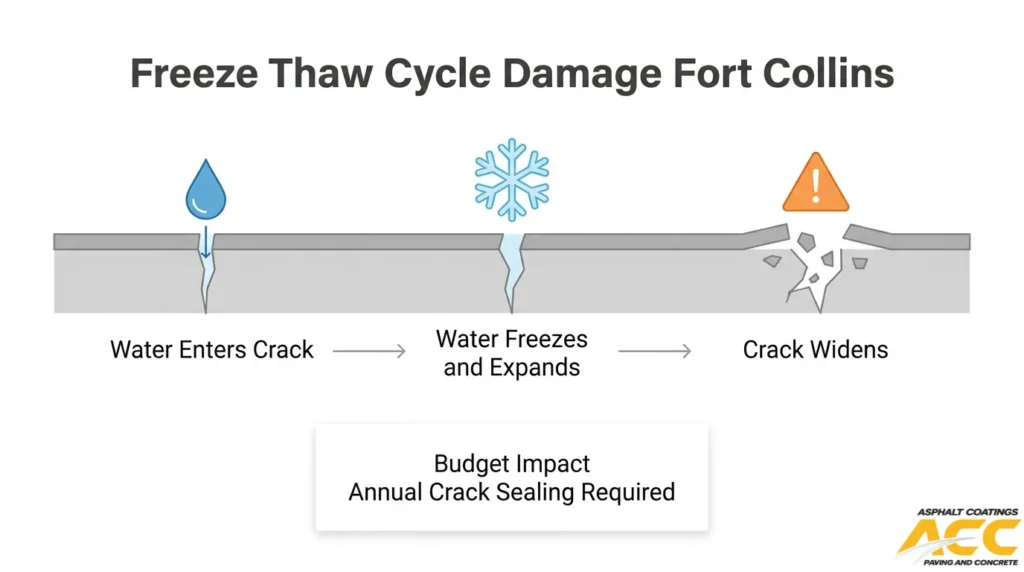
The freeze-thaw cycle in Northern Colorado impacts budget planning by requiring property managers to account for accelerated pavement deterioration that occurs when moisture repeatedly freezes and expands within asphalt and concrete. According to a study published by the National Institutes of Health (NIH) via PubMed Central, freeze-thaw damage is one of the most severe threats to the long-term performance of concrete pavement in cold regions, as repeated cycles cause significant internal damage.
Fort Collins regularly experiences prolonged freezing stretches, which compound this effect. Water infiltrates through small cracks, expands during freezing, then contracts during thaws. Each cycle widens existing damage. Budget planning should include annual crack sealing and joint maintenance specifically timed before winter to minimize moisture infiltration during peak freeze-thaw months.
How Do Snow Plows, De-Icers, and Winter Operations Affect Asphalt and Concrete Costs?
Snow plows, de-icers, and winter operations affect asphalt and concrete costs by causing surface abrasion, chemical degradation, and edge damage that accumulates over each winter season. Plow blades scrape the pavement surface, dislodging aggregate and wearing down sealcoat layers prematurely. Chemical de-icers, particularly those containing magnesium chloride or sodium chloride, penetrate surface pores and accelerate deterioration of both asphalt binder and concrete.
Key cost impacts to budget for include:
- Premature sealcoat failure requiring more frequent reapplication.
- Concrete scaling and spalling along curbs and sidewalks exposed to de-icing chemicals.
- Edge and corner damage where plow blades catch raised pavement sections.
- Increased pothole formation where abrasion exposes the base layer to moisture.
Specifying plow-friendly lot designs and using pavement-safe de-icers can reduce these recurring expenses significantly.
How Should High UV Exposure and Summer Heat Influence Your Sealcoating Budget?
High UV exposure and summer heat should influence your sealcoating budget by shortening the effective lifespan of each sealcoat application. Fort Collins sits at roughly 5,000 feet of elevation, where UV radiation intensity is measurably higher than at sea level. This accelerates oxidation of asphalt binder, causing surfaces to become brittle, fade to gray, and develop fine surface cracking faster than in lower-elevation markets.
For most commercial lots in the Fort Collins area, this means sealcoating intervals may need to be shorter than national averages suggest. Budgeting for more frequent applications protects the binder from UV-driven oxidation and keeps the surface flexible enough to resist cracking. In my experience, property managers who underestimate Colorado’s UV factor consistently face premature surface failures that cost far more than an adjusted sealcoating schedule would.
How Do Soil Movement and Subgrade Conditions in Fort Collins Affect Long-Term Costs?
Soil movement and subgrade conditions in Fort Collins affect long-term costs by influencing how stable the pavement foundation remains over time. According to the USDA Natural Resources Conservation Service, the Fort Collins soil series consists of very deep, well-drained soils formed in mixed eolian sediments and alluvium.
While well-drained soils generally support pavement better than expansive clay, localized conditions across the Front Range vary considerably. Areas with higher clay content can experience seasonal swelling and shrinking that shifts subgrade support, leading to uneven settlement, cracking, and eventual structural failure. Proper subgrade preparation and compaction testing before paving are essential budget items that prevent costly reconstruction later.
Understanding your site’s specific soil conditions before any major paving or rehabilitation project is one of the most cost-effective steps a property manager can take.
How Much Should a Commercial Property Manager in Fort Collins Budget Each Year?
A commercial property manager in Fort Collins should budget based on lot size, property type, and a phased maintenance timeline. The following sections cover per-square-foot estimating, property-type differences, and multi-year phasing strategies.
How Can You Estimate a Maintenance Budget per Square Foot of Parking Lot?
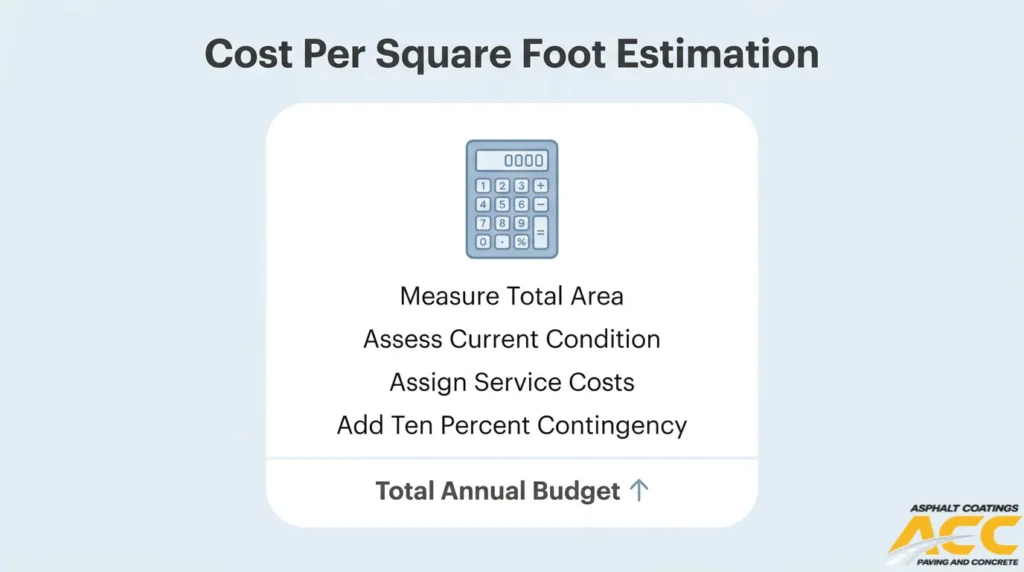
You can estimate a maintenance budget per square foot of parking lot by calculating total square footage, assessing current pavement condition, and assigning cost ranges to each planned service. Start by measuring the full paved area, including drive lanes, stalls, and loading zones.
A practical approach involves these steps:
- Measure or confirm total lot square footage from site plans or aerial surveys.
- Assess the pavement’s current condition to identify needed services such as crack sealing, sealcoating, or patching.
- Assign per-square-foot cost estimates for each service category.
- Add a contingency of 10% to 15% for unexpected repairs caused by freeze-thaw damage or heavy traffic wear.
Most commercial property managers find that bundling preventive treatments into an annual per-square-foot figure simplifies year-over-year budget comparisons and board approvals.
How Should Budgets Differ for Small Retail Lots Versus Large Shopping Centers?
Budgets should differ for small retail lots versus large shopping centers because each property type faces distinct traffic volumes, maintenance scales, and scheduling constraints. Small retail lots typically have lower total costs but higher per-square-foot rates, since mobilization fees and minimum service charges represent a larger share of the project.
Key differences include:
- Traffic intensity: Shopping centers handle significantly more daily vehicle turns, accelerating surface wear and increasing sealcoating and striping frequency.
- Scope of drainage infrastructure: Large lots require more catch basins, inlets, and grading maintenance than a single-pad retail site.
- ADA compliance footprint: Shopping centers need more accessible stalls, ramps, and pathways, expanding the compliance portion of the budget.
- Scheduling flexibility: Small lots can often close entirely for a day, while shopping centers require phased night or off-peak work to avoid revenue disruption.
For property managers overseeing both property types, maintaining separate line-item budgets prevents small-lot needs from being overshadowed by large-center priorities.
How Should Apartment and HOA Parking Lots Budget Differently from Healthcare Facilities?
Apartment and HOA parking lots should budget differently from healthcare facilities because each property type carries distinct liability exposure, traffic patterns, and compliance requirements. Residential properties prioritize resident satisfaction, curb appeal, and long-term reserve planning, while healthcare facilities must meet stricter safety and accessibility standards.
According to the National Safety Council, tens of thousands of crashes occur in parking lots and garage structures annually, resulting in hundreds of deaths and thousands of injuries. Healthcare facilities face heightened risk because patients, elderly visitors, and individuals with mobility limitations navigate these surfaces daily.
Budgeting distinctions include:
- Apartments and HOAs should emphasize sealcoating schedules, aesthetic striping, and reserve fund contributions spread across homeowner assessments.
- Healthcare facilities should allocate more toward ADA-compliant ramp maintenance, trip-hazard mitigation, well-lit signage, and emergency surface repairs that prevent patient injuries.
How Can You Phase Parking Lot Work Over Multiple Years to Smooth Out Costs?
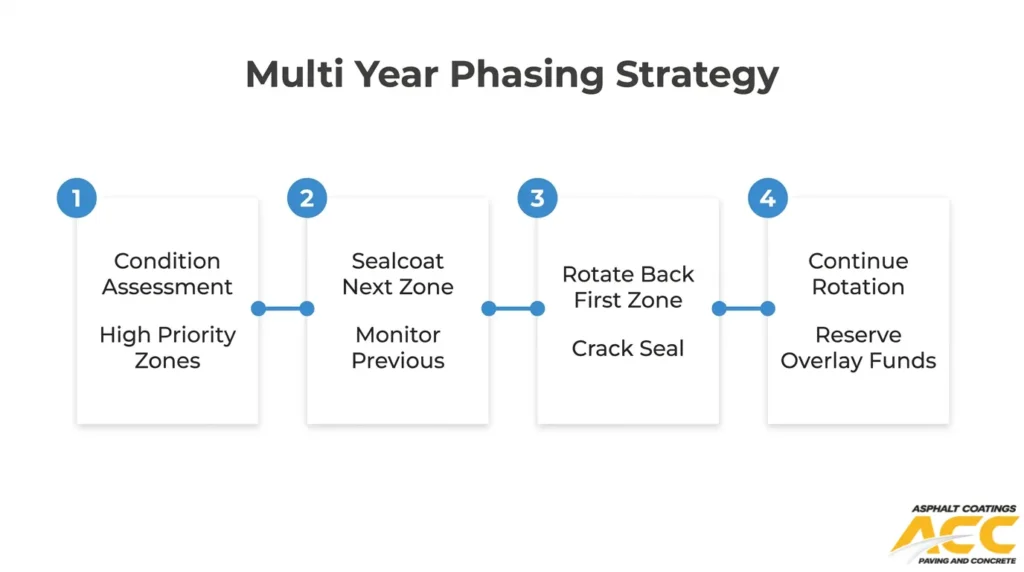
You can phase parking lot work over multiple years by dividing the property into maintenance zones and scheduling treatments on a rotating cycle. This approach converts large capital spikes into predictable annual operating expenses.
According to the Federal Highway Administration, materials and workmanship warranties for preventive maintenance treatments generally range from two to four years, which provides a natural framework for scheduling repeat applications. A practical phasing plan follows this pattern:
- Year one: Complete a full condition assessment and address the highest-priority zones, such as areas with active cracking or drainage failure.
- Year two: Sealcoat and re-stripe the next zone while monitoring previously treated areas.
- Year three: Rotate back to the first zone for re-evaluation and schedule crack sealing or patching as needed.
- Year four and beyond: Continue the rotation, reserving capital funds for overlay or reconstruction on sections approaching end-of-life.
Aligning phased work with warranty timelines ensures each zone receives timely retreatment before protection lapses. With a multi-year phasing plan established, the next step is understanding how material and design choices further shape long-term costs.
How Do Asphalt Material Choices and Design Decisions Influence Your Budget?
Asphalt material choices and design decisions influence your budget by determining both upfront construction costs and long-term maintenance spending. The subsections below cover mix selection, concrete versus asphalt trade-offs, drainage design, and construction quality.
How Do Different Asphalt Mixes and Thicknesses Change Life-Cycle Cost?
Different asphalt mixes and thicknesses change life-cycle cost by shifting the balance between initial material expense and future repair frequency. A thicker structural section costs more upfront but distributes traffic loads more effectively, which delays cracking and base failure. Thinner installations may seem budget-friendly initially, yet they often require earlier overlays or full-depth patching.
The Federal Highway Administration promotes Life-Cycle Cost Analysis (LCCA) as an engineering economic analysis tool that allows transportation officials to quantify the differential costs of alternative investment options for new construction or preservation strategies. Applying LCCA to your parking lot project reveals the true cost of each mix and thickness option over a 20-to-30-year horizon. For most commercial lots, investing in the right mix design upfront is one of the most reliable ways to lower total ownership cost.
How Does Choosing Concrete Versus Asphalt for Certain Areas Impact Budget?
Choosing concrete versus asphalt for certain areas impacts budget by introducing higher initial material costs in exchange for longer service life in specific applications. Concrete performs well in stationary-load zones where heavy vehicles idle, such as dumpster pads, loading docks, and drive-through lanes. Asphalt remains more cost-effective for large open parking areas because it is faster to install and easier to repair.
A practical approach combines both materials strategically:
- Concrete for high-stress pads, curbs, ADA ramps, and sidewalks.
- Asphalt for driving lanes, general parking stalls, and large surface areas.
This hybrid strategy concentrates spending where durability matters most while keeping overall project costs manageable. Matching the material to the specific demand of each zone prevents premature failure and avoids paying premium prices across the entire lot.
How Can Proper Drainage Design Reduce Future Maintenance Expenses?
Proper drainage design reduces future maintenance expenses by directing water away from the pavement surface and subgrade before it causes structural damage. Standing water accelerates oxidation, infiltrates cracks, and weakens the base layer, all of which lead to potholes and alligator cracking that demand costly repairs.
According to a Minnesota House of Representatives report, deferring pavement maintenance may increase costs by over 20% over a five-year period, whereas every $1 spent on maintenance could save $6 to $10 in future expenses. Much of that deferred cost traces back to drainage failures. Well-designed inlets, catch basins, and graded surfaces eliminate the conditions that trigger accelerated deterioration. Investing in drainage during initial construction is consistently one of the highest-return decisions a property manager can make.
How Does Initial Construction Quality Affect Long-Term Budget Needs?
Initial construction quality affects long-term budget needs by establishing the structural foundation that every future maintenance dollar depends on. Poor compaction, inadequate subgrade preparation, or incorrect asphalt temperatures during installation create hidden weaknesses that surface as premature cracking, rutting, and base failure within just a few years.
The National Asphalt Pavement Association (NAPA) maintains over 1,000 technical reports, webinars, and industry tools dedicated to high-quality asphalt pavement construction and maintenance. These resources exist because the industry recognizes that construction shortcuts are the single fastest way to inflate lifetime costs. Hiring a qualified contractor who follows proper mix placement, compaction standards, and grading protocols protects every subsequent budget cycle from avoidable emergency repairs.
Understanding how materials and design shape your budget prepares you to schedule maintenance at the right intervals.
How Often Should You Schedule Key Parking Lot Maintenance Tasks in Fort Collins?
Key parking lot maintenance tasks in Fort Collins should follow a schedule shaped by pavement age, traffic volume, and Colorado’s harsh seasonal cycles. The sections below cover sealcoating frequency, crack sealing timing, striping refresh intervals, and when conditions demand overlay or reconstruction.
How Frequently Should Commercial Lots Be Sealcoated in Colorado’s Front Range?
Commercial lots on Colorado’s Front Range should be sealcoated every two to three years to maintain adequate protection against UV degradation and moisture infiltration. New asphalt typically receives its first sealcoat 12 to 18 months after installation, once the pavement has fully cured.
High-traffic areas, such as shopping center entrances and drive lanes near large box stores, often need the shorter end of that cycle. Lots with lighter traffic or covered sections may safely extend closer to three years. Fort Collins properties face intense high-altitude sun exposure during summer alongside punishing freeze-thaw cycles in winter, both of which accelerate binder oxidation. Scheduling sealcoating in late spring or early fall, when sustained surface temperatures stay above 50°F, ensures proper adhesion and curing.
When Should You Plan Routine Crack Sealing Throughout the Year?
You should plan routine crack sealing in Fort Collins during the spring and fall shoulder seasons, when moderate temperatures allow sealant to bond effectively. Cracks wider than a quarter inch warrant hot-pour sealant, while narrower cracks respond well to cold-applied products.
Spring inspections, conducted once freeze-thaw cycles taper off in late March or April, catch damage inflicted over winter before water penetrates the subgrade during summer storms. A second inspection in early fall addresses any cracks that developed under summer heat expansion. According to a study published in NIH’s PubMed Central, freeze-thaw damage is one of the most severe threats to long-term pavement performance in cold regions because repeated cycles cause significant internal damage. Sealing cracks promptly after each winter prevents this moisture-driven deterioration from escalating into costly base failures.
How Often Should You Refresh Striping and ADA Symbols for Compliance and Safety?
You should refresh striping and ADA symbols every 12 to 24 months, depending on traffic volume, snow plow abrasion, and paint wear. High-traffic commercial lots in Fort Collins typically need annual re-striping because plow blades and de-icer chemicals degrade markings each winter.
The U.S. Department of Justice requires accessible parking spaces to be at least 96 inches wide with 60-inch access aisles and a maximum slope of 2.08% in all directions. Faded or missing ADA symbols create compliance violations and increase liability exposure. Scheduling striping immediately after sealcoating protects the investment in both services. For properties with moderate traffic, a biennial refresh may suffice, but a visual inspection each spring should confirm that all directional arrows, fire lane markings, and handicap symbols remain clearly legible.
When Do Conditions Signal That It Is Time for Overlay or Reconstruction Instead of Patching?
Conditions signal it is time for overlay or reconstruction when widespread distresses, such as alligator cracking, deep rutting, or base failures, cover more than 25 to 30 percent of the lot surface. At that point, patching becomes a diminishing return.
Isolated potholes and localized cracking respond well to spot repairs, but interconnected fatigue cracking indicates structural failure beneath the surface layer. Standing water that persists after storms often points to subgrade settlement or drainage collapse, both of which patching cannot resolve. A pavement management assessment helps quantify whether overlay or full-depth reconstruction delivers better long-term value. In most cases, overlay suits lots where the base remains structurally sound, while reconstruction becomes necessary when subgrade conditions have deteriorated beyond salvage. Recognizing these thresholds early prevents the cycle of repeated patches that ultimately costs more than a planned capital project. Asphalt Coatings Company offers comprehensive mill and pave services, asphalt overlay installation, and subgrade preparation work for commercial properties across the Front Range, helping property managers make informed capital planning decisions. Recognizing these thresholds early prevents the cycle of repeated patches that ultimately costs more than a planned capital project.
With a clear maintenance schedule in place, avoiding common budgeting mistakes keeps these investments on track.
What Common Mistakes Cause Commercial Parking Lot Maintenance Budgets to Fail?
Commercial parking lot maintenance budgets fail when property managers defer repairs, skip preventive maintenance, ignore weather impacts, or rely on one-off bids instead of long-term plans. The following subsections break down each of these costly mistakes.
How Does Deferring Minor Repairs Lead to Major, Unplanned Capital Expenses?
Deferring minor repairs leads to major, unplanned capital expenses because small issues like hairline cracks and shallow potholes compound rapidly when left untreated. Water infiltrates unsealed cracks, erodes the subgrade, and accelerates structural failure across surrounding pavement sections. What begins as a simple crack seal costing a few hundred dollars can escalate into a full-depth patch or overlay costing thousands. According to a Minnesota House of Representatives report, deferring pavement maintenance may increase costs by over 20% over a five-year period, whereas $1 of maintenance could save $6 to $10 in future expenses. This compounding effect is the single most predictable budget-breaker in commercial lot management.
Why Is It Risky to Budget Only for Emergencies and Not Preventive Maintenance?
Budgeting only for emergencies and not preventive maintenance is risky because it forces reactive spending at premium rates while pavement deteriorates faster than necessary. Emergency repairs typically cost more per square foot than scheduled work, since mobilization fees, rush material orders, and after-hours labor all inflate pricing. A preventive approach, including routine sealcoating, crack sealing, and timely striping, extends pavement life and keeps annual costs predictable. Without these line items, property managers face unpredictable capital spikes that strain operating budgets. For most commercial lots, allocating even a modest annual preventive maintenance fund delivers far better cost control than holding reserves exclusively for emergencies.
How Can Underestimating Weather Impacts Undermine Your Parking Lot Budget?
Underestimating weather impacts can undermine your parking lot budget by leaving no financial cushion for the accelerated deterioration that Fort Collins conditions cause. Freeze-thaw cycles, high UV exposure, and heavy snowfall all shorten pavement life beyond what mild-climate maintenance schedules assume. According to the Colorado Climate Center at Colorado State University, Fort Collins experienced an eight consecutive day streak of freezing temperatures in February 2021, the kind of sustained cold that drives moisture deep into pavement cracks. Budgets built without a weather contingency line item routinely fall short when spring reveals extensive frost-heave damage, oxidized sealcoat, or plow-scarred surfaces that demand immediate attention.
How Do One-Off Bids Without a Long-Term Plan Lead to Higher Costs Over Time?
One-off bids without a long-term plan lead to higher costs over time because each isolated project misses opportunities for economies of scale and strategic sequencing. When property managers request separate bids for sealcoating one year, crack sealing the next, and striping after that, they pay repeated mobilization fees and lose volume pricing leverage. A multi-year maintenance contract bundles these services, coordinates timing around weather windows, and locks in more favorable unit rates. Equally important, a long-term plan ensures work follows a logical sequence; sealcoating before crack sealing, for example, wastes material and shortens service life. Strategic planning consistently outperforms piecemeal procurement for commercial parking lots.
With common budgeting pitfalls identified, building a multi-year capital plan prevents these mistakes from recurring.
How Can You Build a Multi-Year Parking Lot Capital Plan for Fort Collins Properties?
You can build a multi-year parking lot capital plan by assessing current conditions, forecasting costs over defined time horizons, and prioritizing work by traffic volume and liability risk. The following subsections cover condition assessment, cost forecasting, area prioritization, and multi-property coordination.
How Do You Assess Current Pavement Condition to Set Budget Priorities?
You assess current pavement condition to set budget priorities by conducting a systematic surface evaluation and scoring each section of your lot. The pavement condition index (PCI) is the standard tool for this process. According to ASTM International, PCI is a numerical indicator that rates surface condition based on observed distresses, providing a measure of present pavement health.
A PCI survey identifies specific defects:
- Alligator cracking and block cracking
- Rutting and depressions
- Raveling and weathering
- Potholes and edge deterioration
Each distress type receives a severity and density rating, which produces a score from 0 to 100. Sections scoring below 55 typically need structural repair, while those above 70 often qualify for preventive treatments like sealcoating. Mapping these scores across your entire lot lets you direct limited budget dollars where they prevent the steepest decline first.
How Can You Use Pavement Management Plans to Forecast 3–10 Year Costs?
You can use pavement management plans to forecast 3–10 year costs by combining PCI data with projected deterioration curves and treatment cost estimates. This approach converts reactive spending into a predictable capital schedule. According to the Federal Highway Administration, short-term performance warranties generally range from 5 to 10 years depending on pavement type and project design, including specific performance criteria to be achieved.
A functional pavement management plan includes:
- Current PCI scores for every lot section
- Predicted deterioration rates based on traffic loads and climate
- Scheduled treatment windows for sealcoating, crack sealing, overlay, and reconstruction
- Estimated costs per treatment type, adjusted annually for material price trends
Aligning warranty periods with your maintenance timeline ensures coverage gaps do not create unbudgeted expenses. For most Fort Collins commercial properties, a rolling five-year plan with annual reviews strikes the right balance between forecast accuracy and planning flexibility.
How Should You Prioritize High-Traffic and High-Liability Areas in Your Plan?
You should prioritize high-traffic and high-liability areas in your plan by ranking lot sections according to both usage intensity and legal exposure. Fire lanes, ADA-accessible routes, main drive aisles, and building entrances deteriorate faster and carry greater compliance obligations than peripheral parking rows.
Effective prioritization considers these factors:
- Daily vehicle and pedestrian traffic volume per section
- ADA compliance requirements for accessible stalls, ramps, and pathways
- Trip-hazard potential near sidewalks, curbs, and transitions
- Drainage patterns that accelerate localized damage
Sections where pavement failure could injure a pedestrian or violate accessibility standards deserve first claim on capital dollars. Addressing these areas early also reduces insurance exposure. Lower-traffic perimeter zones, while still important, can often tolerate a longer interval between treatments without creating safety or legal risk.
How Can You Coordinate Maintenance Across Multiple Properties or Campuses?
You can coordinate maintenance across multiple properties or campuses by centralizing your PCI data, standardizing treatment specifications, and consolidating work into seasonal packages. Managing several lots under one capital plan creates economies of scale that single-property budgeting cannot achieve.
Key coordination strategies include:
- Maintaining a unified pavement inventory with PCI scores, square footage, and last-treatment dates for every property
- Grouping geographically close lots into single mobilization events to reduce contractor setup costs
- Staggering major work across fiscal years so no single budget cycle absorbs disproportionate capital expense
- Using consistent material specifications across all properties to simplify quality control
For property managers overseeing multiple Fort Collins locations, this centralized approach turns fragmented, reactive spending into a disciplined program. Consolidating scope under one qualified contractor also simplifies accountability and warranty tracking.
With a structured capital plan in place, the next consideration is how safety, liability, and ADA compliance requirements shape your budget allocations.
How Do Safety, Liability, and ADA Compliance Requirements Affect Your Budget?
Safety, liability, and ADA compliance requirements affect your budget by adding mandatory line items for accessible infrastructure, hazard mitigation, visible markings, and emergency repairs. The sections below cover ADA-compliant construction, trip-hazard prevention, striping and signage risks, and post-weather emergency reserves.
How Should You Budget for ADA-Compliant Ramps, Stalls, and Accessible Routes?
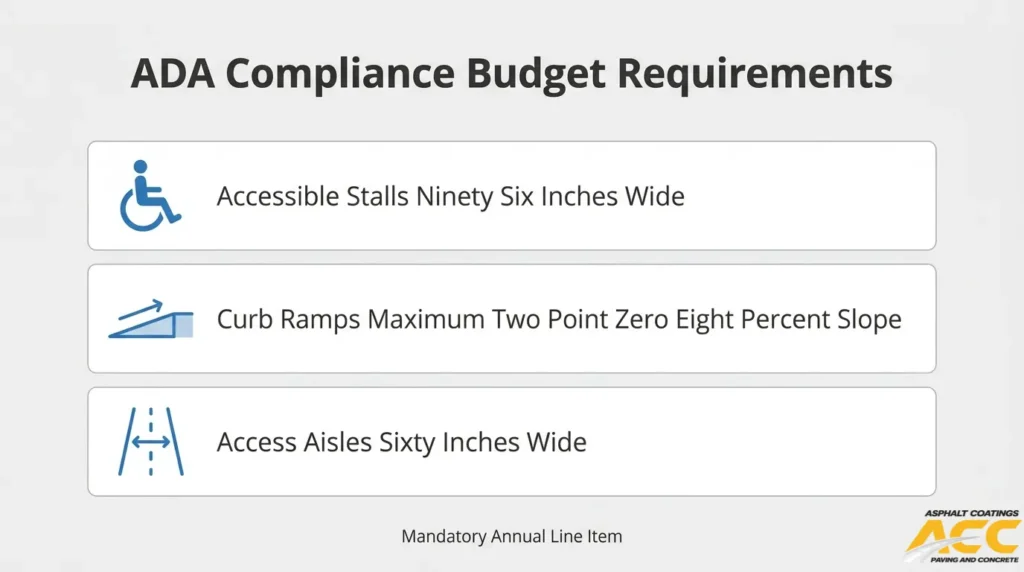
You should budget for ADA-compliant ramps, stalls, and accessible routes as a non-negotiable annual line item. The Americans with Disabilities Act mandates that parking lots include properly marked accessible spaces, ramps, and pathways. According to the U.S. Department of Justice, car accessible parking spaces must be at least 96 inches wide, have an access aisle at least 60 inches wide, and maintain no more than a 2.08% slope in all directions.
Key ADA budget items include:
- Curb ramp installation or reconstruction with compliant slopes and detectable warning surfaces.
- Accessible stall restriping with correct dimensions and signage.
- Route repairs to eliminate surface gaps, heaving, or uneven transitions.
Failing to meet these specifications exposes property owners to federal complaints, lawsuits, and costly retrofit orders. Budgeting proactively for ADA compliance is far less expensive than reacting to a violation notice.
How Can You Plan for Trip-Hazard Mitigation in Sidewalks and Concrete Flatwork?
You can plan for trip-hazard mitigation by scheduling annual concrete inspections and reserving funds specifically for flatwork repairs. Sidewalk panels that shift, crack, or heave create vertical displacements that become legal liabilities the moment a pedestrian is injured.
Common trip-hazard sources to monitor include:
- Tree root uplift beneath sidewalk panels.
- Freeze-thaw heaving at control joints.
- Settlement gaps between concrete sections and asphalt transitions.
The most cost-effective approach involves grinding minor offsets early, before they exceed the half-inch threshold that triggers ADA non-compliance. When displacement is too severe for grinding, panel replacement becomes necessary. Allocating a dedicated concrete flatwork repair line item each year prevents small hazards from compounding into large capital expenses or insurance claims.
How Do Faded Striping and Poor Signage Increase Liability and Insurance Risk?
Faded striping and poor signage increase liability and insurance risk by obscuring traffic flow, hiding accessible parking designations, and creating confusion that leads to collisions and pedestrian injuries. The National Safety Council reports that tens of thousands of crashes occur in parking lots and garage structures annually, resulting in hundreds of deaths and thousands of injuries.
When striping fades, several risks escalate simultaneously:
- ADA-accessible stall markings become invisible, triggering compliance violations.
- Fire lane and directional arrows lose clarity, increasing collision probability.
- Stop bars and crosswalk lines disappear, raising pedestrian strike risk.
Insurance carriers often scrutinize lot maintenance records after incident claims. Documenting regular restriping cycles strengthens your defense position and may reduce premium increases. For most commercial lots, annual striping touch-ups and full restriping every two to three years represent a small investment relative to the liability exposure they prevent.
What Budget Should You Reserve for Emergency Safety Repairs After Weather Events?
The budget you should reserve for emergency safety repairs after weather events is typically 5% to 10% of your total annual parking lot maintenance allocation. Severe storms, heavy snowfall, and rapid freeze-thaw cycles can create sudden hazards that demand immediate response, including potholes, drainage failures, and displaced concrete.
Priority emergency repairs include:
- Pothole filling in high-traffic lanes and pedestrian crossings.
- Catch basin clearing after heavy rain or snowmelt flooding.
- Temporary barricading of heaved sidewalk sections or collapsed curb areas.
Properties that lack an emergency reserve often redirect funds from planned preventive work, which disrupts the entire maintenance cycle. A dedicated contingency fund keeps scheduled sealcoating, crack sealing, and striping on track while still addressing urgent safety issues promptly.
Understanding these compliance and safety costs positions you to control expenses through proactive service bundling.
How Can You Control Parking Lot Maintenance Costs Without Sacrificing Quality?
You can control parking lot maintenance costs without sacrificing quality by bundling services, choosing contractors with in-house crews, scheduling work during off-peak hours, and conducting regular inspections. Each strategy targets a different cost driver.
How Can Grouping Services (Sealcoat, Crack Seal, Striping) Save Money?
Grouping services like sealcoating, crack sealing, and striping into a single mobilization event saves money by eliminating redundant setup, equipment transport, and crew staging costs. When a contractor visits once to perform all three tasks, the per-service mobilization fee drops significantly compared to scheduling each service separately across different months.
Bundled projects also reduce cumulative downtime for tenants and customers, since the lot closes once instead of three times. According to a Minnesota House of Representatives report, deferring pavement maintenance may increase costs by over 20% over a five-year period, while $1 of maintenance could save $6 to $10 in future expenses. Coordinating preventive treatments together is one of the simplest ways to capture those savings early.
How Does Working with In-House Crews Versus Subcontractors Affect Cost Control?
Working with in-house crews versus subcontractors affects cost control by reducing markup layers, improving scheduling reliability, and ensuring consistent quality standards. Subcontracted work typically carries added coordination fees, and each intermediary introduces margin that inflates the final price.
In-house crews operate under a single management structure, which means:
- Direct accountability for materials, workmanship, and timelines.
- Faster response to change orders or unexpected site conditions.
- Consistent application methods across sealcoating, crack sealing, and striping.
- No third-party scheduling conflicts that delay project completion.
For property managers overseeing multiple budget line items, this single-source approach simplifies vendor management and reduces the administrative cost of coordinating separate contractors for each service.
How Can Off-Peak or Night Work Scheduling Help Manage Operational Disruption Costs?
Off-peak or night work scheduling helps manage operational disruption costs by keeping parking spaces available during peak business hours. Retail centers, healthcare facilities, and office parks lose revenue and frustrate tenants when large sections of a lot close during daytime operations.
Scheduling sealcoating, striping, or crack sealing during overnight hours or low-traffic windows minimizes those losses. Cooler nighttime temperatures in Colorado’s Front Range can also benefit certain material applications. For commercial properties where tenant satisfaction directly affects lease renewals, the indirect savings from reduced disruption often justify any modest premium for after-hours work.
How Can Regular Inspections Help You Catch Issues Before They Become Expensive?
Regular inspections help you catch issues before they become expensive by identifying small defects, such as hairline cracks, early-stage raveling, or drainage blockages, while they still qualify for low-cost preventive repairs. A crack that costs a few dollars per linear foot to seal today can become a pothole requiring hundreds of dollars in patching within a single freeze-thaw season.
Scheduling walkthroughs at least twice per year, ideally after winter and after summer, creates a documented maintenance record that supports warranty claims and budget forecasting. Properties that rely on reactive repairs instead of routine assessments consistently face higher annual costs and shorter pavement life spans.
With cost-control strategies in place, evaluating contractor bids ensures those savings translate into quality results.
How Should You Evaluate and Compare Bids for Commercial Parking Lot Work in Fort Collins?
You should evaluate and compare bids for commercial parking lot work in Fort Collins by examining scope specificity, long-term cost projections, material quality, crew qualifications, and local climate expertise. The sections below cover scope details, value versus low price, key contractor questions, and the importance of Colorado experience.
What Scope Details and Specifications Should Every Asphalt Maintenance Bid Include?
Every asphalt maintenance bid should include precise scope details such as square footage, material types and quantities, surface preparation methods, number of coats or lifts, cure times, and a defined project timeline. Vague line items like “sealcoating” or “crack repair” without specifications make meaningful comparison impossible.
A complete bid should also itemize:
- Exact areas to be treated, identified by lot section or map reference.
- Material brand names and application rates per square foot.
- Surface cleaning and preparation steps before treatment.
- Traffic control and phasing plans to minimize business disruption.
- ADA compliance work, including striping dimensions and ramp specifications.
- Disposal methods for removed asphalt or debris.
Bids missing these details often signal shortcuts during execution. Any proposal that groups work into a single lump sum without itemization deserves scrutiny before signing.
How Do You Compare Short-Term Low Bids Against Long-Term Value and Longevity?
You compare short-term low bids against long-term value by calculating total cost of ownership over a 5 to 10 year period, not just the upfront price. A low bid using thinner material applications or skipping proper surface preparation will require earlier reapplication, increasing cumulative spend.
Fort Collins’ climate makes this calculation especially critical. With an annual average snowfall of 51.4 inches, according to the Coloradoan, parking surfaces endure significant freeze-thaw stress that exposes substandard work within one or two winters. A contractor offering premium materials and proper application thickness may cost 15 to 25 percent more upfront but deliver pavement life that justifies the investment.
Request each bidder’s projected maintenance timeline. The contractor whose work lasts longest between treatments typically delivers the lowest per-year cost.
What Questions Should You Ask About Materials, Crew Experience, and Warranties?
The questions you should ask about materials, crew experience, and warranties focus on verifiable specifics rather than general assurances. Before signing any contract, confirm these details directly:
- What specific sealcoat or asphalt mix products will be used, and do they meet CDOT specifications?
- Are crews employed in-house, or will work be subcontracted?
- How many years of commercial parking lot experience does the assigned crew have?
- What warranty coverage applies, and what does it exclude?
According to the Federal Highway Administration, materials and workmanship warranties for preventive maintenance treatments generally range from 2 to 4 years. Any contractor offering less than two years of warranty coverage on sealcoating or crack sealing may lack confidence in their own work quality. Contractors using in-house crews typically maintain tighter quality control than those relying on subcontractors.
How Important Is Local Colorado Experience When Selecting a Contractor?
Local Colorado experience is critically important when selecting a contractor because Fort Collins’ environmental conditions demand region-specific knowledge. Freeze-thaw cycling, high-altitude UV degradation, and expansive soils create failure patterns that contractors from milder climates may not anticipate.
A qualified local contractor understands:
- Optimal application windows based on northern Colorado’s short warm season.
- Material formulations that resist UV oxidation at 5,000 feet elevation.
- Subgrade preparation techniques suited to Fort Collins’ well-drained eolian and alluvial soils.
- Snow plow damage prevention through proper lot grading and edge design.
Contractors without years of Front Range project history often underestimate how quickly Colorado’s climate punishes poor workmanship. Prioritizing local experience over marginally lower out-of-state bids protects both pavement longevity and your maintenance budget.
With bids properly evaluated, partnering with an experienced local contractor ensures your budget translates into lasting results.
How Should You Approach Commercial Parking Lot Budgeting With Asphalt Coatings Company?
You should approach commercial parking lot budgeting with Asphalt Coatings Company by treating the process as a long-term partnership rather than a one-time transaction. The sections below cover how bundled services optimize your maintenance budget and the key takeaways for planning in Fort Collins.
How Can Asphalt Coatings Company’s Sealcoating, Crack Sealing, and Paving Services Help Optimize Your Maintenance Budget?
Asphalt Coatings Company’s sealcoating, crack sealing, and paving services help optimize your maintenance budget by consolidating preventive and corrective work under a single contractor with in-house crews. This single-source approach eliminates coordination delays between separate vendors for striping, crack filling, and overlay projects.
Asphalt Coatings Company has served Colorado’s Front Range since 1986, bringing decades of regional expertise to every scope of work. That experience matters for compliance; according to the City of Castle Pines, many Colorado municipalities require specific contractor licenses, such as a Class H Asphalt Paving Contractor license, for asphalt paving on both public right-of-way and private property.
Bundling sealcoating with crack sealing and striping in a single mobilization reduces per-visit costs and minimizes operational disruption to tenants and customers. For property managers overseeing multiple lots, this coordination is one of the most effective ways to stretch a maintenance budget further.
What Are the Key Takeaways About Planning a Commercial Parking Lot Maintenance Budget in Fort Collins, CO?
The key takeaways about planning a commercial parking lot maintenance budget in Fort Collins, CO, center on three principles: invest preventively, account for local climate, and maintain ADA compliance year-round.
- Preventive maintenance consistently costs less than reactive repair; every dollar spent on sealcoating and crack sealing can prevent far larger expenses in overlay or reconstruction.
- Fort Collins’ freeze-thaw cycles, heavy snowfall, and high UV exposure accelerate asphalt deterioration, making climate-adjusted scheduling essential for budget accuracy.
- The Americans with Disabilities Act mandates that parking lots remain accessible, including properly marked accessible spaces, ramps, and pathways, according to Brotherhood Mutual Insurance Company. Non-compliance creates both legal liability and unplanned repair costs.
- Phasing work across multiple years, grouping services, and using pavement condition assessments all help smooth out capital expenditures.
- Selecting a licensed Colorado contractor with documented local experience protects your investment through proper materials, workmanship, and warranty coverage.
Asphalt Coatings Company combines these principles into a partnership approach built on transparency, in-house crews, and nearly four decades of Front Range expertise. Reaching out for a site evaluation is the most practical first step toward a maintenance plan that protects your pavement and your budget.