Sub-grade inspection is the process of evaluating the compacted native soil beneath a commercial pavement structure to confirm it can support every layer built on top of it. It is the single most important quality-control step before asphalt paving begins.
This guide covers Fort Collins soil and climate challenges, failure consequences of skipped inspections, inspection procedures and soil-specific design, sub-grade corrections and long-term investment protection, and property-type considerations for working with a Colorado-experienced contractor.
Fort Collins sub-grades consist of fine-loamy soils with clay content ranging from 18 to 35 percent, creating foundations prone to swelling, shrinkage, and frost heave. Annual freeze-thaw cycles compound this risk by repeatedly expanding trapped moisture within the soil, weakening compaction and producing uneven bearing capacity across commercial sites.
Skipping inspection leads to premature alligator cracking, rutting, surface depressions, and hidden drainage failures. Each of these distresses compounds over time, and repeated surface repairs never resolve the root cause. Cumulative maintenance costs can exceed what proper sub-grade preparation would have cost within just a few years.
A thorough inspection includes visual assessment, geotechnical soil testing, moisture evaluation, and load-bearing capacity analysis through CBR testing. Results directly determine asphalt and base layer thickness, compaction targets, and drainage slope design for the specific site.
When inspection reveals weak or marginal soils, corrections range from undercutting and replacement to lime or cement stabilization and sub-drainage installation. These interventions protect pavement longevity, reduce lifecycle costs, and ensure ADA accessibility compliance across parking surfaces.
Inspection priorities also shift based on property type. Retail plazas, apartment complexes, healthcare facilities, and industrial sites each impose distinct load, drainage, and surface tolerance demands on the sub-grade beneath them.
What Does “Sub-Grade” Mean in Commercial Asphalt Paving?
The sub-grade is the prepared and compacted native soil that forms the lowest layer of a commercial pavement structure. It supports every layer above it. The following sections explain how the sub-grade relates to other pavement layers, what soil conditions define Fort Collins sites, and how Colorado’s freeze-thaw cycles affect this critical foundation.
How Is the Sub-Grade Different From the Base and Asphalt Layers?
The sub-grade is different from the base and asphalt layers in both position and function. The sub-grade sits at the bottom of the pavement structure as compacted native earth. The base layer rests above it, providing support for construction traffic and uniformity of load distribution. The asphalt surface course sits on top, directly receiving vehicle loads and weather exposure.
According to an FHWA Technical Brief on Bases and Subbases, the subbase layer protects pavement from frost heave and improves constructability, while the base layer ensures uniform structural support. When any layer loses integrity, problems cascade upward. Fatigue cracking, for example, often originates from loss of sub-grade or base support caused by poor drainage. For commercial properties, understanding this layered relationship is essential because a failure at the sub-grade level compromises every layer built on top of it.
What Soil Conditions Commonly Make Up Sub-Grades in Fort Collins?
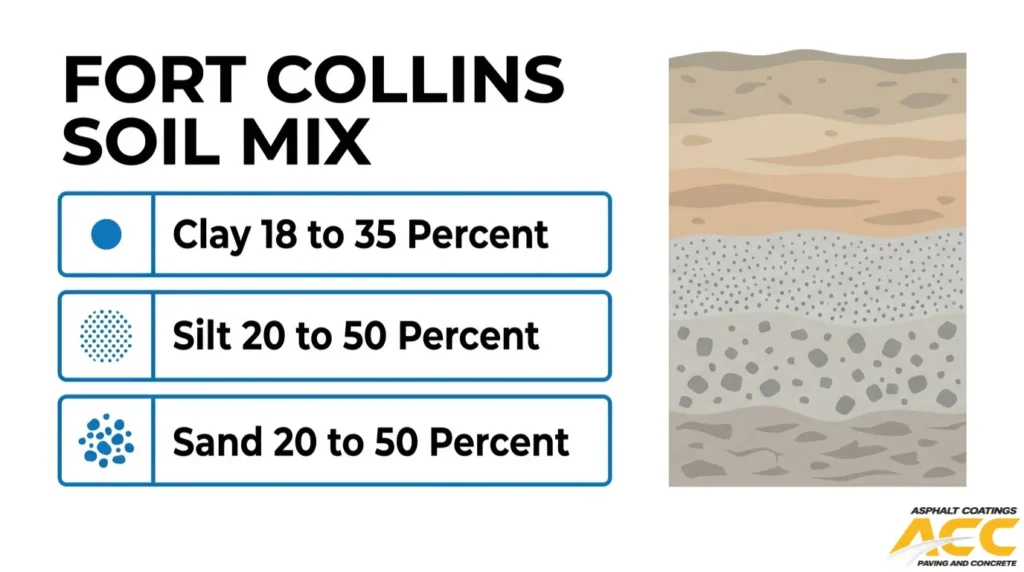
The soil conditions that commonly make up sub-grades in Fort Collins are fine-loamy mixtures with variable clay, silt, and sand content. According to the USDA Fort Collins Soil Series, these soils are classified as fine-loamy, mixed, superactive, mesic Aridic Haplustalfs, with Bt horizon clay content of 18 to 35 percent, silt content of 20 to 50 percent, and sand content of 20 to 50 percent.
This composition creates a sub-grade that can shift significantly with moisture changes. Higher clay percentages increase the risk of swelling and shrinkage, while sandier zones may drain too quickly and lose compaction stability. Proper sub-grade inspection accounts for this variability across a single commercial site.
How Do Freeze-Thaw Cycles in Colorado Affect the Sub-Grade?
Freeze-thaw cycles in Colorado affect the sub-grade by repeatedly expanding and contracting moisture trapped within the soil. According to FHWA LTPP frost penetration data, Colorado LTPP Site 1053 recorded an average maximum freeze depth of 0.336 meters (1.1 feet), with freeze periods spanning December through February.
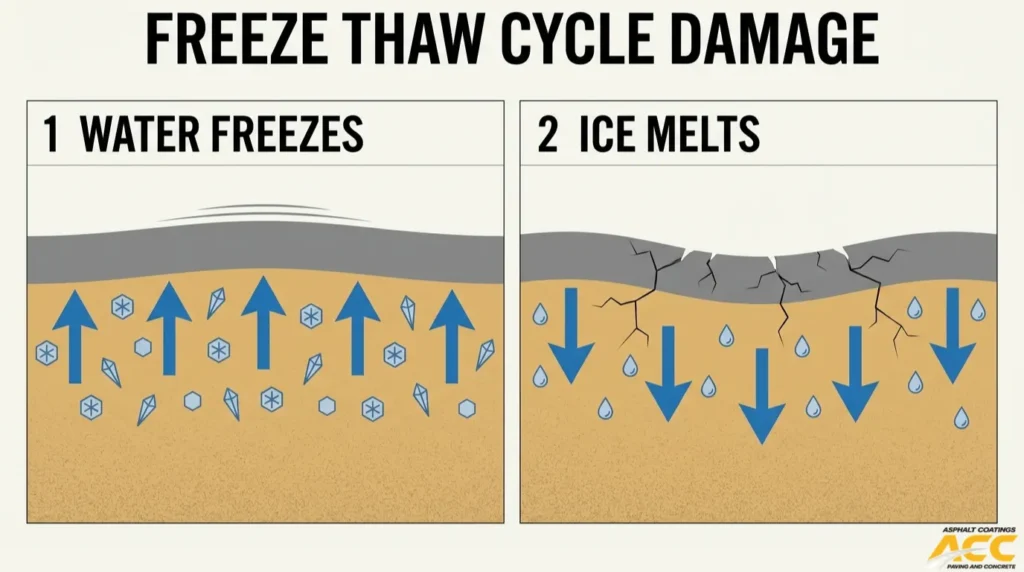
When sub-grade moisture freezes, the soil heaves upward. As temperatures rise, the ice melts and the soil settles unevenly. Over multiple seasons, this cycle weakens compaction, creates voids, and produces inconsistent bearing capacity across the pavement footprint. Fort Collins properties face this challenge annually, making pre-paving sub-grade inspection particularly valuable for identifying frost-susceptible soils before they cause premature pavement distress.
Understanding sub-grade composition and climate exposure sets the stage for evaluating why inspection matters specifically in Fort Collins’ environment.
Why Is Sub-Grade Inspection Especially Important in Fort Collins’ Climate?
Sub-grade inspection is especially important in Fort Collins’ climate because freeze-thaw cycles, high-altitude UV exposure, and localized drainage challenges all accelerate pavement deterioration from the foundation up. The following sections cover how each factor threatens sub-grade integrity.
How Do Freeze-Thaw Cycles Increase the Risk of Asphalt Failure?
Freeze-thaw cycles increase the risk of asphalt failure by turning trapped moisture into a destructive force within the pavement structure. When water infiltrates the sub-grade through cracks or poor drainage, freezing temperatures cause it to expand inside the soil and aggregate layers. According to Bituminous Roadways, water expands by approximately 10 percent when frozen, exerting upwards of 25,000 psi of pressure against surrounding asphalt and acting like a hydraulic wedge that forces the pavement apart from the inside out. Each cycle weakens the sub-grade’s bearing capacity further, compounding damage over a single winter. A thorough pre-paving inspection identifies moisture-prone zones before this cycle begins.
How Do High-Altitude UV and Temperature Swings Impact the Sub-Grade?
High-altitude UV and temperature swings impact the sub-grade by accelerating binder oxidation at the surface while subjecting the foundation to rapid thermal expansion and contraction. Fort Collins sits near 5,000 feet, where UV intensity is significantly stronger than at sea level. This increased radiation hardens the asphalt layer above, making it brittle and more likely to crack. Once cracks form, moisture reaches the sub-grade, where daily temperature swings between hot afternoons and cold nights cause repeated soil movement. Over time, these conditions loosen compacted material and reduce load-bearing strength. Pre-paving inspection ensures the sub-grade can tolerate this thermal stress before the surface layer is placed.
Why Do Local Drainage Patterns in Fort Collins Matter for Sub-Grade Performance?
Local drainage patterns in Fort Collins matter for sub-grade performance because the city’s semi-arid climate produces intense, short-duration storms that overwhelm surfaces and saturate underlying soils quickly. Fort Collins’ stormwater utility, established in 1980 according to the City of Fort Collins, was created to protect the community from flooding, pooling, erosion, and harmful pollutants. Most stormwater discharges directly to local water bodies without treatment, meaning commercial sites must manage runoff on their own property. Saturated sub-grade soil loses compaction and bearing capacity rapidly. Inspecting drainage conditions before paving reveals low spots, poor grading, and water table proximity that would otherwise compromise the finished pavement.
Understanding these climate-driven risks helps property managers plan effective sub-grade corrections before paving begins.
What Problems Can Happen If You Skip Proper Sub-Grade Inspection?
Skipping proper sub-grade inspection leads to premature cracking, surface depressions, drainage failures, and escalating repair costs. Each of these failure modes compounds over time, turning a preventable oversight into a major financial burden.
How Does Poor Sub-Grade Lead to Premature Cracking and Alligatoring?
Poor sub-grade leads to premature cracking and alligatoring by failing to provide uniform structural support beneath the pavement. When the soil foundation shifts, settles, or erodes unevenly, the asphalt surface above absorbs stress it was never designed to handle alone. Repeated traffic loading on this weakened structure causes fatigue failure, which appears as interconnected cracks across the surface.
According to the Tarmac View Glossary, pavement failure encompasses premature cracking, pavement deterioration, and structural failure, all of which trace back to inadequate bearing layer conditions. Once alligatoring begins, the damage accelerates because water infiltrates through the crack network and further weakens the sub-grade below. For commercial properties with heavy daily traffic, this cycle can reduce expected pavement life by years.
Why Does Inadequate Sub-Grade Compaction Cause Rutting and Depressions?
Inadequate sub-grade compaction causes rutting and depressions because loosely consolidated soil settles unevenly under load. According to Pavement Interactive, a depression is a localized pavement surface area with lower elevation than surrounding pavement, caused by subgrade settlement resulting from inadequate compaction during construction. These low spots collect water, which accelerates further deterioration.
Rutting follows a similar pattern. When sub-grade soil deforms excessively under construction traffic before paving, those ruts can reflectively transfer through the finished asphalt surface. Correcting compaction deficiencies before paving is straightforward; correcting them after the asphalt is placed requires costly removal and reconstruction. This is why verifying compaction density during inspection is non-negotiable for commercial sites.
How Can Hidden Sub-Grade Issues Trigger Drainage and Ponding Problems?
Hidden sub-grade issues trigger drainage and ponding problems by creating undetected low spots and inconsistent soil permeability beneath the pavement. If portions of the sub-grade contain pockets of soft, poorly draining clay surrounded by more permeable material, water migrates to these zones and has no path to escape. The result is subsurface saturation that eventually manifests as surface ponding.
Standing water on commercial parking lots creates slip hazards, accelerates oxidation of the asphalt binder, and can violate local stormwater management requirements. A thorough sub-grade inspection identifies these drainage vulnerabilities before they are sealed beneath layers of base and asphalt, when corrections are still practical and affordable.
In What Ways Can Sub-Grade Failures Drive Up Long-Term Maintenance Costs?
Sub-grade failures drive up long-term maintenance costs by forcing repeated surface repairs that never address the root cause. Patching depressions, filling cracks, and resurfacing rutted areas provide only temporary relief when the underlying soil foundation remains compromised. Each repair cycle costs more than the last because the surrounding pavement continues to deteriorate.
Over a pavement’s service life, this reactive approach can multiply total maintenance spending several times over compared to addressing sub-grade deficiencies before paving. For commercial property managers, the hidden cost extends beyond materials and labor to include tenant disruption, liability exposure from uneven surfaces, and diminished property appearance. Investing in proper sub-grade inspection before paving is consistently the most cost-effective decision in the entire project timeline.
With failure consequences clearly outlined, understanding what a thorough sub-grade inspection includes helps prevent these outcomes.
What Does a Thorough Commercial Sub-Grade Inspection Typically Include?
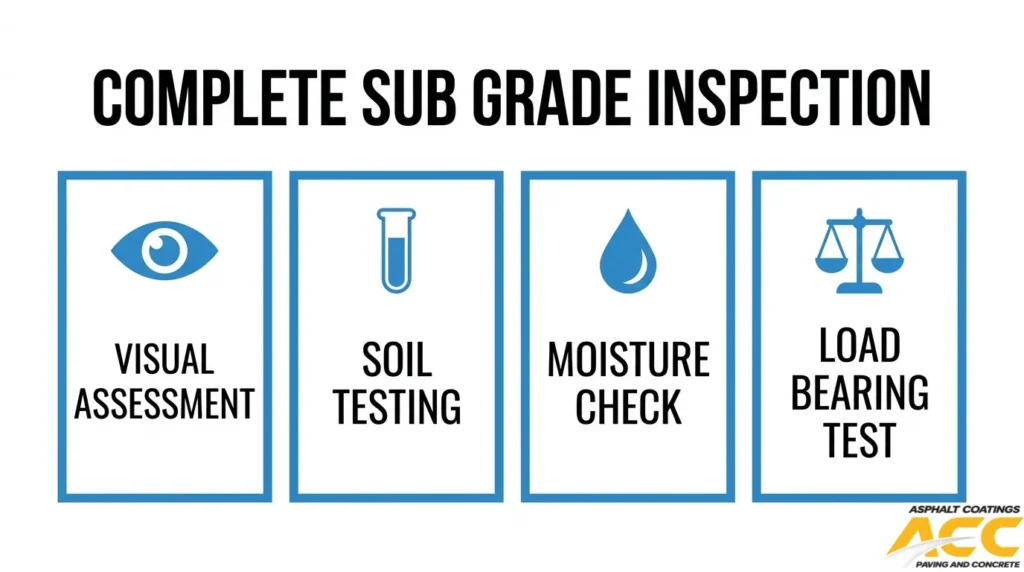
A thorough commercial sub-grade inspection typically includes visual assessment, soil testing, moisture evaluation, and load-bearing capacity analysis. These four components work together to reveal hidden weaknesses before paving begins.
How Do Contractors Visually Inspect and Probe Existing Pavement and Sub-Grade?
Contractors visually inspect and probe existing pavement and sub-grade by walking the entire site to identify surface distress patterns, soft spots, and signs of subsurface failure. Key indicators they look for include:
- Alligator cracking that suggests loss of structural support below
- Localized depressions or ponding areas indicating settlement
- Rutting under traffic paths that may reflect subgrade weakness
- Vegetation patterns or seepage revealing moisture intrusion
After the visual survey, contractors use probing tools and test pits to physically examine soil conditions beneath the surface. If subgrade ruts excessively under construction traffic, it should be repaired before being paved over, since unrepaired ruts can reflectively cause premature pavement rutting, according to Pavement Interactive. This hands-on assessment guides every decision that follows.
What Role Do Soil Testing and Geotechnical Evaluations Play?
Soil testing and geotechnical evaluations play a foundational role in determining whether the sub-grade can support the planned pavement system. According to Marshall GeoScience, “The subgrade is the most critical part of any pavement system. It bears the entire weight of traffic, climate effects, and construction materials above.”
Geotechnical evaluations typically assess:
- Soil classification (particle size distribution, plasticity index)
- Organic content and contamination potential
- Atterberg limits to measure shrink-swell behavior
- Compaction characteristics via Standard Proctor testing
Without this data, engineers cannot determine whether the native soil needs stabilization, replacement, or additional base material. For commercial sites in Fort Collins, where clay content can vary significantly across a single parcel, skipping geotechnical evaluation is one of the costliest shortcuts a project team can take.
How Are Moisture Content and Drainage Conditions Evaluated?
Moisture content and drainage conditions are evaluated through field sampling, laboratory analysis, and site grading review. Technicians collect soil samples at multiple depths and locations to measure in-situ moisture relative to the optimum moisture content identified during Proctor testing.
Drainage evaluation focuses on:
- Existing slope and grade across the site
- Evidence of standing water, erosion channels, or saturated zones
- Subsurface water table depth
- Permeability characteristics of the native soil
Soil that is too wet cannot achieve proper compaction, while overly dry conditions create a brittle foundation prone to cracking under load. Identifying these conditions early allows contractors to plan dewatering, regrading, or sub-drainage installation before any paving material is placed.
How Is Load-Bearing Capacity of the Sub-Grade Assessed for Commercial Traffic?
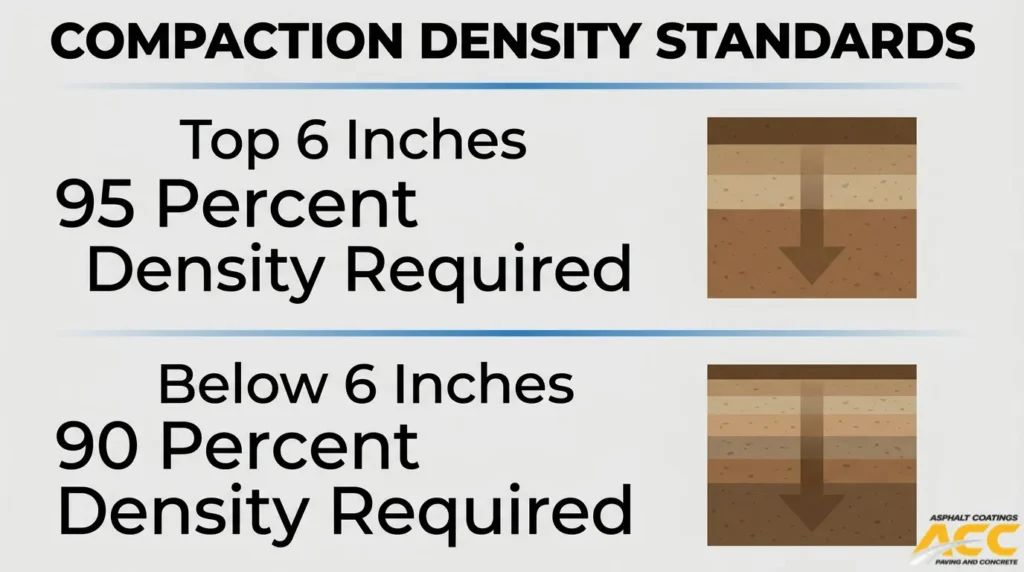
Load-bearing capacity of the sub-grade is assessed for commercial traffic primarily through California Bearing Ratio (CBR) testing and plate load tests. The top 150 mm (6 inches) of subgrade must reach not less than 95 percent of maximum density, according to Pavement Interactive. In fill areas, material below that depth requires compaction to at least 90 percent relative density.
CBR results directly determine pavement section thickness:
- CBR of 3 to 5 percent indicates poor subgrade, requiring thicker pavement layers
- CBR of 5 to 10 percent represents fair to good conditions
- CBR of 10 percent or higher demands minimal additional thickness
Commercial sites handling heavy truck traffic need particularly rigorous assessment, since underestimating load requirements leads to accelerated structural failure. With accurate load-bearing data established, the design team can specify the right asphalt section for the site’s actual traffic demands.
How Do Different Soil Types in Fort Collins Affect Sub-Grade Design?
Different soil types in Fort Collins affect sub-grade design by dictating compaction methods, stabilization needs, and pavement thickness. Subgrade strength and uniformity are the most critical factors in pavement design, so identifying the native soil composition determines every structural decision that follows. The sections below cover clay-rich soils, sandy or loamy sub-grades, and expansive or frost-susceptible conditions.
How Should Clay-Rich Soils Around Fort Collins Be Evaluated and Treated?
Clay-rich soils around Fort Collins should be evaluated through moisture content testing, Atterberg limits analysis, and compaction trials before any treatment begins. Fort Collins soils contain Bt horizon clay content ranging from 18 to 35 percent, which means many commercial sites sit on material prone to shrinking when dry and swelling when wet. This volume change weakens load-bearing capacity and creates uneven support beneath pavement layers.
Treatment typically involves one or more of these approaches:
- Lime stabilization to reduce plasticity and improve workability.
- Moisture conditioning to bring clay within the optimal compaction range.
- Over-excavation and replacement with engineered fill when clay content is too high.
For most commercial projects on Fort Collins clay, skipping stabilization is a gamble that rarely pays off.
What Special Considerations Apply to Sandy or Loamy Sub-Grades?
Sandy or loamy sub-grades require attention to drainage behavior, compaction characteristics, and particle gradation. Fort Collins soils contain sand content between 20 and 50 percent and silt content between 20 and 50 percent, according to the USDA Fort Collins Soil Series. These compositions drain faster than clay but may lack cohesion, making them vulnerable to shifting under heavy commercial traffic loads.
Key considerations include:
- Verifying adequate fines content to maintain cohesion after compaction.
- Testing for uniform particle gradation to prevent internal erosion.
- Confirming moisture levels during compaction, since sandy soils lose density quickly when too dry.
Sandy sub-grades often compact easily, but that ease can mislead contractors into underestimating long-term settlement risk.
How Do Expansive or Frost-Susceptible Soils Change the Inspection Approach?
Expansive or frost-susceptible soils change the inspection approach by requiring deeper soil sampling, swell-potential testing, and freeze-depth analysis beyond standard compaction checks. According to the Colorado Geological Survey, Colorado’s most significant geologic hazard is expansive or swelling soil, with annual losses exceeding those from tornadoes, floods, earthquakes, and hurricanes combined.
Inspectors must assess:
- Swell index and plasticity index to quantify expansion risk.
- Frost penetration depth to determine how deep sub-grade preparation must extend.
- Seasonal moisture fluctuation patterns at the specific site.
Treating these soils often involves chemical stabilization, moisture barriers, or increased base layer thickness. When expansive conditions go undetected, the resulting heave and settlement can destroy even well-constructed asphalt within a few seasonal cycles. Understanding soil behavior at this level directly shapes which correction methods are needed before paving begins.
How Does Sub-Grade Inspection Influence the Design of a Commercial Asphalt Section?
Sub-grade inspection influences the design of a commercial asphalt section by providing the soil strength data, grade tolerances, and drainage characteristics that determine every layer above it. CDOT Standard Specifications require the subgrade plane not to vary more than 0.04 foot where asphalt-surfacing materials are placed directly on the subgrade. The following subsections cover how sub-grade quality sets layer thickness, how traffic loads shape requirements, and how sub-grade data guides drainage and slope design.
How Does Sub-Grade Quality Determine Asphalt and Base Layer Thickness?
Sub-grade quality determines asphalt and base layer thickness through California Bearing Ratio (CBR) testing, which quantifies load-bearing capacity. Lower CBR values represent weaker subgrade conditions and demand thicker pavement layers to safely distribute traffic loads. A CBR of 3 to 5 percent indicates poor subgrade, CBR of 5 to 10 percent is fair to good, and CBR at or above 10 percent requires minimal pavement thickness, according to a pavement thickness design analysis using the CBR method. Essentially, the weaker the soil beneath the surface, the more structural work the base and asphalt layers must perform. This is why skipping sub-grade testing often leads to either over-built sections that waste budget or under-built sections that fail prematurely.
How Does Anticipated Traffic Load on Commercial Sites Affect Sub-Grade Requirements?
Anticipated traffic load on commercial sites affects sub-grade requirements by dictating the structural capacity the soil foundation must support. Retail parking lots receiving passenger vehicles need far less bearing strength than distribution centers handling daily semi-truck traffic. Larimer County Urban Area Street Standards require subgrade to have a minimum one-foot layer of R=20 material and pavement design to follow the AASHTO Guide for Design of Pavement Structures. Without matching sub-grade preparation to actual vehicle weights and turning frequencies, even a well-compacted foundation can deteriorate under loads it was never engineered to handle. For high-traffic commercial sites, combining accurate sub-grade data with realistic traffic projections is the single most effective way to prevent early structural failure.
How Does Sub-Grade Data Inform Drainage and Slope Design for Parking Lots?
Sub-grade data informs drainage and slope design for parking lots by revealing soil permeability, compaction uniformity, and grade accuracy that collectively determine how water moves across and beneath the surface. According to the APAI Parking Lot Design Guide, parking area surfaces should have a minimum slope of 2 percent (1/4 inch per foot) and should be constructed so water does not accumulate at the pavement edge. The same guide specifies that graded subgrade must not deviate from required grade by more than 1/2 inch in 10 feet.
ADA compliance adds another layer of precision. The U.S. Access Board requires accessible parking spaces to have no more than 1.48 percent slope in all directions. Achieving that narrow tolerance on top while maintaining adequate drainage slope everywhere else demands highly accurate sub-grade grading underneath. When sub-grade data reveals uneven compaction or inconsistent soil density, corrections must happen before paving to ensure both drainage performance and accessibility compliance.
With design parameters established from sub-grade data, the next critical step is identifying what corrections may be needed before paving begins.
What Sub-Grade Corrections Might Be Needed Before Commercial Asphalt Paving?
Sub-grade corrections before commercial asphalt paving include undercutting weak material, chemical stabilization, targeted compaction, and drainage improvements. The following sections cover when each correction applies.
When Is Undercutting and Replacing Weak Sub-Grade Material Necessary?
Undercutting and replacing weak sub-grade material is necessary when native soils cannot achieve adequate density or bearing capacity despite compaction efforts. Organic deposits, saturated clays, and pockets of loose fill are common triggers. Contractors excavate the unsuitable material to a specified depth and replace it with engineered fill, such as crushed aggregate or select granular material, that can be compacted to specification. In my experience, undercutting is often the most straightforward correction when isolated problem areas are discovered during proof-rolling; attempting to stabilize severely compromised soil in place usually costs more and takes longer than simply removing it.
When Should Lime, Cement, or Other Stabilization Methods Be Considered?
Lime, cement, or other stabilization methods should be considered when native soils are marginal but widespread, making full removal impractical. Cement-stabilized subgrade increases soil stiffness and strength enough to provide structural benefits to pavement foundations. Lime works especially well with high-plasticity clays. According to Mintek Resources, lime stabilization can reduce initial construction costs through improved subgrade stability and reductions in pavement structure thickness. Other options include fly ash and geopolymer binders. Chemical stabilization makes the most sense when soil testing reveals consistent weakness across a large area; spot-treating with lime or cement is far more cost-effective than hauling out and replacing thousands of cubic yards of marginal material.
How Do Contractors Decide on Compaction Targets for Commercial Sub-Grades?
Contractors decide on compaction targets for commercial sub-grades by referencing Standard Proctor density results from laboratory soil testing. The top 150 mm of subgrade typically requires a minimum relative density of 95 percent, while fill areas below that depth must reach at least 90 percent. Nuclear density gauges or lightweight deflectometers verify these values in the field. Compaction targets also account for anticipated traffic loads; heavy-truck sites and distribution centers demand tighter tolerances than standard parking lots. Setting targets before mobilizing equipment prevents costly rework after paving begins.
When Is Installing Sub-Drainage or Geotextiles the Right Solution?
Installing sub-drainage or geotextiles is the right solution when moisture infiltration threatens long-term sub-grade stability. French drains, perforated pipe systems, and edge drains redirect groundwater before it saturates the soil beneath the pavement. Geotextile fabrics serve a different purpose: they separate weak sub-grade soils from aggregate base layers, preventing fine particles from migrating upward and compromising structural integrity. Sites with high water tables, poor natural drainage, or frost-susceptible soils benefit most from these systems. Investing in sub-drainage during construction is significantly cheaper than rehabilitating a failed pavement caused by trapped moisture. Asphalt Coatings Company’s 39 years of Colorado experience includes designing and installing sub-drainage systems across commercial properties throughout the Front Range, where moisture management is critical to pavement longevity.
With corrections addressed, understanding how proper sub-grade preparation protects your investment becomes the next priority.
How Does Proper Sub-Grade Preparation Protect Your Commercial Asphalt Investment?
Proper sub-grade preparation protects your commercial asphalt investment by extending pavement life, reducing costly repairs, and ensuring regulatory compliance. The following sections cover longevity, cost savings, and safety considerations.
How Does a Strong Sub-Grade Extend Pavement Life for Busy Commercial Sites?
A strong sub-grade extends pavement life for busy commercial sites by providing a stable, uniform foundation that distributes traffic loads without shifting or settling. When the sub-grade is properly compacted and graded, each layer above it performs as designed, and the pavement structure resists the fatigue cracking and depressions that shorten service life.
According to an Iowa State University life-cycle cost analysis, initial costs account for 55 to 75 percent of total life-cycle costs for asphalt pavements, with those costs including subgrade preparation, base, subbase, and surface materials. Investing in thorough sub-grade work during that initial phase directly reduces the frequency and severity of future interventions. For high-traffic commercial lots, this upfront discipline is often the single most cost-effective decision a property manager can make.
How Can Upfront Sub-Grade Work Reduce Future Patching and Overlay Costs?
Upfront sub-grade work reduces future patching and overlay costs by eliminating the weak spots that trigger localized failures. Unaddressed soft areas, moisture pockets, and uneven compaction beneath the surface inevitably produce depressions, rutting, and cracking that demand repeated repairs.
Each patch or overlay addresses only the symptom; the underlying sub-grade deficiency remains, causing the same distress to return within a few seasons. Correcting these conditions before paving means the asphalt wears evenly under traffic rather than failing in isolated zones. Property managers who skip this step often spend more on cumulative maintenance within five to seven years than the original sub-grade preparation would have cost. Prioritizing sub-grade quality turns a reactive maintenance cycle into a predictable, long-term asset.
Why Is Sub-Grade Quality Critical for Safety and ADA Accessibility Compliance?
Sub-grade quality is critical for safety and ADA accessibility compliance because surface smoothness and slope tolerances depend entirely on the uniformity of the foundation beneath them. According to the U.S. Access Board, accessible parking spaces must have slopes not exceeding 1:50 in all directions, and ground surfaces must be stable, firm, and slip resistant. Sub-grade settlement creates uneven surfaces, ponding water, and grade changes that violate these requirements and create trip hazards.
Maintaining ADA-compliant slopes over time is nearly impossible when the sub-grade shifts beneath the pavement. For commercial properties serving the public, non-compliance carries both legal liability and real safety risks for visitors with mobility challenges.
Understanding how sub-grade preparation safeguards your investment raises practical questions about oversight during construction.
What Should Property and Facility Managers Ask About Sub-Grade Inspection?
Property and facility managers should ask targeted questions about sub-grade process, testing verification, and how findings shape project budgets. The following sections cover contractor vetting, documentation review, and budget planning.
What Questions Should You Ask a Paving Contractor About Their Sub-Grade Process?
You should ask a paving contractor about their sub-grade process to confirm they follow recognized standards and test for site-specific soil conditions. Key questions include:
- What soil testing methods do you use to evaluate bearing capacity?
- Do you test compaction density against Standard Proctor targets?
- How do you account for Fort Collins’ expansive clay soils and freeze-thaw exposure?
- What is your protocol if the sub-grade ruts under construction equipment?
- Will you provide a geotechnical report before paving begins?
According to Pavement Interactive, adequate sub-grade density requires not less than 95 percent of maximum density in the top 150 mm. Any contractor who cannot explain their compaction verification method is a red flag worth taking seriously.
How Can You Verify That Proper Testing and Documentation Were Completed?
You can verify that proper testing and documentation were completed by requesting specific records before paving begins. Essential documents include:
- Nuclear density gauge or sand cone test results confirming compaction percentages
- Moisture content readings at the time of compaction
- Geotechnical soil classification reports identifying clay content and plasticity
- Proof roll observations noting any areas of deflection or rutting
- Grade tolerance measurements confirming surface uniformity
CDOT Standard Specifications require the sub-grade plane not to vary more than 0.04 foot where asphalt surfacing is placed directly on it. Managers who collect and archive these records create an accountability trail that protects them during warranty claims or future maintenance disputes.
How Should Sub-Grade Findings Influence Your Budget and Project Phasing?
Sub-grade findings should influence your budget and project phasing by revealing whether stabilization, undercutting, or additional base material is needed before paving. A weak sub-grade with low CBR values demands thicker pavement layers, which increases material and labor costs. Conversely, a strong, well-compacted sub-grade can reduce overall section thickness and lower expenses.
Phasing becomes critical when inspection uncovers isolated problem zones. Addressing those areas first, rather than paving the entire site and repairing later, prevents compounding costs. For most commercial projects, investing in thorough sub-grade correction upfront is far more cost-effective than patching premature failures within the first few years.
With the right questions answered, the next step is understanding how inspection priorities shift across different commercial property types.
How Does Sub-Grade Inspection Differ for Various Commercial Property Types?
Sub-grade inspection differs for various commercial property types based on traffic loads, drainage demands, and surface tolerances unique to each use case. The following sub-sections cover adjustments for retail, residential, healthcare, and industrial sites.
How Should Sub-Grade Inspection Adjust for Shopping Centers and Retail Plazas?
Sub-grade inspection for shopping centers and retail plazas should adjust to account for high-volume turning movements, frequent delivery truck access, and expansive drainage requirements. Fire lanes and loading dock approaches experience concentrated loads that exceed standard passenger vehicle stress, so these zones need targeted compaction verification. Drainage is equally critical; according to the APAI Parking Lot Design Guide, parking area surfaces require a minimum slope of 2 percent (1/4 inch per foot) and must be constructed so water does not accumulate at the pavement edge. Inspectors should map utility trench locations across the lot, since backfilled trenches often settle unevenly and create depressions under the finished surface. Prioritizing these high-stress zones during inspection prevents costly repairs in areas customers see first.
What Sub-Grade Considerations Are Unique to Apartment and HOA Parking Lots?
The sub-grade considerations unique to apartment and HOA parking lots center on long-term serviceability under sustained static loads and strict ADA compliance. Vehicles parked in the same stalls for extended periods concentrate weight on fixed points, making uniform compaction across every bay essential. According to the U.S. Access Board, accessible parking spaces must have no more than 1.48 percent (1:50) slope in all directions. Sub-grade uniformity directly controls whether finished surfaces hold these tolerances over time. Inspectors should also evaluate areas near landscaping and irrigation lines, where moisture infiltration softens soil and accelerates differential settlement. For HOA properties especially, the cost of post-construction corrections often falls on association budgets, making thorough upfront inspection a financial safeguard. Asphalt Coatings Company serves apartment complexes and HOA communities across Denver, Aurora, Colorado Springs, Fort Collins, and Boulder with commercial paving services designed specifically for Colorado’s soil and climate conditions.
How Do Healthcare and Medical Facilities Influence Sub-Grade Requirements?
Healthcare and medical facilities influence sub-grade requirements by demanding zero-tolerance surface uniformity for ambulance access, wheelchair transport, and gurney movement. Emergency vehicle lanes carry concentrated axle loads at high frequency, requiring compaction verification that exceeds standard parking lot thresholds. The U.S. Access Board specifies that accessible ground surfaces must be stable, firm, and slip resistant, with changes in level limited to 1/4 inch without treatment. Any sub-grade settlement that creates surface irregularities can compromise patient safety and trigger compliance violations. Inspectors should focus on porte-cochère zones, ambulance bays, and covered drop-off areas where drainage design must balance slope requirements against accessibility mandates. In my experience, healthcare sites benefit most from geotechnical testing at tighter grid intervals than standard commercial properties.
How Do Industrial and Heavy-Truck Sites Change Sub-Grade Inspection Priorities?
Industrial and heavy-truck sites change sub-grade inspection priorities by shifting the focus toward load-bearing capacity and deep compaction uniformity. Semi-trucks, forklifts, and loaded trailers impose axle loads several times greater than passenger vehicles, which means weak sub-grade zones fail quickly and visibly. According to Pavement Interactive, if sub-grade ruts excessively under construction traffic, it should be repaired before paving, as unrepaired ruts reflectively cause premature pavement rutting. Inspectors should verify compaction at greater depths in loading dock approaches, turning aprons, and container staging areas. Subsurface drainage also takes on heightened importance, since pooled water beneath heavy-load zones accelerates bearing capacity loss. Industrial properties represent the highest-consequence sub-grade failures in commercial paving, making rigorous pre-pave inspection non-negotiable.
With property-specific inspection needs defined, partnering with a Colorado-experienced contractor ensures these standards translate into lasting pavement performance.
How Should You Approach Sub-Grade Inspection and Asphalt Paving With a Colorado-Specific Contractor?
You should approach sub-grade inspection and asphalt paving with a Colorado-specific contractor by choosing a firm that understands local soil conditions, freeze-thaw cycles, and regional compliance standards. The following sections cover how Asphalt Coatings Company supports proper sub-grade preparation and the key takeaways from this guide.
How Can Asphalt Coatings Company’s Commercial Paving Expertise Help Ensure Proper Sub-Grade Preparation?
Working with an experienced Colorado commercial paving contractor helps ensure proper sub-grade preparation through regional expertise, trained crews familiar with Front Range soil conditions, and dedicated subgrade preparation services. Insufficient site preparation remains the leading cause of premature pavement failure on commercial projects. According to Case Construction, “when subgrade soils are not properly evaluated, conditioned, and compacted, premature pavement failure is inevitable.” Asphalt Coatings Company addresses this risk directly by evaluating soil composition, verifying compaction density, and designing drainage solutions before any asphalt is placed. For commercial property managers across Fort Collins and the Front Range, working with contractors who understand that proper sub-grade preparation directly impacts pavement longevity helps protect long-term paving investments.
What Are the Key Takeaways About the Importance of Sub-Grade Inspection Before Commercial Asphalt Paving in Fort Collins?
The key takeaways about the importance of sub-grade inspection before commercial asphalt paving in Fort Collins are:
- Fort Collins’ clay-rich, expansive soils and freeze-thaw cycles create conditions where uninspected sub-grades fail prematurely.
- Proper compaction to 95 percent maximum density and accurate grading prevent rutting, depressions, and alligator cracking.
- Sub-grade quality directly determines base and asphalt layer thickness, drainage design, and overall project cost.
- Soil testing, moisture evaluation, and load-bearing assessments should precede every commercial paving project.
- Stabilization methods and sub-drainage solutions address weak or frost-susceptible soils before they become costly problems.
- ADA slope compliance and stormwater management both depend on precise sub-grade preparation.
Investing in thorough sub-grade inspection before paving is the single most effective step commercial property owners can take to maximize pavement longevity and minimize lifecycle costs.