Spring pothole repair for Colorado Springs commercial lots is the process of assessing, patching, and restoring asphalt pavement damaged by 150+ annual freezing nights at 6,035 feet elevation. It combines post-winter inspection, targeted repair methods, and preventive maintenance to protect commercial parking surfaces from recurring failure.
This guide covers freeze-thaw damage mechanics, spring pavement assessment, commercial repair methods and costs, liability risks, weather-dependent repair timing, long-term prevention, and contractor selection.
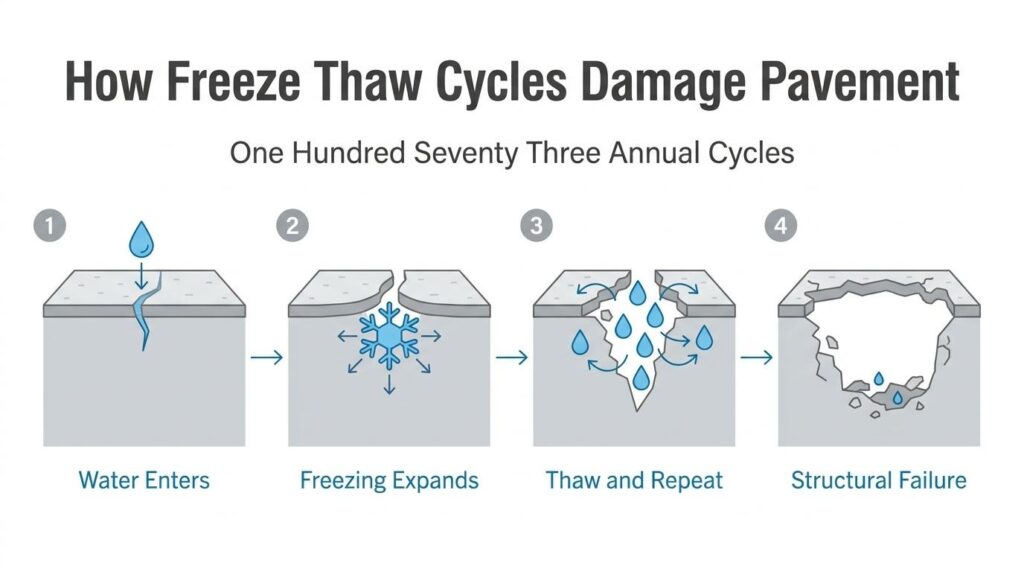
Colorado Springs averages roughly 173 freeze-thaw cycles per year, where daily temperature swings of 40 to 50 degrees force water into pavement cracks, expand it by 9% during freezing, and progressively destroy the asphalt bond and subbase. Heavy commercial traffic accelerates this process by pumping snowmelt deeper into compromised layers.
Effective spring assessment goes beyond counting surface potholes. Saturated subgrades can lose 50 to 70% of their load-bearing capacity during seasonal thaws, and professional diagnostics separate simple surface patches from full-depth structural failures requiring reconstruction.
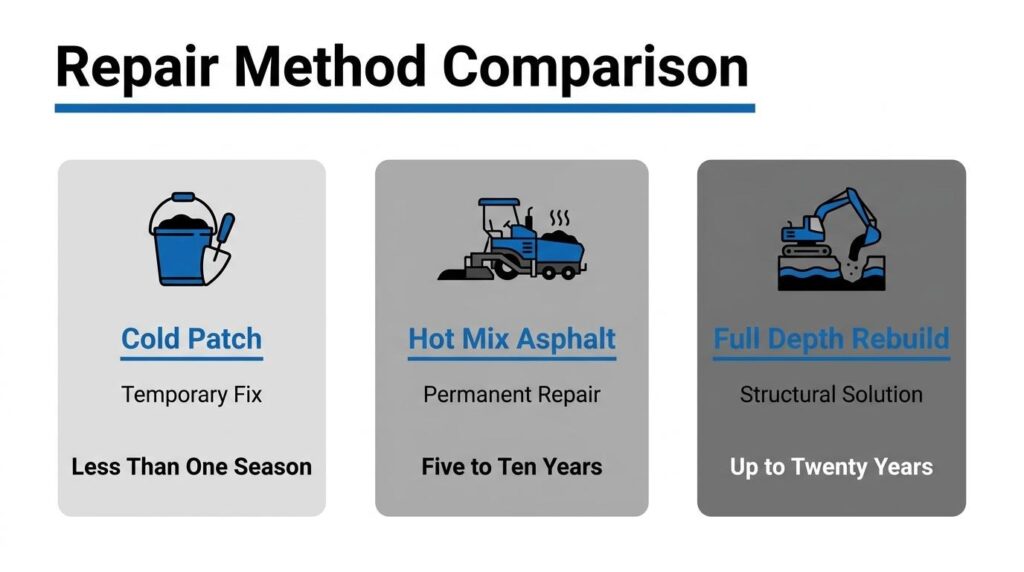
Repair options range from cold-patch stopgaps (lasting less than one season) to hot-mix asphalt patching ($3 to $7 per square foot) and full-depth reclamation that can extend pavement life by up to 20 years. Choosing the right method depends on damage severity, subbase condition, and spring temperature windows.
Unrepaired potholes carry real financial consequences. The Colorado Premises Liability Act holds property owners accountable for known or discoverable hazards, and ADA violations can trigger federal penalties up to $75,000 per occurrence.
Pairing timely repairs with sealcoating, drainage correction, and a preventive maintenance plan delivers the strongest return; every $1 invested in proactive care saves $4 to $10 in future rehabilitation costs.
Why Do Colorado Springs Commercial Lots Develop Potholes After 150+ Freezing Nights?
Colorado Springs commercial lots develop potholes after 150+ freezing nights because repeated freeze-thaw cycles, high elevation, snowmelt infiltration, and heavy vehicle loads systematically break down asphalt from within. The sections below explain each stage of this damage process.
How Does the Freeze-Thaw Cycle Damage Commercial Asphalt?
The freeze-thaw cycle damages commercial asphalt by repeatedly expanding and contracting moisture trapped within the pavement structure. When water inside small cracks freezes, it exerts outward pressure that widens those cracks. As temperatures rise, the ice melts and the weakened voids collect even more water. This cycle repeats dozens of times each winter in Colorado Springs, progressively degrading the asphalt binder and aggregate bond.
Colorado Springs sits at 6,035 feet elevation, which intensifies these cycles through more extreme daily temperature swings. Each freeze event chips away at pavement integrity, and without intervention, isolated cracking escalates into full pothole formation within a single season.
Why Does Colorado Springs’ High Elevation Accelerate Pothole Formation?
Colorado Springs’ high elevation accelerates pothole formation because the city’s 6,035-foot altitude produces sharper temperature fluctuations than lower-elevation cities along the Front Range. Thinner atmosphere at elevation allows surfaces to heat rapidly under direct sun, then cool just as fast after sunset. These swings can reach 40 to 50 degrees in a single day, multiplying the number of effective freeze-thaw transitions pavement endures.
According to a Garage Door Colorado Springs climate analysis, the region averages approximately 173 freeze-thaw cycles per year. That volume of thermal stress is far beyond what standard asphalt mix designs are engineered to tolerate without a proactive maintenance program.
How Does Snowmelt Water Infiltration Weaken Asphalt Subbase?
Snowmelt water infiltration weakens asphalt subbase by saturating the compacted aggregate layers beneath the surface. Water enters through hairline cracks, failed joints, and pavement edges where sealant has deteriorated. Once trapped below the surface, this moisture has no efficient path to drain.
According to the National Asphalt Pavement Association, water expands by approximately 9% when it freezes, exerting internal pressure that fractures the asphalt matrix and destabilizes the subbase. As frozen ground thaws in spring, the subbase softens into a spongy layer that can no longer support surface loads. Potholes form when the weakened surface collapses under traffic.
Why Does Heavy Commercial Traffic Worsen Freeze-Thaw Damage?
Heavy commercial traffic worsens freeze-thaw damage by applying concentrated loads to already compromised pavement. Delivery trucks, waste haulers, and fully loaded vehicles generate repetitive stress that flexes weakened asphalt sections. Each pass pumps standing snowmelt deeper into cracks and voids, accelerating subbase saturation.
As the American Public Works Association notes, the weight of commercial vehicles forces snowmelt water into the asphalt subbase through existing cracks. Once moisture reaches the subbase, freeze events lock it in place while thaw events allow further penetration. High-traffic areas like loading zones, dumpster pads, and drive aisles deteriorate fastest because they absorb the most wheel loads over the weakest pavement sections.
With the causes of pothole formation established, a thorough spring inspection reveals which areas need immediate attention.
How Can You Assess Pothole Damage on a Commercial Lot in Spring?
You can assess pothole damage on a commercial lot in spring by conducting a systematic pavement inspection that evaluates surface distress, subsurface integrity, and structural depth. The following sections cover what a post-winter inspection includes, how to detect hidden failures, and when damage signals a full-depth issue.
What Should a Post-Winter Pavement Inspection Cover?
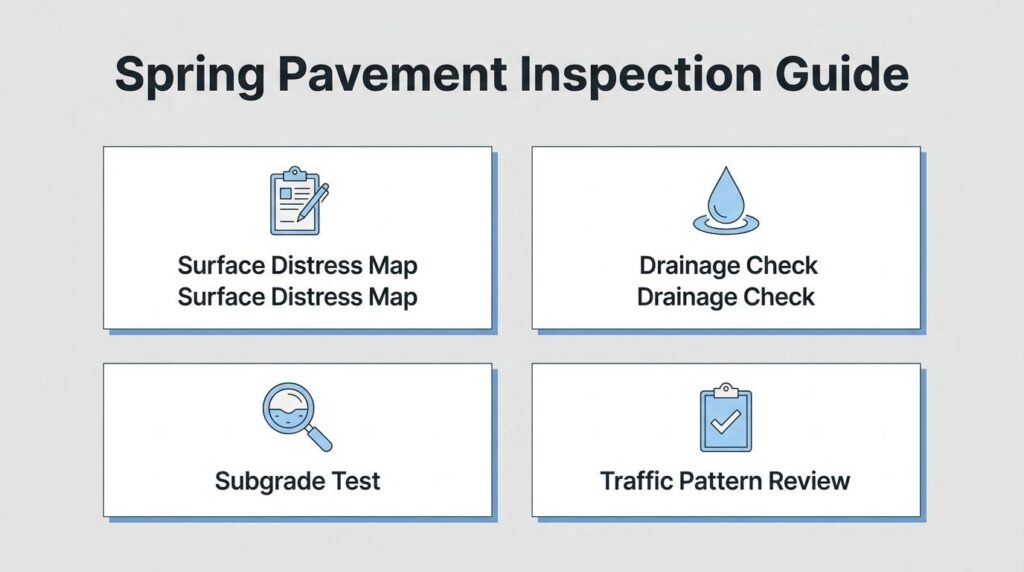
A post-winter pavement inspection should cover surface distress mapping, drainage evaluation, and subgrade condition assessment across the entire commercial lot. Inspectors document every crack, depression, and pothole by location, size, and severity to prioritize repairs.
Key elements of a thorough spring inspection include:
- Surface distress inventory: Catalog all potholes, alligator cracking, edge failures, and raveling with measurements and photos.
- Drainage assessment: Check catch basins, lot grading, and standing water areas where moisture accelerates deterioration.
- Joint and seam evaluation: Inspect transitions between pavement sections, curb lines, and utility cuts for separation.
- Traffic pattern analysis: Identify high-load zones where truck turning movements concentrate stress.
As Corey Farkas, Colorado Springs’ manager for public works operations and maintenance, told KRDO News, the seasonal surge in potholes is “a very, very big deal” for infrastructure. Commercial property managers should treat spring inspections with the same urgency.
How Do You Identify Subsurface Failures Beneath Visible Potholes?
You identify subsurface failures beneath visible potholes by probing the surrounding pavement for soft spots, testing material cohesion, and evaluating moisture conditions in the subgrade layer. A surface pothole often signals deeper deterioration that simple patching cannot resolve.
According to soil mechanics research published on ScienceDirect, saturated subgrades lose 50–70% of their load-bearing capacity during seasonal thaws. Warning signs of subsurface failure include:
- Pavement deflection under vehicle loads near the pothole perimeter.
- Soft, spongy areas when probed with a screwdriver or rod.
- Water seeping from cracks adjacent to the pothole after rainfall.
- Progressive widening of the pothole despite previous patches.
Skipping subsurface evaluation is one of the most common mistakes in commercial lot maintenance. A patch over a failed subgrade will deteriorate within months, wasting both time and budget.
When Does Pothole Damage Indicate a Full-Depth Structural Issue?
Pothole damage indicates a full-depth structural issue when failures penetrate through the entire asphalt layer into the aggregate base or native soil. Recurring potholes in the same location, widespread alligator cracking, and visible base material inside the cavity all point to structural compromise rather than surface wear.
Professionals use Ground Penetrating Radar (GPR) and Falling Weight Deflectometers (FWD) to distinguish surface potholes from full-depth structural failures, according to the Virginia Transportation Research Council. When testing confirms structural failure, full-depth reclamation (FDR) can improve pavement structural capacity and extend service life by up to 20 years.
For commercial property managers in Colorado Springs, investing in diagnostic tools before committing to a repair method prevents the costly cycle of patching pavement that needs reconstruction. Accurate assessment at this stage determines whether the lot needs targeted repairs or a comprehensive restoration plan.
What Are the Best Pothole Repair Methods for Commercial Lots?
The best pothole repair methods for commercial lots range from temporary cold-patch fixes to permanent solutions like hot-mix asphalt, saw-cut replacement, and full-depth reclamation. Each method suits a different level of damage severity.
How Does Cold-Patch Pothole Repair Perform as a Temporary Fix?
Cold-patch pothole repair performs as a temporary fix that stabilizes damage quickly but lacks long-term durability. This method uses pre-mixed, ambient-temperature material that can be applied in any weather, making it the go-to option when winter conditions prevent hot-mix paving.
However, longevity is the trade-off. According to HomeGuide, cold-patch repair has a service life often less than one season in high-traffic commercial areas. The material does not chemically bond with surrounding pavement, so repeated vehicle loads gradually dislodge it.
For Colorado Springs commercial lots still experiencing late-season freezing, cold patch buys time until permanent repairs become viable. It is a stopgap, not a solution.
When Should You Use Hot-Mix Asphalt for Permanent Pothole Repair?
You should use hot-mix asphalt for permanent pothole repair once ambient temperatures consistently reach 45°F and rising, which ensures proper compaction and asphalt adhesion. In Colorado Springs, this window typically opens in late April or May after the heaviest spring snowfall subsides.
Hot-mix asphalt patching creates a permanent bond with existing pavement and can last 5 to 10 years when the surrounding surface is stable and properly maintained. For seamless results, infrared asphalt repair technology heats existing asphalt to 325°F, creating a thermal bond between old and new material that eliminates cold joints.
This is the most reliable method for commercial parking lot maintenance. Scheduling hot-mix repairs early in the season prevents minor potholes from expanding into costly structural failures.
How Does Saw-Cut and Replace Repair Address Deep Pothole Damage?
Saw-cut and replace repair addresses deep pothole damage by removing the entire deteriorated section down to stable subbase. Crews cut clean, straight edges around the damaged area using a diamond-blade saw, excavate the failed material, and install fresh hot-mix asphalt in compacted lifts.
This method eliminates irregular patch boundaries that trap water and re-crack under traffic. It is the preferred approach when potholes extend below the surface course into the binder layer or when surrounding pavement shows alligator cracking. Clean geometric cuts also produce a more professional appearance for high-visibility commercial properties.
When Does Full-Depth Reclamation Make More Sense Than Patching?
Full-depth reclamation makes more sense than patching when widespread subbase failure renders individual pothole repairs ineffective. If a commercial lot shows recurring potholes across large sections, the underlying aggregate and soil have likely lost structural integrity.
According to a study published in ScienceDirect on civil engineering applications, full-depth reclamation can improve pavement structural capacity and extend service life by up to 20 years in severe failure cases. The process pulverizes existing asphalt and base material, blends them with stabilizing agents, and recompacts the mixture into a reinforced foundation.
For property managers weighing repeated patch costs against a single comprehensive repair, full-depth reclamation often delivers the stronger long-term return. Understanding repair costs helps determine which method fits your budget.
How Much Does Spring Pothole Repair Cost for Colorado Springs Commercial Lots?
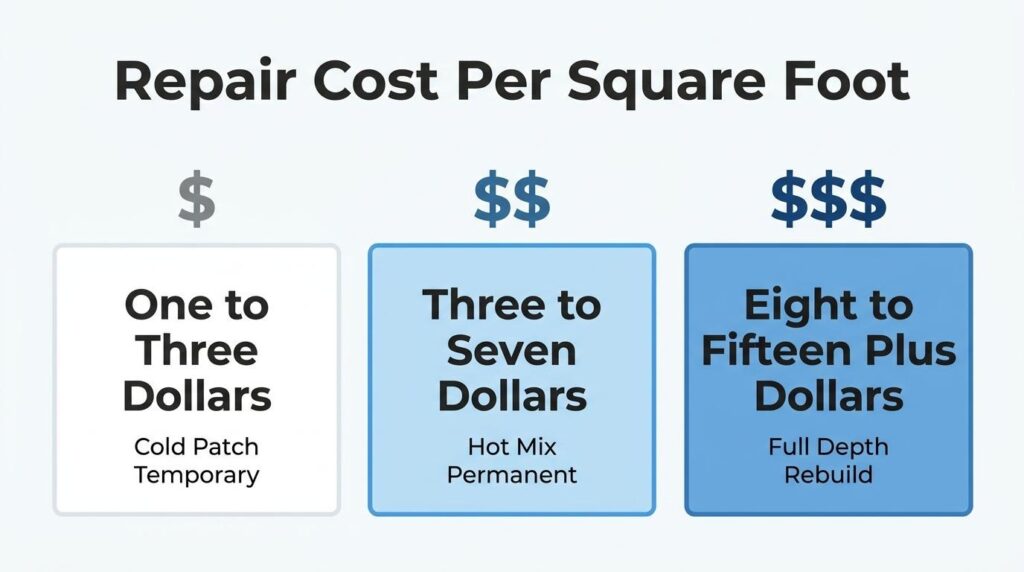
Spring pothole repair cost for Colorado Springs commercial lots ranges from $1 to $15+ per square foot depending on the repair method. The three most common approaches, cold-patch, hot-mix asphalt patching, and full-depth replacement, each carry distinct price points.
How Much Does Cold-Patch Pothole Repair Cost Per Square Foot?
Cold-patch pothole repair costs approximately $1 to $3 per square foot for material and labor on Colorado Springs commercial lots. While the upfront price is the lowest of any patching method, the true cost is often higher than it appears. Cold-patch material degrades quickly under heavy commercial traffic, frequently failing within a single season. Property managers who rely on repeated cold-patch applications through spring often spend more cumulatively than a one-time hot-mix repair would have cost. For most commercial lots, cold-patch makes sense only as a stopgap measure while waiting for temperatures to support permanent repairs.
How Much Does Hot-Mix Asphalt Patching Cost Per Square Foot?
Hot-mix asphalt patching costs $3 to $7 per square foot in Colorado commercial markets, according to a 2024 industry cost analysis, with variation depending on mobilization fees and overall job size. Smaller isolated potholes carry higher per-square-foot costs because mobilization and equipment setup represent a larger share of the total. Consolidating multiple patches into a single service visit reduces the per-unit expense significantly. Given that hot-mix patches can last 5 to 10 years on stable pavement, this method delivers the strongest cost-to-longevity ratio for most commercial parking lots in Colorado Springs.
How Much Does Full-Depth Asphalt Replacement Cost Per Square Foot?
Full-depth asphalt replacement costs $8 to $15+ per square foot for Colorado Springs commercial lots. This method involves removing the failed asphalt surface and compromised subbase entirely, then rebuilding with new aggregate and asphalt lifts. The higher price reflects excavation, subgrade recompaction, and multi-layer installation. Full-depth replacement is warranted when subsurface failures have undermined the pavement’s structural capacity beyond what surface patching can address. Though the upfront investment is substantial, it eliminates the cycle of recurring patch failures that drives costs upward over time.
Understanding repair costs helps property managers budget effectively, but liability exposure adds urgency to the timeline.
What Are the Liability Risks of Unrepaired Potholes on Commercial Property?
The liability risks of unrepaired potholes on commercial property include premises liability lawsuits, ADA compliance violations, and federal fines. Colorado law holds property owners to a specific standard of care, and unresolved pavement defects create measurable legal and financial exposure.
Under the Colorado Premises Liability Act, property owners are liable if they knew or “should have found” a dangerous condition like a pothole. This standard means that neglecting routine inspections does not reduce liability; it increases it. A visitor who trips in an unmarked pothole or a vehicle damaged by a pavement defect can pursue a claim if the owner failed to address a condition that reasonable maintenance would have caught.
ADA compliance adds another layer of risk. Potholes that obstruct accessible routes, ramps, or designated parking spaces can trigger federal enforcement action. According to AR Fence Guide’s ADA parking lot compliance data, failure to comply with ADA parking requirements can result in federal penalties ranging from $15,000 to $75,000 per violation for commercial properties. Colorado Springs itself recently committed to a settlement involving the installation of 15,000 ADA-compliant curb ramps due to historical non-compliance, signaling that enforcement in this market is active.
The financial exposure from a single slip-and-fall lawsuit or ADA complaint often exceeds the cost of repairing an entire parking lot. Beyond direct penalties, unrepaired potholes can increase commercial insurance premiums and reduce property valuations. For property managers overseeing shopping centers, office parks, or healthcare facilities, documented maintenance records serve as the strongest legal defense against premises liability claims.
Addressing pothole damage promptly is not just a maintenance decision; it is a risk management strategy. With spring repair season approaching, understanding how Colorado Springs weather affects your repair timeline ensures fixes happen within the right conditions.
How Does Spring Weather in Colorado Springs Affect Repair Timing?
Spring weather in Colorado Springs affects asphalt and sidewalk repair timing by creating a narrow, unpredictable window between lingering winter conditions and stable warm temperatures. The subsections below cover minimum temperature requirements, early spring risks, and late-season snowfall delays.
What Temperatures Are Required for Permanent Asphalt Repairs?
Permanent asphalt repairs require a minimum ambient temperature of 45°F and rising for proper compaction and adhesion. According to the Asphalt Pavement Association, hot-mix asphalt must reach this threshold consistently to form a durable bond with existing pavement. Below 45°F, the mix cools too rapidly during placement, preventing adequate compaction and leaving the patch vulnerable to early failure.
Surface temperature matters as much as air temperature. Cold ground absorbs heat from fresh asphalt, causing it to stiffen before rollers can achieve target density. For Colorado Springs commercial lots, this means monitoring both readings before scheduling permanent repairs. Similarly, planning for protective treatments like sealcoating also requires careful consideration of local weather patterns, including the Colorado Springs hail season. Rushing the timeline when conditions fall short wastes material and creates patches that crack within weeks.
Why Is Early Spring the Riskiest Window for Premature Patching?
Early spring is the riskiest window for premature patching because Colorado Springs temperatures routinely fluctuate 40 to 50 degrees within a single day. A midday reading above 45°F can mislead property managers into scheduling hot-mix work, only for overnight lows to compromise the cure before the patch fully sets.
Premature patching also fails when residual moisture from snowmelt saturates the subbase. Laying hot-mix over a wet subgrade traps water beneath the repair, and the next freeze cycle fractures it from within. The result is a failed patch that costs as much to redo as the original repair. Waiting until daytime highs hold consistently above 50°F, with dry subgrade conditions confirmed, produces far better outcomes for commercial parking lots.
How Does Colorado Springs’ Late-Season Snowfall Delay Repairs?
Colorado Springs’ late-season snowfall delays repairs by resetting the temperature and moisture clock just when conditions seem ready for permanent work. According to the National Weather Service, Colorado Springs averages its highest snowfall in March at 8.1 inches, which often pushes the viable hot-mix repair window into late April or even May.
Each late storm reintroduces moisture into the pavement structure. Subgrades that had begun drying resaturate, requiring additional time before they can support a lasting repair. For commercial lot managers, this means building flexibility into spring maintenance schedules rather than locking in early dates. Cold-patch material can serve as a temporary safety measure during this waiting period, but permanent repairs should only proceed once both temperature and subgrade conditions stabilize.
With weather variables understood, preventing future potholes becomes the next priority.
How Can You Prevent Potholes From Returning After Spring Repairs?
You can prevent potholes from returning after spring repairs by combining sealcoating, drainage improvements, and scheduled preventive maintenance. These three strategies address the root causes of recurring pavement failure.
How Does Sealcoating Protect Repaired Asphalt From Future Freeze-Thaw Cycles?
Sealcoating protects repaired asphalt from future freeze-thaw cycles by creating a waterproof barrier that prevents moisture from penetrating the pavement surface. When water cannot infiltrate cracks and joints, it cannot expand during freezing and fracture the asphalt matrix beneath.
This protective layer also shields the binder from UV degradation, which is particularly aggressive at Colorado Springs’ 6,035-foot elevation. Applied after spring repairs cure, sealcoating locks out the two primary forces that restart pothole formation: water intrusion and oxidation. For commercial lots enduring 150+ freezing nights annually, sealcoating every two to three years is one of the most cost-effective defenses available.
Why Is Proper Drainage Critical to Long-Term Pothole Prevention?
Proper drainage is critical to long-term pothole prevention because standing water is the single greatest accelerator of pavement failure. Even a well-executed patch will deteriorate rapidly if water pools around it, saturates the subbase, and initiates new freeze-thaw damage from below.
Effective drainage strategies for commercial lots include:
- Regrading low spots where water collects after snowmelt.
- Clearing and maintaining catch basins and storm drains seasonally.
- Installing or repairing curb and gutter systems to direct runoff away from pavement edges.
- Correcting reverse slopes in parking areas that trap water against building foundations.
Without functioning drainage, repairs become a recurring expense rather than a lasting solution. Addressing water flow during the spring repair window prevents the same potholes from reappearing the following season.
How Does a Preventive Maintenance Plan Reduce Annual Repair Costs?
A preventive maintenance plan reduces annual repair costs by addressing small defects before they escalate into structural failures requiring expensive reconstruction. Crack sealing, sealcoating, and routine inspections catch deterioration early, when intervention is simple and affordable.
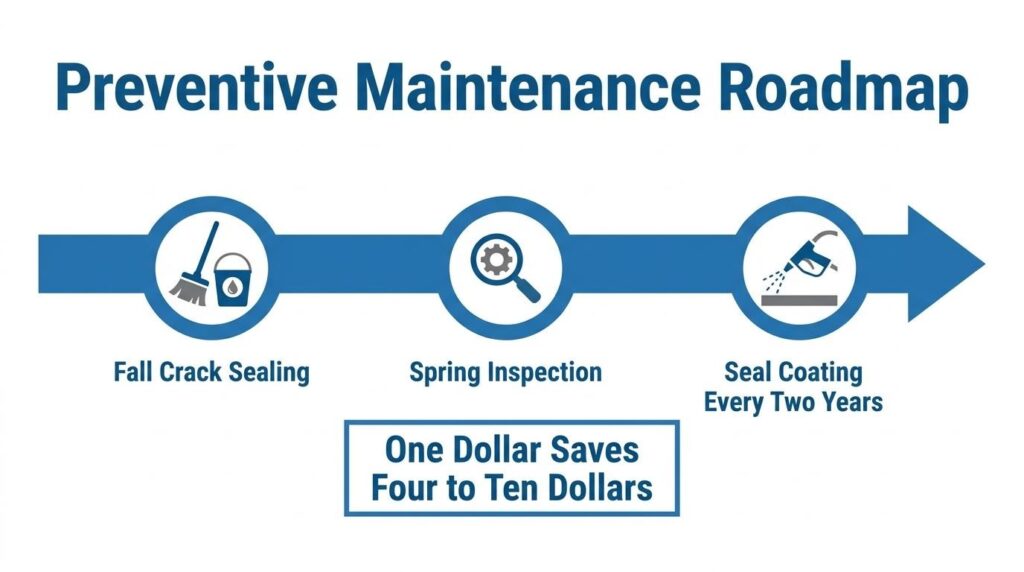
According to APWA Reporter, every $1 spent on preventive maintenance like sealcoating and crack sealing saves $4 to $10 in future rehabilitation and reconstruction costs. For Colorado Springs commercial properties, this return is amplified by the region’s extreme freeze-thaw exposure, which punishes deferred maintenance far more aggressively than milder climates.
A practical annual plan includes fall crack sealing before winter, spring inspections after snowmelt, and sealcoating on a two-to-three-year rotation. This proactive cycle is consistently more economical than reactive “search and destroy” approaches to pothole repair.
Implementing a comprehensive preventive maintenance plan requires a contractor familiar with Colorado’s specific environmental challenges, including the region’s extreme freeze-thaw cycles and high-altitude UV exposure that accelerates pavement deterioration
How Should You Choose a Contractor for Commercial Pothole Repair in Colorado Springs?
You should choose a contractor for commercial pothole repair in Colorado Springs by verifying local experience, reviewing detailed bids, and confirming liability coverage. The sections below cover Asphalt Coatings Company’s in-house capabilities and the key takeaways for spring repair.
Can Asphalt Coatings Company’s In-House Crews Handle Large-Scale Commercial Pothole Repair?
Yes, Asphalt Coatings Company’s in-house crews can handle large-scale commercial pothole repair across Colorado Springs. Since 1986, Asphalt Coatings Company has performed commercial asphalt repair, pavement patching, parking lot maintenance, and subbase stabilization using dedicated crews rather than subcontractors. This single-source approach streamlines scheduling and quality control for large commercial lots.
Asphalt Coatings Company also provides ADA-compliant concrete work, which is critical given that failure to meet ADA parking requirements can result in federal penalties ranging from $15,000 to $75,000 per violation. Reliable commercial paving contractors provide detailed bids with material breakdowns rather than lump-sum quotes, and Asphalt Coatings Company follows this standard with transparent, specification-driven proposals for every project.
What Are the Key Takeaways About Spring Pothole Repair for Colorado Springs Commercial Lots After 150+ Freezing Nights?
The key takeaways about spring pothole repair for Colorado Springs commercial lots after 150+ freezing nights center on timing, method selection, and proactive maintenance:
- Colorado Springs averages approximately 150 days at or below freezing annually, making spring pothole damage virtually inevitable on commercial pavement.
- March snowfall averages 8.1 inches, which often delays the permanent hot-mix repair window into mid-spring.
- Small commercial pothole repairs (up to 1 sq ft) typically cost $150 to $300 per unit in the Colorado Springs market, so early intervention keeps costs manageable.
- Under the Colorado Premises Liability Act, property owners face liability if they knew or should have found a dangerous condition like a pothole, making prompt repairs a legal priority.
- ADA compliance adds urgency; Colorado Springs recently committed to installing 15,000 ADA-compliant curb ramps following a settlement over historical non-compliance.
Scheduling a professional pavement assessment as soon as temperatures consistently reach 45°F positions property managers to lock in permanent repairs before summer traffic peaks. Asphalt Coatings Company serves Colorado Springs commercial properties with the full scope of services needed to address spring pothole damage, from subgrade preparation through sealcoating and ADA-compliant concrete work.