A spring commercial parking lot inspection for Denver property managers is a systematic evaluation of pavement condition, drainage function, compliance markings, and safety hazards conducted after winter to identify damage before it compounds. This guide covers climate-driven damage assessment, asphalt surface distress identification, drainage and grading verification, striping and ADA compliance, concrete element evaluation, sealcoat condition, safety and liability documentation, and repair prioritization.
Denver’s 82 annual freeze-thaw cycles make spring the narrowest window to catch hidden structural stress in commercial pavement. We explain how repeated expansion and contraction of trapped moisture creates cracking, potholes, and base failures, and why even mild winters still produce significant deterioration that worsens under warmer-weather traffic loads.
Asphalt surface distresses range from alligator cracking indicating subgrade failure to longitudinal cracks, transverse cracks, raveling, and depressions. We walk through identification methods for each type, including crack-width thresholds that determine whether a repair calls for simple sealing or full-depth patching.
Drainage verification focuses on catch basin blockages, standing water from inadequate slope grading, and shifted drainage paths caused by settling or frost heave. Striping and ADA compliance sections cover fire lane paint condition, faded directional markings, and handicap space dimensional requirements under current federal and Colorado standards.
Concrete curbs, gutters, sidewalks, and aprons each face freeze-thaw displacement and spalling that creates trip hazards carrying serious liability exposure. Sealcoat evaluation identifies oxidation, aggregate exposure, and resealing timing based on Denver’s high-altitude UV intensity and temperature requirements.
We close with a framework for separating emergency repairs from scheduled maintenance, building phased budgets for large lots, and connecting inspection findings to professional repair scopes.
Why Is Spring the Critical Time to Inspect Denver Parking Lots?
Spring is the critical time to inspect Denver parking lots because winter inflicts cumulative freeze-thaw damage that worsens rapidly once temperatures rise. The subsections below explain how Denver’s climate drives pavement failure and what happens when inspections are delayed.
How Do Denver’s Freeze-Thaw Cycles Cause Winter Damage?
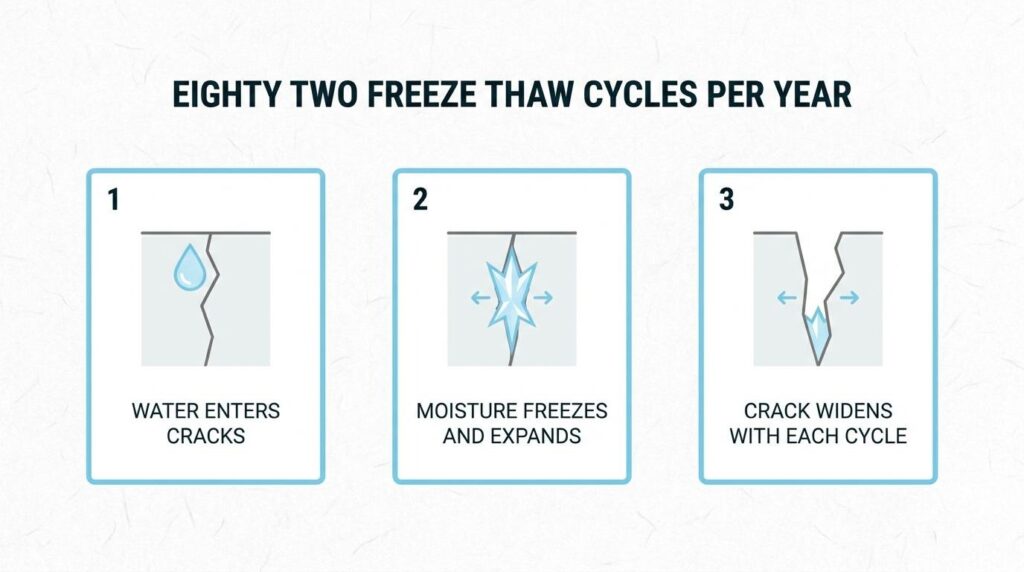
Denver’s freeze-thaw cycles cause winter damage by forcing moisture trapped in pavement cracks to expand when it freezes and contract when it thaws, progressively widening those cracks with each cycle. According to data from the National Centers for Environmental Information, Denver experiences an average of 82 freeze-thaw cycles per year, making it one of the most aggressive climates for asphalt deterioration along the Front Range.
Each cycle pushes water deeper into the asphalt’s base layer. Over an entire winter, this repeated expansion and contraction loosens aggregate bonds, undermines subgrade stability, and creates the conditions for potholes, alligator cracking, and surface raveling. By the time spring arrives, months of hidden structural stress are ready to surface. For property managers overseeing commercial lots, this makes early spring the narrowest window to catch damage before it compounds under warmer-weather traffic loads.
What Happens If You Delay Spring Inspections in Colorado?
Delaying spring inspections in Colorado allows minor winter damage to escalate into costly structural failures. Small cracks left untreated absorb spring rain and snowmelt, saturating the base layer and accelerating subgrade erosion. What might have required simple crack sealing in April can demand full-depth patching or reconstruction by summer.
Liability exposure also increases. Undetected potholes and heaving create trip-and-fall hazards for pedestrians and vehicle damage claims from tenants and visitors. Denver Revised Municipal Code Section 55-266 requires licensed parking lots to maintain proper illumination whenever open to public use, so storm-damaged lighting fixtures missed during inspection can trigger code violations on top of safety risks.
From a budgeting perspective, every week of delay narrows the scheduling window for temperature-sensitive repairs like sealcoating, which cannot be applied until conditions consistently reach 50°F. Acting early gives Denver property managers the best contractor availability and the lowest repair costs before summer demand peaks.
What Asphalt Surface Distresses Should You Look For?
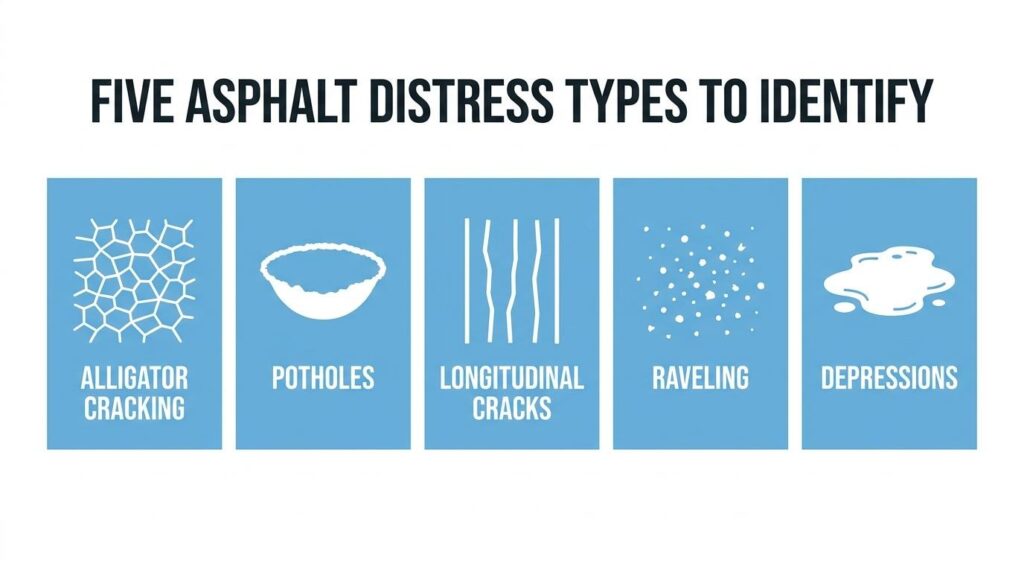
Asphalt surface distresses you should look for include alligator cracking, potholes, longitudinal and transverse cracking, raveling, and depressions. Each distress type signals a different failure mechanism requiring specific repair strategies.
How Do You Identify Alligator Cracking in a Commercial Lot?
Alligator cracking in a commercial lot is identified by a pattern of interconnected cracks resembling reptile skin, typically concentrated in wheel paths and high-traffic areas. According to a Federal Highway Administration publication, fatigue (alligator) cracking is a series of interconnected cracks caused by fatigue failure of the asphalt surface under repeated traffic loading, often indicating a subgrade failure.
During your spring walkthrough, look for these characteristics:
- Interconnected crack patterns forming irregular polygons across the pavement surface.
- Concentration in areas where vehicles brake, turn, or idle repeatedly.
- Visible pumping of fine material through cracks after rainfall.
- Progressive widening that allows water infiltration into the base layer.
When alligator cracking appears, surface-only repairs rarely hold. The underlying base and subgrade typically need evaluation before any overlay or patching will last.
What Does Pothole Formation Look Like After a Denver Winter?
Pothole formation after a Denver winter appears as bowl-shaped depressions where chunks of asphalt have broken free, exposing the aggregate base beneath. Potholes begin as small cracks that allow moisture infiltration; freeze-thaw cycling then expands that moisture, weakening the surrounding pavement until traffic loads dislodge loose material.
Even mild winters cause pothole development in Denver. According to FOX31 Denver, the winter of 2025 to 2026 was marked as one of the warmest, driest, and least snowy seasons in the city’s weather record books. Despite reduced snowfall, temperature swings still drove enough freeze-thaw activity to fracture compromised pavement sections. Look for potholes near drain inlets, curb lines, and utility cuts where existing seams accelerate moisture entry.
How Do You Assess Longitudinal and Transverse Cracking?
Longitudinal and transverse cracking is assessed by walking the lot and documenting crack orientation, width, and severity along systematic grid lines. Longitudinal cracks run parallel to the pavement centerline and often follow paving joint seams or reflect poor lane-joint bonding. According to Pavement Interactive, transverse cracking consists of cracks predominantly perpendicular to the pavement centerline, often caused by low-temperature shrinkage or thermal cycling.
Measure crack width to determine repair method:
- Cracks under 1/4 inch typically need routing and crack sealing.
- Cracks between 1/4 inch and 1 inch require hot-pour sealant application.
- Cracks exceeding 1 inch may indicate structural failure needing partial-depth or full-depth patching.
In Denver, thermal cycling makes transverse cracking especially common, so spring inspections should prioritize these areas before moisture penetration worsens base conditions.
What Are Signs of Raveling or Surface Deterioration?
Signs of raveling or surface deterioration include loose aggregate scattered across the pavement, a rough or pitted texture replacing the original smooth finish, and visible erosion of the asphalt binder that once held surface materials together. Raveling typically starts at pavement edges and spreads inward as UV exposure and oxidation break down the binder over successive seasons.
Watch for these indicators during your inspection:
- Loose gravel or small stones accumulating in low spots and along curb lines.
- A faded, gray appearance replacing the original dark asphalt color.
- A sandpaper-like texture when you run your hand across the surface.
Raveling accelerates quickly once started. If left untreated, it exposes the aggregate base to direct traffic wear and moisture, compounding the damage significantly within a single season.
How Do You Evaluate Depressions and Low Spots?
Depressions and low spots are evaluated by observing where water pools after rainfall or snowmelt, then measuring the depth and extent of each affected area. Any depression holding standing water for more than 48 hours after precipitation signals a grading or base failure that needs correction.
Walk the lot within 24 hours of a rain event and mark every location where puddles form. Depressions deeper than one inch typically require milling and overlay or infrared patching to restore proper grade. Shallower depressions may respond to skin patching if the base remains structurally sound.
For Denver property managers, documenting depressions during spring is critical because pooled water accelerates base erosion throughout summer thunderstorm season.
With surface distresses documented, inspecting drainage systems ensures water is moving away from these vulnerable areas.
What Drainage Issues Should Denver Property Managers Check?
Denver property managers should check for clogged catch basins, standing water, and compromised drainage slopes. These three issues signal that winter debris and settling have disrupted the lot’s ability to move water off the surface.
Are Catch Basins and Storm Drains Clear of Debris?
Catch basins and storm drains should be clear of all debris before spring storms arrive. Winter accumulates sand, gravel, leaves, and sediment that block inlet grates and reduce flow capacity. A single clogged basin can redirect stormwater across the pavement surface, accelerating erosion in areas never designed to handle concentrated runoff.
During inspection, remove grate covers and check for sediment buildup inside the basin itself. Compacted material below the grate often goes unnoticed until water backs up during heavy rain. For Denver properties that received heavy deicing treatments over winter, salt residue mixed with sand creates a particularly stubborn layer that requires manual clearing.
Is Standing Water Pooling in Areas Across the Lot?
Standing water pooling in areas across the lot indicates drainage failure that demands immediate attention. Parking lots should be graded to a minimum 1–2% slope toward drainage inlets to prevent ponding, which is a primary cause of pavement base erosion and failure, according to ParkingBoxx.
When water sits on asphalt, moisture penetrates the base layer, leading to subgrade saturation and significant reduction in load-bearing capacity. Even shallow puddles that persist 48 hours after rainfall signal inadequate grading or a blocked outlet. Walk the lot after a rain event and mark every location where water collects; these areas need regrading or inlet repair before summer heat bakes weakened pavement into potholes.
Are Drainage Slopes Still Directing Water Properly?
Drainage slopes should still direct water toward designated inlets and collection points. Over time, heavy vehicle traffic, frost heave, and subgrade settling can alter the original grade, creating low spots that trap water in unintended locations.
To verify slope integrity, observe water flow patterns during or immediately after rainfall. Water should move steadily toward curb lines and catch basins without reversing direction or pooling mid-lot. Areas where flow stalls or diverts often indicate localized settlement that corrective grading can resolve. Catching these shifts early prevents the kind of base saturation that leads to costly structural repairs later in the season.
With drainage concerns identified, the next step is evaluating whether lot striping and markings still meet visibility and compliance standards.
What Condition Should Parking Lot Striping and Markings Be In?
Parking lot striping and markings should be clearly visible, properly colored, and fully compliant with local fire codes and ADA regulations. The subsections below cover fire lane and ADA compliance, faded directional markings, and Colorado handicap space standards.
Are Fire Lane and ADA Markings Still Compliant?
Fire lane and ADA markings are still compliant only when they retain their designated colors, correct dimensions, and legible signage. Fire lanes require red curb paint and visible “No Parking” text. ADA markings must display the International Symbol of Accessibility in high-contrast blue and white.
Winter plowing, deicing chemicals, and UV exposure accelerate paint degradation across Denver lots. During a spring inspection, check that:
- Fire lane curbs show solid, unbroken red paint with no fading to pink or bare concrete.
- ADA access aisle hash marks remain bright, continuous, and correctly sized.
- “Van Accessible” signage is intact where required.
Non-compliant markings expose property managers to fire code violations and ADA enforcement actions. Restriping these critical zones should be prioritized before any cosmetic line work.
Have Directional Arrows and Stall Lines Faded Beyond Visibility?
Directional arrows and stall lines have faded beyond visibility when drivers can no longer distinguish traffic flow patterns or individual parking spaces from a normal viewing distance. This creates confusion, increases fender-bender risk, and reduces the lot’s effective capacity as vehicles park unevenly.
Inspect these elements in daylight and note areas where:
- Arrow markings show less than 50% of their original paint coverage.
- Stall lines blend into the surrounding asphalt surface.
- Crosswalk striping near building entries has worn through entirely.
Faded markings also signal that the underlying sealcoat may be deteriorating, since both surfaces endure the same weathering forces. For high-traffic commercial lots, this inspection finding often justifies a full restriping scope rather than spot touch-ups.
Do Handicap Spaces Meet Current Colorado ADA Standards?
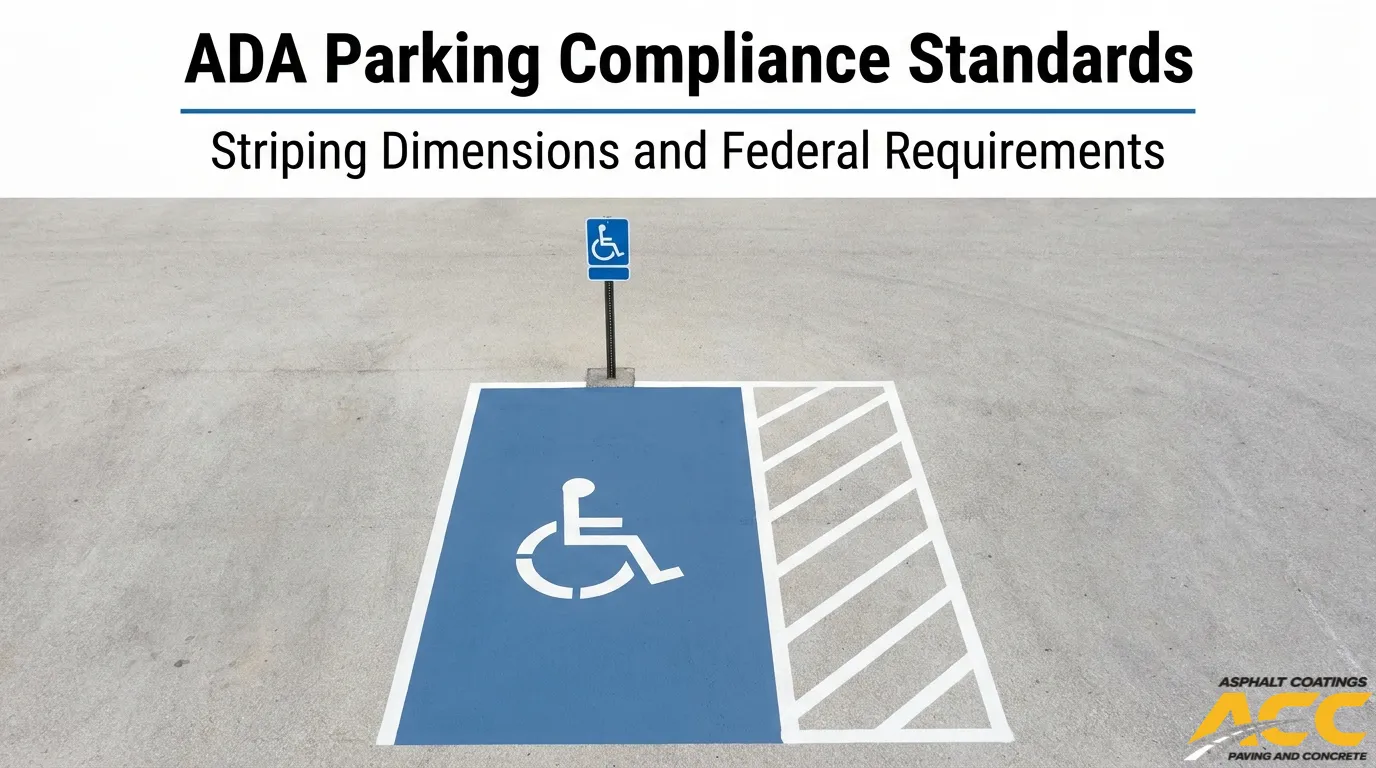
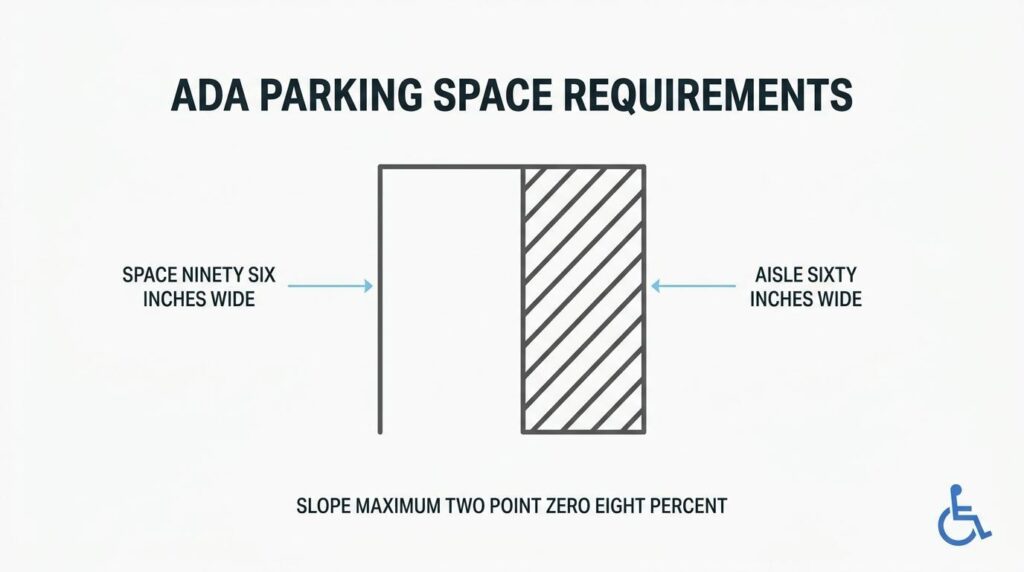
Handicap spaces meet current Colorado ADA standards when they satisfy federal dimensional requirements and local accessibility codes. According to ADA.gov, car-accessible parking spaces must measure at least 96 inches wide with an adjacent access aisle at least 60 inches wide, maintaining no more than a 2.08% slope in all directions.
During your spring walkthrough, verify that:
- Each accessible space includes a properly mounted sign at the correct height.
- Access aisles are free of cracks, heaving, or debris that would impede wheelchair passage.
- Curb ramps at adjacent sidewalks remain flush and stable, since Denver’s concrete curbs must meet specific durability standards per DOTI specifications.
Even minor settling or frost heave can push slopes out of compliance over a single winter season. Proactive measurement with a digital level helps catch violations before they become costly liability issues.
With striping conditions assessed, inspecting the concrete curbs, gutters, and sidewalks surrounding the lot reveals the next layer of potential spring damage.
What Concrete Elements Need Inspection Each Spring?
Concrete elements that need inspection each spring include curbs, gutters, sidewalks, and concrete aprons. These components endure significant stress from Denver’s freeze-thaw cycles and snowplow activity.
Are Curbs and Gutters Cracked or Displaced?
Curbs and gutters are among the first concrete elements to show winter damage in Denver commercial lots. Freeze-thaw cycling forces moisture into small cracks, expanding them over successive winters until sections shift or break apart entirely. Snowplow blade strikes accelerate this displacement, pushing curb sections out of alignment.
During your spring walkthrough, check for:
- Vertical or horizontal cracks wider than 1/4 inch.
- Sections that have shifted, tilted, or separated at joints.
- Crumbling edges where deicing chemicals have degraded the concrete surface.
- Gaps between the curb face and the adjacent asphalt, which allow water infiltration into the subbase.
According to Denver’s Department of Transportation and Infrastructure, concrete used for curbs and gutters must meet specific durability standards to withstand environmental stress and heavy loads. Displaced curbs compromise drainage flow, directing water into the pavement structure rather than toward collection points. For properties with high traffic volume, even minor curb displacement creates a compounding problem that worsens with each season if left unaddressed.
Do Sidewalks and Concrete Aprons Show Heaving or Spalling?
Sidewalks and concrete aprons show heaving or spalling when subsurface moisture freezes and lifts slab sections unevenly. Heaving creates vertical offsets between adjacent panels, while spalling causes the surface layer to flake and pit.
Key indicators to document include:
- Raised or sunken panels creating uneven walking surfaces.
- Surface flaking, scaling, or exposed aggregate from salt and freeze damage.
- Joint sealant failure allowing water to reach the subgrade.
- Tree root intrusion pushing slabs upward near landscaped areas.
Any vertical change of 1/4 inch or more at panel joints constitutes a tripping hazard under OSHA and ADA safety standards. These trip points carry serious liability exposure for Denver property managers. Concrete aprons at building entrances and loading docks deserve particular attention because they bear both pedestrian and vehicle loads simultaneously. Identifying these defects early in spring keeps repair costs manageable before summer heat compounds the deterioration.
With concrete conditions assessed, evaluating the sealcoat layer reveals how well the asphalt surface weathered winter exposure.
How Should You Evaluate the Sealcoat Condition?
You should evaluate the sealcoat condition by inspecting for color fading, surface brittleness, and exposed aggregate. The subsections below cover how to identify wear and when Denver lots typically need resealing.
Is the Existing Sealcoat Showing Wear or Oxidation?
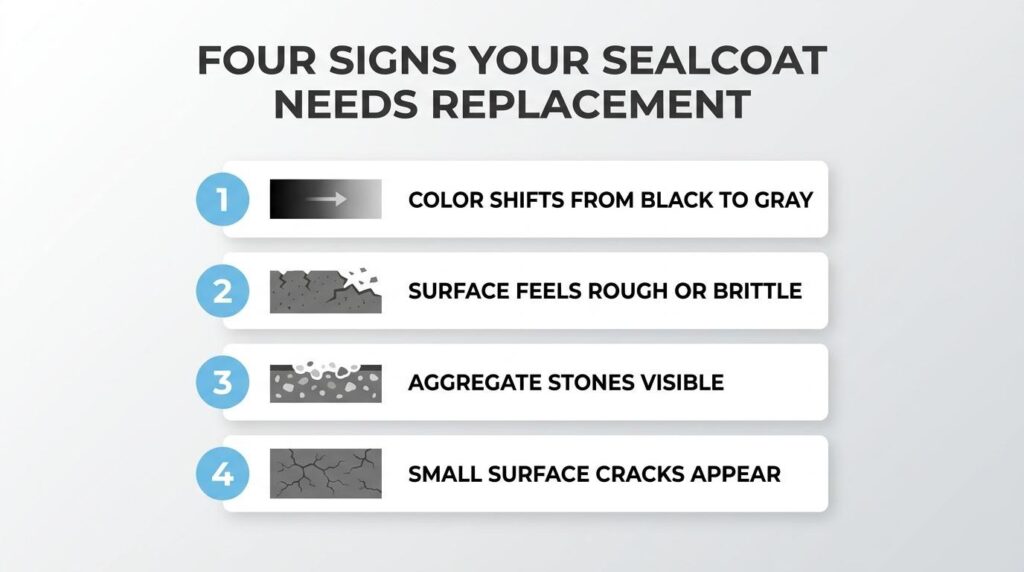
The existing sealcoat is showing wear or oxidation when the surface shifts from rich black to a dull, faded gray. This color change signals that UV radiation and moisture have begun breaking down the protective binder layer. During a spring walkthrough, look for these specific indicators:
- Aggregate stones are visible or loose on the surface.
- The pavement feels dry, rough, or brittle underfoot.
- Small surface cracks have appeared in areas without heavy traffic loading.
- Patches of the original asphalt are exposed where the sealant has worn away entirely.
Oxidized sealcoat no longer repels water or resists fuel spills effectively. For Denver properties, high-altitude UV intensity accelerates this deterioration faster than in lower-elevation markets, making spring evaluation especially important after months of winter exposure.
When Does a Denver Parking Lot Need Resealing?
A Denver parking lot needs resealing when visible oxidation, aggregate exposure, or widespread color fading appears across the surface. Most commercial asphalt lots in Denver require resealing every two to three years to protect against high UV exposure and the region’s intense freeze-thaw cycles, according to CO Pavement Solutions.
Timing matters as much as condition. The Colorado Asphalt Pavement Association specifies that sealcoating should not be applied unless pavement and air temperatures are at least 50 degrees Fahrenheit and rising, with no freezing expected for at least 24 hours. In Denver, this window typically opens in late April or May, making spring the ideal season to schedule resealing after completing your inspection.
With the sealcoat condition assessed, documenting safety and liability hazards ensures no risk goes unaddressed.
What Safety and Liability Hazards Should You Document?
The safety and liability hazards you should document include trip hazards at curb transitions, pavement failures that risk vehicle damage, and damaged or missing signage. Each category carries distinct legal exposure for Denver property managers.
Are Trip Hazards Present at Curb Transitions or Expansion Joints?
Trip hazards are present at curb transitions or expansion joints when vertical surface changes reach a threshold that violates safety standards. According to OSHA and ADA guidelines, any vertical change in a floor or walking surface that is 1/4 inch or more constitutes a tripping hazard. Denver’s freeze-thaw cycles frequently cause concrete slabs to heave at expansion joints, creating exactly this type of displacement.
During your spring walkthrough, check these common trip hazard locations:
- Curb ramps where settled asphalt meets raised concrete
- Expansion joints along sidewalks and pedestrian pathways
- Transitions between parking surfaces and building entries
- Accessible route edges near ADA-designated spaces
Measure any vertical displacement with a straightedge. Document the exact location, offset height, and a timestamped photograph for each instance. This record demonstrates proactive risk management if a slip-and-fall claim arises.
Do Any Pavement Failures Create Vehicle Damage Risk?
Pavement failures create vehicle damage risk when potholes, severe depressions, or undermined surfaces are deep enough to harm tires, wheels, or undercarriages. Unrepaired failures that cause documented vehicle damage expose property managers to premises liability claims under Colorado law.
Prioritize documenting these conditions:
- Potholes deeper than two inches, especially near driving lanes and entries
- Base failures where pavement has collapsed into subgrade voids
- Loose aggregate or broken pavement chunks in traffic paths
- Steel utility covers that have settled below the surrounding surface
For each defect, record its dimensions, depth, and precise location on a lot map. Flagging or coning severe hazards immediately reduces interim liability while repairs are scheduled. Failing to address known vehicle damage risks is one of the most avoidable yet costly oversights in commercial lot management.
Is Signage Damaged or Missing After Winter Storms?
Signage is frequently damaged or missing after winter storms due to snowplow contact, high winds, and salt corrosion weakening sign posts. Missing or illegible signs create liability because they remove critical safety communication for drivers and pedestrians.
Inspect these sign categories during your spring review:
- Stop signs, speed limit signs, and directional markers
- Fire lane signage and no-parking designations
- ADA-accessible parking signs and van-accessible indicators
- Warning signs for speed bumps, pedestrian crossings, and exits
Colorado property owners carry a legal duty to maintain safe access on their premises, and visible, compliant signage is a core component of that obligation. Replace any sign that is bent, faded beyond legibility, or entirely absent. Keep a photographic log of every deficiency found and every replacement completed.
With hazards documented and prioritized, the next step is building a phased repair budget.
How Should You Prioritize and Budget for Repairs?
You should prioritize repairs by separating safety-critical emergencies from scheduled maintenance, then budget using a phased plan that spreads costs across quarters. The following subsections cover emergency classification and phased planning for large lots.
Which Repairs Are Emergency Fixes vs Scheduled Maintenance?
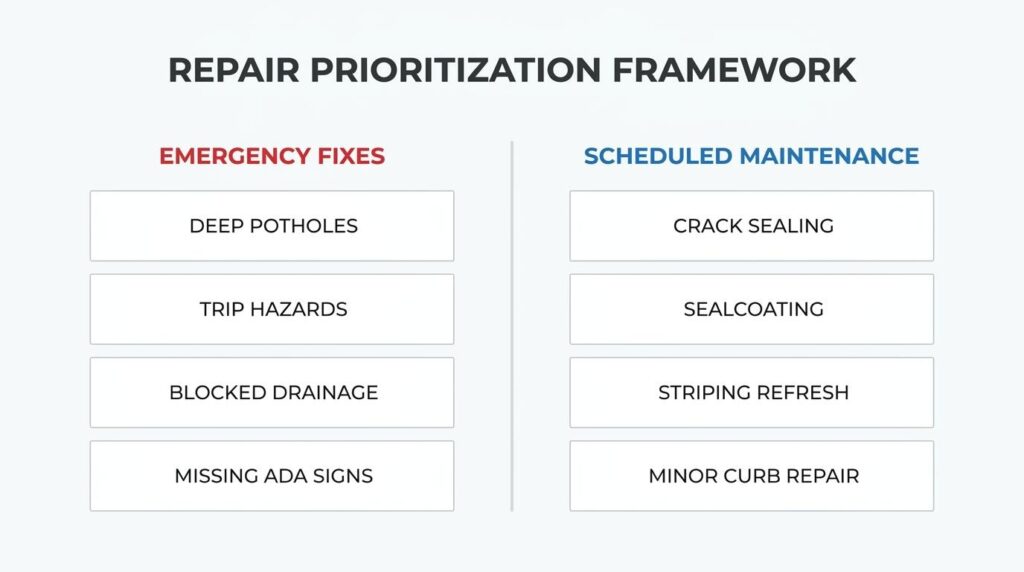
Emergency fixes are repairs that address immediate safety hazards or liability risks, while scheduled maintenance covers preventive work that can be planned within a normal budget cycle. Distinguishing between the two prevents overspending on non-urgent items while ensuring dangerous conditions get resolved fast.
Emergency fixes include:
- Potholes deeper than two inches in high-traffic lanes.
- Trip hazards at curb transitions exceeding 1/4 inch of vertical displacement.
- Collapsed or blocked drainage inlets causing standing water near building entrances.
- Missing or destroyed ADA signage and markings.
Scheduled maintenance includes:
- Crack sealing across stable longitudinal or transverse cracks.
- Sealcoating applications on a two-to-three-year cycle.
- Faded striping and directional arrow repainting.
- Minor curb and gutter repairs with no pedestrian safety risk.
For most Denver commercial lots, addressing emergencies within days and batching scheduled work into spring or early summer yields the best cost efficiency.
How Do You Create a Phased Repair Plan for Large Lots?
You create a phased repair plan by dividing a large lot into priority zones, assigning each zone a repair timeline, and distributing costs across multiple budget quarters or fiscal years. According to Rose Paving, routine maintenance including annual crack filling ($500–$1,000) and triennial sealcoating ($1,500–$3,000) can save over $80,000 in reconstruction costs over a 15-year period.
A practical phased approach follows this sequence:
- Address emergency repairs in all zones immediately.
- Complete high-traffic zones first, typically main entrances and fire lanes.
- Schedule mid-priority zones, such as secondary aisles and loading areas, for the following quarter.
- Defer cosmetic improvements in low-traffic perimeter areas to late summer or fall.
This phased structure lets property managers maintain cash flow while steadily improving overall lot condition. With repair priorities and budgets defined, professional asphalt services can turn inspection findings into actionable project scopes.
How Can Professional Asphalt Services Address Spring Inspection Findings?
Professional asphalt services address spring inspection findings by matching each documented distress to the right repair method. The subsections below cover Asphalt Coatings Company’s capabilities and the key takeaways from this checklist.
Can Asphalt Coatings Company Handle Paving and Sealcoating Repairs for Denver Commercial Properties?
Yes, Asphalt Coatings Company can handle paving and sealcoating repairs for Denver commercial properties. With 39 years of Front Range experience, Asphalt Coatings Company performs asphalt paving, patching, crack sealing, sealcoating, striping, and ADA-compliant concrete work using in-house crews.
Denver’s high UV exposure and intense freeze-thaw cycles mean most commercial asphalt lots require resealing every two to three years. Asphalt Coatings Company designs sealcoating schedules around these conditions, applying CDOT-approved materials once pavement temperatures support proper adhesion. In 2026, commercial sealcoating costs range from $0.18 to $0.36 per square foot, depending on sealer type. For property managers dealing with cracking, potholes, drainage failures, or faded markings uncovered during a spring inspection, a single-source contractor simplifies scheduling and accountability across every repair category. Beyond repairs, expert knowledge of freeze-thaw asphalt mix design is vital for new installations and ensures long-term pavement durability in Denver’s challenging climate.
What Are the Key Takeaways From This Spring Parking Lot Inspection Checklist for Denver Property Managers?
The key takeaways from this spring parking lot inspection checklist for Denver property managers are:
- A structured spring inspection reduces liability risks, extends pavement life, and controls maintenance spending by catching winter damage early.
- Colorado property owners have a legal duty to maintain safe access, making documented inspections essential for compliance.
- Surface distresses, drainage failures, sealcoat wear, ADA deficiencies, and safety hazards each require different repair timelines and budgets.
- Phased repair plans help large properties spread costs without letting high-priority issues worsen.
According to Rose Paving, systematic spring assessments allow managers to identify deterioration before it compounds into costly reconstruction. Parking lot cleaning in Denver averages approximately $81.47 per sweep for a 500-space lot in 2026, making routine upkeep a manageable line item when planned ahead. Property owners must also account for wider strategic considerations, such as Denver's recent elimination of parking minimums, which can significantly influence future property upgrades and redesigns. Partnering with an experienced commercial contractor like Asphalt Coatings Company ensures every finding from your spring checklist translates into a clear, prioritized action plan built for Colorado conditions.