Trip-hazard liability in Colorado Springs is the legal and financial exposure property owners face when heaved, cracked, or uneven sidewalks cause pedestrian injuries. Colorado Springs City Code 3.4.103 makes every owner and occupant of real property primarily liable in tort for injuries on abutting public sidewalks, setting a strict local standard that goes beyond default state law.
This guide covers the geologic and environmental forces behind sidewalk heaving, the liability framework governing property owners and municipalities, Colorado’s legal standards for trip-hazard claims, grinding and replacement as competing repair methods, inspection and documentation protocols, and how local climate shapes repair scheduling.
Colorado Springs sits on clay-rich soils containing bentonite minerals that swell when wet and shrink when dry, generating forces strong enough to crack and displace concrete panels. Over 100 annual freeze-thaw cycles compound this damage by degrading concrete from within its pore structure, while tree roots and poor subgrade preparation accelerate failure on individual slabs.
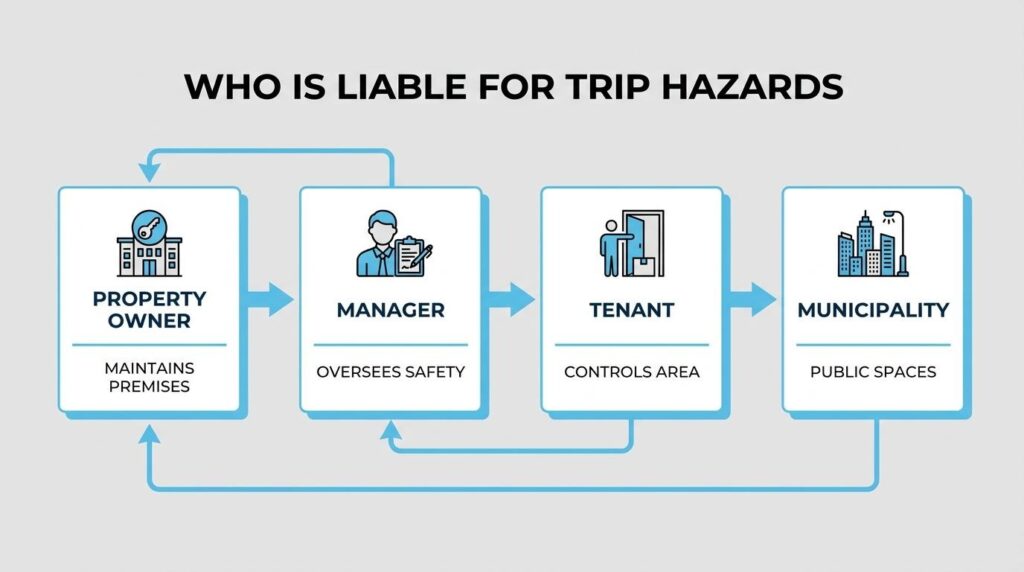
Liability splits between property owners, commercial managers, tenants, and municipal entities depending on lease terms, local ordinances, and the Colorado Governmental Immunity Act. The ADA sets the trip-hazard threshold at just one-quarter inch of vertical displacement; Colorado’s comparative negligence statute bars recovery for plaintiffs found 50% or more at fault.
Grinding corrects minor offsets up to roughly 1.5 inches at a fraction of replacement cost, while full-panel replacement addresses structural failures and delivers a 25- to 30-year service life when paired with proper subgrade work. Bimonthly sidewalk surveys, timestamped photo documentation, and scheduling repairs during optimal spring or fall curing windows form the foundation of a defensible maintenance program.
What Causes Sidewalk Heaving in Colorado Springs?
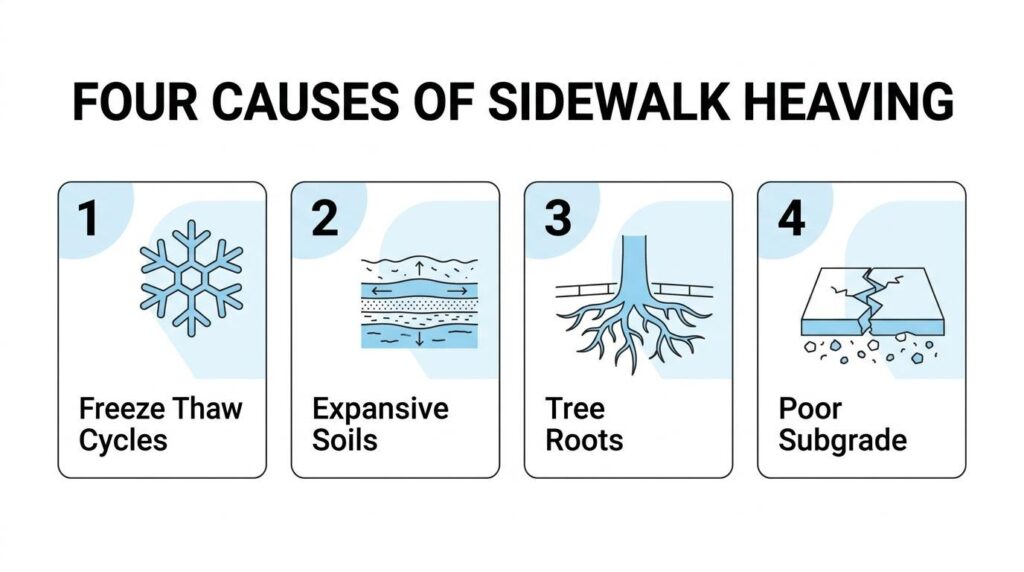
Sidewalk heaving in Colorado Springs results from freeze-thaw cycles, expansive soils, tree root intrusion, and poor subgrade preparation. Each factor works differently beneath the surface.
How Does the Freeze-Thaw Cycle Lift Concrete Slabs?
The freeze-thaw cycle lifts concrete slabs by forcing moisture trapped in the soil and concrete pore structure to expand as it freezes, then contract as it thaws. This repeated expansion and contraction pushes slabs upward incrementally over time.
Concrete in Colorado Springs endures over 100 freeze-thaw cycles annually, causing it to deteriorate faster than in most other regions of the United States. According to research published in the ASCE Library, concrete curing requires a minimum of 16 days before freeze-thaw exposure to maintain hydraulic performance and structural integrity. Slabs poured late in the season or inadequately cured are especially vulnerable. Compressive strength decreases significantly as cycles accumulate, particularly when moisture saturates the concrete’s internal pore network. For commercial property managers, this means even well-installed sidewalks face accelerated degradation without proper drainage and seasonal monitoring.
Why Do Colorado Springs Expansive Soils Push Sidewalks Upward?
Colorado Springs expansive soils push sidewalks upward because they contain clay minerals, particularly bentonite, that swell dramatically when wet and shrink when dry. These volume changes generate vertical and horizontal forces strong enough to crack and heave concrete slabs.
According to the Colorado Geological Survey, Colorado’s soils often contain bentonite minerals that create destructive forces capable of displacing sidewalks and driveways. El Paso County soils specifically exhibit low to moderate swell potential, often requiring over-excavation and replacement to mitigate damage risk. Heaving bedrock compounds the problem; individual bentonite beds in the Colorado Springs area contribute to localized upward ground movement. The City of Colorado Springs assigns a “Moderate Severity” rating when vertical settlement reaches 1 to 1.5 inches. This is a threshold that commercial properties can reach within just a few seasonal moisture cycles if soil conditions are not addressed during initial construction.
How Do Tree Roots Contribute to Sidewalk Heaving?
Tree roots contribute to sidewalk heaving by growing laterally beneath concrete slabs, exerting upward pressure as they expand in diameter over time. Roots naturally seek moisture concentrated along slab edges where irrigation runoff and rainwater collect.
As roots thicken, they displace the subgrade material and push individual panels upward, creating uneven joints and trip hazards. Mature trees planted within four to six feet of a sidewalk pose the highest risk. The resulting damage often appears as a single raised panel rather than a widespread failure, making it easy to overlook during routine inspections. For commercial property owners, this is particularly consequential: the Colorado Governmental Immunity Act (C.R.S. § 24-10-106) waives sovereign immunity for injuries caused by dangerous sidewalk conditions, which can shift legal exposure toward the adjacent property when municipal trees cause damage on abutting walkways.
What Role Does Poor Subgrade Preparation Play in Uneven Sidewalks?
Poor subgrade preparation plays a critical role in uneven sidewalks by creating an unstable foundation that cannot uniformly support concrete loads. When the soil beneath a slab is not properly compacted, graded, or amended before pouring, differential settlement becomes inevitable.
Voids form as loose fill material consolidates under the weight of the concrete and foot traffic. These voids allow individual panels to sink or tilt independently, producing the offset joints that create trip hazards. In Colorado Springs, where expansive clay soils already impose significant stress on concrete, inadequate subgrade work accelerates failure. Proper preparation includes compacting native soil to specified density, removing organic material, and adding granular base material for drainage. Skipping these steps during initial construction is one of the most preventable causes of premature sidewalk heaving on commercial properties.
Understanding what drives sidewalk displacement is the first step toward determining who bears legal responsibility when injuries occur.
Who Is Liable for a Sidewalk Trip Hazard in Colorado?
Liability for a sidewalk trip hazard in Colorado depends on who controls or maintains the property where the hazard exists. The ADA defines a trip hazard as any vertical change exceeding 1/4 inch. The following sections cover property owners, commercial managers, tenants, and municipal entities.
When Is the Property Owner Liable for a Sidewalk Injury?
The property owner is liable for a sidewalk injury when a municipal ordinance assigns maintenance responsibility for abutting public sidewalks. Under Colorado Springs City Code 3.4.103, every owner and occupant of real property is primarily liable in tort for any injury caused by their failure to keep abutting public sidewalks free from dangerous obstructions.
This local code is significant because, under Colorado Revised Statutes Section 13-21-115, property owners are generally not classified as “landowners” of adjacent public sidewalks unless specific municipal ordinances shift that duty. Colorado Springs is one jurisdiction that does shift it. Owners may also face liability for failing to clear ice and snow within the timeframe local law requires. For commercial property owners, this means proactive sidewalk maintenance is not optional; it is a legal obligation that directly reduces exposure to costly premises liability claims.
When Does a Commercial Property Manager Assume Liability?
A commercial property manager assumes liability when a management agreement or lease transfers maintenance duties from the owner to the manager. Once that responsibility is contractually assigned, the manager bears the same duty of care as the owner for keeping sidewalks safe.
According to All American Property Inspection, annual inspections are recommended for commercial properties over 10 years old to detect exterior issues early and mitigate liability risks. Neglecting routine sidewalk assessments after accepting maintenance responsibility creates a direct path to legal exposure. In practice, any property manager overseeing aging commercial sites in Colorado Springs should treat sidewalk condition monitoring as a core operational task, not an afterthought.
Can a Tenant or Lessee Be Held Responsible for Trip Hazards?
Yes, a tenant or lessee can be held responsible for trip hazards when the lease agreement explicitly assigns exterior maintenance obligations. If a commercial lease requires the tenant to maintain sidewalks, clear snow, or address surface defects, that tenant assumes a duty of care toward pedestrians.
Liability often hinges on the specific language in the lease. A triple-net lease, for example, commonly transfers exterior upkeep duties to the lessee. Even without explicit lease terms, a tenant who creates or worsens a hazard through their own actions may face liability. Reviewing lease provisions carefully is essential for any Colorado Springs business occupying leased commercial space.
What Liability Do Municipal Entities Carry for Public Sidewalks?
Municipal entities carry liability for public sidewalks when a dangerous condition exists on infrastructure they own or control. The Colorado Governmental Immunity Act (CGIA), codified at C.R.S. § 24-10-106, waives sovereign immunity for public entities in claims involving injuries caused by a dangerous condition of a public highway, road, street, or sidewalk.
This waiver means the City of Colorado Springs can be sued for injuries resulting from neglected public sidewalks, though claimants must follow strict notice requirements and filing deadlines under the CGIA. However, where local ordinances like City Code 3.4.103 place primary maintenance responsibility on adjacent property owners, the municipality may argue that the property owner, not the city, bore the duty to correct the hazard. This overlapping framework makes it critical for commercial property owners to document their own maintenance efforts thoroughly.
Understanding who holds liability is the first step; knowing Colorado’s legal standards for trip-hazard claims determines whether that liability results in a judgment.
What Are Colorado’s Legal Standards for Trip-Hazard Claims?
Colorado’s legal standards for trip-hazard claims involve specific height thresholds, premises liability rules, filing deadlines, and fault-sharing doctrines. The following sections cover each standard in detail.
What Height Differential Triggers a Trip-Hazard Violation?
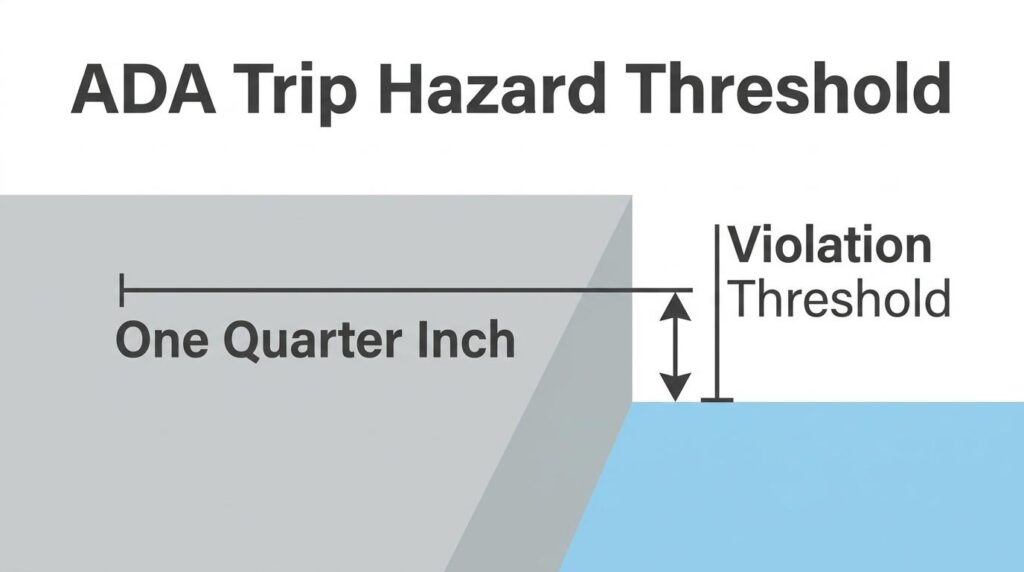
A trip-hazard violation is triggered by any vertical change in level greater than 1/4 inch under the Americans with Disabilities Act. The ADA requires that differentials between 1/4 inch and 1/2 inch be beveled with a slope no steeper than 1:2. The Public Right-of-Way Accessibility Guidelines reinforce that vertical surface discontinuities shall not exceed 0.5 inches.
Colorado Springs applies its own severity scale on top of federal thresholds. The City assigns a “Moderate Severity” rating to concrete damage where vertical settlement reaches 1 to 1.5 inches. Even minor offsets below that city threshold still violate ADA standards and expose property owners to claims. For smaller differentials, sidewalk leveling can be completed for as low as $450 to $650 per project, according to Acme Concrete Paving, making early correction far cheaper than litigation.
How Does Premises Liability Law Apply to Sidewalk Injuries?
Premises liability law applies to sidewalk injuries by holding property owners and occupants responsible for maintaining safe conditions on and adjacent to their property. Under Colorado Springs City Code 3.4.103, every owner and occupant of real property is primarily liable in tort for injuries caused by their failure to keep abutting public sidewalks free from dangerous obstructions.
This local ordinance is significant because state law alone does not automatically assign liability. Under Colorado Revised Statutes Section 13-21-115, a property owner is generally not classified as the “landowner” of a public sidewalk unless a municipal ordinance shifts that maintenance duty. In Colorado Springs, the city code explicitly makes that shift. Property owners who ignore heaved or cracked sidewalk panels face direct legal exposure, regardless of whether the sidewalk sits on public right-of-way.
What Is the Statute of Limitations for a Trip-and-Fall Claim?
The statute of limitations for a trip-and-fall claim in Colorado is typically two years from the date of the accident, according to Chalat Hatten & Banker PC. This deadline applies to premises liability claims filed in civil court.
Missing this window almost always bars the injured party from recovering damages. For property owners, however, the two-year clock creates a different kind of urgency: documented maintenance and timely repairs completed before an incident provide the strongest defense. Waiting until a claim is filed to address a known hazard undermines any argument of reasonable care.
How Does Comparative Negligence Affect a Sidewalk Injury Case?
Comparative negligence affects a sidewalk injury case by determining whether the injured person’s own fault reduces or eliminates their recovery. Under C.R.S. § 13-21-111, a plaintiff can recover damages only if their negligence was not as great as the negligence of the person against whom recovery is sought.
This means Colorado follows a modified comparative negligence standard with a 50% bar. If a pedestrian is found 50% or more at fault, they recover nothing. If they are 30% at fault and the property owner 70%, the award is reduced by 30%. For commercial property owners, this doctrine cuts both ways. A well-documented maintenance history can shift fault toward the plaintiff, while deferred repairs make it far harder to argue shared responsibility.
Understanding these legal standards helps property owners evaluate whether proactive repair, through grinding or replacement, is the more defensible strategy.
What Is Sidewalk Grinding and How Does It Fix Trip Hazards?
Sidewalk grinding is a concrete repair method that removes raised edges at slab joints to eliminate trip hazards. The process, costs, and durability depend on the severity of the height differential.
How Does a Contractor Grind Down a Raised Concrete Slab?
A contractor grinds down a raised concrete slab by using a diamond-blade grinding machine to shave the higher side of an uneven joint until it sits flush with the adjacent panel. The process follows a consistent sequence:
- The contractor marks the trip-hazard location and measures the vertical offset.
- A walk-behind or handheld diamond grinder cuts into the raised slab surface.
- Material is removed in progressive passes until the transition meets the target slope.
- The ground area is smoothed to prevent rough edges that could catch footwear or wheelchair wheels.
Most grinding jobs on a single joint take under an hour, and the sidewalk can handle foot traffic immediately afterward. For commercial properties in Colorado Springs, this speed minimizes disruption to tenants and visitors.
What Height Differences Can Grinding Effectively Correct?
Grinding effectively corrects height differences up to approximately 1.5 inches between adjacent concrete slabs. Offsets of one-quarter inch to one-half inch are the most common candidates, since the ADA classifies any vertical change above one-quarter inch as a trip hazard requiring correction.
Offsets between one-half inch and 1.5 inches respond well to grinding when the surrounding concrete is structurally sound. Beyond 1.5 inches, grinding removes too much material, weakening the slab and exposing aggregate. At that threshold, full-panel replacement becomes the more reliable option. For most commercial sidewalks in Colorado Springs, where expansive soils create moderate heaving, grinding addresses the majority of early-stage offsets before they escalate.
How Long Does a Sidewalk Grinding Repair Typically Last?
A sidewalk grinding repair typically lasts 5 to 10 years, depending on soil movement, drainage conditions, and traffic volume. In Colorado Springs, ongoing freeze-thaw cycling and expansive clay soils can shorten this window if the underlying cause of heaving remains unaddressed.
Grinding treats the surface symptom rather than the subsurface force driving the displacement. When paired with proper drainage improvements or root barriers, longevity extends toward the upper range. According to Angi, professional sidewalk repair, including grinding, typically costs between $726 and $2,485, making it a cost-effective interim solution compared to full replacement. For commercial property managers, scheduling periodic re-inspections after grinding catches reoffending joints before they reach actionable liability thresholds again.
With the grinding process clarified, understanding when full replacement becomes necessary completes the repair decision.
What Is Sidewalk Replacement and When Is It Necessary?
Sidewalk replacement is the complete removal and repour of one or more concrete panels that have deteriorated beyond what surface-level repairs can correct. The following subsections explain when grinding falls short, what full-panel replacement involves, and how long new concrete lasts.
When Is the Damage Too Severe for Grinding Alone?
The damage is too severe for grinding alone when structural failures extend below the surface or when vertical displacement exceeds what a grinder can safely remove. Grinding works well for minor lip offsets, but several conditions require full replacement:
- The slab has settled or heaved more than approximately 1.5 inches, which the City of Colorado Springs classifies as beyond “Moderate Severity.”
- Deep structural cracks run through the full depth of the panel.
- The subgrade beneath the slab has eroded, creating voids that will cause re-settlement.
- Spalling or deterioration covers a large percentage of the panel surface.
- Tree root intrusion has fractured the slab in multiple locations.
For commercial properties in Colorado Springs, where expansive soils and aggressive freeze-thaw cycling compound these failures, grinding a severely damaged panel only masks the problem temporarily.
What Does Full-Panel Concrete Replacement Involve?
Full-panel concrete replacement involves sawcutting the damaged section at its control joints, breaking out and hauling away the old concrete, preparing the subgrade, and pouring a new panel. The typical process follows these steps:
- A contractor sawcuts along existing joints to isolate the damaged panel.
- The crew demolishes and removes all old concrete from the site.
- The exposed subgrade is inspected, compacted, and corrected for drainage or soil instability.
- Forms are set to match the existing sidewalk grade and alignment.
- New concrete is poured, finished, and cured according to local specifications.
Subgrade preparation is especially critical in Colorado Springs, where El Paso County’s clay-rich soils often require over-excavation and backfill with stable material to prevent future heaving.
How Long Does a Replaced Sidewalk Section Last?
A replaced sidewalk section lasts 25 to 30 years on average when proper subgrade preparation and concrete mix design are used. Several factors influence that lifespan in Colorado Springs:
- Subgrade quality: Stable, well-compacted base material prevents differential settlement.
- Concrete mix and air entrainment: Properly air-entrained concrete resists freeze-thaw damage far longer than standard mixes.
- Curing conditions: According to a study published in the ASCE Library, concrete requires a minimum curing period of 16 days before freeze-thaw exposure to maintain structural integrity.
- Ongoing maintenance: Timely joint sealing and crack repair slow deterioration.
Investing in correct installation practices upfront is one of the most effective ways to extend panel life and reduce long-term liability exposure. With replacement fundamentals covered, the next step is comparing its cost and ROI against grinding.
How Does Grinding Compare to Replacement for Cost and ROI?
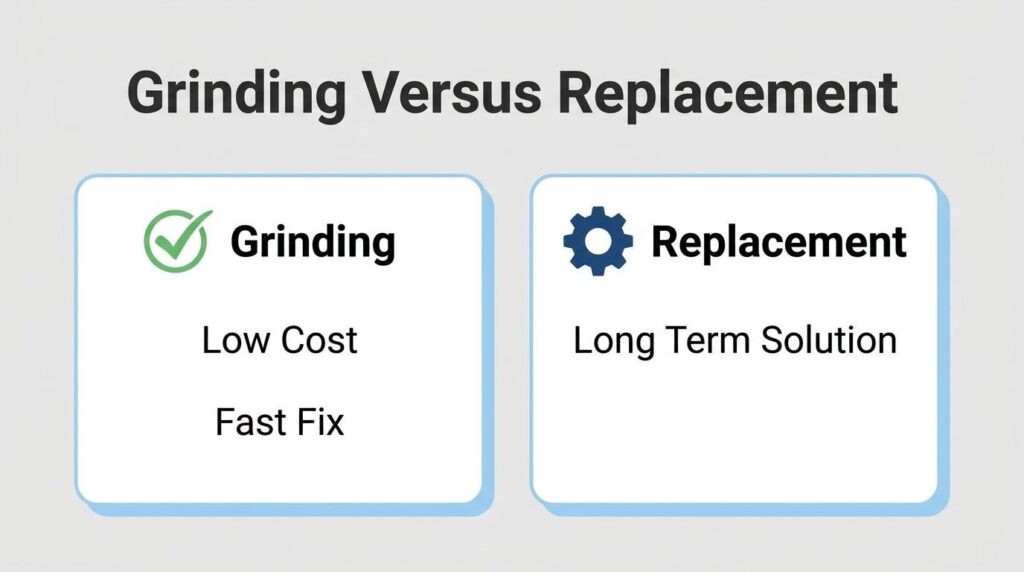
Grinding compares to replacement as a significantly lower-cost option with faster ROI for minor trip hazards, while replacement delivers longer-term structural value for severely damaged panels. The sections below break down per-foot grinding costs, per-square-foot replacement costs, and long-term liability implications.
How Much Does Sidewalk Grinding Cost per Linear Foot?
Sidewalk grinding cost per linear foot is substantially lower than new concrete installation. Professional sidewalk repair methods, including grinding, typically range from $726 to $2,485 per project, according to Angi. For context, new concrete sidewalk installation in 2026 is projected to cost $25 to $55 per linear foot for a standard 4-foot-wide walkway.
Grinding addresses the specific raised joint rather than replacing an entire panel, which concentrates spending on the actual hazard. For commercial property managers overseeing multiple buildings, this targeted approach can resolve dozens of trip points for less than the cost of replacing a single sidewalk section. When the height differential falls within correctable range, grinding delivers the fastest liability reduction per dollar spent.
How Much Does Full Sidewalk Replacement Cost per Square Foot?
Full sidewalk replacement cost per square foot typically ranges from $10 to $25, depending on site conditions and accessibility. Colorado Springs property owners may qualify for the city’s cost-sharing program, which in 2024 priced new sidewalk installation at $2.90 per square foot, with an additional $2.25 per square foot for removing damaged concrete.
Even with cost-sharing, replacement requires demolition, hauling, subgrade preparation, forming, pouring, and curing time. These steps multiply both direct costs and operational disruption for commercial properties. Replacement is the right investment when structural damage runs too deep for surface correction, but for isolated heave points under two inches, the price premium is difficult to justify.
Which Option Reduces Long-Term Liability Exposure More?
The option that reduces long-term liability exposure more depends on the severity of the underlying cause. Grinding eliminates the immediate trip hazard quickly, which removes the most urgent legal exposure. However, if expansive soils or root intrusion continue driving movement beneath the slab, the hazard can return.
Replacement addresses both the surface defect and the subgrade condition when paired with proper base preparation. For properties with recurring heave patterns, replacement combined with soil stabilization provides the most durable liability protection. A practical strategy for commercial portfolios combines both methods: grind minor offsets to eliminate immediate risk, then budget replacement for panels showing progressive structural failure.
With cost and ROI factors established, routine inspections help property owners catch new hazards early.
How Should Commercial Property Owners Inspect for Trip Hazards?
Commercial property owners should inspect for trip hazards through scheduled walkthrough surveys and thorough documentation. The following subsections cover recommended inspection frequency and the records that protect against liability claims.
How Often Should You Survey Sidewalks on Commercial Property?
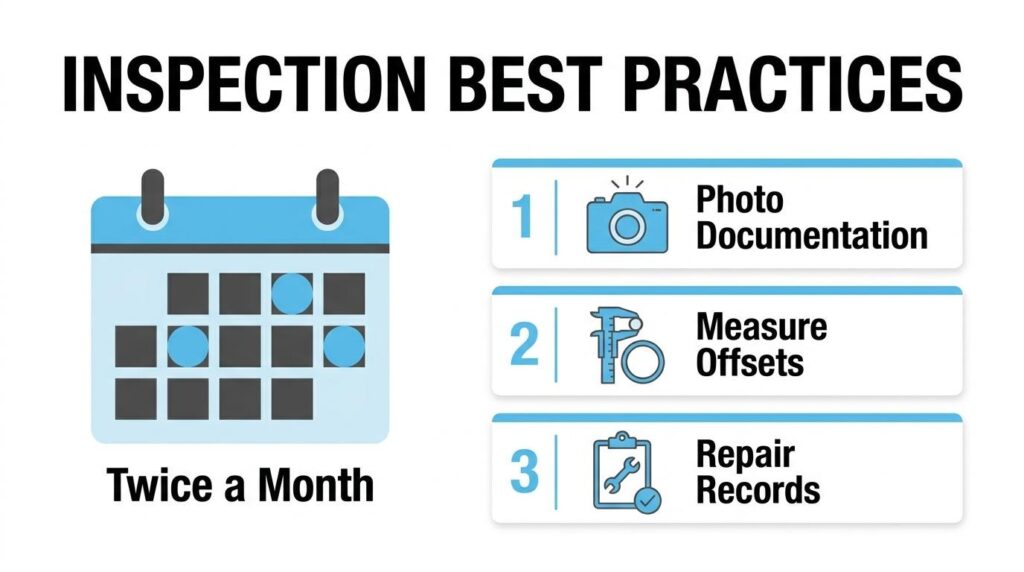
You should survey sidewalks on commercial property at least twice a month. According to Metro Commercial, regular site inspections at this frequency help identify hazards like potholes or sidewalk cracks before they lead to injury claims. Properties over ten years old benefit from additional annual comprehensive assessments that evaluate the full exterior envelope.
A consistent bimonthly schedule catches seasonal damage early, particularly in Colorado Springs where freeze-thaw cycles accelerate concrete deterioration between inspections. Key areas to prioritize during each survey include:
- High-traffic entry points and building frontages
- Sidewalk joints adjacent to mature tree root zones
- Transitions between concrete panels and asphalt surfaces
- ADA-accessible routes and curb ramps
- Areas where drainage collects or pools near walkways
Roughly 68% of exterior system issues stem from maintenance problems identifiable through routine surveys. Waiting for a complaint or visible failure creates unnecessary exposure.
What Documentation Protects You if a Trip-Hazard Claim Arises?
The documentation that protects you if a trip-hazard claim arises includes dated inspection logs, timestamped photographs, and written repair records. These materials establish that reasonable care was exercised, which is the central question in any premises liability case.
Essential records to maintain for every inspection cycle include:
- Dated inspection checklists signed by the surveyor
- Photographs with timestamps showing sidewalk condition at each checkpoint
- Measurement records of any vertical displacement found at joints
- Written work orders and contractor invoices for completed repairs
- Incident reports filed within 24 hours of any reported fall
Without this paper trail, a property owner’s claim of diligent maintenance becomes difficult to prove. Courts evaluate whether an owner knew or should have known about a hazard; consistent documentation demonstrates proactive awareness and timely response.
With inspection protocols established, seasonal timing determines when repairs deliver the best results.
How Does Colorado Springs Climate Affect Repair Timing?
Colorado Springs climate affects repair timing by compressing the viable work season into narrow windows when temperatures support proper concrete curing. The sections below cover optimal scheduling months and the impact of rapid temperature swings.
What Is the Best Season to Schedule Sidewalk Repairs?
The best season to schedule sidewalk repairs in Colorado Springs is late spring or early fall. According to Crestone Concrete, the ideal months for pouring concrete in Colorado are May through June and September through October, when temperatures consistently range between 50°F and 60°F. These conditions allow concrete to hydrate properly without the risks that extreme heat or freezing temperatures introduce.
Summer repairs are possible but require careful timing around afternoon thunderstorms common along the Front Range. Winter pours, by contrast, should generally be avoided unless cold-weather additives and insulated curing blankets are used. For commercial property managers facing active trip hazards, scheduling repairs during these optimal spring repair windows prevents costly rework and ensures the finished surface meets long-term durability expectations.
How Do Rapid Temperature Swings Shorten a Repair Window?
Rapid temperature swings shorten a repair window by disrupting the curing process that fresh concrete requires. Colorado Springs routinely experiences 40- to 50-degree daily temperature shifts, where a mild afternoon can drop below freezing overnight. A study published in PubMed Central found that the compressive strength of concrete decreases significantly as freeze-thaw cycles increase, particularly when moisture remains within the pore structure.
Fresh concrete needs a minimum curing period of 16 days before freeze-thaw exposure to maintain structural integrity. When overnight lows dip unexpectedly, partially cured slabs can develop micro-fractures that accelerate future heaving. This reality makes real-time weather monitoring essential for contractors working in Colorado Springs, since even a single premature freeze event can compromise an entire pour.
Understanding these climate constraints helps property owners plan repairs that last, rather than cycling through premature failures.
How Can Commercial Concrete Services Address Your Trip-Hazard Risk?
Commercial concrete services address trip-hazard risk through professional grinding, full-panel replacement, and ADA-compliant repairs tailored to each property’s conditions.
Can Asphalt Coatings Company’s Concrete Team Handle Grinding and Replacement?
Yes, Asphalt Coatings Company’s concrete team can handle both grinding and replacement for commercial properties across Colorado Springs. Since 1986, Asphalt Coatings Company has provided concrete flatwork installation, sidewalk construction, and ADA-compliant concrete work using in-house crews. This single-source approach means one contractor manages subgrade preparation, slab removal, grinding, and new paving, eliminating coordination gaps that delay repairs and extend liability exposure.
Asphalt Coatings Company specializes exclusively in commercial projects, serving property managers, shopping centers, office parks, healthcare centers, and apartment complexes throughout Colorado’s Front Range. For property owners facing heaved sidewalks, combining grinding for minor differentials with targeted replacement for severe damage is often the most cost-effective strategy to restore compliance quickly.
What Are the Key Takeaways About Sidewalk Heaving Liability and Repair Options in Colorado Springs?
The key takeaways about sidewalk heaving liability and repair options in Colorado Springs center on three factors: understanding local soil conditions, knowing your legal obligations, and choosing the right repair method.
- Colorado Springs expansive soils and over 100 annual freeze-thaw cycles make sidewalk heaving a persistent, recurring problem that demands proactive management.
- Property owners bear primary tort liability under Colorado Springs City Code 3.4.103 for injuries caused by poorly maintained abutting sidewalks.
- ADA standards classify any vertical change exceeding one-quarter inch as a trip hazard, setting a low threshold that many heaved slabs exceed.
- Grinding corrects minor height differentials at a fraction of full replacement cost, while severely damaged panels require complete removal and repaving.
- According to Focus Building Inspections, approximately 68% of commercial exterior issues stem from maintenance problems identifiable through routine surveys.
- Scheduling repairs during Colorado’s optimal concrete-pouring windows and maintaining documented inspection records strengthens both pavement longevity and legal defensibility.
Proactive sidewalk management is ultimately less expensive than reactive litigation. Asphalt Coatings Company can assess your Colorado Springs commercial property and recommend the right combination of grinding and replacement to reduce trip-hazard liability.