A commercial paving company is a specialized contractor that builds, maintains, and repairs asphalt and concrete surfaces for businesses, institutions, and multi-tenant properties. We created this guide to cover property value protection and liability reduction, core paving services, property types served, contractor selection criteria, and climate-driven maintenance planning.
Professionally maintained pavement preserves long-term asset value by preventing subgrade failures, while proactive repairs eliminate trip hazards and ADA violations that expose owners to costly injury claims and legal action.
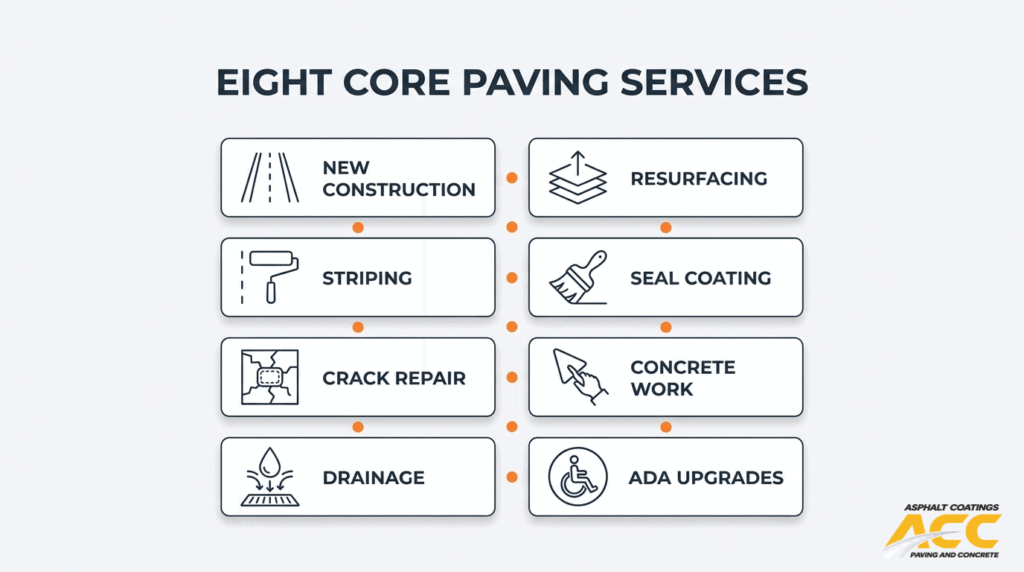
Commercial paving services span new asphalt construction, resurfacing overlays, sealcoating, crack sealing, pothole repair, striping, concrete flatwork, drainage engineering, and ADA compliance upgrades; each service targets a specific stage in the pavement lifecycle.
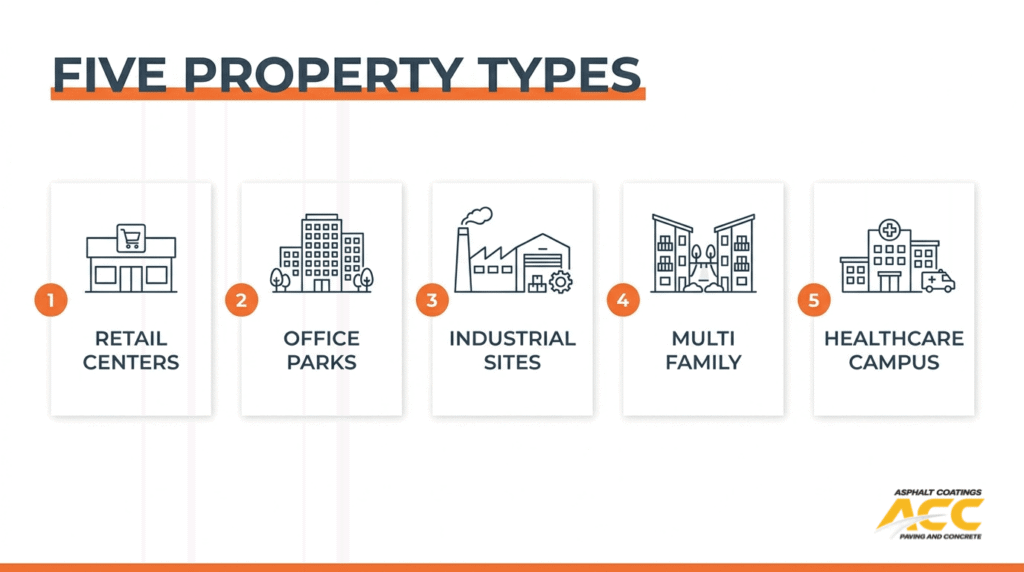
Retail centers, office parks, industrial facilities, multi-family communities, and healthcare or educational campuses all require commercial-grade paving, though each property type presents distinct load requirements, traffic patterns, and regulatory obligations.
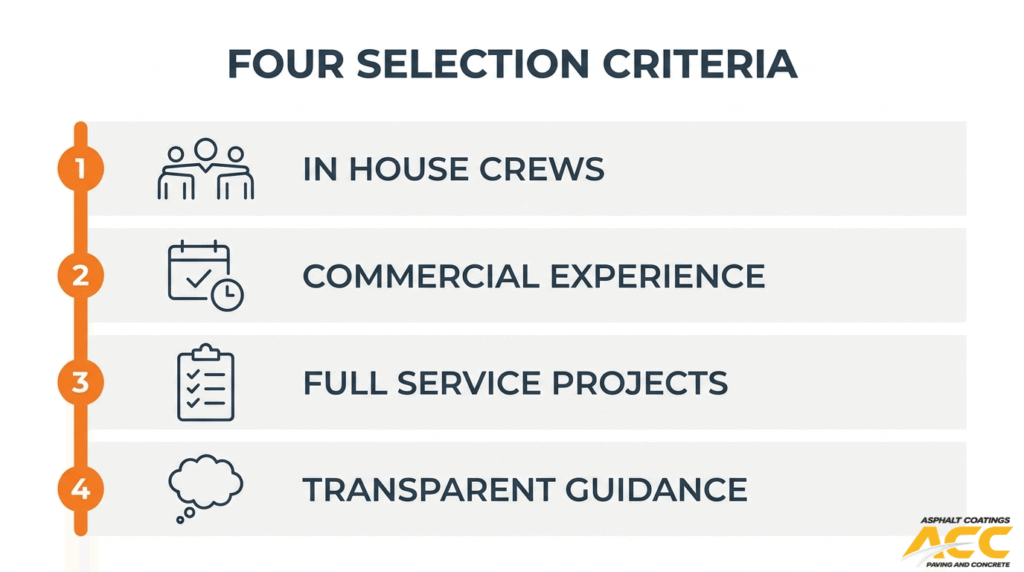
Selecting the right contractor depends on whether crews are in-house, how many years of commercial-specific experience they hold, whether they manage full lifecycle projects, and whether they provide consultative guidance beyond a simple bid.
Regional climate conditions, particularly freeze-thaw cycling, high-altitude UV exposure, and variable precipitation, dictate material choices, maintenance intervals, and drainage design decisions that determine how long pavement performs before requiring reconstruction.
Why Is a Commercial Paving Company Important for Property Owners?
A commercial paving company is important for property owners because it protects asset value, minimizes legal exposure, and shapes visitor perception. The following sections detail how professional paving achieves each of these outcomes.
How Does Professional Paving Protect Long-Term Property Value?
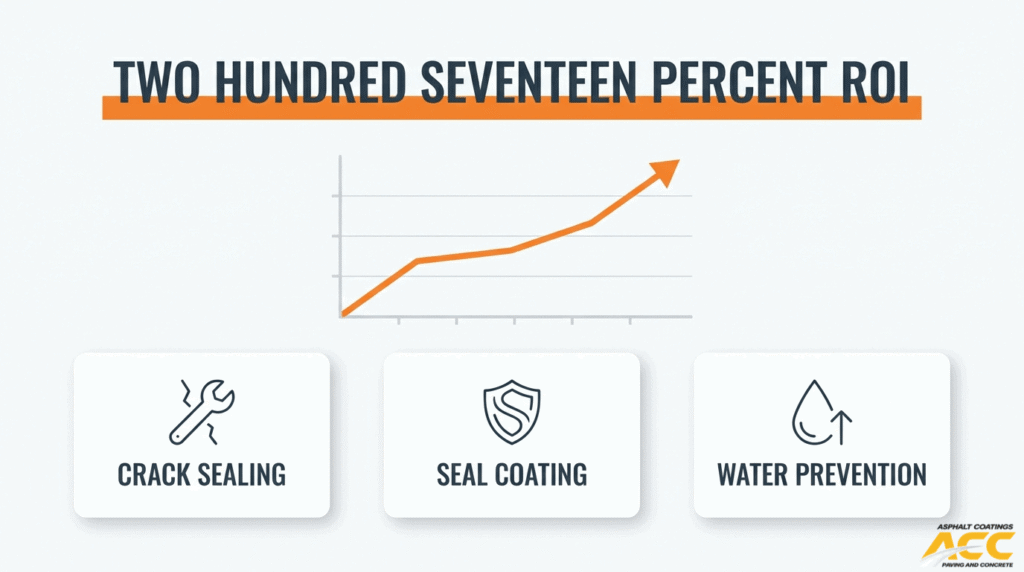
Professional paving protects long-term property value by preserving structural integrity and extending pavement lifespan through timely maintenance. Preventive treatments, such as crack sealing and sealcoating, prevent water from entering the subgrade, which avoids costly full-depth failures. A 2023 survey from the National Association of Realtors reported a 217% return on investment for standard exterior maintenance services that contribute to overall property condition and buyer appeal. Well-maintained asphalt signals responsible ownership, which directly influences appraisal outcomes and tenant retention. Neglecting pavement, by contrast, accelerates deterioration and compresses the window before expensive reconstruction becomes unavoidable.
How Does a Commercial Paving Company Reduce Liability Risk?
A commercial paving company reduces liability risk by identifying and correcting surface hazards before they cause injury or property damage. Cracked pavement, potholes, and faded markings create conditions for slip-and-fall incidents, vehicle damage, and ADA violations. According to the National Safety Council, the average cost for a medically consulted work injury in 2024 was $48,000, while a workplace death was estimated at $1,540,000. Professional paving contractors address these exposures through:
- Routine pothole repair and crack sealing to eliminate trip hazards.
- ADA-compliant access routes, ramps, and parking stall configurations.
- Clear striping and directional markings that guide traffic safely.
Proactive maintenance is far less expensive than a single liability claim.
How Does Expert Paving Improve First Impressions for Businesses?
Expert paving improves first impressions for businesses by delivering smooth, clean, and clearly marked surfaces that communicate professionalism before a customer reaches the front door. A survey by the National Association of REALTORS® found that 92% of realtors recommend improving curb appeal prior to listing, underscoring how powerfully exterior condition influences perception. For commercial properties, the parking lot is often the first physical touchpoint. Fresh sealcoating, sharp line striping, and even grading signal that ownership invests in quality, which builds visitor confidence and encourages repeat patronage.
With property value, liability, and curb appeal addressed, understanding the specific services a paving company provides clarifies how these benefits are delivered.
What Services Does a Commercial Paving Company Provide?
A commercial paving company provides a full range of asphalt and concrete services, from new construction to ongoing maintenance. The following subsections cover eight core service categories.
New Asphalt Construction
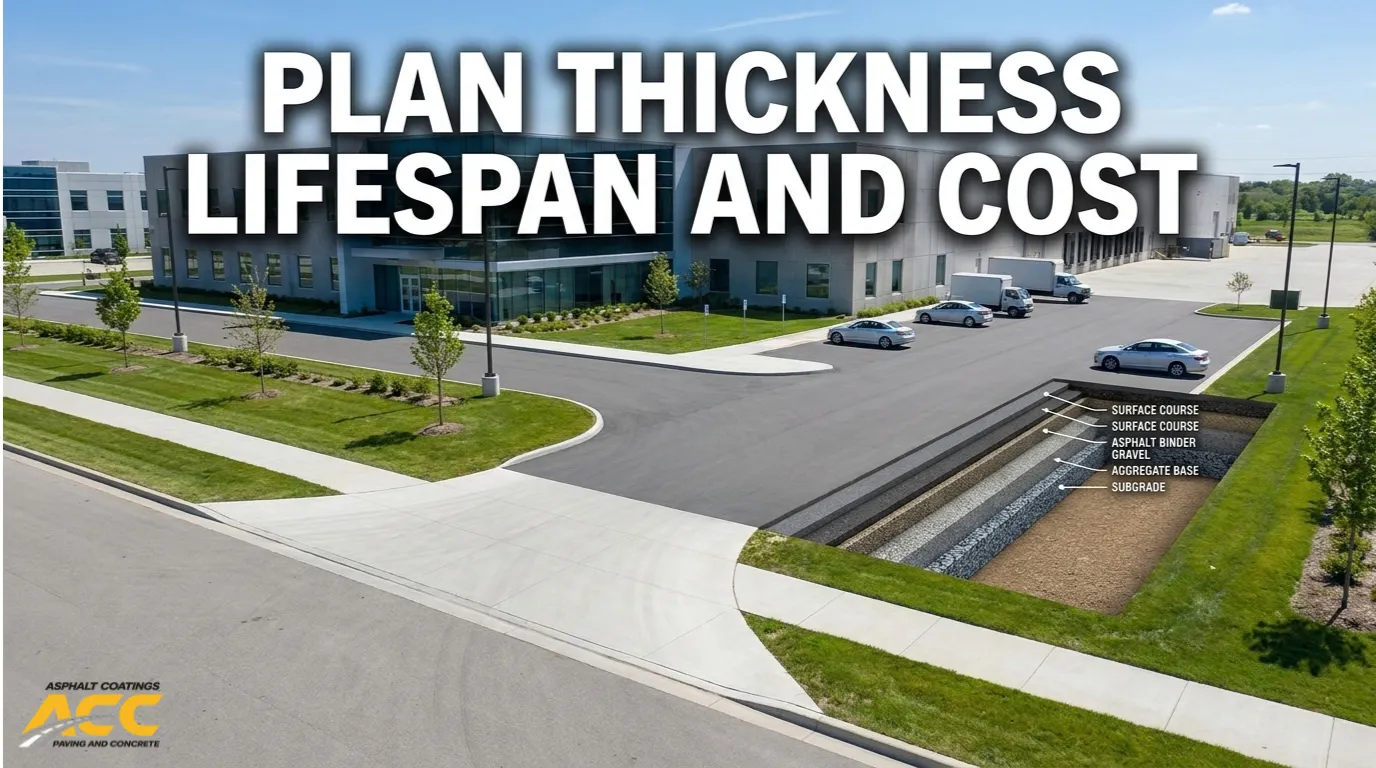
New asphalt construction is the process of building a pavement surface from the ground up on a previously unpaved or fully demolished site. This service includes subgrade preparation, grading, base compaction, and laying hot-mix asphalt in engineered lifts. Commercial projects require specialized equipment and larger crews to handle the increased scope and scale, as noted by RDC Paving. Proper installation at this stage determines how the pavement performs for decades, making material selection and compaction density critical from the first pass.
Asphalt Resurfacing and Overlays
Asphalt resurfacing is the application of a new asphalt layer over an existing pavement surface that remains structurally sound. An overlay costs approximately $31,000 and lasts around 12 years, producing an annual cost of roughly $2,583, compared to full replacement at $100,000 over a 25-year lifespan at about $4,000 per year. For properties where the base is intact but the surface shows wear, resurfacing delivers significant savings. This makes overlays one of the most cost-efficient solutions for extending pavement life without full-depth reconstruction.
Parking Lot Striping and Marking
Parking lot striping and marking involves painting directional lines, stall boundaries, fire lanes, and accessible space designations onto paved surfaces. According to the Federal Highway Administration, center line markings are required on all paved urban arterials and collectors with a traveled way of 20 feet or more in width and an average daily traffic count of 6,000 vehicles or greater. Clear markings improve traffic flow, reduce confusion, and help property owners meet local code requirements.
Sealcoating
Sealcoating is a preventive maintenance treatment that applies a protective bituminous coating over existing asphalt to shield it from UV rays, water infiltration, and chemical spills. According to The Pavement Group, most commercial parking lots require sealcoating every two to three years, depending on traffic volume and environmental conditions. When applied on schedule, this relatively low-cost treatment preserves surface flexibility and delays the oxidation that leads to cracking and deterioration.
Crack Sealing and Pothole Repair
Crack sealing and pothole repair are corrective maintenance services that address surface failures before they compromise the pavement structure. A study published on ResearchGate found crack sealing to be a highly cost-effective method, with optimal effectiveness when the pretreatment pavement condition index falls between 81 and 89. Sealing cracks early prevents water from reaching the subgrade, which is especially critical in climates with freeze-thaw cycles. Pothole patching restores surface integrity and reduces vehicle damage risk for tenants and visitors.
Concrete Flatwork and Curbing
Concrete flatwork and curbing encompass the installation and repair of sidewalks, curbs, gutters, and other non-asphalt hardscape elements on commercial properties. Curbing defines traffic boundaries, protects landscaping, and directs stormwater toward drainage infrastructure. Flatwork provides durable, slip-resistant pedestrian surfaces that withstand heavy foot traffic. These concrete components work alongside asphalt pavement to create a complete, functional site layout.
Drainage and Grading Solutions
Drainage and grading solutions involve engineering proper surface slopes and installing stormwater management features to prevent water from pooling on or beneath pavement. Most cities and counties require permits for excavation and drainage on commercial projects, which are typically handled by the paving contractor. Without adequate drainage, standing water accelerates asphalt deterioration and creates safety hazards. Proper grading during initial construction, or as a retrofit, protects the subgrade and extends overall pavement lifespan.
ADA Compliance Upgrades
ADA compliance upgrades are modifications to parking lots, sidewalks, and access routes that bring commercial properties into alignment with federal accessibility standards. According to the U.S. Department of Justice, a parking facility with 1 to 25 total spaces must provide at least 1 accessible space, while facilities exceeding 1,000 spaces require 20 plus 1 for every additional 100. These upgrades include accessible ramps, detectable warning surfaces, and compliant signage. Failing to meet ADA standards exposes property owners to legal action and costly fines, making proactive upgrades a sound investment.
Understanding the full scope of available services helps property owners match the right solution to each property type.
What Types of Commercial Properties Need Professional Paving?
The types of commercial properties that need professional paving include retail centers, office parks, industrial facilities, multi-family communities, and healthcare or educational campuses. Each property type presents unique traffic patterns, load requirements, and compliance needs.
Shopping Centers and Retail Complexes
Shopping centers and retail complexes require professional paving due to constant stop-and-go traffic that accelerates surface deterioration. According to Monroe County Planning research, retail properties such as convenience stores are designed to attract high volumes of stop-and-go traffic, which increases wear and tear on parking lot surfaces compared to other commercial land uses. These facilities need frequent striping updates, ADA-compliant accessible spaces, and smooth surfaces that prevent cart damage and trip hazards. Sealcoating every two to three years is especially critical for retail lots exposed to oil drips and turning movements.
Office Parks and Corporate Campuses
Office parks and corporate campuses need professional paving to maintain polished curb appeal and accommodate daily employee and visitor traffic. These properties typically feature extensive connected parking areas, internal roadways, and pedestrian pathways that demand coordinated drainage design. Because tenants and clients form first impressions from the parking lot, cracked or faded asphalt signals neglect. Consistent pavement management across multiple buildings requires specialized equipment and larger crews than residential projects demand.
Industrial Facilities and Warehouses
Industrial facilities and warehouses require heavy-duty paving engineered for concentrated loads from forklifts, tractor-trailers, and shipping containers. According to the National Asphalt Pavement Association, the average price of asphalt binders is approximately $480 per ton, making material selection a significant cost factor for large industrial surfaces. Thicker asphalt sections, reinforced subgrades, and proper grading prevent rutting in loading dock areas. These properties also need clear lane markings for safe truck circulation and compliance with local permits for excavation and drainage.
Multi-Family and HOA Communities
Multi-family and HOA communities need professional paving for shared parking lots, private drives, and pedestrian walkways that serve hundreds of residents daily. Poorly maintained surfaces create liability exposure; the National Safety Council reports the average cost for a medically consulted work injury in 2024 was $48,000, underscoring the financial risk of trip-and-fall incidents on deteriorated pavement. These communities benefit from phased maintenance plans that minimize resident disruption while preserving long-term pavement life.
Healthcare and Educational Campuses
Healthcare and educational campuses require professional paving to ensure safe, accessible surfaces for patients, students, visitors, and emergency vehicles. ADA compliance is non-negotiable; facilities with over 1,000 parking spaces must provide at least 20 accessible spots plus one for each additional 100 spaces. Smooth pavement also supports wheelchair and gurney transport, while clear wayfinding markings guide ambulances and buses efficiently. For properties of this complex, a commercial paving partner with broad project experience ensures consistent quality across every surface.
How Does a Commercial Paving Company Differ from a Residential One?
A commercial paving company differs from a residential one in scale, equipment, regulatory requirements, and project complexity. Commercial projects demand larger crews, heavier machinery, and compliance with municipal codes that residential driveways rarely involve.
According to RDC Paving, commercial and municipal paving projects almost always involve installing pavements that are much larger than residential pavements, requiring specialized equipment and larger crews to handle the increased scope and scale. The differences extend beyond size into permitting, design standards, and long-term maintenance planning.
Key distinctions between commercial and residential paving include:
- Project scale: Commercial lots serve hundreds or thousands of vehicles daily, while residential projects typically cover a single driveway or walkway.
- Equipment requirements: Commercial work requires industrial pavers, rollers, and milling machines that residential contractors do not maintain.
- Regulatory compliance: Most cities and counties require permits for excavation, drainage, and ADA compliance on commercial projects, which the paving contractor typically handles.
- Traffic management: Commercial sites must accommodate ongoing business operations during construction, requiring phased scheduling and traffic control plans.
- Maintenance cycles: Commercial parking lots require sealcoating every two to three years based on traffic volume and environmental conditions, a frequency residential surfaces rarely need.
- Structural design: Heavy vehicle loads from delivery trucks and equipment demand thicker subbase layers and higher-grade asphalt mixes than residential applications.
For property managers overseeing retail centers, office parks, or industrial facilities, these differences make working with a commercial-focused contractor essential. A residential paving company simply lacks the crew depth, equipment fleet, and code expertise to manage multi-phase commercial projects effectively. With these distinctions clear, choosing the right contractor becomes the next critical decision.
What Should You Look for When Choosing a Commercial Paving Company?
You should look for in-house crews, commercial-specific experience, full-service project capabilities, and transparent guidance when choosing a commercial paving company.
Does the Company Use In-House Crews or Subcontractors?
A company that uses in-house crews provides greater quality control, accountability, and scheduling consistency than one relying on subcontractors. According to a 2025 ResearchGate study on subcontractor selection for construction projects, assessing trade-offs between cost, quality, and time is a critical criterion when evaluating whether a contractor self-performs work or outsources it. In-house teams answer directly to the paving company, which means communication stays streamlined and standards remain uniform across every phase. For property managers coordinating tenant operations, this single point of responsibility eliminates finger-pointing between multiple parties when issues arise.
How Many Years of Commercial-Specific Experience Do They Have?
The number of years of commercial-specific experience a paving company has directly reflects its ability to handle large-scale project demands. According to H&H Paving, property owners should evaluate a contractor’s experience based on adaptability to different project demands and consistency of work across various commercial projects. Residential driveways and commercial parking lots involve fundamentally different equipment, material volumes, and regulatory requirements. A contractor with decades of commercial focus has encountered the full range of challenges, from coordinating phased construction around active tenants to meeting ADA compliance standards and municipal permitting timelines.
Can They Manage Projects from New Construction to Maintenance?
Yes, a qualified commercial paving company can manage projects from new construction to maintenance under a single scope of work. Full-service capabilities matter because commercial pavement requires ongoing attention. Most commercial parking lots require sealcoating every two to three years depending on traffic volume and environmental conditions. A contractor offering new asphalt installation, overlays, crack sealing, striping, and sealcoating eliminates the need to vet separate vendors for each lifecycle phase. This continuity ensures the original design intent carries through every maintenance cycle.
Do They Offer Transparent Guidance Rather Than Just a Bid?
A commercial paving company that offers transparent guidance educates property owners on options, timelines, and trade-offs rather than simply submitting a price. The best contractors explain why an overlay may serve better than full replacement in certain conditions, or why scheduling crack sealing at a specific pavement condition index maximizes cost-effectiveness. This consultative approach transforms the relationship from transactional to partnership-oriented, helping owners make informed decisions that protect long-term pavement performance and budget.
With selection criteria established, understanding how regional climate conditions affect pavement helps inform those decisions.
How Do Climate and Regional Conditions Affect Commercial Paving?
Climate and regional conditions affect commercial paving by accelerating deterioration through freeze-thaw cycles, UV radiation, and water infiltration. The following sections cover freeze-thaw damage, high-altitude UV degradation, and drainage design for variable climates.
How Do Freeze-Thaw Cycles Damage Commercial Pavement?
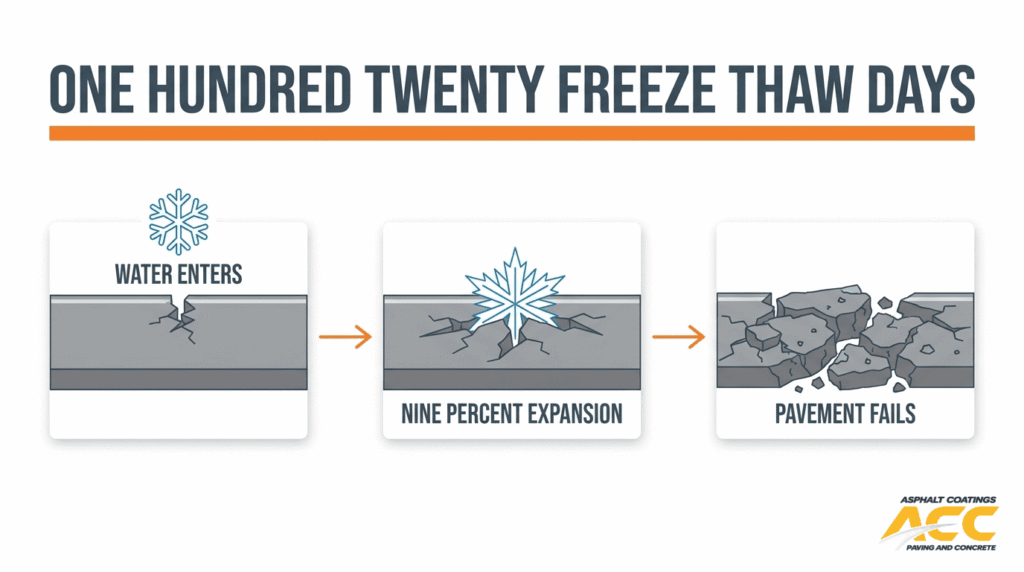
Freeze-thaw cycles damage commercial pavement by forcing water trapped in cracks to expand repeatedly, creating internal pressures that widen fissures and destabilize the subgrade. Water expands by over 9% when it freezes, generating enough force to split asphalt from within.
Denver experiences an estimated 120 freeze-thaw days annually, according to the Colorado Department of Transportation, a frequency that accelerates crack propagation and pothole formation across parking lots and access roads. Each cycle compounds the damage from the last, meaning untreated cracks in autumn become structural failures by spring.
For commercial properties with high traffic volumes, this repetitive stress compounds quickly. Proactive crack sealing before winter limits water entry and interrupts the cycle before costly reconstruction becomes necessary.
How Does UV Exposure at High Altitude Degrade Asphalt?
UV exposure at high altitude degrades asphalt by oxidizing the binder that holds aggregate together, causing the surface to become brittle, fade to gray, and develop fine surface cracking known as raveling. Colorado’s elevation intensifies ultraviolet radiation compared to sea-level regions, accelerating this oxidation process year-round.
As the binder loses flexibility, the pavement can no longer absorb thermal expansion or traffic loads without cracking. Surface deterioration then allows moisture penetration, which compounds damage during freeze-thaw events. Regular sealcoating restores a protective barrier over the oxidized surface, slowing UV penetration and extending pavement life. Properties at higher elevations along the Front Range often need more frequent sealcoat applications to counteract this intensified exposure.
Why Does Proper Drainage Design Matter in Variable Climates?
Proper drainage design matters in variable climates because standing water is the primary catalyst for both freeze-thaw damage and subgrade erosion. Without adequate grading and drainage infrastructure, water pools on surfaces, infiltrates cracks, and saturates the base layer beneath the asphalt.
In Colorado’s variable climate, rapid snowmelt followed by refreezing creates especially dangerous conditions for poorly drained lots. Pavement preservation treatments such as crack sealing can extend useful pavement life for several years by preventing water from entering the subgrade, according to Michigan Technological University. Effective drainage combines proper cross-slopes, catch basins, and channel systems to move water off the surface before it causes harm.
Addressing drainage during initial construction or resurfacing prevents the costliest form of pavement failure: base saturation that requires full-depth removal and replacement.
With climate factors identified, property owners can determine the right maintenance timing to stay ahead of deterioration.
When Should a Commercial Property Schedule Paving Maintenance?
A commercial property should schedule paving maintenance on a proactive, condition-based timeline rather than waiting for visible failures. Key intervals include sealcoating every two to three years, crack sealing when pavement condition remains above a score of 80, and annual inspections after seasonal freeze-thaw cycles.
According to The Pavement Group, most commercial parking lots require sealcoating every two to three years, depending on traffic volume and environmental conditions, to preserve the surface and reduce long-term maintenance needs. Properties in climates with frequent temperature swings benefit from scheduling inspections each spring, when winter damage becomes visible, and each fall before conditions worsen.
The optimal maintenance schedule depends on several factors:
- Sealcoating: Every 2–3 years for standard traffic lots; annually for high-volume retail locations.
- Crack sealing: When the pavement condition index is between 81 and 89, before cracks allow water infiltration.
- Pothole repair: Immediately upon detection to prevent liability exposure and subgrade damage.
- Full inspection: At least once per year, ideally in early spring after freeze-thaw season ends.
- Resurfacing evaluation: When surface distress becomes widespread but structural integrity remains sound.
Waiting until pavement visibly crumbles often means the most cost-effective window for preventive treatments has already passed. For property managers balancing multiple capital priorities, a scheduled maintenance program consistently outperforms reactive repairs in both cost and pavement longevity.
With a maintenance timeline established, the next step is choosing a paving partner equipped to execute that plan across Colorado’s demanding conditions.
How Can a Colorado-Focused Paving Partner Protect Your Investment?
A Colorado-focused paving partner protects your investment by combining regional climate knowledge with decades of hands-on commercial experience. The following sections explain how Asphalt Coatings Company’s Front Range expertise solves property-specific challenges and summarize the key role a commercial paving company plays.
Can 39 Years of Front Range Expertise Address Your Property’s Paving Challenges?
Yes, 39 years of Front Range expertise can address your property’s paving challenges. Asphalt Coatings Company has served Colorado’s commercial properties since 1986, building deep knowledge of the freeze-thaw cycles, high-altitude UV exposure, and variable drainage conditions that destroy poorly designed pavement. According to the Colorado Department of Transportation, Denver experiences an estimated 120 freeze-thaw days annually, causing water to expand by over 9% when freezing and creating internal pressures that crack asphalt from within.
That kind of regional insight shapes every decision, from subgrade preparation to sealcoat scheduling. Asphalt Coatings Company uses in-house crews across Denver, Colorado Springs, and the surrounding Front Range to deliver consistent quality without subcontractor variability. For property managers dealing with aging lots or planning new construction, a partner with nearly four decades of Colorado-specific experience offers solutions calibrated to the conditions that matter most.
What Are the Key Takeaways About the Role of a Commercial Paving Company?
The key takeaways about the role of a commercial paving company center on protecting property value, reducing liability, and maintaining safe, functional surfaces through expert services. A qualified commercial paving partner handles every phase of pavement management, from new asphalt construction and ADA compliance upgrades to ongoing maintenance such as sealcoating and crack sealing.
The most important lessons from this guide include:
- Well-maintained pavement directly supports curb appeal, tenant satisfaction, and long-term property value.
- Proactive maintenance strategies, including timely sealcoating and crack repair, cost far less than full replacement.
- Colorado’s freeze-thaw cycles and high-altitude UV demand region-specific materials and scheduling.
- Choosing a contractor with in-house crews, transparent guidance, and commercial-specific experience reduces risk across cost, quality, and project timelines.
Partnering with a company that understands both the technical standards and the local climate turns paving from a reactive expense into a strategic investment.