An asphalt milling machine is a self-propelled unit equipped with a rotating drum of carbide-tipped cutting teeth that pulverizes and removes layers of asphalt pavement for recycling or resurfacing. Deciding whether to rent or buy one depends on project frequency, budget constraints, and operational capacity.
This guide covers machine types and mechanics, rental and purchase costs, decision criteria for renting versus buying, and professional milling as an alternative.
Asphalt milling machines range from small walk-behind units with 60 hp engines and 4-inch cutting depths to full-size cold planers producing 636 hp with 79-inch milling widths. Cold milling machines, micro milling machines, half-lane and full-lane units, and walk-behind models each serve distinct project scopes.
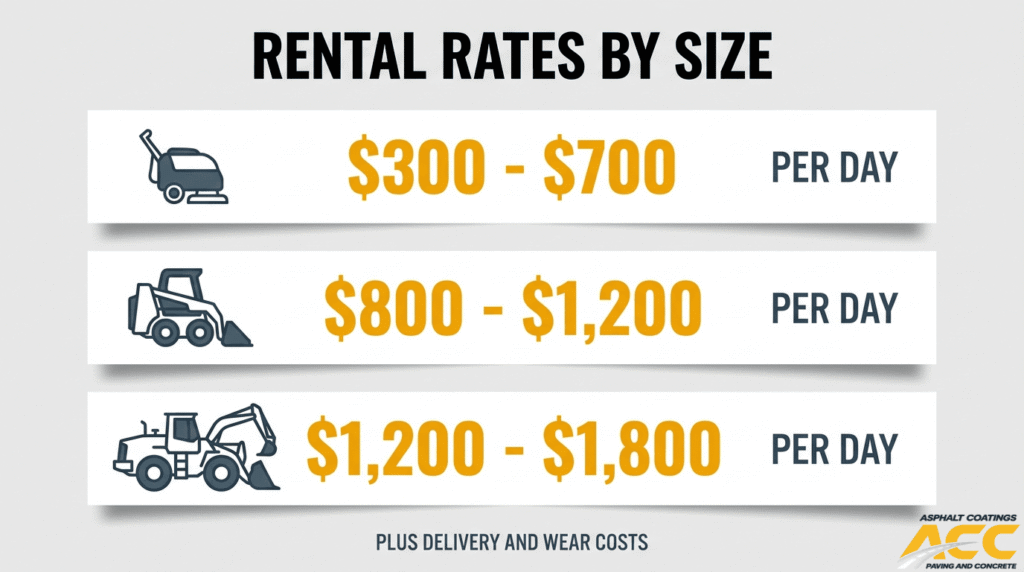
Rental rates span approximately $300 per day for small machines to over $1,500 per day for full-size cold planers, with monthly rates reaching $11,556 for mid-width units. Factors like shift-hour limits, delivery fees, carbide pick wear, and seasonal labor surcharges all influence what you actually pay.
Purchasing costs range from $140,000 for used equipment to nearly $800,000 for new full-size models, with hidden ownership expenses including pick replacements every 4 to 20 hours and tool holder service every 1,500 working hours. Renting favors one-time projects and organizations lacking certified operators or storage facilities, while buying suits contractors milling weekly or monthly where cumulative rental fees exceed ownership costs.
For commercial property owners who need reliable results without managing equipment logistics, professional milling services eliminate capital risk, licensing requirements, and maintenance obligations entirely.
What Is an Asphalt Milling Machine and How Does It Work?
An asphalt milling machine is a self-propelled unit equipped with a rotating cutting drum that removes layers of asphalt pavement. It works by impacting the surface with carbide-tipped tools mounted on the drum, pulverizing the material for removal and recycling.
The milling drum rotates while the machine advances across the pavement surface. Carbide-tipped cutting teeth break the asphalt into granulated reclaimed asphalt pavement (RAP), which a height-adjustable discharge conveyor transfers directly onto transport vehicles. According to the Wirtgen Group, milling machines can handle working widths from 1 ft 2 in up to 14 ft 5 in and working depths up to 1 ft 2 in in a single pass. Operators control depth settings, conveyor direction, and travel speed to match project specifications. OSHA applies specific regulations to worker exposure to respirable crystalline silica generated during asphalt pavement milling, making dust suppression systems an essential operational component.
Understanding how these machines function is critical for anyone evaluating whether to rent or buy one, since operational complexity directly influences staffing and training requirements.
What Are the Different Types of Asphalt Milling Machines?
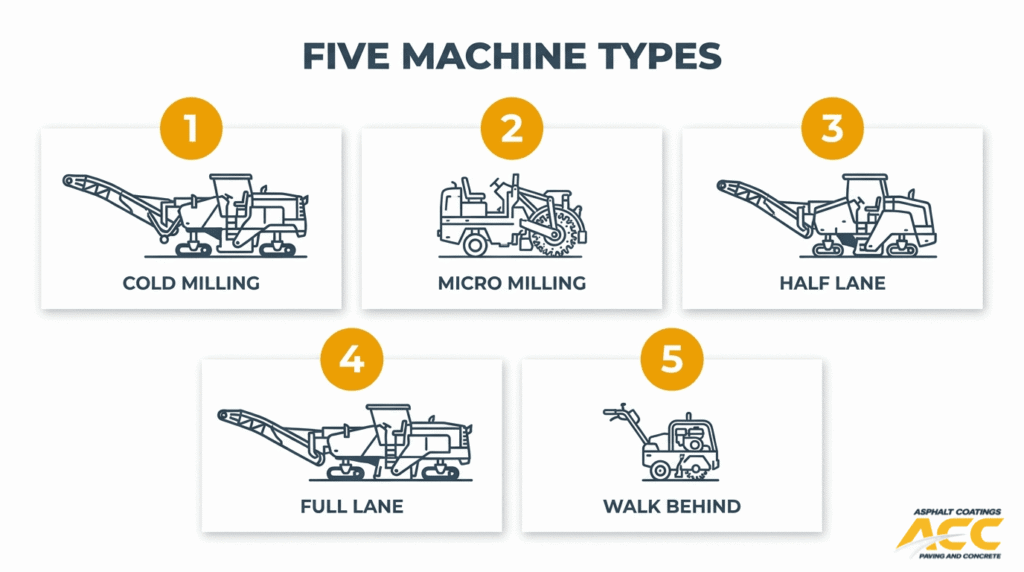
The different types of asphalt milling machines are cold milling machines, micro milling machines, half-lane and full-lane milling machines, and small or walk-behind milling machines. Each type serves distinct project scopes and surface requirements.
Cold Milling Machine
A cold milling machine is the most common type of asphalt milling equipment, using a rotating drum with carbide-tipped teeth to remove pavement layers without heat. These machines range from compact units to large-scale cold planers capable of removing full road surfaces in a single pass.
The Caterpillar PM620 cold planer features a milling width of 79.1 inches and a gross power of 636 hp, making it suitable for highway-scale projects. Mini-milling machines within this category are specialized for localized milling around manholes and valves.
According to a 2024 Credence Research report, the global road milling machine market was valued at USD 1.76 billion and is anticipated to reach USD 2.58 billion by 2032 at a CAGR of 4.93%. Operating these machines often requires a CDL B license, and daily rental rates for a 20-inch wide cold milling machine run approximately $1,527.
Micro Milling Machine
A micro milling machine is a specialized variant that produces an exceptionally smooth surface texture. Micro milling is accomplished by replacing the cutting drum of a conventional mill, which has 5/8 to 3/4 inch cutting teeth spacing, with one featuring approximately 3/16 inch spacing, according to RoadResource.org.
This tighter tooth configuration removes thin surface layers with precision, making micro milling ideal for restoring skid resistance or correcting surface irregularities without deep pavement removal. For projects requiring a drivable finish immediately after milling, this machine type is often the best choice.
Half-Lane and Full-Lane Milling Machine
A half-lane milling machine removes asphalt across approximately one traffic lane width, while a full-lane milling machine covers the entire lane in a single pass. Half-lane machines offer greater maneuverability in tight work zones where traffic must continue flowing on adjacent lanes.
Full-lane machines maximize production speed on large resurfacing projects by reducing the number of passes required. Contractors select between these configurations based on road geometry, traffic management plans, and project timeline constraints.
Small or Walk-Behind Milling Machine
A small or walk-behind milling machine is a compact unit designed for confined spaces and detail work. Small milling machines feature a right rear wheel that can be swiveled inwards for milling flush to the edges of obstacles such as curbs, utility covers, and building foundations.
The Wirtgen W 35 XRi small milling machine has a maximum milling depth of 4 inches and a maximum power of 60 hp. These units excel at sidewalk repairs, small parking lot patches, and utility trench restoration where larger equipment cannot physically access the work area.
Understanding which machine type fits your project scope directly influences whether renting or buying makes financial sense.
How Much Does It Cost to Rent an Asphalt Milling Machine?
The cost to rent an asphalt milling machine ranges from approximately $500 per day for small units to over $1,500 per day for full-size machines. Rental pricing varies by machine size, rental duration, and regional availability.
How Much Does It Cost to Rent a Small Milling Machine?
It costs approximately $300 to $700 per day to rent a small milling machine, depending on cutting width and local market conditions. Weekly and monthly rates offer significant discounts over daily pricing. Beyond the base rental rate, operators should factor in consumable wear costs. According to Everpads, tool holder replacement for milling machines is necessary every 1,500 working hours and costs $2,640 per replacement. For occasional users renting small units, this maintenance expense typically falls on the rental company, making short-term rentals cost-effective for limited-scope projects like utility cuts or parking lot patch work.
How Much Does It Cost to Rent a Mid-Size Milling Machine?
It costs approximately $800 to $1,200 per day to rent a mid-size milling machine with cutting widths between 24 and 48 inches. These machines handle lane-width milling on commercial lots and municipal roads. Weekly rates typically fall between $2,500 and $4,000, while monthly contracts reduce the effective daily cost further. Mid-size units strike a practical balance between production capacity and transport logistics. For most commercial resurfacing projects lasting one to two weeks, a mid-size rental delivers the best value per square yard milled.
How Much Does It Cost to Rent a Full-Size Milling Machine?
It costs approximately $1,200 to $1,800 per day to rent a full-size milling machine. According to the New York State Office of General Services, a 20-inch wide cold road milling machine carries a 2024–2025 daily rental rate of $1,527, a weekly rate of $4,298, and a monthly rate of $11,556. Full-size units with cutting widths of 79 inches or more command rates at the upper end of this range. Delivery fees, fuel consumption, and operator costs add substantially to the base rental price, often increasing total project expense by 30% to 50% beyond the machine rate alone.
With rental costs established across size categories, understanding what drives those rates helps you budget more accurately.
What Factors Affect Asphalt Milling Machine Rental Rates?
Asphalt milling machine rental rates are affected by machine size, rental duration, project depth requirements, consumable wear, and seasonal labor surcharges. The following factors determine what you will actually pay.
Machine size and cutting width directly determine the base rental tier. Larger machines with wider drums command significantly higher daily, weekly, and monthly rates than compact or walk-behind units.
Rental duration structure follows industry-standard shift calculations. According to Wheeler Machinery’s 2025 construction equipment rental rate schedule, standard rental rates are based on a single shift of 8 hours a day, 40 hours a week, and 176 hours a month. Exceeding these thresholds triggers overtime surcharges.
Milling depth and production demands influence both machine selection and total rental cost. Typical production rates for milling asphalt between 0 to 2 inches thick range from 8,500 to 25,000 square yards per day, with 17,000 square yards being typical. Projects requiring deeper cuts or faster speeds generate larger RAP chunks, which may necessitate upgraded equipment.
Consumable wear charges add hidden cost to rentals. Carbide asphalt pick life expectancy typically ranges from 4 to 20 hours depending on pavement hardness, aggregate type, and milling depth. Renters often bear responsibility for replacing worn picks during the rental period.
Seasonal rate adjustments and labor surcharges fluctuate annually. The California Department of Transportation’s 2024 rate schedule confirms that labor surcharge and equipment rental rates for asphalt pavers are in effect from April 1, 2024, through March 31, 2025, illustrating how government agencies update pricing cycles that ripple through the private rental market.
Delivery and mobilization fees scale with distance, adding hundreds or thousands of dollars depending on how far the machine must travel to reach the jobsite.
For most commercial projects, the interplay between machine class and rental duration drives the largest portion of total cost. Choosing slightly longer rental windows often reduces the effective daily rate, but only if your project timeline genuinely requires the extra days.
How Much Does It Cost to Buy an Asphalt Milling Machine?
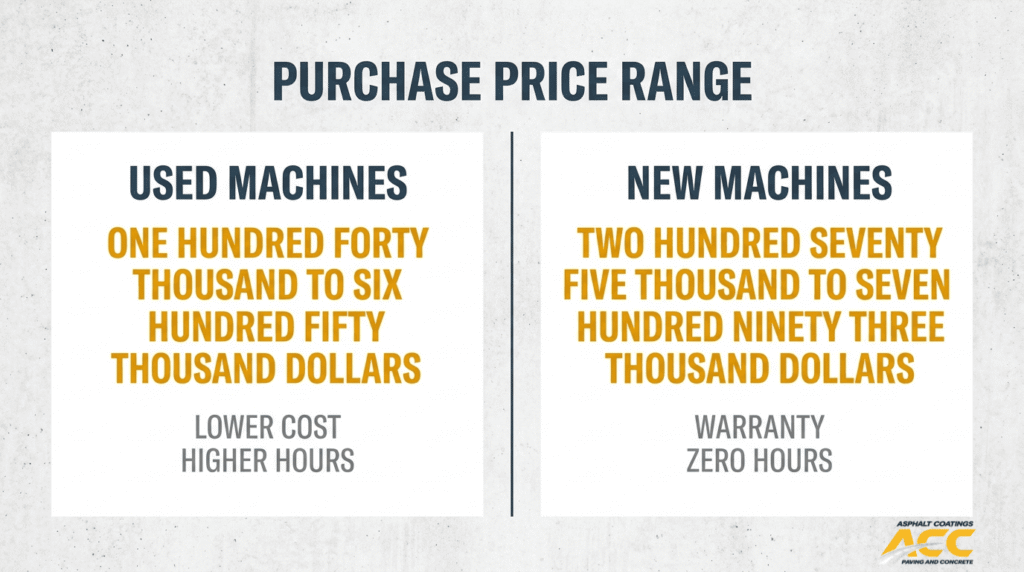
Buying an asphalt milling machine costs between $140,000 and $800,000 depending on size, condition, and manufacturer. New machines command premium prices, while used units offer significant savings.
How Much Does a New Asphalt Milling Machine Cost?
A new asphalt milling machine costs between $275,000 and $793,000 for mid-size to full-size models. These self-propelled units feature cutting heads equipped with carbide-tipped tools for the pulverization and removal of asphalt or concrete layers. High-production models capable of processing up to 500 tons per hour sit at the upper end of that range.
According to Asphalt Zipper, many cities and towns now purchase their own asphalt milling machines for road repairs as an alternative to outsourcing, driven by long-term cost savings on recurring maintenance programs. For contractors running daily milling operations, the investment typically pays for itself within three to five years of consistent use.
How Much Does a Used Asphalt Milling Machine Cost?
A used asphalt milling machine costs between $140,000 and $650,000, depending on age, hours, and model. According to PavingEquipment.com, used Wirtgen W200 units range from $145,000 to $650,000 based on condition and accumulated operating hours.
Machines with fewer than 2,000 hours command prices closer to new equipment, while higher-hour units offer the deepest discounts. For organizations needing reliable milling capability without the full capital outlay of new equipment, the used market presents a practical middle ground worth exploring carefully.
With purchase costs established, understanding when renting makes more financial sense helps clarify the best path forward.
When Does Renting an Asphalt Milling Machine Make More Sense?
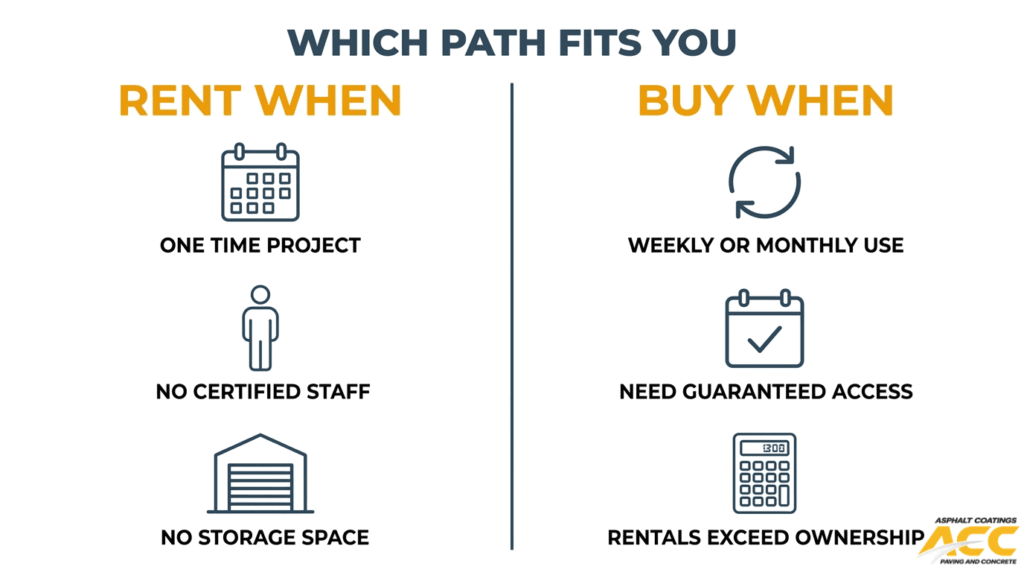
Renting an asphalt milling machine makes more sense when project frequency, staffing limitations, or logistical constraints outweigh the benefits of ownership. The scenarios below cover one-time projects, operator shortages, and storage challenges.
What If You Only Need Milling for a One-Time Project?
If you only need milling for a one-time project, renting eliminates the burden of a six-figure capital investment for a single use. A parking lot resurfacing that includes milling and repairs typically costs $10,000 to $30,000 for a 10,000 square foot area, according to a 2025 cost guide from C&C Super Seal. Paying a fraction of that for a short-term rental keeps the project economically viable without tying up capital in idle equipment. For most property managers facing a single resurfacing need, renting or hiring a professional crew is the clear financial choice.
What If You Lack Certified Operators or Support Staff?
If you lack certified operators or support staff, renting without qualified personnel creates serious safety and compliance risks. OSHA requires all powered industrial truck operators to be trained and certified by their organizations under 29 CFR 1910.178(l). Milling machines demand skilled operators who understand cut depth calibration, conveyor loading, and grade control. Without this expertise in-house, the liability exposure and potential for pavement damage far exceed any savings from self-performed work. Hiring a contractor with trained crews solves both the equipment and labor gap simultaneously.
What If Storage and Maintenance Are Not Feasible?
If storage and maintenance are not feasible, renting removes two of ownership’s heaviest ongoing obligations. Cold milling machines require covered storage to protect hydraulic systems, electronics, and cutting drums from weather degradation. Routine maintenance includes replacing carbide picks, servicing tool holders, and inspecting conveyor systems. Without dedicated yard space and a maintenance program, ownership costs escalate through accelerated wear and unplanned downtime. Renting shifts these responsibilities entirely to the rental provider.
When these constraints apply, partnering with a professional milling contractor often delivers better results than managing rental logistics independently.
When Does Buying an Asphalt Milling Machine Make More Sense?
Buying an asphalt milling machine makes more sense when your operation demands frequent use, guaranteed availability, or when cumulative rental costs exceed ownership expenses. The following scenarios clarify when purchasing is the stronger financial decision.
What If You Mill Asphalt on a Weekly or Monthly Basis?
If you mill asphalt on a weekly or monthly basis, purchasing a machine eliminates recurring rental fees that compound rapidly. A 20-inch cold milling machine rents for approximately $11,556 per month; at that rate, just a few months of consistent use each year pushes total rental spending toward the price of a used unit. Contractors with predictable milling schedules build equity in an owned asset rather than paying repeatedly for temporary access. For operations milling multiple times per month, ownership typically pays for itself within two to three years of steady utilization.
What If You Need Consistent Machine Availability Across Jobs?
If you need consistent machine availability across jobs, owning your milling machine guarantees access without competing for rental inventory. Rental fleets face seasonal demand spikes during paving season, which can leave contractors waiting for equipment during critical project windows. Ownership removes scheduling dependencies entirely. When a job requires milling tomorrow, an owned machine is already on-site or in your yard. This reliability directly protects project timelines and client commitments, particularly for contractors managing multiple concurrent commercial sites.
What If Long-Term Ownership Costs Less Than Repeated Rentals?
If long-term ownership costs less than repeated rentals, buying becomes the financially sound decision. According to a break-even analysis published by ScienceDirect, equipment ownership proves more economical than rental under variable efficiency conditions. While ownership carries maintenance obligations, such as tool holder replacements and carbide pick wear, these predictable expenses are often lower than months of accumulated rental charges for high-use operations. Running a detailed cost comparison that accounts for purchase price, annual maintenance, and projected utilization hours reveals the true crossover point.
With ownership economics clarified, understanding hidden costs ensures the full financial picture remains accurate.
What Are the Hidden Costs of Owning a Milling Machine?
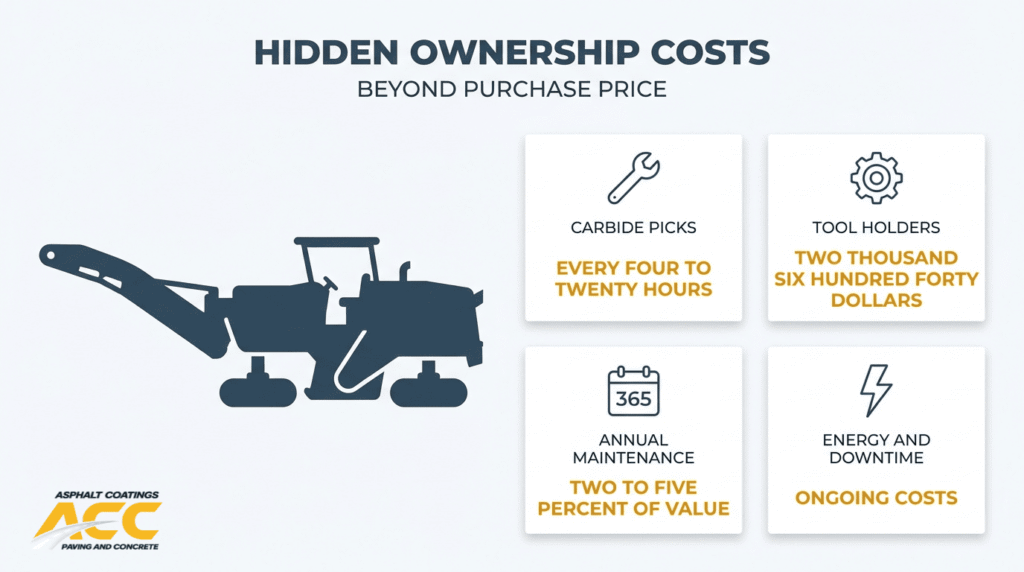
The hidden costs of owning a milling machine include consumable replacements, tool holder wear, maintenance budgets tied to asset value, and energy consumption during operations. These expenses accumulate beyond the purchase price and significantly affect total cost of ownership.
- Carbide pick replacement: Carbide asphalt picks have a life expectancy of only 4 to 20 hours depending on pavement hardness and milling depth, requiring frequent bulk purchases.
- Tool holder replacement: According to Everpads, tool holder replacement is necessary every 1,500 working hours at a cost of $2,640 per replacement.
- Annual maintenance budgets: Industry benchmarks recommend allocating 2% to 5% of total replacement asset value for equipment maintenance each year.
- Energy consumption: Milling machines consume significant energy removing pavement layers, with drums rotating at approximately 200 rpm under heavy load.
- Downtime risk: Failing to replace milling drum parts regularly leads to more costly repairs and lost productivity during peak season.
For a machine valued at $650,000, the 2% to 5% maintenance guideline translates to $13,000 to $32,500 annually before accounting for consumables or major repairs. These recurring ownership costs often surprise buyers who focus only on the sticker price, making professional milling services a practical alternative for many commercial property owners.
What Should You Look for When Renting a Milling Machine?
When renting a milling machine, you should evaluate machine specifications, rental agreement terms, included support services, and equipment condition. Key considerations include:
- Milling width and depth capacity matching your project scope, since machines range from 1 ft 2 in up to 14 ft 5 in working widths and depths up to 1 ft 2 in per pass.
- Shift-hour limits in the rental contract, as standard rental rates are typically based on a single shift of 8 hours per day, 40 hours per week, and 176 hours per month.
- Delivery and mobilization fees, which vary by distance and can add significant cost for remote job sites.
- Carbide pick condition, since pick life expectancy ranges from 4 to 20 hours depending on pavement hardness and milling depth.
- Operator requirements, because many rental agreements assume you provide a certified operator with proper licensing.
- Conveyor and loading capability for efficient RAP transfer to haul trucks.
- Insurance and damage liability terms defining your financial responsibility during the rental period.
According to Wheeler Machinery’s 2025 rate schedule, standard rental pricing assumes single-shift operation; exceeding those hours typically triggers overtime surcharges that can erode your budget quickly. Always confirm whether consumable wear items like cutting teeth are included or billed separately, as this single factor often creates the largest gap between quoted and actual rental costs.
For property managers weighing these details against project timelines, partnering with an experienced contractor often eliminates rental complexity entirely.
Do You Need a Licensed Operator for an Asphalt Milling Machine?
Yes, you typically need a licensed operator for an asphalt milling machine, though requirements vary by jurisdiction and machine size. Licensing affects both safety compliance and operator compensation.
Operating light to medium sized milling equipment often requires a CDL B license. However, some positions allow operators to work without a commercial license at reduced pay rates. According to a 2025 Coastal Road Repair job listing, asphalt milling machine operators may be paid $28.00 per hour without a driver’s license, $30.00 with a Class C license, and higher rates with a Class B license.
This pay differential reflects the added value that licensed operators bring to jobsite safety, equipment transport, and regulatory compliance. For companies deciding between renting or buying, factoring in operator licensing costs is essential, since hiring qualified personnel represents a significant ongoing expense beyond the machine itself.
Understanding operator requirements helps clarify whether professional milling services offer a simpler path than managing equipment independently.
How Does Professional Milling Compare to DIY Equipment Rental?
Professional milling compares to DIY equipment rental across cost, quality, and risk. Hiring a contractor eliminates operator training, maintenance burdens, and equipment logistics that renters must manage independently.
Professional milling services deliver consistent results because experienced operators control milling depth, drum speed, and material discharge with precision. DIY equipment rental shifts all operational responsibility to the renter, including machine calibration, site safety compliance, and material hauling. According to a ScienceDirect break-even analysis, equipment ownership proves more economical than rental under variable efficiency conditions, yet this advantage applies primarily to contractors who mill frequently, not occasional users.
Key differences between the two approaches include:
- Quality control: Professional crews maintain tight tolerances on grade and depth; inexperienced renters risk uneven surfaces that compromise overlay adhesion.
- Licensing requirements: Operators often need a CDL B license and OSHA-compliant training, which most property owners lack.
- Hidden costs: Renters pay delivery fees, carbide pick wear, fuel, and potential damage charges on top of the daily rate.
- Production speed: Professional teams equipped with full-size machines achieve significantly higher daily output than a property manager operating a rented small milling machine.
For commercial property owners who need milling once or twice rather than monthly, professional services typically deliver lower total project cost when factoring labor, logistics, and rework risk. The rental path makes sense primarily for contractors building internal capacity over dozens of recurring projects.
With professional milling as a viable alternative, partnering with experienced contractors simplifies the decision further.
How Can Commercial Asphalt Experts Handle Your Milling Needs?
Commercial asphalt experts can handle your milling needs by providing fully managed services that eliminate equipment decisions entirely. The following sections cover how professional paving replaces the need to rent or buy, and key takeaways for your decision.
Can Professional Paving and Repair Services Replace the Need to Rent or Buy a Milling Machine?
Yes, professional paving and repair services can replace the need to rent or buy a milling machine for most commercial property owners. Asphalt Coatings Company provides mill and pave services with in-house crews, trained operators, and properly maintained equipment. This eliminates concerns about licensing, storage, and the ongoing upkeep that milling machines demand. According to Kennametal, regular replacement of milling drum parts prevents more costly repairs and in-season downtime. Professional contractors absorb these maintenance burdens as part of their standard operations. For property managers focused on results rather than equipment logistics, outsourcing milling to experienced contractors delivers consistent quality without capital risk.
What Are the Key Takeaways About Renting or Buying an Asphalt Milling Machine?
The key takeaways about renting or buying an asphalt milling machine center on project frequency, budget, and operational capacity:
- Renting suits one-time or infrequent projects where operator certification and storage are barriers.
- Buying makes sense when weekly or monthly milling volume justifies the capital investment and maintenance commitment.
- Milling machines consume significant energy, impacting pavement with teeth mounted on a drum rotating at approximately 200 rpm, according to the Asphalt Institute.
- Hidden costs, including picks, tool holders, transport, and licensed operators, affect both options.
- Professional milling services from Asphalt Coatings Company eliminate equipment decisions entirely while delivering precision results backed by 39 years of Colorado commercial paving expertise.
For most commercial property owners, partnering with a dedicated asphalt contractor remains the most cost-effective path to quality milling outcomes.