Planning asphalt maintenance budgets for the next 10 years is the process of aligning scheduled pavement treatments with annual financial allocations across a full decade, so every dollar targets the right repair at the right time.
This guide covers the financial case for proactive maintenance, activity-specific cost benchmarks and scheduling, condition assessment methodology, budget structure and tax classification, and long-term contractor partnerships.
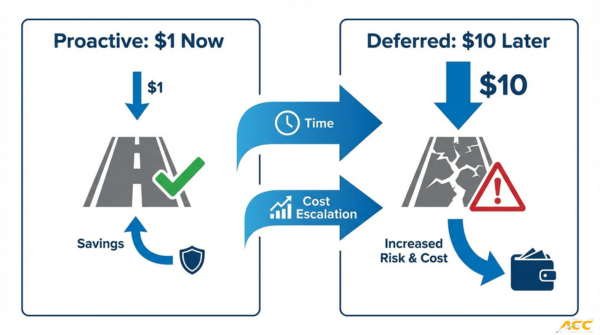
Proactive budgeting replaces emergency spending with planned, lower-cost treatments. Every $1 invested in preventive maintenance can save $6 to $10 in future rehabilitation costs, while deferred work accelerates structural failure and forces expensive reconstruction that could have been avoided entirely.
A complete 10-year plan accounts for sealcoating, crack sealing, pothole patching, striping, overlays, and full-depth reconstruction. Per-square-foot pricing for each activity ranges from as low as $0.10 for sealcoating to $10.00 for full reconstruction, and scheduling each treatment at the correct point in the pavement lifecycle maximizes the return on every line item.
Pavement Condition Index scoring provides the objective baseline that drives all spending decisions. Standardized visual surveys rate surfaces from 0 to 100, mapping each score range to specific treatment types so budgets reflect actual deterioration rather than assumptions.
Climate stressors, traffic loads, and crude oil price swings introduce 15% to 25% cost variability into material pricing alone. Separating capital expenditures from operating expenses, building 10% to 15% contingency reserves, and avoiding common mistakes like disconnecting technical needs from financial planning keep a 10-year budget realistic and resilient.
A dedicated long-term paving partner contributes consistent condition monitoring, multi-year pricing stability, and coordinated project execution that holds the entire plan together across budget cycles.
Why Does Long-Term Asphalt Maintenance Budgeting Matter?
Long-term asphalt maintenance budgeting matters because it aligns financial planning with the technical needs of your pavement over its full lifecycle. The following sections explain what happens when maintenance is deferred and how proactive budgeting lowers total cost of ownership.
What Happens When You Defer Asphalt Maintenance?
Deferred asphalt maintenance accelerates pavement deterioration and dramatically increases repair costs. Small cracks left unsealed allow water infiltration, which leads to base failure and structural degradation requiring full-depth reconstruction instead of simpler preservation treatments.
According to the Texas A&M Transportation Institute, the Federal Highway Administration estimates that every $1 spent on preventive maintenance can save $6 to $10 in future rehabilitation costs. That ratio makes deferred maintenance one of the most expensive decisions a property manager can make.
Climate compounds the problem. Cold climates expose asphalt to thermal cracking, while hot climates accelerate bitumen aging and oxidation, both of which shorten service life without site-specific intervention. Waiting to act only narrows available treatment options while widening the budget gap.
How Does Proactive Budgeting Reduce Total Cost of Ownership?
Proactive budgeting reduces total cost of ownership by replacing emergency spending with planned, lower-cost treatments scheduled at optimal intervals. Historical data and predictive modeling allow property managers to forecast needs accurately, while reactive strategies consistently produce higher annual paving costs.
The broader economic consequences of neglected pavement are significant. According to the American Society of Civil Engineers, additional vehicle operating costs from driving on deteriorated roads totaled $725 per motorist in 2023. For commercial properties, poor pavement condition translates to liability exposure, tenant dissatisfaction, and declining property value.
Budgeting proactively is not just a cost exercise; it is a risk management strategy. With a structured plan, condition assessments guide spending decisions across a 10-year timeline.
What Is the Typical Lifespan of a Commercial Asphalt Pavement?
The typical lifespan of a commercial asphalt pavement ranges from 15 to 25 years, depending on installation quality, traffic load, climate conditions, and maintenance consistency. Understanding this range is essential for building a realistic 10-year budget.
Well-constructed commercial parking lots and access roads that receive timely preventive care typically reach the upper end of that range. Neglected pavements, however, can deteriorate to the point of requiring full reconstruction in as few as 10 to 12 years. According to the American Society of Civil Engineers, the share of federal-aid highway pavements with good ride quality improved from 40.7% in 2008 to 47.2% in 2018, while pavements rated as poor rose from 15.8% to 22.6% over the same period. This divergence illustrates how maintenance directly splits pavement populations into longer-lasting and rapidly failing categories.
Climate plays a significant role in where a pavement falls within that range. Cold climates subject asphalt to thermal cracking from freeze-thaw cycles, while hot climates accelerate bitumen aging and oxidation. Both mechanisms shorten service life when left unaddressed through site-specific maintenance strategies.
For budget planning purposes, the most practical approach is to assume a 20-year design life and schedule preservation activities at regular intervals within your 10-year window. Sealcoating, crack sealing, and minor repairs during the first decade can keep pavement in serviceable condition well into the second, whereas skipping these treatments compresses the effective lifespan and forces costly capital projects earlier than necessary. Knowing where your pavement sits in its lifecycle determines which budget categories deserve the most funding.
What Maintenance Activities Should a 10-Year Budget Include?
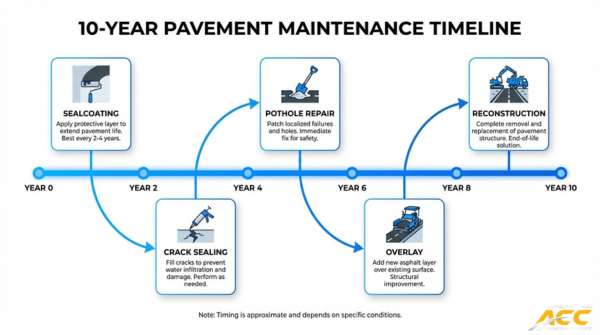
A 10-year budget should include sealcoating, crack sealing, pothole patching, striping, overlay or resurfacing, and full-depth reconstruction. Each activity addresses a different stage of pavement deterioration.
What Should You Budget for Sealcoating?
You should budget for sealcoating every two to three years as the first line of defense against oxidation and moisture penetration. Sealcoating applies a protective layer over the asphalt surface that slows UV damage and prevents water from reaching the base material.
For most commercial properties, this is the single most cost-effective line item in a 10-year plan. Skipping even one cycle accelerates surface brittleness, which leads to cracking that requires more expensive interventions. Budget a sealcoat application for each parking area on a rotating schedule so costs spread evenly across years.
What Should You Budget for Crack Sealing and Repair?
You should budget for crack sealing and repair annually or as cracks appear, since small cracks left untreated allow water intrusion that erodes the subbase. Crack sealing uses hot-pour or cold-pour sealant to fill individual cracks before they widen into alligator cracking or potholes.
According to U.S. Lawns, ignoring regular maintenance and waiting for failures to occur leads to emergency call-out costs that significantly drain facility maintenance budgets beyond the cost of the repair itself. Allocating a dedicated annual line item for crack sealing prevents these reactive cost spikes. For properties with heavy traffic or freeze-thaw exposure, increasing the annual crack sealing budget by 10 to 15 percent provides a practical safety margin.
What Should You Budget for Pothole Patching?
You should budget for pothole patching as a reactive but recurring line item, since potholes develop when water infiltrates failed pavement sections. Pothole repairs range from temporary cold-patch fills to semi-permanent hot-mix applications depending on the severity and location.
Even with strong preventive maintenance, some potholes will form over a 10-year period. Reserving a modest annual allowance for pothole patching keeps the parking surface safe and limits liability exposure. Properties in climates with severe freeze-thaw cycles should expect higher patching frequency, particularly in the first few years after pavement reaches mid-life condition.
What Should You Budget for Striping and Pavement Markings?
You should budget for striping and pavement markings every one to two years, since line visibility directly affects traffic flow, ADA compliance, and safety. Faded markings create liability risk and reduce the professional appearance of a commercial property.
Budget for a full re-stripe after every sealcoat application, because the sealant covers existing lines. Between sealcoat cycles, plan a touch-up application for high-wear areas like drive lanes and handicap stalls. Factoring striping into every maintenance year ensures compliance never lapses and avoids the compounded cost of a full-lot re-mark after years of neglect.
What Should You Budget for Overlay or Resurfacing?
You should budget for overlay or resurfacing once pavement reaches mid-life, typically between years five and eight of a 10-year plan. An overlay, sometimes called a mill-and-fill, removes the top layer of deteriorated asphalt and replaces it with fresh hot-mix material.
This treatment restores structural integrity and ride quality without disturbing the existing base. It costs substantially less than full reconstruction and resets the pavement’s maintenance clock. Including one overlay cycle in a 10-year budget is realistic for most commercial lots, though timing depends on traffic volume and current condition scores.
What Should You Budget for Full-Depth Reconstruction?
You should budget for full-depth reconstruction when pavement has deteriorated beyond the point where surface treatments or overlays can restore performance. Full-depth reconstruction removes and replaces all asphalt layers and, in many cases, the subbase material beneath them.
This is the most expensive line item in any 10-year plan, so it should be planned years in advance with dedicated capital reserves. For properties managing multiple lots, staggering reconstruction across different budget years prevents a single year from absorbing a disproportionate cost burden. Proactive budgeting for smaller maintenance activities earlier in the plan often delays or eliminates the need for reconstruction entirely, which is the strongest financial argument for a comprehensive maintenance schedule. Understanding the full 20-year pavement lifecycle helps align reconstruction timing with realistic condition expectations across the portfolio.
How Much Does Each Maintenance Activity Cost Per Square Foot?
Each maintenance activity costs a different amount per square foot depending on scope, materials, and pavement condition. The subsections below break down pricing for sealcoating, crack sealing, pothole repair, overlay, and full reconstruction.
How Much Does Sealcoating Cost Per Square Foot?
Sealcoating costs approximately $0.10 to $0.25 per square foot for most commercial parking lots. Total project cost depends on lot size, surface condition, and the number of coats applied. Lots with extensive oxidation or minor surface damage may require additional preparation, which increases the per-square-foot price slightly. Sealcoating remains the lowest-cost preventive treatment in a 10-year budget. For property managers overseeing large portfolios, even small per-square-foot differences compound quickly across thousands of square feet, making accurate estimates essential during budget planning.
How Much Does Crack Sealing Cost Per Linear Foot?
Crack sealing costs between $0.50 and $3.00 per linear foot. According to Pave It Forward LLC, preventive maintenance typically costs three times less than reactive repairs, with crack sealing at this price range compared to significantly higher costs for reactive patching or reconstruction. The wide range reflects differences in crack width, depth, sealant material, and accessibility. Routing cracks before sealing adds cost but improves sealant adhesion and longevity. Addressing cracks early prevents water infiltration into the subbase, which is the primary driver of pothole formation and structural failure.
How Much Does Pothole Repair Cost Per Square Foot?
Pothole repair costs roughly $2.00 to $6.00 per square foot for commercial properties. Pricing varies based on pothole depth, base condition, and whether a temporary cold patch or permanent hot-mix asphalt repair is used. Permanent repairs cost more upfront but eliminate recurring patch failures. Emergency pothole repairs during winter months often carry premium pricing due to material limitations and mobilization costs. Budgeting for scheduled pothole repair rather than reactive emergency fixes keeps per-square-foot costs closer to the lower end of this range.
How Much Does Asphalt Overlay Cost Per Square Foot?
Asphalt overlay costs between $1.50 and $4.00 per square foot for commercial applications. An overlay, also called resurfacing, applies a new layer of hot-mix asphalt over the existing surface. Mill-and-fill projects, which remove the deteriorated top layer before paving, fall at the higher end. The existing pavement must be structurally sound for an overlay to perform well; otherwise, reflective cracking develops quickly. This treatment is one of the most cost-effective ways to extend pavement life by 8 to 15 years without full removal, making it a cornerstone of mid-cycle budget planning.
How Much Does Full Reconstruction Cost Per Square Foot?
Full reconstruction costs approximately $4.00 to $10.00 per square foot. According to research from the University of Twente, pavement failures are significantly accelerated by deferred maintenance, leading to structural degradation that necessitates full-depth reconstruction instead of simpler preservation methods. This process involves removing the existing pavement, regrading the subbase, and installing new asphalt from the ground up. It represents the highest single-line expense in any 10-year maintenance budget. Scheduling lower-cost preventive treatments on time reduces the likelihood that any lot reaches the point where reconstruction becomes the only viable option.
With per-unit costs established, scheduling each activity at the right time maximizes budget efficiency.
When Should Each Maintenance Activity Be Scheduled?
Each maintenance activity should be scheduled based on pavement age, condition, and the treatment’s effective lifespan. The following subsections cover ideal timing for sealcoating, crack sealing, and resurfacing within a 10-year plan.
When Should You Schedule Sealcoating in a 10-Year Plan?
You should schedule sealcoating in a 10-year plan starting one to two years after initial paving, then repeating every two to three years. This cycle means a typical lot receives three to four sealcoat applications over a decade. Sealcoating protects the asphalt binder from UV oxidation and moisture infiltration, so timing applications before visible surface degradation appears is critical. According to the Kansas University Transportation Center, an effective pavement management plan should ideally be updated annually or on a maximum three-year cycle to ensure maintenance activities are correctly timed. Aligning sealcoat scheduling with these review intervals prevents gaps that accelerate deterioration between applications.
When Should You Schedule Crack Sealing in a 10-Year Plan?
You should schedule crack sealing in a 10-year plan as soon as cracks appear, typically beginning around years two through four and continuing annually or biannually through year ten. Crack sealing is most effective when applied to active, non-alligator cracks before water penetrates the subbase. In freeze-thaw climates, fall applications before winter are especially important because moisture trapped in untreated cracks expands and widens damage during cold months. Because of the documented cost benefits of regular crack sealing, which costs three times less than reactive repairs according to Pave It Forward LLC, addressing cracks early in each budget year preserves structural integrity at a fraction of what patching or reconstruction would cost later. For most commercial properties, dedicating a small annual line item to crack sealing delivers the highest return of any preventive treatment.
When Should You Schedule Resurfacing in a 10-Year Plan?
You should schedule resurfacing in a 10-year plan between years seven and ten, once the pavement’s structural base remains sound but surface distresses exceed what sealcoating and crack sealing can address. Resurfacing, often called an overlay or mill-and-fill, is a major rehabilitation step that resets the pavement’s surface life. Properties that maintained consistent preventive care in earlier years can typically push resurfacing closer to year ten, while neglected surfaces may require it sooner. Planning resurfacing in the later budget years also allows earlier savings from preventive maintenance to accumulate, offsetting the higher per-square-foot cost of this treatment. With resurfacing positioned as the capstone investment, the full 10-year cycle aligns preventive and rehabilitative activities into a cohesive spending strategy.
What Factors Cause Asphalt Maintenance Costs to Fluctuate?
Asphalt maintenance costs fluctuate due to climate stressors, traffic loads, and material price volatility. The sections below cover freeze-thaw damage, UV degradation, traffic impact, and shifting material prices.
How Do Freeze-Thaw Cycles Affect Maintenance Budgets?
Freeze-thaw cycles affect maintenance budgets by accelerating pavement cracking and subbase erosion, which increases the frequency and cost of repairs. Water infiltrates small surface cracks, then expands as it freezes. This repeated expansion forces cracks wider and weakens the underlying aggregate structure.
Over successive winters, what begins as minor surface distress can progress into alligator cracking or pothole formation requiring more expensive treatments. Properties in regions with frequent temperature swings around the freezing point tend to need crack sealing and patching on shorter intervals. Budgeting for accelerated maintenance cycles in cold climates is one of the most practical ways to prevent small weather-driven damage from compounding into major rehabilitation costs.
How Does UV Exposure Accelerate Pavement Deterioration?
UV exposure accelerates pavement deterioration by oxidizing the asphalt binder, which causes the surface to become brittle and lose flexibility. As the binder hardens, it can no longer absorb the micro-movements caused by thermal expansion or traffic loads.
This oxidation process first appears as surface graying and fine hairline cracks. Left untreated, these cracks allow water penetration, which compounds structural damage from within. High-altitude locations and south-facing surfaces receive more intense UV radiation, making sealcoating on a regular schedule essential. Timely sealcoat applications restore a protective barrier against UV rays, slowing oxidation and extending the interval before costlier resurfacing becomes necessary.
How Do Traffic Volume and Load Weight Impact Costs?
Traffic volume and load weight impact costs by increasing the rate of structural fatigue in the pavement system. Heavy axle loads from delivery trucks, waste haulers, and freight vehicles compress the asphalt layers and accelerate rutting, while high traffic volume compounds surface wear across the entire lot.
According to a 2024 report by the American Concrete Pavement Association, unit costs fall significantly as inter-industry competition increases in competitive bid environments. For property managers, this means that areas with more paving contractors may yield lower per-project pricing. Parking areas serving heavy commercial vehicles should be budgeted for thicker cross-sections and more frequent maintenance than standard passenger-vehicle lots.
How Do Material Price Changes Affect Long-Term Budgets?
Material price changes affect long-term budgets by introducing cost uncertainty that can shift project timing and scope. According to 360 Research Reports, changes in crude oil availability have historically caused 15% to 25% fluctuations in asphalt binder pricing, a primary component of overall material costs.
Because asphalt binder is a petroleum byproduct, its price tracks closely with global oil markets. Supply disruptions, refinery output changes, and seasonal demand spikes all influence what contractors pay for raw materials. Building a 10% to 15% contingency line into each budget year helps absorb these swings without forcing project deferrals. Locking in multi-year contractor agreements can also provide pricing stability that protects against sudden market shifts.
Understanding these cost drivers prepares you to build a structured, year-by-year maintenance budget.
How Do You Build a Year-by-Year Maintenance Budget?
You build a year-by-year maintenance budget by establishing a baseline condition assessment, ranking properties by urgency, and reserving contingency funds for each budget cycle. The following sections cover each step.
How Do You Assess Current Pavement Condition as a Baseline?
You assess current pavement condition as a baseline by conducting a standardized visual survey that scores every distress type across your lot. According to ResearchGate, pavement condition assessments conducted in accordance with ASTM D6433 provide a standardized framework for evaluating asphalt and concrete surfaces to guide maintenance prioritization in budget-limited environments.
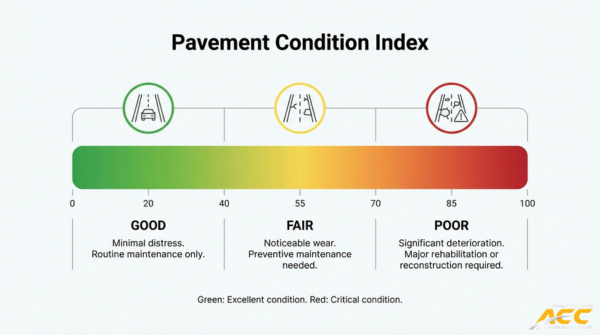
The Pavement Condition Index (PCI) rating scale assigns each surface a score from 0 to 100:
- Good (85–100): Minimal distress; routine sealcoating and crack sealing maintain condition.
- Satisfactory (70–85): Minor surface wear; preventive treatments extend life.
- Fair (55–70): Moderate cracking or rutting; targeted repairs needed soon.
- Poor (40–55): Significant structural distress; overlay or major repair required.
- Very Poor (25–40): Extensive failure; reconstruction planning should begin.
- Serious (10–25): Near-total failure across most of the surface.
- Failed (0–10): Complete structural failure requiring full-depth reconstruction.
Documenting baseline PCI scores for every lot gives your budget a defensible starting point for allocating funds across the full decade.
How Do You Prioritize Lots When Managing Multiple Properties?
You prioritize lots when managing multiple properties by ranking each surface according to its PCI score, daily traffic volume, and safety liability exposure. Lots scoring in the “Poor” or lower PCI ranges with high pedestrian or vehicle traffic should receive funding first, because delaying repairs at that stage accelerates structural degradation far faster than it does on a “Fair” or “Satisfactory” surface.
A practical ranking framework weighs three factors:
- Condition severity: Lower PCI scores indicate greater urgency.
- Usage intensity: High-traffic retail or distribution lots deteriorate faster than low-traffic office parks.
- Liability risk: Surfaces near building entries, ADA routes, or fire lanes carry higher legal exposure.
Sorting properties by these weighted criteria prevents the common mistake of spreading funds evenly and underfunding the lots that need intervention most.
How Do You Build Contingency Reserves Into Each Budget Year?
You build contingency reserves into each budget year by setting aside a fixed percentage of your total annual maintenance allocation to cover unplanned repairs and material price swings. A reserve of 10% to 15% of each year’s planned spend is a reasonable starting point for most commercial portfolios.
Contingency funds absorb costs that fall outside scheduled work, such as:
- Unexpected pothole failures after severe freeze-thaw cycles.
- Mid-year material cost increases driven by crude oil price shifts.
- Emergency ADA compliance repairs identified during routine inspections.
Without a dedicated reserve, unplanned events force budget reallocation from scheduled preventive work, which compounds future costs. For property managers overseeing multiple lots, revisiting reserve adequacy during each annual PCI update keeps the contingency aligned with actual portfolio risk.
With a structured budget framework in place, understanding the PCI scoring system sharpens every spending decision.
What Is a Pavement Condition Index and How Does It Guide Spending?
A Pavement Condition Index is a numerical rating that quantifies surface health to direct where maintenance dollars go first. Understanding how PCI scores map to treatment types helps property managers allocate budgets with precision rather than guesswork.
The Pavement Condition Index (PCI) is a numerical rating from 0 to 100, where 100 represents the best possible condition and 0 represents the worst possible condition. Visual surveys of observed distresses, such as cracking, rutting, and weathering, determine each score. According to a ResearchGate-published framework on PCI evaluation of asphalt and concrete pavements, these assessments follow standardized procedures that make results consistent and repeatable across different properties.
Each score range corresponds to a specific condition category:
- Good (85–100): Pavement requires only routine preventive maintenance, such as sealcoating.
- Satisfactory (70–85): Minor treatments like crack sealing preserve structural integrity.
- Fair (55–70): Targeted repairs and localized patching become necessary.
- Poor (40–55): Significant rehabilitation, including partial overlays, is typically warranted.
- Very Poor (25–40): Major structural intervention is needed before further deterioration occurs.
- Serious (10–25): Extensive reconstruction planning should begin immediately.
- Failed (0–10): Full-depth reconstruction is the only viable corrective action.
This scoring system transforms subjective observations into objective budget decisions. Sections rated “Good” receive low-cost preventive treatments, while sections falling below 55 trigger capital-intensive rehabilitation line items. By assigning each lot or section a PCI score, property managers can rank competing projects and fund the interventions that deliver the highest return per dollar spent.
For property managers overseeing multiple sites, PCI scoring is one of the most practical tools available for defending budget requests with data rather than assumptions. Pairing regular PCI assessments with annual budget reviews keeps spending aligned with actual pavement needs. With condition scores established, the next step is understanding how those budget dollars are categorized as capital expenditures or operating expenses.
How Do Capital Expenditure and Operating Expense Budgets Differ?
Capital expenditure and operating expense budgets differ in how asphalt costs are classified, deducted, and planned over time. Understanding this distinction shapes how property managers allocate funds across a 10-year maintenance plan.
IRS rules distinguish repairs from capital improvements. Repairs that restore asphalt to its ordinary condition, such as crack sealing, pothole patching, and sealcoating, qualify as operating expenses (OpEx) that are immediately deductible in the year they occur. Capital improvements that extend useful life or add new value, such as full-depth reconstruction or major overlays, must be depreciated over time as capital expenditures (CapEx).
The practical budgeting implications break down as follows:
- Operating expenses (OpEx) include routine maintenance activities like sealcoating, crack filling, striping, and minor patching. These reduce taxable income in the current fiscal year.
- Capital expenditures (CapEx) include mill-and-overlay projects, full reconstruction, and new pavement installation. The IRS allows asphalt pavement to be depreciated as land improvement property with a 15-year recovery period under the General Depreciation System or 20 years under the Alternative Depreciation System.
A well-structured 10-year budget separates these two categories into distinct line items. OpEx funding should remain consistent year over year to cover preventive treatments. CapEx reserves, by contrast, require advance planning since large rehabilitation projects concentrate spending in specific budget years. Misclassifying a capital improvement as a repair, or vice versa, can create tax compliance issues and distort long-term financial projections. For property managers overseeing multiple lots, correctly categorizing each planned activity ensures accurate forecasting and avoids budget shortfalls when major projects come due.
What Mistakes Do Property Managers Make With Maintenance Budgets?
Property managers make several critical mistakes with maintenance budgets, including disconnecting technical needs from financial planning, relying on reactive repairs, and ignoring hidden emergency costs.
The most common budgeting errors include:
- Separating maintenance planning from budget decisions. According to The Handbook of Maintenance Management, maintenance professionals often make a fundamental mistake by not adequately involving the budgeting process with the long-term technical needs of the facility, leading to underfunded requirements.
- Waiting for failures instead of scheduling preventive work. Ignoring regular maintenance and waiting for breakdowns leads to emergency call-out costs that drain budgets far beyond the repair itself.
- Underestimating escalation from deferred work. Small cracks left unsealed become base failures requiring full reconstruction, turning a minor line item into a capital expense. Understanding how potholes form reveals why that progression happens so quickly: water infiltration through unsealed cracks erodes the subbase, and freeze-thaw cycles accelerate the damage into structural failure.
- Skipping annual condition assessments. Without current pavement data, managers allocate funds based on assumptions rather than actual deterioration rates.
- Failing to build contingency reserves. Material price swings and unexpected damage leave rigid budgets overrun within the first few years of a 10-year plan.
For property managers overseeing multiple commercial lots, the compounding effect of these mistakes is severe. A budget built around reactive spending almost always costs more over a decade than one anchored to scheduled preventive treatments and regular condition surveys. Partnering with an experienced contractor can bridge the gap between facility operations and long-term financial planning.
How Can a Long-Term Asphalt Partner Help You Plan Budgets?
A long-term asphalt partner can help you plan budgets by providing consistent condition monitoring, predictable pricing, and strategic maintenance scheduling across multiple budget cycles. The following sections cover how Asphalt Coatings Company manages 10-year plans and the key takeaways for asphalt budget planning.
Can Asphalt Coatings Company Manage Your 10-Year Plan?
Yes, Asphalt Coatings Company can manage your 10-year plan by combining nearly four decades of Colorado-specific paving expertise with a structured, long-term approach to pavement management. Consistent data collection across annual inspections allows for more efficient maintenance allocation, as demonstrated by long-term pavement performance research published in ScienceDirect showing that sustained monitoring plans improve how agencies distribute maintenance resources.
Asphalt Coatings Company builds each 10-year plan around life-cycle cost analysis, aligning short-term preservation work like sealcoating and crack sealing with longer-horizon projects such as overlays or reconstruction. This approach mirrors the data-driven framework detailed in our article on life-cycle cost analysis, which quantifies the long-term financial impact of maintenance versus replacement decisions.
What Are the Key Takeaways About Planning Asphalt Budgets?
The key takeaways about planning asphalt budgets center on acting early, scheduling consistently, and partnering with a contractor who understands your pavement’s full life cycle.
- Preventive maintenance costs far less than reactive repairs, so front-loading sealcoating and crack sealing in years one through three protects against compounding deterioration.
- Condition assessments using PCI scoring should drive every spending decision, ensuring limited budgets target the lots and surfaces with the highest return on investment.
- Material costs fluctuate with crude oil markets, making contingency reserves and multi-year pricing agreements essential for budget stability.
- Capital expenditures and operating expenses require separate budget lines with distinct tax treatments, so categorizing each project correctly avoids financial surprises.
- A dedicated long-term partner provides continuity in condition data, eliminates redundant mobilization costs, and holds institutional knowledge of your specific properties.
For property managers ready to move from reactive spending to a structured 10-year strategy, Asphalt Coatings Company offers the partnership and expertise to make that plan actionable.