Parking lot resurfacing is the process of milling a deteriorated asphalt surface and applying a new overlay over a structurally sound base, typically costing between $1 and $7 per square foot depending on project size and conditions.
This guide covers per-square-foot pricing by lot size, the factors that shift total project cost, what a complete resurfacing project includes, how resurfacing compares to other repair options, and how to secure accurate free quotes.
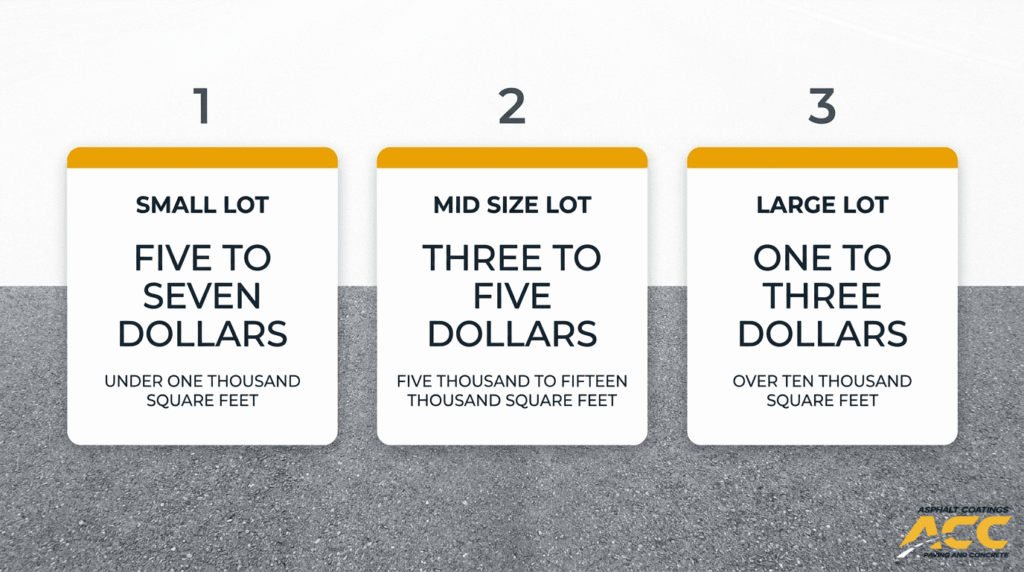
Commercial lots exceeding 10,000 square feet benefit from economies of scale, dropping to $1 to $3 per square foot, while small lots under 1,000 square feet can reach $7 per square foot due to fixed mobilization costs spread across less area.
Lot size, pavement condition, overlay thickness, drainage needs, and site accessibility each shift the estimate significantly. Pavement scoring between 40 and 60 on the Condition Index qualifies for resurfacing, while scores below 40 typically require full reconstruction.
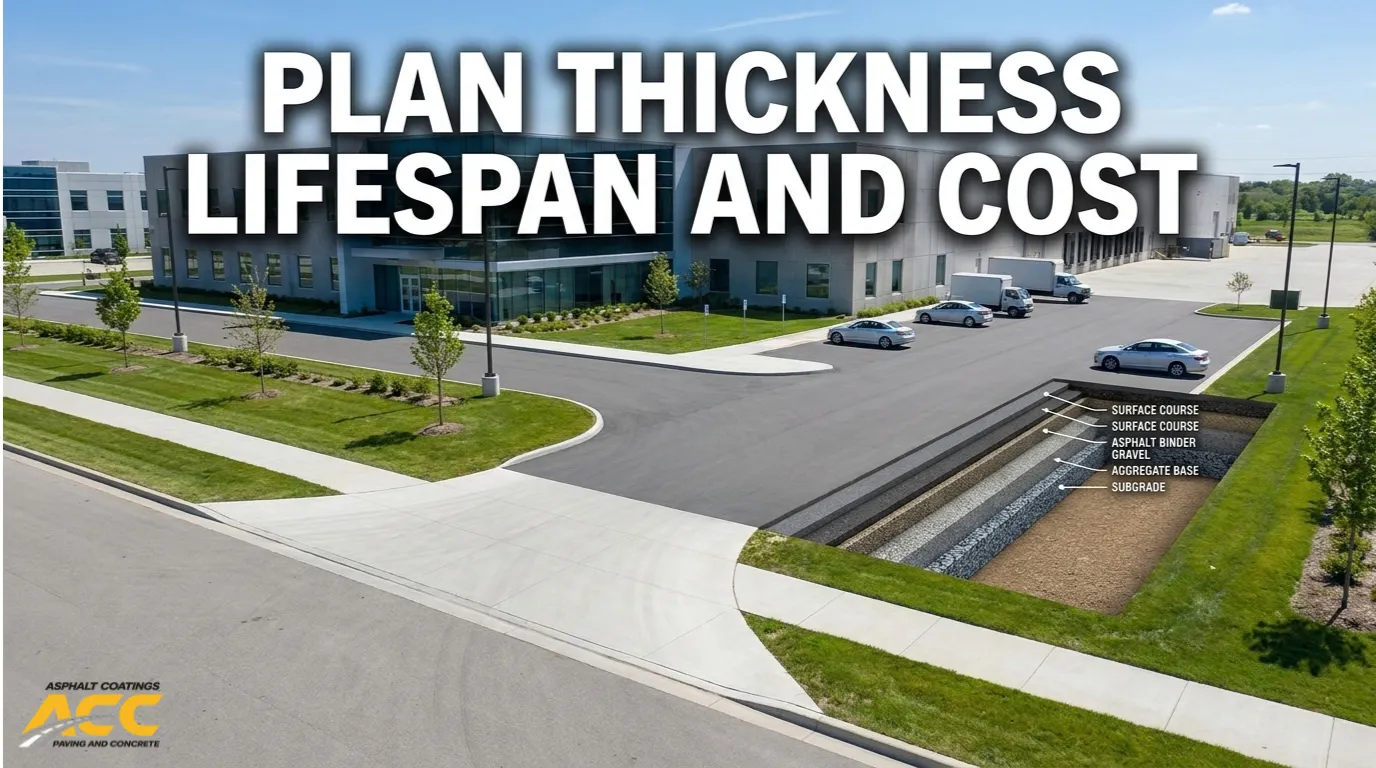
A complete project moves through surface preparation (milling, crack repair, tack coat), overlay installation at a controlled 1.5- to 2-inch thickness, and finishing work including striping, ADA compliance markings, and drainage verification.
Resurfacing delivers 40% to 60% savings compared to full-depth replacement and lasts 15 to 25 years with proactive maintenance. Strategic care from year one can extend that lifespan by an additional 5 to 10 years.
Comparing at least three itemized quotes, providing detailed lot information upfront, and vetting contractor experience protects commercial property managers from overpaying or receiving substandard work.
How Much Does Parking Lot Resurfacing Cost Per Square Foot?
Parking lot resurfacing costs between $1 and $7 per square foot, depending on project size and scope. The sections below break down pricing for small, mid-size, and large commercial lots.
How Much Does Resurfacing a Small Parking Lot Cost?
Resurfacing a small parking lot costs approximately $5 to $7 per square foot. According to VF Paving, small asphalt projects under 1,000 square feet can reach up to $7 per square foot, while lots exceeding 10,000 square feet drop to $2 or $3 per square foot due to economies of scale.
Higher per-square-foot rates on smaller projects reflect fixed mobilization costs, equipment setup, and minimum material deliveries spread across less area. For property managers with compact lots, combining resurfacing with a restripe project can maximize value without requiring full redesign.
How Much Does Resurfacing a Mid-Size Parking Lot Cost?
Resurfacing a mid-size parking lot costs approximately $3 to $5 per square foot. Lots between 5,000 and 15,000 square feet fall into a pricing sweet spot where contractors can operate efficiently without the premium associated with small-scale mobilization.
At this scale, the overlay itself represents the largest cost component. According to the Federal Highway Administration, milling and overlay for a 1.5-inch thick application costs approximately $8.00 per square yard (roughly $0.89 per square foot) for the overlay portion alone. Adding surface preparation, tack coat, striping, and traffic control brings the total into the $3 to $5 range. Mid-size lots often represent the best balance of cost efficiency and project simplicity for commercial property managers.
How Much Does Resurfacing a Large Commercial Parking Lot Cost?
Resurfacing a large commercial parking lot costs between $1 and $3 per square foot. Economies of scale significantly reduce per-unit pricing once lot size exceeds 10,000 square feet, with the largest projects approaching the lower end of that range.
According to Sherer Architecture, commercial property owners can achieve a cost-based ROI of approximately 53.8% for strategic property improvements, which helps justify the upfront investment. For a 50,000 square foot retail center lot, total resurfacing costs typically range from $50,000 to $150,000 depending on existing pavement condition, overlay thickness, and finishing requirements like ADA-compliant striping.
With project size established as the primary cost variable, understanding what other factors influence your specific estimate becomes essential.
What Factors Affect the Total Cost of Parking Lot Resurfacing?
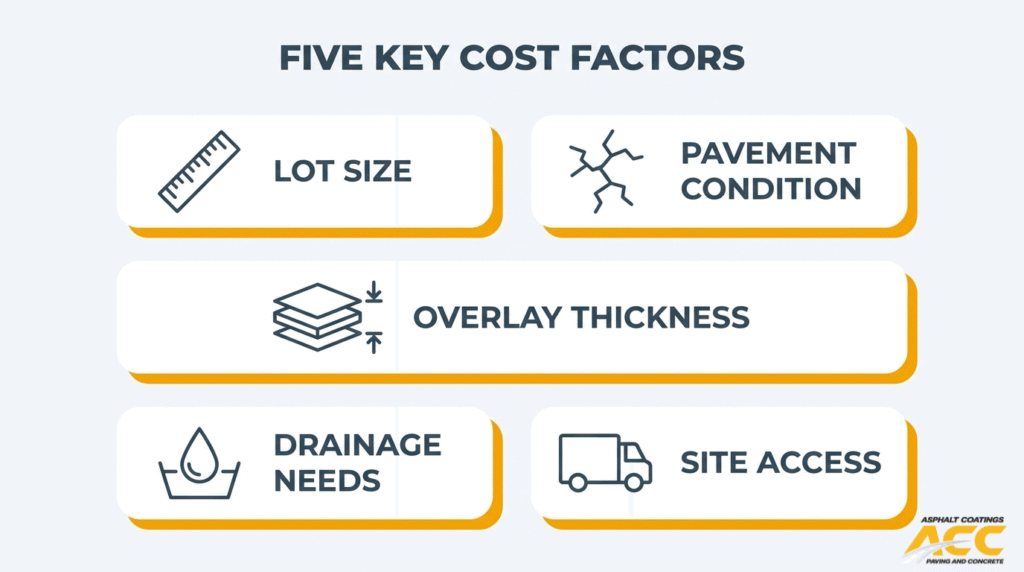
The total cost of parking lot resurfacing depends on lot size, pavement condition, overlay thickness, drainage needs, and site accessibility. Each factor shifts the estimate significantly.
How Does Lot Size Influence Resurfacing Price?
Lot size influences resurfacing price through economies of scale. Larger commercial lots spread mobilization, equipment, and labor costs across more square footage, reducing the per-unit rate. Small projects under 1,000 square feet can cost up to $7 per square foot, while lots exceeding 10,000 square feet often drop to $2 or $3 per square foot, according to VF Paving. This means a 50,000-square-foot retail lot benefits from substantially lower unit pricing than a small office pad. For most commercial property managers, consolidating phased work into a single larger project yields better value than multiple small mobilizations.
How Does Pavement Condition Change the Cost?
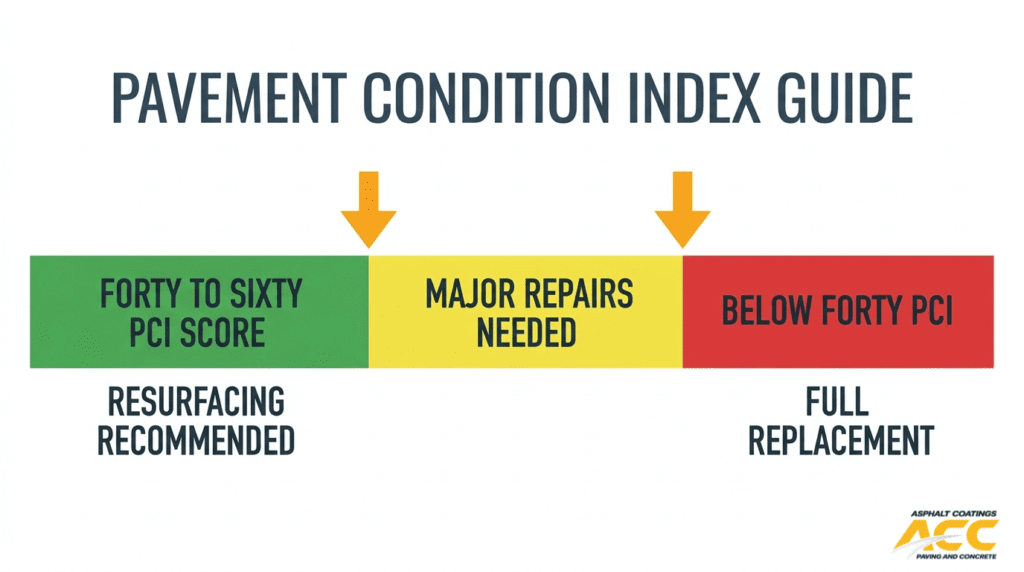
Pavement condition changes the cost by determining which repair methods are necessary before overlay. The Pavement Condition Index (PCI) scores pavement from 0 to 100; lots scoring 60 to 70 typically qualify for preservation treatments like slurry seals, while those below 40 usually require full reconstruction.
When existing damage is moderate, preservation techniques such as Full Depth Reclamation can offer cost savings of approximately 45% to 55% compared to traditional reconstruction, according to the Pavement Preservation & Recycling Alliance. Addressing deterioration early matters considerably. Strategic maintenance from year one can extend pavement lifespan by 5 to 10 years, avoiding thousands in premature replacement costs.
How Does Asphalt Overlay Thickness Affect Pricing?
Asphalt overlay thickness affects pricing because material volume is the single largest variable cost in resurfacing. A standard 1.5-inch overlay uses less hot-mix asphalt than a 2- or 3-inch lift, directly reducing material and hauling expenses. Thicker overlays are required when traffic loads are heavy or when the existing surface has structural deficiencies that a thin lift cannot bridge. Each additional half-inch of thickness increases tonnage per square yard, compounding costs across the entire lot. Matching overlay depth to actual load requirements prevents both over-spending and premature failure.
How Do Drainage Repairs Add to Resurfacing Costs?
Drainage repairs add to resurfacing costs by introducing excavation, grading, and infrastructure work beyond the overlay itself. Standing water accelerates asphalt deterioration, so correcting slopes, replacing catch basins, or installing new drain inlets often becomes necessary during resurfacing. These items require separate materials, labor, and sometimes utility coordination that fall outside standard paving line items. Neglecting drainage during resurfacing is a common mistake that shortens pavement life and increases long-term costs. Addressing it upfront protects the new surface investment.
How Does Site Accessibility Impact the Estimate?
Site accessibility impacts the estimate by affecting equipment mobilization, staging logistics, and project duration. Tight entrances, active traffic lanes, multi-level structures, or limited staging areas require smaller equipment, phased closures, or off-hours work. Each constraint adds labor time and coordination costs.
Key accessibility factors that increase pricing include:
- Narrow access points requiring smaller paving equipment.
- Active businesses requiring phased lane closures and traffic control.
- Remote locations increasing material transport distance.
- Underground utilities limiting milling depth or equipment weight.
With accessibility challenges accounted for, the next step is understanding what a complete resurfacing project actually includes.
What Is Included in a Parking Lot Resurfacing Project?
A parking lot resurfacing project includes surface preparation, asphalt overlay installation, and finishing work. Each phase builds on the previous one to deliver a structurally sound, code-compliant surface.
What Surface Preparation Work Is Required Before Overlay?
Surface preparation work required before overlay includes cleaning, crack repair, milling, and base stabilization. These steps ensure the new asphalt bonds properly to the existing pavement.
Key preparation tasks include:
- Removing debris, dirt, and vegetation from the existing surface
- Routing and filling cracks to prevent reflective cracking through the overlay
- Milling damaged or uneven areas to establish correct grade and profile
- Repairing failed subgrade sections where base material has deteriorated
- Applying tack coat to promote adhesion between old and new asphalt layers
Skipping preparation is the most common reason overlays fail prematurely. According to municipal benchmarks documented by Jet-Black, resurfacing bid items in high-cost regions range from $32 to $75 per square yard, with preparation quality directly influencing whether that investment holds up over time.
What Does the Asphalt Overlay Installation Involve?
The asphalt overlay installation involves placing a new layer of hot-mix asphalt over the prepared surface using a mechanical paver. Crews spread the material at a controlled thickness, typically 1.5 to 2 inches for commercial lots, then compact it with steel-drum and pneumatic rollers to achieve proper density.
Temperature control is critical. Asphalt paving in Colorado requires a minimum ambient temperature of 50 degrees Fahrenheit and rising for proper installation and patching, according to industry guidelines published by Bethel Heights.
Overlay differs from repaving in that it adds material on top of the existing structure rather than removing and rebuilding the full pavement section. This distinction makes resurfacing faster and less disruptive to daily operations.
What Finishing Work Follows the Resurfacing?
Finishing work that follows the resurfacing includes striping, signage installation, ADA compliance markings, and final drainage verification. These elements restore full functionality to the lot.
Standard finishing tasks include:
- Painting traffic lane lines, directional arrows, and stall markings
- Installing or refreshing handicap-accessible spaces with correct signage
- Verifying proper water flow toward drains and catch basins
- Placing wheel stops, bollards, or bumper blocks as needed
- Conducting a final walkover inspection for surface deviations
Finishing work transforms raw asphalt into an organized, compliant parking facility. For most commercial properties, this phase also represents the best opportunity to improve traffic flow geometry or add spaces without additional paving costs.
With the full project scope defined, understanding how resurfacing compares to complete replacement helps determine which approach fits your situation.
How Does Resurfacing Compare to Full Parking Lot Replacement?
Resurfacing compares to full parking lot replacement primarily in cost, timeline, and structural scope. Resurfacing applies a new asphalt overlay over an existing base, while full replacement removes all layers down to the subgrade and rebuilds from scratch.
The key differences between resurfacing and full replacement include:
- Cost: Resurfacing typically costs $1 to $3 per square foot, while full replacement ranges from $4 to $9 per square foot depending on project size and conditions.
- Scope of work: Resurfacing mills the top layer and applies fresh asphalt over a structurally sound base. Full replacement excavates the entire pavement structure, regrading and rebuilding subbase layers before paving.
- Timeline: Resurfacing completes in days for most commercial lots. Full replacement requires weeks due to excavation, grading, compaction, and multi-lift paving.
- Disruption: Resurfacing allows phased work that keeps portions of the lot operational. Replacement often requires complete closure.
- Pavement condition threshold: Pavement sections with a PCI between 40 and 60 are classified as needing major rehabilitation, while those below 40 typically require full reconstruction, according to the Duluth Airport Authority’s pavement assessment methodology.
For most commercial properties where the subgrade remains intact and structural failures are absent, resurfacing delivers 40% to 60% savings compared to full-depth reconstruction. This makes it the preferred option when surface deterioration has not compromised the underlying foundation. However, when alligator cracking covers more than 25% of the surface or drainage failures have destabilized the base, no overlay will perform adequately over time.
Understanding this cost-performance threshold helps property managers determine when resurfacing remains viable versus when replacement becomes unavoidable.
When Is Resurfacing the Right Choice Over Other Repairs?
Resurfacing is the right choice when pavement damage extends beyond what patching or sealcoating can address, yet the base remains structurally sound. The following subsections clarify when resurfacing outperforms patching, when it surpasses sealcoating, and when full-depth replacement becomes unavoidable.
When Should You Choose Resurfacing Over Patching?
You should choose resurfacing over patching when surface distress covers more than 25% to 30% of the total lot area. Patching works well for isolated potholes or localized cracking, but once damage becomes widespread, individual patches create an uneven surface that accelerates further deterioration. According to the Duluth Airport Authority’s pavement assessment, sections with a Pavement Condition Index between 40 and 60 are classified as needing major rehabilitation rather than spot repairs. At that threshold, an overlay delivers a uniform driving surface and resets the deterioration clock in ways that scattered patches simply cannot. For most commercial property managers, resurfacing at this stage prevents the compounding maintenance costs of repeated patching campaigns.
When Should You Choose Resurfacing Over Sealcoating?
You should choose resurfacing over sealcoating when the pavement shows structural distress that a surface coating cannot correct. Sealcoating is a preservation treatment designed for pavements still in good condition, typically those scoring between 60 and 70 on the Pavement Condition Index. Once cracking penetrates the full asphalt depth, rutting develops, or drainage pooling appears, sealcoating merely masks problems without restoring load-bearing capacity. Resurfacing adds new material thickness that corrects grade issues and eliminates surface failures. In Colorado, where freeze-thaw cycles accelerate crack propagation once flexibility is lost, waiting too long on sealcoating alone often pushes pavement past the point where a simple overlay remains viable.
When Is Full-Depth Replacement Necessary Instead?
Full-depth replacement is necessary instead of resurfacing when the subbase has failed. Pavement sections scoring below 40 on the PCI typically require complete reconstruction because the underlying aggregate or soil can no longer support traffic loads. Signs include severe alligator cracking across large areas, deep rutting exceeding one inch, and standing water caused by base settlement. Overlaying compromised subbase material results in premature failure of the new surface. According to the Pavement Preservation and Recycling Alliance, full-depth reclamation techniques can offer cost savings of approximately 45% to 55% compared to traditional reconstruction, making base stabilization worth evaluating before committing to full removal and replacement.
Understanding these decision thresholds helps identify early warning signs that signal when action is needed.
What Signs Indicate Your Parking Lot Needs Resurfacing?
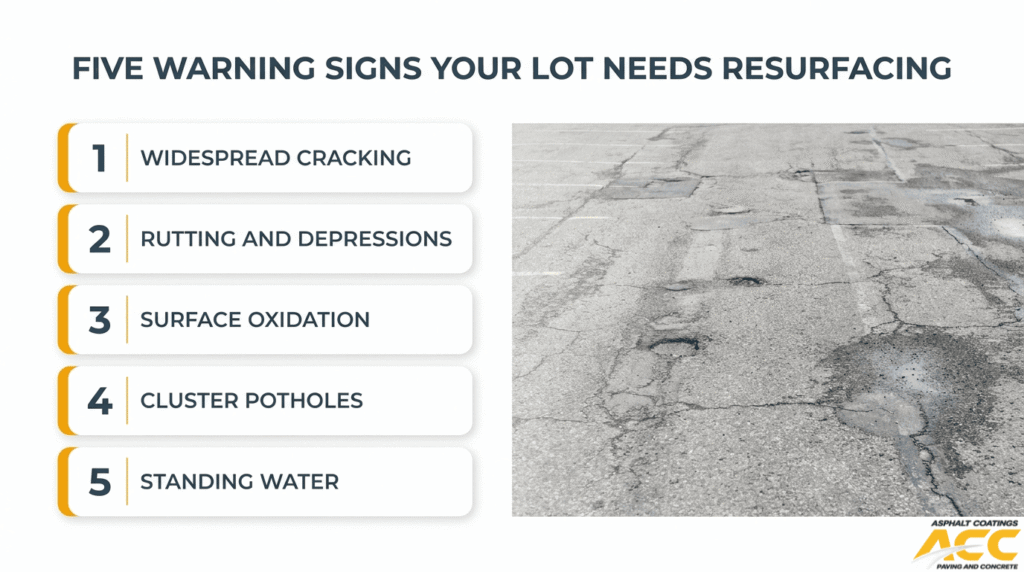
The signs that indicate your parking lot needs resurfacing include widespread cracking, rutting, drainage pooling, and faded or brittle surface texture. These visible symptoms signal that the existing asphalt has deteriorated beyond what sealcoating or patching can correct.
Key indicators to watch for:
- Interconnected cracking (alligator cracking) covers large areas rather than isolated spots, suggesting base-level fatigue.
- Rutting and depressions from repeated traffic loads create standing water and accelerate further damage.
- Extensive oxidation turns the surface gray and brittle, meaning the binder has lost flexibility.
- Potholes forming in clusters indicate the pavement structure is failing, not just the surface layer.
- Standing water after rain reveals grade loss or drainage failure that resurfacing can correct.
According to the Duluth Airport Authority’s pavement assessment report, pavement sections with a Pavement Condition Index between 40 and 60 are classified as needing major rehabilitation, while those below 40 typically require full reconstruction. A lot scoring in that 40-to-60 range is the ideal candidate for resurfacing; waiting until the PCI drops below 40 often eliminates the overlay option entirely.
For property managers uncertain about their lot’s condition, the most reliable approach is a professional pavement evaluation that assigns an objective PCI score rather than relying solely on visual judgment. Catching deterioration while resurfacing remains viable saves thousands compared to full-depth replacement.
With these warning signs identified, understanding how long a resurfaced lot will perform helps justify the investment.
How Long Does a Resurfaced Parking Lot Last?
A resurfaced parking lot lasts between 15 and 25 years when professionally installed. According to Ellsworth Pavement Maintenance, strategic pavement maintenance from year one can stretch a pavement’s lifespan by an extra 5 to 10 years, saving thousands of dollars in long-term replacement costs.
Several factors influence actual longevity:
- Traffic volume and vehicle weight determine wear rates on the overlay surface.
- Climate exposure, particularly freeze-thaw cycles and UV degradation, accelerates cracking.
- Drainage quality prevents water infiltration that undermines the asphalt bond.
- Maintenance frequency, including sealcoating and crack sealing, preserves surface flexibility.
For commercial property managers, this lifespan makes resurfacing one of the strongest long-term investments in pavement management. Proactive care during the first few years sets the trajectory for the full service life.
With expected lifespan established, the next step is obtaining accurate project estimates.
How Can You Get Accurate Free Quotes for Resurfacing?
You can get accurate free quotes for resurfacing by providing detailed project information, comparing multiple estimates, and vetting contractors thoroughly.
What Information Should You Provide for an Estimate?
The information you should provide for an estimate includes lot square footage, current pavement condition, desired project timeline, and any known drainage or ADA compliance concerns. Photographs of visible distress, such as cracking patterns, potholes, or standing water, help contractors assess scope without a preliminary site visit. Sharing previous maintenance records or the lot’s original installation date allows estimators to gauge remaining pavement life more precisely. The more specific your details, the tighter the quote range becomes, reducing the chance of unexpected change orders once work begins.
How Many Quotes Should You Compare?
You should compare at least three quotes from different contractors to establish a reliable pricing baseline. Three estimates reveal whether a bid falls within the typical market range or signals potential issues, such as underquoting that leads to corners cut on materials or overlay thickness. Comparing line-item breakdowns side by side exposes discrepancies in milling depth, tack coat application, and traffic control allowances. For most commercial property managers, this comparison process takes one to two weeks and prevents overpaying by thousands of dollars.
What Should You Look for in a Resurfacing Contractor?
You should look for a resurfacing contractor who demonstrates verifiable commercial experience, proper licensing, and transparent project documentation. According to the Asphalt Pavement Association of Washington’s quality construction checklist, key benchmarks include verifying that mix temperature stays within guidelines in the paver hopper and ensuring the finished mat has no deviations greater than 1/4 inch over 10 feet. Additional criteria to evaluate include:
- Active liability insurance and workers’ compensation coverage.
- A portfolio of completed commercial lots similar in size to yours.
- Written warranties specifying coverage duration and exclusions.
- In-house crews rather than subcontracted labor, which improves accountability.
Contractors who welcome site inspections and provide itemized proposals signal the professionalism that protects your investment long term.
How Does Colorado’s Climate Affect Parking Lot Resurfacing?
Colorado’s climate affects parking lot resurfacing by accelerating pavement deterioration through extreme temperature swings, freeze-thaw cycles, and intense UV exposure. These factors shorten asphalt lifespan and narrow the seasonal window for quality installation.
Can Asphalt Coatings Company Handle Your Resurfacing?
Yes, Asphalt Coatings Company can handle your resurfacing. With 39 years of experience serving Colorado’s Front Range, Asphalt Coatings Company designs asphalt solutions specifically for the state’s freeze-thaw cycles and high-altitude UV exposure. Asphalt paving in Colorado requires a minimum ambient temperature of 50 degrees Fahrenheit and rising for proper installation. Asphalt Coatings Company uses in-house crews to manage project timing around these temperature constraints, ensuring overlay compaction meets specifications. For commercial property managers dealing with pavement cracking driven by daily temperature swings exceeding 40 degrees, this Colorado-specific expertise translates into longer-lasting resurfacing results.
What Are the Key Takeaways About Parking Lot Resurfacing Costs?
The key takeaways about parking lot resurfacing costs are:
- Commercial resurfacing typically costs $1 to $3 per square foot, representing 40% to 60% savings compared to full reconstruction.
- Lot size is the most significant cost variable; projects exceeding 10,000 square feet benefit from economies of scale.
- Pavement condition determines whether resurfacing is viable or full replacement is necessary.
- Colorado’s extreme temperature swings accelerate cracking, making proactive maintenance essential to extend pavement life by 5 to 10 years.
- Collecting multiple detailed quotes with consistent scope ensures accurate cost comparisons.
For Colorado property managers, prioritizing early intervention over deferred maintenance consistently delivers the strongest long-term return on pavement investment.