A new-construction paving project in a growing Colorado Springs corridor is a multi-phase process that transforms raw land into a finished, code-compliant asphalt surface through sequential site preparation, engineered subbase work, hot-mix asphalt installation, and final striping.
This guide covers site preparation and drainage infrastructure, project timelines and installation phases, freeze-thaw resilience and climate-adapted design, permits and regulatory compliance, corridor-specific growth challenges, costs, quality verification, and contractor selection.
Site preparation involves clearing, geotechnical soil testing, grading to engineered contours, and installing drainage components like storm inlets and detention basins before any asphalt is placed. Colorado Springs’ expansive clay soils make this foundational work especially critical for preventing long-term settlement.
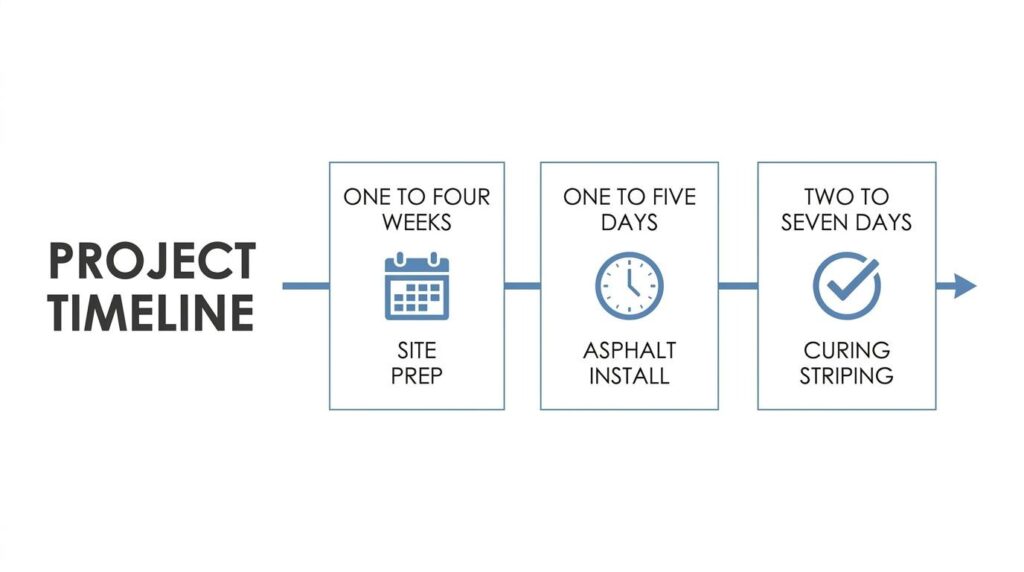
Typical project timelines span several weeks to a few months: one to four weeks for site preparation, one to five days for asphalt installation on most commercial lots, and two to seven days for curing and striping. Weather dependency tightens every phase of this schedule.
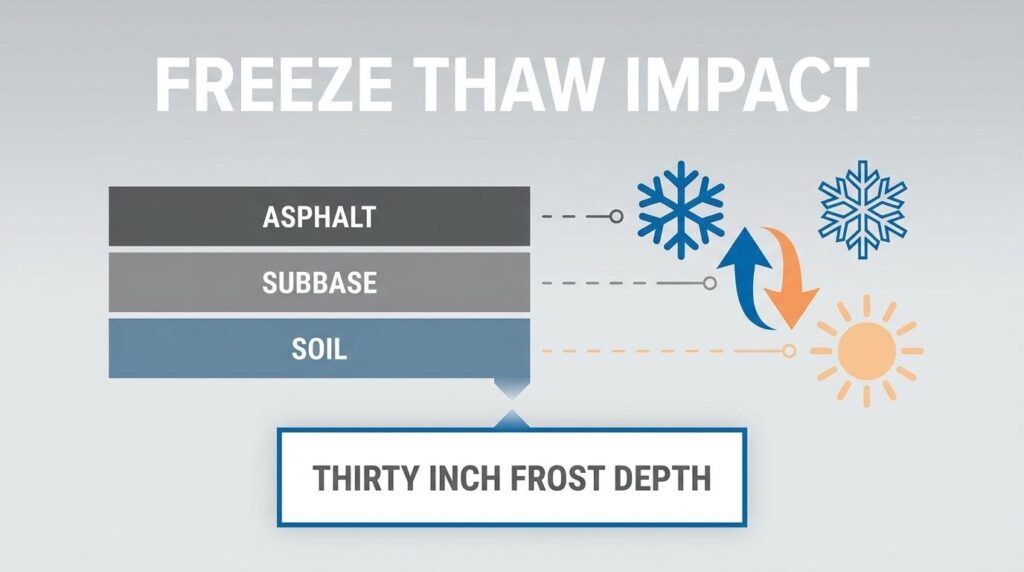
The region’s 30-inch frost depth and persistent freeze-thaw cycling require deeper subbases, polymer-modified binders, and anti-strip additives that resist moisture infiltration and deicing chemical damage. Seasonal paving windows between late spring and early fall provide the most reliable compaction conditions.
City grading permits, stormwater maintenance agreements, CDOT access approvals, and utility coordination through 811 locate requests must all be secured before breaking ground. In growing corridors, overlapping construction timelines, phased development sequencing, and shared access roads add scheduling complexity that demands proactive coordination.
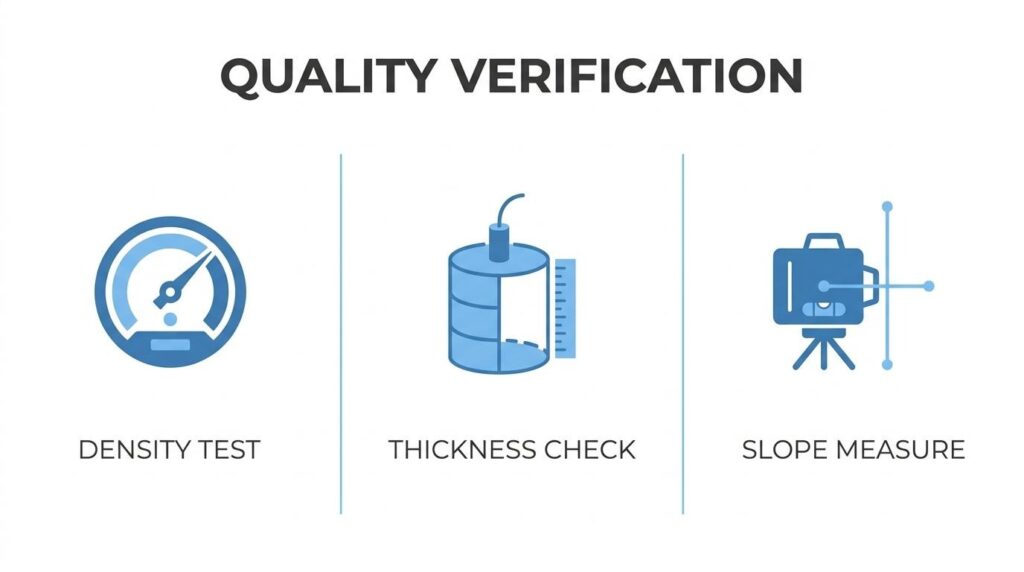
Commercial paving costs range from roughly $2.50 to $6 per square foot depending on project scale, while quality checks including compaction density testing, core sampling for thickness verification, and laser-guided drainage slope measurement protect the finished pavement against premature failure.
What Does a New-Construction Paving Project Actually Involve?
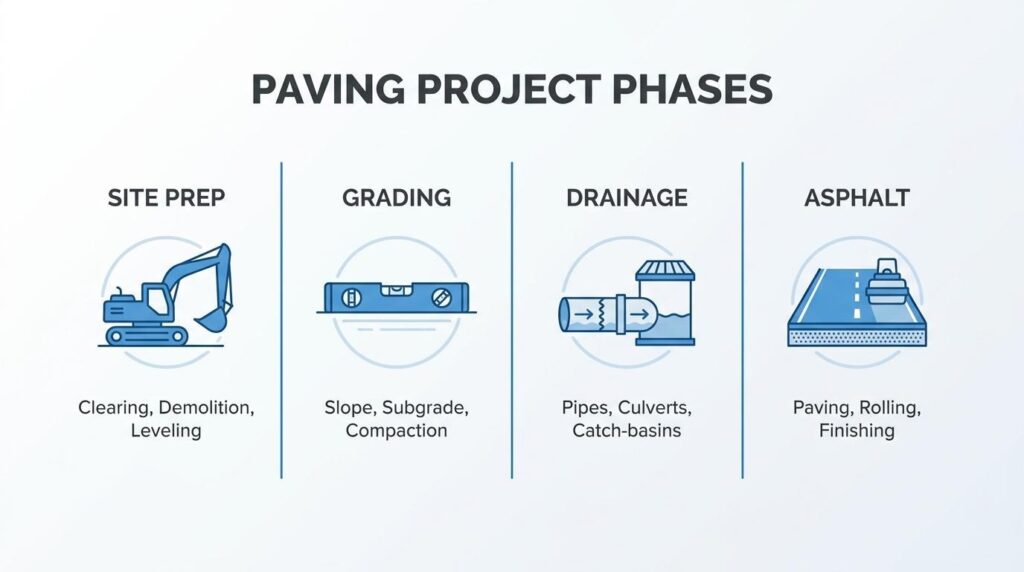
A new-construction paving project involves sequential phases of site preparation, grading, subbase installation, and drainage work before any asphalt is placed. The subsections below cover each critical phase.
What Site Preparation Steps Happen Before Paving Begins?
Site preparation steps that happen before paving begins include clearing, staking, and soil testing to establish a stable foundation for the pavement structure. Crews remove vegetation, topsoil, and debris from the construction footprint first. Surveyors then stake grade elevations and alignment markers so earthwork matches the engineered plan.
Geotechnical testing follows to evaluate soil bearing capacity and moisture content. In Colorado Springs, expansive clay soils are common, making this step essential for preventing future settlement. The Pikes Peak Region Asphalt Paving Specifications (Version 7), established on March 31, 2026, govern materials and construction standards within El Paso County and the City of Colorado Springs, setting the benchmark every site preparation phase must meet.
Skipping or rushing soil analysis is one of the most costly mistakes in commercial paving; problems hidden at the subgrade level always surface later in the finished pavement.
What Grading and Subbase Work Is Required for New Construction?
Grading and subbase work required for new construction includes rough grading to design elevation, fine grading for slope accuracy, and placement of compacted aggregate base layers. Rough grading shapes the site to match engineered contours, while fine grading establishes the precise cross-slopes and longitudinal grades that direct water away from the pavement surface.
Key subbase requirements for commercial projects in Colorado Springs include:
- Aggregate base course compacted in uniform lifts, typically 6 to 8 inches for commercial applications.
- Proof rolling to identify soft spots before base placement proceeds.
- Moisture conditioning of subgrade soils to achieve optimal compaction density.
- Grade verification with laser-guided or GPS-equipped equipment for consistent thickness.
Colorado Springs sits at high elevation with significant temperature swings, so subbase depth and compaction quality directly determine how well the finished pavement withstands long-term stress.
What Drainage Infrastructure Is Installed Alongside New Paving?
Drainage infrastructure installed alongside new paving includes storm inlets, underground pipe systems, swales, and retention or detention basins designed to manage stormwater runoff from the new impervious surface. Proper drainage prevents water from pooling beneath or on the pavement, which accelerates deterioration.
Common drainage components in a commercial paving project include:
- Catch basins and curb inlets positioned at low points to capture surface runoff.
- Subsurface storm drain pipes connecting inlets to the municipal system or on-site detention.
- Concrete curb and gutter to channel water toward collection points.
- Graded swales or bioretention areas for sites requiring stormwater quality treatment.
For commercial projects in growing Colorado Springs corridors, drainage design must align with local stormwater regulations from the outset. Retrofitting drainage after paving is complete costs significantly more and risks undermining pavement integrity.
With drainage strategies in place, understanding the project timeline helps set realistic expectations for each construction phase.
What Does the Typical Timeline Look Like for New-Construction Paving in Colorado Springs?
The typical timeline for new-construction paving in Colorado Springs spans several weeks to a few months, depending on project scale and weather conditions. Site preparation, asphalt installation, and curing each follow distinct schedules.
How Long Does the Site Preparation Phase Take?
The site preparation phase takes one to four weeks for most commercial paving projects in Colorado Springs. This phase covers clearing, grading, subbase compaction, and drainage installation. Colorado Springs’ 30-inch frost depth, as defined in the Pikes Peak Regional Building Code, requires deeper excavation than many other regions, which adds time to earthwork operations.
Utility coordination and soil stabilization can extend this window further, particularly in growing corridors where multiple developers share infrastructure access. For projects requiring stormwater BMPs or significant cut-and-fill work, preparation alone can stretch beyond four weeks. Scheduling this phase during dry conditions keeps the timeline from slipping.
How Long Does the Asphalt Installation Phase Take?
The asphalt installation phase takes one to five days for most commercial lots, though larger corridor projects may require one to two weeks. Paving crews typically place 200 to 400 tons of hot-mix asphalt per day, depending on crew size and equipment availability.
According to the Colorado Department of Transportation, all HMA must be compacted to 92 to 96 percent of maximum theoretical density, verified by core sampling or nuclear density gauge testing. Achieving proper density requires consistent ambient temperatures, so installation schedules in Colorado Springs are tightly weather-dependent. Each lift must be placed and rolled before the mix cools below compaction temperature, making efficient crew coordination the single largest factor in keeping this phase on track.
How Long Do Curing and Striping Add to the Schedule?
Curing and striping typically add two to seven days to the overall paving schedule. Fresh asphalt needs 24 to 72 hours of curing before it can handle vehicle traffic, though full hardening continues for several months as lighter oils in the binder oxidize.
Striping and pavement markings follow curing and usually require one to two days for a standard commercial lot. Thermoplastic or paint application needs dry, warm surface conditions, which can cause brief delays during Colorado Springs’ unpredictable spring weather. Rushing this step risks poor adhesion and premature re-striping costs.
Understanding the full project timeline helps set realistic expectations before freeze-thaw conditions enter the equation.
How Do Colorado Springs Freeze-Thaw Cycles Affect New Paving?
Colorado Springs freeze-thaw cycles damage new paving by repeatedly expanding and contracting moisture trapped in asphalt and subbase layers. Subbase depth, seasonal timing, and mix design each determine how well a pavement structure withstands this stress.
What Subbase Depth Is Needed to Handle Freeze-Thaw Movement?
The subbase depth needed to handle freeze-thaw movement in Colorado Springs must account for the region’s 30-inch established frost depth, as defined in the Pikes Peak Regional Building Code. A subbase that extends below the frost line prevents ice lenses from forming directly beneath the pavement surface, where heaving causes the most structural damage.
For commercial projects in growing corridors, this typically means engineered aggregate base layers thick enough to distribute loads across frost-susceptible soils. Skimping on subbase depth is one of the most common cost-cutting mistakes in new construction; the savings disappear within a few winters when surface cracking begins, often necessitating pavement reconstruction methods.
How Does Seasonal Timing Influence Asphalt Compaction and Curing?
Seasonal timing influences asphalt compaction and curing because hot-mix asphalt requires adequate ambient and surface temperatures to achieve proper density. According to research from the University of Colorado Boulder, freeze-thaw cycles are the primary stressor for Colorado asphalt road networks, necessitating more robust pavement structures for climate adaptation.
Paving during Colorado Springs’ shoulder seasons, when overnight temperatures can drop below freezing while afternoons stay warm, creates inconsistent compaction conditions. Key timing considerations include:
- Late spring through early fall provides the most reliable compaction window.
- Ground temperatures below 40°F prevent asphalt from bonding properly to the base layer.
- Rapid temperature swings during curing can trap moisture, accelerating early-season damage.
What Mix Designs Perform Best in Front Range Climates?
The mix designs that perform best in Front Range climates use polymer-modified binders and anti-strip additives that resist moisture infiltration during freeze-thaw cycling. A 2026 study by the Mountain-Plains Consortium (MPC-549) found that common deicing agents used in Colorado can accelerate the stripping of asphalt binder from aggregate in cold environments.
This finding makes anti-strip additives especially critical for commercial pavements in Colorado Springs corridors, where deicing salt application is routine throughout winter. Higher-performing mixes also incorporate well-graded, angular aggregates that interlock tightly, reducing the void space where water collects and freezes.
With freeze-thaw resilience built into the design, proper permitting ensures these standards meet local code.
What Permits and Regulations Apply in Growing Colorado Springs Corridors?
Permits and regulations in growing Colorado Springs corridors include city grading permits, stormwater compliance agreements, CDOT access approvals, and utility coordination clearances. Each requirement affects project scheduling and design.
What City of Colorado Springs Grading and Stormwater Permits Are Required?
City of Colorado Springs grading and stormwater permits required for new-construction paving include a grading permit for earthwork, a stormwater management plan, and a Maintenance Agreement for permanent best management practices. According to the City of Colorado Springs Water Resources division, landowners must enter into a Maintenance Agreement for any permanent Best Management Practice (BMP) to ensure ongoing stormwater compliance.
Key permit requirements include:
- Grading permit: Required before any earthwork or subgrade preparation begins on the project site.
- Stormwater management plan: Must demonstrate how runoff will be controlled during and after construction.
- BMP Maintenance Agreement: Obligates the property owner to maintain permanent drainage controls indefinitely.
- Pavement design compliance: Principal arterial roadways require a minimum of 8 inches of HMA or 9 inches of PCC per city design criteria.
- Frost depth consideration: The Pikes Peak Regional Building Code establishes a 30-inch frost depth, which influences footing and subbase design for any paved surface.
Failing to secure these permits before breaking ground can halt a project entirely, making early coordination with city departments one of the most practical steps a property owner can take.
What CDOT Access and Right-of-Way Approvals May Be Needed?
CDOT access and right-of-way approvals may be needed when a new-construction paving project connects to or affects a state highway. CDOT controls access points along state routes that pass through Colorado Springs corridors, including major arteries like Powers Boulevard and Academy Boulevard.
Projects requiring CDOT involvement typically include:
- Access permits: Required for any new driveway, curb cut, or commercial entrance onto a state highway.
- Right-of-way encroachment permits: Needed when construction activity, staging, or drainage improvements extend into CDOT-owned right-of-way.
- Traffic control plans: CDOT requires approved traffic management plans for any work affecting state road traffic flow.
These approvals often take longer than city permits, so initiating the CDOT application process early prevents costly scheduling delays.
What Utility Coordination Is Required Before Breaking Ground?
Utility coordination required before breaking ground includes locating all underground utilities, scheduling relocations, and obtaining clearance from each provider. Colorado law mandates contacting the Utility Notification Center of Colorado (UNCC) through an 811 call before any excavation.
Essential coordination steps include:
- 811 locate request: Filed at least three business days before digging to mark gas, electric, water, sewer, and telecom lines.
- Utility relocation scheduling: If existing lines conflict with the grading plan, relocations must be completed before subgrade work begins.
- Provider-specific permits: Some utilities, such as Colorado Springs Utilities, require separate encroachment or connection permits for work near their infrastructure.
- As-built verification: Confirming that relocated or newly installed utilities match approved plans before paving over them.
In rapidly growing corridors, where multiple developments share underground infrastructure, overlooked utility conflicts are among the most common causes of project delays. Understanding permit and regulation requirements sets the stage for managing the unique paving challenges these expanding corridors present.
How Does Rapid Corridor Growth Create Unique Paving Challenges?
Rapid corridor growth creates unique paving challenges by forcing multiple projects into overlapping timelines, shifting construction sequences, and introducing shared infrastructure conflicts. The subsections below cover scheduling disruptions from adjacent sites, phased development impacts, and shared access road complications.
How Do Adjacent Active Construction Sites Affect Scheduling?
Adjacent active construction sites affect scheduling by creating competing demands for road access, material deliveries, and heavy equipment staging. When multiple developers break ground simultaneously along a corridor, paving crews must coordinate haul routes and delivery windows to avoid gridlock. Dust, vibration, and runoff from neighboring sites can also compromise freshly placed subgrade or asphalt surfaces if timing is not carefully managed.
In Colorado Springs corridors like those along Powers Boulevard and the eastern growth areas, this overlap is common. The City of Colorado Springs 2C Road Improvement program plans paving projects spanning 2021 to 2027, with 2026 updates covering major corridors like Circle, Union, and Palmer Park. Proactive scheduling coordination between adjacent projects prevents costly rework and keeps compaction windows on track.
How Does Phased Development Change the Paving Sequence?
Phased development changes the paving sequence by requiring contractors to install pavement in stages rather than a single continuous operation. A traditional project paves the entire surface after all underground utilities and grading are complete. In phased corridors, however, some parcels remain under active development while others are already occupied, which means paving must accommodate future tie-ins, temporary transitions, and staged drainage connections.
This incremental approach demands careful joint placement between phases so that later connections do not compromise the structural integrity of earlier lifts. For commercial property owners, phased paving often means accepting a base course first, then returning for the final surface course once adjacent construction loads have subsided. Sequencing each phase correctly protects the long-term performance of the entire pavement section.
How Do Shared Access Roads Complicate New-Construction Paving?
Shared access roads complicate new-construction paving by distributing construction traffic, ownership responsibilities, and maintenance obligations across multiple property owners. When several commercial developments rely on a single access road, heavy truck loads from one site can damage pavement designed to serve another. Coordinating construction timing becomes critical because paving a shared road too early exposes it to abuse from ongoing adjacent work.
Easement agreements, load restrictions during curing periods, and clearly defined maintenance responsibilities must be established before paving begins. Without these agreements, disputes over premature deterioration are common. For properties in fast-growing Colorado Springs corridors, addressing shared access logistics early in the planning process avoids expensive repairs and protects the investment in new pavement.
Understanding these corridor-specific challenges helps property owners prepare for the asphalt installation process itself.
What Should You Expect During Each Phase of Asphalt Installation?
You should expect four distinct phases during asphalt installation: subgrade compaction, aggregate base placement, hot-mix asphalt laydown, and final striping with site restoration.
What Happens During Subgrade Compaction and Proof Rolling?
Subgrade compaction and proof rolling happen first to verify that the underlying soil can support the pavement structure. Crews compact the native soil using vibratory rollers, then run a loaded dump truck across the surface in a process called proof rolling. Any areas that deflect or pump under the truck’s weight indicate soft spots requiring excavation and replacement with stable material. This step is especially critical in Colorado Springs, where expansive clay soils are common along growing corridors. Skipping proper proof rolling risks premature cracking and settlement after paving is complete. According to Colorado Department of Transportation specifications, all hot-mix asphalt must ultimately achieve 92 to 96 percent of maximum theoretical density, a standard that starts with a stable subgrade.
What Happens During Aggregate Base Placement?
Aggregate base placement happens after subgrade approval, creating the load-bearing foundation beneath the asphalt surface. Crews spread crushed stone in controlled lifts, compacting each layer to specification before adding the next. In the Pikes Peak region, where the established frost depth reaches 30 inches, sufficient base thickness prevents frost heave from pushing the pavement upward during winter cycles. Base material is typically graded to promote internal drainage, directing moisture away from the subgrade. For commercial projects in Colorado Springs, base depth varies by traffic load and soil conditions; principal arterials, for example, require significantly thicker pavement sections than low-traffic parking areas. Proper base placement is the single most influential factor in long-term pavement performance.
What Happens During Hot-Mix Asphalt Laydown and Rolling?
Hot-mix asphalt laydown and rolling happen once the compacted aggregate base passes inspection. A paving machine spreads HMA at temperatures typically between 275°F and 325°F, while steel-wheel and pneumatic rollers follow closely behind to achieve target density before the mix cools. Timing is critical; crews must complete compaction within a narrow temperature window, which tightens further during Colorado Springs’ cooler shoulder seasons. Each lift is placed and rolled independently, with joints staggered to prevent weak seams. For commercial projects in growing corridors, multiple paver passes may be needed to cover wide access roads or large parking areas. Proper rolling technique eliminates air voids that would otherwise allow moisture infiltration and freeze-thaw damage.
What Happens During Final Striping and Site Restoration?
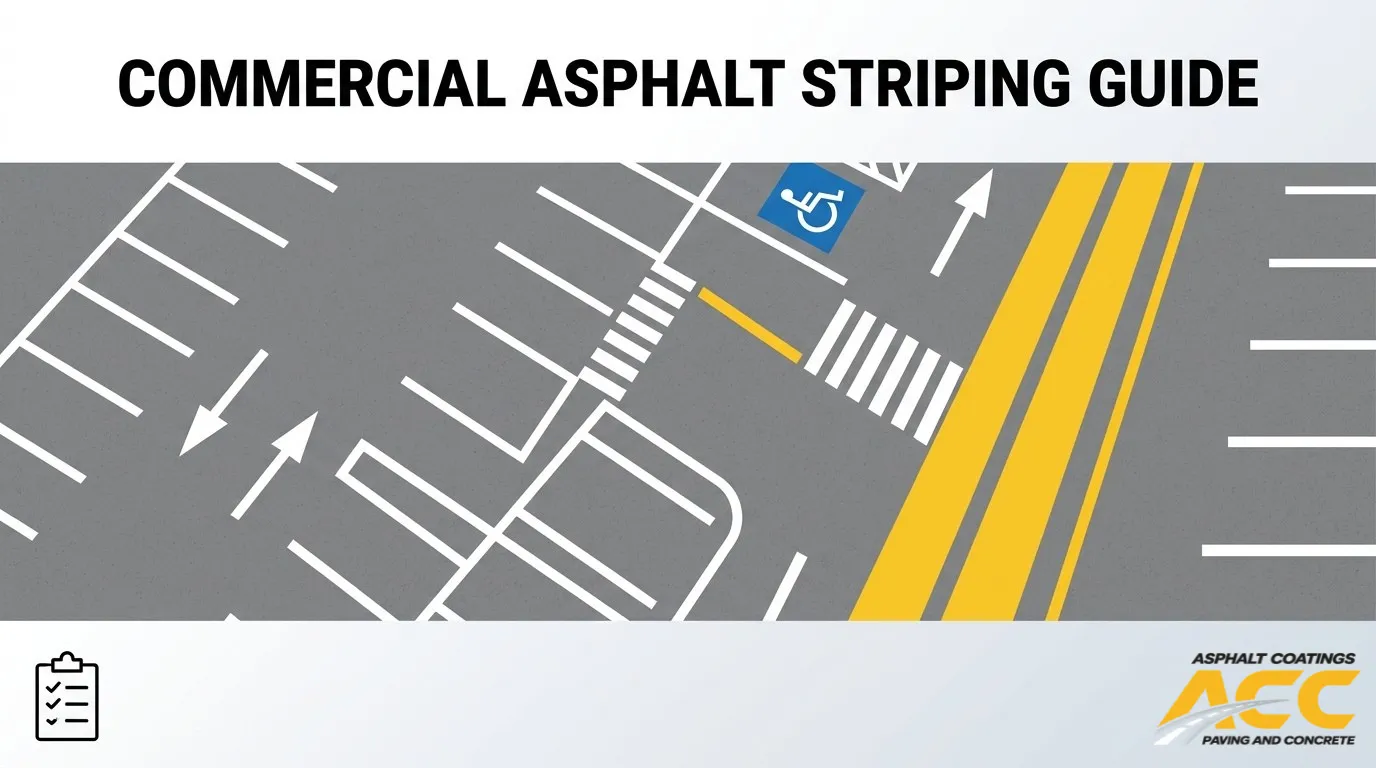
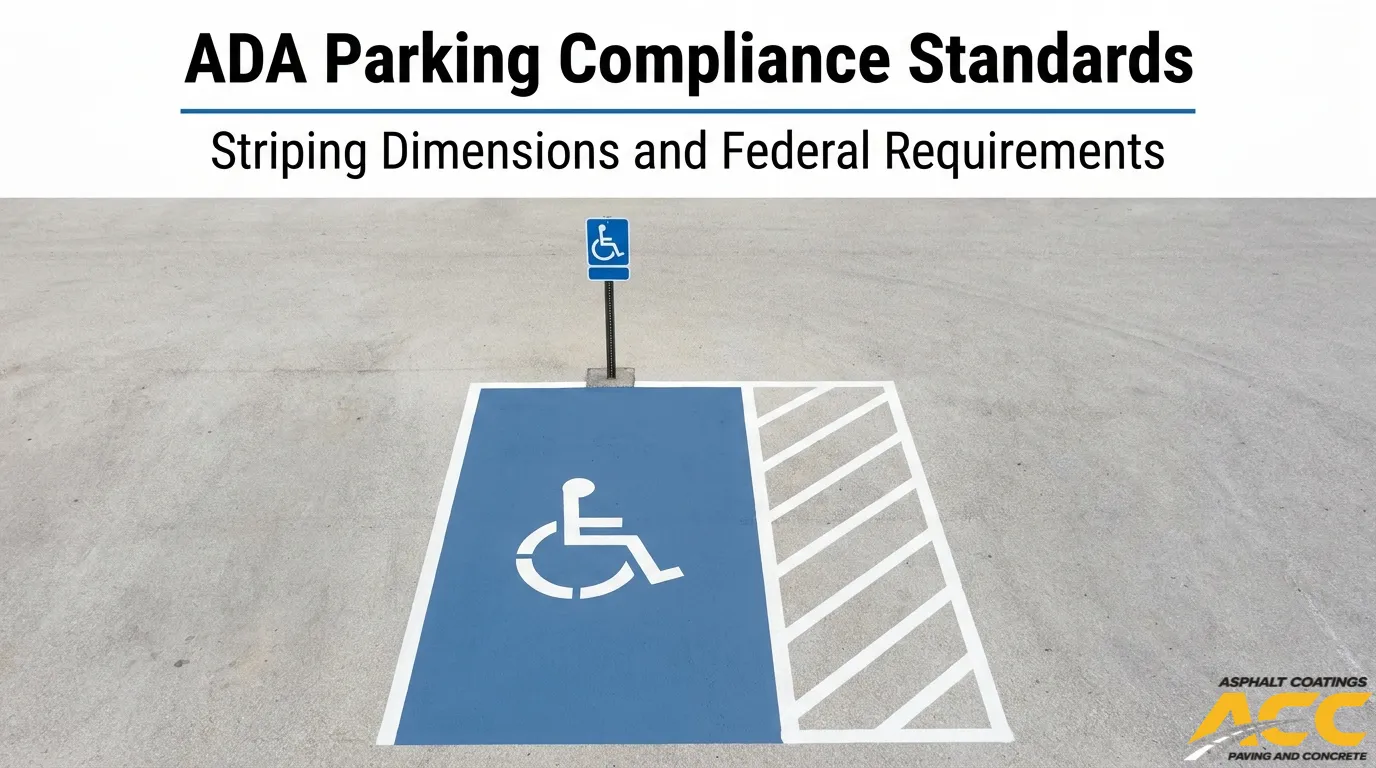
Final striping and site restoration happen after the asphalt has cooled and cured sufficiently to accept paint. Crews apply traffic markings, including parking stall lines, directional arrows, fire lanes, and ADA-accessible designations, using thermoplastic or traffic-grade latex paint. Site restoration follows, which involves grading disturbed shoulder areas, seeding exposed soil, installing permanent signage, and removing temporary construction barriers. Stormwater best management practices are also finalized during this phase. In Colorado Springs, landowners must enter into a Maintenance Agreement for any permanent stormwater BMP to ensure ongoing compliance with city regulations. Once striping and restoration are complete, the site is ready for traffic.
With each installation phase complete, understanding associated costs helps you budget accurately for new-construction paving.
How Much Does New-Construction Commercial Paving Cost in Colorado Springs?
New-construction commercial paving cost in Colorado Springs depends on project scale, site conditions, and required pavement thickness. Below, costs are broken down by small parking lots, large retail or industrial lots, and access roads in new developments.
What Does Paving a Small Commercial Parking Lot Cost?
Paving a commercial asphalt paving typically costs between $3 and $6 per square foot for standard asphalt installation in the Colorado Springs market. A lot serving 20 to 50 vehicles generally ranges from $25,000 to $75,000, depending on subgrade conditions, drainage requirements, and whether curb and gutter work is included.
Several factors push small-lot costs higher in this region:
- Frost depth requirements of 30 inches, as defined in the Pikes Peak Regional Building Code, demand deeper subbase preparation than many other markets.
- Stormwater BMP compliance adds engineering and maintenance agreement costs.
- Mobilization fees represent a larger percentage of total cost on smaller projects.
For most small commercial properties, the subbase and site preparation work accounts for nearly as much expense as the asphalt itself.
What Does Paving a Large Retail or Industrial Lot Cost?
Paving a large retail or industrial lot costs roughly $2.50 to $5 per square foot in Colorado Springs, with total project budgets commonly ranging from $200,000 to over $1 million. Larger footprints benefit from economies of scale in material delivery and crew efficiency, which lowers the per-square-foot rate compared to smaller projects.
Industrial lots that support heavy truck traffic require thicker pavement sections. According to the City of Colorado Springs Pavement Design Criteria Manual, the minimum pavement thickness for principal arterial roadways is 8 inches of hot mix asphalt or 9 inches of Portland cement concrete. Heavy-use commercial lots often follow similar structural standards to handle sustained loading. Drainage infrastructure, ADA-compliant concrete work, and phased construction in active corridors all add to the final figure.
What Does Paving an Access Road in a New Development Cost?
Paving an access road in a new development costs approximately $40 to $70 per linear foot for a standard two-lane configuration in Colorado Springs, though width, grade changes, and utility coordination significantly affect final pricing. Total costs for a quarter-mile access road commonly fall between $150,000 and $400,000.
Access roads in growing corridors face unique cost pressures:
- CDOT right-of-way approvals and traffic control requirements add permitting and engineering expenses.
- Shared-access agreements with adjacent parcels may require wider pavement sections or deceleration lanes.
- Utility relocation and coordination with active adjacent construction sites introduce scheduling delays that increase labor costs.
Given these variables, accurate budgeting requires a detailed site evaluation before construction begins. Understanding these cost factors helps property owners plan effectively for the quality checks that follow installation.
What Quality Checks Should You Watch for During a New Paving Project?
Quality checks you should watch for during a new paving project include subgrade compaction verification, asphalt thickness confirmation, and drainage slope measurement. These three checkpoints protect long-term pavement performance.
How Is Subgrade Compaction Density Verified?
Subgrade compaction density is verified through core sampling or nuclear density gauge testing performed on the prepared soil before paving begins. According to the Colorado Department of Transportation, all hot mix asphalt must be compacted to a density of 92 to 96 percent of the maximum theoretical density. This standard applies to the subgrade and base layers as well, since insufficient compaction beneath the surface leads to settling, cracking, and premature failure. A nuclear gauge provides real-time readings on site, while core samples offer lab-confirmed accuracy. For commercial projects in Colorado Springs, insisting on documented density test results at multiple points across the subgrade is one of the most effective ways to catch problems before asphalt is placed.
How Is Asphalt Thickness Confirmed After Placement?
Asphalt thickness is confirmed after placement by extracting pavement cores at designated intervals and measuring the compacted lift depth against design specifications. The City of Colorado Springs Pavement Design Criteria Manual requires a minimum pavement thickness of 8 inches of hot mix asphalt for principal arterial roadways. Core samples, typically pulled within days of paving, reveal whether each lift meets the specified depth. Thin spots compromise structural capacity, particularly in high-traffic commercial corridors where heavy loads are common. Reviewing core reports before final project acceptance ensures the installed pavement matches what was engineered for Colorado Springs soil and traffic conditions.
How Are Proper Drainage Slopes Measured?
Proper drainage slopes are measured using laser-guided survey equipment and stringline grading checks that confirm water flows toward designated collection points. Even minor deviations in grade can cause ponding, which accelerates surface deterioration through freeze-thaw cycling. Surveyors verify cross-slope percentages at multiple stations across the paved surface, comparing field readings to the engineered drainage plan. Given that landowners in Colorado Springs must maintain permanent stormwater best management practices under a city-required Maintenance Agreement, correct slopes established during construction directly affect long-term compliance obligations. Verifying drainage grades before striping is the last practical opportunity to correct grading deficiencies without costly rework.
Understanding what to look for during quality checks helps you evaluate whether a contractor meets the standard your project demands.
How Do You Choose the Right Paving Contractor for New Construction in Colorado Springs?
You choose the right paving contractor for new construction in Colorado Springs by evaluating commercial project experience, local climate knowledge, and compliance with regional specifications. The following subsections cover what to assess.
What Experience Should a Contractor Have with Large-Scale Commercial Projects?
A contractor should have experience managing full-scope commercial paving projects, including subgrade preparation, drainage coordination, utility sequencing, and multi-phase asphalt installation. Large-scale work for properties such as shopping centers, industrial complexes, and office parks demands capabilities that residential contractors simply do not develop.
Key experience indicators to look for include:
- A verified portfolio of parking lots, access roads, and commercial developments exceeding 10,000 square feet.
- Demonstrated ability to coordinate with civil engineers, utility crews, and general contractors on active construction sites.
- Familiarity with phased paving sequences common in growing corridor developments.
- In-house crews rather than subcontracted labor, which ensures consistent quality control across every lift.
For growing corridors where adjacent sites are under simultaneous development, a contractor’s scheduling adaptability becomes just as important as technical skill.
Why Does Local Climate Expertise Matter for a Colorado Springs Paving Contractor?
Local climate expertise matters for a Colorado Springs paving contractor because the region’s environmental conditions directly determine mix design, subbase depth, compaction timing, and long-term pavement durability. A contractor unfamiliar with these factors risks premature failure.
Colorado Springs sits at over 6,000 feet of elevation, where intense UV exposure, rapid temperature swings, and a 30-inch frost depth create stresses that standard specifications from lower-altitude regions do not address. According to research from the University of Colorado Boulder, freeze-thaw cycles are the primary stressor for Colorado asphalt road networks, necessitating more robust pavement structures for climate adaptation.
A contractor with Front Range experience understands how to select polymer-modified binders, schedule pours within optimal temperature windows, and design subbases that accommodate seasonal ground movement. Without this expertise, even a well-installed surface can crack within its first winter.
How Can Asphalt Coatings Company Help with New-Construction Paving in Colorado Springs?
Asphalt Coatings Company helps with new-construction paving in Colorado Springs by providing full-scope commercial services, from subgrade preparation and grading through final striping, using in-house crews with 39 years of Front Range experience. Asphalt Coatings Company operates from a dedicated Colorado Springs office at 4740 Forge Rd STE 110B.
All new-construction projects must comply with the Pikes Peak Region Asphalt Paving Specifications (Version 7), established on March 31, 2026, which govern asphalt materials and construction within El Paso County and the City of Colorado Springs. Property managers overseeing these developments should also be aware of specific compliance requirements for federally funded projects, which often have their own set of guidelines. Asphalt Coatings Company builds every project to meet these regional standards while also accounting for challenges like deicing chemical exposure, which a 2026 Mountain-Plains Consortium study (MPC-549) found accelerates binder stripping from aggregate in cold environments.
Asphalt Coatings Company specializes exclusively in commercial projects, serving property managers, industrial complex owners, shopping centers, office parks, healthcare centers, and apartment complexes across the region.
What Are the Key Takeaways About New-Construction Paving in a Growing Colorado Springs Corridor?
The key takeaways about new-construction paving in a growing Colorado Springs corridor center on preparation, compliance, and choosing the right partner:
- Successful projects require thorough site preparation, proper subbase engineering, and drainage infrastructure before any asphalt is placed.
- Colorado Springs freeze-thaw cycles, high-altitude UV, and deicing agents demand climate-adapted mix designs and robust pavement structures.
- City permits, stormwater compliance agreements, and regional paving specifications set strict requirements that must be addressed early in the planning phase.
- Rapid corridor growth introduces scheduling complexity from adjacent construction, phased development, and shared access roads.
- Selecting a contractor with large-scale commercial experience and proven local climate knowledge protects your investment over the pavement’s full lifecycle.