Mill-and-overlay is a pavement rehabilitation method that removes deteriorated surface asphalt and replaces it with fresh hot-mix asphalt, while full-depth reconstruction removes the entire pavement section and rebuilds from the subgrade up. Choosing the right method for an aging Colorado Springs industrial lot depends on structural condition, soil stability, climate exposure, and long-term cost.
This guide covers how each method works, the structural and environmental factors that determine which one fits, cost and lifespan comparisons, and the compliance and planning steps that protect your investment.
Mill-and-overlay restores surface quality on lots where the aggregate base remains sound, with milling depths of 3 to 4 inches and new HMA placed directly over the existing structure. Full-depth reconstruction addresses failures that extend below the surface, rebuilding stabilized base courses to handle cumulative heavy-truck loads that can exceed 7 million ESALs over an industrial pavement’s design life.
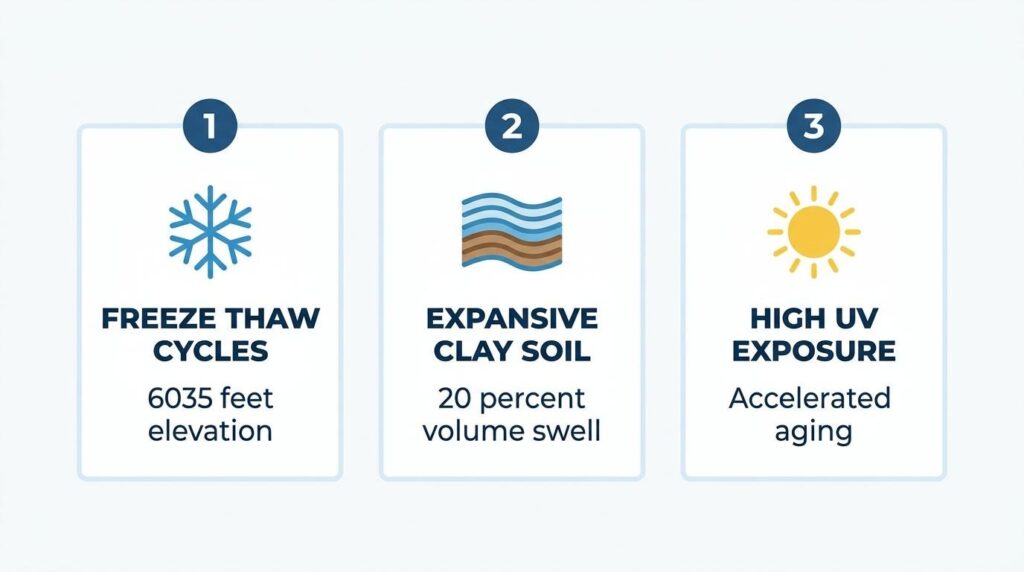
Colorado Springs presents unique challenges for both methods. Freeze-thaw cycling at 6,035 feet of elevation accelerates reflective cracking in overlays, expansive bentonite clays can heave pavement from below, and high-altitude UV exposure stiffens asphalt binder faster than at lower elevations. These conditions often push borderline lots toward reconstruction.
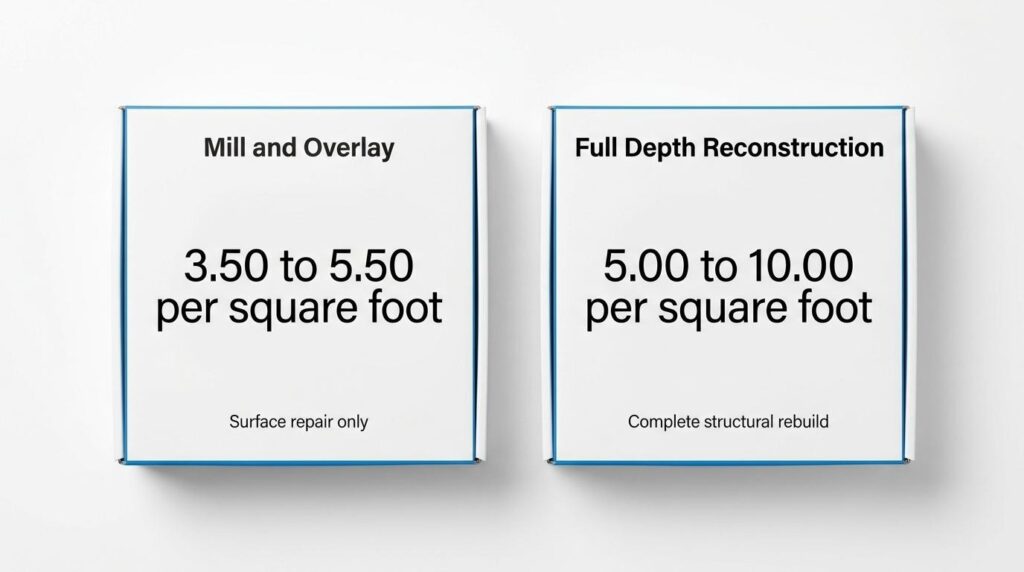
Cost differences are substantial: overlays range from $3.50 to $5.50 per square foot while reconstruction runs $5.00 to $10.00. However, overlaying a compromised base leads to repeated failures that compound expenses over time. Pavement thickness, core sample results, and drainage conditions ultimately determine which method delivers true long-term value.
ADA compliance, stormwater permitting, and phased paving schedules round out the planning process, ensuring rehabilitation meets both structural and regulatory requirements without shutting down daily operations.
What Is Mill-and-Overlay for Industrial Asphalt Lots?
Mill-and-overlay for industrial asphalt lots is a rehabilitation method that removes a specified depth of deteriorated asphalt surface using a milling machine, then replaces it with fresh hot-mix asphalt (HMA). This process restores ride quality, corrects surface drainage, and extends pavement life without disturbing the underlying aggregate base or subgrade. For industrial facilities in Colorado Springs, where heavy truck traffic and harsh environmental conditions accelerate surface wear, mill-and-overlay serves as a cost-effective alternative to full removal when the existing pavement structure remains structurally sound.
The milling phase uses a rotary drum equipped with carbide-tipped teeth to grind the existing asphalt surface to a precise depth. According to a U.S. Department of Transportation report, net productivity in asphalt milling increases as the depth of cut increases up to about 75 mm to 100 mm (3 to 4 inches), beyond which two passes of the machine may be more efficient than a single pass. This matters on industrial lots where milling depths often need to address years of accumulated distress across large surface areas. Once milling is complete, the reclaimed asphalt pavement (RAP) is typically hauled off-site for recycling.
After milling, crews apply a tack coat to bond the new material to the milled surface, then lay fresh HMA using a paver. Proper compaction is critical at this stage. The National Asphalt Pavement Association (NAPA) notes that Superpave mixes, which tend to be coarser and contain modified binders, require breakdown rolling right behind the paver when the mix is hottest to achieve sufficient density. For industrial lots handling forklift traffic, Class 8 trucks, and heavy equipment, achieving target compaction directly determines how long the overlay will perform before showing distress.
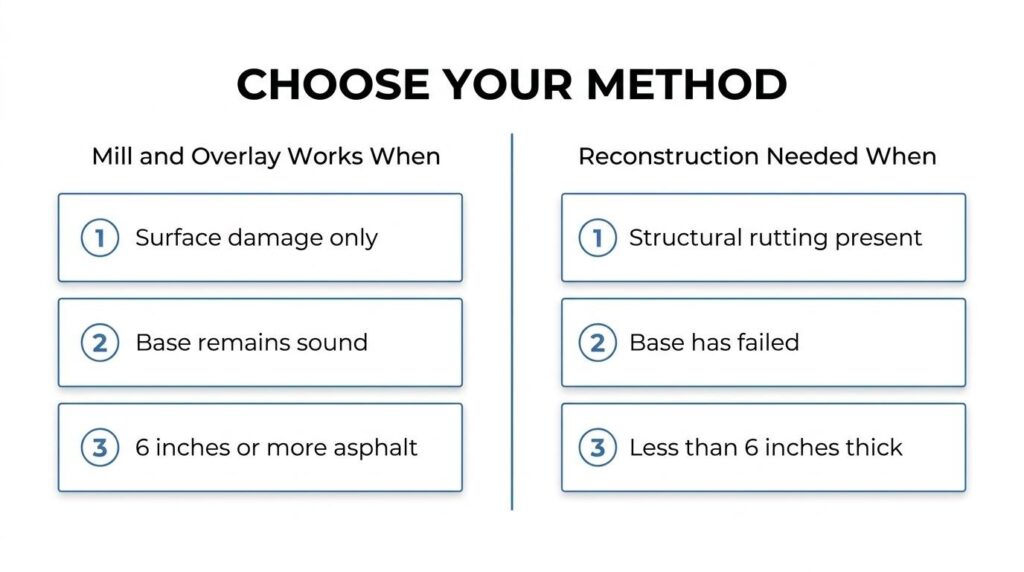
Mill-and-overlay works best when the existing pavement structure, including the aggregate base and subgrade, can still support current traffic loads. Surface distresses such as minor cracking, oxidation, and shallow rutting are ideal candidates. However, if core samples reveal the base has failed or if widespread alligator cracking extends through the full asphalt depth, overlay alone will not resolve the underlying structural deficiency. For Colorado Springs industrial lot owners, understanding this distinction is the first step toward choosing the right rehabilitation strategy.
What Is Full-Depth Reconstruction for Industrial Lots?
Full-depth reconstruction for industrial lots is a pavement rehabilitation method that removes the entire existing asphalt section and a portion of the underlying base, then rebuilds the pavement structure from the subgrade up. This process addresses failures that extend below the surface layer into the aggregate base and soil.
According to the Federal Highway Administration, full depth reclamation treats the entire asphalt pavement section and a predetermined amount of underlying materials to produce a stabilized base course, typically performed to a depth of 100 to 300 mm (4 to 12 in). For Colorado Springs industrial facilities handling heavy truck traffic, this approach corrects subgrade deficiencies that surface-level treatments cannot reach.
The process typically follows a defined sequence:
- Existing asphalt and deteriorated base materials are pulverized or excavated.
- The exposed subgrade is evaluated, graded, and stabilized if expansive soils are present.
- A new engineered aggregate base is installed and compacted.
- Fresh hot-mix asphalt (HMA) is placed in multiple lifts to achieve the design thickness.
Industrial lots often require this level of intervention because cumulative heavy-vehicle loading degrades the entire pavement structure over time, not just the surface. When structural rutting, widespread fatigue cracking, or base failure is present, overlaying the existing surface simply transfers those problems into the new layer. Full-depth reconstruction eliminates that risk by building on a verified, properly compacted foundation designed for the specific load demands of the facility.
For most aging industrial properties in Colorado Springs, this method represents the only path to a pavement section engineered for another full service cycle.
How Do You Know When an Industrial Lot Needs More Than Mill-and-Overlay?
An industrial lot needs more than mill-and-overlay when pavement failures originate below the surface layer. Subbase failure, insufficient remaining asphalt thickness, and cumulative heavy truck damage all signal that resurfacing alone will not restore structural capacity.
What Pavement Failures Indicate the Subbase Has Failed?
Pavement failures that indicate the subbase has failed include structural rutting, fatigue cracking, and localized depressions that persist after surface repairs. These distresses originate beneath the asphalt layer, meaning a new surface will inherit the same problems.
Structural rutting appears as depressions in the wheel path accompanied by subsidence in the subgrade, which suggests the aggregate base and existing pavement thickness are insufficient to carry current traffic loads. Fatigue cracking, often called alligator cracking, results from repeated bending under wheel loads when traffic exceeds the pavement structure’s capacity, according to the Asphalt Institute.
When these patterns cover more than isolated areas, they confirm the damage extends well below what milling can reach. In Colorado Springs, where expansive clay soils compound subbase instability, ignoring these signs typically leads to premature overlay failure.
What Does a Core Sample Reveal About Remaining Asphalt Life?
A core sample reveals the remaining asphalt life by exposing layer thickness, material condition, and bonding integrity at each depth. Engineers extract cylindrical cores to measure how much viable hot-mix asphalt (HMA) remains above the aggregate base.
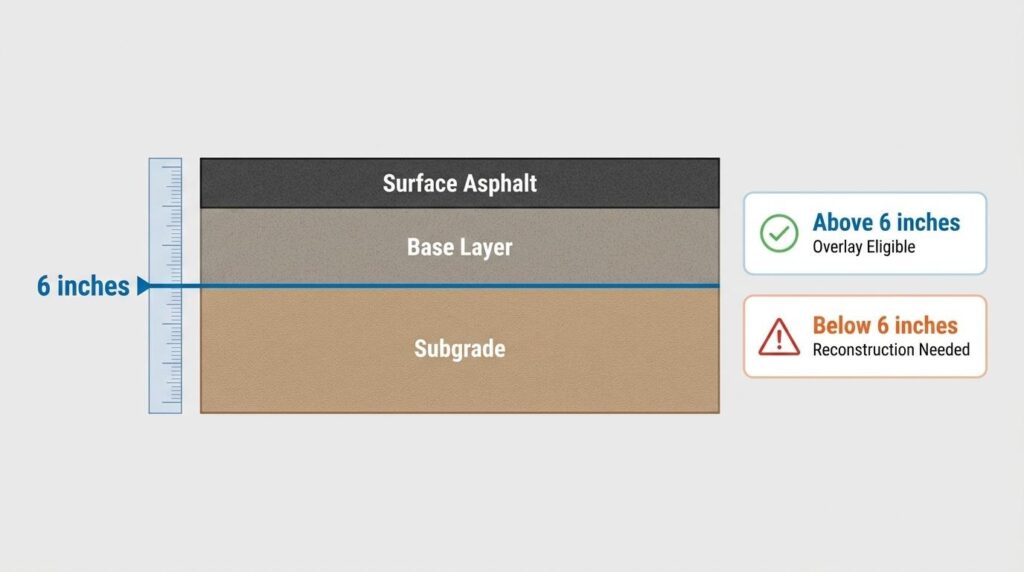
A widely referenced rule of thumb in civil engineering holds that pavements with a 6-inch or deeper HMA section typically do not exhibit bottom-up cracking and can be considered “perpetual.” When cores show the sound asphalt has thinned below that threshold, or when stripping and moisture damage appear between lifts, mill-and-overlay becomes insufficient. For industrial lots in Colorado Springs, core sampling also identifies whether expansive clay has migrated into the base layer, a condition no overlay can correct.
How Do Heavy Truck Loads Accelerate Structural Decline?
Heavy truck loads accelerate structural decline by delivering exponentially greater force per axle pass than passenger vehicles. The equivalent single axle load (ESAL) concept quantifies this impact by equating any axle configuration to a standard 18,000-pound single axle with dual tires.
According to the American Trucking Associations, a single 5-axle tractor/semi-trailer at the 80,000-pound interstate limit generates approximately 2.45 ESALs per pass, equivalent to the pavement impact of 6,123 passenger cars. Over a 50-year design life, cumulative ESALs in industrial zones can exceed 7 million, requiring structural HMA thickness of 6 inches or more.
This cumulative loading is precisely why many industrial lots in Colorado Springs fail prematurely; they were originally designed for lighter traffic. When ESAL demand outpaces structural capacity, full-depth reconstruction becomes the only viable path forward.
With structural indicators assessed, the next consideration is how Colorado Springs climate compounds these failures.
How Does Colorado Springs Climate Affect Each Method?
Colorado Springs climate affects each method by introducing freeze-thaw stress, expansive soil movement, and intense UV degradation that shorten pavement life. The sections below cover how each factor uniquely challenges mill-and-overlay versus full-depth reconstruction.
How Do Freeze-Thaw Cycles Impact a Mill-and-Overlay?
Freeze-thaw cycles impact a mill-and-overlay by forcing water trapped in micro-cracks to expand repeatedly, widening those cracks with each cycle until the new surface separates from the substrate. According to the Evergreen Design Group, at 6,035 feet of elevation in Colorado Springs, freeze-thaw cycling is more severe and frequent than at lower-elevation Front Range markets, demanding explicit engineering attention to expansion joint design.
Because a mill-and-overlay bonds a new layer onto the existing structure, any pre-existing crack that was not addressed before repaving becomes a channel for moisture infiltration. Once water enters the bond line and freezes, it generates hydraulic pressure that accelerates reflective cracking. Full-depth reconstruction eliminates this vulnerability by rebuilding the entire pavement section. For industrial lots that cannot tolerate premature resurfacing, factoring Colorado Springs’ elevation-driven freeze-thaw intensity into method selection is essential.
How Does Expansive Clay Soil Undermine Overlay Longevity?
Expansive clay soil undermines overlay longevity by generating subgrade movement that a surface-level repair cannot resist. According to the Colorado Geological Survey, bentonite and montmorillonite clays in Colorado can expand up to 20% by volume when exposed to water and exert forces up to 30,000 pounds per square foot.
This swell-and-shrink cycle heaves the pavement upward when wet, then drops it when dry, creating undulations that crack any overlay bonded to the shifting base. These surface irregularities, which can lead to unsightly and hazardous low spots and ponding, are precisely what targeted infrared asphalt repair can effectively address. A mill-and-overlay does not address subgrade instability; it simply places new material on top of the problem. Full-depth reconstruction allows engineers to excavate, stabilize, or replace high-plasticity clay before rebuilding the pavement section. In areas of Colorado Springs where bentonite is prevalent, skipping geotechnical evaluation before choosing a rehabilitation method often results in premature overlay failure within just a few seasons.
How Does High-Altitude UV Exposure Degrade New Surfaces?
High-altitude UV exposure degrades new surfaces by accelerating oxidation of the asphalt binder, which makes the pavement brittle and prone to cracking. A study published in MDPI Materials found that UV radiation causes a 35 to 40% increase in stiffness for unaged polymer-modified asphalt, significantly reducing the material’s flexibility.
UV-driven photo-oxidation penetrates only 4 to 5 micrometers into the bitumen surface, but that thin oxidized layer becomes water-soluble, allowing moisture to strip the binder from aggregates. Both mill-and-overlay and full-depth reconstruction surfaces face this challenge equally, since UV targets the topmost layer regardless of the structural method beneath it. Proactive sealcoating and polymer-modified binder selection help counteract this degradation. For Colorado Springs industrial lots at over 6,000 feet, scheduling timely surface protection is one of the most cost-effective ways to preserve either investment.
With climate factors evaluated, the next step is comparing costs for each method.
How Do Costs Compare for Mill-and-Overlay vs Full-Depth Reconstruction?
Costs for mill-and-overlay vs full-depth reconstruction differ significantly in both upfront price and long-term value. The sections below break down per-square-foot pricing for each method and explain when choosing the cheaper option upfront actually costs more over time.
What Does Mill-and-Overlay Cost per Square Foot in Colorado Springs?
Mill-and-overlay costs $3.50 to $5.50 per square foot for resurfacing on structurally sound lots in the Colorado Springs market. This range assumes the existing base and subgrade remain intact, requiring only surface removal and a new hot-mix asphalt lift. Costs fluctuate with asphalt material pricing; preliminary bid data for FY 2026 Q1 shows asphalt prices at $59 per ton, down from $69 per ton in FY 2025. For industrial lots, the actual price depends on milling depth, lot accessibility, and total square footage. Facilities with straightforward layouts and minimal utility conflicts tend to fall near the lower end of this range.
What Does Full-Depth Reconstruction Cost per Square Foot?
Full-depth reconstruction costs $5.00 to $10.00 per square foot for new commercial asphalt installations. This higher price reflects the complete removal of existing pavement, subgrade preparation, base stabilization, and placement of a full structural section. According to Iowa State University’s InTrans research, initial construction costs typically account for 55 to 75% of the total life-cycle cost for asphalt pavements. Colorado Springs projects often push toward the upper end of this range when expansive clay soils require specialized subgrade stabilization before paving. Despite the steeper upfront investment, full-depth reconstruction addresses root structural failures that overlays cannot correct.
When Does a Lower Upfront Cost Lead to Higher Long-Term Spend?
A lower upfront cost leads to higher long-term spend when an overlay is placed over a compromised base or failing subgrade. The overlay treats the surface while structural problems, such as rutting from inadequate base thickness or movement from expansive clays, continue deteriorating the pavement from below. Preventative maintenance programs can deliver ROI as high as 545% when applied to structurally sound pavements. However, that return disappears when repeated overlays are stacked on a base that needed full reconstruction from the start. Each failed overlay cycle adds mobilization costs, material waste, and operational downtime that compounds over the pavement’s life. Spending more initially on reconstruction is often the more cost-effective path for heavily loaded industrial lots.
Understanding cost differences is only part of the equation; service life under daily truck traffic determines true long-term value.
How Long Does Each Method Last on a Heavy-Use Industrial Lot?
Each method lasts a significantly different length of time under heavy industrial traffic. Mill-and-overlay service life and full-depth reconstruction longevity depend on cumulative truck loads, subgrade stability, and Colorado Springs environmental stressors.
How Long Does a Mill-and-Overlay Last Under Daily Truck Traffic?
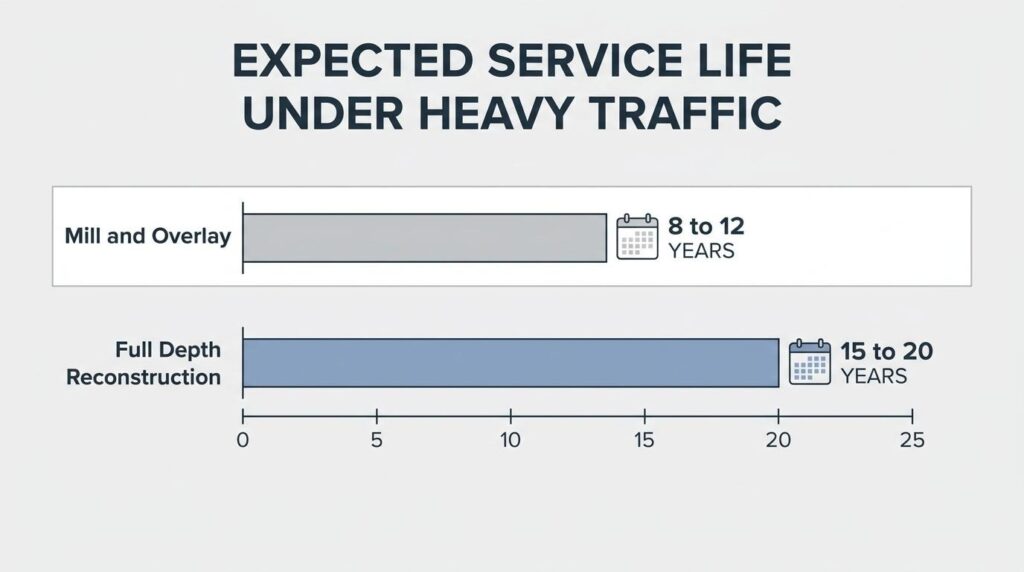
A mill-and-overlay lasts approximately 8 to 12 years on a heavy-use industrial lot, though that range shrinks considerably when daily Class 8 truck traffic is involved. According to the American Trucking Associations, a single 80,000-pound 5-axle tractor/semi-trailer generates approximately 2.45 ESALs per pass, equivalent to the pavement impact of 6,123 passenger cars. On lots receiving dozens of these passes daily, cumulative fatigue accumulates far faster than on commercial retail surfaces. Colorado Springs freeze-thaw cycling and high-altitude UV exposure further accelerate surface deterioration, often pushing overlays toward the lower end of that range. For facilities with sustained heavy loads, an overlay buys time rather than a permanent solution.
How Long Does Full-Depth Reconstruction Last Under the Same Load?
Full-depth reconstruction lasts 15 to 20 years or longer under the same heavy truck loads. According to Iowa State University’s Institute for Transportation, full-depth reclamation with cement-stabilized bases typically provides a 15- to 20-year life expectancy when topped with a thick hot-mix asphalt surface course. Pavements built with 6 inches or more of HMA often resist bottom-up fatigue cracking entirely, a threshold civil engineers consider “perpetual” pavement design. Because reconstruction addresses the subgrade and base layers that overlays leave untouched, it handles the cumulative ESAL demands of industrial zones, where design values can exceed 7 million over the pavement’s life. For Colorado Springs industrial lots with daily heavy traffic, reconstruction delivers roughly double the functional lifespan of an overlay.
Understanding expected service life helps frame how much downtime each approach requires during construction.
How Much Downtime Should an Industrial Facility Expect?
An industrial facility should expect downtime ranging from a few days for mill-and-overlay to several weeks for full-depth reconstruction. The sections below cover project timelines for each method and how phased paving reduces disruption.
How Long Does a Mill-and-Overlay Project Take to Complete?
A mill-and-overlay project takes significantly less time than full reconstruction, typically allowing sections of an industrial lot to reopen within days. According to a comparative life-cycle cost analysis published in ScienceDirect (Case Studies in Construction Materials), asphalt pavement construction demonstrated the lowest user cost due to its significantly shorter construction duration and ability to utilize day-only work schedules. Milling crews remove the deteriorated surface layer, and paving follows closely behind. Because the existing base remains intact, there is no excavation or subgrade preparation delay. For most Colorado Springs industrial lots, this compressed timeline means truck routes and loading docks can resume operations quickly.
How Long Does Full-Depth Reconstruction Take to Complete?
Full-depth reconstruction takes considerably longer to complete because it involves removing the entire pavement section and rebuilding from the subgrade up. According to the Federal Highway Administration, full-depth reclamation treats the entire asphalt section and underlying materials to a depth of 100 to 300 mm (4 to 12 in) to produce a stabilized base course. Each phase, including excavation, subgrade stabilization, aggregate base compaction, and multi-lift HMA placement, requires curing time before the next can proceed. Colorado Springs sites with expansive clay soils may add further time for soil treatment. For large industrial lots, total project duration often extends to several weeks or longer, depending on lot size and weather conditions.
How Can Phased Paving Minimize Operational Disruption?
Phased paving minimizes operational disruption by dividing the project into sections so portions of the lot remain accessible throughout construction. According to Asphalt Inc., dividing a commercial paving project into manageable phases allows businesses to keep tenants open and customers safe by maintaining access during construction. Crews complete two lifts of asphalt in one zone before shifting to the next, keeping truck routes and loading areas functional. Ramp repairs and waterproofing membranes can also be staged in sections to avoid full closures. For Colorado Springs industrial facilities where daily operations cannot stop, phased scheduling is the most practical approach to balancing pavement rehabilitation with uninterrupted productivity.
With project timelines established, understanding drainage and grading requirements helps ensure each method performs as designed.
What Drainage and Grading Issues Affect the Decision?
Drainage and grading issues affect the decision between mill-and-overlay and full-depth reconstruction by determining whether surface corrections alone can redirect water or whether the entire subgrade slope must be rebuilt. Poor drainage accelerates pavement failure in Colorado Springs, where expansive soils and freeze-thaw cycles compound water-related damage.
A mill-and-overlay can correct minor surface drainage problems by adjusting asphalt thickness to restore cross-slopes and direct sheet flow toward catch basins. However, this approach only addresses the top layer. If the underlying grade is wrong, water still pools beneath the new surface, saturating the subgrade.
Full-depth reconstruction allows engineers to re-establish proper grading from the subgrade up, installing or repositioning subsurface drainage systems, correcting lot slopes, and compacting a stable base before paving. According to the Colorado Geological Survey, bentonite and montmorillonite clays in Colorado can expand up to 20% by volume when exposed to water and exert forces up to 30,000 pounds per square foot. When these soils sit beneath a poorly graded industrial lot, trapped moisture triggers heaving that no overlay can withstand.
Colorado stormwater regulations add another layer to the decision. Under Colorado construction stormwater requirements, any construction site that disturbs more than one acre of land must obtain a Colorado Discharge Permit System (CDPS) permit. Full-depth reconstruction on large industrial lots almost always crosses this threshold, requiring erosion control plans and stormwater management infrastructure that become part of the project scope.
Key drainage factors that push the decision toward full-depth reconstruction include:
- Standing water remains on the lot surface more than 24 hours after rainfall.
- Subgrade soils contain high-plasticity clays that swell when saturated.
- Existing storm drains sit at incorrect elevations relative to the pavement surface.
- Repeated overlay cycles have raised the lot above curb and gutter inlets.
- Frost heave has created uneven grade changes that milling cannot level.
For industrial lots with only minor ponding or shallow grade inconsistencies, a properly designed mill-and-overlay with adjusted profile elevations often resolves the issue at a fraction of reconstruction costs. Drainage problems that originate below the pavement surface, though, require the subgrade access that only full-depth reconstruction provides.
Understanding these drainage constraints is essential before evaluating ADA compliance and municipal code requirements.
How Do ADA Compliance and Municipal Codes Factor In?
ADA compliance and municipal codes factor in by setting enforceable design standards that directly influence whether a mill-and-overlay or full-depth reconstruction is required. Parking dimensions, slope tolerances, and stormwater permits all shape the scope of work.
According to the U.S. Department of Justice, the 2010 ADA Standards for Accessible Design require car-accessible parking spaces to be at least 96 inches wide with an adjacent access aisle of at least 60 inches. A mill-and-overlay can preserve existing ADA-compliant geometry if grades and slopes remain within tolerance. However, when settling or base failure has altered cross-slopes beyond the 2% maximum, full-depth reconstruction becomes necessary to re-establish compliant profiles from the subgrade up.
Colorado Springs municipal codes add another layer. Under Colorado construction stormwater requirements, any construction site that disturbs more than one acre of land must obtain a Colorado Discharge Permit System (CDPS) permit, as outlined by state regulatory guidance. Full-depth reconstruction projects on large industrial lots almost always exceed this threshold, requiring erosion control plans, sediment basins, and post-construction stormwater management. Mill-and-overlay projects, because they disturb less total area, may fall below the permit trigger depending on lot size.
Key compliance considerations for Colorado Springs industrial lot rehabilitation include:
- ADA-compliant parking space dimensions must be verified and corrected during any resurfacing scope.
- Cross-slope and running-slope tolerances often cannot be fixed through overlay alone if the base has shifted.
- CDPS stormwater permits apply to reconstruction projects disturbing more than one acre.
- Curb ramp and detectable warning surface upgrades may be triggered by the scope of pavement work.
- El Paso County and City of Colorado Springs right-of-way permits may require additional review for projects near public roadways.
Overlooking these regulatory requirements is one of the most costly mistakes an industrial property owner can make. Code violations discovered after paving can force partial tear-outs, and ADA non-compliance carries significant legal liability. The smartest approach is factoring compliance into the project design from day one rather than treating it as an afterthought.
Existing pavement thickness also plays a role in determining which rehabilitation method meets both structural and regulatory requirements.
What Role Does Existing Pavement Thickness Play in Eligibility?
Existing pavement thickness determines whether an aging industrial lot qualifies for mill-and-overlay or requires full-depth reconstruction. Thicker asphalt sections with sound structural integrity can support milling and resurfacing, while thinner or deteriorated sections lack the load-bearing capacity for an overlay to perform.
A civil engineering rule of thumb holds that pavements with a 6-inch or deeper section of hot-mix asphalt (HMA) typically do not exhibit bottom-up cracking and can be considered “perpetual.” When core samples reveal this depth of intact HMA, mill-and-overlay becomes a viable option because the remaining structure can still distribute heavy loads effectively. Milling typically removes 3 to 4 inches of surface material, so a 6-inch section retains enough structural asphalt beneath the mill line to support the new overlay.
Thinner pavement sections tell a different story. According to a University of Wyoming study, pavement design ESAL values for industrial zones can exceed 7 million over the design life, requiring structural thickness that often includes a 6-inch or deeper HMA section. If the existing lot measures only 3 to 4 inches total, milling would cut into or through the aggregate base, eliminating any structural benefit from an overlay.
Colorado Springs conditions make this threshold even more critical. Expansive bentonite clays beneath the subgrade can heave and crack thin pavement sections from below, and freeze-thaw cycling at 6,035 feet accelerates that damage. A thin pavement sitting on compromised subgrade soil will not hold an overlay regardless of surface condition.
For industrial facility owners evaluating rehabilitation options, the decision framework is straightforward:
- Lots with 6 or more inches of structurally sound HMA are strong candidates for mill-and-overlay.
- Lots with less than 6 inches, or sections showing structural rutting and subgrade subsidence, typically require full-depth reconstruction to build adequate load capacity.
- Core sampling at multiple locations across the lot is essential, since thickness can vary significantly from one area to another.
Pavement thickness is not just one factor among many; it is the single most decisive structural metric in determining rehabilitation eligibility. Getting this assessment right at the outset prevents costly overlay failures and ensures the chosen method matches the lot’s actual structural capacity.
With thickness eligibility established, partnering with an experienced Colorado Springs paving contractor ensures the right method is applied correctly.
How Should You Plan Industrial Lot Rehabilitation with an Experienced Colorado Springs Paving Contractor?
You should plan industrial lot rehabilitation by partnering with a contractor who evaluates pavement distress, soil conditions, traffic loads, and budget before recommending mill-and-overlay or full-depth reconstruction. Adhering to local guidelines, such as the Colorado Springs Drainage Criteria Manual, is a crucial part of this planning process. The following sections cover Asphalt Coatings Company’s capabilities and the core takeaways from this guide.
Can Asphalt Coatings Company’s Commercial Paving Services Handle Large-Scale Industrial Lot Projects?
Yes, Asphalt Coatings Company’s commercial paving services can handle large-scale industrial lot projects. With 39 years of experience across Colorado’s Front Range, Asphalt Coatings Company performs mill-and-pave services, parking lot construction, subgrade preparation, and grading using in-house crews rather than subcontractors. This single-source approach streamlines scheduling for phased paving on active industrial sites. Asphalt Coatings Company also provides ADA-compliant concrete work, crack sealing with CDOT-approved materials, and sealcoating, covering every stage of rehabilitation from initial assessment through long-term maintenance. For Colorado Springs industrial facilities facing expansive clay soils and severe freeze-thaw cycling, that regional expertise makes a measurable difference in pavement longevity.
What Are the Key Takeaways About Mill-and-Overlay vs Full-Depth Reconstruction for Colorado Springs Industrial Lots?
The key takeaways about mill-and-overlay vs full-depth reconstruction for Colorado Springs industrial lots center on matching the method to the pavement’s structural condition, site-specific climate stressors, and long-term budget goals.
- Mill-and-overlay suits lots with surface distress where the aggregate base remains structurally sound, costing $1.50 to $3.50 per square foot for resurfacing.
- Full-depth reconstruction addresses failed subbases, structural rutting, and fatigue cracking that repeated heavy truck loads create over time.
- Colorado Springs conditions, including freeze-thaw cycling at 6,035 feet of elevation, expansive bentonite clays, and intense UV exposure, accelerate pavement deterioration and often push borderline lots toward reconstruction.
- According to Iowa State University (InTrans), life-cycle cost analysis shows initial construction accounts for 55 to 75% of total life-cycle cost for asphalt pavements, making the upfront method choice the single largest financial decision in any rehabilitation project.
- Phased paving keeps industrial operations running during either method, and preventive maintenance after completion protects the investment for decades.
Choosing the right rehabilitation path starts with a thorough site evaluation; contact Asphalt Coatings Company to schedule an assessment of your Colorado Springs industrial lot.