Infrared asphalt repair is a heat-based pavement correction method that softens existing asphalt so crews can regrade low spots, eliminate ponding, and restore proper drainage without full removal. It is one of the most efficient tools available for commercial property managers in Colorado Springs.
This guide covers how the infrared process works, why low spots and ponding develop on Colorado Springs commercial pavement, speed and cost comparisons against traditional methods, where infrared repair is most effective, its limitations, and how local weather conditions influence both scheduling and long-term results.
The infrared process uses radiant heat to warm damaged pavement to 325–350°F, allowing technicians to scarify, regrade, and compact the surface with fresh hot-mix asphalt and rejuvenating agents. This creates a seamless thermal bond with the surrounding pavement rather than a cold joint that fails prematurely.
Colorado Springs commercial asphalt faces a punishing combination of over 100 annual freeze-thaw cycles, magnesium chloride de-icer use, heavy vehicle traffic, and high-altitude UV exposure. These forces create low spots through pore expansion, surface compression, subgrade settlement, and binder oxidation faster than in most U.S. regions.
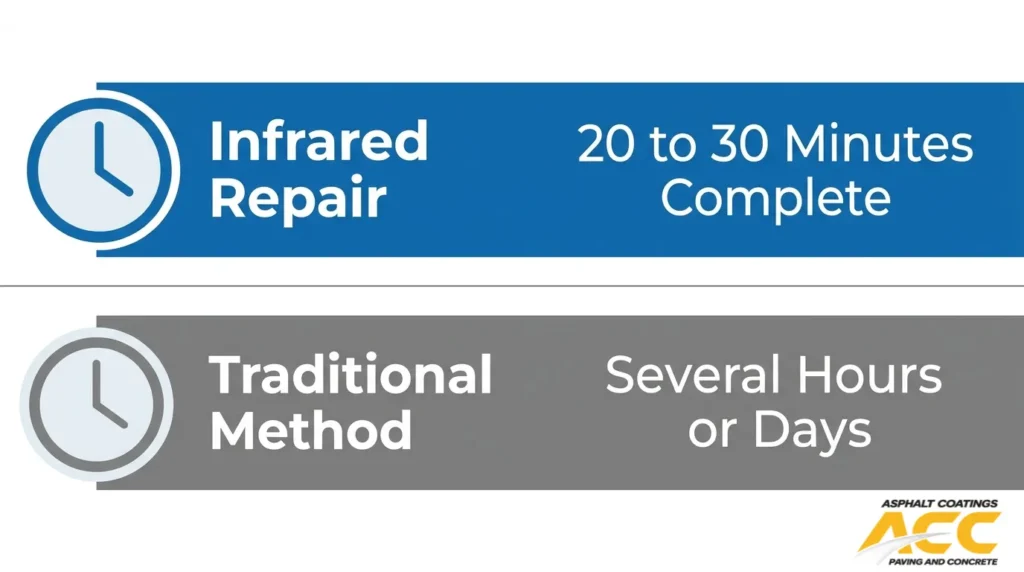
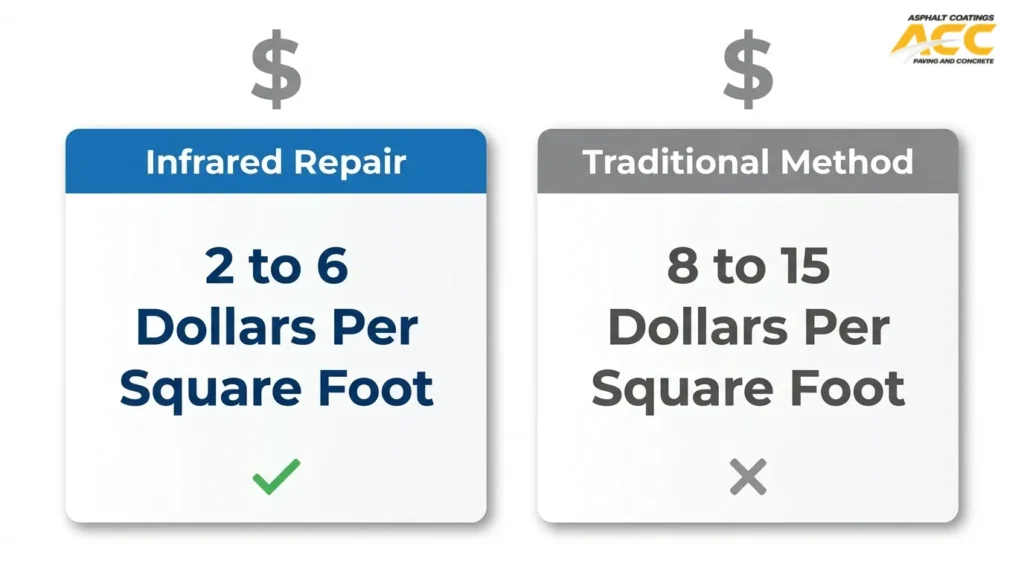
Infrared patching completes in roughly 20 to 30 minutes per area and reopens to traffic within 30 to 60 minutes, compared to several hours or days for traditional cut-and-replace. At $2 to $6 per square foot versus $8 to $15 for conventional methods, it typically cuts project costs by half or more.
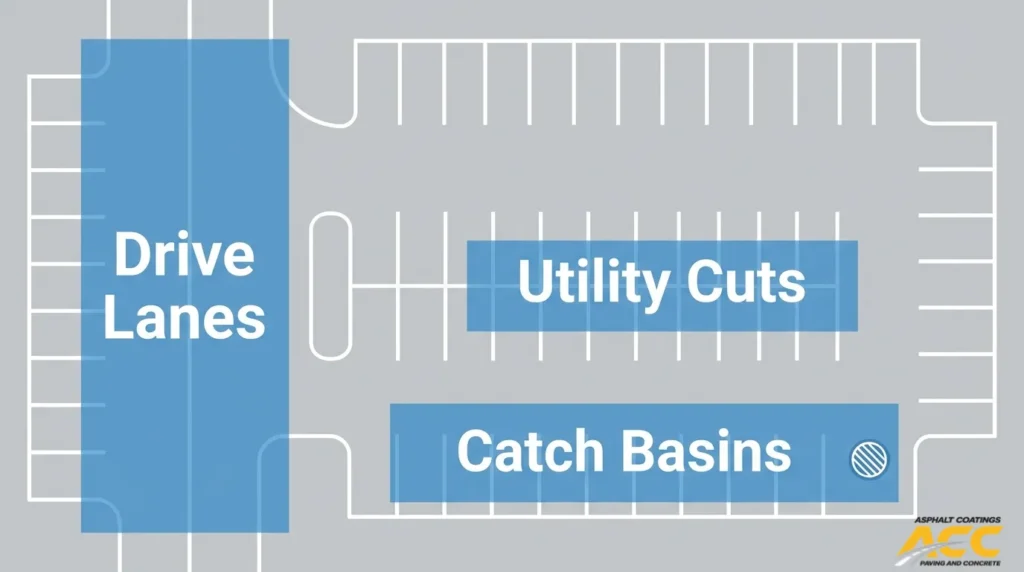
The technique works best on surface-level depressions in drive lanes, around catch basins, and over settled utility cuts where the subgrade remains stable. It is not the right solution for deep base failures or severely oxidized pavement that crumbles under heat rather than softening.
How Does Infrared Asphalt Repair Work?
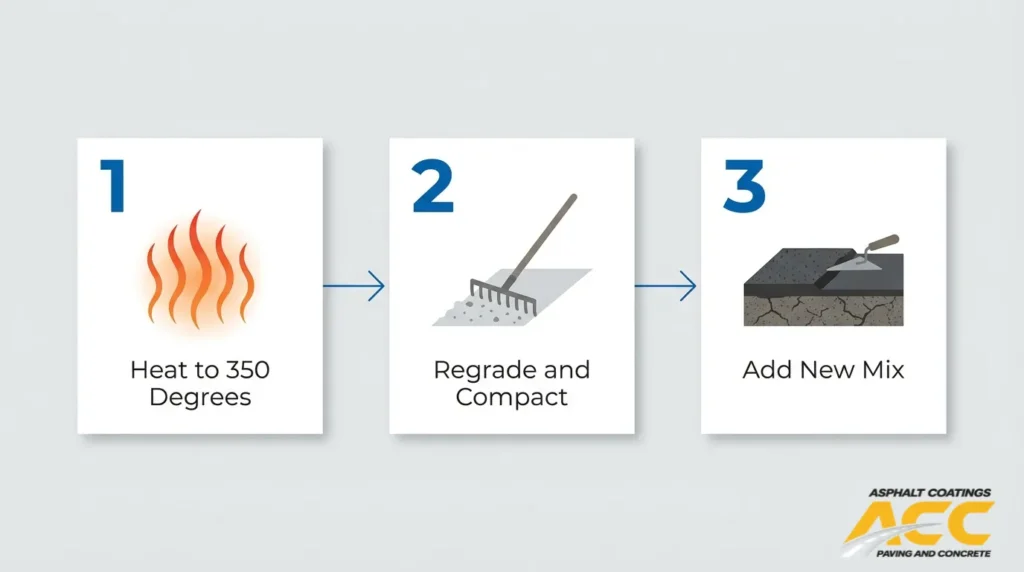
Infrared asphalt repair works by using targeted heat to soften existing pavement, allowing crews to regrade and compact the surface without full removal. The process involves three key phases: heating, regrading, and material addition.
What Happens During the Heating Phase?
During the heating phase, an infrared heater is positioned over the damaged area and emits infrared wavelengths that penetrate the asphalt surface. This radiant heat warms the pavement evenly from the inside out, unlike direct flame methods that can scorch the top layer and leave the subsurface cold. According to KM International, infrared asphalt repair involves heating the damaged area to 325–350°F, followed by scarifying to a minimum depth of 1.5 inches to ensure a seamless thermal bond between new and existing material. Once the asphalt reaches working temperature, the softened material is ready for manipulation. This even heat distribution is what allows the repair to bond seamlessly with the surrounding pavement rather than creating a cold joint.
How Is the Softened Asphalt Regraded and Compacted?
The softened asphalt is regraded by raking the heated material to correct the surface profile, filling in low spots and restoring proper drainage slope. Crews redistribute the loosened mat to eliminate depressions where water would otherwise pond. A vibratory roller then compacts the reworked area. As a general rule, the loose mat compacts approximately 1/4 inch per 1 inch of thickness, so technicians leave the patch slightly high before final rolling to account for this settling. Proper compaction density is critical; without it, the repaired area will ravel or develop new depressions under traffic loads within months.
What Materials Are Added During an Infrared Patch?
The materials added during an infrared patch typically include fresh hot-mix asphalt and a rejuvenating agent. Fresh mix is blended into the heated existing pavement to restore volume where material has been lost to wear or displacement. Rejuvenating agents help replace oxidized oils in the aged binder, improving flexibility. However, these additions work only when the existing asphalt retains enough viable binder to form a thermal bond. If the pavement base has failed, surface-level heating and material addition cannot address deep structural issues like alligator cracking caused by subgrade instability.
Understanding this three-step process clarifies why pavement condition matters before choosing infrared repair.
Why Do Low Spots and Ponding Develop on Commercial Asphalt?
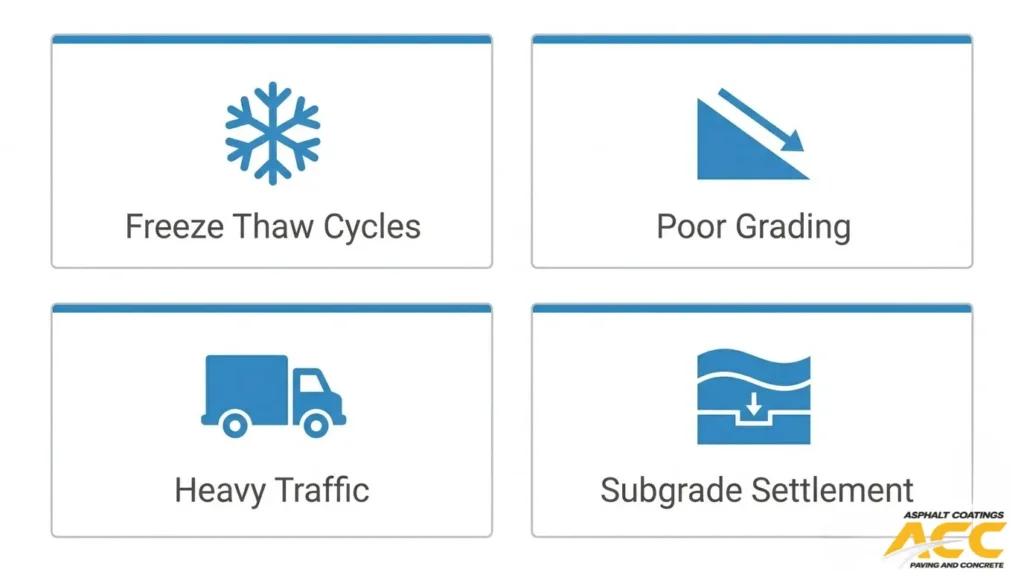
Low spots and ponding develop on commercial asphalt due to environmental stress, construction deficiencies, traffic loads, and soil movement. The following subsections cover freeze-thaw damage, grading errors, heavy vehicle impact, and subgrade settlement.
How Do Colorado Springs Freeze-Thaw Cycles Create Low Spots?
Colorado Springs freeze-thaw cycles create low spots by repeatedly expanding and contracting moisture trapped within asphalt pores, weakening the pavement structure from the inside out. Colorado Springs experiences over 100 freeze-thaw cycles annually, accelerating pavement degradation faster than in most other U.S. regions. Each cycle forces water into micro-cracks, where it freezes, expands, then thaws, leaving slightly larger voids behind. Over successive winters, these voids compound into measurable surface depressions.
According to the City of Colorado Springs, roadway deterioration is significantly exacerbated by magnesium chloride de-icers, which lower the freezing point of water and increase the number of freeze-thaw cycles occurring within the pavement’s surface layer. This chemical interaction means commercial lots treated with de-icers often develop low spots faster than untreated surfaces. For property managers along the Front Range, recognizing this accelerated wear pattern is critical to timely intervention.
How Does Poor Initial Grading Lead to Ponding Water?
Poor initial grading leads to ponding water by creating surface irregularities that prevent proper drainage. Commercial asphalt surfaces require a minimum slope, typically 1% to 2%, to direct water toward catch basins and drainage channels. When grading is rushed or improperly surveyed during construction, subtle depressions remain in the finished surface.
These low areas trap rainwater and snowmelt, which has nowhere to flow. Even half an inch of elevation error across a parking lot can produce persistent standing water after every storm. Over time, ponding in these poorly graded zones softens the underlying binder, accelerating further depression and creating a self-worsening cycle that demands corrective repair.
How Does Heavy Commercial Traffic Cause Surface Depressions?
Heavy commercial traffic causes surface depressions by concentrating repeated loads on the same wheel paths. Delivery trucks, garbage haulers, and loaded trailers exert significantly more force per axle than passenger vehicles, compressing the asphalt mat beyond its design tolerance in high-traffic zones.
Loading docks, drive-through lanes, and dumpster access points are particularly vulnerable because vehicles stop, idle, and turn in the same locations daily. This localized stress gradually pushes the surface downward, forming ruts and depressions that collect water. Once ponding begins in these high-traffic areas, the trapped moisture further weakens the asphalt, accelerating the rate of depression with each additional load cycle.
How Does Subgrade Settlement Contribute to Ponding?
Subgrade settlement contributes to ponding by creating voids beneath the asphalt surface that cause the pavement to sag unevenly. The subgrade is the compacted soil foundation beneath the aggregate base and asphalt layers. When this foundation shifts, compresses, or erodes, the surface above follows.
Common causes include improperly compacted fill material, underground utility trenches that were backfilled without adequate compaction, and soil erosion from water infiltration. Colorado’s expansive clay soils are especially prone to volumetric changes with moisture fluctuation, shrinking during dry periods and swelling after heavy rain. These movements produce uneven settlement that manifests as low spots on the pavement surface, trapping water where none pooled before.
Understanding the root cause of ponding determines whether a surface-level correction like infrared repair will deliver a lasting solution.
How Fast Is Infrared Repair Compared to Traditional Methods?
Infrared repair is significantly faster than traditional methods, completing most patches in under an hour while conventional approaches require several hours or days. Below, each step’s timeline shows why.
How Long Does an Infrared Asphalt Repair Take to Complete?
An infrared asphalt repair takes approximately 20 to 30 minutes to complete. The process begins by heating the damaged area to 325–350°F using infrared wavelengths, then scarifying to a minimum depth of 1.5 inches to create a seamless thermal bond between new and existing material, according to KM International’s best practices published by ForConstructionPros. During compaction, the loose mat compresses roughly 1/4 inch per 1 inch of thickness, so crews leave the patch slightly high before final rolling. This precision means most low spots and ponding areas in Colorado Springs parking lots can be corrected during a single visit.
How Quickly Can Traffic Return After Infrared Patching?
Traffic can return after infrared patching within 30 to 60 minutes of completion. Because infrared technology reheats and recompacts the existing asphalt rather than pouring new material that needs extended cure time, the repaired surface cools and stabilizes rapidly. For Colorado Springs property managers, this minimal downtime is particularly valuable; parking lots, drive lanes, and loading areas stay operational with only brief closures. Most commercial sites can schedule repairs during off-peak hours and resume full traffic flow before the next business rush.
How Long Does a Traditional Cut-and-Replace Repair Take?
A traditional cut-and-replace repair takes several hours to multiple days, depending on the scope. The process involves saw-cutting the damaged section, excavating old material, preparing the subgrade, placing new hot-mix asphalt, and compacting in lifts. Each step adds time, and larger areas or deep base work can extend projects significantly. Cure times further delay reopening, especially in cooler Colorado Springs temperatures where asphalt sets more slowly. For commercial properties managing daily traffic, this extended timeline translates to longer closures and greater disruption compared to infrared patching’s 30-to-60-minute turnaround.
With speed differences this clear, the next consideration is how repair costs compare.
How Much Does Infrared Asphalt Repair Cost in Colorado Springs?
Infrared asphalt repair in Colorado Springs costs between $2 and $6 per square foot. The sections below break down per-square-foot pricing, savings versus saw-cut removal, and how costs compare to full-depth replacement.
How Much Does Infrared Repair Cost per Square Foot?
Infrared repair costs between $2 and $6 per square foot. According to Barts Asphalt, this represents a significant cost advantage over traditional saw-cut-and-replace methods, which average $8 to $15 per square foot. Several factors influence where a project falls within that range:
- Size of the repair area
- Depth of regrading needed
- Accessibility and mobilization requirements
- Volume of new hot-mix asphalt added
For most commercial properties in Colorado Springs, infrared patching delivers a reliable fix at roughly one-third the cost of conventional removal methods. That cost efficiency makes it particularly practical for property managers addressing multiple low spots across a parking lot in a single visit.
How Does Infrared Repair Cost Compare to Saw-Cut Removal?
Infrared repair cost compares favorably to saw-cut removal. Where infrared patching runs $2 to $6 per square foot, saw-cut-and-replace methods average $8 to $15 per square foot. The difference stems from labor intensity and material waste. Saw-cut removal requires cutting out the damaged section, hauling away debris, placing new base material, and compacting fresh asphalt in layers.
Infrared repair eliminates most of those steps by reheating and reworking the existing pavement in place. Less equipment, fewer crew hours, and minimal waste disposal all reduce the final invoice. For commercial lots with scattered ponding issues, this streamlined process can cut total project costs by 50% or more.
How Does Infrared Repair Cost Compare to Full-Depth Replacement?
Infrared repair cost compared to full-depth replacement is substantially lower, both in direct expense and operational disruption. According to TruSeal Asphalt and Concrete, a standard infrared repair takes approximately 20 to 30 minutes to complete and can be reopened to traffic within 30 to 60 minutes. Full-depth replacement, by contrast, requires several hours or days.
That speed difference translates directly into savings for commercial properties. Shorter closures mean less revenue loss for retail tenants, fewer parking disruptions for office complexes, and reduced liability exposure from barricaded areas. When the subgrade is structurally sound, infrared repair delivers a permanent-quality fix at a fraction of full-depth pricing.
Understanding repair costs helps property managers budget effectively; knowing where infrared repair works best ensures those dollars are well spent.
Where Is Infrared Repair Most Effective on Commercial Properties?
Infrared repair is most effective on commercial properties where surface-level depressions cause ponding in high-traffic areas with an intact subgrade. The most common applications include parking lot drive lanes, catch basin perimeters, and utility cut depressions.
Can Infrared Repair Fix Ponding in Parking Lot Drive Lanes?
Yes, infrared repair can fix ponding in parking lot drive lanes where the base layer remains structurally sound. Drive lanes concentrate repetitive wheel loads along narrow paths, gradually compressing the surface into shallow depressions that trap water. Infrared equipment heats the affected zone, allowing crews to regrade the softened material to restore proper cross-slope drainage. Because drive lanes typically involve surface-level compaction issues rather than subgrade failure, they represent an ideal application for this method. For property managers at shopping centers or distribution warehouses, correcting drive lane ponding also reduces splash hazards and liability exposure during Colorado Springs’ frequent storm events.
Can Infrared Repair Correct Low Spots Near Catch Basins?
Yes, infrared repair can correct low spots near catch basins when the surrounding asphalt has settled at the surface level. Catch basins rely on precise grading to channel stormwater efficiently; even minor depressions within a few feet of the grate can reverse drainage flow and create standing water. Infrared heating allows technicians to soften the settled pavement, add fresh hot-mix asphalt, and recompact the area to match the basin’s intake elevation. This is one of the most practical applications for commercial lots because traditional saw-cut methods near drainage structures risk disturbing pipe connections. Restoring proper grade around catch basins prevents the accelerated freeze-thaw damage that standing water causes in Colorado Springs.
Can Infrared Repair Address Depressions Around Utility Cuts?
Yes, infrared repair can address depressions around utility cuts where previous backfill has settled but the base remains stable. Utility trenches often develop surface depressions months after the initial patch, as backfill material compacts under traffic loads. Infrared technology heats both the original pavement and the utility patch simultaneously, creating a seamless thermal bond that eliminates cold joints. According to KM International, infrared repair heats the damaged area to 325–350°F, followed by scarifying to a minimum depth of 1.5 inches to ensure this seamless bond between new and existing material. This makes utility cut corrections faster and more durable than re-cutting the same trench.
Understanding where infrared repair works best helps determine when a different approach may be necessary.
When Is Infrared Asphalt Repair Not the Right Solution?
Infrared asphalt repair is not the right solution when damage extends below the asphalt surface layer or when the existing pavement has deteriorated beyond the point of thermal restoration. The two most common disqualifying conditions are deep structural base failures and severe oxidative aging.
Why Can’t Infrared Repair Fix Deep Structural Base Failures?
Infrared repair can’t fix deep structural base failures because the process only heats and reworks the top 1.5 to 2 inches of asphalt. According to Beckage Sealcoating, infrared repair is considered a temporary solution when the underlying pavement base has failed, since surface-level heating cannot address deep structural issues like alligator cracking caused by subgrade instability.
Signs that base failure requires full-depth reconstruction include:
- Widespread alligator cracking across large connected areas.
- Visible pavement heaving or settling that returns after surface repairs.
- Soft, spongy subgrade detected during core sampling.
- Recurring depressions in the same location after previous patching.
For Colorado Springs commercial properties experiencing base failure, full-depth replacement with proper subgrade preparation is the only lasting solution. Applying infrared repair over a compromised base wastes budget on a fix that will fail within months.
Why Is Infrared Repair Ineffective on Severely Oxidized Asphalt?
Infrared repair is ineffective on severely oxidized asphalt because the binder has lost so much flexibility that reheating cannot restore workability. While rejuvenating agents applied at 0.1 gallon per square yard can replace oxidized maltenes and restore binder flexibility in moderately aged pavement, asphalt that has reached advanced oxidation simply crumbles when heated rather than softening into a reworkable state.
Colorado Springs properties face accelerated oxidation due to high-altitude UV exposure, which means asphalt can reach this threshold sooner than the national average. When surface material is brittle, gray, and extensively cracked, mill-and-overlay or full replacement delivers far more reliable results than attempting infrared restoration.
Recognizing these limitations early helps property managers choose the repair method that actually solves the problem.
How Does Colorado Springs Weather Affect Infrared Repair?
Colorado Springs weather affects infrared repair through extreme cold-weather temperature swings and intense high-altitude UV radiation. These factors influence both when repairs can be performed and how long they last.
Can Infrared Asphalt Repair Be Done in Cold Weather?
Yes, infrared asphalt repair can be done in cold weather. The infrared heating process raises the damaged pavement to 325–350°F, which is sufficient to soften and rework the existing material even when ambient temperatures drop well below freezing. Cold conditions do require longer heating times, since the surrounding pavement loses warmth more quickly. Compaction must happen immediately after regrading to ensure a proper thermal bond before the mat cools.
Colorado Springs experiences over 100 freeze-thaw cycles annually, according to The Colorado Handyman. That constant cycling makes timely cold-weather patching essential; leaving low spots unrepaired through winter allows water infiltration that accelerates further damage with each freeze event. For most commercial properties, scheduling infrared repairs during brief warm stretches between cold fronts yields the best long-term results. Similarly, these harsh climate conditions often necessitate timely decisions regarding sidewalk grinding versus replacement to address dangerous heaving.
How Does High-Altitude UV Exposure Affect Repaired Areas?
High-altitude UV exposure affects repaired areas by accelerating asphalt oxidation, which strips the binder of its flexibility and leads to surface brittleness and cracking sooner than at lower elevations. Colorado Springs sits above 6,000 feet, where UV intensity is significantly stronger year-round.
According to Clear Choice Paving, high-altitude UV radiation in Colorado accelerates asphalt oxidation, necessitating more frequent maintenance than the national average. Freshly repaired patches, while structurally sound, still contain binder exposed to this relentless UV bombardment. Pairing infrared repairs with sealcoating within the first year provides a protective barrier that extends patch life considerably.
Understanding these weather factors helps property managers plan maintenance proactively rather than reactively.
How Long Does an Infrared Asphalt Repair Last?
An infrared asphalt repair lasts between 3 and 8 years when the underlying base remains structurally sound. Actual longevity depends on traffic volume, base condition, and local climate severity. In Colorado Springs, where environmental stressors are more aggressive than national averages, proper maintenance plays an outsized role in reaching the upper end of that range.
A study published in PubMed Central found that the Carbonyl Index serves as a robust indicator of long-term oxidative aging in asphalt, with a threshold of approximately 5.6 years of service life in certain climates marking the onset of significant cracking susceptibility. That benchmark aligns closely with what property managers in high-altitude, freeze-thaw-heavy regions like Colorado Springs should expect from a well-executed infrared patch.
Several factors determine where a specific repair falls on the durability spectrum:
- Base integrity is the single largest variable; repairs over a stable subgrade consistently outlast those over compromised foundations.
- Traffic loading from heavy commercial vehicles compresses service life faster than standard passenger car traffic.
- Freeze-thaw exposure in Colorado Springs, which exceeds 100 cycles annually, subjects repaired areas to repeated moisture infiltration and expansion stress.
- UV radiation at altitude accelerates binder oxidation, making timely sealcoating essential for extending patch life.
- Rejuvenator application during the repair restores flexibility to aged binder, slowing the re-hardening process that leads to cracking.
For most commercial properties, pairing infrared repairs with a preventive maintenance schedule that includes crack sealing and sealcoating is the most cost-effective way to push durability toward the higher end. A patch left unprotected in Colorado Springs conditions will age faster than the same repair in a milder climate. Proactive follow-up care turns infrared repair from a short-term fix into a lasting investment.
How Does Infrared Repair Prevent Further Ponding Damage?
Infrared repair prevents further ponding damage by eliminating the standing water that drives asphalt deterioration. The sections below explain how ponding accelerates decay and how correcting drainage reduces freeze-thaw destruction.
How Does Standing Water Accelerate Asphalt Deterioration?
Standing water accelerates asphalt deterioration by saturating the pavement surface, softening the binder, and opening pathways for deeper structural damage. When water pools in low spots, it infiltrates microcracks and weakens the bond between aggregate particles. Prolonged moisture exposure strips the asphalt binder from aggregate surfaces, a process known as moisture-induced stripping.
This problem compounds in Colorado Springs, where environmental stressors intensify water-related decay. According to Clear Choice Paving, high-altitude UV radiation in regions like Peyton, Colorado, accelerates asphalt oxidation, requiring more frequent maintenance than the national average to prevent surface brittleness and cracking. Oxidized pavement develops more cracks, which trap more water, creating a self-reinforcing cycle. For commercial properties, addressing ponding before this cycle takes hold is one of the most cost-effective maintenance decisions a property manager can make.
How Does Eliminating Ponding Reduce Freeze-Thaw Damage?
Eliminating ponding reduces freeze-thaw damage by removing the water source that expands inside asphalt pores during temperature drops. Water trapped in pavement cracks freezes, expands by approximately 9% in volume, and forces those cracks wider. When temperatures rise, the ice melts and the water settles deeper into the newly enlarged voids.
In Colorado Springs, this cycle repeats aggressively throughout winter and spring. Infrared repair corrects the low spots where water collects, restoring proper surface grade so runoff drains away from the pavement. Without standing water present, there is no moisture available to freeze within the asphalt structure. Each ponding area eliminated is one fewer entry point for freeze-thaw forces, which significantly extends pavement service life across commercial parking lots and drive lanes.
With ponding damage under control, property managers can shift focus to a proactive maintenance strategy.
How Should Property Managers Address Low Spots and Ponding?
Property managers should address low spots and ponding by partnering with a commercial asphalt maintenance provider experienced in infrared repair techniques. The following subsections cover how professional services help and the key takeaways from this guide.
Can Commercial Asphalt Maintenance Services Help With Ponding?
Yes, commercial asphalt maintenance services can help with ponding by diagnosing root causes and applying targeted corrections. Infrared repair is particularly effective for regrading localized low spots without disrupting surrounding pavement or daily business operations.
Asphalt Coatings Company specializes in commercial asphalt paving, repair, and maintenance across Colorado Springs and the broader Front Range. With in-house crews and 39 years of Colorado-specific expertise, Asphalt Coatings Company understands how freeze-thaw cycles and high-altitude UV exposure create the drainage problems property managers face. Asphalt Coatings Company provides subgrade preparation, grading, sealcoating, and crack sealing alongside patching services, offering a single-source solution for comprehensive parking lot maintenance. For property managers dealing with recurring ponding, a site assessment from Asphalt Coatings Company can determine whether infrared correction, mill-and-pave, or full-depth reconstruction is the right approach.
What Are the Key Takeaways About Infrared Asphalt Repair?
The key takeaways about infrared asphalt repair are that it provides a faster, more cost-effective solution for correcting low spots and ponding on commercial asphalt when the underlying base remains structurally sound. According to Asphalt Magazine, the process relies on heating existing pavement, applying rejuvenating agents, and compacting a seamless thermal bond that restores proper drainage grades.
The most important points for Colorado Springs property managers include:
- Infrared repair costs significantly less per square foot than traditional saw-cut-and-replace methods.
- Repaired areas can reopen to traffic quickly, minimizing disruption to tenants and customers.
- The technique works best for surface-level depressions, utility cut settlements, and catch basin corrections.
- Severely oxidized asphalt or failed subgrades require different solutions, such as full-depth replacement.
- Colorado’s intense freeze-thaw cycling and UV exposure make proactive ponding correction essential before water infiltration compounds damage.
Addressing low spots early protects pavement longevity, reduces long-term repair costs, and preserves safe, accessible surfaces for commercial properties.