In-house paving crews outperform subcontractors on Colorado Springs commercial projects because direct employment gives one company unified control over quality, scheduling, cost, and accountability across every construction phase.
This guide covers crew structure differences and their impact on commercial paving, quality control through direct supervision and equipment consistency, scheduling reliability during Colorado Springs’ compressed paving season, climate and altitude factors unique to the region, cost advantages of eliminating subcontractor markups and rework, accountability and liability structures, project-specific requirements for parking lots, industrial facilities, and healthcare campuses, and the role of local Front Range expertise.
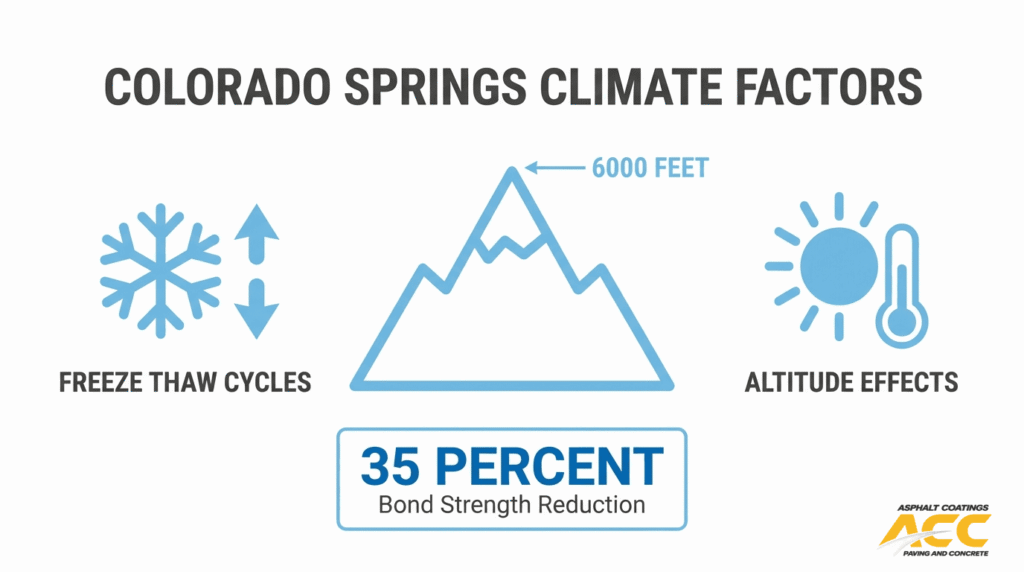
In-house crews maintain direct supervision from subgrade preparation through final compaction, catching defects in real time. At Colorado Springs’ altitude, where freeze-thaw cycles can reduce asphalt bond strength by over 35%, this on-site oversight prevents failures that fragmented subcontractor chains routinely miss.
Scheduling reliability improves because in-house teams answer to one chain of command rather than juggling competing client commitments. During peak paving season, dedicated crews secure confirmed start dates while subcontractor-dependent firms wait weeks for available labor.
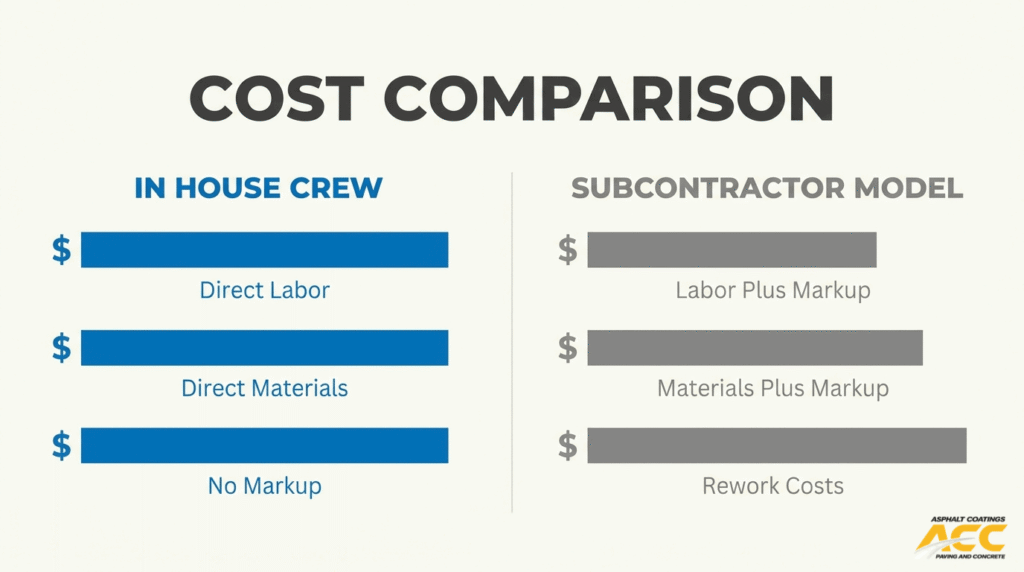
Subcontractor markups on labor and materials layer profit margins that inflate budgets before work begins; rework from subcontractor errors contributes to over half of total cost growth on construction projects. In-house crews eliminate both cost drivers.
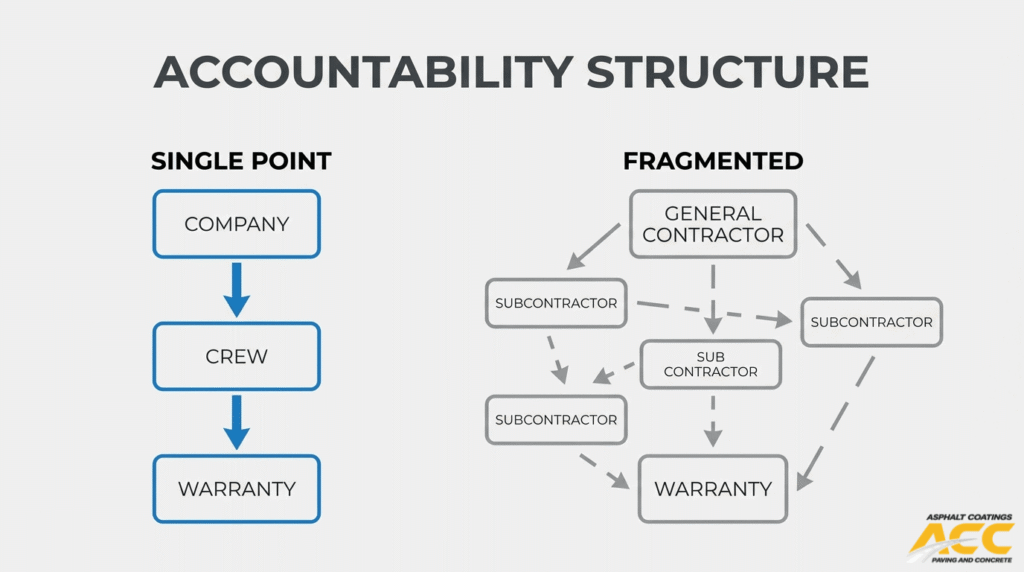
Liability stays consolidated under one insurance policy and one warranty when a single company self-performs all work. Subcontracted projects fragment responsibility across multiple parties, creating coverage gaps that leave property owners exposed.
Crews with years of local experience recognize Colorado Springs’ expansive clay soils, navigate municipal permitting requirements, and design drainage systems calibrated to Front Range storm patterns; knowledge that subcontractors rotating between regions rarely carry.
What Is the Difference Between In-House Paving Crews and Subcontractors?
The difference between in-house paving crews and subcontractors comes down to employment, control, and accountability. In-house crews are direct employees of the paving contractor, while subcontractors are independent companies hired to perform specific tasks. The sections below break down how each model works and why the distinction matters for commercial projects.
In-house paving crews work as permanent, full-time employees of the primary contracting firm. These crew members operate under direct company supervision, use company-owned equipment, and follow internal quality standards on every job. Because they report to one employer, their training, scheduling, and performance remain under unified management.
Subcontractors, by contrast, are outside companies or laborers hired by a general contractor to perform specific tasks. According to a workforce management analysis by Atto, this arrangement means subcontractors maintain their own employees, equipment, and operational methods separate from the hiring contractor. Once a subcontracted crew leaves the jobsite, the general contractor’s direct oversight ends.
Several key distinctions shape how these models perform on commercial paving projects:
- Employment relationship: In-house crews receive W-2 wages and company benefits; subcontractors operate as independent businesses under separate contracts.
- Supervision and oversight: In-house teams answer directly to project managers within the same organization, while subcontracted crews follow their own internal chain of command.
- Equipment control: In-house crews use company-maintained pavers, rollers, and trucks; subcontractors bring whatever equipment their own fleet includes.
- Quality standards: In-house personnel train on one consistent set of procedures, whereas subcontractors may apply varying methods from project to project.
- Accountability path: When issues arise, in-house crews have a single, clear line of responsibility back to the contracting firm. Subcontractor accountability often involves multiple parties and separate contracts.
For commercial property managers evaluating paving partners in Colorado Springs, this structural difference directly influences project quality, cost predictability, and long-term pavement performance. Understanding how crew structure shapes outcomes on the ground is the first step toward making an informed decision.
Why Does Crew Structure Matter for Commercial Paving Projects?
Crew structure matters for commercial paving projects because it determines quality consistency, cost control, scheduling reliability, and accountability across every phase of construction.
Commercial paving involves coordinated trades, strict specifications, and tight timelines. The two primary crew models are in-house teams (direct employees of the contracting firm) and subcontractors (outside companies hired for specific tasks). According to Prost Builders, general contractors often utilize a “self-performing” model where they control critical trades with their own in-house crews to avoid hidden costs associated with subcontracting. In the Pikes Peak region, Superpave Asphalt Pavement Material construction is governed by standardized regional specifications, making crew competence and consistency essential for compliance. The model a contractor uses directly shapes how well a project meets these local standards, stays on budget, and holds up over time.
How Do In-House Crews Deliver Better Quality Control on Commercial Paving?
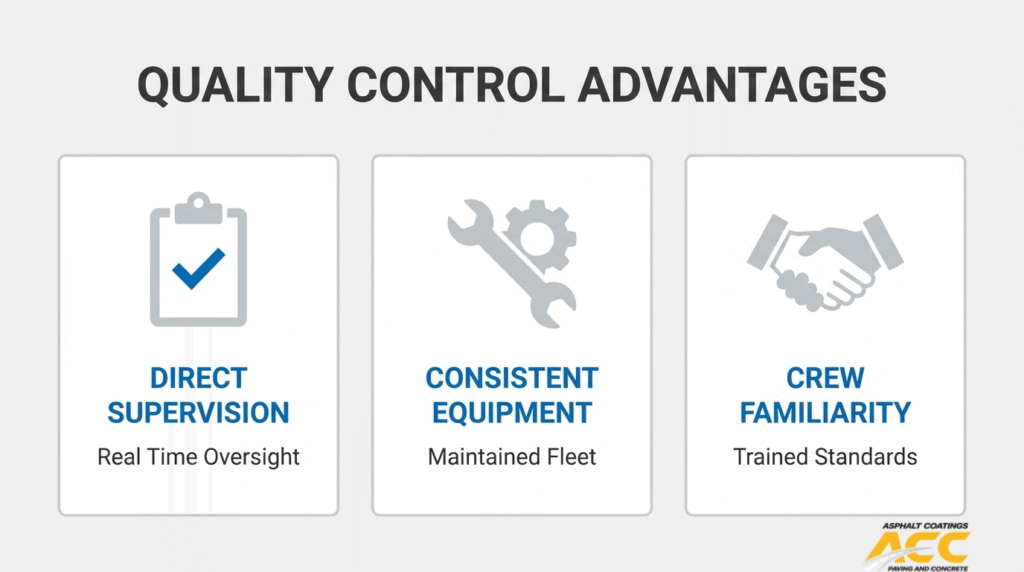
In-house crews deliver better quality control on commercial paving by maintaining direct supervision, dedicated equipment, and trained personnel who follow a single company’s standards. The sections below cover how supervision reduces defects, how equipment consistency improves results, and how crew familiarity strengthens workmanship.
How Does Direct Supervision Reduce Asphalt Defects?
Direct supervision reduces asphalt defects by placing company foremen on-site during every phase of installation, from subgrade preparation through final compaction. When supervisors work alongside the same crew daily, they catch issues like improper mat temperatures or rolling patterns before they become permanent flaws.
This level of oversight matters especially in Colorado Springs. According to a study published in ScienceDirect, high-altitude environmental conditions, including temperature fluctuations and freeze-thaw cycles, can reduce the bond strength of asphalt overlays by over 35%. A supervisor who understands these local variables can adjust mix placement timing and compaction sequences in real time, preventing defects that subcontracted crews, operating without that direct chain of command, might miss entirely.
Quality control responsibilities must be well-defined for every employee, including specific quality-related tasks for field personnel. In-house structures make this accountability chain far simpler to enforce than fragmented subcontractor arrangements.
How Does Consistent Equipment Access Improve Paving Results?
Consistent equipment access improves paving results by ensuring the right machinery is available, calibrated, and maintained for each project phase. In-house crews operate company-owned pavers, rollers, and compactors that receive regular maintenance on a fixed schedule, rather than relying on whatever equipment a subcontractor happens to bring.
This consistency eliminates variables that compromise finished surfaces. When the same paving team uses the same screed assembly across multiple commercial lots, they know its heating characteristics and calibration tendencies. Subcontracted crews often arrive with unfamiliar or differently maintained equipment, which introduces inconsistencies in mat thickness and surface texture. For commercial properties that demand uniform pavement performance across large areas, this equipment reliability is a meaningful quality advantage.
How Does Crew Familiarity With Company Standards Affect Workmanship?
Crew familiarity with company standards directly improves workmanship by reducing errors and increasing productivity. According to research published by the American Psychological Association, the level of familiarity among crew members in construction environments significantly affects overall productivity and performance outcomes.
When the same team works together project after project, they internalize quality benchmarks without needing constant instruction. Each member understands their role during critical operations like joint construction, tack coat application, and compaction sequencing. This shared knowledge base is something subcontracted crews, assembled from different companies for each job, simply cannot replicate. For commercial paving in Colorado Springs, where altitude and climate demand precise execution within tight windows, that built-in coordination often separates a pavement that lasts from one that fails prematurely.
Understanding how quality control operates on-site leads naturally to questions about scheduling reliability.
Why Are In-House Paving Crews More Reliable for Project Scheduling?
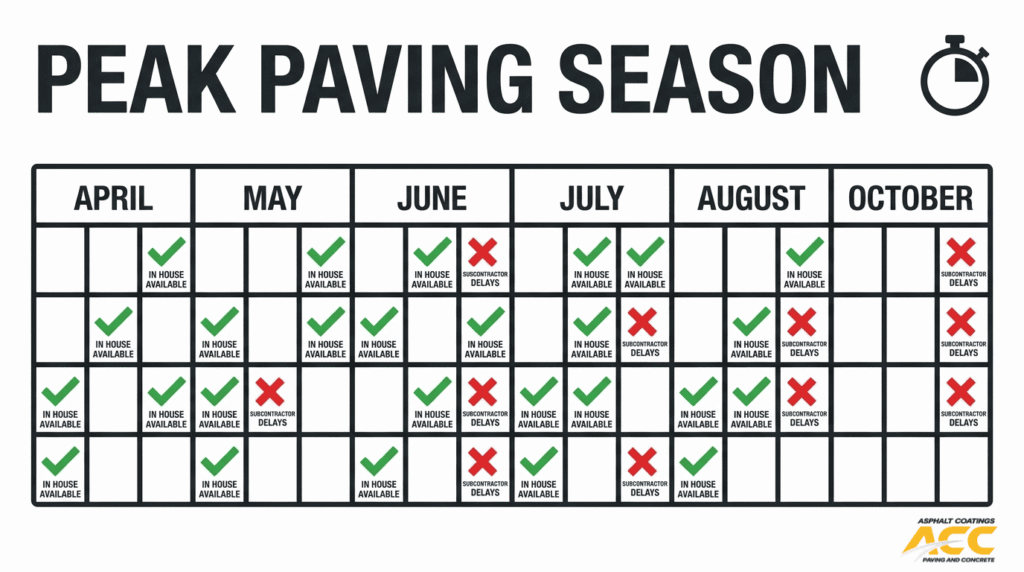
In-house paving crews are more reliable for project scheduling because they operate under direct management control, eliminating the competing priorities that plague subcontractor-dependent timelines. The sections below cover scheduling conflict prevention, peak season availability, and cascading delay risks.
How Do In-House Crews Prevent Scheduling Conflicts on Large Projects?
In-house crews prevent scheduling conflicts on large projects by operating under a single management structure that controls daily task assignments, crew deployment, and project sequencing. When a paving contractor manages its own workforce, scheduling decisions happen internally rather than being negotiated between separate companies with competing commitments.
Subcontractors, by contrast, juggle multiple clients simultaneously. A crew promised to your parking lot repave on Monday may get pulled to finish another contractor’s highway job that ran behind schedule. This divided loyalty creates gaps that compound across multi-phase commercial projects. In-house teams answer to one chain of command, which means priority conflicts are resolved before they reach the jobsite. For Colorado Springs commercial properties requiring phased work across active parking areas, this single-source scheduling control is not a convenience; it is a project necessity.
How Does Crew Availability Change During Peak Paving Season?
Crew availability during peak paving season shifts dramatically as demand for asphalt work concentrates into Colorado Springs’ limited warm-weather window. The Pikes Peak region’s standardized asphalt paving specifications, governed by El Paso County Public Works, define technical requirements that restrict viable installation months, compressing the schedule further.
Subcontractor crews become scarce during this compressed season because every general contractor in the region competes for the same limited labor pool. Firms relying on subcontracted paving often find themselves pushed to the back of the queue, waiting weeks for an available crew. In-house teams, however, are pre-committed to their employer’s project pipeline. This dedicated availability means commercial property managers secure confirmed start dates rather than tentative estimates. Prioritizing a paving partner with dedicated crews is the single most effective way to protect your project timeline during high-demand months.
How Do Subcontractor Delays Create Cascading Timeline Problems?
Subcontractor delays create cascading timeline problems because commercial paving projects involve sequential, interdependent phases where one missed deadline pushes every subsequent task backward. When a subcontracted crew arrives late to complete grading, the paving crew cannot start on schedule. That pushes striping, concrete curb work, and final inspection into later dates, often overlapping with other scheduled site activities.
These compounding delays are especially damaging on occupied commercial properties. A shopping center that planned weekend paving to minimize tenant disruption may lose that window entirely, forcing work into peak business hours. Each rescheduled phase also introduces new weather risk in Colorado Springs’ unpredictable climate. In-house crews mitigate cascading delays because their supervisors coordinate all phases internally, adjusting sequencing in real time without waiting on third-party confirmations.
With scheduling reliability established, the next factor to consider is how Colorado Springs weather conditions further favor in-house crew performance.
How Do Colorado Springs Weather Conditions Favor In-House Crews?
Colorado Springs weather conditions favor in-house crews because the city’s extreme climate demands crews who understand local environmental patterns intimately. The following sections cover freeze-thaw cycles, altitude effects on asphalt, and narrow paving windows.
How Do Freeze-Thaw Cycles Demand Specialized Paving Knowledge?
Freeze-thaw cycles demand specialized paving knowledge because repeated temperature swings between freezing and thawing degrade asphalt bonds and accelerate pavement failure when installations aren’t calibrated for these conditions. According to a ScienceDirect study, high-altitude environmental conditions, including temperature fluctuations and freeze-thaw cycles, can reduce the bond strength of asphalt overlays by over 35%.
In-house crews working consistently in Colorado Springs develop an intuitive understanding of how these cycles affect mix design, compaction timing, and joint construction. Subcontractors rotating between regions rarely build this depth of localized knowledge. For commercial projects where pavement longevity directly affects operating budgets, this specialized expertise is not optional.
Why Does Altitude Affect Asphalt Application and Curing?
Altitude affects asphalt application and curing because Colorado Springs sits above 6,000 feet, where thinner air, lower atmospheric pressure, and intensified UV exposure alter how hot-mix asphalt behaves during placement and compaction. Asphalt cools faster at elevation, which compresses the workable time window for achieving proper density.
Crews unfamiliar with these conditions often underestimate how quickly the mix stiffens, resulting in inadequate compaction and premature surface failures. In-house teams that pave at altitude year after year learn to adjust roller patterns, laydown temperatures, and logistics accordingly. This experience-driven calibration is difficult to replicate with crews who primarily work at lower elevations along the Front Range or beyond.
How Do Narrow Paving Windows Require Rapid Crew Mobilization?
Narrow paving windows require rapid crew mobilization because Colorado Springs offers a limited freeze-free season for asphalt installation. According to KOAA News5, the average first freeze has trended later in recent years, now typically occurring in early October rather than late September, yet the overall window remains tight.
Commercial projects carry stricter requirements for subgrade preparation and pavement thickness compared to residential work, which means more tasks must fit within fewer weather-appropriate days. In-house crews can mobilize immediately when conditions align, without the scheduling negotiations subcontractors require. This responsiveness is especially critical during Colorado Springs’ unpredictable shoulder seasons, when a single missed weather window can delay a project by weeks.
With climate factors shaping every paving decision, cost structure becomes the next critical advantage.
Why Do In-House Crews Reduce Costs on Commercial Paving Projects?
In-house crews reduce costs on commercial paving projects by eliminating subcontractor markups, minimizing rework expenses, and reducing change order frequency. The following sections explain how each cost driver impacts your budget.
How Do Subcontractor Markups Inflate Commercial Paving Budgets?
Subcontractor markups inflate commercial paving budgets by adding layered profit margins on top of labor and materials before work even begins. The average general contractor markup on labor is typically 25% or higher, while material markups can reach as high as 50%. These compounding percentages mean a significant portion of every dollar goes toward intermediary profit rather than pavement quality.
According to the U.S. Bureau of Labor Statistics, overhead and profit markups in nonresidential building construction reached historically high levels of increase during the 2018-to-2022 period. When an in-house crew performs the work directly, those layered margins disappear from the project budget entirely. For Colorado Springs commercial properties, where parking lots and access roads demand substantial material volumes, even modest markup reductions translate into meaningful savings.
How Does Rework From Subcontractor Errors Increase Total Cost?
Rework from subcontractor errors increases total cost by forcing property owners to pay twice for the same scope of work. According to an analysis published by the American Society of Civil Engineers, rework contributes to an average of 52% of total cost growth observed on construction projects. Direct field rework alone averages 5% of total project costs, with ranges extending from 2% to 20% depending on project type.
Pre-completion corrections average 0.38% of contract value, but post-completion fixes run significantly higher. Subcontractors working unfamiliar sites in Colorado Springs are more prone to errors in compaction, grade tolerances, and drainage alignment. In-house crews, already trained to company standards, catch problems before they compound into costly callbacks.
How Does Streamlined Communication Lower Change Order Expenses?
Streamlined communication lowers change order expenses by removing the layers of coordination that delay decisions and inflate costs. When a subcontractor encounters an unexpected site condition, the message travels from the field crew to the subcontractor’s project manager, then to the general contractor, and finally to the property owner. Each handoff adds hours or days, and unresolved questions often generate formal change orders with added administrative fees.
In-house crews report directly to one project manager, so field decisions happen in real time. Faster resolution means fewer billable scope changes and less downtime for equipment sitting idle. For commercial paving in Colorado Springs, where narrow weather windows already compress schedules, this communication advantage directly protects the bottom line.
How Does Accountability Differ Between In-House Crews and Subcontractors?
Accountability differs between in-house crews and subcontractors in how responsibility, warranties, and liability are structured. The following sections cover defect responsibility, warranty terms, and liability when multiple subcontractors are involved.
Who Is Responsible When Paving Defects Appear After Completion?
The party responsible when paving defects appear after completion depends on whether in-house crews or subcontractors performed the work. With in-house crews, the paving contractor bears direct responsibility for every defect, creating a single point of accountability. Property managers can contact one company to resolve issues without navigating disputes between separate firms.
When subcontractors perform the work, responsibility fragments. The general contractor may point to the subcontractor, while the subcontractor may claim the defect originated from specifications they were given. According to a study published in Public Administration Review, monitoring mechanisms for in-house services differ significantly from those used for contracted services. This gap in oversight often delays defect resolution on commercial projects. For Colorado Springs property managers, a single accountable party eliminates finger-pointing and accelerates repairs.
How Do Warranty Terms Change With Subcontracted Work?
Warranty terms change with subcontracted work because coverage becomes layered and harder to enforce. In-house crews provide warranties directly from the contracting company; if pavement fails, one warranty covers the labor, materials, and workmanship under a single agreement.
Subcontracted work introduces complications:
- The general contractor’s warranty may exclude work performed by a subcontractor’s crew.
- The subcontractor’s own warranty may carry shorter coverage periods or narrower scope.
- Warranty claims require coordination between multiple parties, delaying resolution.
- If a subcontractor goes out of business, the warranty can become unenforceable entirely.
Commercial properties in Colorado Springs face aggressive freeze-thaw cycling that tests pavement durability for years after installation. A fragmented warranty structure leaves property owners vulnerable precisely when long-term coverage matters most.
How Does Liability Shift When Multiple Subcontractors Are Involved?
Liability shifts when multiple subcontractors are involved because each subcontractor typically carries separate insurance policies with different coverage limits and exclusions. According to Vertikal RMS, general contractor insurance policies typically exclude work performed by subcontractors, which can leave both parties exposed to liability gaps if specific coverage is not in place.
On a commercial paving project requiring grading, paving, and striping, three separate subcontractors might each hold partial responsibility. When pavement failure occurs, determining which subcontractor’s work caused the issue becomes a legal and logistical burden for the property owner. Gaps between policies can leave no party clearly liable.
In-house crews eliminate this fragmentation entirely. One company, one insurance policy, and one chain of command mean liability stays consolidated. For Colorado Springs commercial projects, this streamlined accountability structure is one of the strongest practical advantages of choosing a self-performing contractor.
With accountability clarified, the next consideration is which project types benefit most from in-house crews.
What Commercial Project Types Benefit Most From In-House Crews?
The commercial project types that benefit most from in-house crews are parking lots, industrial facilities, and healthcare and shopping center developments. Each demands unique coordination, consistency, and regional paving expertise.
Why Do Parking Lot Construction Projects Require In-House Teams?
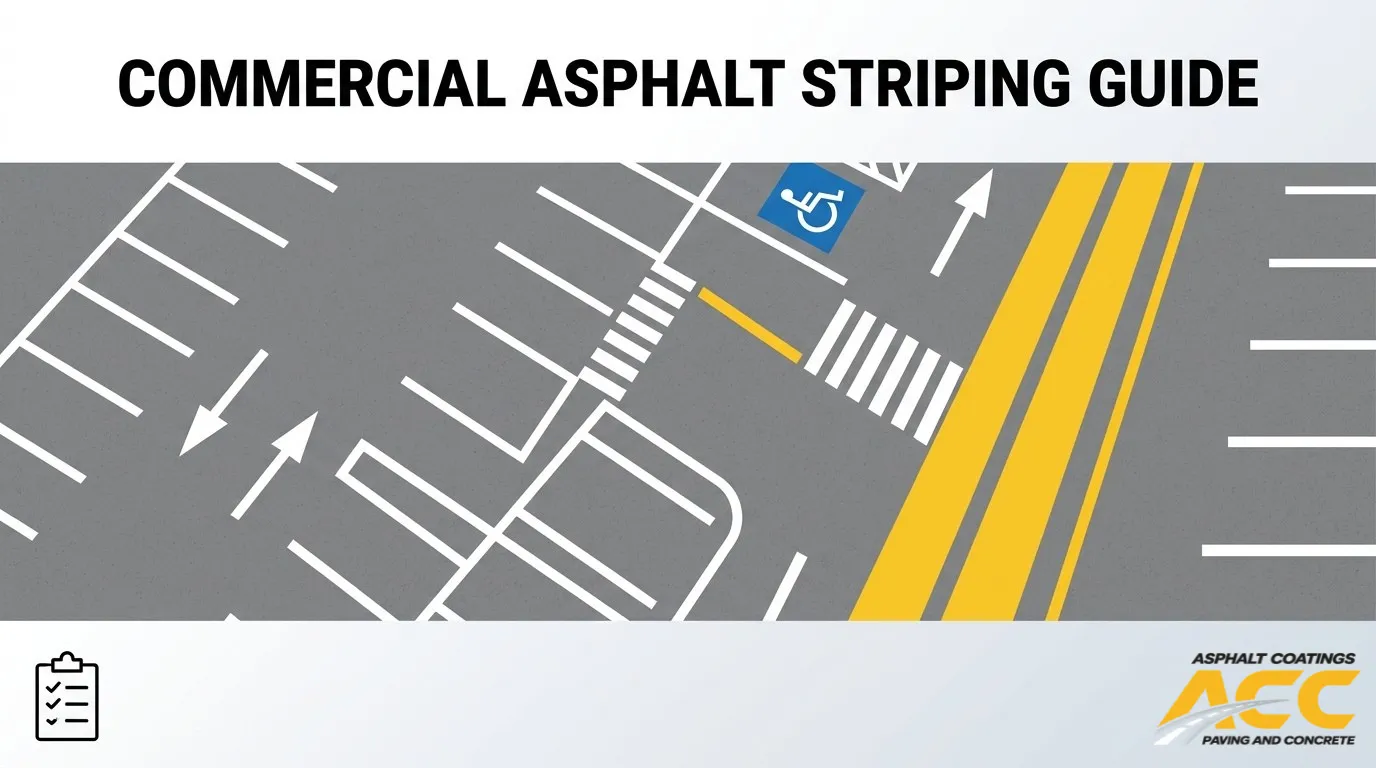
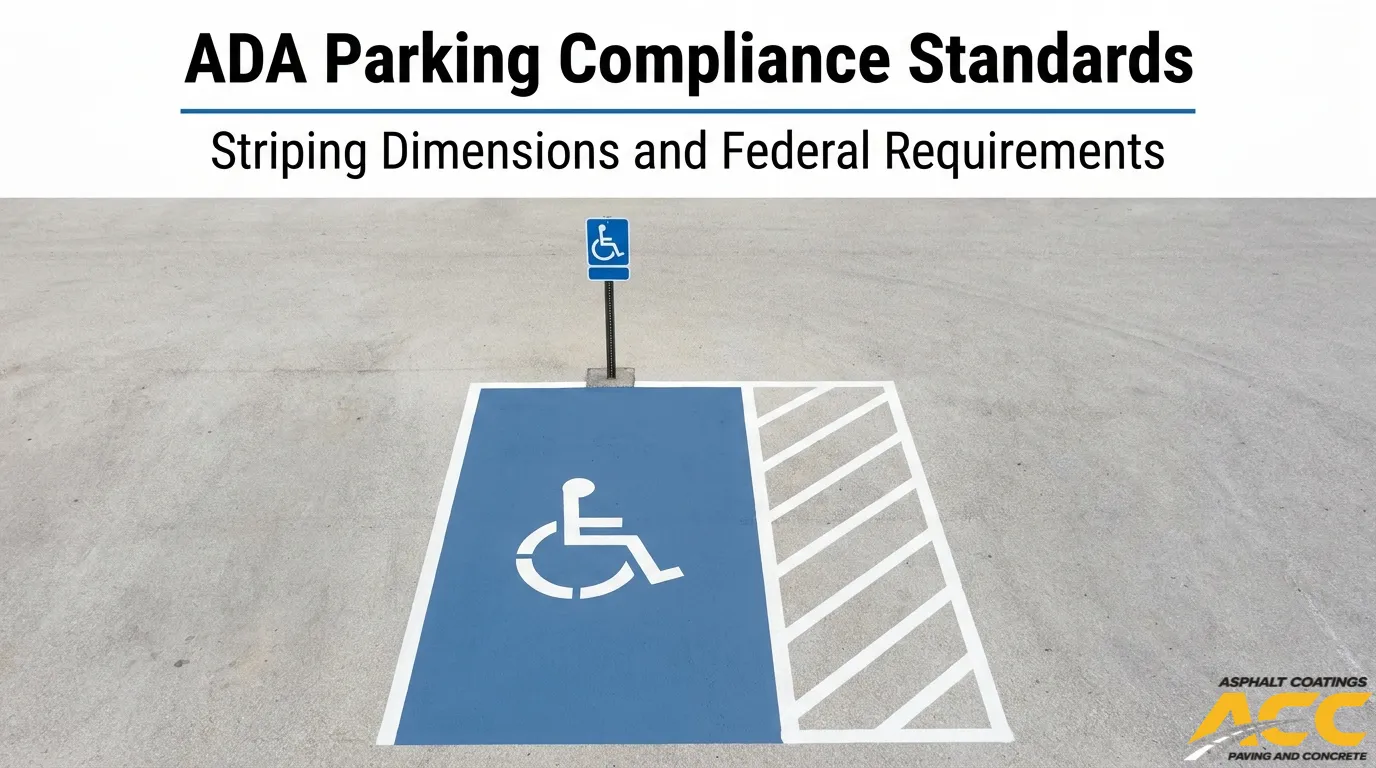
Parking lot construction projects require in-house teams because they involve phased work across active properties where staging, traffic flow, and sequencing must align precisely. A single crew that controls grading, paving, striping, and ADA-compliant concrete work eliminates the handoff gaps that occur between separate subcontractors. In the Pikes Peak region, Superpave Asphalt Pavement Material construction is governed by standardized regional specifications that define the technical requirements for local paving projects, according to El Paso County Public Works. Crews unfamiliar with these specifications risk mix design errors and compaction failures. Parking lots also require drainage integration from the start; an in-house team that handles subgrade preparation through final striping catches grade issues before they become costly corrections.
How Do Industrial Facility Paving Projects Demand Crew Consistency?
Industrial facility paving projects demand crew consistency because they involve heavy-duty pavement sections designed to withstand constant truck traffic, forklift loads, and equipment staging. Thickness tolerances and compaction standards are far less forgiving than standard commercial work. When the same crew handles every phase, from subgrade compaction to final surface course, each layer builds on verified work from the previous step. Rotating subcontractor crews often lack context about prior lifts and underlying conditions. For distribution warehouses and manufacturing plants in Colorado Springs, this continuity directly affects whether the pavement holds up under repeated heavy loads or fails prematurely at joints and transitions.
Why Do Healthcare and Shopping Center Projects Need Tighter Coordination?
Healthcare and shopping center projects need tighter coordination because both facility types must remain partially operational during paving work. Hospitals require uninterrupted emergency vehicle access, while shopping centers cannot afford to close high-traffic entrances during business hours. Phased paving schedules on these properties demand a crew that adjusts daily staging plans without waiting for a subcontractor’s availability. In-house teams communicate changes in real time, shifting equipment and personnel within hours rather than days. For property managers overseeing these complex commercial sites, this level of responsiveness is often the difference between a project that stays on schedule and one that disrupts tenants and visitors for weeks.
With the right project type identified, local Colorado Springs experience further sharpens the in-house advantage.
How Does Local Colorado Springs Experience Give In-House Crews an Edge?
Local Colorado Springs experience gives in-house crews an edge by providing deep knowledge of regional soils, permitting requirements, and drainage patterns. The following subsections cover soil and subgrade conditions, municipal permitting processes, and Front Range drainage challenges.
Why Does Knowledge of Local Soils and Subgrade Conditions Matter?
Knowledge of local soils and subgrade conditions matters because Colorado Springs sits on highly variable terrain where expansive clays can destroy pavement from below. According to the Colorado Geological Survey, expansive soils containing bentonite and montmorillonite clays can expand up to 20% by volume when exposed to water. These swelling forces, sometimes reaching 30,000 pounds per square foot, are sufficient to crack and heave commercial pavement sections.
In-house crews that work this ground repeatedly learn to identify problem soils during subgrade preparation. They recognize when clay content requires lime stabilization or deeper aggregate bases before a single lift of asphalt is placed. Subcontractors rotating between regions rarely carry this site-specific instinct, which often leads to premature pavement failure.
How Does Familiarity With Colorado Springs Permitting Speed Up Projects?
Familiarity with Colorado Springs permitting speeds up projects by eliminating the trial-and-error delays that unfamiliar crews face with municipal requirements. The City of Colorado Springs requires contractors performing excavation or concrete work in the public right-of-way to hold specific licenses, bonds, and insurance separate from a general contractor license. Crews unfamiliar with this distinction can stall a project before work even begins.
Local experience also means understanding how the paving season aligns with permitting timelines. Historical climate data (1981-2010) shows a 90% probability of the freeze-free period lasting at least 134 days, with the last spring freeze near May 8th and the first fall freeze around early October. In-house crews that navigate these windows annually submit permit applications well before the season opens, coordinating inspections without costly idle days.
Why Does Understanding Front Range Drainage Patterns Prevent Failures?
Understanding Front Range drainage patterns prevents failures because improper water management is the single fastest way to destroy commercial pavement in this region. Colorado Springs receives intense, concentrated rainfall events that overwhelm poorly graded surfaces, and the expansive clay soils underneath trap moisture rather than allowing percolation.
In-house crews familiar with local drainage behavior design proper cross-slopes, install adequate inlet structures, and direct stormwater away from pavement edges. They know which commercial sites sit in natural drainage corridors and which require retention features to meet municipal stormwater standards. This pattern recognition, built through years of working the same geography, is difficult to replicate with subcontractors who lack Front Range project history.
With local knowledge supporting every phase of execution, choosing the right paving partner becomes the final decision.
How Should You Choose a Commercial Paving Partner in Colorado Springs?
You should choose a commercial paving partner in Colorado Springs by evaluating crew structure, local experience, and accountability. The following sections explain what Asphalt Coatings Company offers and summarize the key reasons in-house crews outperform subcontractors.
Can Asphalt Coatings Company’s In-House Crews Handle Your Commercial Project?
Yes, Asphalt Coatings Company’s in-house crews can handle your commercial project. Since 1986, Asphalt Coatings Company has performed commercial asphalt paving and concrete work across Colorado’s Front Range with in-house crews, not subcontractors. This single-source model covers everything from subgrade preparation and new construction paving to sealcoating, crack sealing, and ADA-compliant concrete flatwork.
Asphalt Coatings Company maintains a Colorado Springs office at 4740 Forge Rd STE 110B, Colorado Springs, CO 80907, serving healthcare campuses, industrial complexes, shopping centers, and apartment communities. According to a study published in the ASCE Journal of Construction Engineering and Management, in-house workforces and outsourcing methods both produce measurable differences in project costs and contract periods. That cost and schedule advantage becomes especially pronounced when one team controls quality from the first estimate through the final lift of asphalt.
What Are the Key Takeaways About Why In-House Paving Crews Outperform Subcontractors on Colorado Springs Commercial Projects?
The key takeaways about why in-house paving crews outperform subcontractors on Colorado Springs commercial projects center on quality, cost, scheduling, and accountability:
- In-house crews are direct employees of the contracting firm, enabling unified quality control that subcontractors, as outside laborers hired for specific tasks, cannot consistently match.
- Colorado Springs commercial projects span healthcare campuses, industrial facilities, and shopping centers, all of which demand coordinated crews familiar with site-specific conditions.
- Eliminating subcontractor markups and rework reduces total project cost while keeping timelines predictable.
- Colorado’s 2024 legislative measures now make general contractors guarantors of subcontractor wage payments, adding financial risk to firms that rely heavily on outsourced labor.
- Local expertise with Front Range soils, freeze-thaw cycles, and municipal permitting prevents failures that unfamiliar crews frequently cause.
For property managers evaluating their next paving project, prioritizing a partner with dedicated in-house crews is the most reliable way to protect both investment and infrastructure.