Preventive asphalt maintenance is a proactive strategy of applying scheduled treatments to pavement while it remains in good condition, rather than waiting for visible failures to trigger costly reconstruction. Every dollar spent on preservation can save several times that amount in future rehabilitation, making it one of the most cost-effective infrastructure investments available to commercial property owners.
This guide covers the causes of asphalt deterioration, the types and mechanics of preventive treatments, optimal scheduling, cost savings versus replacement, the consequences of deferred maintenance, and how to build a long-term pavement plan with a professional contractor.
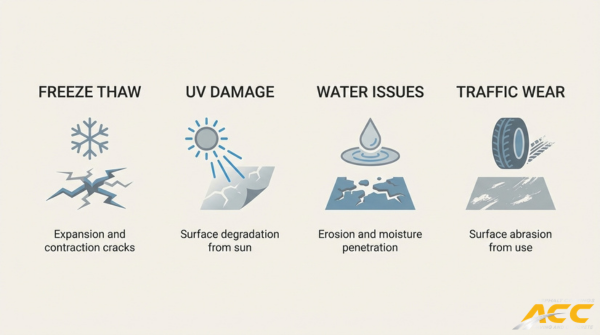
Asphalt pavement breaks down through four primary mechanisms: freeze-thaw cycles that crack the surface from within, UV oxidation that hardens and brittles the binder, water infiltration that erodes the structural base, and heavy traffic loading that fatigues the surface over thousands of repetitions. Colorado properties face especially aggressive conditions, with high annual freeze-thaw frequency and elevated UV intensity at altitude.
Preventive treatments target each failure mode directly. Sealcoating blocks UV radiation and repels moisture at a fraction of a cent per square foot. Crack sealing stops water from reaching the subbase before freeze-thaw cycles can widen the damage. Patching contains localized failures before they spread, and drainage maintenance protects the foundation layers that support every other treatment.
Scheduling these treatments correctly is essential. New asphalt should receive its first sealcoat within 6 to 12 months, with reapplication every 2 to 3 years for commercial lots. Pavement that misses these windows follows a predictable decline curve: slow quality loss through 75% of its design life, then rapid deterioration in the final stretch.
A structured maintenance plan built on Pavement Condition Index assessments, proper financial categorization, and consistent contractor partnership prevents that accelerated decline and keeps total lifecycle costs far below what reactive replacement demands.
Why Does Asphalt Pavement Deteriorate Over Time?
Asphalt pavement deteriorates over time because of environmental exposure, moisture intrusion, and repeated loading. The four primary causes are freeze-thaw cycles, UV oxidation, water infiltration, and heavy traffic.
How Do Freeze-Thaw Cycles Damage Asphalt Pavement?
Freeze-thaw cycles damage asphalt pavement by forcing water trapped in small cracks and pores to expand as it freezes, then contract when it thaws. Each cycle widens existing cracks and creates new ones in the pavement surface. According to a Colorado Department of Transportation climate study, Denver experiences an estimated 120 freeze-thaw days annually. Over multiple seasons, this repeated expansion and contraction breaks apart the asphalt matrix from the inside out, turning hairline cracks into alligator cracking and potholes. For Colorado properties, freeze-thaw damage is arguably the single most destructive environmental force acting on pavement.
How Does UV Oxidation Break Down Asphalt Binder?
UV oxidation breaks down asphalt binder by causing the liquid asphalt cement to harden, become brittle, and lose its flexibility. Prolonged ultraviolet radiation exposure evaporates the lighter oils in the binder, leaving a dry, gray surface prone to cracking. According to the EPA’s Guide to the UV Index, UV intensity increases by approximately 2% for every 1,000-foot increase in elevation. Colorado’s high-altitude locations receive significantly more UV radiation than sea-level regions, which accelerates this aging process. Once the binder loses elasticity, the aggregate loosens and the surface ravels, creating entry points for water and further deterioration.
How Does Water Infiltration Lead to Pavement Failure?
Water infiltration leads to pavement failure by penetrating through surface cracks and weakening the subbase layers beneath the asphalt. Once water reaches the aggregate base, it softens compacted materials and erodes their load-bearing capacity. Saturated subbases shift under traffic, causing depressions, rutting, and eventual structural collapse. In cold climates, trapped subsurface moisture compounds the problem by feeding freeze-thaw damage from below. A study published in MDPI Sustainability found that asphalt pavements in cold climates are particularly susceptible to thermal cracking when moisture is present, which reduces overall service life without site-specific maintenance. Addressing drainage early prevents this cascading failure pattern.
How Does Heavy Traffic Loading Accelerate Wear?
Heavy traffic loading accelerates wear by applying repeated stress to the asphalt surface, gradually fatiguing the pavement structure. Each vehicle pass compresses the surface layer slightly; over thousands of repetitions, this creates rutting in wheel paths and fatigue cracking across loaded areas. Commercial properties with delivery trucks, garbage collection vehicles, and high daily traffic counts experience this degradation much faster than lightly traveled surfaces. When traffic loading combines with an already oxidized or moisture-compromised pavement, the rate of decline increases sharply. Addressing these four deterioration mechanisms early through preventive maintenance is what separates pavements that last decades from those that fail prematurely.
What Is Preventive Asphalt Maintenance?
Preventive asphalt maintenance is a proactive strategy of applying scheduled treatments to pavement while it remains in good condition, rather than waiting for visible failures to occur. Common treatments include sealcoating, crack sealing, patching, and drainage upkeep. The goal is to slow deterioration caused by environmental factors such as UV oxidation, freeze-thaw cycles, and water infiltration, keeping pavement above critical condition thresholds for as long as possible.
This approach differs fundamentally from reactive repair, where work begins only after damage becomes severe. According to the Federal Highway Administration (FHWA), every $1 spent on preventive maintenance can save $6 to $10 in future rehabilitation costs, as cited by a Texas A&M Transportation Institute report. That return on investment exists because pavement condition follows a predictable curve: surfaces experience a slow decline during the initial 75% of their design life, followed by rapid deterioration in the remaining 25%. Intervening early, while the Pavement Condition Index (PCI) score is still high, costs a fraction of what full-depth reconstruction demands once that accelerated decline begins.
For commercial property managers, preventive maintenance is one of the most cost-effective tools available for extending pavement lifespan. Treating minor distresses before they compound into structural problems preserves ride quality, reduces liability risk, and protects the overall investment in asphalt infrastructure. The following sections cover the specific treatment types, how each one extends pavement life, and when to schedule them for maximum benefit.
What Are the Types of Preventive Asphalt Maintenance?
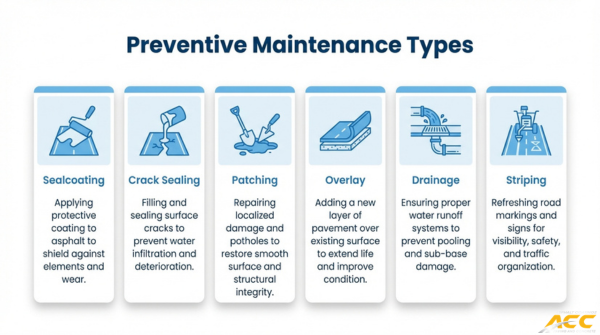
The types of preventive asphalt maintenance are sealcoating, crack sealing and filling, patching and pothole repair, asphalt overlay, drainage maintenance, and striping preservation. Each treatment targets a specific stage of pavement deterioration.
Sealcoating
Sealcoating is a protective surface treatment that applies a thin coal-tar or asphalt-based emulsion over existing pavement. This barrier shields the asphalt binder from UV oxidation, moisture penetration, and chemical spills from oil or fuel. According to a cost-benefit analysis by Pave It Forward LLC, sealcoating typically costs between $0.15 and $0.30 per square foot, making it one of the most affordable preventive treatments available. For commercial parking lots exposed to heavy traffic and constant sun, sealcoating delivers outsized value relative to its low cost. Regular applications every two to three years maintain the flexible binder properties that keep pavement resilient.
Crack Sealing and Crack Filling
Crack sealing and crack filling are two distinct methods for addressing pavement cracks before water infiltration causes subsurface damage. Crack sealing uses heated rubberized sealant applied to active (working) cracks, creating a flexible, waterproof bond that expands and contracts with temperature changes. Crack filling, by contrast, places material into non-working cracks where minimal movement is expected. In Colorado’s demanding freeze-thaw environment, using CDOT-approved crack sealing materials ensures compliance with state standards while maximizing treatment longevity, a specification that professional contractors follow when addressing active crack movement on commercial properties.
The critical difference lies in longevity: sealed cracks resist reopening through freeze-thaw cycles, while filled cracks suit stable, low-movement areas. Addressing cracks early prevents water from reaching the aggregate base, where erosion and structural failure begin.
Patching and Pothole Repair
Patching and pothole repair restore localized areas of pavement failure before damage spreads to surrounding sections. Full-depth patching removes the deteriorated asphalt down to the subgrade, replaces compromised base material, and installs new hot-mix asphalt. Skin patching addresses shallow surface defects without disturbing the underlying structure. Potholes form when water infiltrates cracks, weakens the base, and causes the surface to collapse under traffic loading. A more detailed breakdown of why potholes form and how to prevent them is available in our dedicated guide on this subject. Timely repair prevents adjacent pavement from losing structural support. For most commercial properties, prioritizing pothole repair during routine inspections is the single fastest way to prevent small failures from becoming full-lane reconstruction projects.
Asphalt Overlay
Asphalt overlay is a resurfacing method that places a new layer of hot-mix asphalt, typically 1.5 to 3 inches thick, over the existing pavement surface. Overlay restores ride quality, structural capacity, and surface appearance without the cost of full-depth removal and reconstruction. This treatment works best when the existing base remains structurally sound and the Pavement Condition Index scores are in the fair-to-satisfactory range. Sometimes referred to as a mill-and-fill when combined with milling the old surface first, an overlay resets the pavement’s aging clock significantly. It is one of the most cost-effective options for extending service life on commercial lots and roadways that have moderate, widespread surface distress.
Drainage Maintenance
Drainage maintenance preserves the systems that direct water away from the pavement structure, including catch basins, storm drains, swales, and graded slopes. Standing water is one of the primary accelerators of asphalt deterioration because it softens the subgrade, strips the asphalt binder from aggregate, and amplifies freeze-thaw damage. Clearing debris from inlets, repairing damaged drain lines, and maintaining proper surface grading prevents ponding. Although often overlooked in pavement management plans, drainage failures are frequently the root cause behind premature base failure. Keeping water moving off the surface and away from the pavement edge protects every other maintenance investment.
Striping and Surface Marking Preservation
Striping and surface marking preservation maintains the painted lines, directional arrows, and ADA-compliant markings on parking lots and roadways. Faded or missing markings create safety hazards, reduce traffic flow efficiency, and can expose property owners to liability. Fresh striping also improves the visual appearance of commercial properties, which directly influences tenant and customer perception. Restriping is typically performed after sealcoating or overlay applications, since these treatments cover existing markings. Maintaining clear, code-compliant markings is a low-cost step that completes any preventive maintenance program.
With these treatment types defined, the next section examines how each one specifically extends pavement life.
How Does Each Preventive Treatment Extend Pavement Life?
Each preventive treatment extends pavement life by targeting a specific failure mechanism before it escalates. Sealcoating blocks oxidation, crack sealing stops water infiltration, patching contains localized damage, and drainage maintenance protects the structural base.
How Does Sealcoating Protect Against Oxidation and Moisture?
Sealcoating protects against oxidation and moisture by applying a protective barrier over the asphalt surface that shields the binder from UV radiation and prevents water penetration. UV exposure breaks down the maltenes in asphalt binder, causing the surface to become brittle and crack. According to the EPA’s UV Index guide, UV intensity increases by approximately 2% for every 1,000-foot increase in elevation, making this protection especially critical for Colorado pavements.
A properly applied sealcoat also repels moisture, oil, and chemical spills that would otherwise soften or erode the surface. At $0.15 to $0.30 per square foot, sealcoating remains one of the most cost-effective preservation treatments available. For property managers maintaining large commercial lots, this low per-square-foot cost delivers outsized returns by preserving surface integrity across the full pavement lifecycle.
How Does Crack Sealing Prevent Subsurface Water Damage?
Crack sealing prevents subsurface water damage by filling open cracks with flexible, CDOT-approved sealant materials that block moisture from reaching the aggregate base and subgrade. Once water infiltrates below the surface, freeze-thaw cycles expand and contract it, breaking apart the pavement structure from within. According to a Colorado Department of Transportation climate study, Denver experiences an estimated 120 freeze-thaw days annually, which makes unsealed cracks a direct path to accelerated base failure.
Addressing cracks early, when they are still narrow surface fractures, prevents them from widening into alligator cracking or potholes. This single intervention can interrupt the deterioration cycle that otherwise leads to costly full-depth reconstruction.
How Does Timely Patching Stop Small Failures From Spreading?
Timely patching stops small failures from spreading by removing and replacing deteriorated pavement sections before damage reaches the subgrade. A pothole or localized depression exposes the base layer to moisture and traffic loading, and without intervention, the surrounding pavement weakens rapidly. Research from the University of Twente on pavement deterioration confirms that pavements experience a 40% drop in quality over 75% of their design life, with deterioration accelerating sharply in the final stages.
Patching while distresses are still isolated preserves the structural integrity of adjacent pavement areas. Property managers who delay patching often face repair costs that compound quickly, since each freeze-thaw cycle and heavy vehicle pass widens the damaged zone. Addressing failures at the earliest visible stage is consistently the most effective way to avoid escalation.
How Does Proper Drainage Reduce Structural Deterioration?
Proper drainage reduces structural deterioration by directing water away from the pavement surface and subgrade before it can weaken the foundation layers. Standing water saturates the aggregate base, reducing its load-bearing capacity and accelerating rutting, depressions, and base failure under traffic. Even well-maintained asphalt will deteriorate prematurely if drainage systems are clogged, graded improperly, or undersized for the site’s runoff volume.
Effective drainage maintenance includes keeping catch basins clear, ensuring positive slope across the lot surface, and repairing curb and gutter sections that channel water away from paved areas. Of all preventive treatments, drainage is the most frequently overlooked, yet arguably the most consequential for long-term pavement performance.
With each treatment targeting a distinct failure mode, scheduling these interventions at the right time maximizes their protective value.
When Should You Schedule Preventive Asphalt Maintenance?
You should schedule preventive asphalt maintenance based on pavement age, treatment type, and seasonal conditions. The following subsections cover first sealcoat timing for new asphalt, recoating frequency for commercial lots, and optimal seasonal windows in Colorado.
When Should New Asphalt First Receive Sealcoating?
New asphalt should first receive sealcoating 6 to 12 months after initial paving. This waiting period allows the asphalt binder to fully cure and the lighter oils in the mix to evaporate, which produces a harder surface that bonds more effectively with the sealant. According to a Kansas University Transportation Center report on pavement management, the first sealcoat application is ideally performed 6 to 12 months after installation to provide early protection against environmental degradation. Applying sealcoat too soon traps volatile compounds and can cause the coating to peel or blister. Waiting longer than 12 months, however, leaves the surface exposed to UV oxidation and moisture infiltration during a critical early period. Hitting that 6-to-12-month window is one of the simplest ways to protect a new pavement investment from the start.
How Often Should Commercial Parking Lots Be Sealcoated?
Commercial parking lots should be sealcoated every 2 to 3 years under typical traffic and weather conditions. High-traffic lots serving retail centers, distribution warehouses, or healthcare facilities may benefit from a 2-year cycle, while lower-traffic office parks can often extend to 3 years. Sealcoating costs typically range from $0.15 to $0.30 per square foot, making it one of the most cost-effective preventive treatments available for commercial properties. An effective pavement management plan should be updated annually, or on a maximum 3-year cycle, to ensure maintenance activities remain correctly timed. For Denver-area properties managing high traffic volumes, scheduling commercial parking lot sealcoating in Denver on a 2-year cycle is a proven approach to protecting surface integrity against UV exposure and freeze-thaw stress.
When Is the Best Season for Asphalt Maintenance in Colorado?
The best season for asphalt maintenance in Colorado is late spring through early fall, when ambient and surface temperatures consistently stay above 50°F. Sealcoating and crack sealing materials require warm, dry conditions to cure properly, so scheduling between May and September yields the most durable results. Colorado’s climate presents unique timing challenges; Denver alone experiences an estimated 120 freeze-thaw days annually, according to a Colorado Department of Transportation climate study. These rapid temperature swings make fall deadlines especially critical, since any treatment applied too late risks incomplete curing before winter. Planning maintenance early in the season also avoids contractor backlogs that build through summer, giving property managers more flexibility on scheduling.
Understanding when to act sets the stage for evaluating how much these timely treatments actually save. For Denver property managers, scheduling professional crack sealing services before the freeze-thaw season begins ensures repairs are completed while temperatures are still warm enough for proper cure.
How Much Does Preventive Maintenance Save Compared to Replacement?
Preventive maintenance saves property owners significantly more than waiting for full pavement replacement. The cost differences span treatments like sealcoating and crack sealing versus reconstruction, and the return on investment compounds over time.
Preventive asphalt maintenance typically costs three times less than reactive repairs. Sealcoating ranges from $0.15 to $0.30 per square foot, while crack sealing costs between $0.50 and $3.00 per linear foot. Full-depth reconstruction, by comparison, demands substantially higher investment per square foot. According to the Federal Highway Administration, every $1 spent on preventive maintenance can save $6 to $10 in future rehabilitation costs, as cited by the Texas A&M Transportation Institute.
These savings grow because pavement deterioration follows a predictable curve. A surface experiences roughly a 40% drop in quality over the first 75% of its design life, then declines rapidly in the final stretch. Catching distress early with low-cost preservation treatments prevents the pavement from crossing into that accelerated failure zone, where only expensive mill-and-fill or full replacement can restore serviceability.
For commercial property managers, the math is straightforward: spending a fraction of the replacement cost on scheduled sealcoating, crack sealing, and patching keeps the Pavement Condition Index high enough to avoid capital-intensive reconstruction for years longer. Few line items in a facility budget offer a comparable return, which makes proactive pavement preservation one of the most cost-effective infrastructure investments available.
Understanding what happens when these treatments are skipped reveals the full financial risk of deferred maintenance.
What Happens If You Skip Preventive Asphalt Maintenance?
Skipping preventive asphalt maintenance accelerates structural deterioration, multiplies repair costs, and shortens pavement lifespan dramatically. The consequences compound quickly once the surface passes a critical condition threshold.
Deferred maintenance forces pavement into a rapid decline cycle. Pavements typically experience a slow decline in Pavement Condition Index (PCI) during the initial 75% of their design life, followed by rapid deterioration in the remaining 25%. According to research compiled by the University of Twente, this phenomenon follows a “40 percent drop in quality” rule: a pavement can lose 40% of its quality over 75% of its lifetime, with deterioration accelerating sharply in the last 12% of its service life — illustrating the hidden costs of delaying asphalt repairs in Colorado’s freeze-thaw climate.
Once that tipping point arrives, the consequences escalate across several fronts:
- Structural degradation forces full-depth reconstruction instead of simpler preservation methods like sealcoating or crack sealing.
- Repair costs multiply significantly, since preventive maintenance typically costs three times less than reactive repairs.
- Pavement condition drops below recoverable thresholds, pushing PCI scores from “Fair” or “Satisfactory” ranges into “Poor” or “Failed” categories where overlay or mill-and-fill treatments can no longer restore the surface.
- Vehicle operating costs increase for everyone using the deteriorated surface, with the ASCE reporting additional costs of $725 per motorist in 2023 due to poor road conditions.
What makes deferred maintenance so costly is the nonlinear nature of pavement failure. A parking lot that looks acceptable today can cross the rapid-decline threshold within a single season of unaddressed freeze-thaw cycles and UV oxidation. At that point, property managers face capital expenditures for full replacement rather than modest operational expenses for preservation treatments. For most commercial properties, the difference between a proactive sealcoating schedule and a reactive reconstruction project represents a cost increase of several hundred percent.
Building a structured maintenance plan prevents this cascade of failures entirely.
How Do You Build a Long-Term Pavement Maintenance Plan?
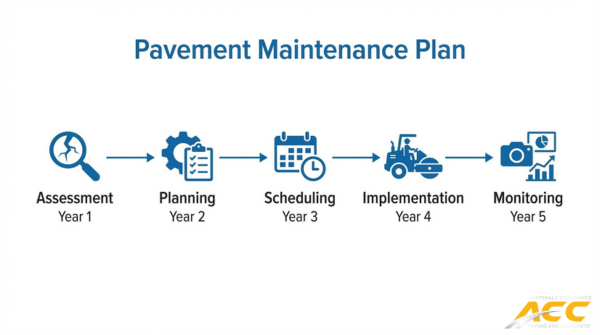
You build a long-term pavement maintenance plan by combining regular condition assessments, scheduled preventive treatments, and a structured budget that accounts for material cost fluctuations. The key components include PCI scoring, annual plan updates, and proper financial categorization.
A long-term pavement maintenance plan starts with understanding your pavement’s current condition and mapping treatments across a multi-year timeline. According to the Kansas University Transportation Center, an effective pavement management plan should ideally be updated annually or on a maximum 3-year cycle to align with standard data collection frequencies and ensure maintenance activities are correctly timed. This update cadence keeps your budget aligned with actual surface conditions rather than assumptions.
The Pavement Condition Index (PCI) is a numerical rating from 0 to 100 that provides the foundation for prioritization. Assessments conducted in accordance with ASTM D6433 offer a standardized framework for evaluating asphalt surfaces and directing limited budgets toward the sections that need attention most urgently. The PCI rating scale categorizes condition as follows:
| PCI Range | Condition Rating |
| 100–85 | Good |
| 85–70 | Satisfactory |
| 70–55 | Fair |
| 55–40 | Poor |
| 40–25 | Very Poor |
| 25–10 | Serious |
| 10–0 | Failed |
Sections scoring below 55 typically require rehabilitation or reconstruction rather than simple preservation treatments. Catching pavement while it remains in the “Satisfactory” or “Good” range is where preventive maintenance delivers its strongest return on investment.
Proper financial planning also requires understanding how the IRS classifies pavement work. The IRS allows asphalt pavement to be depreciated as land improvement property with a recovery period of 15 years under the General Depreciation System (GDS) or 20 years under the Alternative Depreciation System (ADS). Routine repairs, such as crack sealing and sealcoating, are generally deductible as operating expenses in the year they occur. Capital improvements, such as full overlays or reconstruction, must be depreciated over time. Categorizing treatments correctly can significantly affect your annual tax position.
Budget accuracy depends on anticipating material cost shifts. Historically, changes in crude oil availability have caused 15% to 25% fluctuations in asphalt binder pricing. Building a contingency buffer of at least 10% to 15% into your annual pavement budget helps absorb these swings without delaying critical treatments.
One of the most common budgeting mistakes is disconnecting the financial planning process from actual pavement conditions. As noted by The Handbook of Maintenance Management, maintenance professionals often fail to adequately involve the budgeting process with the long-term technical needs of the facility, leading to underfunded requirements. When budgets are set without PCI data or a treatment schedule, deferred maintenance accelerates deterioration and drives costs upward.
The FHWA’s revamped Pavement Management Roadmap provides a 10-year program strategy framework with both short-term and long-term action items. For commercial property managers, adopting a similar multi-year view, even at a simplified scale, prevents the reactive cycle that costs three times more than proactive care. Property managers who build a long-term pavement management plan based on PCI data and treatment schedules consistently spend less over a 10-year window than those who react to failures as they appear.
A practical long-term plan should include these core elements:
- Conduct a baseline PCI assessment across all paved areas.
- Categorize each section by condition rating and assign treatment types.
- Establish a recurring schedule for sealcoating, crack sealing, and inspections.
- Separate capital expenditures from operating expenses for accurate budgeting.
- Update the plan annually based on fresh condition data and material pricing.
- Build a contingency fund to cover asphalt binder price fluctuations.
Property managers who commit to this structured approach consistently spend less over a 10-year window than those who react to failures as they appear. A well-maintained plan is not just a maintenance document; it is a financial strategy that protects property value and reduces long-term liability. Partnering with an experienced contractor makes executing that plan far more efficient.
How Should You Approach Pavement Maintenance With a Commercial Asphalt Contractor?
You should approach pavement maintenance with a commercial asphalt contractor by prioritizing proactive service partnerships over reactive, emergency-driven repairs. The following sections cover how professional services extend pavement lifespan and the key takeaways from a preventive maintenance strategy.
Can Professional Sealcoating and Repair Services Help Extend Your Pavement Lifespan?
Yes, professional sealcoating and repair services can help extend your pavement lifespan by addressing deterioration before it compounds into structural failure. Sealcoating shields asphalt binder from UV oxidation and moisture infiltration, while crack sealing and patching prevent water from reaching the subbase.
According to research published by the Texas A&M Transportation Institute, the Federal Highway Administration estimates that every $1 spent on preventive maintenance saves $6 to $10 in future rehabilitation costs. This return on investment makes a strong case for scheduled contractor-led treatments rather than waiting for visible damage to escalate.
A long-term partnership with a commercial asphalt contractor also enables consistent condition monitoring, which aligns repair timing with the pavement’s actual lifecycle stage. For most commercial properties, this proactive approach is the single most effective way to avoid the rapid quality decline that occurs in the final quarter of a pavement’s design life. Contractors with dedicated in-house crews rather than subcontractors offer property managers greater scheduling consistency and quality control throughout multi-year maintenance programs, which directly supports the proactive timing that extends pavement life.
What Are the Key Takeaways About How Preventive Asphalt Maintenance Extends Pavement Lifespan?
The key takeaways about how preventive asphalt maintenance extends pavement lifespan center on timing, cost efficiency, and consistent professional oversight:
- Preventive treatments such as sealcoating, crack sealing, and patching cost significantly less than reactive repairs or full-depth reconstruction.
- Asphalt pavement experiences a slow decline during the first 75% of its design life, followed by rapid deterioration in the remaining 25%, making early intervention critical.
- Environmental stressors like freeze-thaw cycles and UV radiation accelerate damage when left unmanaged; scheduled maintenance directly counteracts both.
- A pavement management plan updated on an annual or three-year cycle keeps maintenance correctly timed and budgets aligned with actual conditions.
- Long-term contractor partnerships enable data-driven prioritization, reducing emergency costs and extending overall service life.
Asphalt Coatings Company specializes in commercial asphalt paving, sealcoating, crack sealing, patching, and concrete services across Colorado’s Front Range. With 39 years of Colorado-specific expertise and in-house crews (not subcontractors), Asphalt Coatings Company partners with property managers to build proactive maintenance plans that protect pavement investments for the long term.