EV charging stations impact asphalt design and maintenance by introducing heavier vehicle loads, prolonged static stress, thermal cycling from equipment, and chemical exposure that standard parking lot pavement sections are not engineered to handle.
This guide covers the unique demands EVs place on pavement, the design specifications charging areas require, common damage patterns at charging sites, proactive maintenance strategies, and the planning considerations property managers need before installation begins.
Electric vehicles weigh 10% to 15% more than their combustion-engine equivalents, and pavement distress scales exponentially with axle load. Charging stalls concentrate that heavier weight in fixed positions for 30 minutes to several hours, accelerating rutting and depression formation well beyond typical parking wear.
Proper design for charging zones requires thicker subbases, polymer-modified asphalt binders, enhanced drainage systems, and carefully restored conduit trenches. Each element addresses a specific structural vulnerability that charging infrastructure introduces into the pavement section.
Charger equipment generates localized heat that softens asphalt binder, while EV thermal management fluids chemically degrade pavement at the molecular level. Freeze-thaw cycles then compound this damage by forcing water into weakened areas, progressively breaking the structure from within.
Sealcoating every two to three years, sealing cracks as soon as they appear, and patching depressions before they spread are the frontline defenses for extending pavement life at charging sites. These targeted maintenance actions cost a fraction of the full-depth repairs they prevent.
Property managers also need to coordinate ADA-compliant stall dimensions, striping layouts, permitting timelines, and utility trenching routes before construction begins. Building charging infrastructure into new construction rather than retrofitting existing lots delivers stronger pavement and significantly lower lifecycle costs.
Why Do EV Charging Stations Create Unique Demands on Asphalt?
EV charging stations create unique demands on asphalt because heavier vehicles, prolonged parking, and equipment foundations combine to accelerate pavement stress beyond standard parking lot conditions. The following sections cover vehicle weight, dwell time, and equipment-related factors.
How Does the Weight of Electric Vehicles Affect Pavement Load?
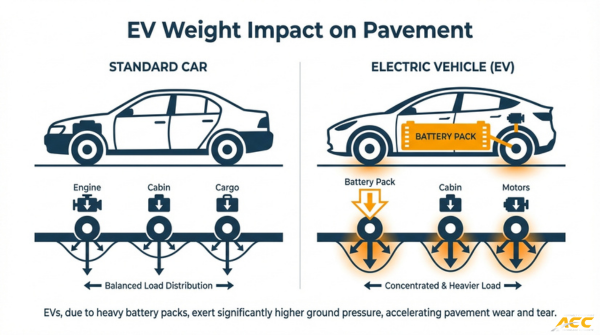
The weight of electric vehicles affects pavement load significantly because EV battery packs range from 550 to 2,000 lbs, making EVs 10% to 15% heavier than their internal combustion engine equivalents. This additional mass compounds quickly under a well-established engineering principle: pavement distress is approximately proportional to axle load raised to the fourth power. A modest weight increase, then, translates into dramatically accelerated degradation.
According to a 2024 study published in Transportation Research Part D, heavy-duty electric vehicles apply relatively higher load-induced stresses on flexible pavements compared to conventional diesel trucks. Local roads and standard parking areas not engineered for these loads face failure mechanisms such as cracking and shoving. For property managers planning charging stalls, this means standard pavement sections may prove inadequate from day one.
Why Does Extended Dwell Time at Chargers Cause More Damage?
Extended dwell time at chargers causes more damage because vehicles remain stationary on the same pavement area for 30 minutes to several hours, depending on charger speed. Unlike standard parking where vehicles come and go throughout the day, charging stalls concentrate sustained static loads on identical contact points.
This prolonged pressure allows asphalt to deform under the vehicle’s weight, especially during warm weather when binder softens. Repeated loading in the same spot accelerates rutting and depression formation. The combination of heavier EVs and longer occupancy creates a compounding effect that standard parking lot designs rarely account for. Designing charging areas with this static-load pattern in mind is one of the most overlooked steps in EV infrastructure planning.
How Do Charging Equipment Foundations Stress Surrounding Asphalt?
Charging equipment foundations stress surrounding asphalt through thermal transfer, structural discontinuity, and chemical exposure. EVSE (Electric Vehicle Supply Equipment) units require concrete pad foundations that create rigid-to-flexible transition zones where cracking commonly initiates.
Thermal effects present an additional concern. According to research published in Applied Thermal Engineering, dynamic wireless charging coils produce cyclical temperature fluctuations from repeated heating and cooling phases, leading to thermal degradation and increased fatigue cracking in surrounding pavement. Inductive power transfer systems can push asphalt temperatures to 75°C in summer conditions. Chemical exposure adds another layer of risk; polyethylene glycol (PEG), common in EV thermal management fluids, adversely affects both high- and low-temperature properties of asphalt binder. Understanding these combined stressors helps inform the specific design changes needed for EV charging areas.
What Asphalt Design Changes Are Needed for EV Charging Areas?
The asphalt design changes needed for EV charging areas include thicker subbases, modified mix designs, enhanced drainage systems, and careful conduit trenching plans. Each factor addresses the unique structural and functional demands these installations place on pavement.
What Subbase Thickness Is Required for EV Charging Lanes?
The subbase thickness required for EV charging lanes is typically 8 to 12 inches of compacted aggregate base, compared to the 4 to 6 inches common in standard parking areas. EVs impose heavier static loads due to battery weight, and vehicles remain stationary for extended charging sessions, concentrating stress on a single point. A thicker subbase distributes these loads more evenly across the subgrade, reducing the risk of rutting and depressions. For lots expecting heavy-duty electric vehicles such as delivery vans or electric trucks, engineers may specify even greater depth. Investing in proper subbase thickness during initial construction prevents costly structural failures later.
How Should Asphalt Mix Design Differ for Charging Stalls?
Asphalt mix design for charging stalls should use polymer-modified binders and denser aggregate gradations to resist the concentrated, prolonged loads EVs place on pavement. Higher binder content improves flexibility and fatigue resistance in areas where vehicles remain parked for 30 minutes to several hours. Stall dimensions also influence design; according to the U.S. Access Board, EV charging spaces with mobility features require a minimum width of 132 inches and a minimum length of 240 inches. Surface slopes must not exceed 1:48 to ensure accessibility. These dimensional and accessibility requirements mean the mix must maintain consistent structural performance across a larger, precisely graded surface area.
What Drainage Considerations Apply to EV Charging Zones?
The drainage considerations that apply to EV charging zones center on preventing water from pooling around electrical equipment and undermining pavement structure. Standing water near EVSE pedestals accelerates base erosion and creates safety hazards. Effective solutions include:
- Crown or cross-slope grading at a minimum 2% grade to direct water away from charging stalls.
- Trench drains or slot drains installed along equipment pad edges.
- Permeable pavement sections at the perimeter to manage stormwater runoff.
Charging zones concentrate vehicle traffic in predictable patterns, so drainage paths must account for both surface flow and subsurface moisture migration beneath the pavement structure. Scheduling regular preventative pavement maintenance around charging stalls helps property managers address drainage-related wear before it escalates into structural damage.
How Does Conduit and Utility Trenching Affect Pavement Integrity?
Conduit and utility trenching affects pavement integrity by creating linear weak points where backfill settles, compaction is inconsistent, and cracks propagate outward into surrounding asphalt. According to the Federal Highway Administration, asphalt-treated permeable bases (ATPBs) with specific material gradations help maintain structural integrity in areas where trenching disrupts the pavement section. High-power charging installations require detailed site diagrams outlining excavation areas, conduit routes, and concrete pad placements before any cutting begins. Proper trench restoration demands full-depth backfill compaction in lifts, matching the original pavement section from subbase through surface course. Poorly restored trenches are among the most common sources of premature pavement failure at charging sites.
With design specifications established, understanding how charger-generated heat affects asphalt becomes the next critical consideration.
How Does Heat Generation From EV Chargers Affect Asphalt?
Heat generation from EV chargers affects asphalt by introducing cyclical thermal stress that softens binder, accelerates oxidation, and promotes fatigue cracking in surrounding pavement. The severity depends on charger type, power level, and ambient conditions.
Charging equipment converts electrical energy into stored battery power, but inefficiencies in this process release heat into the pavement surface and subsurface layers. Conductive (plug-in) chargers concentrate heat at pedestal foundations and cable routing areas, while wireless inductive power transfer systems embed coils directly within the asphalt structure itself, creating a more distributed thermal load.
According to a thermal impact analysis published on ResearchGate, wireless charging systems generate heat as a byproduct of energy transfer, causing asphalt surrounding the coils to reach temperatures up to 75°C in summer conditions. At those temperatures, the asphalt binder softens well beyond its normal performance grade, making the pavement vulnerable to deformation under vehicle loads.
The damage compounds over time through a mechanism that is easy to underestimate. During dynamic charging, coil temperatures exhibit cyclical fluctuations from repeated heating and cooling phases, which lead to thermal degradation and increased fatigue cracking in surrounding asphalt pavement. Each cycle weakens the binder’s elasticity slightly, and hundreds of daily charging sessions can accumulate significant structural fatigue within a single season.
Even standard Level 2 and DC fast chargers produce localized heat at transformer pads and electrical junction points. While less intense than embedded wireless systems, this concentrated warmth still accelerates binder aging in adjacent asphalt, particularly when chargers operate continuously during peak hours.
For property managers planning EV charging installations, specifying polymer-modified asphalt binders with higher performance grades around charging equipment is one of the most practical defenses against thermal degradation. Pavement sections nearest to heat sources benefit from mixes designed for higher service temperatures, similar to what engineers specify for bus stops or industrial loading areas where sustained heat exposure is expected. Understanding these thermal patterns also informs where targeted maintenance, such as sealcoating and crack sealing, should be prioritized.
What Pavement Damage Patterns Are Common at EV Charging Sites?
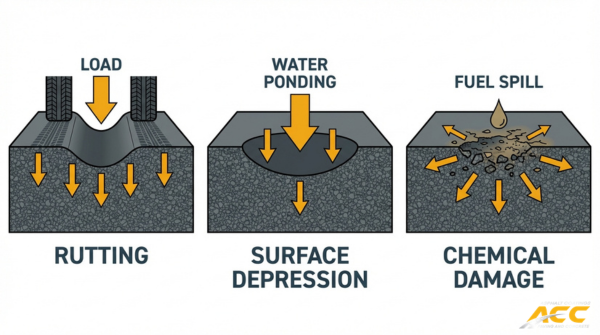
Common pavement damage patterns at EV charging sites include rutting, surface depressions, and chemical degradation from fluid leaks. Each pattern develops from distinct mechanisms tied to EV weight, dwell time, and vehicle chemistry.
What Causes Rutting in EV Charging Stalls?
Rutting in EV charging stalls is caused by the combination of concentrated static loads and repeated vehicle positioning in the same wheel paths. EVs sit 10% to 15% heavier than equivalent ICE vehicles, and that additional weight presses into the same narrow tire contact areas for extended charging sessions.
Unlike typical parking where vehicles come and go quickly, charging stalls endure sustained loads lasting 30 minutes to several hours. This prolonged pressure displaces the asphalt binder, especially in warm conditions when the mix softens. Over time, visible grooves form along the wheel paths. Polymer-modified asphalt mixes with higher rut resistance are often necessary to counteract this pattern in high-turnover charging areas.
Why Do Depressions Form Where Vehicles Park During Charging?
Depressions form where vehicles park during charging because prolonged static loading compresses the subbase and surface layers beyond their designed tolerance. Standard parking lot pavement sections assume brief occupancy, not the multi-hour dwell times that Level 2 chargers require.
The sustained downward force gradually consolidates underlying aggregate, creating localized low spots that trap water. Pooled water then accelerates further deterioration through moisture infiltration and stripping. According to Virginia Clean Cities, building new EV charging spaces during the initial construction phase offers significant cost savings per parking space compared to retrofitting existing infrastructure. Designing adequate subbase depth from the start prevents these depressions far more effectively than corrective overlays after the damage appears.
How Do Oil and Coolant Leaks From EVs Degrade Asphalt?
Oil and coolant leaks from EVs degrade asphalt by chemically dissolving the petroleum-based binder that holds aggregate together. While EVs lack traditional engine oil, they use thermal management fluids, brake fluid, and gear lubricants that are equally harmful to pavement surfaces.
According to a study published in Construction and Building Materials, polyethylene glycol (PEG), a common component in EV thermal management fluids, adversely affects both the high-temperature and low-temperature properties of asphalt binder, compromising its stress sensitivity. This chemical softening weakens the pavement structure at the molecular level, making affected areas more vulnerable to cracking and raveling under traffic loads. Routine inspection of charging stalls for fluid stains helps catch degradation before it spreads.
With these damage patterns identified, targeted maintenance strategies can address each one before costly repairs become necessary.
How Do Freeze-Thaw Cycles Compound EV Charging Pavement Wear?
Freeze-thaw cycles compound EV charging pavement wear by amplifying existing damage from heavy static loads, thermal stress, and chemical exposure. Water infiltrates micro-cracks formed under EV weight and charging heat, then expands as it freezes, widening those cracks with each cycle. In regions like Colorado’s Front Range, where temperatures can swing above and below freezing dozens of times per season, this repeated expansion and contraction accelerates deterioration far beyond what either factor causes alone.
The compounding effect follows a predictable pattern. Heavier EVs create surface depressions and fatigue cracking in charging stalls. Thermal cycling from charging equipment weakens the binder surrounding embedded infrastructure. These vulnerabilities become entry points for moisture. Once water penetrates the asphalt surface, each freeze event generates internal hydraulic pressure that progressively breaks apart the pavement structure from within. Subbase materials lose compaction as saturated aggregate shifts during thaw periods, leading to potholes and structural failure.
What makes EV charging areas especially vulnerable is the combination of prolonged static loading with freeze-thaw exposure. Vehicles parked for 30 to 60 minutes during charging sessions compress already weakened pavement sections. When those same areas undergo overnight freezing, the damage compounds exponentially. Joints around conduit trenching and equipment foundations are particularly susceptible, since backfilled sections rarely achieve the same density as the surrounding undisturbed pavement.
Proper drainage design, adequate subbase depth, and timely sealcoating are the most effective defenses against this compounding cycle. Preventing water from pooling in charging stalls eliminates the primary mechanism through which freeze-thaw damage escalates.
With freeze-thaw risks understood, proactive maintenance strategies become essential for protecting these high-stress areas.
What Maintenance Strategies Extend Asphalt Life at Charging Sites?
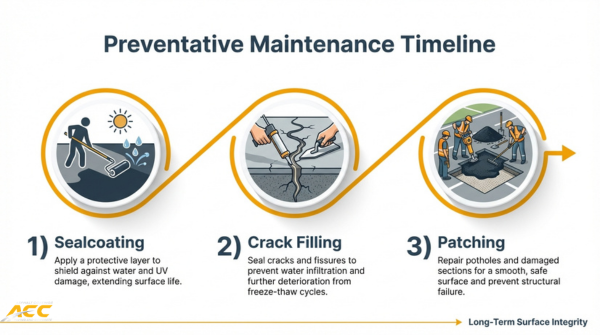
The maintenance strategies that extend asphalt life at charging sites are sealcoating, crack filling, and timely patching. Each targets a specific failure mode accelerated by heavier EV loads and stationary vehicle stress.
How Often Should EV Charging Area Asphalt Be Sealcoated?
EV charging area asphalt should be sealcoated every two to three years, though high-traffic charging zones may benefit from more frequent applications. Sealcoating protects the binder from oxidation and moisture penetration, both of which accelerate under the sustained loads EVs place on parking surfaces. According to a report covered by the Lansing State Journal, scheduled sealcoating is a critical preventative maintenance strategy that extends pavement service life by shielding against these exact degradation factors. Charging stalls experience concentrated wear in fixed positions, making consistent sealcoat scheduling more important than in standard parking areas. For properties with multiple EVSE stations, prioritizing these zones during routine maintenance cycles prevents costly full-depth repairs later.
When Is Crack Filling Necessary Around Charging Infrastructure?
Crack filling is necessary around charging infrastructure as soon as cracks appear, regardless of width. Even hairline fractures near conduit trenches, concrete equipment pads, and charging stalls allow moisture to reach the subbase. Once water infiltrates, freeze-thaw cycles rapidly widen these cracks into structural failures. The transition zones where asphalt meets concrete pads or utility trenching are especially vulnerable because different materials expand at different rates. Waiting for cracks to “get bad enough” is one of the most common and costly mistakes property managers make. Sealing cracks promptly at these junctions preserves pavement integrity and protects the electrical conduit running beneath the surface.
What Role Does Timely Patching Play Near Charging Equipment?
Timely patching near charging equipment plays a critical role in preventing localized failures from spreading into large-scale pavement damage. Depressions, potholes, and surface deterioration around charging stalls develop faster than in standard parking areas due to the concentrated, repetitive loading from stationary EVs. When left unaddressed, damaged sections channel water toward equipment foundations and underground conduit, compounding both pavement and infrastructure problems. Patching these areas before they expand keeps repair costs manageable and maintains safe, level surfaces required for ADA-compliant access aisles. Proactive patching is far more cost-effective than reactive full-depth replacement, especially in retrofitted lots where utility connections already complicate the subgrade.
With maintenance strategies in place, proper striping and layout keep charging areas functional and compliant.
How Should Parking Lot Striping and Layout Accommodate Chargers?
Parking lot striping and layout should accommodate chargers by meeting ADA dimensional requirements, maintaining clear traffic circulation, and integrating compliant signage. The following subsections cover accessibility rules for EV stall design and how charger placement influences traffic flow and striping patterns.
What ADA Compliance Rules Apply to EV Charging Stall Design?
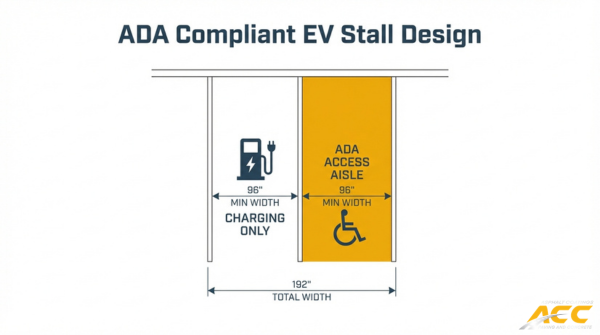
ADA compliance rules that apply to EV charging stall design include minimum dimensional standards, surface slope limits, and accessible path requirements. According to the U.S. Access Board, EV charging spaces with mobility features must provide a vehicle space at least 132 inches (11 feet) wide and 240 inches (20 feet) long. Ground surfaces of charging spaces and access aisles should not exceed a slope of 1:48, ensuring safe use of mobility devices.
Beyond dimensions, the permitting process itself adds complexity. Site installation plans may require approval from fire, environmental, and electrical inspection entities, which can extend project timelines significantly. Striping crews must coordinate with these approvals before marking accessible stalls, access aisles, and signage locations. Overlooking ADA requirements during the design phase is one of the costliest mistakes property managers make; correcting non-compliant stalls after construction often means re-milling and re-striping entire sections.
How Does Charger Placement Affect Traffic Flow and Striping?
Charger placement affects traffic flow and striping by dictating vehicle queuing paths, turn radii, and aisle widths throughout the lot. Positioning EVSE stations at the perimeter or along drive aisle ends prevents charging vehicles from blocking through-traffic lanes. Stalls oriented perpendicular to the main circulation aisle allow drivers to pull in, charge, and exit without reversing into active traffic.
Striping must clearly delineate:
- Dedicated EV-only stalls with appropriate signage markings.
- Cable management zones that prevent trip hazards across pedestrian paths.
- Directional arrows guiding drivers toward and away from charging areas.
- Fire lane clearances adjacent to high-power charging equipment.
Parking aprons near charger pedestals also require reinforced pavement markings, since these areas experience concentrated turning stress. When charger placement is planned alongside the initial lot layout rather than retrofitted afterward, striping patterns integrate seamlessly with traffic flow, reducing confusion and maintenance costs over time.
With striping and layout addressed, property managers can focus on the broader decisions involved in adding EV chargers.
What Should Property Managers Know Before Adding EV Chargers?
Property managers should understand how ownership models, retrofitting costs, and permitting timelines affect both ROI and asphalt integrity. The sections below cover retrofitting versus new construction and the permits and utility coordination that impact pavement work.
How Does Retrofitting Chargers Differ From New Construction?
Retrofitting chargers into an existing parking lot differs from new construction in cost, complexity, and pavement disruption. New construction allows conduit, subbase reinforcement, and charging pad foundations to be integrated during initial grading and paving. Retrofitting requires cutting into cured asphalt for trenching, which compromises pavement integrity at seam lines and increases long-term maintenance needs.
According to Virginia Clean Cities, building new EV charging spaces during the initial construction phase offers significant cost savings per parking space compared to retrofitting existing infrastructure. For property managers weighing both paths, new construction nearly always delivers better asphalt longevity because the pavement structure is engineered as a unified system rather than patched together after the fact.
What Permits and Utility Coordination Impact Asphalt Work?
The permits and utility coordination that impact asphalt work include electrical permits, site installation plans, fire safety reviews, and environmental inspections. According to the California Governor’s Office of Business and Economic Development, the permitting process for EV charging stations may require approval from fire, environmental, and electrical inspection entities, which can add significant time to the project timeline.
Utility coordination determines where conduit trenching crosses the parking surface, directly influencing excavation scope and pavement cuts. Property managers should engage both their utility provider and paving contractor early to align trenching routes with existing infrastructure, minimizing unnecessary asphalt disruption.
Understanding these planning requirements upfront helps property managers protect their pavement investment as charger installations move forward.
How Can Commercial Paving Expertise Support EV-Ready Parking Lots?
Commercial paving expertise supports EV-ready parking lots by combining proper installation, preventative maintenance, and ADA-compliant design into a unified approach. The following sections cover how asphalt services extend pavement life and summarize the key takeaways from this article.
Can Asphalt Installation and Sealcoating Extend Pavement Life at EV Charging Sites?
Yes, asphalt installation and sealcoating can extend pavement life at EV charging sites. Charging areas face amplified stress from heavier vehicles, prolonged dwell times, and embedded equipment foundations. Proper installation with reinforced subbase layers and appropriate mix designs establishes the structural baseline these sites demand.
Scheduled crack sealing and sealcoating services are critical preventative maintenance strategies that protect asphalt from oxidation and moisture penetration, extending the pavement’s service life, as reported by the Lansing State Journal. For property managers planning EV infrastructure, partnering with a contractor experienced in both new construction paving and ongoing maintenance programs ensures charging zones stay functional and structurally sound across their full lifecycle.
What Are the Key Takeaways About How EV Charging Stations Impact Asphalt Design and Maintenance?
The key takeaways about how EV charging stations impact asphalt design and maintenance center on three principles: build stronger, maintain proactively, and plan holistically.
- EV battery packs make these vehicles significantly heavier than conventional cars, accelerating pavement distress through rutting, depressions, and cracking.
- Charging equipment foundations, conduit trenching, and thermal effects from chargers introduce stress points that standard parking lot designs do not account for.
- Asphalt mix selection, subbase thickness, and drainage planning must be tailored specifically for charging zones.
- Sealcoating, crack filling, and timely patching protect against the accelerated wear these areas experience.
- ADA compliance, proper striping layout, and permitting coordination are essential before any construction begins.
Asphalt Coatings Company specializes in commercial parking lot construction, sealcoating, crack sealing, ADA-compliant concrete work, and parking lot striping. With services spanning new construction paving through ongoing maintenance, Asphalt Coatings Company can help property managers build EV-ready parking infrastructure designed to last.