Heavy truck traffic near Fort Carson shortens pavement life by subjecting roads and parking lots to repeated military-grade loads that cause exponentially more damage than passenger vehicles. Pavement deterioration under these conditions follows a power-of-four relationship, meaning doubled vehicle weight produces roughly 16 times more structural harm.
This guide covers Fort Carson’s traffic generation and corridor impacts, the mechanics of heavy-load pavement damage, accelerated deterioration measurement, freeze-thaw compounding effects, engineering design strategies, and ongoing maintenance planning for commercial properties.
Fort Carson operates as one of the largest Army installations in the western United States, routing vehicles like the 68,000-pound HEMTT and convoys of armored carriers through corridors such as South Academy Boulevard, where over 50 percent of peak-hour westbound traffic connects to the installation.
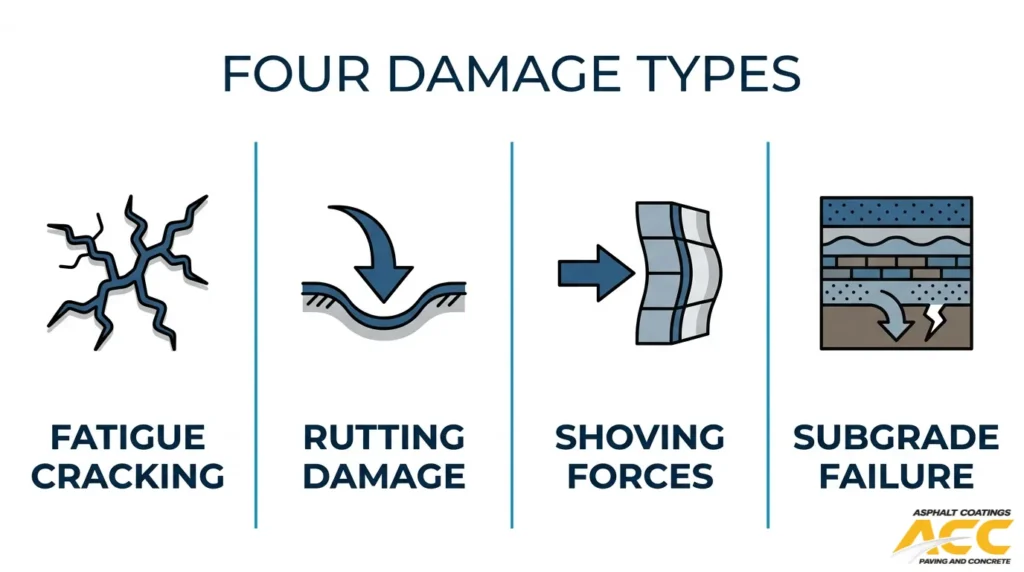
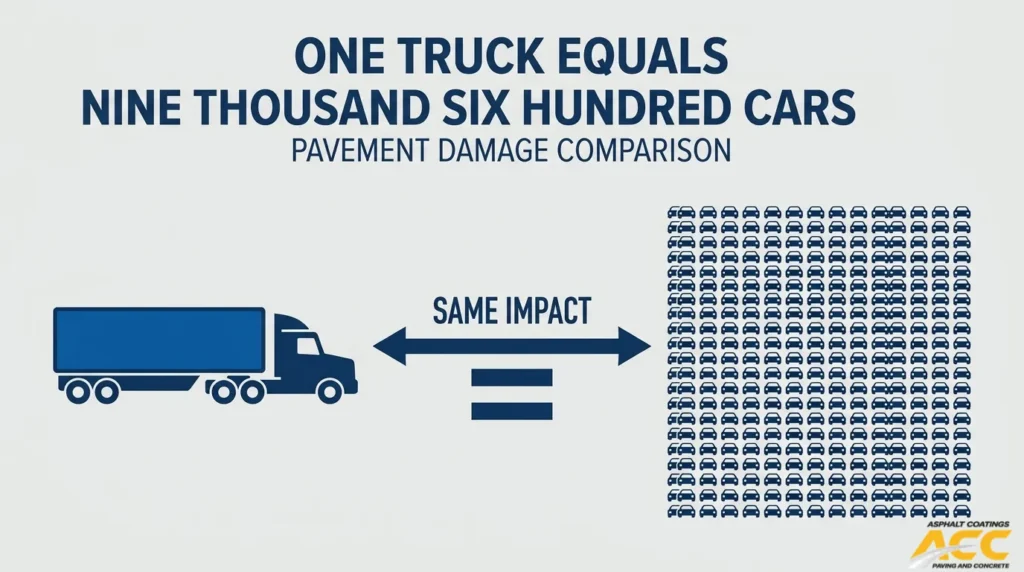
Heavy trucks destroy asphalt through four distinct mechanisms: fatigue cracking from repeated axle stress, rutting from concentrated tire pressure, shoving from lateral braking and turning forces, and progressive subgrade failure beneath cumulative loads. A single 5-axle tractor/semi-trailer produces pavement impact equivalent to 9,600 passenger cars.
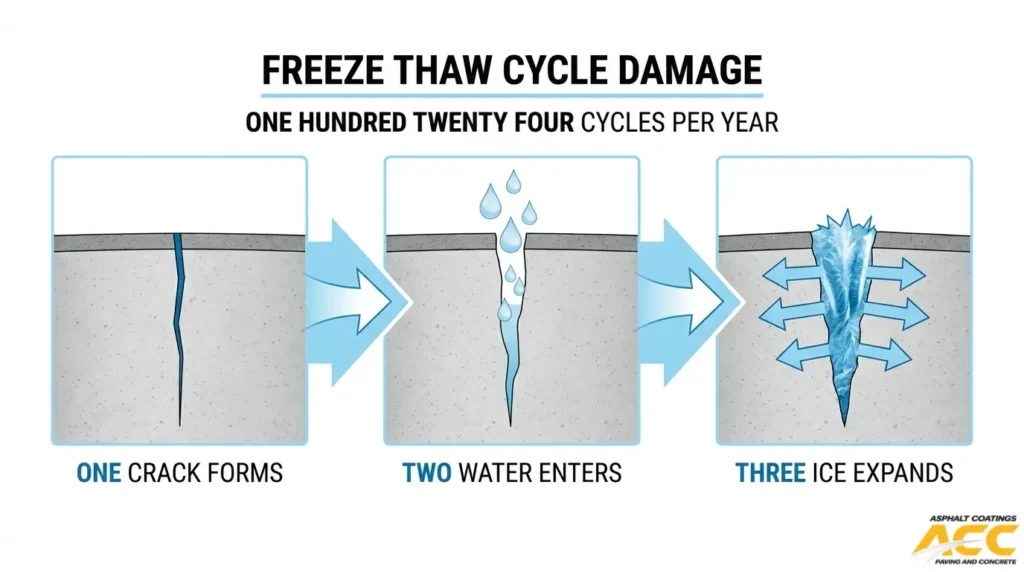
Colorado Springs’ 124 annual freeze-thaw cycles compound every crack that truck traffic initiates, forcing moisture deeper into the pavement structure and accelerating failures that standard designs cannot absorb.
Effective countermeasures include increased subbase thickness with geotextile reinforcement, rut-resistant mix designs like Stone Matrix Asphalt, full-depth paving, proper subsurface drainage, and concrete in static-load zones. Early crack sealing, scheduled sealcoating every two to three years, and timely mill-and-overlay interventions prevent minor distress from escalating into costly reconstruction.
Why Does Fort Carson Generate So Much Heavy Truck Traffic?
Fort Carson generates heavy truck traffic because it operates as one of the largest Army installations in the western United States, deploying armored vehicles, logistics convoys, and supply trucks across surrounding Colorado Springs roads daily. The subsections below cover the military vehicle types using these routes and the corridors carrying the heaviest loads.
What Military Vehicle Types Use Roads Near Fort Carson?
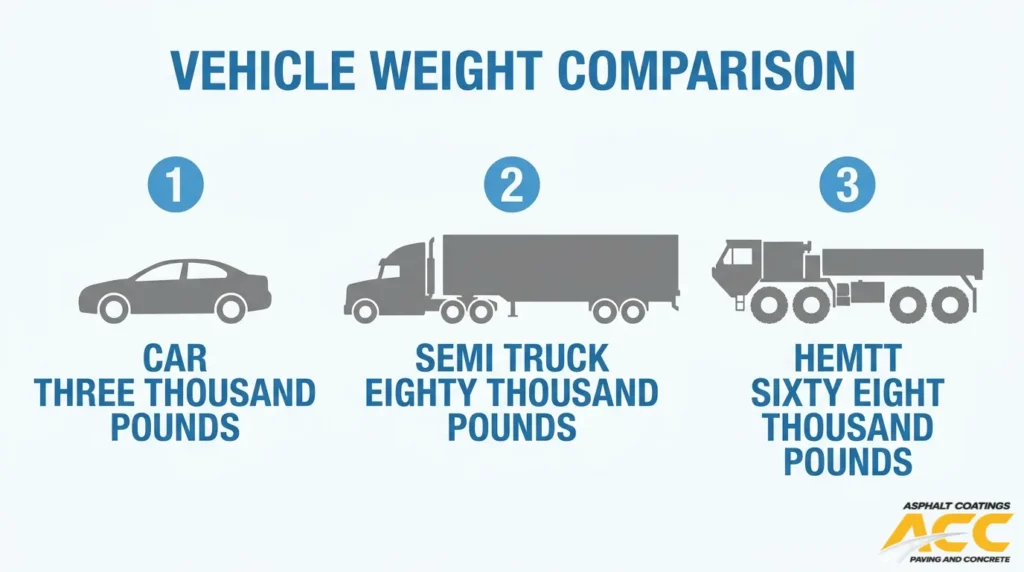
The military vehicle types that use roads near Fort Carson include main battle tanks, armored personnel carriers, and heavy logistics trucks. The M1A2 Abrams tank carries a combat weight of 69.54 tons, according to a Congressional Research Service report. The M1120A4 Heavy Expanded Mobility Tactical Truck (HEMTT) holds a gross vehicle weight rating of 68,000 pounds. The M1126 Stryker Infantry Carrier Vehicle transports nine-soldier squads with full armor protection.
These vehicles far exceed the 80,000-pound federal highway weight limit designed for commercial trucks. Even when transported on flatbed trailers rather than driven directly, the combined load concentrates enormous force on surrounding pavement. For property owners along these corridors, understanding which vehicles pass nearby is the first step in choosing the right pavement design.
Which Colorado Springs Routes Carry the Most Fort Carson Traffic?
The Colorado Springs routes carrying the most Fort Carson traffic center on South Academy Boulevard and the Highway 115 corridor. According to the Colorado Department of Transportation, South Academy Boulevard provides direct access to Fort Carson Gates 3 and 4, through which approximately 30 percent of all Fort Carson traffic enters. During peak hours, more than 50 percent of all westbound traffic on South Academy Boulevard is accessing or leaving the installation.
These concentrated loads compound pavement stress significantly in commercial zones along the corridor. Colorado Springs averages 32.5 inches of snow annually, with a 50-year frost depth reaching 38 inches. That freeze-thaw exposure, layered on top of heavy military traffic, accelerates deterioration far beyond what standard pavement designs anticipate.
Understanding which routes absorb the heaviest loads helps explain why pavement near Fort Carson fails faster than in other parts of the city.
How Do Heavy Trucks Damage Asphalt Pavement?
Heavy trucks damage asphalt pavement through repeated loading, concentrated tire pressure, lateral forces, and cumulative subgrade stress. Pavement damage increases exponentially with vehicle weight; doubling a vehicle’s weight causes approximately 16 times more damage. The following sections explain each failure mechanism.
How Do Repeated Axle Loads Cause Fatigue Cracking?
Repeated axle loads cause fatigue cracking by subjecting the asphalt surface to cyclic stress that exceeds its elastic recovery capacity. Each heavy axle pass creates micro-strain at the bottom of the HMA layer. Over thousands of load cycles, these micro-strains propagate upward as interconnected cracks.
According to Pavement Interactive, fatigue cracking is a series of interconnected cracks caused by fatigue failure of the HMA surface or stabilized base under repeated traffic loading. The resulting pattern, often called alligator cracking, signals structural exhaustion rather than surface wear. Once initiated, each subsequent truck pass accelerates crack propagation because the weakened pavement absorbs load less efficiently. For routes near Fort Carson carrying heavy military and commercial vehicles daily, fatigue cracking can develop years ahead of standard design projections.
How Does Tire Pressure From Heavy Trucks Create Rutting?
Tire pressure from heavy trucks creates rutting by concentrating vertical force into narrow contact patches along the wheelpath. Heavy truck tires typically operate at 100 to 120 psi, pressing downward with far greater intensity per square inch than passenger vehicles. This focused stress pushes the asphalt binder and aggregate laterally, forming permanent surface depressions.
Pavement uplift, or shearing, often develops along the sides of each rut as displaced material migrates outward. High summer temperatures in Colorado Springs soften the binder further, reducing the mix’s resistance to deformation under sustained heavy loads. Once ruts reach half an inch or deeper, water pools in the depressions, accelerating further deterioration. Properly specifying high-stability mix designs is one of the most effective ways to delay this failure mode on truck-heavy corridors.
How Do Turning and Braking Forces Cause Shoving?
Turning and braking forces cause shoving by applying horizontal stress to the asphalt surface layer. When a loaded truck decelerates or navigates a curve, tires generate lateral and longitudinal shear forces that push the pavement in the direction of travel. This displaces the HMA, creating characteristic ripples or corrugations.
Intersections, loading dock approaches, and gate entries near military installations experience concentrated shoving because trucks repeatedly brake and turn in the same locations. The problem compounds when surface temperatures rise, because softer binder resists shear less effectively. Shoving typically appears as wavelike surface distortions, and once it begins, the weakened bond between lifts makes progressive failure likely without corrective intervention.
How Does Heavy Traffic Accelerate Subgrade Failure?
Heavy traffic accelerates subgrade failure by transmitting repeated compressive stress through the pavement structure into the underlying soil. Each heavy axle pass deflects the entire pavement section, and the cumulative effect progressively consolidates or shears weak subgrade soils beneath.
When the subgrade loses bearing capacity, the pavement above loses its structural support. Symptoms include:
- Widespread fatigue cracking across the full lane width, not just wheelpaths.
- Deep rutting that does not respond to surface-level repairs.
- Localized depressions or settlement after wet periods.
Colorado Springs soils with high clay content are particularly vulnerable because moisture fluctuations cause volume changes that compound load-induced deformation. For properties near Fort Carson, where heavy vehicle passes accumulate rapidly, subgrade reinforcement during initial construction is far more cost-effective than structural rehabilitation after failure.
With these damage mechanisms understood, measuring their cumulative impact requires a standardized load comparison method.
How Much Faster Does Pavement Deteriorate Under Heavy Loads?
Pavement deteriorates under heavy loads at an exponential rate, not a linear one. The sections below explain how engineers quantify truck damage, how military vehicles compare to passenger cars, and how quickly overloaded routes lose structural capacity.
How Do Equivalent Single Axle Loads Measure Truck Damage?
Equivalent Single Axle Loads (ESALs) measure truck damage by converting every axle pass into a standardized 18,000-pound reference load. The AASHTO load equivalency relationship, known as the Fourth Power Law, states that pavement damage relates to axle weight by a power of four. Doubling an axle’s weight causes roughly 16 times more damage.
According to an analysis published by the American Trucking Associations using the Fourth Power Law, a single 5-axle tractor/semi-trailer has a pavement impact equivalent to 9,600 passenger cars. That ratio reveals why even moderate truck volumes consume pavement life far faster than high volumes of light vehicles. For properties near Fort Carson, understanding ESALs is essential to specifying pavement sections that match actual loading conditions.
How Does One Military Vehicle Compare to Passenger Cars?
One military vehicle compares to passenger cars by generating dramatically higher ESAL values per trip. The M1120A4 HEMTT, a common logistics truck at Fort Carson, carries a gross vehicle weight rating of 68,000 pounds. Applying the Fourth Power Law to its axle loads places its per-pass damage at hundreds of times that of a standard passenger car.
Heavier platforms intensify the contrast further. The M-1A2 Abrams tank, at a combat weight of 69.54 tons, distributes load across wide tracks that produce roughly 15 PSI of ground pressure. Although that figure is actually lower than a passenger car’s approximately 30 PSI tire pressure, the sheer total weight concentrates cumulative structural fatigue across a much larger damage zone. Every convoy movement along Colorado Springs corridors effectively compresses years of normal wear into a single event.
How Quickly Can Overloaded Routes Lose Structural Capacity?
Overloaded routes can lose structural capacity within a fraction of their intended design life. Because damage follows the fourth-power relationship, a road engineered for standard commercial traffic that regularly receives military convoys or overweight trucks accumulates fatigue damage at a rate that can cut expected service life by half or more.
Fatigue cracking, rutting, and subgrade depression compound with each overloaded pass. Once initial cracks form, moisture enters the pavement structure and accelerates deterioration from within. In Colorado Springs, where freeze-thaw cycling is relentless, this moisture infiltration turns minor distress into structural failure rapidly. Routes that were designed for a 20-year lifespan under normal traffic may require major rehabilitation within 8 to 10 years when subjected to sustained heavy loading without upgraded pavement sections.
Understanding these accelerated timelines is critical for budgeting and design, especially on commercial properties that share corridors with Fort Carson traffic.
How Do Colorado Springs Freeze-Thaw Cycles Compound Truck Damage?
Colorado Springs freeze-thaw cycles compound truck damage by forcing moisture into load-related cracks, then expanding it as ice, widening failures that heavy vehicles initiated. The subsections below explain how moisture infiltration and frost heave each accelerate this process.
How Does Moisture Infiltration Worsen Load-Related Cracking?
Moisture infiltration worsens load-related cracking by seeping into fatigue cracks and microfractures that heavy truck axles create in the HMA surface. Once water enters these voids, each freeze cycle converts it to ice, expanding crack width by roughly 9%. When temperatures rise, meltwater penetrates even deeper into the weakened pavement structure.
This repeated process turns hairline load cracks into interconnected alligator patterns far faster than traffic alone would cause. According to NOAA’s National Centers for Environmental Information, Colorado Springs averages 124 freeze-thaw cycles annually based on data from 1988 to 2017. That means moisture trapped in truck-damaged pavement undergoes over a hundred expansion-contraction events each year, compounding structural loss at a rate most standard designs cannot absorb.
For properties near Fort Carson, where heavy military vehicles generate constant fatigue stress, even minor surface cracks become entry points for rapid freeze-thaw deterioration.
Why Does Frost Heave Accelerate Under Heavy Traffic Stress?
Frost heave accelerates under heavy traffic stress because repeated axle loads compress and disturb the subgrade, creating voids and uneven density zones where moisture collects before freezing. When that trapped moisture freezes, ice lenses form and push the pavement surface upward. Heavy trucks then drive over these raised sections, cracking the lifted surface and compressing the softened, thaw-weakened subgrade beneath.
This creates a destructive feedback loop: trucks fracture heaved pavement, exposing more subgrade to moisture, which freezes again and heaves further. Conventional passenger traffic rarely generates enough force to break through frost-heaved surfaces, but military transport vehicles and loaded tractor-trailers shatter these sections routinely.
Proper subgrade drainage and sufficient base thickness are the most effective countermeasures for breaking this cycle on high-load corridors near Fort Carson. Ensuring well-maintained curb and gutter systems helps channel surface water away, preventing it from infiltrating the subgrade and exacerbating freeze-thaw damage.
What Pavement Design Strategies Handle Heavy Truck Loads?
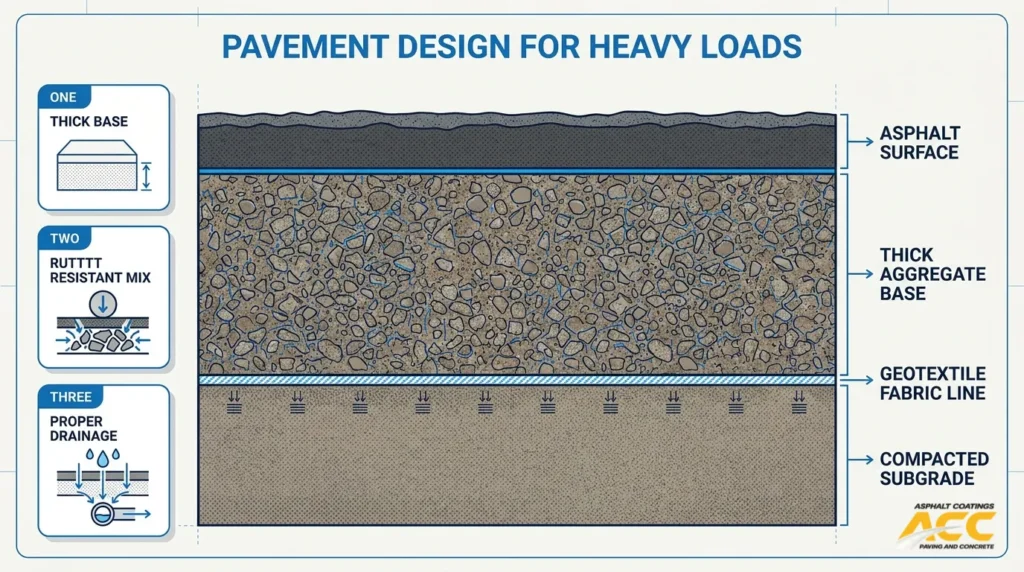
Pavement design strategies that handle heavy truck loads include increased subbase thickness, rut-resistant asphalt mix designs, full-depth asphalt paving, and concrete pavement for the most extreme applications. Truck parking lot design standards recommend planning for 80,000-lb loads.
What Subbase Thickness Is Needed for Heavy Truck Routes?
The subbase thickness needed for heavy truck routes typically ranges from 12 to 18 inches of compacted aggregate, depending on subgrade soil strength and anticipated load repetitions. Weak or expansive soils near Colorado Springs often demand the upper end of that range. Geotextiles perform four main functions in pavement design: separation, reinforcement, filtration, and drainage, according to a 2024 article published by ScienceDirect. Placing geotextile fabric between the subgrade and aggregate base prevents fine soil particles from migrating upward, which preserves structural capacity over time. For routes carrying military convoys or loaded semis, skipping this step is the fastest way to guarantee premature base failure.
Which Asphalt Mix Designs Resist Rutting From Heavy Loads?
The asphalt mix designs that resist rutting from heavy loads are Stone Matrix Asphalt (SMA) and mixes formulated with highly modified asphalt (HiMA) binders. SMA mixtures use a stone-on-stone aggregate skeleton that locks together under compression, distributing wheel loads across a wider area. HiMA binders contain more than double the polymer modification of conventional binders, which increases elasticity at high temperatures. According to a study published through the National Institutes of Health, high-temperature stability in asphalt mixtures refers to their capacity to resist permanent deformation, primarily rutting, under repetitive traffic loading. For commercial lots near Fort Carson handling daily truck traffic, specifying these mix designs upfront costs less than repeated rut repairs.
How Does Full-Depth Asphalt Paving Extend Pavement Life?
Full-depth asphalt paving extends pavement life by placing hot-mix asphalt directly on a prepared subgrade, eliminating untreated aggregate base layers that can shift or degrade under heavy loads. This monolithic structure distributes stress more uniformly, reducing the concentrated strain that causes fatigue cracking. Timely preservation treatments amplify these benefits further. According to a 2024 Auburn University study, the life-extending benefit from crack sealing as a preservation treatment ranged from 1.1 to 7.3 years depending on pretreatment condition and traffic loading. Full-depth sections paired with early maintenance interventions represent one of the most cost-effective long-term strategies for heavy-traffic corridors in Colorado Springs.
When Should Concrete Pavement Replace Asphalt Under Trucks?
Concrete pavement should replace asphalt under trucks when static loads, slow-moving vehicles, or turning movements create conditions asphalt cannot sustain. Loading docks, truck staging areas, and intersection aprons where vehicles idle or pivot are prime candidates. Concrete’s rigid structure resists the shoving and depression that flexible asphalt experiences under these forces. According to a Department of Defense facilities guide, typical maintenance on asphalt and concrete pavements consists principally of the care of joints, sealing of cracks, and surface treatments. While concrete carries higher upfront costs, its 30-plus-year service life in static-load zones often makes it the more economical choice overall.
Understanding which design strategy fits each zone of a property sets the stage for proper drainage and subgrade protection.
What Drainage and Subgrade Improvements Protect High-Load Pavements?
Drainage and subgrade improvements that protect high-load pavements include subsurface drainage systems, geotextile fabric layers, proper grading, and stabilized subbase materials. These measures prevent moisture from weakening the foundation beneath heavy truck traffic. Effective drainage is especially critical in Colorado Springs, where 124 annual freeze-thaw cycles can turn trapped water into a destructive force beneath loaded pavements.
Saturated subgrades lose bearing capacity rapidly under repeated heavy axle loads. When water cannot escape the pavement structure, hydraulic pressure builds during each load cycle, pumping fine soil particles out of the subbase and creating voids. This process accelerates structural failure far beyond what traffic loading alone would cause.
Geotextiles serve as the first line of defense in high-load pavement sections. According to ScienceDirect, geotextiles perform four main functions in pavement design: separation, reinforcement, filtration, and drainage. Separation prevents subgrade soils from migrating into aggregate base layers, while filtration allows water movement without carrying destabilizing fines. Reinforcement distributes loads across a wider area, reducing stress concentrations that lead to rutting and fatigue cracking.
Proper subgrade preparation requires compaction to specified density targets and crown slopes that direct water toward collection points. For routes carrying military and commercial truck traffic near Fort Carson, edge drains and French drain systems should be installed along pavement margins to intercept groundwater before it reaches the structural section. Colorado Springs’ 38-inch frost depth means drainage infrastructure must extend below the frost line to remain functional through winter months.
Stabilized subgrades using lime or cement treatment improve load-bearing capacity in areas with weak native soils. Combined with adequate aggregate base thickness and continuous drainage pathways, these improvements create a pavement foundation that resists the moisture-related failures commonly seen on overloaded routes. For commercial properties handling regular heavy vehicle access, investing in drainage and subgrade quality during initial construction costs far less than repeated structural repairs.
With drainage strategies in place, regular maintenance keeps these protections effective.
How Should Ongoing Maintenance Extend Pavement Life on Truck Routes?
Ongoing maintenance extends pavement life on truck routes by addressing distress early, before minor damage compounds into structural failure. The following subsections cover crack sealing timing, sealcoating frequency, and the role of mill and overlay.
When Should Crack Sealing Begin on Heavy-Traffic Pavement?
Commercial crack sealing should begin on heavy-traffic pavement as soon as non-working cracks appear in the surface, typically within the first two to three years of service. Waiting until cracks widen allows moisture to penetrate the subbase, where freeze-thaw cycles and continued loading accelerate deterioration rapidly.
According to a study at Auburn University, the life-extending benefit from crack sealing as a preservation treatment ranged from 1.1 to 7.3 years depending on pretreatment condition and traffic loading. That range underscores an important reality: the earlier you seal, the more years you gain. On routes carrying military and commercial truck traffic near Fort Carson, where repeated heavy axle loads generate fatigue cracking faster than on standard roads, early intervention is especially critical. Sealing cracks while they remain tight and shallow prevents the kind of moisture infiltration that, combined with Colorado Springs’ 124 annual freeze-thaw cycles, rapidly destroys pavement structure from within.
How Often Should Sealcoating Be Applied Near High-Load Areas?
Sealcoating should be applied near high-load areas every two to three years, though actual frequency depends on traffic volume, surface condition, and environmental exposure. Standard low-traffic lots can often stretch intervals to four or five years; truck routes cannot.
Heavy vehicles generate higher surface stresses that strip asphalt binder and expose aggregate more quickly. Colorado Springs’ intense UV at altitude and frequent temperature swings further oxidize unprotected surfaces. Together, these forces demand shorter maintenance cycles. Commercial parking lot sealcoating restores the protective binder layer, slows oxidation, and seals minor surface voids before they develop into cracks requiring more costly repairs. For commercial properties near Fort Carson handling regular truck traffic, treating sealcoating as a scheduled preventive measure rather than a reactive fix consistently delivers lower lifecycle costs. Skipping even one cycle on a heavy-load surface can allow deterioration to outpace what sealcoating alone can address.
What Role Does Timely Mill and Overlay Play Before Full Failure?
Timely mill and overlay plays the role of a structural reset, removing deteriorated surface layers and restoring load-bearing capacity before damage reaches the subbase. This intervention sits between surface treatments and full reconstruction on the maintenance spectrum.
When fatigue cracking, rutting, or surface raveling progresses beyond what crack sealing and sealcoating can correct, milling strips the damaged asphalt to a specified depth. A fresh overlay then bonds to the sound underlying structure. The result is a renewed riding surface with restored thickness and improved load distribution. On truck routes where pavement absorbs punishing repetitive axle loads, the window for effective mill and overlay is narrow. Once distress penetrates into the aggregate base, overlay alone cannot compensate, and full-depth reconstruction becomes the only option, at significantly greater cost. Proactive pavement monitoring identifies the optimal intervention point, ensuring overlay happens while the underlying structure still supports it.
With a disciplined maintenance program in place, the next consideration is designing commercial properties for long-term durability.
How Can Commercial Properties Near Fort Carson Design for Longevity?
Commercial properties near Fort Carson can design for longevity by engineering parking lots and access roads to handle heavy loads from the start. The following sections cover heavy-load parking lot construction and key takeaways about truck traffic and pavement life.
Can Asphalt Coatings Company Build Parking Lots for Heavy Loads?
Yes, Asphalt Coatings Company can build parking lots for heavy loads. With 39 years of commercial paving experience across Colorado’s Front Range, Asphalt Coatings Company specializes in asphalt paving, subgrade preparation, and maintenance designed for demanding environments. Industry truck parking lot design standards recommend planning for 80,000-lb loads, including proper layout dimensions and drainage solutions. Asphalt Coatings Company applies these standards using in-house crews and CDOT-approved materials, with deep knowledge of Colorado-specific pavement requirements. For properties near Fort Carson that regularly handle military supply vehicles, delivery trucks, or heavy equipment, perpendicular parking layouts with two-way traffic flow provide the most efficient use of space while distributing load stress evenly across the pavement structure.
What Should You Remember About Truck Traffic and Pavement Life?
The key thing you should remember about truck traffic and pavement life is that heavy vehicles cause exponentially more damage than passenger cars, making proactive design and maintenance essential. Crucial elements for longevity include not only structural considerations but also visible markings; thus, parking lot striping plays a vital role in traffic management and safety on heavily trafficked commercial sites. According to the American Trucking Associations, a single 5-axle tractor/semi-trailer has a pavement impact equivalent to 9,600 passenger cars. For commercial properties near Fort Carson, this reality demands:
- Thicker subbase and full-depth asphalt sections engineered for actual truck volumes.
- Rut-resistant asphalt mix designs suited to Colorado Springs conditions.
- Timely crack sealing, sealcoating, and mill-and-overlay before structural failure occurs.
- Drainage systems that prevent moisture from compounding load-related damage.
The CDOT Pavement M-E Design Manual provides location-specific design procedures applicable throughout Colorado, reinforcing why pavement near military installations requires regionally calibrated engineering. Investing in proper design upfront costs far less than repeated emergency repairs on an undersized pavement section.