Hail Alley storm season damages commercial asphalt in Colorado Springs through direct impact fracturing, progressive binder erosion, and compounding weathering forces that exploit every crack hailstones leave behind. Colorado’s Front Range receives the highest frequency of large hail in North America, and the city’s five-month storm window concentrates repeated punishment on parking lots, access lanes, and pavement surfaces across commercial properties.
This guide covers the geographic forces behind Hail Alley, asphalt material vulnerabilities, the mechanics of hail damage, seasonal compounding effects, property-specific risk exposure, hidden financial costs, and professional protection strategies.
Colorado Springs sits at the convergence of warm plains air and cold mountain downdrafts, producing catastrophic hailstorms that have caused hundreds of millions in insured damage from single events. That storm frequency places commercial pavement under cumulative stress no other U.S. metro corridor matches.
Asphalt binder chemistry and high-altitude UV exposure at 6,035 feet make local pavement uniquely fragile. Lighter binder components oxidize faster in thinner atmosphere, leaving surfaces brittle and unable to absorb hail impact energy before storm season even begins.
Hailstones crack pavement, erode binder, strip sealcoat aggregate, and destroy parking lot striping. Post-storm rain then forces moisture into every new fracture, while freeze-thaw cycles exceeding 120 per year widen those cracks into base-layer failures.
Shopping centers, industrial yards, and multi-tenant properties face the greatest cumulative risk due to large exposed surfaces and heavy traffic loads. Deferred repairs after hail events can reduce property values significantly and push maintenance costs toward full replacement.
Professional sealcoating, infrared repair, and scheduled post-storm inspections shift property managers from reactive emergency spending to predictable maintenance that protects pavement through each successive hail season.
Why Is Colorado Springs Called Part of Hail Alley?
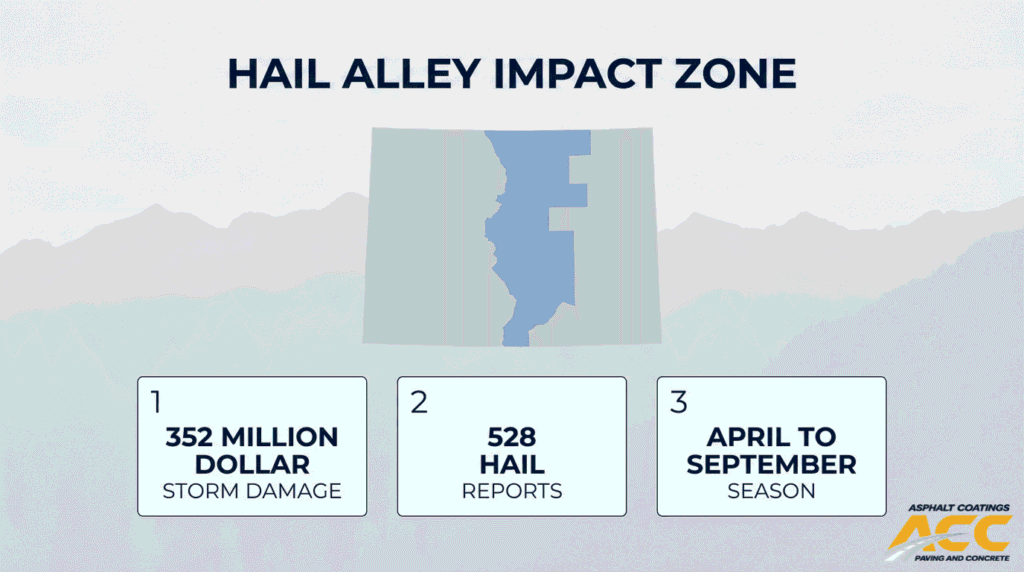
Colorado Springs is called part of Hail Alley because the city sits along Colorado’s Front Range, a corridor that receives the highest frequency of large hail in North America. According to the Rocky Mountain Insurance Information Association, this region averages three or four catastrophic hailstorms annually, each producing at least $25 million in insured damage. The convergence of warm, moisture-laden air from the plains with cold downdrafts off the Rocky Mountains creates ideal conditions for severe convective storms that generate large hailstones repeatedly throughout the season.
The scale of destruction in this corridor is staggering. A single hailstorm on July 28, 2016, caused $352.8 million in insured damage across the Colorado Springs area. Trained weather spotters have documented 528 on-the-ground hail reports in the region, and El Paso County has been placed under severe weather warnings 68 times during that recorded period. Hail risk is so dominant locally that it accounts for 52.5% of a homeowner’s insurance premium in El Paso County, dwarfing wildfire risk at just 6%.
Colorado’s hail season typically lasts from mid-April to mid-September, with storms occurring most frequently in June and reaching peak destructive intensity by mid-June. For commercial property managers, this five-month window concentrates repeated hail exposure across parking lots, access lanes, and pavement surfaces that bear the full force of each storm. That seasonal intensity is precisely what makes commercial asphalt in Colorado Springs uniquely vulnerable to cumulative damage.
Understanding this geographic and climatic reality is essential before examining how asphalt composition responds to hail impact.
What Makes Commercial Asphalt Vulnerable to Hail Impact?
Commercial asphalt is vulnerable to hail impact because of its chemical composition, its reliance on a flexible binder, and the accelerated weathering conditions at Colorado Springs’ high elevation. The sections below cover binder chemistry, sealcoat aggregate bonds, and altitude-driven UV degradation.
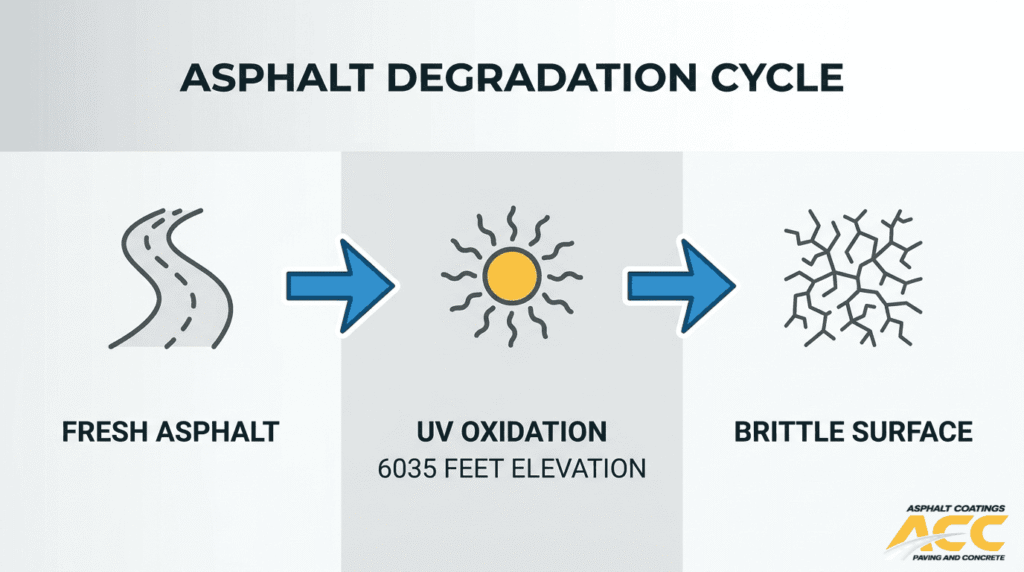
Commercial asphalt depends on a binder system that loses flexibility over time, especially under Colorado Springs’ intense environmental pressures. According to the National Center for Biotechnology Information, asphalt binder is composed of four chemical components collectively known as SARA: saturates, aromatics, resins, and asphaltenes. These components give fresh asphalt its elasticity and waterproofing capability. As the lighter fractions (saturates and aromatics) evaporate through oxidation, the binder stiffens and becomes brittle. Once brittleness sets in, the pavement can no longer absorb hail impact energy; instead, it cracks and fractures on contact.
Sealcoating protects asphalt from UV radiation, moisture, and freeze-thaw damage by shielding the binder from environmental breakdown. Aggregates embedded in sealcoating provide structural strength to the cured sealant, helping it resist wear that would otherwise shorten pavement life. However, when sealcoat ages or is applied inconsistently, the aggregate-to-binder bond weakens. Hailstones striking these vulnerable areas dislodge granules and expose the raw asphalt underneath, creating entry points for moisture and accelerating deterioration between storm events.
Colorado Springs sits at approximately 6,035 feet, where thinner atmosphere filters fewer UV rays. This intensified sunlight accelerates the oxidation of asphalt binders far faster than at lower elevations. Pavement that might remain flexible for years at sea level stiffens in just a few seasons along the Front Range. For commercial property managers, this means parking lots and access lanes enter each hail season with less impact resistance than identical surfaces in lower-altitude cities, making pre-season assessment essential.
Understanding these material vulnerabilities clarifies how hail physically breaks down pavement surfaces.
How Does Hail Physically Damage Commercial Asphalt Surfaces?
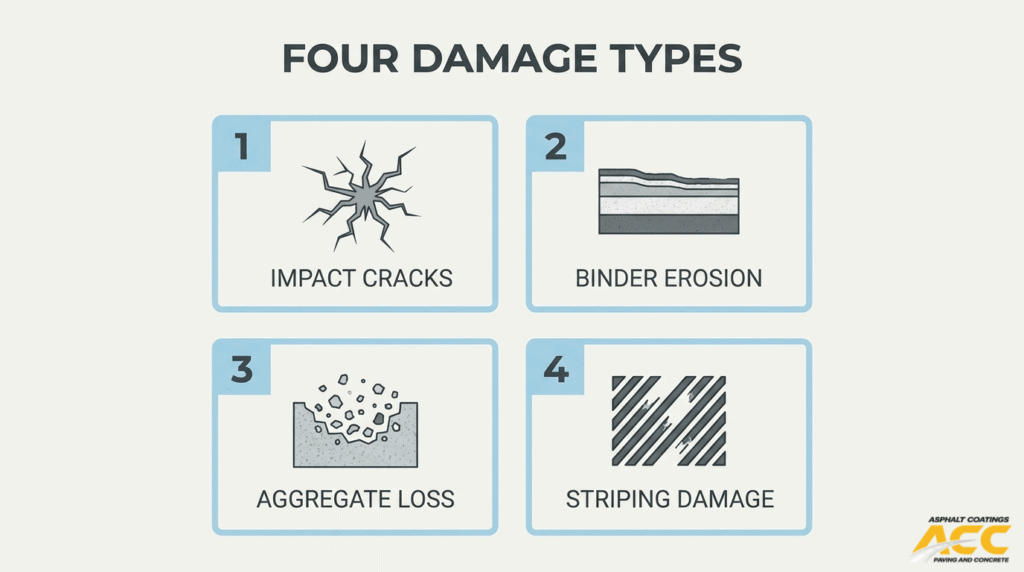
Hail physically damages commercial asphalt surfaces through direct impact force that cracks pavement, erodes binder material, strips aggregate from sealcoating, and destroys parking lot striping. Each damage type escalates depending on hailstone size and storm frequency.
How Does Large Hail Crack and Fracture Asphalt Pavement?
Large hail cracks and fractures asphalt pavement by striking the surface with enough kinetic energy to create indentations, bruises, and structural breaks in the pavement matrix. According to Haag Global, professional hail damage inspections for asphalt-composition materials involve identifying bruises, punctures, or fractures within 100-square-foot test areas. These impact points concentrate stress on the pavement’s surface layer, splitting the hardened binder and creating entry points for moisture. Once fractured, the surrounding pavement weakens rapidly under continued traffic loads. For commercial lots in Colorado Springs, even a single severe storm can produce fracture patterns across thousands of square feet that demand immediate evaluation.
How Does Repeated Small Hail Erode the Asphalt Binder?
Repeated small hail erodes the asphalt binder by progressively dislodging protective surface material with each successive storm event. Asphalt binder contains four chemical components collectively known as SARA: saturates, aromatics, resins, and asphaltenes. Small hailstones may not crack the surface outright, but cumulative impacts chip away at this binder matrix, exposing the underlying aggregate. According to a 2025 study published in Frontiers in Materials, repeated exposure to sub-severe hail events can dislodge enough protective granules to accelerate material deterioration and increase vulnerability to future severe hail damage. This gradual erosion is especially deceptive because the pavement appears intact until sudden failure occurs.
How Does Hail Strip Aggregate From Sealcoated Surfaces?
Hail strips aggregate from sealcoated surfaces by breaking the adhesive bond between the sealant layer and its embedded aggregate particles. Aggregates in sealcoating provide structural strength to the cured sealant, helping it resist wear and environmental damage. When hailstones strike a sealcoated lot, the impact force pops these particles loose, leaving bare patches where the protective barrier no longer functions. Research from the University of Texas at Austin Center for Transportation Research confirms that stripping in asphalt mixtures occurs when moisture causes physical separation of the asphalt cement from the aggregate due to adhesion loss. Without intact aggregate, sealcoating cannot shield the underlying pavement from UV radiation or water infiltration.
How Does Hail Damage Compromise Parking Lot Striping?
Hail damage compromises parking lot striping by chipping, scuffing, and eroding the thermoplastic or paint markings that define lanes, spaces, and safety zones. According to Rose Paving, harsh weather and UV radiation cause parking lot striping to lose vibrancy, leading to poorly marked lanes and increased liability for accidents. Hail accelerates this degradation significantly; impact strikes fracture painted lines and scatter reflective beads embedded in the marking material. Faded or missing striping creates confusion for drivers, increases collision risk, and can trigger ADA compliance violations. For Colorado Springs property managers, restriping after storm season is not cosmetic maintenance; it is a liability management priority.
Understanding how hail inflicts these four types of physical damage reveals why storm season compounds the problem over time.
How Does Storm Season Compound Hail Damage Over Time?
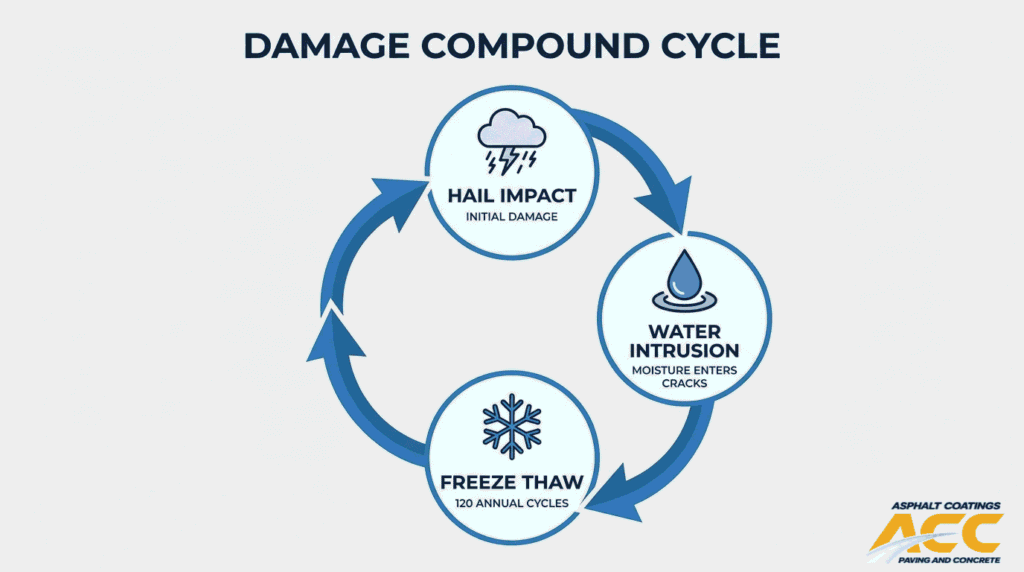
Storm season compounds hail damage over time through sequential weathering forces that exploit every crack and indentation hail leaves behind. Post-hail rainstorms, freeze-thaw cycles, and high-altitude UV exposure each worsen existing damage progressively.
How Do Post-Hail Rainstorms Accelerate Pavement Failure?
Post-hail rainstorms accelerate pavement failure by forcing water into the cracks, indentations, and exposed aggregate that hail impacts create. Once moisture infiltrates the asphalt matrix, it attacks the bond between binder and aggregate from within.
According to research from the University of Texas at Austin Center for Transportation Research, stripping in asphalt mixtures occurs when moisture causes a physical separation of the asphalt cement from the aggregate due to a loss of adhesion between the two materials. In Colorado Springs, where intense afternoon thunderstorms frequently follow hail events during the mid-April to mid-September season, this cycle repeats rapidly. Each rainstorm pushes water deeper into hail-bruised pavement, weakening the internal structure well before surface-level distress becomes visible.
How Do Freeze-Thaw Cycles Worsen Hail-Created Cracks?
Freeze-thaw cycles worsen hail-created cracks by expanding trapped moisture into ice, which widens fractures with each cycle. Water that entered through hail damage freezes overnight, generates internal pressure, then thaws and settles deeper into the pavement.
According to a study published in MDPI’s Coatings Journal, high-altitude areas in typical mountainous regions can encounter more than 120 freeze-thaw cycles annually, significantly impacting long-term pavement performance. Colorado Springs sits at approximately 6,035 feet, placing commercial lots squarely in this high-cycle zone. Freeze-thaw action reduces asphalt binder stiffness and compressive strength over successive winters, turning hairline hail cracks into potholes that require costly structural repair. For property managers, this makes post-hail crack sealing one of the highest-return preventive investments available.
How Does High-Altitude UV Exposure Degrade Hail-Weakened Asphalt?
High-altitude UV exposure degrades hail-weakened asphalt by accelerating the oxidation of binder components that hail impacts have already compromised. Colorado Springs sits at approximately 6,035 feet, where thinner atmosphere filters fewer UV rays, intensifying solar radiation on pavement surfaces year-round.
Asphalt binder contains four chemical components known as SARA: saturates, aromatics, resins, and asphaltenes. UV radiation breaks down the lighter aromatic and resin fractions first, leaving the pavement brittle and gray. When hail has already displaced protective surface material, UV penetrates deeper into the binder layer, speeding this breakdown considerably. Unprotected parking lots lose flexibility faster, making them more susceptible to cracking under normal traffic loads. Sealcoating acts as a UV barrier that shields these vulnerable binder components from solar degradation.
Understanding how these seasonal forces compound sets the stage for identifying which commercial properties face the greatest cumulative risk.
What Types of Commercial Properties Face the Most Hail Risk?
The types of commercial properties that face the most hail risk are those with large, exposed asphalt surfaces and high traffic volumes, such as shopping centers, industrial complexes, and multi-tenant buildings. Each property type presents distinct vulnerabilities during Colorado Springs storm season.
How Are Shopping Center Parking Lots Affected by Hail?
Shopping center parking lots are affected by hail through widespread surface damage across their expansive pavement areas. According to MMG Investment, retail properties like shopping centers are particularly vulnerable to storm damage because they often consist of older, one-story buildings with large exposed roof and pavement surfaces. These lots typically span tens of thousands of square feet, meaning a single hailstorm creates damage across the entire surface simultaneously.
Constant customer traffic then grinds hail-loosened aggregate deeper into the pavement, accelerating deterioration between storm events. Harsh weather and UV radiation also cause parking lot striping to lose vibrancy, leading to poorly marked lanes and increased accident liability. For shopping centers in Colorado Springs, where tenant leases often hold property managers responsible for lot maintenance, even one deferred storm season can compound repair costs significantly.
How Are Industrial Complex Yards Affected by Hail?
Industrial complex yards are affected by hail through concentrated stress on pavement already weakened by heavy equipment loads. Forklifts, delivery trucks, and loaded trailers impose constant point loads on asphalt surfaces. When hail fractures or pits the surface layer, these heavy vehicles drive moisture into every new crack and indentation.
The combination is particularly destructive because high-altitude areas in mountainous regions like Colorado Springs can encounter more than 120 freeze-thaw cycles annually, according to research published in MDPI’s Coatings Journal. Water forced into hail-damaged pavement by industrial traffic expands through those cycles, turning minor surface pitting into base-layer failures. Industrial operators who delay post-storm repairs often face full-depth pavement failures that disrupt operations far more than a timely patch would have.
How Are Multi-Tenant Property Access Lanes Affected by Hail?
Multi-tenant property access lanes are affected by hail through accelerated wear on narrow, high-traffic pavement sections that serve multiple businesses. These shared lanes concentrate vehicle turning movements, braking, and acceleration into limited surface area. Hail damage compounds this stress by creating weak points where repetitive tire action breaks the pavement apart.
Deferred maintenance on these shared surfaces creates compounding financial risk. Properties with significant deferred maintenance backlogs can face immediate property value reductions of 10% to 25%, according to Oxmaint research on inherited repair liabilities. For multi-tenant properties, disagreements over shared repair costs frequently delay action, allowing one storm season’s damage to escalate into the next.
Understanding which property types carry the greatest exposure helps prioritize post-storm inspections and budgeting.
What Are the Hidden Costs of Ignoring Hail Damage on Asphalt?
The hidden costs of ignoring hail damage on asphalt include accelerated pavement deterioration, rising emergency repair expenses, declining property values, and increased liability exposure. Each cost compounds silently when damage goes unaddressed.
Unrepaired hail impacts allow moisture to infiltrate the asphalt binder, triggering a cycle of freeze-thaw expansion that widens cracks each winter. In high-altitude areas like Colorado Springs, where mountainous regions can encounter more than 120 freeze-thaw cycles annually according to a study published in MDPI’s Coatings Journal, this degradation accelerates far faster than property managers expect.
Deferred maintenance creates financial consequences that extend well beyond the pavement surface. Properties with significant deferred maintenance backlogs can face immediate property value reductions of 10% to 25% due to inherited repair liabilities. Meanwhile, faded parking lot striping from UV and weather exposure leads to poorly marked lanes, increasing accident liability for commercial property owners.
The cost difference between proactive and reactive approaches is substantial. Maintained commercial lots can reduce emergency repair costs by up to 70% through predictable maintenance schedules every 3 to 5 years, rather than responding to crises after failures occur. For Colorado Springs properties already weakened by hail, every storm season without intervention pushes repair costs closer to full replacement territory.
Retail properties face particular financial risk because shopping centers typically consist of older, one-story buildings with large exposed pavement surfaces that absorb maximum hail impact. This combination of age, scale, and exposure makes deferred hail damage on commercial lots one of the most expensive maintenance oversights a property manager can make.
Recognizing these costs early starts with knowing what hail damage actually looks like on commercial pavement.
How Can You Identify Hail Damage on Commercial Pavement?
You can identify hail damage on commercial pavement by inspecting for surface indentations, displaced aggregate, fresh cracking patterns, and faded striping after a storm. The signs range from obvious fractures to subtle surface erosion that only a trained eye catches.
Professional hail damage inspections for asphalt-composition materials involve identifying bruises, punctures, or fractures within 100-square-foot test areas, according to Haag Global. This systematic grid approach ensures no damaged zone goes unnoticed across large commercial lots.
Key signs of hail damage on commercial asphalt include:
- Surface indentations or “bruises” that appear as shallow, circular depressions where hailstones struck the pavement.
- Loose or displaced aggregate scattered across the surface, indicating the protective top layer has been compromised.
- New cracking patterns radiating outward from impact points, distinct from typical thermal or fatigue cracking.
- Exposed dark binder where surface material has been knocked away, leaving the asphalt cement vulnerable to moisture and UV.
- Faded or chipped parking lot striping caused by direct hail strikes eroding paint from the pavement surface.
- Granule accumulation in drainage areas where dislodged surface material collects after storms.
Many property managers overlook sub-severe damage because the pavement still appears functional. However, these subtle signs, particularly loose aggregate and hairline fractures, accelerate deterioration rapidly once Colorado’s freeze-thaw cycles and intense UV exposure take hold. Documenting damage early with photographs and measurements strengthens insurance claims and prevents small issues from compounding into costly base failures.
Knowing what to look for is only half the equation; timing your inspection correctly determines whether damage gets caught before it spreads.
When Should You Inspect Asphalt After a Colorado Springs Hailstorm?
You should inspect asphalt within 48 to 72 hours after a Colorado Springs hailstorm. Prompt assessment prevents hidden damage from escalating through moisture infiltration and freeze-thaw cycling. A structured inspection covers timing, methodology, and documentation.
Colorado Springs sits in Hail Alley, where storms strike frequently between mid-April and mid-September. Because hail damage to pavement often lacks the obvious visibility of roof damage, commercial property managers benefit from a systematic post-storm inspection protocol. According to Haag Global, professional hail damage inspections for asphalt-composition materials involve identifying bruises, punctures, or fractures within 100-square-foot test areas. This grid-based approach ensures no section of a large parking lot or access lane goes unchecked.
Waiting even a few weeks allows Colorado Springs’ intense conditions to compound the problem. Water enters hairline cracks created by hail impact, and with the region experiencing over 120 freeze-thaw cycles annually at high altitude, those small fractures can rapidly expand into potholes and base-layer failures. The cost difference between early intervention and delayed repair is significant; a properly maintained commercial lot can reduce emergency repair costs by up to 70% through predictable maintenance schedules every 3 to 5 years, according to The Pavement Group.
For a thorough post-hailstorm inspection, property managers should prioritize these steps:
- Walk the entire lot within 48 to 72 hours, noting any new surface indentations, loose aggregate, or fresh cracking.
- Mark and photograph damage in 100-square-foot grid sections to create a documented scope-of-loss report.
- Check sealcoated areas for granule displacement or exposed binder, which signals compromised surface protection.
- Examine parking lot striping for chipping or fading caused by hail impact, since damaged markings increase accident liability.
- Schedule a professional pavement assessment before the next forecasted storm to establish repair priorities.
Documenting damage promptly also strengthens insurance claims. In El Paso County, hail risk accounts for 52.5% of a homeowner’s insurance premium, reflecting how seriously insurers treat storm exposure in this region. Commercial property policies carry similar hail-related provisions, making thorough photo documentation and professional assessment reports essential for successful claims.
For most commercial properties in Colorado Springs, the smartest approach is treating every significant hailstorm as an inspection trigger rather than waiting for visible deterioration. With the right maintenance partner, post-storm assessments become part of a predictable care schedule rather than a reactive scramble. Asphalt Coatings Company conducts comprehensive post-storm assessments for commercial properties throughout Colorado Springs, documenting damage within grid-based inspection areas and providing transparent repair prioritization based on 39 years of Front Range experience.
How Can Sealcoating and Paving Protect Against Hail Season Damage?
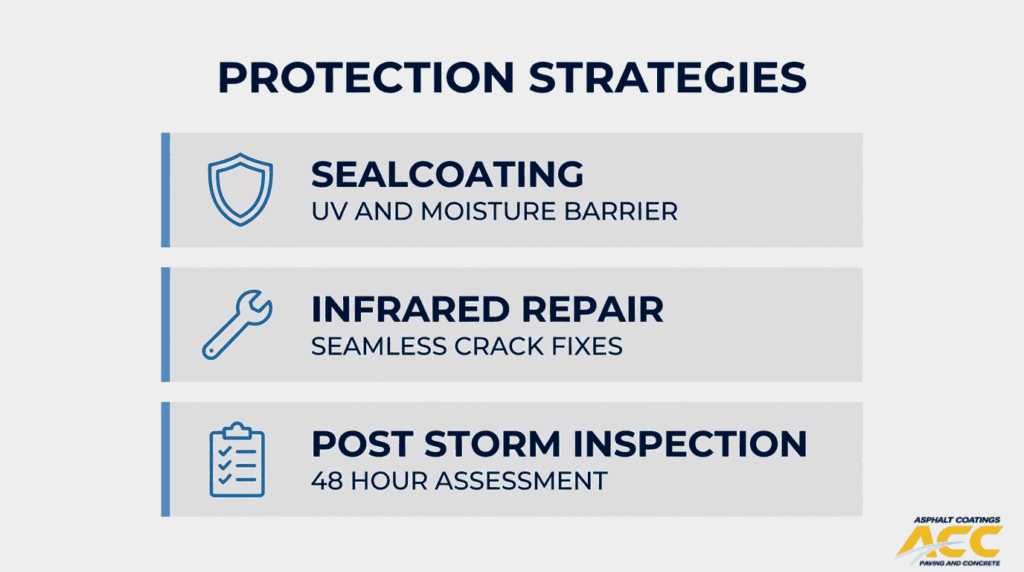
Sealcoating and paving protect against hail season damage by restoring surface integrity, sealing moisture entry points, and reinforcing the asphalt binder against future impacts. The following sections cover professional restoration methods and key takeaways for Colorado Springs property managers.
Can Professional Sealcoating and Paving Restore Hail-Damaged Commercial Asphalt?
Yes, professional sealcoating and paving can restore hail-damaged commercial asphalt. Sealcoating shields the binder from UV radiation, moisture infiltration, and freeze-thaw deterioration, while aggregates embedded in the sealant add structural resistance to future impacts. For pavement where hail has cracked through to the base layers, full-depth reclamation outperforms complete replacement in cost-efficiency. Infrared asphalt repair heats existing material to create seamless bonds with new asphalt, permanently eliminating potholes and trip hazards created by storm damage. According to The Pavement Group, a properly maintained commercial lot can reduce emergency repair costs by up to 70% through predictable maintenance schedules every 3 to 5 years. For Colorado Springs properties facing over 120 annual freeze-thaw cycles and intense high-altitude UV, proactive sealcoating before hail season is one of the most cost-effective investments a property manager can make.
What Are the Key Takeaways About Hail Alley Storm Damage to Commercial Asphalt?
The key takeaways about Hail Alley storm damage to commercial asphalt are:
- Colorado Springs sits in Hail Alley, where hail season runs mid-April through mid-September, with the most destructive storms peaking in mid-June.
- Hail displaces surface granules, cracks asphalt binder, and creates moisture entry points that worsen through post-storm rain and freeze-thaw cycling.
- High-altitude UV exposure at 6,035 feet accelerates binder breakdown on surfaces already weakened by hail impact.
- Retail centers, industrial yards, and multi-tenant properties with large exposed pavement surfaces face the greatest cumulative risk.
- Deferred maintenance after hail events can reduce property values by 10% to 25%.
- Professional sealcoating, paving, and scheduled inspections shift costs from emergency repairs to predictable maintenance.
Asphalt Coatings Company has served Colorado’s Front Range since 1986, delivering commercial sealcoating, paving, and repair solutions designed specifically for the region’s freeze-thaw and UV challenges.