Federally-funded paving in Colorado Springs is commercial pavement work financed through federal grant programs such as CDBG, FHWA allocations, or HUD accessibility grants, each carrying strict compliance obligations that property managers must satisfy from application through project closeout.
This guide covers funding sources and eligibility, federal compliance mandates, procurement rules, climate-driven specifications, inspection and reporting protocols, common disqualifying mistakes, federal-to-local timeline coordination, and contractor selection.
CDBG, FHWA, and HUD programs each serve different project types, from parking lot rehabilitation to roadway access improvements. Eligibility hinges on serving low- to moderate-income populations or advancing accessibility, and CDBG funds operate on a reimbursement basis that demands careful cash flow planning.
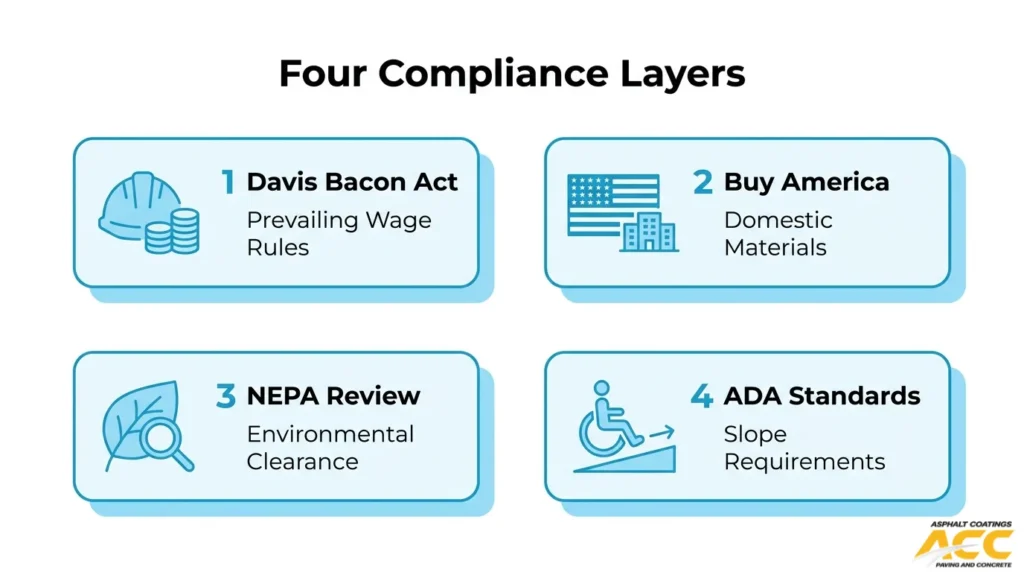
Compliance spans multiple layers simultaneously. The Davis-Bacon Act sets prevailing wage rates for every worker classification on site, Buy America provisions govern domestic sourcing for manufactured components, NEPA environmental reviews must clear before construction begins, and ADA standards enforce precise slope tolerances on all accessible routes.
Federal procurement under 2 CFR 200 establishes competitive bidding thresholds that dictate how contractors are solicited and selected. Complete documentation, from independent cost estimates to conflict-of-interest disclosures, is required at every stage to survive audit scrutiny.
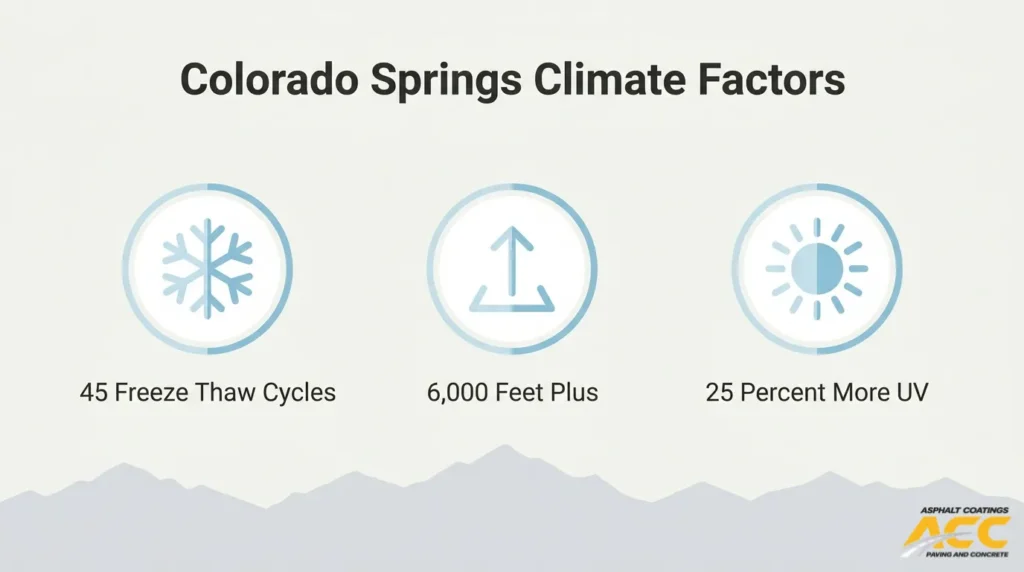
Colorado Springs’ elevation above 6,000 feet subjects pavement to 45 or more freeze-thaw cycles annually and UV intensity 25 to 35 percent higher than sea level, requiring specialized mix designs, polymer-modified binders, and deeper subgrade investigation.
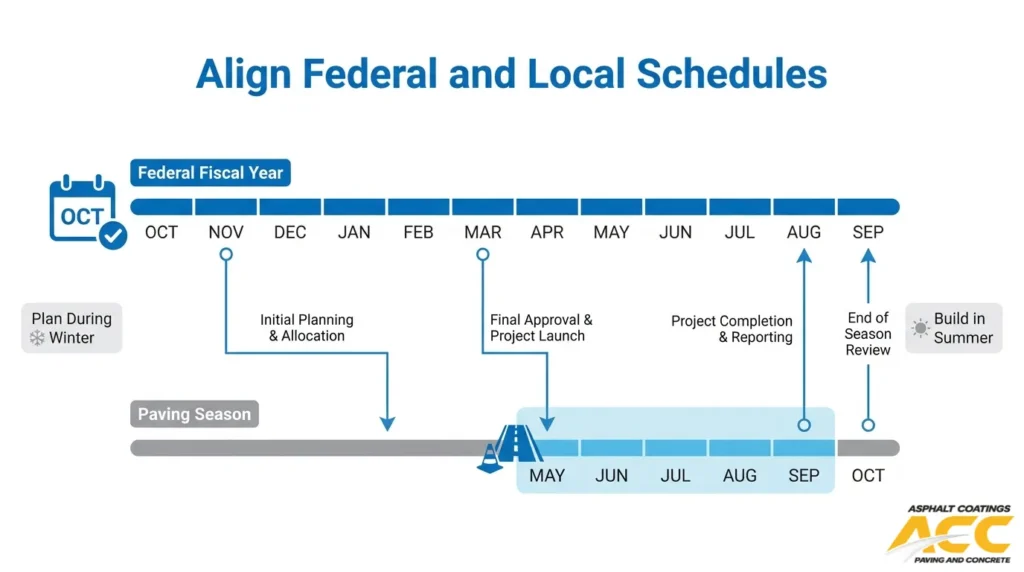
The federal fiscal year starts October 1, just as local paving season ends. Property managers must front-load geotechnical work, environmental reviews, and material certifications during winter months to execute construction within the May-through-October window. Choosing a contractor with proven federal compliance experience and regional climate knowledge prevents the documentation gaps, schedule failures, and specification errors that most commonly disqualify or delay grant-funded projects.
What Federal Funding Sources Apply to Commercial Paving Projects?
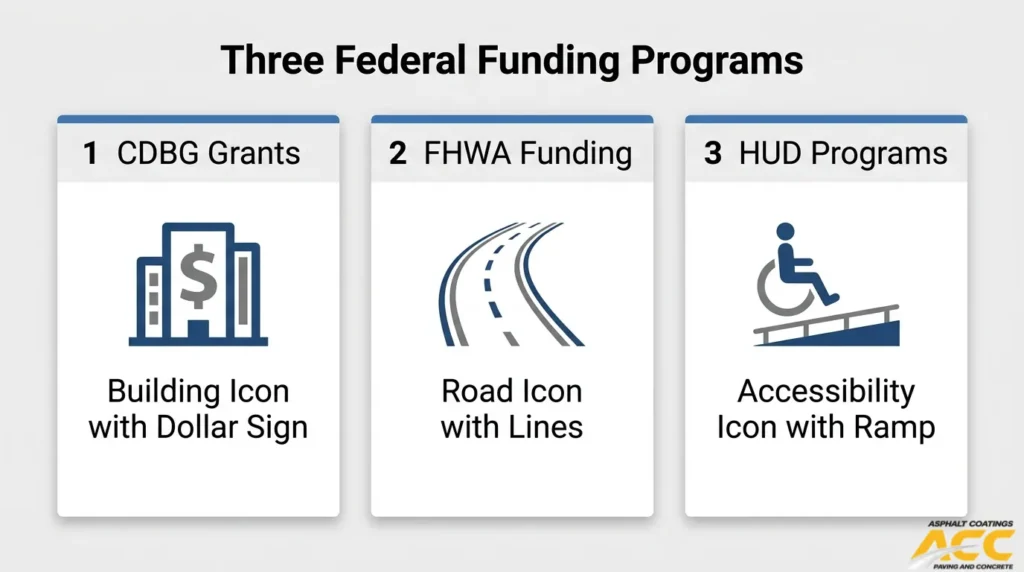
Federal funding sources that apply to commercial paving projects in Colorado Springs include CDBG grants, FHWA transportation allocations, and HUD accessibility programs. Each source carries distinct eligibility rules, reimbursement structures, and project requirements.
How Does CDBG Funding Support Paving for Commercial Properties?
CDBG funding supports paving for commercial properties by financing infrastructure improvements in areas that serve low- to moderate-income populations. Eligible projects include parking lot construction, road resurfacing, and site access improvements tied to community development objectives.
Property managers in the Colorado Springs region should note that this funding operates on a reimbursement basis, meaning recipients must incur costs before receiving federal funds. According to El Paso County, the CDBG application cycle for nonprofits runs from January 2 to February 2, 2026, targeting projects in unincorporated areas and participating municipalities. Planning cash flow around this reimbursement model is critical; without adequate working capital, even approved projects can stall before federal dollars arrive.
What Role Does FHWA Funding Play in Local Paving Projects?
FHWA funding plays a role in local paving projects by financing roadway, access, and infrastructure improvements through the federal-aid highway program. PPACG, the federally designated Metropolitan Planning Organization for the Pikes Peak region, manages the Transportation Improvement Program that channels these dollars to qualifying projects.
Paving work connected to public roadways, commercial access roads, or shared-use corridors may qualify when included in the regional TIP. While most FHWA funds target public infrastructure, commercial properties benefit indirectly when adjacent road improvements, turn lanes, or access points receive federal investment. For property managers, understanding whether a proposed project intersects with planned FHWA-funded corridors can unlock cost-sharing opportunities that reduce private expenditure.
How Do HUD Grants Apply to Parking Lot and Access Improvements?
HUD grants apply to parking lot and access improvements when projects advance accessibility, eliminate blight, or directly benefit low- to moderate-income communities. Parking surface rehabilitation, ADA-compliant ramp installation, and striping upgrades all fall within eligible use categories.
A 2025 El Paso County CDBG program allocation, administered through HUD, will provide ADA-accessibility upgrades to the parking lot adjacent to the downtown playpark in Monument. This type of project illustrates how HUD-funded paving extends beyond roads into commercial and community parking facilities. Property managers considering similar improvements should document how the project serves a qualifying national objective, since HUD approval hinges on that alignment.
With funding sources identified, understanding the federal compliance requirements attached to each program becomes the next essential step.
What Federal Compliance Requirements Govern Funded Paving Work?
Federal compliance requirements governing funded paving work include Davis-Bacon prevailing wage mandates, Buy America material sourcing rules, NEPA environmental reviews, and ADA accessibility standards. The following subsections break down each requirement for Colorado Springs property managers.
What Is the Davis-Bacon Act and How Does It Affect Paving Contracts?
The Davis-Bacon Act is a federal law requiring contractors on federally-funded projects to pay workers no less than the locally prevailing wage and fringe benefits. This mandate affects paving contracts by setting minimum hourly rates that often exceed standard market pay.
According to U.S. Department of Labor Wage Determination CO20250008 (effective January 3, 2025), the prevailing rate for an Asphalt Raker in El Paso County is $17.54 per hour plus $3.16 in fringes, while a Power Equipment Operator (Asphalt Paver) earns $21.50 per hour plus $3.50 in fringes.
Property managers should factor these rates into project budgets early. Certified payroll documentation is required for every pay period, and non-compliance can trigger funding clawbacks.
What Are the Buy America Provisions for Asphalt Materials?
The Buy America provisions for asphalt materials require that iron, steel, and manufactured products used on federally-funded projects be produced domestically. For paving work, this primarily affects steel reinforcement, drainage grates, and certain manufactured components.
However, not all paving inputs carry the same restrictions. According to the Federal Highway Administration, the Build America, Buy America Act domestic sourcing requirements generally do not apply to aggregates such as stone, sand, or gravel, nor to cement and cementitious materials. This distinction matters for asphalt mix design, since aggregate typically represents the largest material volume in hot mix asphalt.
Contractors should verify sourcing documentation for every manufactured component before delivery to avoid costly project delays.
How Do Environmental Review Requirements Apply in Colorado Springs?
Environmental review requirements apply in Colorado Springs through the National Environmental Policy Act (NEPA) process, which HUD and FHWA mandate before federal dollars can be committed to construction. Paving projects typically require, at minimum, a Categorical Exclusion or Environmental Assessment evaluating stormwater impact, historical preservation, and noise.
Colorado Springs adds a local layer through the City’s Pavement Design Criteria Manual, which governs material standards and subgrade investigation. CDBG-funded projects must also satisfy a National Objective. According to the City of Colorado Springs, all CDBG projects must serve individual clients who make 80% area median income or below, or serve a predominantly low- to moderate-income Census tract.
Skipping or rushing environmental clearance is one of the most common causes of project holdups in federally-assisted paving.
What ADA Accessibility Standards Must Federally-Funded Paving Meet?
ADA accessibility standards that federally-funded paving must meet include specific slope limits, detectable warning surface placement, and accessible route continuity across parking lots and pedestrian pathways. Federal funding triggers full compliance with the ADA Standards for Accessible Design.
Key requirements include:
- Ramp cross slopes must not exceed 1:48 (2.08%), per the U.S. Access Board.
- Maximum running slope for new ramps is 1:12 (8.33%).
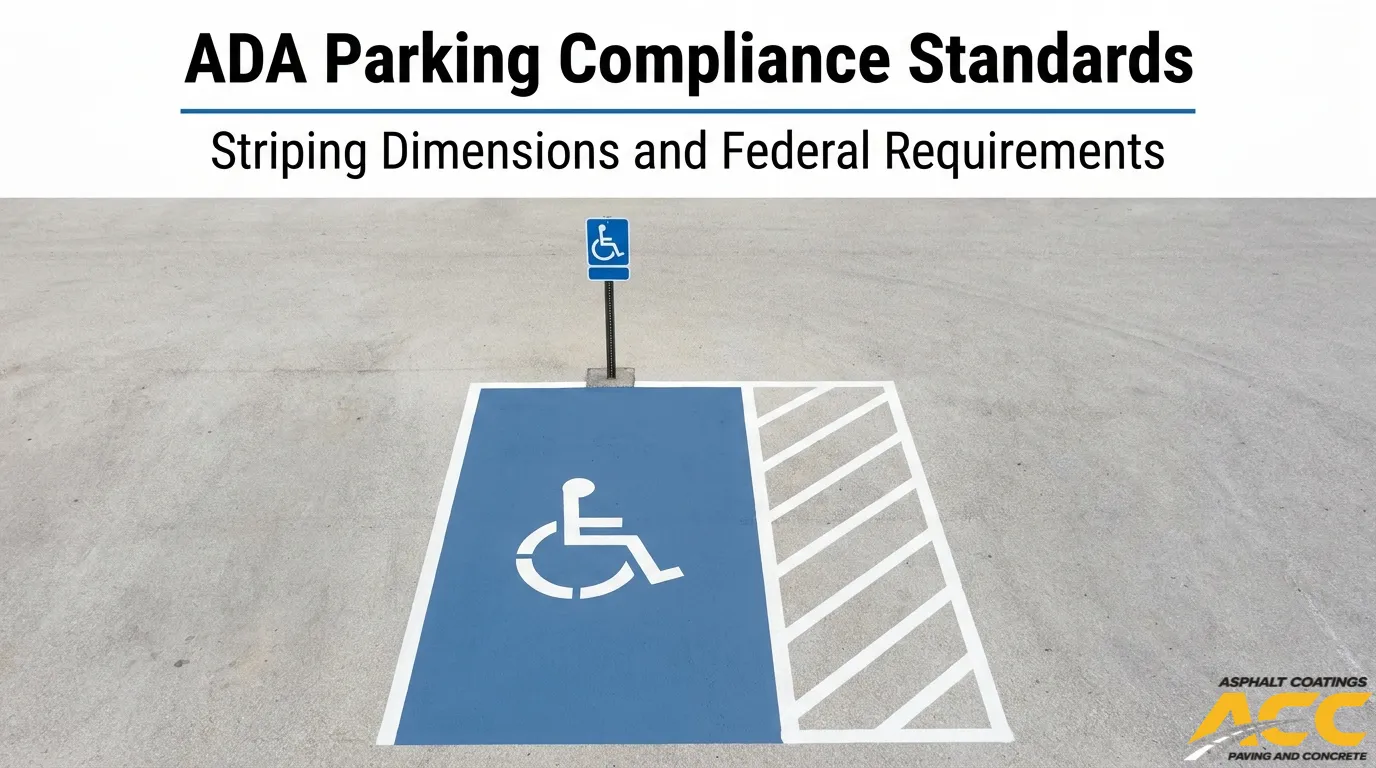
- Accessible parking spaces require firm, stable, and slip-resistant surfaces with compliant signage and van-accessible aisles.
- Curb ramps must be provided wherever an accessible route crosses a curb.
These standards are non-negotiable on grant-funded work. For property managers in Colorado Springs, pairing ADA compliance with proper subgrade preparation prevents settling that can push slopes out of tolerance within just a few years.
Understanding these compliance layers positions property managers to navigate the procurement process more effectively.
What Procurement Rules Must Property Managers Follow?
Property managers must follow federal procurement rules that govern bidding thresholds, documentation standards, and disadvantaged business participation. The subsections below cover competitive bidding limits, required bid documentation, and DBE goal requirements.
What Competitive Bidding Thresholds Apply to Federal Projects?
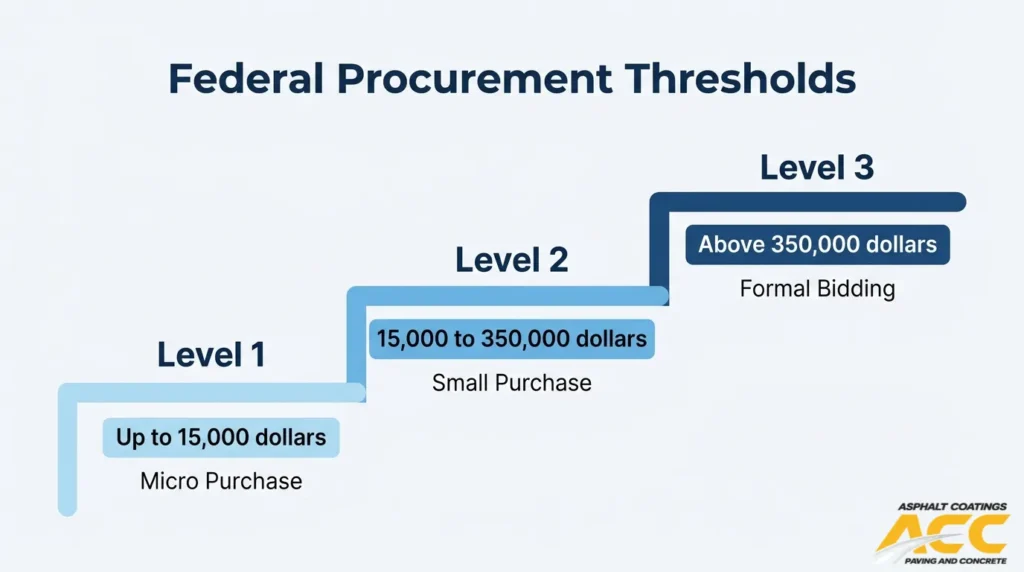
Competitive bidding thresholds for federal projects are set by 2 CFR 200 (Uniform Guidance) and determine when formal competition is required. Effective October 1, 2025, the federal Micro-Purchase Threshold increased to $15,000, and the Simplified Acquisition Threshold rose to $350,000.
These thresholds create three procurement tiers:
- Micro-purchases (up to $15,000) may be awarded without soliciting competitive quotes.
- Small purchases ($15,001 to $350,000) require price or rate quotations from an adequate number of qualified sources.
- Formal procurement (above $350,000) requires sealed bids or competitive proposals with full public solicitation.
Misaligning a project budget with the wrong threshold is a common disqualification trigger. According to the M.J. Murdock Charitable Trust, budget errors such as failing to “right-size” a project request to fit an organization’s capacity can lead to immediate disqualification of federal grant proposals. Property managers should confirm their paving project’s total cost before selecting a procurement method.
What Documentation Must Accompany a Federally-Funded Bid Process?
The documentation that must accompany a federally-funded bid process includes a complete procurement file demonstrating fair and open competition. Federal auditors review these records to verify compliance with 2 CFR 200 requirements.
Essential bid documentation includes:
- Independent cost estimate prepared before soliciting bids.
- Solicitation records showing how and where the opportunity was advertised.
- Evaluation criteria and scoring methodology used to assess proposals.
- Bid tabulation sheets comparing all received responses.
- Conflict-of-interest disclosures from every individual involved in the selection.
- Written justification if fewer than three bids were received or if a sole-source award was necessary.
Missing even one element can trigger audit findings or funding clawbacks. For paving projects in Colorado Springs, maintaining organized procurement files from day one protects against costly compliance failures during closeout reviews.
How Do Disadvantaged Business Enterprise Goals Affect Contractor Selection?
Disadvantaged Business Enterprise goals affect contractor selection by requiring federally-funded projects to include participation targets for certified small businesses owned by socially and economically disadvantaged individuals. These goals, governed by 49 CFR Part 26, typically apply to FHWA and CDOT-administered contracts.
However, the current regulatory landscape in Colorado has shifted. According to CDOT, the agency paused DBE goals for contracts executed on or after October 3, 2025, while continuing to advance the Emerging Small Business (ESB) program. Property managers should verify whether their specific funding source still carries DBE requirements, since HUD-funded projects may operate under different participation mandates than CDOT-administered work.
Even with paused DBE goals, documenting good-faith outreach efforts to small and disadvantaged firms remains a best practice that strengthens audit readiness. Understanding which procurement rules apply to each funding stream helps property managers avoid delays during contractor selection.
How Does Colorado Springs Climate Influence Federally-Funded Paving Specifications?
Colorado Springs climate influences federally-funded paving specifications by imposing strict material and structural requirements that account for extreme freeze-thaw cycling, intense UV radiation, and a narrow construction season. The subsections below cover freeze-thaw design requirements, elevation-driven material choices, and seasonal paving restrictions.
What Freeze-Thaw Cycle Requirements Affect Pavement Design?
Freeze-thaw cycle requirements that affect pavement design include enhanced subgrade preparation, increased pavement thickness, and mix designs formulated to resist moisture infiltration and thermal cracking. Adhering to these specifications is crucial for meeting Colorado Springs MS4 stormwater permit obligations on commercial repaving projects. At elevations near Colorado Springs, asphalt pavements endure 45 to 50 or more freeze-thaw cycles annually, according to Mountain Property Protection data from the Monument, Colorado area at 7,311 feet.
Each cycle forces water trapped in pavement pores to expand and contract, progressively weakening the asphalt matrix. Federally-funded projects carry heightened scrutiny here because, as the City of Colorado Springs Pavement Design Criteria Manual states, “public monies are at risk and a direct fiduciary responsibility exists.” Property managers should expect specifications calling for:
- Air-entrained mix designs that accommodate internal moisture expansion
- Deeper subgrade borings to assess frost-susceptible soils
- Thicker base courses to distribute freeze-induced heaving stresses
How Do Elevation and UV Exposure Shape Material Specifications?
Elevation and UV exposure shape material specifications by accelerating asphalt oxidation and requiring binder grades engineered for high-altitude conditions. Colorado Springs sits above 6,000 feet, where UV intensity is 25 to 35 percent higher than at sea level. This increased radiation breaks down the lighter hydrocarbon fractions in asphalt binder faster, causing surfaces to become brittle and crack prematurely.
Most local paving guides, even those for asphalt contractor selection, overlook this factor entirely. Federally-funded projects, however, must meet CDOT-interchangeable standards that account for performance grading adjusted to local climate. Polymer-modified binders and UV-resistant sealcoat formulations are common specification responses. For property managers, this means budgeting for higher-grade materials that cost more upfront but resist oxidation-driven failures over the pavement’s design life.
What Seasonal Restrictions Apply to Paving in Colorado Springs?
Seasonal restrictions that apply to paving in Colorado Springs generally limit hot mix asphalt placement to the warmer months, typically May through October, when ambient and surface temperatures support proper compaction and curing. Nighttime temperatures that drop below 40°F prevent adequate binder adhesion, and early-season snowmelt saturates subgrades.
These restrictions create scheduling pressure for federally-funded projects, which must also align with federal fiscal year obligations. Property managers should build weather contingency windows into project timelines and coordinate closely with contractors who understand both the local climate and federal reporting deadlines. Failing to account for Colorado Springs’ compressed paving season is one of the most common planning oversights on grant-funded work.
Understanding how climate shapes specifications helps property managers anticipate the inspections and reporting federal agencies require.
What Inspections and Reporting Do Federal Agencies Require?
Federal agencies require certified payroll submissions, material testing documentation, and post-completion audits for federally-funded paving projects. The subsections below cover prevailing wage reporting, quality assurance standards, and audit procedures.
What Prevailing Wage Reporting Must Contractors Submit?
Prevailing wage reporting that contractors must submit includes weekly certified payroll records filed on federal form WH-347. Each report lists every worker’s classification, hours, pay rate, and fringe benefits for that payroll period. When a project uses a mix of federal and private funds, such as a shared-use parking lot funded partly through CDBG, contractors must still report certified payroll for all hours worked on the federally-assisted portion. Payroll records must match the applicable Davis-Bacon wage determination for the project location. In El Paso County, for example, the U.S. Department of Labor’s General Decision Number CO20250008 (effective January 3, 2025) sets the hourly rate for a Power Equipment Operator (Asphalt Paver) at $21.50 plus $3.50 in fringes. Incomplete or late filings can trigger payment holds on reimbursement requests.
What Material Testing and Quality Assurance Standards Apply?
Material testing and quality assurance standards that apply to federally-funded paving in Colorado Springs require compliance with both federal specifications and local pavement design criteria. According to the City of Colorado Springs Pavement Design Criteria Manual, all hot mix asphalt must meet material specifications and construction standards interchangeable with CDOT test standards. Common required tests include:
- Asphalt content and gradation analysis on plant-produced mix samples.
- In-place density verification using nuclear gauge or core sampling.
- Subgrade compaction testing at specified depths and intervals.
- Visual inspection of finished surfaces for segregation, cracking, and proper drainage slope.
Independent testing laboratories typically perform these assessments, and results become part of the permanent project file submitted to the funding agency.
How Are Completed Projects Audited for Federal Compliance?
Completed projects are audited for federal compliance through a combination of financial reviews, field inspections, and records verification. Funding agencies such as HUD or FHWA may conduct desk audits of pay applications, certified payroll records, and procurement documentation to confirm adherence to 2 CFR 200 (Uniform Guidance). On-site closeout inspections verify that the constructed work matches approved plans, ADA standards, and material specifications. Projects receiving $750,000 or more in federal funds within a single fiscal year also trigger Single Audit requirements under federal law. Property managers should retain all contracts, change orders, test reports, and payroll records for a minimum of three years after project closeout; this retention period is the standard federal requirement for grant-funded work.
With reporting and audit protocols understood, avoiding the most common compliance mistakes becomes the next priority.
What Mistakes Disqualify or Delay Federally-Funded Paving Projects?
Mistakes that disqualify or delay federally-funded paving projects include vague project schedules, budget miscalculations, procurement violations, missed ADA slope tolerances, and incomplete Davis-Bacon payroll documentation. The following errors are among the most common and consequential.
- Vague or unrealistic project schedules. According to ODGS Grants, a primary reason for federal transportation grant rejection is the submission of vague or unrealistic project schedules that fail to demonstrate project readiness.
- Budget sizing errors. Proposals that fail to right-size a project request to fit an organization’s capacity and infrastructure face immediate disqualification.
- ADA slope violations. The U.S. Access Board requires ramp cross slopes no steeper than 1:48 (2.08%) and running slopes no steeper than 1:12 (8.33%); non-compliant grades trigger costly rework and funding holds.
- Incomplete certified payroll records. Missing or inaccurate prevailing wage documentation under the Davis-Bacon Act can halt reimbursements and trigger federal audits.
- Procurement threshold violations. Failing to follow competitive bidding requirements when project costs exceed the federal Micro-Purchase Threshold of $15,000 or the Simplified Acquisition Threshold of $350,000 risks full disqualification.
- Missing environmental clearances. Starting work before NEPA review completion violates grant conditions and can require repayment of all disbursed funds.
For property managers in Colorado Springs, where the paving season already compresses timelines, even one of these errors can push a project past its grant obligation deadline. Proactive compliance planning, particularly around documentation and ADA design, is the most reliable way to protect both the funding and the construction schedule.
Understanding these pitfalls makes aligning federal timelines with local construction seasons far more manageable.
How Do Federal Timelines Align with Colorado Springs Construction Seasons?
Federal timelines align with Colorado Springs construction seasons through careful coordination of the federal fiscal year, which begins October 1, with the local paving window that typically runs from May through October. Planning ahead bridges the gap between grant obligation deadlines and weather-dependent construction.
The federal fiscal year starts in autumn, just as Colorado Springs temperatures drop and asphalt plants begin seasonal shutdowns. This mismatch means property managers who receive grant obligations in October or November often cannot begin paving until the following May. That six-to-seven-month gap requires precise scheduling to avoid grant expiration while meeting local construction standards.
Colorado Springs imposes rigorous site preparation requirements that demand early action. According to the City of Colorado Springs Pavement Design Criteria Manual, borings for pavement design must reach a minimum of 4 feet below design subgrade, with every fourth boring extending to 9 feet. Completing geotechnical work during late fall or early winter, when ground conditions still permit drilling, positions projects to break ground as soon as spring temperatures stabilize.
Material compliance adds another scheduling layer. The City of Colorado Springs requires all hot mix asphalt to meet material specifications and construction standards interchangeable with CDOT test standards. Confirming material sourcing, mix designs, and lab certifications during winter months prevents delays once the paving season opens.
Property managers should target this general coordination sequence:
- October through December: Secure grant obligation, finalize contractor selection, and initiate geotechnical borings.
- January through March: Complete environmental reviews, submit certified payroll documentation frameworks, and confirm material specifications.
- April: Mobilize equipment, verify subgrade preparation, and schedule batch plant coordination.
- May through September: Execute paving operations within optimal temperature windows for HMA placement and compaction.
Failing to front-load administrative and design tasks during the off-season compresses the construction window and risks pushing work into late fall, when cold temperatures compromise asphalt quality. For property managers balancing federal deadlines with Colorado Springs’ short paving season, the winter months are not downtime; they are the critical planning phase that determines whether the project meets both compliance and quality benchmarks.
Understanding these federal-to-local timing dynamics prepares property managers to select a contractor experienced in navigating both regulatory schedules and regional conditions.
How Should Property Managers Choose a Paving Contractor for Federally-Funded Work in Colorado Springs?
Property managers should choose a paving contractor for federally-funded work in Colorado Springs by verifying federal compliance experience, Davis-Bacon familiarity, and local material knowledge. The sections below cover how experienced contractors simplify compliance and the key takeaways for managing these projects.
Can an Experienced Commercial Paving Contractor Simplify Federal Project Compliance?
Yes, an experienced commercial paving contractor can simplify federal project compliance by managing Davis-Bacon certified payroll, Buy America documentation, and ADA-compliant construction specifications as integrated parts of their standard workflow. Contractors unfamiliar with federal requirements often produce incomplete submittals that stall projects during agency review.
According to ODGS Grants, a primary reason for federal transportation grant rejection is the submission of vague or unrealistic project schedules that fail to demonstrate project readiness. A contractor with prior federal project experience builds credible timelines that satisfy grant administrators, reducing rejection risk before work even begins.
Key compliance capabilities to verify include:
- Certified payroll preparation and prevailing wage tracking under the Davis-Bacon Act.
- Familiarity with 2 CFR 200 procurement documentation requirements.
- Knowledge of Colorado Springs pavement design standards aligned with CDOT specifications.
- ADA accessibility construction experience, including slope and cross-slope tolerances.
Asphalt Coatings Company brings 39 years of commercial paving experience across Colorado’s Front Range, with in-house crews based in Colorado Springs. That depth of regional knowledge, from freeze-thaw cycle engineering to CDOT material standards, positions a contractor to anticipate compliance issues rather than react to them. This expertise extends to specialized services such as asphalt mill and pave operations, ensuring longevity and compliance for large-scale projects.
What Are the Key Takeaways About Federally-Funded Paving for Property Managers in Colorado Springs?
The key takeaways about federally-funded paving for property managers in Colorado Springs center on early planning, strict compliance, and contractor selection:
- Federal paving projects require adherence to Davis-Bacon prevailing wages, Buy America sourcing rules, ADA accessibility standards, and environmental review procedures simultaneously.
- Procurement must follow competitive bidding thresholds under 2 CFR 200, with thorough documentation at every stage.
- Colorado Springs’ high elevation creates unique pavement challenges, including accelerated freeze-thaw cycling and elevated UV exposure, that must be addressed in federally-approved material specifications.
- The federal fiscal year begins October 1, while Colorado Springs’ optimal paving season runs May through October; synchronizing grant obligation deadlines with construction windows prevents funding expiration.
- Selecting a contractor with proven federal project experience eliminates the most common compliance failures before they threaten grant funding.
For property managers navigating these requirements in Colorado Springs, Asphalt Coatings Company offers the combination of federal project readiness and local climate expertise needed to protect both the investment and the grant.