Expansive clay soil heaving in the Pikes Peak region is the upward displacement of parking-lot pavement caused by moisture-sensitive clay minerals in the subgrade that swell when wet and shrink when dry. The Pierre Shale and Dawson formations underlying much of Colorado Springs contain montmorillonite, smectite, and illite clays capable of generating forces that far exceed the weight of any asphalt surface.
This guide covers the geology and mineral behavior driving heave, climate factors that accelerate soil movement, visible damage patterns and compliance risks, site vulnerabilities and geotechnical testing, and engineering and maintenance strategies that protect parking lots on Pikes Peak clay.
Smectite-group minerals in the Pierre Shale absorb water between submicroscopic plates, expanding up to 20% by volume and exerting pressures that can reach 30,000 pounds per square foot. Bentonite seams produce sudden, localized uplift, while mixed montmorillonite-illite subgrades create broader, more gradual displacement.
Colorado Springs’ semi-arid climate delivers only about 16 inches of annual precipitation, concentrated in intense summer bursts that saturate desiccated clay through deep shrinkage cracks. Freeze-thaw cycles then compound that swelling with ice-lens formation, and rising fall temperatures are extending the overlap window between soil moisture and freezing.
Heaving produces raised crack edges, polygonal surface fractures, disrupted drainage slopes, and vertical displacements that exceed ADA trip-hazard thresholds. Poor subsurface drainage, uncontrolled irrigation, and insufficient subgrade preparation all amplify these risks.
Geotechnical assessments, including plasticity index and swell-pressure testing, quantify heave potential before paving. Proven mitigation combines lime stabilization, moisture barriers, engineered subbase compaction, and flexible pavement sections, while ongoing sealcoating and crack sealing slow moisture infiltration into reactive soils.
What Are Expansive Clay Soils in the Pikes Peak Region?
Expansive clay soils in the Pikes Peak region are mineral-rich subgrade materials that swell significantly when exposed to moisture and shrink during dry periods. The sections below cover the specific minerals driving this behavior, the Colorado Springs neighborhoods most affected, and how bentonite and montmorillonite differ locally.
What Minerals Make Pikes Peak Clay Soils Expansive?
The minerals that make Pikes Peak clay soils expansive are primarily smectite, illite, and montmorillonite, all present within the region’s dominant Pierre Shale formation. According to the U.S. Geological Survey, the Pierre Shale is a Late Cretaceous marine clay-shale composed predominantly of mixed-layer illite/smectite and quartz, responsible for severe expansive clay damage along the Front Range.
This formation weathers easily and contains overconsolidated claystone along with evaporite minerals, including sulfates such as gypsum. Gypsum complicates stabilization efforts because it reacts with common lime treatments. Engineers measure swell potential using one-dimensional swell tests following ASTM D4546, which quantify percent swell and swell pressure to determine mitigation requirements. Understanding the specific mineral composition at a site is the essential first step before any parking-lot paving project in this region.
Where Are Expansive Clay Soils Most Common Around Colorado Springs?
Expansive clay soils are most common around Colorado Springs in the southwest neighborhoods, areas underlain by Pierre Shale, and developments along the Dawson formation’s claystone outcrops. According to the Colorado Geological Survey, the state’s most significant geologic hazard is expansive soil containing bentonite and montmorillonite clays that can expand up to 20% by volume and exert forces up to 30,000 pounds per square foot.
Key facts about local distribution and regulatory response:
- Southwest Colorado Springs neighborhoods sit on bentonite-rich soils that frequently cause foundation and pavement heaving.
- Common swelling minerals in the area include montmorillonite, illite, and kaolinite, which attract water molecules between flat, submicroscopic clay plates.
- The City of Colorado Springs prohibits paving on highly expansive soils with swell potential greater than 2.00% under a 200 psf surcharge without an approved subgrade treatment.
- Pavement design requires soil borings at least 4 feet deep below design subgrade, with every fourth boring extending to 9 feet to investigate moisture-sensitive layers.
- When water-soluble sulfate content exceeds 0.2%, the city mandates a double application method for lime stabilization, including a 7-day mellow period with constant wetting.
For property managers, these regulations are not optional guidelines; they represent the minimum standard for protecting a parking-lot investment on Pikes Peak clay. Professional commercial paving contractors with experience in the Pikes Peak region understand these City of Colorado Springs requirements and can navigate the permitting and testing protocols required for compliant subgrade treatment on expansive soils.
How Do Bentonite and Montmorillonite Behave Differently in This Region?
Bentonite and montmorillonite behave differently in this region primarily in their origin, purity, and swelling intensity, though montmorillonite is actually the dominant mineral within bentonite. Montmorillonite is a specific smectite-group clay mineral with an expandable crystal lattice that absorbs water between its layers. Bentonite is a naturally occurring clay deposit composed mostly of montmorillonite, formed from weathered volcanic ash.
In the Pikes Peak region, bentonite deposits tend to occur in concentrated seams that produce localized, severe heaving. Pure montmorillonite layers within the Pierre Shale, by contrast, are often interspersed with illite and quartz, producing more distributed but still significant swell. Practically, a parking lot built over a bentonite seam may experience sudden, dramatic uplift in one area, while a site on mixed montmorillonite-illite subgrade typically shows broader, more gradual movement. Both require geotechnical testing, but bentonite concentrations demand more aggressive mitigation strategies.
Understanding which clay type dominates a site directly shapes subgrade treatment decisions, from lime dosage to whether full over-excavation is necessary.
How Do Expansive Clays Physically Cause Parking-Lot Heaving?
Expansive clays physically cause parking-lot heaving through a three-stage process: mineral-level water absorption, volumetric swelling that generates upward pressure, and measurable vertical lift that displaces pavement.
What Happens to Clay Minerals When They Absorb Water?
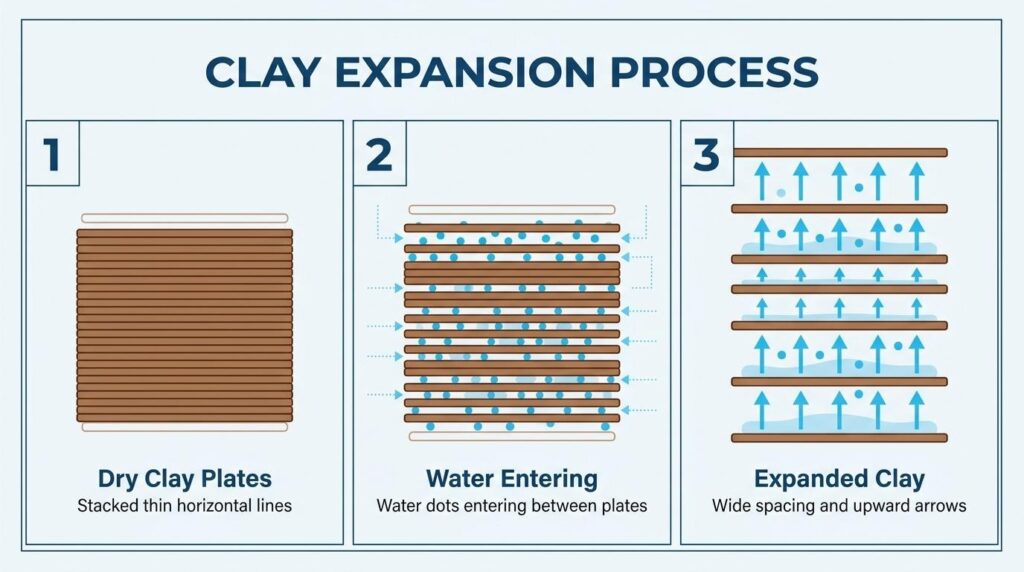
Clay minerals absorb water through a process called adsorption, where water molecules are chemically attracted to the flat, submicroscopic plates that make up expansive clay structures. Montmorillonite and smectite minerals have a layered crystalline arrangement with weak bonds between sheets. When moisture reaches these layers, water molecules wedge between the plates, forcing them apart. This interlayer expansion occurs at the molecular scale but accumulates across billions of clay particles in a subgrade. The result is a soil mass that physically increases in volume as it wets, with the expansion concentrated in whichever zone receives the most moisture infiltration.
How Does Volumetric Swelling Translate to Upward Pressure on Pavement?
Volumetric swelling translates to upward pressure on pavement because expanding clay has nowhere to move but up. Lateral confinement from surrounding soil forces the volume increase vertically against the weakest resistance point: the pavement surface. As subgrade soils swell unevenly beneath a parking lot, differential pressure develops. One section may heave while adjacent areas remain stable, creating the buckled, cracked surfaces property managers recognize as heave damage. The weight of asphalt and aggregate base alone cannot counteract these forces, since confined expansive clay generates pressures that far exceed typical pavement dead loads.
How Much Vertical Lift Can Expansive Soils Generate?
Expansive soils can generate extraordinary vertical lift. According to the Colorado Geological Survey, expansive soils laced with bentonite and montmorillonite can expand up to 20% by volume and exert forces reaching 30,000 pounds per square foot. For context, a standard commercial parking lot exerts roughly 100 to 150 pounds per square foot of dead-load pressure on its subgrade. The mismatch is staggering; swell pressure can exceed pavement weight by a factor of 200 or more. This is why even thick asphalt sections offer no real resistance once the clay activates. Moisture barriers, both vertical and horizontal, are often the only reliable strategy for preventing water from reaching reactive subgrade soils in the first place.
Understanding how these forces develop is essential, because regional climate patterns determine how often they activate.
Why Does the Pikes Peak Region’s Climate Accelerate Soil Heaving?
The Pikes Peak region’s climate accelerates soil heaving because its sharp wet-dry swings and frequent freeze-thaw cycles keep expansive clay in constant motion. The following sections explain how seasonal moisture cycles, freezing temperatures, and semi-arid precipitation patterns each compound the problem.
How Do Wet-Dry Seasonal Cycles Trigger Repeated Swelling and Shrinking?
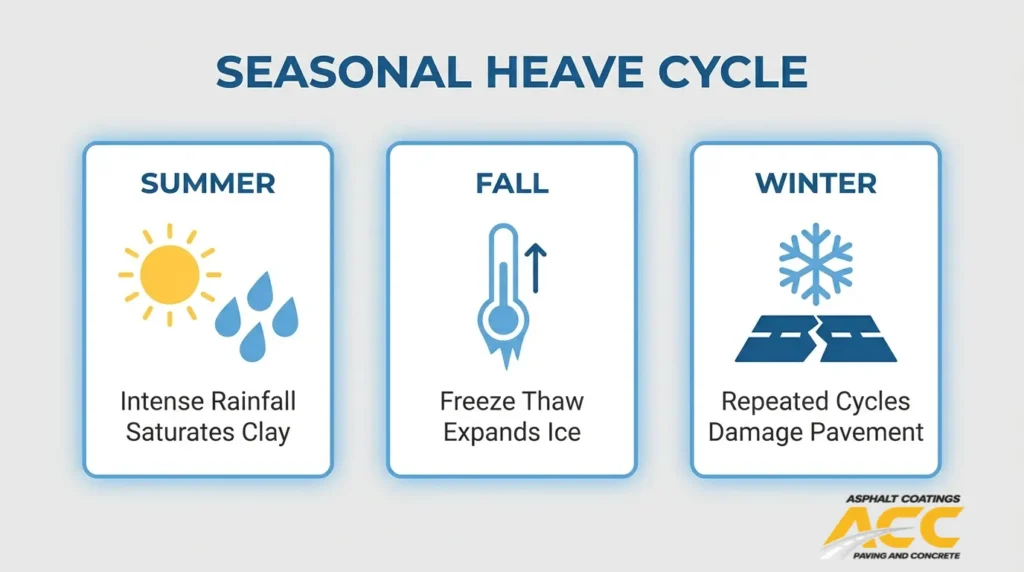
Wet-dry seasonal cycles trigger repeated swelling and shrinking by alternately saturating and desiccating clay minerals throughout the year. During Colorado Springs’ summer monsoon months, concentrated rainfall hydrates montmorillonite and smectite layers, causing rapid volumetric expansion. When precipitation stops, the semi-arid atmosphere pulls moisture from the upper soil profile, and the clay contracts, leaving voids and surface cracks beneath pavement.
This cyclical process is cumulative. Each swell-shrink event displaces aggregate and weakens the bond between subgrade and pavement structure, so parking lots built on untreated clay rarely return to their original grade. Over multiple seasons, differential movement produces the uneven surfaces property managers commonly mistake for simple settling.
How Do Freeze-Thaw Cycles Compound Expansive Soil Movement?
Freeze-thaw cycles compound expansive soil movement by adding ice-lens formation on top of clay swelling. When temperatures drop, moisture trapped in already-expanded clay freezes and increases in volume, pushing pavement upward beyond what swelling alone produces. As temperatures rise, the ice melts, leaving loosened soil that cannot fully reconsolidate before the next freeze event.
According to the National Weather Service, Colorado Springs receives an annual precipitation normal of 15.91 inches, peaking in July at 3.12 inches, which means moisture absorbed during summer remains in the subgrade well into the fall and winter freeze season. A 2022 Colorado State University climate report found that statewide annual average temperatures warmed by 2.3°F from 1980 to 2022, with fall temperatures rising 3.1°F. This shift extends the transition window where soil moisture and freezing overlap, intensifying cumulative heave damage.
Why Does Colorado Springs’ Semi-Arid Precipitation Pattern Worsen Clay Instability?
Colorado Springs’ semi-arid precipitation pattern worsens clay instability because it delivers moisture in intense, concentrated bursts rather than steady, evenly distributed rainfall. With only about 16 inches of annual precipitation, the soil spends long dry periods in a desiccated, cracked state. When summer storms arrive, water penetrates deep into those cracks, reaching clay layers that would remain dry under a more temperate rainfall pattern.
This boom-and-bust moisture cycle is arguably the single most damaging aspect of the regional climate for parking-lot subgrades. Consistent moisture would allow clay to reach equilibrium; instead, the semi-arid pattern guarantees that expansive minerals never stabilize. For property managers, this means even well-constructed lots face ongoing heave risk without proper subgrade treatment and moisture management.
Understanding these climate drivers clarifies why engineered mitigation matters before any pavement is placed.
What Does Parking-Lot Heaving Damage Look Like?
Parking-lot heaving damage appears as uneven pavement surfaces, irregular cracking, and displaced sections that disrupt traffic flow and accessibility. The following subsections explain how heaving differs from other pavement distress, what crack patterns to watch for, and how heaving affects drainage and ADA compliance.
How Does Heaving Differ from Frost Heave or Settling?
Heaving differs from frost heave and settling in cause, direction, and duration. Expansive soil heaving results from clay minerals absorbing moisture and swelling upward, often producing permanent displacement that worsens over seasonal wet-dry cycles. Frost heave, by contrast, occurs when subsurface water freezes into ice lenses that push pavement up temporarily; the surface typically settles back once temperatures rise. Settling moves pavement downward, usually caused by poorly compacted subgrade or soil erosion beneath the surface.
In Colorado Springs, all three mechanisms can affect the same parking lot. Distinguishing between them matters because each requires a different repair strategy. Heaving produces localized mounds and tilted slabs, while settling creates depressions and birdbaths where water pools.
What Cracking Patterns Indicate Expansive Soil Movement?
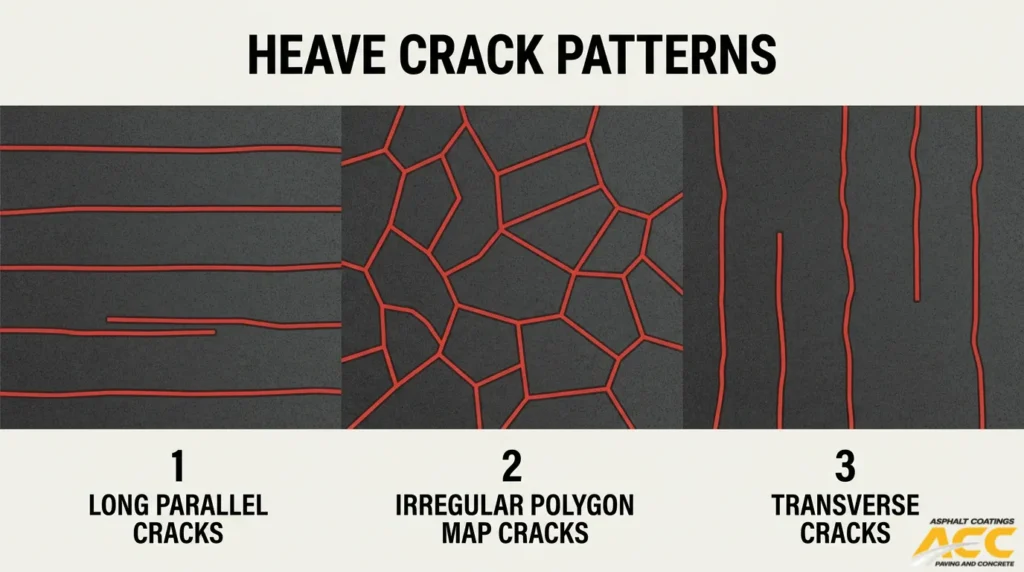
The cracking patterns that indicate expansive soil movement include longitudinal cracks running parallel to pavement edges, irregular polygonal or “map” cracking across wide areas, and transverse cracks that form where swelling pressure concentrates beneath joints or transitions. Unlike load-related fatigue cracking, which radiates from wheel paths, expansive soil cracks often appear in areas with minimal traffic, such as lot perimeters and landscape-adjacent zones.
Property managers frequently ask how to distinguish heaving from settling damage. According to a Google PAA analysis, the most common questions about expansive soil pavement damage include “How do I know if my parking lot is heaving or settling?” and “What is the best way to repair heaving asphalt?” Raised crack edges and upward-displaced sections confirm active swelling rather than subsurface loss.
How Does Heaving Compromise Drainage and ADA Compliance?
Heaving compromises drainage and ADA compliance by altering pavement grades, creating ponding areas, and producing trip hazards. When expansive clay pushes sections upward, the original slope design loses effectiveness. Water collects in newly formed low spots instead of flowing to catch basins, accelerating subgrade saturation and further swelling.
According to ADA compliance guidelines, vertical displacement exceeding 1/4 inch constitutes a trip hazard that often requires remediation to maintain accessibility and reduce premises liability. Heaved surfaces can also push cross-slopes beyond the ADA-mandated 2% maximum for accessible routes and parking stalls. For commercial property owners in the Pikes Peak region, ignoring these shifts creates compounding risk: worsening drainage feeds the very soil movement causing the problem, while non-compliant surfaces expose owners to legal claims.
Recognizing these visible signs of heaving early helps property managers prioritize targeted repairs before structural and compliance issues escalate.
What Site Conditions Make a Parking Lot More Vulnerable to Heaving?
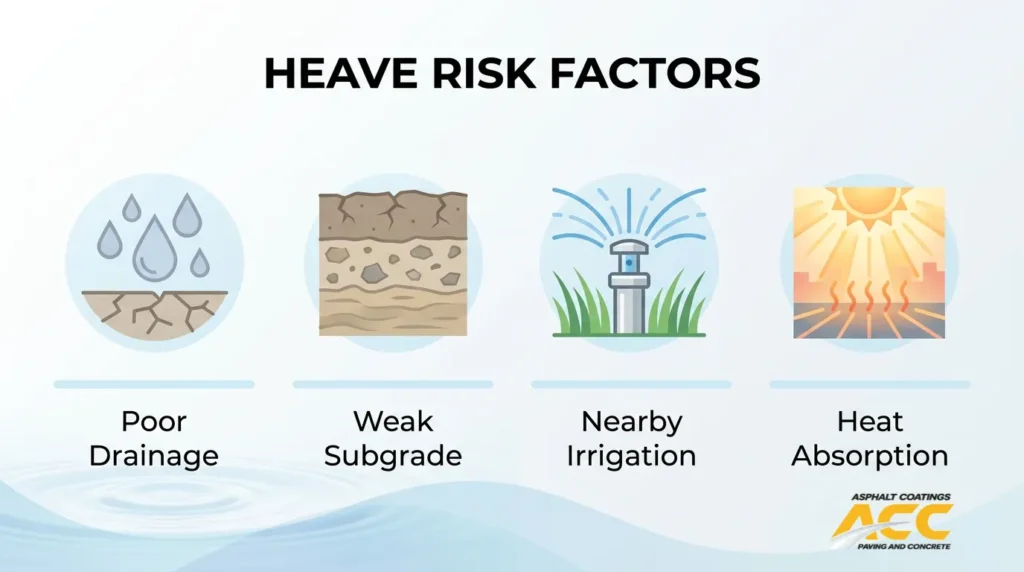
Site conditions that make a parking lot more vulnerable to heaving include poor subsurface drainage, inadequate subgrade preparation, nearby irrigation sources, and excessive solar heat absorption. Each factor influences how moisture interacts with expansive clay beneath the pavement.
How Does Poor Subsurface Drainage Increase Heave Risk?
Poor subsurface drainage increases heave risk by allowing water to accumulate beneath the pavement surface, where it saturates expansive clay minerals and triggers volumetric swelling. When stormwater or groundwater has no clear path away from the subgrade, moisture lingers in direct contact with montmorillonite and illite particles.
Common drainage failures that trap moisture beneath parking lots include:
- Clogged or missing underdrains that prevent lateral water movement.
- Low spots in the subgrade that pool water against the pavement structure.
- Compacted fill layers that create perched water tables above the native clay.
- Damaged curb and gutter systems that redirect runoff into the base course.
According to the Colorado Geological Survey, expansive clays laced with bentonite and montmorillonite can expand up to 20% by volume when exposed to water, exerting forces up to 30,000 pounds per square foot. Even minor drainage deficiencies concentrate enough moisture to activate that swelling potential beneath a parking lot.
Why Does Insufficient Subgrade Preparation Lead to Heaving?
Insufficient subgrade preparation leads to heaving because untreated or poorly compacted expansive clay retains its full swell potential directly beneath the pavement section. Without proper testing and treatment, the subgrade acts as a loaded spring waiting for moisture.
Skipping critical preparation steps creates compounding problems:
- Omitting swell-pressure testing leaves the actual expansion risk unknown.
- Placing asphalt over clay with a high Plasticity Index allows unchecked volumetric change.
- Inadequate compaction introduces void spaces that channel water deeper into the soil profile.
The City of Colorado Springs prohibits paving over highly expansive soils with a swell potential greater than 2.00% under a 200 psf surcharge pressure without an approved subgrade treatment. Parking lots built without meeting this threshold are, in practice, engineered to fail.
How Do Nearby Landscaping and Irrigation Contribute to Soil Swelling?
Nearby landscaping and irrigation contribute to soil swelling by introducing a consistent, uncontrolled moisture source directly adjacent to the parking lot subgrade. Sprinkler overspray, drip-line leaks, and deep-rooted plantings all push water laterally into the clay beneath pavement edges.
This effect is particularly damaging because it creates localized, asymmetric swelling. One side of a pavement section heaves while the opposite side remains stable, producing differential movement that cracks the surface and disrupts drainage slopes. Raised medians with irrigation inside a parking lot are among the worst offenders, since moisture migrates outward in every direction beneath the asphalt. In Colorado Springs’ semi-arid climate, where annual precipitation averages only 15.91 inches, irrigated landscape beds can deliver more water to the subgrade than natural rainfall.
Why Are Large Unshaded Asphalt Areas More Susceptible?
Large unshaded asphalt areas are more susceptible because solar radiation heats dark pavement surfaces intensely, accelerating moisture evaporation from the top of the subgrade while deeper clay layers retain water. This thermal gradient creates differential moisture conditions within the soil profile, driving uneven shrink-swell cycles.
The result is a repeating pattern: surface clay dries and contracts while subsurface clay stays wet and expands. Over successive seasons, this mismatch produces cumulative upward displacement. Wide-open parking lots without tree canopy or building shade absorb the most heat, making them especially vulnerable across Colorado Springs’ high-altitude environment where UV intensity compounds the effect.
Understanding these site-specific vulnerabilities helps property managers determine which geotechnical assessments to prioritize before paving.
What Geotechnical Assessments Identify Heave Risk Before Paving?
Geotechnical assessments identify heave risk before paving through laboratory soil tests that measure plasticity, swell percentage, and swell pressure. Two critical evaluations, the soil plasticity index and the swell-pressure test, determine whether subgrade treatment is needed.
What Does a Soil Plasticity Index Reveal About Heave Potential?
A soil plasticity index reveals how much moisture a clay soil can absorb before its volume changes significantly. This index, derived from Atterberg limits testing, quantifies the range between a soil’s liquid limit and plastic limit. Higher values indicate greater water sensitivity and stronger expansion tendencies.
Soils with elevated plasticity indices in the Pikes Peak region frequently contain montmorillonite and illite, both known for aggressive volume change. According to El Paso County geotechnical standards, soils used for fill must have a swell potential of 0.5% or less upon wetting under a 200 psf surcharge pressure when compacted to 95% density. Any fill material exceeding that threshold requires remediation before paving can proceed.
For Colorado Springs parking lots, skipping this test is one of the costliest shortcuts a property manager can make. The plasticity index directly informs whether lime stabilization, over-excavation, or enhanced subbase design will be necessary.
How Does a Swell-Pressure Test Predict Pavement Movement?
A swell-pressure test predicts pavement movement by measuring the force an expansive soil exerts as it absorbs moisture under confinement. The test confines an undisturbed soil sample, introduces water, and records both the percent swell and the pressure required to prevent expansion. These two values together reveal whether the subgrade can physically displace pavement structures.
Engineers in the Pikes Peak region rely on this data to calculate the vertical forces acting against asphalt sections. When swell pressure exceeds the combined weight of the pavement and base course, upward displacement becomes inevitable. Parking lots built without this assessment have no reliable basis for structural design thickness or mitigation selection.
In practice, swell-pressure results often determine whether a project needs moisture barriers, chemical stabilization, or both. This single test converts guesswork into quantifiable engineering parameters for expansive clay subgrades.
With heave risk properly quantified, the next step is selecting engineering strategies that neutralize these forces.
What Engineering Strategies Mitigate Heaving on Expansive Clay?
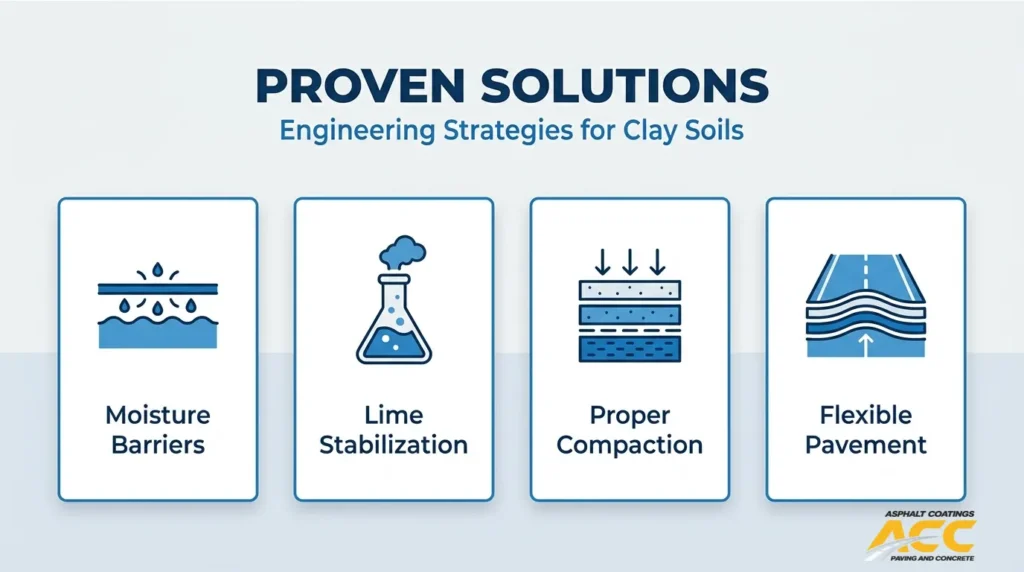
Engineering strategies that mitigate heaving on expansive clay include moisture barriers, chemical stabilization, proper compaction with engineered subbase design, and flexible pavement sections. Each approach targets a different mechanism of soil movement.
How Does Moisture-Barrier Installation Reduce Soil Swelling?
Moisture-barrier installation reduces soil swelling by intercepting water before it reaches expansive subgrade material. Vertical barriers, placed along pavement edges, work alongside horizontal barriers to block lateral and downward moisture migration into clay layers. This combination is especially important in the Pikes Peak region, where seasonal precipitation shifts can rapidly alter soil moisture content beneath parking lots. According to the City of Colorado Springs Engineering Criteria Manual, chemical stabilization using lime requires a laboratory mix design achieving a pH of 12.3 or higher and must reduce soil swell to less than 1% at a 200 psf surcharge. When moisture control is paired with stabilization, the subgrade remains far more volumetrically stable across wet-dry cycles.
How Does Lime or Cement Stabilization Treat Expansive Subgrade?
Lime or cement stabilization treats expansive subgrade by chemically altering clay mineralogy to reduce its capacity to absorb water. Lime reacts with montmorillonite and other smectite minerals, permanently lowering the soil’s Plasticity Index and swell potential. According to a Texas A&M Transportation Institute study, cement treatment alone is generally not effective on expansive soils unless lime agents are also included to first reduce the Plasticity Index. This sequenced approach is critical in Colorado Springs, where high-PI Pierre Shale subgrades demand thorough chemical modification before any structural paving begins. For property managers, skipping the lime pre-treatment step is one of the most common and costly mistakes in commercial parking lot construction on Pikes Peak clay.
Why Is Proper Compaction and Subbase Design Critical on Clay Soils?
Proper compaction and subbase design are critical on clay soils because they create a stable load-distribution layer between the pavement structure and reactive subgrade. A well-graded aggregate subbase distributes wheel loads over a wider area, reducing point stresses that can trigger differential heave. Compaction must target specific density thresholds; in El Paso County, fill soils require a swell potential of 0.5% or less under a 200 psf surcharge when compacted to 95% density. Under-compacted or poorly graded subbases allow moisture pockets to form, accelerating localized swelling. Investing in thorough subbase engineering upfront consistently proves more cost-effective than addressing heave-related failures after paving.
How Do Flexible Pavement Sections Absorb Minor Soil Movement?
Flexible pavement sections absorb minor soil movement by distributing stress through multiple deformable layers rather than resisting it with rigid slabs. Hot-mix asphalt, combined with properly designed aggregate base and subbase courses, flexes incrementally as underlying clay expands or contracts. This flexibility reduces the surface cracking and buckling that rigid concrete sections commonly experience over expansive subgrade. Thicker asphalt lifts and geotextile interlayers further enhance a flexible section’s ability to tolerate small vertical displacements without compromising ride quality or drainage. For commercial parking lots across the Pikes Peak region, flexible pavement design paired with the stabilization and moisture-control strategies outlined above offers the most resilient defense against ongoing clay movement.
With mitigation strategies selected, property managers must next evaluate how to address heaving that has already damaged existing parking lots.
How Should Property Managers Address Heaving in Existing Parking Lots?
Property managers should address heaving in existing parking lots by combining liability assessments, ADA slope evaluations, and cost-informed repair decisions. The sections below cover when reconstruction is necessary versus targeted repair and how ongoing maintenance slows heave progression.
When Does Heaving Require Full Reconstruction Versus Repair?
Heaving requires full reconstruction when subgrade failure is widespread, ADA slope tolerances exceed 2%, or structural integrity cannot be restored through surface-level methods. Localized heaving confined to isolated sections often qualifies for targeted repair instead.
The decision hinges on severity and cost. According to Restoration Systems Inc., strategic restoration and repair of parking structures can save 60–80% of the cost compared to full replacement, which can range from $28,000 to $35,000 per parking space. Key factors that push a project toward reconstruction include:
- Subgrade clay has not been stabilized, and swell potential remains uncontrolled beneath the full pavement section.
- Multiple areas show vertical displacement exceeding 1/4 inch, creating trip hazards across accessible routes.
- Drainage has been permanently redirected by heave-induced grade changes, causing ponding and accelerated deterioration.
For most commercial properties in Colorado Springs, a geotechnical evaluation of the existing subgrade should guide this decision before committing to either path.
How Does Ongoing Sealcoating and Maintenance Slow Heave Damage?
Ongoing sealcoating and maintenance slow heave damage by sealing the pavement surface against moisture infiltration, which is the primary trigger for clay expansion beneath the subgrade. Crack sealing is especially critical because even hairline fractures allow water to reach moisture-sensitive soil layers.
Timely maintenance such as crack sealing can extend an asphalt parking lot’s lifespan from an average of 15 years to approximately 30 years by preventing water from penetrating the subbase. A consistent maintenance schedule should include:
- Sealcoating every two to three years to maintain the surface moisture barrier.
- Crack sealing as soon as cracks appear, before seasonal precipitation drives water into expansive clay.
- Regular drainage inspections to confirm water is not pooling near pavement edges or expansion joints.
These measures do not eliminate heave risk entirely, but they significantly reduce the rate at which moisture reaches reactive soils. With a maintenance plan in place, professional construction ensures long-term pavement stability on Pikes Peak clay.
How Can Professional Parking-Lot Construction Prevent Heaving on Pikes Peak Clay Soils?
Professional parking-lot construction prevents heaving on Pikes Peak clay soils through geotechnical assessment, proper subgrade treatment, and moisture management designed for this region’s expansive formations. The following sections cover Asphalt Coatings Company’s local expertise and the key takeaways from this guide.
Can Asphalt Coatings Company’s Colorado-Specific Paving Expertise Help With Expansive Soil Challenges?
Yes, Asphalt Coatings Company’s Colorado-specific paving expertise can help with expansive soil challenges. Since 1986, Asphalt Coatings Company has served Colorado’s Front Range with commercial asphalt paving, subgrade preparation, and parking lot construction built around the region’s unique geology and climate. Asphalt Coatings Company performs all work with in-house crews, maintaining direct quality control over grading, compaction, and drainage systems critical for sites underlain by expansive clay. Services directly relevant to heave prevention include:
- Subgrade preparation and grading tailored to moisture-sensitive soils
- New construction paving with proper base design
- ADA-compliant concrete work to maintain slope tolerances
- Crack sealing and sealcoating to prevent water infiltration into subgrade layers
For property managers across Colorado Springs managing commercial lots on Pierre Shale or Dawson formation soils, partnering with a contractor who understands local municipal engineering standards is essential to long-term pavement performance.
What Are the Key Takeaways About Why Expansive Clay Soils Cause Parking-Lot Heaving Across the Pikes Peak Region?
The key takeaways about why expansive clay soils cause parking-lot heaving across the Pikes Peak region center on geology, climate, and proactive engineering. According to the Colorado Geological Survey, the Pierre Shale formation and the claystone of the Dawson formation in this region carry moderate to very high swelling potential. Combined with semi-arid wet-dry cycles, these soils generate relentless upward pressure beneath pavement.
Property managers should remember these core lessons:
- Montmorillonite-rich clays absorb water between mineral plates, generating thousands of pounds of uplift force per square foot.
- Seasonal moisture fluctuations and freeze-thaw cycles compound cumulative damage year over year.
- Geotechnical testing before paving identifies swell potential and guides subgrade treatment selection.
- Lime stabilization, moisture barriers, and flexible pavement sections are proven mitigation strategies.
- Ongoing maintenance, including sealcoating and crack sealing, slows moisture infiltration that triggers heaving.
Few resources currently compare the ROI of lime stabilization versus standard over-excavation for commercial parking lots in this region. Making informed mitigation decisions now protects pavement longevity, ADA compliance, and property value for years to come.