Colorado Springs’ updated Drainage Criteria Manual (DCM) is the city’s consolidated regulatory document governing stormwater detention, water quality treatment, erosion control, and best management practices for all commercial development and redevelopment sites. It carries binding enforcement authority under the city’s MS4 Permit, Consent Decree, and Intergovernmental Agreement with Pueblo County.
This guide covers the manual’s regulatory foundation and recent updates, key design changes for commercial paving, parking lot standards and stormwater BMPs, permitting requirements, climate-specific compliance challenges, and material selection strategies.
The updated DCM consolidates previously scattered policy clarifications into a single enforceable standard, which means commercial property owners can no longer rely on older guidance documents during plan review or inspection. Stricter stormwater detention sizing, new impervious surface limits, revised water quality treatment standards, and wider floodplain setbacks all reshape how parking lots, driveways, and access roads must be designed.
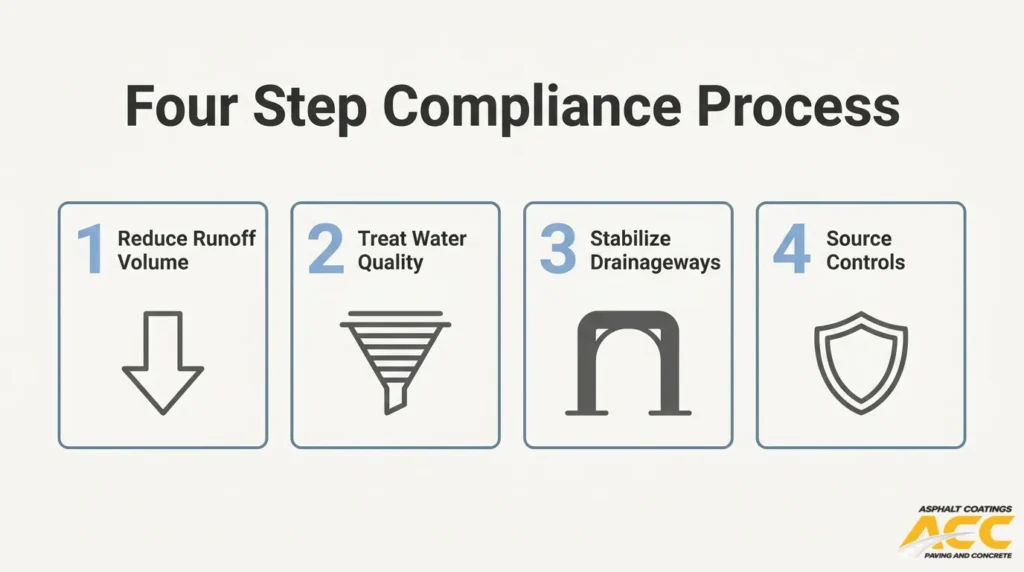
Every commercial project must now follow the city’s Four Step Process: reducing runoff volumes, treating the water quality capture volume, stabilizing drainageways, and implementing long-term source controls. Bioswales, underground detention systems, and permeable pavers each serve distinct compliance roles depending on site constraints.
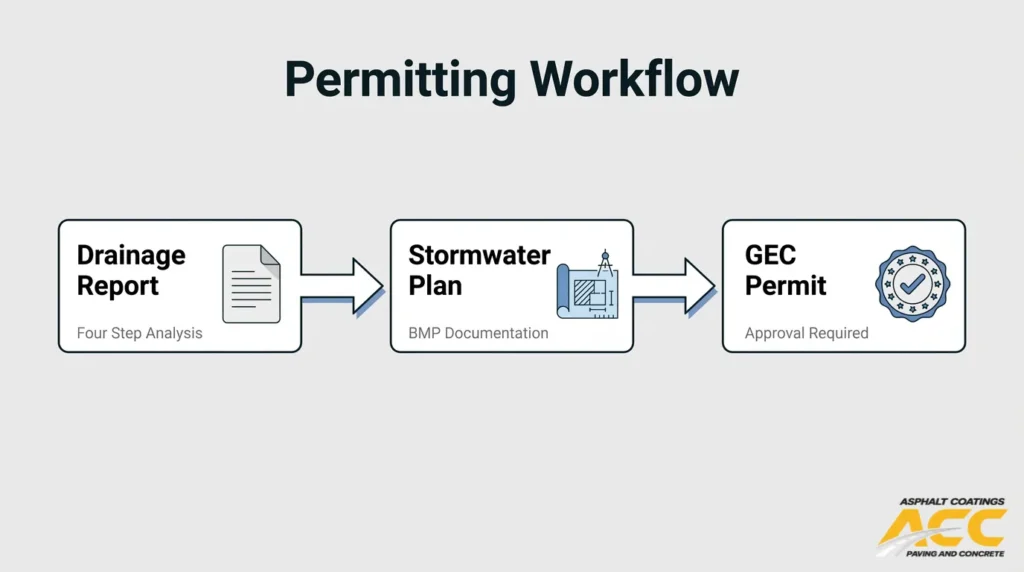
Permitting requires drainage reports, stormwater management plans, and Grading and Erosion Control Permits before any land disturbance begins. Incomplete submissions are one of the most common causes of project delays.
Colorado Springs’ extreme freeze-thaw cycling adds a layer of complexity that affects pavement integrity, inlet connections, and BMP performance over time. Material selection and proper subgrade preparation directly determine whether a drainage system maintains compliance beyond its first winter.
Non-compliance triggers stop work orders, emergency abatement at the owner’s expense, and mandatory retrofit installations that cost significantly more than building correctly from the start.
What Is the Colorado Springs Drainage Criteria Manual?
The Colorado Springs Drainage Criteria Manual is the city’s official regulatory document governing how stormwater runoff must be managed on development sites, including commercial paving projects. It establishes design standards for detention, water quality treatment, erosion control, and best management practices that property owners and contractors must follow.
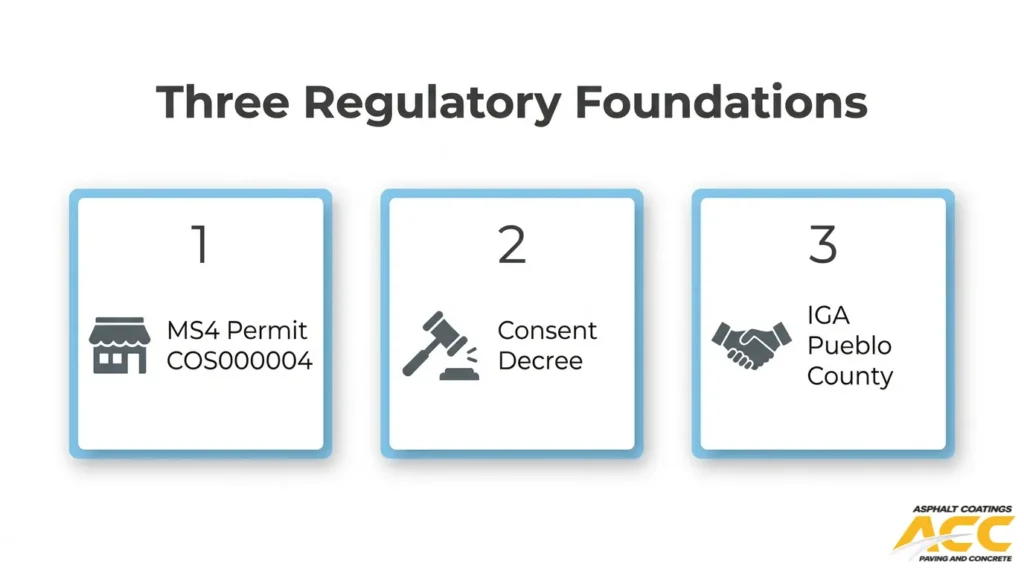
According to the City of Colorado Springs Stormwater Enterprise, the stormwater criteria is written to fulfill the city’s regulatory requirements, including the Municipal Separate Storm Sewer System (MS4) Permit (COS000004), the stormwater Consent Decree, and the 2016 Intergovernmental Agreement with Pueblo County. These three obligations form the legal backbone of the manual, each addressing a different dimension of stormwater pollution prevention and infrastructure accountability.
The Consent Decree, in particular, stems from an EPA enforcement action requiring the city to restore pollution reduction capacity lost when permanent stormwater management structures were not installed at certain developments. That federal settlement elevated drainage compliance from a local planning preference to a legally binding mandate, which is why the manual carries real enforcement weight for commercial projects today.
For commercial property owners in Colorado Springs, the manual dictates requirements across several critical areas:
- Stormwater detention sizing and design for new and redeveloped impervious surfaces.
- Water quality treatment standards using the Four Step Process for receiving water protection.
- Best management practices (BMPs) for construction and post-construction phases, including mandatory inspections.
- Grading and erosion control permits required before any land-disturbing activity begins.
- Floodplain and erosion setback rules that affect site layout and paving boundaries.
The manual is not merely advisory. Violations can trigger stop work orders, and the Stormwater Enterprise Manager holds authority to take emergency enforcement actions at the property owner’s expense when public safety or water resources face imminent hazard. For any commercial paving project in Colorado Springs, understanding this document is the first step toward compliant site design and avoiding costly project delays.
Why Did Colorado Springs Update Its Drainage Criteria Manual?
Colorado Springs updated its Drainage Criteria Manual to clarify requirements tied to the city’s regulatory obligations and to consolidate scattered policy guidance into one unified document. The update addresses compliance with federal mandates, resolves gaps exposed by past enforcement actions, and reflects evolving stormwater management standards.
The DCM update incorporates and supersedes all existing stormwater Policy Clarifications, according to the City of Colorado Springs. This consolidation eliminates confusion that arose when property owners and contractors had to cross-reference multiple standalone policies against the original manual. For commercial paving projects, where stormwater runoff from impervious surfaces is a primary concern, fragmented guidance created real compliance risks.
Several regulatory pressures drove the revision. The city operates under its Municipal Separate Storm Sewer System (MS4) Permit, a stormwater Consent Decree resulting from federal enforcement, and a 2016 Intergovernmental Agreement with Pueblo County. Each of these instruments imposes distinct obligations for how developed sites manage runoff quality and volume. Rather than continuing to layer policy clarifications on top of an outdated manual, the city chose to rebuild the guidance framework so that all three regulatory requirements are addressed cohesively.
For commercial property owners planning paving projects in Colorado Springs, this matters because the updated manual is now the single authoritative source for drainage design standards, detention sizing, water quality treatment, and erosion control. Misinterpreting an outdated policy clarification is no longer a valid defense during plan review or inspection. Understanding what specifically changed, particularly for impervious surfaces, detention, and water quality treatment, is essential before breaking ground on any new construction or redevelopment project.
What Are the Key Changes Affecting Commercial Paving Projects?
The key changes affecting commercial paving projects involve stricter stormwater detention, new impervious surface limits, revised water quality treatment standards, and updated floodplain and erosion setback rules.
How Have Stormwater Detention Requirements Changed?
Stormwater detention requirements have changed to align with the City’s consolidated regulatory framework. According to the City of Colorado Springs, the DCM update is intended to clarify requirements related to the City’s various regulatory obligations, including the MS4 Permit, Consent Decree, and IGA, and will incorporate or supersede all existing stormwater Policy Clarifications.
For commercial paving projects, this consolidation means previously scattered guidance now lives under a single, enforceable standard. Detention facility sizing, release rates, and maintenance obligations are no longer subject to interpretation across multiple policy documents. Property owners who designed systems under older clarifications should verify that existing infrastructure still meets the unified criteria. In practice, this is one of the most overlooked compliance risks for established commercial sites undergoing repaving or expansion.
What Are the New Impervious Surface Limits?
The new impervious surface limits encourage property owners to reduce traditional hard-surface coverage and integrate stormwater-friendly alternatives. As defined by the U.S. Environmental Protection Agency, permeable pavements are a stormwater control that allows stormwater to infiltrate through the surface of the pavement to the ground below, serving as a green infrastructure alternative to traditional impervious surfaces.
Commercial sites in Colorado Springs must now account for total impervious area when designing or repaving parking lots, driveways, and access roads. Key considerations include:
- Calculating net impervious surface as a percentage of total lot area.
- Incorporating permeable pavement sections to offset traditional asphalt or concrete coverage.
- Documenting infiltration capacity in required drainage reports.
For most commercial properties, balancing durability with permeability is the real challenge; site-specific soil conditions in Colorado Springs make this a decision that demands local experience.
How Have Water Quality Treatment Standards Been Revised?
Water quality treatment standards have been revised to require more rigorous pollutant removal before stormwater leaves a commercial site. The updated DCM places greater emphasis on capturing and treating the water quality capture volume through approved best management practices.
Commercial paving projects must now integrate treatment measures such as:
- Bioretention cells positioned adjacent to paved areas.
- Sediment traps or filtration devices at drainage inlets.
- Vegetated buffer strips between parking surfaces and discharge points.
These standards reflect Colorado Springs’ obligations under its MS4 Permit and Consent Decree, which prioritize pollution reduction from developed sites. Failing to incorporate water quality treatment into a paving project’s drainage design is a common reason for permit delays.
What Changed for Floodplain and Erosion Setback Rules?
Floodplain and erosion setback rules changed to impose wider buffer zones between commercial paved surfaces and designated waterways or erosion-prone areas. The updated manual requires commercial projects to maintain greater separation distances from floodplain boundaries and drainageway corridors.
These revisions affect site layout decisions for properties near Fountain Creek, Monument Creek, and their tributaries throughout Colorado Springs. Paving contractors and property owners should anticipate:
- Reduced buildable area on parcels adjacent to mapped floodplains.
- Stricter grading requirements within erosion setback zones.
- Additional stabilization measures for any land disturbance near waterway buffers.
Given Colorado Springs’ semi-arid climate, where intense summer storms can rapidly transform dry channels into high-velocity flows, these expanded setbacks are a practical safeguard that directly shapes where and how commercial paving can be placed.
How Does the Updated Manual Affect Parking Lot Design?
The updated manual affects parking lot design by imposing stricter grading tolerances, revised inlet spacing, and expanded pervious pavement criteria. The following subsections cover slope standards, catch basin placement, and approved permeable surface options.
What Grading and Slope Standards Apply to Commercial Lots?
The grading and slope standards that apply to commercial lots require precise surface contouring to direct stormwater toward designated collection points without ponding or erosion. A Grading and Erosion Control (GEC) Permit is required prior to clearing, grading, excavation, filling, and other land-disturbing activities, according to the City of Colorado Springs Stormwater Enterprise.
Commercial parking lots in Colorado Springs typically must maintain:
- A minimum cross-slope sufficient to prevent standing water on paved surfaces.
- Maximum grades that keep runoff velocities low enough to prevent erosion at pavement edges.
- Transitions between parking areas and drive aisles graded to channel flow toward inlets rather than neighboring properties.
Proper subgrade preparation before paving is just as critical as the finished surface grade, because settling after construction can reverse intended drainage patterns entirely.
How Must Inlet and Catch Basin Placement Be Adjusted?
Inlet and catch basin placement must be adjusted to capture the water quality volume before runoff leaves the site. Colorado Springs requires use of the Four Step Process for receiving water protection, which focuses on reducing runoff volumes, treating the water quality capture volume, stabilizing drainageways, and implementing long-term source controls.
Key placement considerations include:
- Positioning inlets at low points created by the lot’s grading plan so runoff collects efficiently.
- Spacing catch basins closely enough to handle peak flows without surface flooding across driving lanes.
- Connecting inlets to downstream BMPs or detention systems that treat captured stormwater before discharge.
Undersized or poorly spaced inlets are one of the most common reasons commercial sites fail drainage inspections; correcting them after paving is far more expensive than designing them correctly from the start.
What Pervious Pavement Options Satisfy the New Criteria?
The pervious pavement options that satisfy the new criteria include permeable asphalt, permeable concrete, and interlocking permeable pavers. According to a U.S. Environmental Protection Agency technical document, permeable pavements are a stormwater control that allows stormwater to infiltrate through the surface of the pavement to the ground below, serving as a green infrastructure alternative to traditional impervious surfaces.
Each option performs differently under Colorado Springs conditions:
- Permeable asphalt uses an open-graded mix over a stone reservoir base, allowing water to pass through the surface layer.
- Permeable concrete functions similarly but with a cementitious binder and is often used for sidewalks and lighter-traffic zones.
- Interlocking permeable pavers feature joint spaces filled with aggregate that channel water into the subbase.
For high-traffic commercial lots in Colorado Springs, permeable asphalt often strikes the best balance between structural durability and infiltration performance, especially when paired with proper subgrade preparation for freeze-thaw resilience. Understanding BMP requirements strengthens compliance even further.
What Stormwater BMPs Does the Manual Require for Paved Sites?
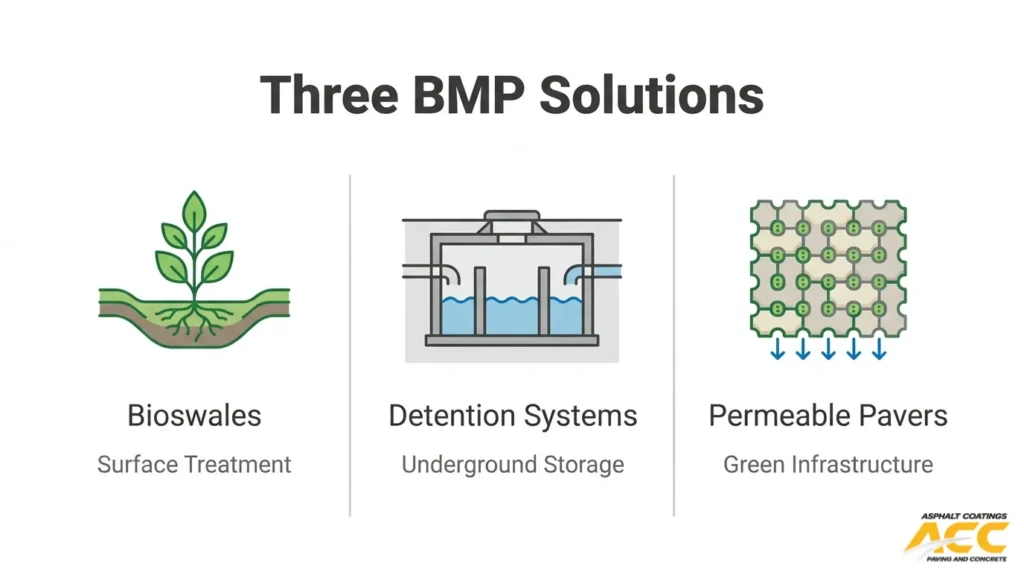
The manual requires Best Management Practices (BMPs) for all new construction and redevelopment to treat stormwater runoff from paved sites. Bioswales, underground detention, and permeable pavers each address different compliance scenarios.
How Do Bioswales Meet Commercial Drainage Requirements?
Bioswales meet commercial drainage requirements by capturing and filtering stormwater runoff before it enters the municipal storm sewer system. These vegetated channels, typically installed along parking lot perimeters or medians, slow runoff velocity while allowing sediment and pollutants to settle naturally.
For paved commercial sites in Colorado Springs, bioswales serve a dual function: they reduce the volume of runoff leaving a property and improve water quality, both of which the updated manual emphasizes. Proper grading during installation ensures water flows into the swale rather than bypassing it. Soil composition and plant selection must account for Colorado Springs’ semi-arid climate and freeze-thaw conditions, since poorly designed bioswales can become maintenance liabilities rather than compliance assets.
When Are Underground Detention Systems Required?
Underground detention systems are required when a commercial site lacks sufficient surface area for open stormwater management features. Dense parking configurations, high lot coverage ratios, and constrained urban parcels often make surface-level BMPs impractical.
According to the City of Colorado Springs, BMPs are mandatory for new construction and redevelopment to treat stormwater runoff, with inspections now required to ensure proper functioning and maintenance. Underground vaults and chamber systems satisfy this mandate by temporarily storing runoff below the pavement surface and releasing it at controlled rates. These systems are particularly common beneath large commercial parking lots where every square foot of surface serves a revenue-generating purpose. Selecting the right chamber sizing depends on site-specific drainage calculations outlined in the required drainage report.
How Do Permeable Pavers Factor Into Compliance?
Permeable pavers factor into compliance by allowing stormwater to infiltrate directly through the pavement surface rather than generating sheet runoff. This infiltration-based approach reduces the total volume of runoff a site produces, which directly supports the manual’s volume-reduction objectives.
As the U.S. Environmental Protection Agency notes, permeable pavements serve as a green infrastructure alternative to traditional impervious surfaces, allowing stormwater to reach the ground below. For commercial properties in Colorado Springs, permeable pavers can reduce or even eliminate the need for separate detention infrastructure when site conditions allow adequate subsurface drainage. However, freeze-thaw cycling at this elevation demands careful aggregate selection and joint design to prevent heaving. Routine maintenance, including vacuum sweeping to prevent clogging, keeps these systems performing at the level inspectors expect.
With appropriate BMPs selected, the next step is understanding which permits Colorado Springs requires before construction begins.
What Permitting Steps Must Commercial Projects Follow?
Commercial projects in Colorado Springs must follow a sequence of permitting steps that includes submitting drainage reports, developing stormwater management plans, and completing the city’s review process.
What Drainage Reports Does the City Require?
The City of Colorado Springs requires drainage reports that demonstrate compliance with its Four Step Process for receiving water protection. According to the City’s municipal code, this process focuses on four objectives:
- Reducing runoff volumes from the development site.
- Treating the water quality capture volume before discharge.
- Stabilizing drainageways to prevent erosion.
- Implementing long-term source controls for ongoing protection.
Commercial paving projects must document how site design addresses each step. For parking lots and other large impervious surfaces, the drainage report typically quantifies pre-development versus post-development runoff and identifies specific BMPs that offset added volume. Submitting an incomplete report is one of the most common causes of permit delays, so addressing all four steps upfront saves significant time.
When Is a Stormwater Management Plan Needed?
A stormwater management plan is needed when a commercial project disturbs land or adds impervious surface that increases pollutant discharge risk to the municipal storm sewer system. According to the U.S. Environmental Protection Agency, certain operators must obtain NPDES permits and develop stormwater management programs (SWMPs) describing stormwater control practices that minimize pollutant discharge into MS4s.
In Colorado Springs, this requirement carries additional weight. The city operates under a federal consent decree that obligates it to restore pollution reduction capacity lost when permanent stormwater management structures were not installed at past developments. As a result, new commercial paving projects face stricter plan requirements than many applicants expect. Preparing a thorough SWMP early in the design phase prevents costly redesigns after submission.
How Long Does Drainage Permit Review Take?
Drainage permit review in Colorado Springs typically takes several weeks, though timelines vary based on project complexity and submission completeness. A Grading and Erosion Control (GEC) Permit must be approved before any clearing, grading, or land-disturbing activity begins, and GEC Plans along with construction stormwater management plans require approval before permit issuance.
Projects with straightforward drainage designs and complete documentation move through review faster. Incomplete submissions, missing BMP details, or failure to address the Four Step Process often trigger resubmittal cycles that add weeks to the timeline. For commercial property managers planning tight construction schedules, front-loading the documentation effort is the most reliable way to avoid delays.
With permitting requirements defined, selecting the right paving materials becomes the next critical compliance decision.
How Do Freeze-Thaw Cycles in Colorado Springs Impact Drainage Compliance?
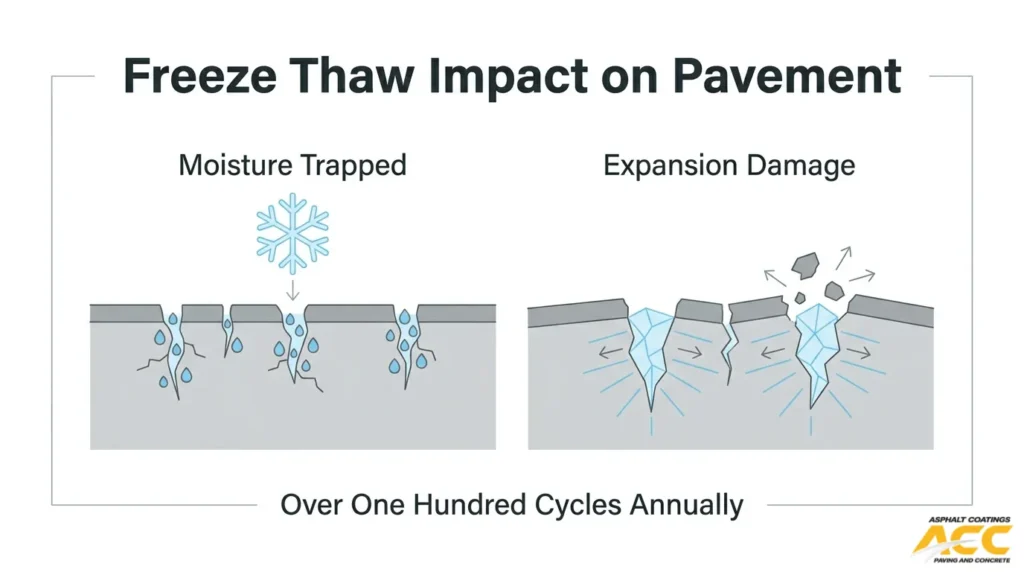
Freeze-thaw cycles in Colorado Springs impact drainage compliance by accelerating pavement deterioration, shifting subgrade soils, and compromising the structural integrity of stormwater management features. Colorado Springs experiences over 100 freeze-thaw cycles annually due to its semi-arid climate, high elevation, and dramatic temperature swings between day and night. Each cycle forces moisture trapped in pavement cracks and base layers to expand as ice, then contract upon thawing, progressively widening fractures and undermining drainage infrastructure.
This repetitive stress creates specific compliance risks for commercial properties subject to the Drainage Criteria Manual. Detention structures, inlet connections, and graded surfaces designed to direct stormwater can lose their engineered slopes when frost heave displaces underlying soils. Permeable pavement systems are particularly vulnerable; if the aggregate reservoir beneath the surface freezes while saturated, the infiltration capacity the system was designed to provide can be temporarily or permanently reduced.
For commercial paving projects, the practical consequences include:
- Alligator cracking and potholing that redirects sheet flow away from designed drainage paths.
- Settlement around catch basins and inlets, creating ponding zones that violate grading standards.
- Frost heave beneath curb and gutter sections, breaking the sealed connection between pavement edge and stormwater conveyance.
- Degraded sealcoat and crack seal barriers, allowing increased water infiltration into base layers during subsequent cycles.
Proactive material selection and construction practices mitigate these risks. Properly compacted subgrade, adequate base thickness, and CDOT-approved crack sealing materials all extend pavement life through harsh Colorado winters. Thicker aggregate reservoirs beneath permeable installations provide a buffer against freeze penetration. Scheduling sealcoat applications and drainage inspections before the fall freeze season helps commercial properties maintain the BMP performance that the city requires. According to the City of Colorado Springs, BMPs for new construction and redevelopment must treat stormwater runoff from a site, and inspections are required to ensure proper functioning and maintenance.
For property owners navigating the updated DCM, freeze-thaw resilience is not optional; it is a core compliance consideration. A drainage system that meets criteria on paper but fails after two winters of thermal cycling exposes the property to enforcement action and costly repairs. Designing with Colorado Springs’ climate in mind from the outset is the most reliable path to sustained compliance, and it is one of the areas where local construction experience matters most.
Understanding how freeze-thaw cycles affect drainage sets the stage for recognizing the enforcement consequences of non-compliance.
What Happens If a Commercial Property Fails to Comply?
A commercial property that fails to comply with Colorado Springs’ Drainage Criteria Manual faces enforcement actions ranging from stop work orders to full remediation at the owner’s expense. Consequences escalate based on the severity of the violation and the risk to public safety or water resources.
The Stormwater Enterprise holds broad authority to act swiftly when violations threaten the municipal storm sewer system. According to the City of Colorado Springs municipal code, if an imminent and substantial hazard exists that jeopardizes public safety, property, or water resources, the Stormwater Enterprise Manager may issue an immediate stop work order or take emergency actions to abate the hazard at the full expense of the record owner of the property.
Common enforcement consequences for non-compliant commercial properties include:
- Stop work orders halt all site activity until violations are corrected, delaying project timelines indefinitely.
- Emergency abatement allows the city to perform corrective work and bill the property owner directly for all costs incurred.
- Permit denial or revocation prevents new development or redevelopment from proceeding until drainage deficiencies are resolved.
- Required retrofit installation may force property owners to add stormwater management structures, such as detention systems or BMPs, after construction is already complete.
- Ongoing inspection requirements ensure that any corrective measures function properly over time.
For commercial property owners in Colorado Springs, the financial exposure from non-compliance often exceeds the cost of building drainage systems correctly from the start. Retroactive installations are inherently more expensive because they require demolition, redesign, and reconstruction of surfaces that were already completed. This makes early compliance planning one of the most cost-effective decisions in any commercial paving project.
Understanding enforcement risk is essential, but selecting the right paving materials also plays a critical role in meeting drainage standards.
What Role Does Material Selection Play in Meeting Drainage Standards?
Material selection plays a central role in meeting drainage standards because surface type directly controls how stormwater moves across, through, or off a commercial site. The sections below examine how asphalt grading and concrete integration each affect compliance.
How Does Asphalt Grading Affect Stormwater Runoff?
Asphalt grading affects stormwater runoff by dictating the speed, direction, and volume of water flowing across a paved surface. Properly graded asphalt directs sheet flow toward inlets, swales, or detention areas, preventing ponding and off-site discharge that violates the Drainage Criteria Manual.
According to the City of Colorado Springs Stormwater Enterprise, a Grading and Erosion Control Permit is required prior to clearing, grading, excavation, filling, and other land-disturbing activities, with approved plans needed before permit issuance. Permeable asphalt options also allow stormwater to infiltrate through the pavement surface to the ground below, serving as a green infrastructure alternative to traditional impervious surfaces.
Selecting the right asphalt mix and grade profile is one of the most effective ways to satisfy both runoff volume reduction and water quality treatment goals simultaneously.
How Does Concrete Perform for Drainage Channel Integration?
Concrete performs well for drainage channel integration because of its structural rigidity, smooth hydraulic profile, and long service life under concentrated water flow. Formed concrete channels, curb-and-gutter systems, and v-ditches maintain consistent cross-sections that keep stormwater moving at design velocities toward collection points.
Key advantages of concrete in drainage channel applications include:
- Dimensional stability: Concrete holds precise grades and slopes over time, reducing maintenance-related compliance risks.
- Erosion resistance: Lined concrete channels prevent scour that can destabilize adjacent pavement sections.
- Design versatility: Concrete accommodates custom inlet transitions, flared end sections, and ADA-compliant surface drainage details.
For most commercial sites in Colorado Springs, pairing asphalt driving surfaces with concrete drainage infrastructure produces the strongest compliance outcome while balancing cost and durability.
With material decisions guiding drainage performance, partnering with an experienced local contractor ensures these choices translate into compliant construction.
How Should You Approach Drainage-Compliant Commercial Paving with an Experienced Colorado Springs Contractor?
You should approach drainage-compliant commercial paving by partnering with a contractor who combines material expertise with deep knowledge of the Drainage Criteria Manual, especially its MS4 permit. The following sections cover how full-service capabilities support compliance and the key takeaways from this guide.
Can Full-Service Asphalt and Concrete Expertise Help Meet Drainage Manual Requirements?
Yes, full-service asphalt and concrete expertise can help meet Drainage Manual requirements by consolidating grading, paving, and stormwater infrastructure under one team. Asphalt Coatings Company provides asphalt paving, concrete flatwork, curb and gutter installation, and subgrade preparation with in-house crews across Colorado Springs. This single-source approach eliminates coordination gaps between separate grading, paving, and drainage subcontractors, reducing the risk of design inconsistencies that trigger permit rejections.
With 39 years of experience on Colorado’s Front Range, Asphalt Coatings Company designs pavement sections and surface grades specifically for local freeze-thaw cycles and high-altitude UV exposure. Partnering with a contractor who understands both material performance and federal funding regulations keeps commercial projects compliant from the first grading permit through final BMP inspection.
What Are the Key Takeaways About Navigating Colorado Springs’ Updated Drainage Criteria Manual for Commercial Paving?
The key takeaways about navigating Colorado Springs’ updated Drainage Criteria Manual for commercial paving are:
- The DCM fulfills regulatory obligations under the MS4 Permit, Consent Decree, and Pueblo County IGA, making compliance non-optional for commercial sites.
- Every project must follow the Four Step Process: reduce runoff volumes, treat the water quality capture volume, stabilize drainageways, and implement long-term source controls.
- Grading and Erosion Control Permits, drainage reports, and approved stormwater management plans are required before any land-disturbing activity begins.
- BMPs such as bioswales, underground detention, and permeable pavers must be installed and maintained with scheduled inspections.
- Material selection, surface grading, and inlet placement directly affect whether a paved site passes drainage review.
For most commercial property owners, the single most valuable step is engaging a qualified contractor early in the design phase, before grading plans are finalized. Asphalt Coatings Company can help Colorado Springs property managers navigate these requirements from initial site assessment through final compliance verification.