Denver’s elimination of parking minimums is a citywide zoning reform that removes all mandatory parking space ratios for new developments, giving commercial property owners full control over how much parking to build or retain.
This guide covers the policy’s origins and mechanics, its impact on existing commercial properties, new development and monetization opportunities, right-sizing parking supply through demand analysis, zoning and permitting rules that still apply, effects on property values and investor sentiment, financial risks of cutting too aggressively, comparisons with other Colorado municipalities, and parking lot optimization during redesign.
Denver City Council voted 9-3 on August 4, 2025, to repeal all minimum vehicle parking requirements, building on state legislation that had already prohibited parking mandates near transit stations. The old rules forced rigid ratios onto every project; restaurants alone required nearly four spaces per 1,000 square feet of indoor area.
For existing properties, the impact depends on current lot utilization and lease terms. Owners with oversized, underused lots gain immediate redevelopment potential, while those with fully utilized parking or long-term lease obligations face a different calculus around timing and tenant negotiations.
The policy unlocks tangible development opportunities: converting surplus pavement into leasable space, expanding building footprints, or selling subdivided parcels. However, right-sizing requires actual demand data, not guesswork. Transit scores, peak-use patterns by property type, and tenant behavior all shape the correct parking count.
Regulatory obligations remain. ADA accessibility standards, stormwater detention requirements, Denver Green Code mandates for EV charging, and site plan review processes apply to every lot modification. Owners who reduce parking without studying demand risk tenant turnover, lease disputes, and depressed valuations.
Across Colorado, adoption varies; Boulder and Fort Collins followed Denver’s lead while Aurora opposed similar reforms, making site-specific due diligence essential for owners operating across multiple Front Range cities.
What Are Parking Minimums and Why Did Denver Eliminate Them?
Parking minimums are zoning rules that require developers to build a set number of parking spaces for each new project. Denver eliminated them in 2025 to reduce housing costs, encourage transit use, and give property owners more flexibility. The following sections cover the previous requirements, the specific policy changes, and the motivations behind Denver’s decision.
What Were Denver’s Previous Parking Minimum Requirements?
Denver’s previous parking minimum requirements mandated specific ratios of parking spaces tied to building use and size. Under the former rules, market-rate apartments required one parking space per dwelling unit, while restaurants required nearly four spaces for every 1,000 square feet of indoor space, according to Denver Community Planning and Development’s background report.
These ratios often forced developers to dedicate more land to vehicles than to the people occupying the buildings. Even in zone districts with no parking mandate, the market still drove construction of parking; a downtown office building at 1901 Lawrence Street provided 633 spaces despite zero being required by the D-C zone district. For commercial property owners, the old framework locked valuable land into fixed-use parking regardless of actual demand.
What Policy Changes Did Denver Adopt in 2025?
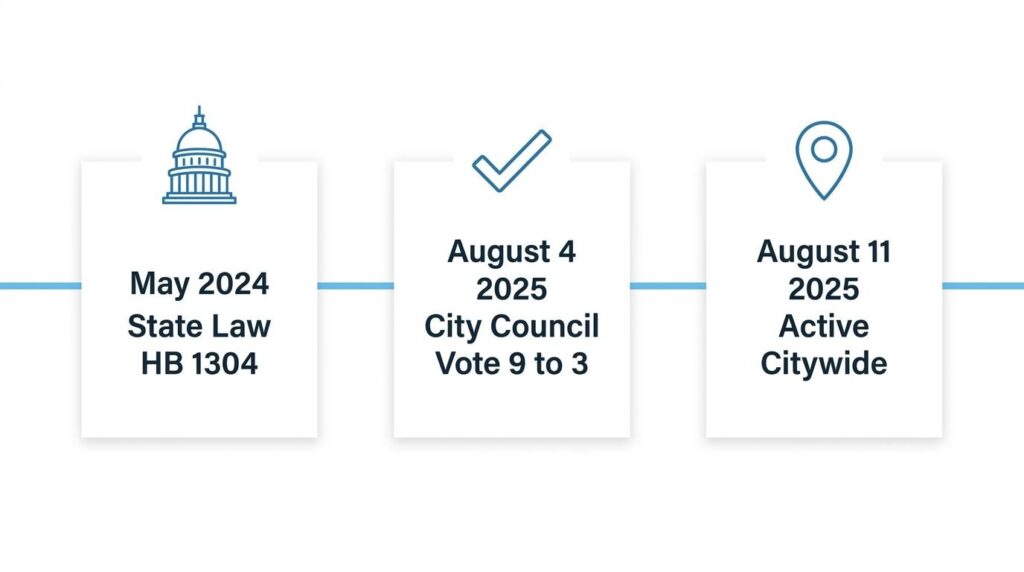
Denver adopted a citywide repeal of all minimum vehicle parking requirements for new developments in 2025. Denver City Council voted 9-3 on August 4, 2025, to approve Bill 25-0684, titled “A bill for an ordinance amending the Denver Zoning Code, by repealing minimum vehicle parking requirements.” Mayor Mike Johnston signed the bill on August 6, 2025, and the new rules took effect on August 11, 2025.
This action built on state legislation. In May 2024, the Colorado Legislature passed HB24-1304, which prohibits municipalities from enforcing parking minimums for multifamily residential development within a quarter-mile of most transit stations. Denver’s ordinance went further by applying the repeal citywide across all property types. Not every Colorado municipality followed suit; the Aurora City Council voted to oppose similar zoning changes at its June 9, 2025, meeting.
Why Did Denver Move to Eliminate Parking Minimums?
Denver moved to eliminate parking minimums to allow more housing development and shift the city away from car dependency. According to Denverite’s reporting, Denver City Council approved the measure to accomplish both goals simultaneously.
Housing affordability drove the decision. Removing expensive parking mandates can save millions in development costs, lowering the per-unit price of new construction. A University of Denver Sturm College of Law simulation using the Terner Housing Simulator found that eliminating parking requirements would increase multifamily housing production by over 460 new units annually, a 13 percent increase from baseline. Denver’s reform also updates Transportation Demand Management requirements so new developments offer subsidized transit passes and car share access. Combined with the Denver Green Code’s 2023 mandate for EV charging infrastructure in commercial parking, the policy positions Denver to prioritize efficient land use over auto-centric planning.
Understanding why Denver made this shift is essential context for evaluating how the policy directly affects existing commercial properties.
How Does This Policy Affect Existing Commercial Properties?
This policy affects existing commercial properties by creating new flexibility for owners to rethink how parking land is used. The impact varies based on current lot utilization, tenant agreements, and redevelopment goals.
How Does It Affect Properties with Oversized Parking Lots?
It affects properties with oversized parking lots by unlocking redevelopment potential on land that was previously mandated for vehicle storage. Many commercial sites built under old zoning ratios now carry far more pavement than tenants or customers actually need.
As Cornelius Brown, PE, notes, “Unless the property is supplementing its retail with entertainment that keeps people on the property, parking designed to historical ratios is underutilized.” This underutilization represents both wasted land and ongoing maintenance costs for asphalt that generates no revenue.
Denver’s market is already responding. The Denver Downtown Development Authority acquired the Denver Pavilions and two adjacent surface parking lots in December 2025, targeting those blocks for revitalization as a central hub of Upper Downtown. For property owners sitting on half-empty lots, the calculus has shifted; excess parking is no longer an obligation but a conversion opportunity.
How Does It Affect Properties with Fully Utilized Lots?
It affects properties with fully utilized lots minimally in the short term, since the policy eliminates minimums rather than imposing maximums. Owners whose parking consistently reaches capacity face no requirement to reduce spaces. The existing supply simply remains in place.
However, the long-term competitive landscape is worth monitoring. As neighboring properties redevelop excess parking into leasable space, fully utilized lots may actually become a differentiator for tenants who prioritize convenient parking. The key consideration is whether current utilization reflects genuine demand or legacy tenant habits that could shift as Denver’s transit infrastructure expands.
How Does It Affect Properties Under Long-Term Leases?
It affects properties under long-term leases by introducing a timing constraint on any parking changes. Most commercial leases include specific parking ratio guarantees, common area maintenance obligations, and co-tenancy provisions that contractually lock in the current lot configuration.
Owners cannot unilaterally reduce parking counts or repurpose paved areas without reviewing lease language first. Key provisions to examine include:
- Minimum parking ratio commitments tied to tenant square footage.
- Exclusive-use clauses that restrict adjacent land changes.
- Common area maintenance cost-sharing formulas based on lot size.
Lease expiration timelines dictate when redevelopment conversations become practical. For properties with staggered lease terms, phased parking reductions aligned with renewal cycles offer the most realistic path forward.
With property-level impacts now clear, understanding the new development opportunities this policy creates is the next step.
What New Development Opportunities Does This Create?
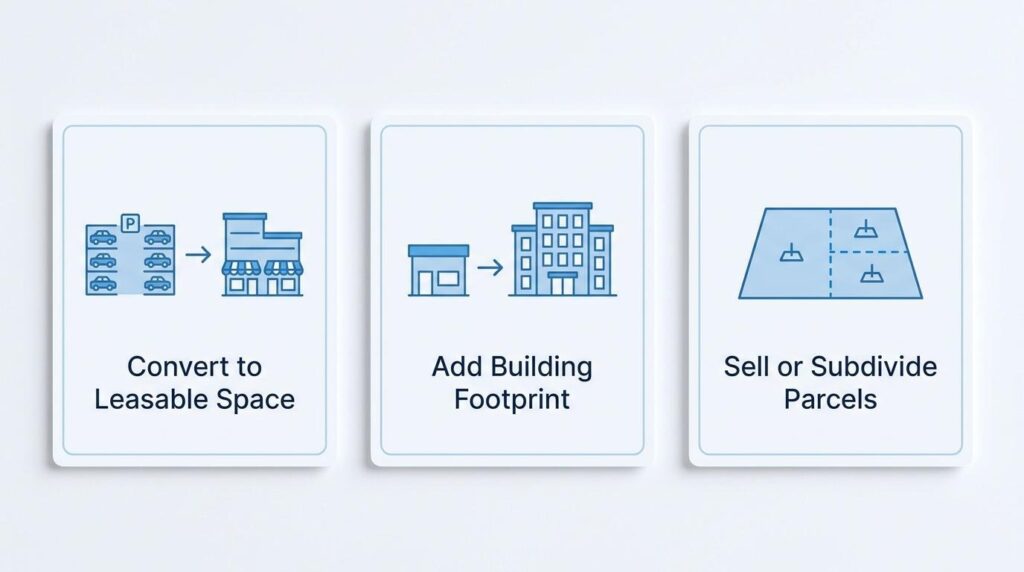
Denver’s parking minimum elimination creates opportunities for owners to redevelop, expand, or monetize underused parking areas. The following subsections cover converting excess parking into leasable space, adding building footprint, and selling or subdividing surplus lots.
Can Owners Redevelop Excess Parking Into Leasable Space?
Yes, owners can redevelop excess parking into leasable space now that Denver no longer mandates minimum parking counts. Surface lots and oversized structured parking represent some of the most valuable conversion opportunities in the city. The DDDA’s acquisition of two surface lots between 15th and 16th Street for $23 million, according to Naked Denver, demonstrates how parking land is already being repositioned for mixed-use development. Quantifying surplus capacity is the essential first step. King County’s Right Size Parking project found that multi-family parking is oversupplied by an average of 0.4 spaces per unit, a pattern consistent with Denver’s own historical overbuilding. For commercial owners sitting on rarely full lots, that surplus translates directly into developable square footage for retail pads, storage facilities, or additional tenant buildouts.
Can Owners Add Building Footprint Where Parking Once Stood?
Yes, owners can add building footprint where parking once stood. With no minimum parking mandate restricting how land is allocated, property owners have the flexibility to expand structures into areas previously reserved for vehicles. According to the American Planning Association, parking mandates often require more land for cars than for the people who live and work in the buildings. That imbalance means many Denver commercial properties have more asphalt devoted to parking than to revenue-generating floor area. Owners considering footprint expansion should conduct a site feasibility study that accounts for setback requirements, stormwater management, and ADA access before breaking ground.
Can Owners Sell or Subdivide Underused Parking Areas?
Yes, owners can sell or subdivide underused parking areas. Denver’s zoning reform removes the regulatory floor that previously locked excess parking in place, so surplus land can now be parceled off through lot splits or sold outright to adjacent developers. This strategy works particularly well for properties with large surface lots where only a fraction of spaces see regular use. Owners should verify that any subdivision complies with current Denver zoning district standards, utility easements, and access requirements before listing parcels. For many commercial properties, monetizing unused pavement may prove more profitable than maintaining it.
With development strategies identified, the next step is determining the right parking supply.
How Should Property Owners Determine the Right Parking Supply?
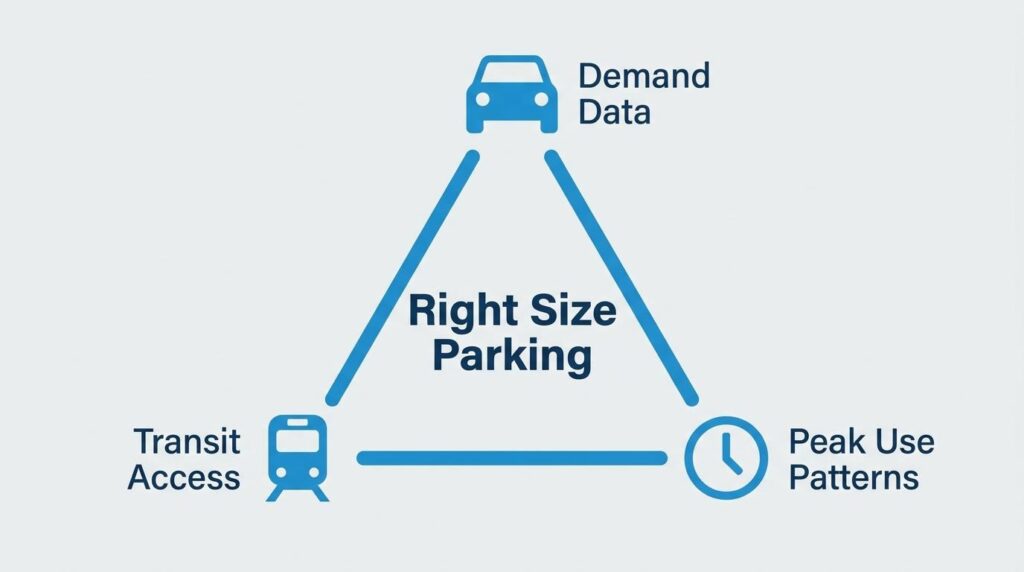
Property owners should determine the right parking supply by analyzing tenant demand data, evaluating transit accessibility, and studying peak-use patterns specific to their property type. The following subsections break down each factor.
What Tenant and Customer Demand Data Should Owners Analyze?
Tenant and customer demand data owners should analyze includes actual occupancy counts, turnover rates, lease requirements, and visitor traffic logs. Counting vehicles at multiple intervals across weekdays and weekends reveals true utilization rather than assumed need. Tenant surveys clarify whether employees drive alone, carpool, or use alternative transportation.
Customer-facing properties benefit from tracking foot traffic against parked-car counts to identify the gap between available spaces and actual demand. King County’s Right Size Parking project found that multi-family parking is oversupplied by an average of 0.4 spaces per unit, according to the county’s transportation research. That pattern holds in many commercial contexts where historical ratios no longer reflect behavior. Owners who collect this data before reconfiguring a lot avoid both costly overbuilding and tenant frustration from undersupply.
How Do Transit Access and Walkability Scores Factor In?
Transit access and walkability scores factor in by quantifying how many tenants and customers can reach a property without a personal vehicle. Properties near RTD light rail stations or high-frequency bus corridors generate measurably lower parking demand because a larger share of daily trips occurs by transit.
Walk Score, Transit Score, and Bike Score provide standardized benchmarks that lenders and appraisers increasingly reference. A commercial property with a Transit Score above 70 in Denver typically supports a smaller lot without tenant complaints. Denver’s parking reform project reinforces this connection by updating Transportation Demand Management requirements so new developments offer subsidized transit passes and support car-share programs. Properties already served by strong transit networks can confidently reduce supply and reallocate that land.
How Do Peak-Use Patterns Differ by Property Type in Denver?
Peak-use patterns differ by property type in Denver based on operating hours, customer dwell time, and seasonal demand cycles. Key distinctions include:
- Office properties peak between 9 a.m. and 3 p.m. on weekdays, with significant vacancy on evenings and weekends.
- Retail centers see midday and weekend surges, particularly during holiday seasons.
- Restaurants and entertainment venues peak during evening hours and weekends, creating inverse schedules from office tenants.
- Medical facilities maintain steadier demand throughout business hours but drop sharply after 5 p.m.
- Industrial and warehouse properties align with shift schedules, often peaking at shift-change windows.
Understanding these patterns allows owners to right-size parking for their specific use rather than defaulting to outdated one-size-fits-all ratios. Mixed-use properties can even share supply across complementary tenants whose peaks do not overlap.
With parking supply calibrated to actual demand, owners still need to navigate the zoning and permitting rules that govern any lot modifications.
What Zoning and Permitting Requirements Still Apply?
Zoning and permitting requirements that still apply include stormwater detention and water quality standards, ADA accessibility mandates, and updated site plan review processes under Denver’s revised zoning code.

What Stormwater and Drainage Rules Govern Lot Changes?
Stormwater and drainage rules that govern lot changes in Denver require compliance with detention and water quality standards outlined in the Denver Storm Drainage Design and Technical Criteria. Projects disturbing between 0.5 and 1.0 acres of soil must meet both detention and water quality requirements, according to the International Code Council’s Denver Green Code provisions. Drainage master plans from the Mile High Flood District should also be consulted to determine proper placement of stormwater management facilities when constructing driveways and parking lot aisles.
Even a partial lot reconfiguration can trigger these thresholds. Property owners who reduce parking footprint or add impervious surface area should verify disturbance acreage early in the planning process to avoid permitting delays.
What ADA Accessibility Standards Still Apply to Parking Areas?
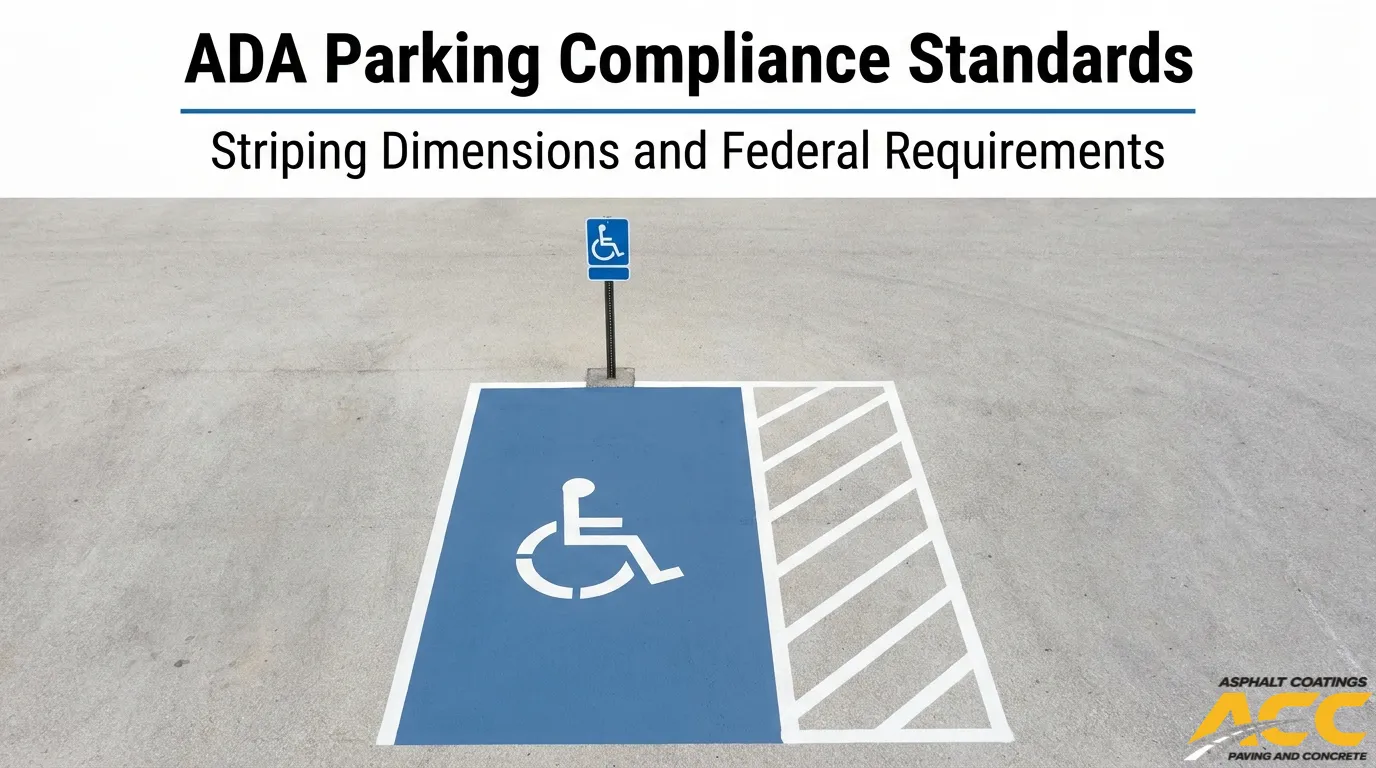
ADA accessibility standards that still apply to parking areas are the 2010 ADA Standards for Accessible Design, which remain fully enforceable regardless of parking minimum changes. These standards require:
- Car accessible spaces must be at least 96 inches wide.
- Access aisles must measure at least 60 inches wide.
- Surface slope cannot exceed 1:48 in all directions.
- At least one accessible means of egress is required for every accessible space, with at least two required where more than one accessible space is provided.
Reducing total parking count does not reduce ADA obligations. A right-sized lot with fewer total spaces may actually need a higher ratio of accessible stalls to remain compliant, making precise striping and grading essential during any redesign.
What Does Denver’s Updated Zoning Code Require for Site Plans?
Denver’s updated zoning code requires that all site modifications, including parking reductions, go through the appropriate site plan review process under Community Planning and Development. Denver Zoning Code Section 12.3.7.C provides that Site Development Plans approved prior to December 31, 2025, have 66 months to obtain a permit, according to analysis from Brownstein Hyatt Farber Schreck. This extended timeline gives property owners significant flexibility to phase redevelopment projects.
Site plans must also address sustainability requirements under Denver’s Green Code, which became mandatory for new commercial projects in 2023. Property owners should coordinate with a qualified paving contractor early to ensure grading, drainage, and ADA elements align with current code before submitting for review.
How Does This Change Affect Commercial Property Values in Denver?
This change affects commercial property values in Denver by shifting how appraisers calculate highest-and-best-use potential and how investors evaluate risk. The subsections below cover appraisal impacts and lender-investor responses.
How Does Reduced Parking Obligation Influence Appraisals?
Reduced parking obligation influences appraisals by expanding the developable area an appraiser can factor into highest-and-best-use analysis. When a commercial site no longer requires a fixed number of spaces, the land previously locked into parking becomes eligible for income-producing uses. This additional buildable square footage directly increases a property’s potential gross income in the income approach to valuation.
Mayor Mike Johnston framed the policy as “making it easier to build housing in our city” through a market-based solution, according to a 2025 statement reported by 9News. That market-based framing matters for appraisals because it signals long-term regulatory stability rather than a temporary exemption.
Properties with oversized lots stand to benefit the most, since surplus parking land can now be valued as redevelopment-ready acreage rather than a fixed site improvement with limited alternative use.
How Are Lenders and Investors Responding to the Policy Shift?
Lenders and investors are responding to the policy shift with cautious optimism, driven by broader commercial real estate recovery trends. According to Inland Investments, institutional investors show a steady recovery in the commercial real estate market as of late 2025, with increased lending, rising capital commitments, and shifting market sentiment.
Denver’s elimination of parking minimums aligns with what capital markets already reward: flexible sites with multiple exit strategies. A commercial property that can be repositioned, densified, or partially redeveloped without a zoning variance carries lower entitlement risk in underwriting models.
That said, lenders still scrutinize tenant retention and access. Properties that reduce parking without a clear demand analysis may face tighter loan terms. For owners considering lot modifications, pairing a right-sizing strategy with professional paving ensures both curb appeal and functional durability remain strong.
What Are the Financial Risks of Reducing Parking Too Aggressively?
The financial risks of reducing parking too aggressively include tenant loss, lease disputes, decreased property appeal, and lower occupancy rates. When commercial property owners cut parking supply below actual demand, tenants and their customers bear the consequences directly.
According to a Haas Berkeley research paper, following an anchor tenant’s failure, co-tenants’ ability to exit the center or obtain rent reductions are critical factors influencing financial losses. Insufficient parking can accelerate this cycle; if customers struggle to park, foot traffic drops, tenant revenues decline, and lease renegotiations or early terminations follow.
Key financial risks include:
- Tenant turnover and vacancy costs. Retail and restaurant tenants depend on convenient customer parking, and inadequate supply gives them grounds to seek alternative locations.
- Lease co-tenancy triggers. Many commercial leases contain co-tenancy clauses that allow remaining tenants to reduce rent or terminate if anchor tenants leave, creating a cascading revenue loss.
- Reduced competitive positioning. Properties competing for the same tenant pool in Denver lose leverage when neighboring developments offer better parking ratios.
- Depressed appraisal values. Appraisers factor occupancy stability and tenant satisfaction into valuations; chronic parking complaints signal operational risk.
- Financing complications. Lenders underwriting commercial properties scrutinize parking adequacy as part of due diligence, and perceived shortfalls can tighten loan terms.
For property owners in Denver, the elimination of parking minimums creates flexibility, not an instruction to eliminate parking itself. The smartest approach treats this policy as permission to right-size rather than minimize. Cutting spaces without studying actual tenant demand, peak-use patterns, and customer behavior is one of the fastest ways to erode net operating income.
Understanding these risks helps owners make data-driven decisions about how many spaces to retain, repurpose, or add when redesigning their lots.

How Does Denver’s Policy Compare to Other Colorado Municipalities?
Denver’s policy compares to other Colorado municipalities as part of a broader statewide trend, though adoption varies significantly by city. Boulder and Fort Collins have followed Denver’s lead, while Aurora has pushed back.
- Denver eliminated all parking minimums citywide on August 4, 2025, covering every property type.
- Boulder voted unanimously to eliminate minimum parking requirements for new developments citywide on June 26, 2025, according to the Boulder Reporting Lab.
- Fort Collins removed all parking mandates for multi-family dwellings on February 4, 2025, with citywide scope.
- Aurora voted to oppose proposed changes to its zoning code regarding multifamily parking and accessory dwelling units at its June 9, 2025 meeting.
- Colorado Springs falls under HB24-1304, the state law signed in May 2024 that prohibits municipalities from enforcing minimum parking requirements in transit service areas.
Denver’s approach stands out as the most comprehensive. While Fort Collins targeted only multi-family housing and Colorado Springs operates under the state transit-area mandate, Denver repealed minimums across all use types citywide. For commercial property owners operating across multiple Front Range cities, this patchwork means parking obligations differ depending on location, making site-specific due diligence essential before any redesign.
With parking requirements clarified across the region, the next consideration is how to optimize whatever lot space remains.
How Should Owners Approach Parking Lot Upgrades During Redesign?
Owners should approach parking lot upgrades during redesign by investing in durable paving, proper drainage, and sustainable materials that maximize the value of a right-sized lot. The sections below cover how commercial asphalt paving supports optimized lots and the key takeaways from Denver’s parking minimum elimination.
Can Commercial Asphalt Paving and Maintenance Maximize a Right-Sized Lot?
Yes, commercial asphalt paving and maintenance can maximize a right-sized lot by ensuring every square foot of retained parking performs at its highest level. Once owners determine the optimal number of spaces, professional-grade paving, sealcoating, crack sealing, and striping protect that investment against Colorado’s freeze-thaw cycles and high-altitude UV exposure.
Permeable pavements offer a particularly strong option for redesigned lots. According to the U.S. Environmental Protection Agency, permeable pavements function as stormwater controls that allow stormwater to infiltrate through the surface to the ground below, serving as green infrastructure. This approach helps owners meet Denver’s detention and water quality requirements while reducing runoff from a reconfigured site.
Fewer, better-built spaces consistently outperform sprawling, neglected lots in both durability and tenant satisfaction. Asphalt Coatings Company specializes in parking lot construction and maintenance across Denver and Colorado’s Front Range, delivering ADA-compliant concrete work, subgrade preparation, and sealcoating with in-house crews. With 39 years of Colorado-specific expertise, Asphalt Coatings Company partners with commercial property owners to build parking surfaces that enhance accessibility, increase property value, and support proper water drainage on right-sized lots.
What Are the Key Takeaways About Denver’s Parking Minimum Elimination for Commercial Owners?
The key takeaways about Denver’s parking minimum elimination for commercial owners center on flexibility, financial opportunity, and continued obligation:
- Denver City Council voted 9-3 on August 4, 2025, to eliminate minimum parking requirements citywide, giving owners full discretion over how many spaces to build or retain.
- Excess parking land can now be redeveloped into leasable retail, office, or mixed-use space without zoning conflicts over minimum space counts.
- Right-sizing parking based on actual tenant and customer demand data reduces maintenance costs and improves per-square-foot property value.
- ADA accessibility standards, stormwater detention requirements, and EV charging mandates under the Denver Green Code still apply to every parking area regardless of the minimum repeal.
- Owners who act early to assess demand, upgrade paving quality, and reconfigure underutilized lots position themselves ahead of competitors still carrying oversized, aging surfaces.
Denver’s parking reform does not eliminate the need for well-built parking; it shifts the decision from a zoning mandate to a market-driven strategy. Commercial owners who pair smart demand analysis with professional-grade asphalt paving and maintenance will extract the most value from this policy change.