Pierre Shale is a Late Cretaceous marine shale formation rich in smectite and montmorillonite clay minerals that swell when wet and shrink when dry, generating a relentless swell-shrink cycle beneath Denver commercial pavements. This cycle is the primary reason parking lots, loading areas, and access roads across the metro area develop cracking, heaving, and settlement that standard maintenance cannot resolve.
This guide covers Pierre Shale geology and its distribution beneath Denver, the mineral properties that make these soils expansive, how the swell-shrink cycle progressively damages pavement structures, the specific distress types commercial properties experience, Denver climate factors that accelerate deterioration, and the geotechnical and design strategies that resist these forces long term.
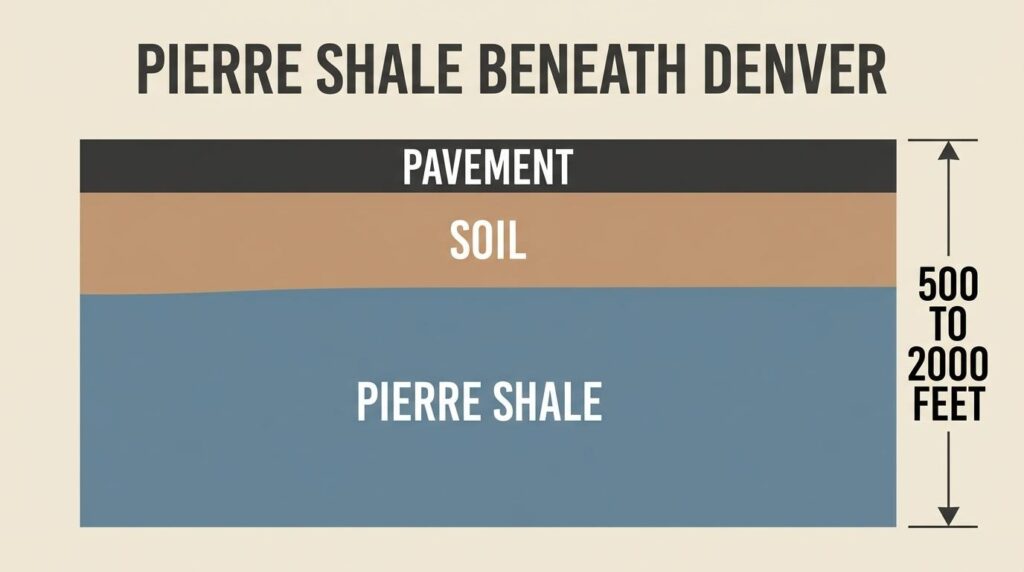
Pierre Shale ranges from 500 to over 2,000 feet thick beneath the Denver Basin, with neighborhoods like Southwest Denver, Roxborough Park, and Green Mountain sitting on especially concentrated expansive soil zones. The formation’s smectite content, approximately 62% by weight in southwest Denver, gives it extraordinary reactivity to moisture changes.
That reactivity drives a destructive mechanical cycle: expanding clay generates heaving pressures up to 30,000 pounds per square foot, lifting pavement upward, while seasonal drying causes linear shrinkage values reaching 23%, pulling support away and creating voids beneath the surface. Over successive seasons, this produces longitudinal cracking, alligator cracking, buckling, and depression distortion.
Denver’s climate compounds the problem through freeze-thaw cycles that reopen cracks, abrupt drought-to-rain swings that trigger rapid swell events, and high-altitude UV radiation that embrittles asphalt binders. Properties with large parking lots and irrigated landscaping face the highest risk because unmanaged water infiltrates the subgrade directly.
Effective prevention combines pre-construction soil testing, lime or cement stabilization, adequate base thickness, and controlled drainage to neutralize swell pressure before it reaches the pavement surface.
What Is Pierre Shale and Where Does It Sit Beneath Denver?
Pierre Shale is a Late Cretaceous marine shale formation that underlies much of the Denver metropolitan area. Its depth, thickness, and geographic reach directly influence pavement performance across the region.
How Deep Is the Pierre Shale Formation Under Denver?
The Pierre Shale formation under Denver typically ranges in depth from 500 to 2,000 feet, reaching a maximum thickness of approximately 2,275 feet in the Upper Shale Unit. According to the Colorado Geological Survey, digital isopach maps confirm this formation’s geographic distribution above the Niobrara Formation across the entire Denver Basin, stretching from Greeley to Colorado Springs.
That extensive footprint means nearly every commercial property along the Front Range sits above some portion of this reactive clay layer. For property managers, understanding this subsurface geology is the first step toward protecting pavement investments.
Which Denver Neighborhoods Sit on the Thickest Pierre Shale?
Denver neighborhoods sitting on the thickest Pierre Shale include Southwest Denver, Roxborough Park, Green Mountain, and Golden, with zip codes 80123, 80127, 80128, and 80235 containing especially prominent expansive soil zones. According to the Colorado Geological Survey, significant deposits also extend north through Boulder, Longmont, Loveland, and Fort Collins.
Properties in these areas face compounding environmental stress. Denver’s high altitude produces approximately 15 to 20% higher UV radiation compared to sea level, accelerating asphalt binder oxidation. Meanwhile, the winter of 2025-2026 averaged 39.6°F, one of the warmest on record, increasing freeze-thaw cycle frequency that drives moisture deeper into already vulnerable pavement.
Understanding where these deposits concentrate helps explain why certain commercial pavements deteriorate faster than others.
Why Are Pierre Shale Soils Classified as Expansive?
Pierre Shale soils are classified as expansive because they contain high concentrations of smectite clay minerals that absorb water and swell dramatically. The sections below explain the mineral mechanism, swell capacity, and shrinkage behavior.
What Role Does Smectite Clay Play in Pierre Shale Expansion?
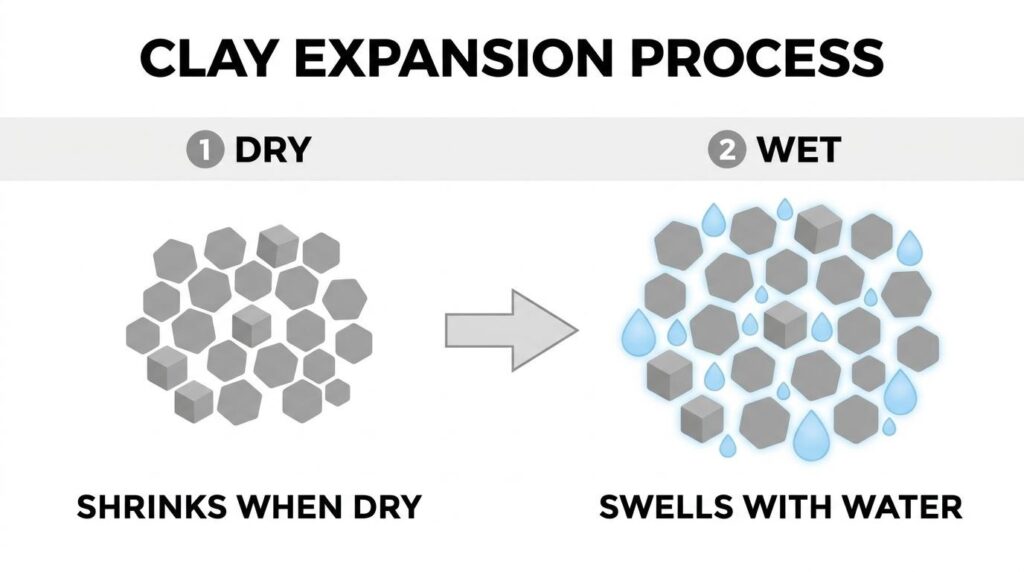
Smectite clay plays the central role in Pierre Shale expansion by incorporating water molecules between its flat, submicroscopic plates, causing those plates to push apart and the soil volume to increase. Montmorillonite, a member of the smectite group, is the primary driver of this behavior. These minerals have an enormous surface area relative to their size, which gives them a disproportionate capacity to attract and hold moisture.
According to a study published in Clays and Clay Minerals, expansive clays in the southwest Denver metropolitan area consist of approximately 62% smectite by weight, with a mixed-layer illite/smectite expandability of 92%. That concentration makes Pierre Shale one of the most reactive subgrade materials beneath any commercial pavement in the Denver Basin.
How Much Can Pierre Shale Swell When It Absorbs Moisture?
Pierre Shale can swell significantly when it absorbs moisture. Pure montmorillonite clay can expand up to 15 times its original volume, while natural soils containing these minerals typically swell to 1.5 times their original volume, representing a 50% increase. According to the Colorado Geological Survey, natural expansive soils in Colorado can expand up to 20% by volume and exert upward heaving forces reaching 30,000 pounds per square foot. For commercial parking lots, even modest swell percentages translate into powerful upward displacement capable of lifting and cracking asphalt surfaces. Few subgrade conditions demand more careful engineering attention.
How Much Does Pierre Shale Shrink During Denver’s Dry Months?
Pierre Shale shrinks substantially during Denver’s dry months as moisture evaporates from smectite clay layers, causing plates to collapse closer together and the soil volume to contract. According to research on undisturbed expansive soils, linear shrinkage values for Pierre Shale can range from 17.86% to 23.57%. This contraction creates voids beneath pavement surfaces, removing the structural support that the asphalt layer depends on. The resulting loss of subgrade contact leads to depressions, cracking, and accelerated fatigue failure. Denver’s semi-arid climate, with prolonged dry stretches between precipitation events, makes this shrinkage phase just as damaging as the swell phase.
Understanding this swell-shrink mechanism reveals how the cycle actively damages pavement structures over time.
How Does the Swell-Shrink Cycle Damage Commercial Pavements?
The swell-shrink cycle damages commercial pavements by alternating upward heaving pressure with downward settlement, stressing the asphalt structure from both directions. Below, each phase of this destructive cycle is examined.
What Happens to Asphalt During Upward Heaving Pressure?
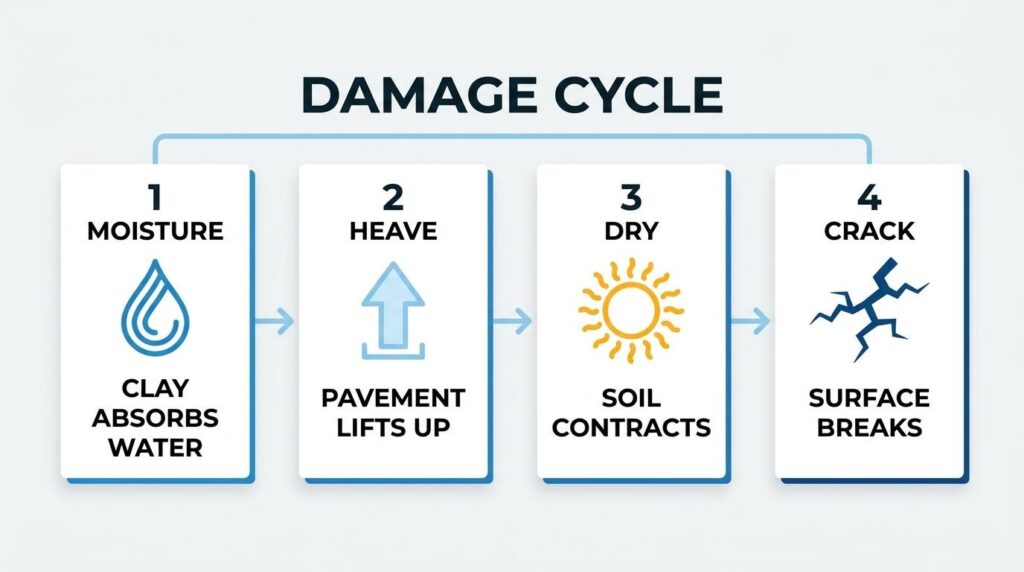
Asphalt during upward heaving pressure is forced out of its original plane as expanding clay pushes the subgrade surface upward. Pierre Shale’s smectite minerals absorb moisture and generate immense vertical force against the pavement structure from below. This uplift creates visible bumps, uneven surfaces, and stress fractures across parking lots and access roads. Because asphalt is semi-rigid, it cannot flex enough to accommodate sudden grade changes. The resulting tension concentrates at the weakest points, typically construction joints, utility trenches, and thin-section transitions, where initial cracks form.
What Happens to Pavement During Soil Shrinkage and Settlement?
Pavement during soil shrinkage and settlement loses the uniform subgrade support it needs to carry traffic loads. As Denver’s dry months pull moisture from Pierre Shale clay, the soil contracts and pulls away from the pavement underside. This creates voids beneath the asphalt surface. When heavy commercial vehicles pass over these unsupported areas, the pavement deflects downward into the gap. Depressions, birdbaths, and localized failures develop where support loss is greatest. Without consistent bearing capacity, even well-constructed asphalt sections begin to sag and crack under routine loading.
How Do Repeated Cycles Cause Progressive Fatigue Cracking?
Repeated cycles cause progressive fatigue cracking by subjecting asphalt to cumulative stress that weakens the binder and aggregate bond over successive seasons. Each swell event strains the pavement upward; each shrinkage event drops support away. According to the Federal Highway Administration, this progressive fatigue effect manifests first as longitudinal cracking in wheel paths, which eventually interconnects into alligator cracking. No single cycle causes catastrophic failure on its own. Instead, micro-damage accumulates invisibly until crack networks propagate across the surface. For Denver commercial properties on Pierre Shale, this fatigue timeline is compressed because seasonal moisture swings are extreme and frequent.
Understanding how progressive damage accumulates helps property managers recognize which pavement distress types to watch for.
What Types of Pavement Damage Does Expansive Soil Cause?
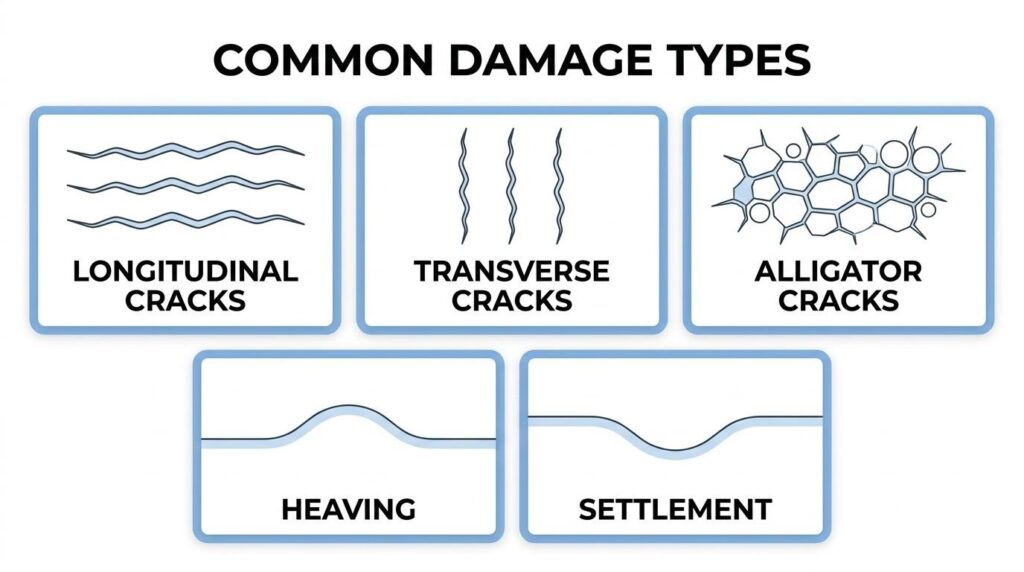
Expansive soil causes several distinct types of pavement damage, including longitudinal cracking, transverse cracking, alligator cracking, heaving, buckling, depression, and settlement distortion. According to the Colorado Geological Survey, shrinking or swelling soils inflict at least $2.3 billion in annual damages to houses, buildings, roads, and pipelines in the United States, more than twice the damage from floods, hurricanes, tornadoes, and earthquakes combined.
Longitudinal Cracking
Longitudinal cracking is a pavement distress that runs parallel to the roadway centerline or the direction of paving. In Denver, this crack pattern frequently develops along wheel paths where repeated traffic loading compounds the stress from an unstable subgrade. As Pierre Shale swells unevenly beneath the surface, differential movement creates tension along the pavement’s length. These cracks often appear as the earliest visible sign of subgrade instability, making them a critical early warning for property managers monitoring commercial parking lots.
Transverse Cracking
Transverse cracking runs perpendicular to the pavement centerline. Expansive soil contributes to transverse cracks when the subgrade shrinks during Denver’s dry months, pulling support away from the asphalt surface in localized zones. The resulting loss of uniform bearing causes the pavement to fracture across its width. Seasonal moisture swings in Pierre Shale regions accelerate the frequency of these cracks, and each cycle widens existing fractures, allowing more water to infiltrate and worsen the underlying soil instability.
Alligator Cracking From Subgrade Movement
Alligator cracking from subgrade movement is a network of interconnected cracks resembling reptile scales. This distress pattern results from progressive fatigue as repeated swell-shrink cycles flex the pavement beyond its structural tolerance. What begins as isolated longitudinal cracks in the wheel paths eventually links into a dense web of fractures. Once alligator cracking develops, the pavement section has reached structural failure; surface treatments alone cannot restore load-bearing capacity, and full-depth repair becomes necessary.
Heaving and Buckling
Heaving and buckling are upward distortions in the pavement surface caused by swelling soil beneath. The Colorado Geological Survey reports that expansion pressures can reach 20,000 to 30,000 pounds per square foot on slabs and confining structures. In Denver commercial pavements over Pierre Shale, this force lifts entire pavement sections, creating raised ridges and uneven surfaces that pose safety hazards. Buckling occurs when lateral expansion compresses adjacent slabs or pavement panels together, forcing material upward at joints and seams.
Depression and Settlement Distortion
Depression and settlement distortion are downward deformations in the pavement surface where the subgrade has lost volume. During dry periods, Pierre Shale shrinks significantly, creating voids beneath the asphalt that cause localized sinking. These depressions collect standing water, which then infiltrates the subgrade and triggers the next swell cycle. For Denver commercial properties, this damage pattern is particularly costly because it compounds over time; each moisture cycle deepens the depression and accelerates surrounding pavement deterioration.
Recognizing these damage types early helps property managers choose the right repair strategy before conditions worsen.
How Does Denver’s Climate Make Pierre Shale Damage Worse?
Denver’s climate makes Pierre Shale damage worse by layering freeze-thaw stress, extreme moisture swings, and intense UV radiation on top of already-unstable expansive subgrade. Each factor compounds the others, accelerating pavement deterioration beyond what soil movement alone would cause.
How Do Freeze-Thaw Cycles Compound Expansive Soil Movement?
Freeze-thaw cycles compound expansive soil movement by adding a second mechanical force on top of clay swell pressure. Water trapped in soil and pavement cracks expands as it turns to ice, lifting the ground surface and shifting foundations. When the ice melts, the supporting soil loses volume and the pavement drops back without uniform support.
According to ISE Structural Engineers, this cycle damages asphalt pavements through repeated lifting and settling that progressively widens existing cracks. Denver’s mild 2025-2026 winter, with temperatures hovering near freezing, increased the frequency of these transitions. Each cycle reopens cracks that expansive soil movement created, letting more moisture penetrate the subgrade and triggering further clay expansion. The result is a compounding loop where frost action and soil swell reinforce each other through shared pathways.
How Does Seasonal Drought-to-Rain Swing Trigger Swell Cycles?
Seasonal drought-to-rain swing triggers swell cycles by alternately desiccating and saturating Pierre Shale’s smectite clays. During Denver’s dry summer months, clay minerals lose moisture and contract, pulling away from pavement structures and creating subsurface voids. When late-summer monsoons or spring snowmelt introduce sudden moisture, those same clays absorb water rapidly and expand.
This abrupt volumetric change generates the heaving pressures that crack asphalt from below. Unlike regions with steady rainfall, Denver’s sharp seasonal moisture contrasts ensure that the full shrink-swell range activates repeatedly each year. For commercial properties, this pattern is particularly damaging because parking lots and building perimeters collect and channel runoff, concentrating moisture exactly where the subgrade is most vulnerable to expansion.
How Does High-Altitude UV Weaken Pavement Already Stressed by Soil?
High-altitude UV weakens pavement already stressed by soil by accelerating the oxidation and embrittlement of asphalt binders. According to a study published in MDPI Buildings Journal, Denver’s elevation produces approximately 15-20% higher UV radiation compared to sea level, which damages asphalt’s internal molecular structures.
Healthy asphalt binder remains flexible enough to absorb minor subgrade movement without cracking. When UV exposure degrades that flexibility, the pavement surface becomes brittle and loses its ability to flex with soil heave. Cracks form sooner and propagate faster under the same soil pressures that a UV-protected surface might tolerate. This means Denver pavements face a dual assault: expansive soil pushes from below while UV radiation weakens the surface above, narrowing the margin before visible damage appears.
With climate factors intensifying soil-driven damage, identifying which commercial properties face the greatest risk becomes essential.
What Commercial Properties Face the Greatest Risk in Denver?
Commercial properties with large parking lots, loading docks, and irrigated landscaping face the greatest risk of expansive soil damage in Denver. The subsections below explain why each property type is especially vulnerable.
Why Are Large Parking Lots More Vulnerable to Soil Heave?
Large parking lots are more vulnerable to soil heave because their expansive surface area covers a wide zone of Pierre Shale subgrade, creating more opportunity for uneven moisture infiltration. Even minor grading inconsistencies across thousands of square feet allow water to pool and penetrate the subgrade unevenly, triggering localized swell zones that buckle the surface.
The financial exposure compounds with scale. According to National Facility Contractors, professional commercial asphalt paving for large surfaces typically costs between $3.00 and $8.00 per square foot in 2026, depending on site conditions and drainage requirements. When soil heave forces a full-depth repair across a 50,000-square-foot lot, costs escalate quickly. For property managers in Denver, investing in proper subgrade preparation before paving is far more cost-effective than reactive repairs after heave damage appears.
Why Do Loading Docks and Heavy-Traffic Areas Fail Faster?
Loading docks and heavy-traffic areas fail faster because concentrated vehicle loads accelerate fatigue in pavement already weakened by swell-shrink movement beneath the surface. Delivery trucks, forklifts, and semi-trailers generate repeated point loads that compress the asphalt into soil voids left by shrinkage cycles, creating depressions and cracking.
Pierre Shale subgrade beneath these zones rarely reaches moisture equilibrium. Constant loading compacts the base unevenly, while oil and fluid leaks degrade the asphalt binder above. This combination of mechanical stress from above and volumetric instability from below shortens pavement life significantly compared to lightly trafficked areas on the same property. Proactive thickness design and reinforced base layers are essential for these high-demand zones.
Why Are Properties Near Irrigation or Poor Drainage at Higher Risk?
Properties near irrigation or poor drainage are at higher risk because water is the primary trigger for Pierre Shale expansion. According to the Colorado Geological Survey, commercial properties with irrigated landscaping face the highest risk of expansive soil damage because improperly managed surface drainage and irrigation water enters the soil, triggering expansion.
Landscape sprinklers positioned near pavement edges saturate the subgrade along the perimeter, creating differential swell between wet edges and drier interior zones. Poor stormwater grading produces similar results when runoff collects against curb lines instead of flowing to catch basins. These moisture imbalances are often the root cause of the longitudinal cracking property managers notice first along parking lot borders.
With high-risk property types identified, recognizing the early warning signs of expansive soil damage helps property managers act before repairs become costly.
How Can You Identify Expansive Soil Damage Early on a Parking Lot?
You can identify expansive soil damage early on a parking lot by watching for visible surface distress patterns that signal subgrade movement beneath the asphalt. The key warning signs fall into several categories.
- Longitudinal cracks running parallel to traffic lanes. These hairline fractures along wheel paths often appear first, indicating the subgrade is shifting unevenly beneath the surface.
- Uneven surface elevation or localized humps. Heaving sections suggest upward swell pressure from moisture-saturated expansive clay pushing against the pavement structure.
- Depressions or dips that collect standing water. Settled areas reveal zones where shrinking soil has pulled support away from the asphalt, creating low spots that accelerate further moisture infiltration.
- Transverse cracks spanning the pavement width. These perpendicular fractures indicate differential movement across the subgrade, often where soil moisture conditions vary between irrigated landscaping and open pavement.
- Early-stage alligator cracking in isolated patches. Interconnected crack networks in specific zones, rather than uniform wear, point to localized subgrade instability rather than simple surface aging.
Timing matters as much as the distress type. In Denver, these signs often intensify after seasonal transitions, particularly following spring snowmelt or late-summer monsoon rains that rehydrate dried Pierre Shale clay. Cracks that widen noticeably between dry and wet seasons are a strong indicator of active swell-shrink cycling below the surface.
Property managers should also monitor areas near irrigation lines, downspout discharge points, and landscape borders where water routinely contacts the subgrade. According to the Colorado Geological Survey, commercial properties with large parking lots and irrigated landscaping face the highest risk of expansive soil damage because improper management of surface drainage and irrigation water enters the soil, triggering expansion.
For Denver property managers, the most practical early detection habit is simple: walk the lot after every major weather shift and photograph any new cracking, heaving, or ponding. Documenting changes over time reveals whether distress is static or progressing, which directly determines whether you need routine maintenance or a deeper geotechnical evaluation. Catching these signs before alligator cracking spreads across large areas can mean the difference between targeted repairs and a full-depth reconstruction.
With early damage patterns identified, the next step is understanding the geotechnical interventions that prevent further soil-related failure.
What Geotechnical Steps Help Prevent Soil-Related Pavement Failure?
Geotechnical steps that help prevent soil-related pavement failure include site-specific soil testing, chemical stabilization, moisture control systems, and engineered subgrade preparation. The following subsections detail each critical measure.
Why Is Pre-Construction Soil Testing Essential in Denver?
Pre-construction soil testing is essential in Denver because Pierre Shale’s expansive clay content varies significantly across the metro area, and designing pavement without knowing the subgrade conditions leads to premature failure. A geotechnical investigation identifies swell potential, plasticity index, and moisture sensitivity before any grading begins. According to the Colorado Geological Survey, effective mitigation of expansive soil damage in Denver requires peripheral drains and surface moisture barriers to minimize water infiltration into the subgrade. Testing results dictate every downstream design decision, from base thickness to drainage layout. Skipping this step is the single most expensive shortcut a commercial property owner can take.
How Does Lime or Cement Stabilization Modify Expansive Subgrade?
Lime or cement stabilization modifies expansive subgrade by chemically altering the clay mineralogy, reducing its ability to absorb water and swell. CDOT Standard Specifications for subgrade stabilization include lime treatment under Section 307 and cement-treated subgrade to modify engineering properties of expansive soils before pavement installation. Lime reacts with smectite clay particles to form cementitious compounds that permanently reduce plasticity. Key benefits of chemical stabilization include:
- Reduced swell potential by lowering the soil’s liquid limit and plasticity index.
- Increased bearing capacity for heavier commercial traffic loads.
- More consistent moisture behavior across seasonal wet-dry transitions.
For Denver properties sitting on Pierre Shale, chemical stabilization is often the most cost-effective intervention available before paving.
How Do Peripheral Drains and Moisture Barriers Protect the Subgrade?
Peripheral drains and moisture barriers protect the subgrade by intercepting water before it reaches expansive clay layers. French drains, edge drains, and impermeable membranes redirect surface runoff and subsurface moisture away from the pavement section. This moisture control is critical because Pierre Shale’s smectite minerals swell dramatically when water infiltrates the subgrade. Without active drainage, irrigated landscaping and poor lot grading channel water directly into the soil, triggering expansion cycles that fracture pavement from below. Properties that combine perimeter drainage with vapor barriers beneath the aggregate base maintain more stable subgrade moisture year-round.
With geotechnical prevention measures in place, pavement design choices determine long-term surface performance.
How Does Proper Pavement Design Resist Expansive Soil Forces?
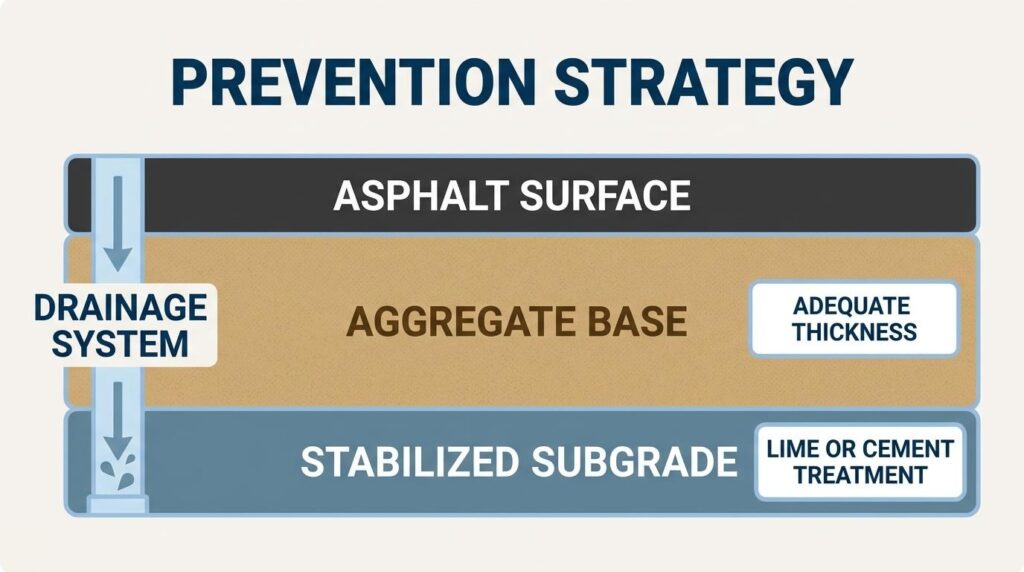
Proper pavement design resists expansive soil forces by combining subgrade stabilization, sufficient base thickness, and controlled drainage to neutralize swell pressure before it reaches the surface. Each layer works together to absorb and distribute movement.
How Does Subgrade Preparation Reduce Swell Pressure?
Subgrade preparation reduces swell pressure by chemically and mechanically altering expansive clay before paving begins. CDOT Standard Specifications for subgrade stabilization include lime treatment (Section 307) and cement-treated subgrade to modify the engineering properties of expansive soils prior to pavement installation. Lime reacts with smectite clay minerals, reducing their ability to absorb water and swell. Cement stabilization increases bearing capacity and creates a rigid platform that resists volumetric change. Without this step, expansive soils in Colorado can expand up to 20% by volume and exert heaving forces up to 30,000 psf, according to research published on ResearchGate. Proper subgrade preparation is the single most cost-effective intervention for Denver commercial pavements over Pierre Shale.
How Does Adequate Base Thickness Protect the Surface Layer?
Adequate base thickness protects the surface layer by creating a buffer zone of non-expansive aggregate between the treated subgrade and the asphalt wearing course. This granular base absorbs residual vertical movement from clay expansion, distributing forces across a wider area so that localized heaving does not translate directly into surface cracks. Thicker base courses also improve load distribution from heavy commercial traffic, reducing stress concentrations at the subgrade interface. For Denver properties over Pierre Shale, engineers typically specify increased base depths beyond standard minimums. The added material cost is minor compared to premature pavement failure, making it one of the most practical investments in long-term pavement performance.
How Does Controlled Drainage Keep Moisture Levels Stable?
Controlled drainage keeps moisture levels stable by preventing water from infiltrating the subgrade where it triggers clay expansion. Peripheral drains, properly graded surfaces, and surface moisture barriers intercept runoff and subsurface water before it reaches expansive soil. Consistent moisture content is critical because smectite clays swell when wet and shrink when dry; eliminating moisture fluctuations neutralizes the swell-shrink cycle at its source. Commercial properties with large parking lots are especially vulnerable when irrigation runoff or poor grading directs water toward the pavement subgrade. Prioritizing drainage design during initial construction prevents the costly cycle of repeated repairs that Denver property managers know too well.
With drainage, base, and subgrade strategies aligned, the next step is choosing the right paving partner.
How Should You Address Expansive Soil Pavement Damage With Commercial Paving and Concrete Services?
You should address expansive soil pavement damage with commercial paving and concrete services that combine geotechnical subgrade work with proper drainage and surface installation. The following subsections cover how Denver-experienced contractors correct Pierre Shale damage and the key takeaways from this article.
Can Denver-Experienced Commercial Paving Help Correct Pierre Shale Damage?
Yes, Denver-experienced commercial paving can help correct Pierre Shale damage when contractors understand the geotechnical conditions driving pavement failure. Surface-level repairs without subgrade stabilization simply delay the next round of cracking and heaving. According to the Colorado Geological Survey, public schools and commercial buildings in the Denver metropolitan area have incurred swelling clay repair costs representing nearly one-third to one-half of their original construction costs.
Asphalt Coatings Company has served Colorado’s Front Range since 1986, bringing decades of regional experience to every project. Asphalt Coatings Company provides subgrade preparation, grading, asphalt paving, concrete flatwork, and drainage solutions with in-house crews. Choosing a contractor that accounts for expansive soil behavior from the subgrade up, rather than treating symptoms at the surface, is the single most cost-effective decision a commercial property owner in Denver can make.
What Are the Key Takeaways About Why Expansive Pierre Shale Soils Crack Denver Commercial Pavements We Covered?
The key takeaways about why expansive Pierre Shale soils crack Denver commercial pavements are:
- Pierre Shale contains smectite and montmorillonite clays that swell with moisture and shrink during dry periods, creating relentless swell-shrink cycles beneath pavement surfaces.
- According to research published in Clays and Clay Minerals, linear shrinkage values for undisturbed Pierre Shale soils range from 17.86% to 23.57%, producing significant cracking during dry cycles.
- Commercial properties with large parking lots and irrigated landscaping face the highest risk because unmanaged surface drainage and irrigation water infiltrate the subgrade, triggering expansion.
- Denver’s freeze-thaw cycles, seasonal drought-to-rain swings, and elevated UV radiation compound the damage that expansive soils initiate.
- Proper pavement design requires geotechnical subgrade preparation, adequate base thickness, and controlled drainage to resist these forces long term.
For Denver commercial property owners dealing with heaving, cracking, or settlement linked to expansive soils, Asphalt Coatings Company delivers the subgrade-to-surface expertise these conditions demand.