Commercial asphalt paving is pavement engineered for business properties with light to moderate vehicle traffic, while heavy duty asphalt paving is pavement designed to resist extreme wheel loads exceeding 7,000 lbs. per tire, contact pressures above 140 psi, and cumulative truck volumes surpassing 50 million passes.
This guide covers property types and traffic thresholds for each category, material and mix design specifications, subgrade preparation and structural thickness, cost comparisons and climate performance, and maintenance planning with decision criteria.
Commercial applications serve parking lots, retail centers, and office parks using standard PG 64-22 binders and pavement sections of 4 to 6 inches over aggregate base, handling traffic below 300,000 ESALs. Heavy duty applications serve ports, distribution yards, and industrial staging areas requiring polymer-modified binders, pavement depths of 18 to 24 inches, and subgrade excavation up to 3 feet for expansive soils.
Material specifications diverge in aggregate angularity, binder stiffness, and Superpave gyration levels; heavy duty mixes use 100 or more compaction cycles compared to fewer than 50 for standard commercial designs. Stone matrix asphalt provides the stone-on-stone contact skeleton that resists deformation under concentrated industrial loads.
Commercial paving costs $4 to $10 per square foot in 2026, while heavy duty installations range from $8 to $18 per square foot due to greater material volume, deeper excavation, and engineered drainage requirements. However, heavy duty pavements offset higher initial investment through longer resurfacing intervals.
Colorado’s freeze-thaw cycles and high-altitude UV exposure accelerate deterioration in both categories, making polymer modification and proactive maintenance schedules essential regardless of pavement type. Matching pavement design to actual operational loads at the planning stage prevents premature failure and reduces lifecycle costs.
What Defines Commercial Asphalt Paving?
Commercial asphalt paving is asphalt pavement engineered for business properties that experience light to moderate vehicle traffic. The following sections cover the property types that use it, the traffic loads it handles, and its typical pavement structure.
What Types of Properties Use Commercial Asphalt Paving?
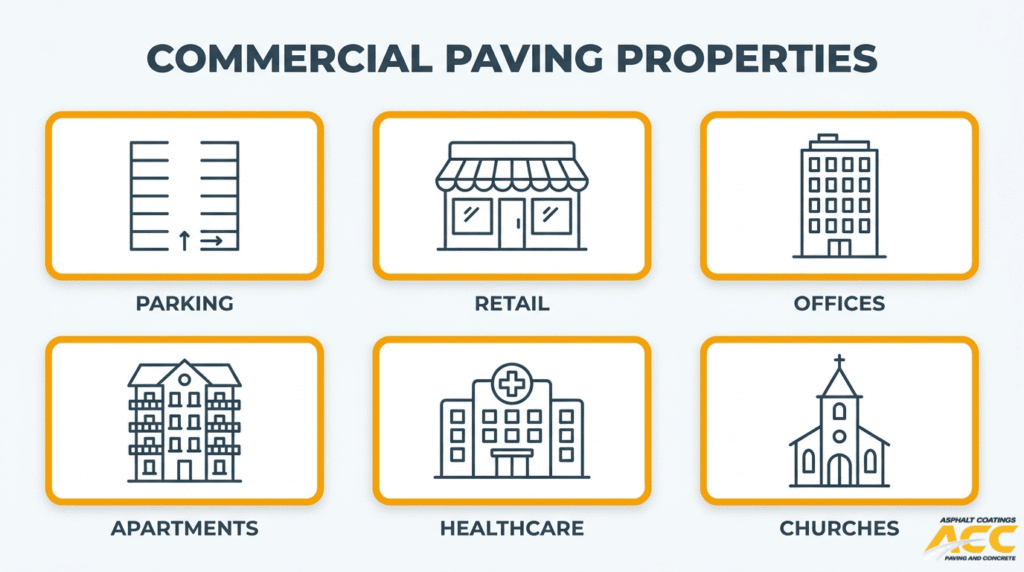
The types of properties that use commercial asphalt paving include parking lots, retail centers, office parks, apartment complexes, healthcare facilities, and church campuses. These applications prioritize smooth ride quality, clear striping, and efficient drainage for passenger vehicles and light delivery trucks.
Asphalt itself is a mixture of aggregates, binder, and filler, with approximately 90 to 95 percent of the mixture by weight consisting of aggregates, according to the European Asphalt Pavement Association. This composition makes it adaptable to a wide range of commercial site layouts. Rising material costs also shape project planning; the U.S. Producer Price Index for asphalt paving mixture and block manufacturing reached 426.00 by December 2025, up from 411.52 in 2024. For property managers budgeting paving projects, tracking these index trends is one of the most practical ways to time investments strategically.
What Traffic Loads Is Commercial Asphalt Designed to Handle?
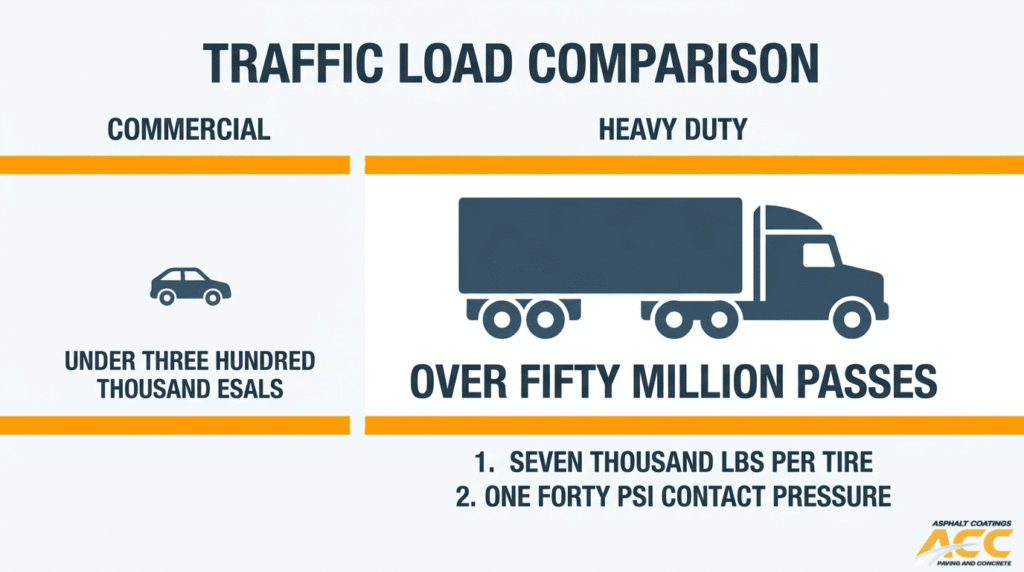
Commercial asphalt is designed to handle low to moderate traffic loads, typically below 300,000 ESALs (Equivalent Single Axle Loads). According to the Federal Highway Administration, the low traffic designation applies to roadways such as local roads, county roads, and city streets where truck traffic is prohibited.
Binder selection reflects these load expectations. Commercial parking lots with low traffic often specify a PG 64-22 binder, whereas high-traffic commercial areas or zones subject to heavy standing loads may require stiffer binders like PG 76-22 to prevent rutting. As traffic levels increase beyond 3 million ESALs, fine aggregate angularity criteria rise to a minimum of 45 percent uncompacted void content for proper interlock and rut resistance. Mill-and-overlay cycles for these pavements typically occur every 8 to 15 years, depending on traffic volume and environmental conditions. Matching binder grade to actual traffic patterns, rather than defaulting to the cheapest option, is one of the most effective ways to extend pavement life.
What Is the Typical Pavement Structure for Commercial Applications?
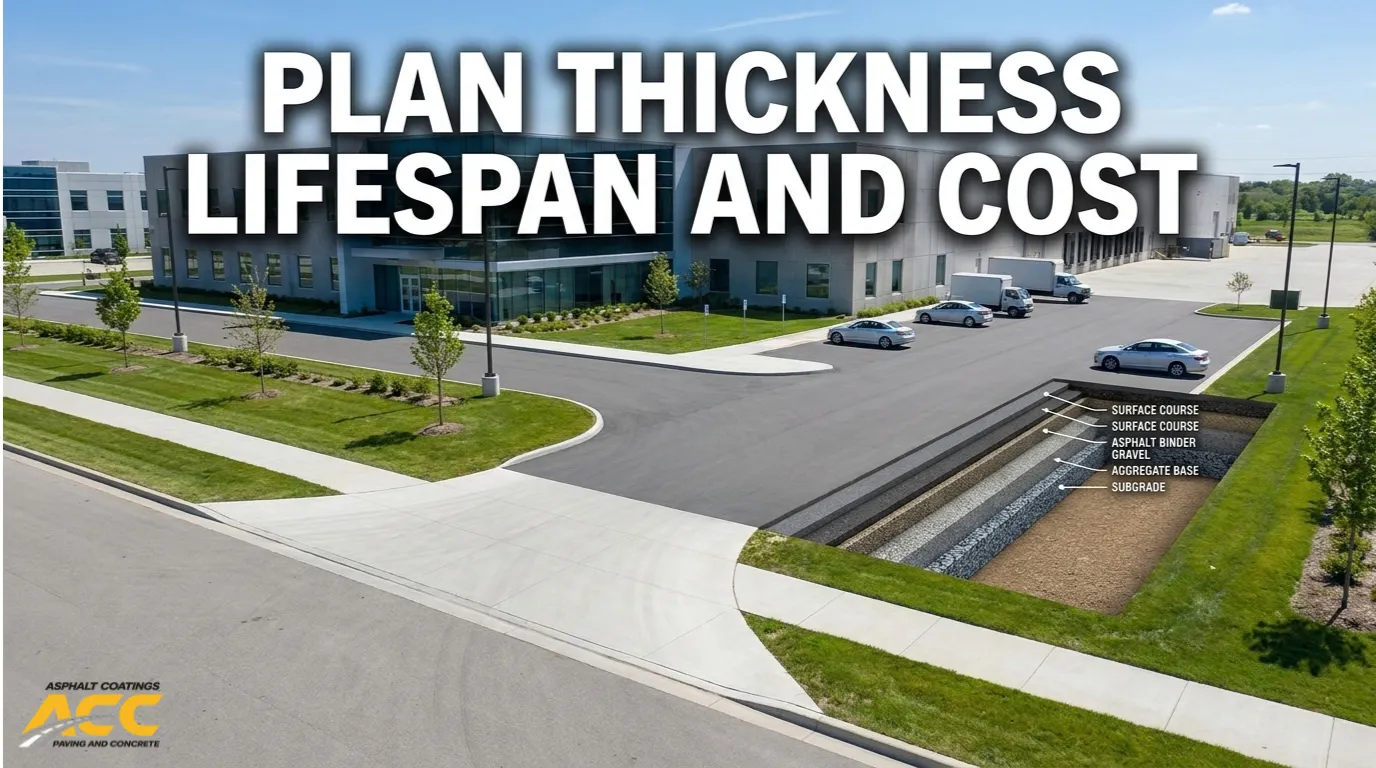
The typical pavement structure for commercial applications is a layered system consisting of compacted subgrade, aggregate base, and one or more lifts of hot mix asphalt (HMA). Full-depth asphalt pavements, placed directly on top of the subgrade soil, represent a common design parameter found in the AASHTO 1993 Guide for Design of Pavement Structures.
In a conventional flexible pavement, the subgrade is compacted to a specified density before aggregate base material is placed and compacted in lifts. The HMA surface layer sits on top, providing the final ride surface and weather protection. Full-depth designs eliminate the granular base entirely, relying on increased asphalt thickness to distribute loads directly into the subgrade. Each approach has trade-offs; full-depth designs simplify construction but demand higher-quality subgrade conditions. Selecting the right structure depends on soil conditions, expected traffic, and long-term maintenance strategy.
With commercial paving fundamentals established, understanding heavy duty asphalt paving reveals how pavement design scales for far greater loads.
What Defines Heavy Duty Asphalt Paving?
Heavy duty asphalt paving is pavement engineered to resist extreme wheel loads, high contact pressures, and sustained heavy truck traffic without structural failure. The following sections cover facility types, load thresholds, and typical pavement structures.
What Types of Facilities Require Heavy Duty Asphalt Paving?
The types of facilities that require heavy duty asphalt paving include:
- Port terminals and container yards
- Intermodal freight hubs
- Industrial material handling areas
- Truck distribution centers
- Mining haul roads
- Airport taxiways and aprons
These facilities share a common demand: concentrated, repetitive loads from oversized vehicles operating daily. According to the Colorado Asphalt Pavement Association’s 2025 Outlook, CDOT estimated a requirement of approximately 1.2 million tons of asphalt materials for state projects in 2025, reflecting the scale of heavy infrastructure demand across Colorado alone. Any facility where vehicle gross weights routinely exceed standard highway limits needs pavement designed well beyond commercial specifications.
What Traffic Loads Is Heavy Duty Asphalt Designed to Handle?
Heavy duty asphalt is designed to handle wheel loads greater than 7,000 lbs. per tire, contact pressures exceeding 140 psi, and cumulative truck volumes surpassing 50 million passes within the design period. According to the National Asphalt Pavement Association, heavy duty pavements must withstand these forces without exhibiting load-related or non-load-related deterioration.
Port pavements face particularly extreme conditions. Industrial material handling areas may encounter body-dump haul vehicles with gross weights exceeding 180,000 lbs. These loads dwarf what standard commercial parking lots experience, which is precisely why engineers specify thicker sections, stiffer binders, and reinforced subgrades for heavy duty applications.
What Is the Typical Pavement Structure for Heavy Duty Applications?
The typical pavement structure for heavy duty applications consists of multiple engineered layers designed to distribute extreme loads:
- Surface course: Dense-graded, polymer-modified HMA (3–5 inches)
- Intermediate/binder course: High-stability HMA providing load distribution (4–8 inches)
- Base course: Crushed aggregate or full-depth asphalt (8–12 inches)
- Stabilized subgrade: Treated or over-excavated soil compacted to specified density
Total pavement depth often reaches 18 to 24 inches or more, depending on anticipated loads. This multi-layer approach ensures that stress dissipates before reaching the subgrade, preventing rutting and fatigue cracking under sustained heavy traffic.
With heavy duty requirements defined, material specifications reveal how mix design choices separate these pavements from standard commercial installations.
How Do Material Specifications Differ Between Commercial and Heavy Duty Paving?
Material specifications differ between commercial and heavy duty paving in mix design complexity, aggregate quality, and binder grade selection. The following sections cover mix designs for each category, aggregate selection criteria, and binder grade requirements.
What Asphalt Mix Design Is Used for Commercial Paving?
The asphalt mix design used for commercial paving is a standard hot mix asphalt (HMA) formulation optimized for moderate traffic volumes and lighter wheel loads. According to the European Asphalt Pavement Association, asphalt is a mixture of aggregates, binder, and filler, with approximately 90 to 95 percent of the mixture by weight consisting of aggregates.
Commercial mix designs typically use Superpave methodology with lower design gyration levels, often below 50 gyrations for parking lots and light-use access roads. Lane distribution factors reduce estimated one-direction cumulative ESALs for multi-lane sections, which directly influences how dense or open the gradation needs to be. For most commercial applications, a dense-graded surface mix provides adequate durability without the premium material costs that heavy duty environments demand.
What Asphalt Mix Design Is Used for Heavy Duty Paving?
The asphalt mix design used for heavy duty paving is a high-performance HMA formulation engineered for extreme wheel loads, elevated contact pressures, and sustained heavy truck volumes. These mixes require higher design gyration levels, typically 100 or more compaction cycles during the Superpave design process, producing a denser, more rut-resistant matrix.
Heavy duty mix designs incorporate stiffer binder grades, higher aggregate angularity requirements, and tighter volumetric controls. Stone matrix asphalt (SMA) is commonly specified for port terminals, intermodal yards, and industrial haul roads because its stone-on-stone contact skeleton resists deformation under concentrated loads. The overall goal is a mix that maintains structural integrity under repetitive stress far beyond what standard commercial pavements encounter.
How Does Aggregate Selection Differ Between the Two?
Aggregate selection differs between the two primarily in angularity requirements, hardness standards, and gradation targets. Commercial paving uses quality aggregates but permits slightly lower angularity thresholds suited to lighter traffic. Heavy duty paving demands crushed, angular aggregates with high Los Angeles abrasion resistance to withstand concentrated wheel loads without degradation.
Key differences include:
- Angularity: Heavy duty mixes require higher coarse and fine aggregate angularity for better interlock and rut resistance.
- Hardness: Aggregates in heavy duty applications must resist polishing and breakdown under repeated heavy axle passes.
- Gradation: Heavy duty designs often use gap-graded or SMA gradations that maximize stone-on-stone contact, while commercial mixes typically use dense gradations.
Selecting the right aggregate source is one of the most consequential decisions in heavy duty pavement design, since no binder upgrade compensates for weak stone.
How Does Binder Grade Differ Between the Two?
Binder grade differs between the two based on traffic volume, load intensity, and expected service temperature range. Commercial parking lots with low traffic commonly specify a PG 64-22 binder, which provides adequate performance for passenger vehicles and occasional delivery trucks. Heavy duty applications require polymer-modified binders such as PG 76-22, which resist rutting under sustained heavy loads and high contact pressures.
According to the Asphalt Institute, high-traffic areas or those subject to heavy standing loads may require stiffer binders like PG 76-22 to prevent rutting and surface deformation. The polymer modification increases the binder’s elastic recovery, allowing it to return to its original shape after deformation rather than permanently flowing under load.
For property managers weighing long-term pavement costs, binder selection represents where material investment most directly translates into extended service life.
How Does Subgrade Preparation Differ for Each Paving Type?
Subgrade preparation differs for each paving type based on the load requirements and soil conditions at the project site. Commercial paving requires moderate subgrade depth, heavy duty paving demands deeper excavation, and soil stabilization methods vary depending on expansive soil properties.
What Subgrade Depth Is Required for Commercial Paving?
The subgrade depth required for commercial paving typically ranges from 8 to 12 inches below finished grade. Standard commercial applications like parking lots and access roads need compacted subgrade sufficient to support passenger vehicles and light delivery trucks. Proper compaction to 95 percent of maximum dry density ensures the prepared roadbed provides adequate structural support for the aggregate base and asphalt layers above it. For most commercial properties, this moderate excavation depth balances cost efficiency with long-term pavement performance.
What Subgrade Depth Is Required for Heavy Duty Paving?
The subgrade depth required for heavy duty paving extends significantly deeper, often 18 to 36 inches or more below finished grade. Facilities handling wheel loads greater than 7,000 pounds per tire or gross vehicle weights exceeding 180,000 pounds need this additional depth to distribute concentrated stresses across a wider soil area. According to the Metropolitan Government Pavement Engineers Council, expansive soils with a Plasticity Index between 20 and 30 require over-excavation depths of 3 feet below normal subgrade elevation to prevent pavement heave and cracking. This deeper preparation is non-negotiable for ports, distribution yards, and industrial staging areas.
How Does Soil Stabilization Differ Between the Two?
Soil stabilization differs between commercial and heavy duty paving in both method intensity and treatment depth. Commercial projects typically use mechanical compaction and moisture conditioning as primary stabilization techniques. Heavy duty applications, by contrast, often require chemical stabilization or complete soil replacement. According to the Colorado Asphalt Pavement Association, expansive soils should be treated to reduce their expansive properties with stabilization, or they can be removed altogether; over-excavating and backfilling with an impermeable soil at 95 percent of maximum dry density is a cost-effective method. For heavy duty sites, lime or cement treatment may extend through the full excavation depth to create a uniformly stable platform capable of resisting differential settlement under concentrated loads.
With subgrade conditions addressed, the thickness and layer design built on top of this foundation determines each pavement’s structural capacity.
How Does Thickness and Layer Design Compare?
Thickness and layer design differ significantly between commercial and heavy duty asphalt sections based on traffic loads and structural demands. The subsections below cover typical commercial thickness, heavy duty thickness, and when full-depth designs become necessary.
How Thick Is a Typical Commercial Asphalt Section?
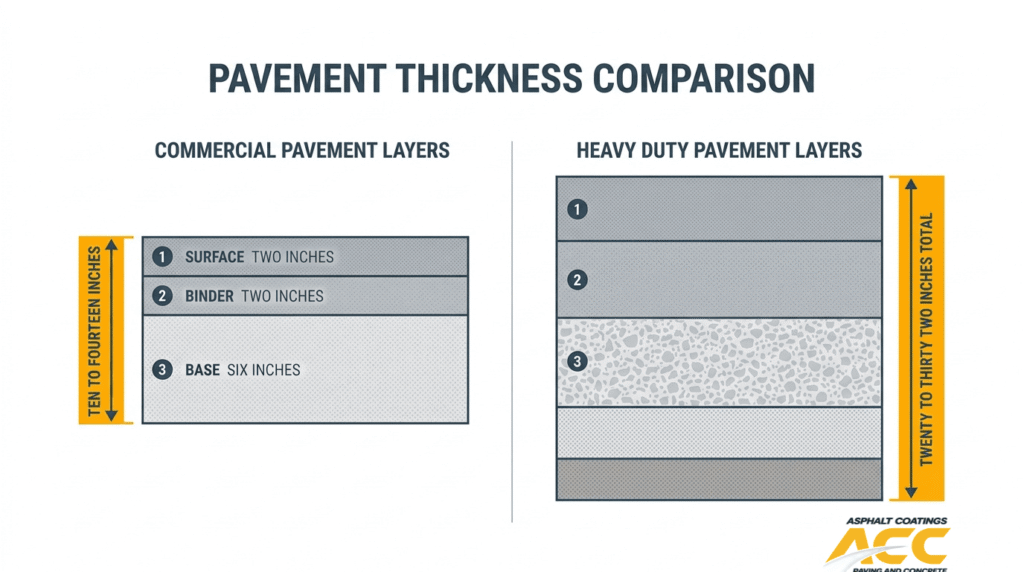
A typical commercial asphalt section is 4 to 6 inches of hot mix asphalt placed over 6 to 8 inches of aggregate base. This layered approach suits properties with standard passenger vehicle traffic and light delivery trucks. The surface course, binder course, and base course each serve distinct structural roles:
- Surface course (1.5 to 2 inches) provides ride quality and weather resistance.
- Binder course (1.5 to 2 inches) distributes loads to lower layers.
- Aggregate base (6 to 8 inches) transfers stress to the prepared subgrade.
For most parking lots and access roads, this combined 10 to 14 inch structural section delivers adequate load distribution without overbuilding.
How Thick Is a Typical Heavy Duty Asphalt Section?
A typical heavy duty asphalt section ranges from 8 to 12 inches of HMA over 12 or more inches of stabilized base material. According to the National Asphalt Pavement Association, heavy duty pavements must withstand wheel loads greater than 7,000 lbs. per tire and contact pressures exceeding 140 psi without deterioration within the design period.
These greater thicknesses accommodate the compounding stress that concentrated loads impose on each structural layer. Port terminals, distribution yards, and industrial staging areas often require additional rich bottom layers or stabilized subbase courses to prevent fatigue cracking under repetitive heavy axle passes. The investment in deeper sections prevents premature structural failure that would cost far more to reconstruct.
When Is a Full-Depth Asphalt Design Necessary?
A full-depth asphalt design is necessary when subgrade soils cannot provide adequate structural support or when eliminating granular base layers simplifies construction logistics. Full-depth asphalt pavements are placed directly on top of the subgrade soil, a design parameter established in the AASHTO 1993 Guide for Design of Pavement Structures, as documented by the North Carolina Department of Transportation.
This approach suits sites with weak or variable subgrades where importing quality aggregate base is impractical or cost-prohibitive. Full-depth sections typically range from 9 to 16 inches of asphalt, depending on projected ESALs. For properties expecting heavy truck traffic on poor soils, full-depth designs eliminate the risk of base layer contamination and provide consistent structural performance throughout the pavement life.
Understanding thickness requirements helps clarify why material costs vary so widely between project types.
How Do Costs Compare Between Commercial and Heavy Duty Paving?
Costs differ significantly between commercial and heavy duty asphalt paving due to material volume, engineering complexity, and subgrade requirements. The following sections break down typical per-square-foot pricing for each category and the factors that drive the gap.
What Does Commercial Asphalt Paving Typically Cost Per Square Foot?
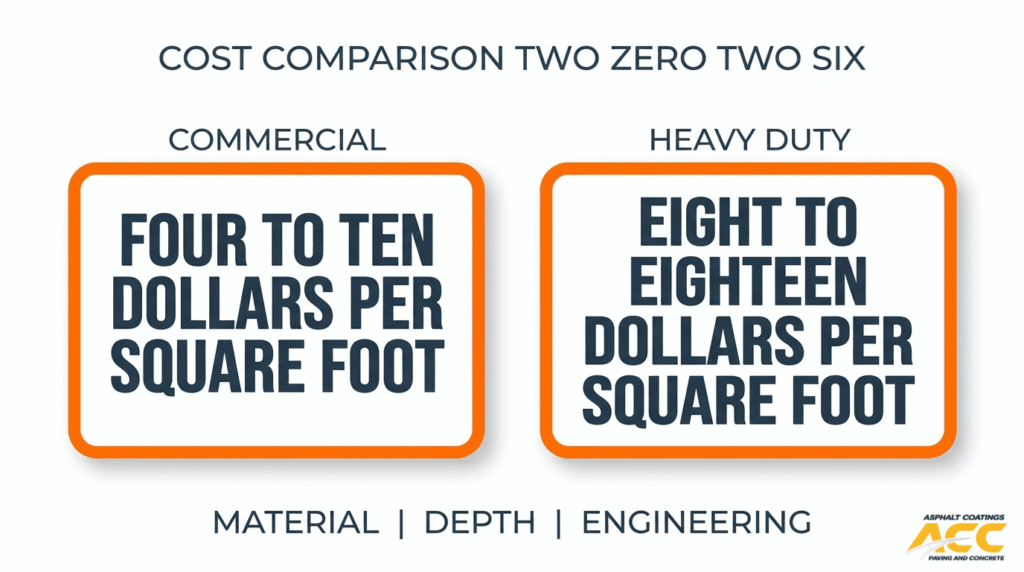
Commercial asphalt paving typically costs between $4 and $10 per square foot in 2026, depending on thickness requirements and site conditions. According to Asphalt Repair Solutions, large-scale projects like parking lots and access roads fall within this range when standard subgrade preparation and conventional mix designs are specified.
Hot mix asphalt material currently runs $90 to $160 per ton nationally, with averages settling between $115 and $125 per ton. Crude oil market fluctuations directly influence these material costs. Professional engineering and design fees typically add approximately 4 percent to total construction cost. Ongoing maintenance also factors into lifecycle budgets; crack sealing is recommended 6 to 12 months after installation, while sealcoating every 2 to 3 years protects against moisture damage and binder oxidation.
What Does Heavy Duty Asphalt Paving Typically Cost Per Square Foot?
Heavy duty asphalt paving typically costs $8 to $18 per square foot, though specialized industrial applications can exceed this range. The premium reflects thicker pavement sections, polymer-modified binders, and more intensive subgrade stabilization required to support loads exceeding 7,000 lbs per tire.
Several factors push heavy duty pricing above commercial rates:
- Thicker asphalt lifts require significantly more material tonnage per square foot.
- Polymer-modified binders like PG 76-22 cost more than standard PG 64-22 grades.
- Deeper subgrade excavation and soil stabilization add labor and disposal costs.
- Engineered drainage systems must handle concentrated loads without compromising the base.
For most facility owners managing ports, distribution centers, or industrial yards, the higher upfront investment prevents premature failure that would cost far more to reconstruct.
What Factors Drive the Cost Difference Between Them?
The factors that drive cost differences between commercial and heavy duty paving include material specifications, structural depth, engineering complexity, and long-term maintenance cycles.
- Material volume: Heavy duty sections use 50 to 100 percent more asphalt tonnage per square foot than standard commercial installations.
- Binder grade: Polymer-modified binders for heavy duty applications carry a 20 to 40 percent price premium over conventional grades.
- Subgrade work: Deep over-excavation (up to 3 feet for problematic soils) and engineered fill dramatically increase site preparation costs.
- Design fees: Complex structural engineering for heavy load calculations increases the 4 percent professional fee baseline.
- Maintenance intervals: Heavy duty pavements require less frequent mill-and-overlay cycles, offsetting higher initial costs over a 20-to-30-year lifecycle.
Selecting the appropriate paving category based on actual traffic loads ensures property owners avoid both overspending and premature pavement failure, which is why accurate load analysis matters before any project begins.
How Does Climate Affect Commercial vs Heavy Duty Pavement Performance?
Climate affects commercial vs heavy duty pavement performance primarily through temperature extremes, which influence rutting at high temperatures and fatigue cracking at low temperatures. The subsections below cover freeze-thaw damage, UV degradation, and thermal cracking risk for each pavement type.
How Do Freeze-Thaw Cycles Impact Each Pavement Type?
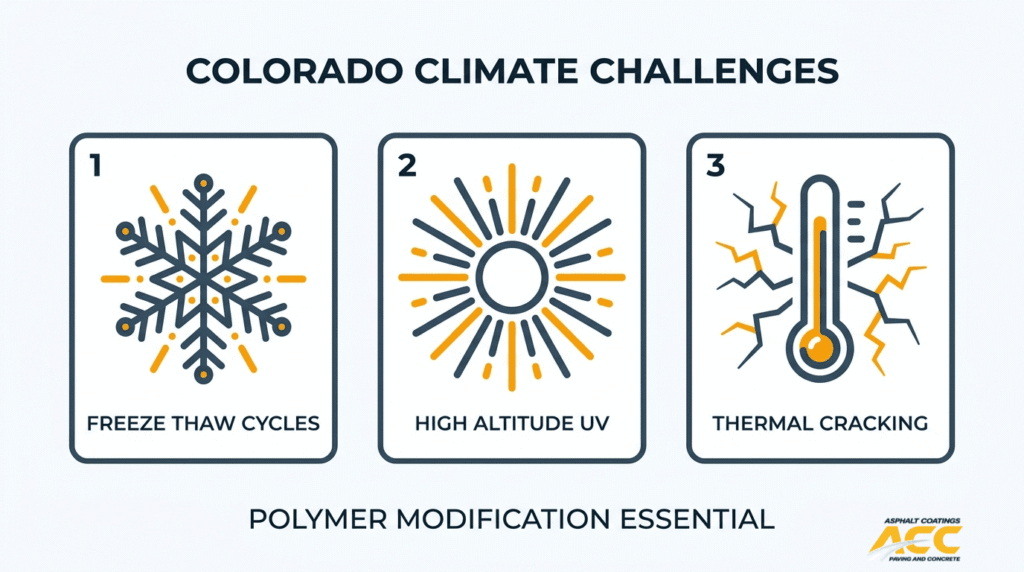
Freeze-thaw cycles impact each pavement type by forcing trapped moisture to expand and contract repeatedly, generating internal stress that fractures the asphalt matrix. According to research published in MDPI Coatings, frequent freeze-thaw cycles in high-altitude areas cause asphalt pavements to experience rapid temperature changes that lead to significant cracking and structural damage due to the expansion of trapped moisture.
Commercial pavements, with thinner structural sections and standard binder grades, are particularly vulnerable because they lack the dense, polymer-modified layers that resist moisture infiltration. Heavy duty pavements tolerate freeze-thaw stress better due to thicker cross-sections and tighter aggregate interlock, though prolonged exposure still accelerates deterioration. For properties in Colorado’s Front Range, where daily temperature swings can cross the freezing threshold dozens of times per winter, proactive crack sealing remains essential for both categories.
How Does UV Exposure Degrade Each Pavement Type Differently?
UV exposure degrades each pavement type differently based on binder composition and surface layer thickness. Ultraviolet radiation oxidizes the asphalt binder, making it brittle and prone to surface raveling over time.
Commercial pavements experience accelerated oxidation because standard PG 64-22 binders lack the polymer modification that resists UV breakdown. Surface courses on parking lots and access roads lose flexibility faster, leading to fine cracking and aggregate loss within a few years without sealcoating. Heavy duty pavements resist UV degradation longer; their polymer-modified binders and denser surface mixes slow oxidation rates considerably. However, the sheer surface area of industrial yards and port facilities means maintenance costs remain significant even when degradation progresses slowly.
How Does Thermal Cracking Risk Differ Between the Two?
Thermal cracking risk differs between the two because commercial pavements use softer binders with lower low-temperature grades, while heavy duty pavements rely on stiffer, polymer-modified binders engineered for broader temperature ranges. Air temperature has the most significant impact on pavement performance among environmental factors, affecting both rutting resistance at high temperatures and fatigue resistance at low temperatures, according to research published in ScienceDirect.
Commercial sections crack when temperatures drop below the binder’s critical low-temperature threshold, particularly in thin overlays that cool rapidly. Heavy duty pavements resist thermal cracking through greater structural mass, which moderates cooling rates, and through polymer modification that maintains flexibility at lower temperatures. Still, heavy commercial vehicles compound thermal stress by imposing loads on already-contracted pavement surfaces, accelerating crack propagation in both categories.
With climate stresses identified, understanding maintenance requirements helps protect both pavement investments.
How Do Maintenance Requirements Differ Between the Two?
Maintenance requirements differ between commercial and heavy duty asphalt primarily in frequency, intensity, and the types of preventive treatments each demands. Commercial pavements follow standard cyclical schedules, while heavy duty surfaces require more aggressive and frequent intervention.
What Maintenance Schedule Does Commercial Asphalt Need?
Commercial asphalt needs a phased maintenance schedule that begins shortly after installation and repeats on predictable cycles. Crack sealing should be performed 6 to 12 months after paving, according to the Minnesota Department of Transportation, while seal coating is typically scheduled every 2 to 3 years to prevent moisture damage and oxidation of the asphalt binder.
A practical commercial maintenance timeline includes:
- 6 to 12 months post-installation: First crack sealing to address early settlement cracks.
- Every 2 to 3 years: Seal coating to protect against UV degradation and water infiltration.
- Every 8 to 15 years: Mill-and-overlay to restore surface smoothness and structural integrity.
Staying ahead of these intervals is one of the most cost-effective ways to extend pavement life, since deferred maintenance on commercial surfaces compounds quickly once moisture penetrates the binder.
What Maintenance Schedule Does Heavy Duty Asphalt Need?
Heavy duty asphalt needs a more compressed and intensive maintenance schedule than commercial pavement. The constant stress from large wheel loads, high contact pressures, and sustained heavy vehicle traffic accelerates surface wear and subsurface fatigue at a faster rate.
Key differences in heavy duty maintenance include:
- Crack sealing: Often required within the first 6 months, with inspections performed quarterly rather than annually.
- Surface treatments: Applied more frequently than the standard 2 to 3 year commercial cycle, particularly in areas subject to standing loads or turning movements.
- Mill-and-overlay: May be needed closer to the 8-year end of the typical range, especially at ports, distribution yards, and industrial staging areas.
Proactive condition monitoring matters more for heavy duty pavements because structural failures under extreme loads escalate far more rapidly than on lighter-use commercial surfaces.
When Should Each Pavement Type Be Resurfaced or Replaced?
Each pavement type should be resurfaced or replaced based on traffic intensity, visible distress patterns, and structural evaluation results. Mill-and-overlay cycles for asphalt pavements typically occur every 8 to 15 years, depending on traffic volume and environmental conditions, to restore surface smoothness before full reconstruction becomes necessary.
Commercial pavements in good maintenance programs generally reach resurfacing around the 12 to 15 year mark. Heavy duty pavements, subjected to loads exceeding 7,000 pounds per tire, often require resurfacing closer to 8 to 10 years. Full replacement becomes necessary when core samples reveal base layer failure or when surface distress exceeds what an overlay can correct.
Choosing the right paving type from the start simplifies every decision about when and how to invest in maintenance.
How Do You Determine Which Paving Type Your Property Needs?
You determine which paving type your property needs by evaluating traffic volume, vehicle weight, and intended use. The following subsections cover the specific thresholds that separate commercial from heavy duty applications.
What Traffic Volume Threshold Separates the Two Categories?
The traffic volume threshold that separates commercial from heavy duty paving is approximately 300,000 ESALs (Equivalent Single Axle Loads). Pavements below this level qualify as low-traffic commercial applications, while those anticipating significantly higher cumulative loads require heavy duty design. According to the Federal Highway Administration, low traffic designation applies to roadways with less than 300,000 ESALs, such as local roads, county roads, and city streets where truck traffic is prohibited. Heavy duty pavements, by contrast, are engineered for volumes exceeding 50 million trucks over the design period. For most property owners, accurately projecting future traffic growth is just as important as measuring current volume.
What Vehicle Weight Threshold Requires Heavy Duty Paving?
The vehicle weight threshold that requires heavy duty paving is wheel loads greater than 7,000 lbs. per tire combined with contact pressures exceeding 140 psi. According to the National Asphalt Pavement Association, heavy duty asphalt mixtures are defined as those withstanding large wheel loads greater than 7,000 lbs. per tire and high contact pressures greater than 140 psi without exhibiting pavement deterioration within the design period. Industrial facilities with body-dump haul vehicles exceeding 180,000 lbs. gross weight represent the extreme end of this spectrum. If your property regularly accommodates loaded semi-trailers or specialized equipment, standard commercial pavement will fail prematurely.
How Does Intended Use Influence the Right Pavement Choice?
Intended use influences the right pavement choice by determining load frequency, stress concentration, and surface wear patterns. Key use-based considerations include:
- Parking lots with passenger vehicles typically qualify for standard commercial paving.
- Distribution warehouses with constant truck staging require heavy duty design.
- Port facilities and material handling yards need pavements rated for sustained high-contact stress.
- Properties with mixed traffic should be designed for the heaviest anticipated load, not the average.
Standing loads from parked heavy equipment concentrate stress differently than rolling traffic, often demanding stiffer binder grades and thicker sections even at lower traffic counts. Matching pavement design to actual operational demands prevents costly early failure and reconstruction.
How Should You Approach Asphalt Paving for Colorado Commercial Properties?
You should approach asphalt paving for Colorado commercial properties by selecting a contractor with regional expertise in high-altitude conditions and the capacity to handle both standard commercial and heavy duty applications.
Can Asphalt Coatings Company Handle Both Commercial and Heavy Duty Paving Projects?
Yes, Asphalt Coatings Company can handle both commercial and heavy duty paving projects. Since 1986, Asphalt Coatings Company has served Colorado’s Front Range with comprehensive asphalt services, including new construction paving, subgrade preparation, mill and pave, sealcoating, and crack sealing using CDOT-approved materials. Asphalt Coatings Company uses in-house crews across all project scales, from parking lots and office parks to industrial complexes and commercial distribution warehouses. A performance study of 28 Colorado projects found that polymer modified asphalt mixtures extended pavement life by 2 to 10 years and reduced fatigue cracking in high-altitude environments, according to the Pacific Northwest Transportation Consortium. Asphalt Coatings Company designs solutions specifically for these Colorado challenges.
What Are the Key Takeaways About Commercial vs Heavy Duty Asphalt Paving?
The key takeaways about commercial vs heavy duty asphalt paving are:
- Commercial paving suits properties with lighter traffic loads, such as retail centers, office parks, and apartment complexes, using standard binder grades and moderate pavement thickness.
- Heavy duty paving is required when wheel loads exceed 7,000 lbs per tire, contact pressures surpass 140 psi, or facilities handle high truck volumes.
- Material specifications, subgrade preparation depth, and maintenance cycles all intensify as load demands increase.
- Colorado’s freeze-thaw cycles and high-altitude UV exposure accelerate deterioration in both pavement types, making regional expertise essential.
- Choosing the correct paving category at the design stage prevents premature failure and reduces long-term maintenance costs.
For properties along Colorado’s Front Range, partnering with a contractor who understands both categories ensures the right solution from the start.