Commercial paving permits in the Colorado Springs area are regulated by separate agencies, portals, and codes depending on whether a project falls within city limits or unincorporated El Paso County.
This guide covers permitting authorities and project types, application processes and portals, zoning and stormwater compliance, fees and inspection requirements, and seasonal and enforcement considerations.
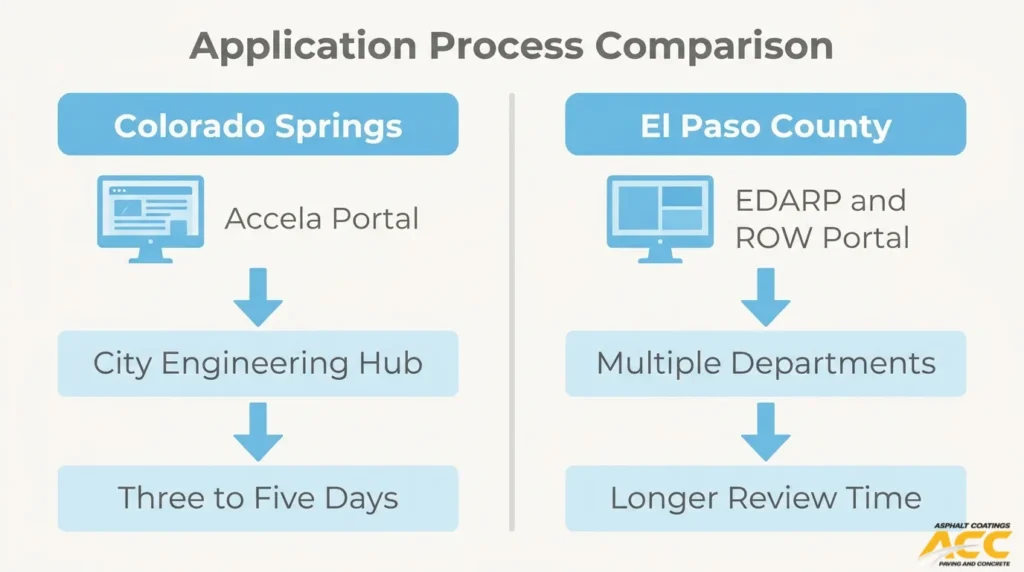
Colorado Springs routes commercial paving permits through its City Engineering Hub under the Public Works department, using the Accela Citizen Access portal for applications, payments, and inspection scheduling. Unincorporated El Paso County splits authority between the Planning and Community Development department and the Department of Public Works, with submissions handled through EDARP and a separate right-of-way portal.
Permit-triggering project types overlap but carry different requirements in each jurisdiction. Colorado Springs requires paving permits for new parking lots, sidewalk and curb work, and right-of-way construction, while El Paso County mandates Access Permits for any driveway connecting to a county road and applies the Land Development Code to all commercial site development.
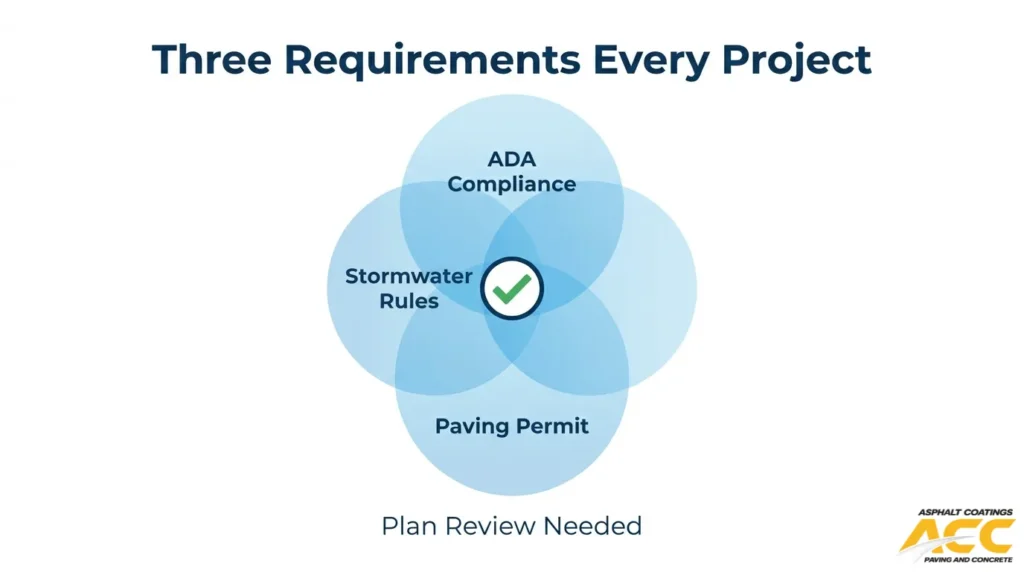
Stormwater rules, zoning standards, and ADA compliance add layers to both processes. Colorado Springs enforces drainage criteria under its MS4 permit and City Code 7.4.701, while the county follows its own Engineering Criteria Manual. The Pikes Peak Regional Building Department reviews accessibility compliance across both jurisdictions.
Fee structures share the same PPRBD schedule for building permits, but the county adds road impact fees of $421.46 per trip for commercial developments. Colorado Springs engineering permits typically process within 3 to 5 business days, while county timelines may run longer due to multi-department coordination. Penalties for unpermitted work in Colorado Springs include doubled investigation fees and daily fines up to $1,000 per violation, making compliance far cheaper than enforcement.
Who Issues Commercial Paving Permits in Colorado Springs?
The City of Colorado Springs Public Works department, specifically the City Engineering Hub, issues commercial paving permits within city limits. This agency handles paving, concrete, excavation, traffic control, and storm drain permits for all projects inside the municipal boundary. The Pikes Peak Regional Building Department also performs plan reviews and conducts inspections for projects throughout the region.
Determining which agency has jurisdiction over your project is the first step, since properties located just outside city limits fall under different permitting authorities entirely. Colorado Springs’ freeze-thaw cycles make proper permitting and construction timing especially critical; winter weather can rapidly worsen minor asphalt issues when paving work is not completed to code. Understanding the correct issuing authority helps avoid costly delays before construction begins.
Who Issues Commercial Paving Permits in Unincorporated El Paso County?
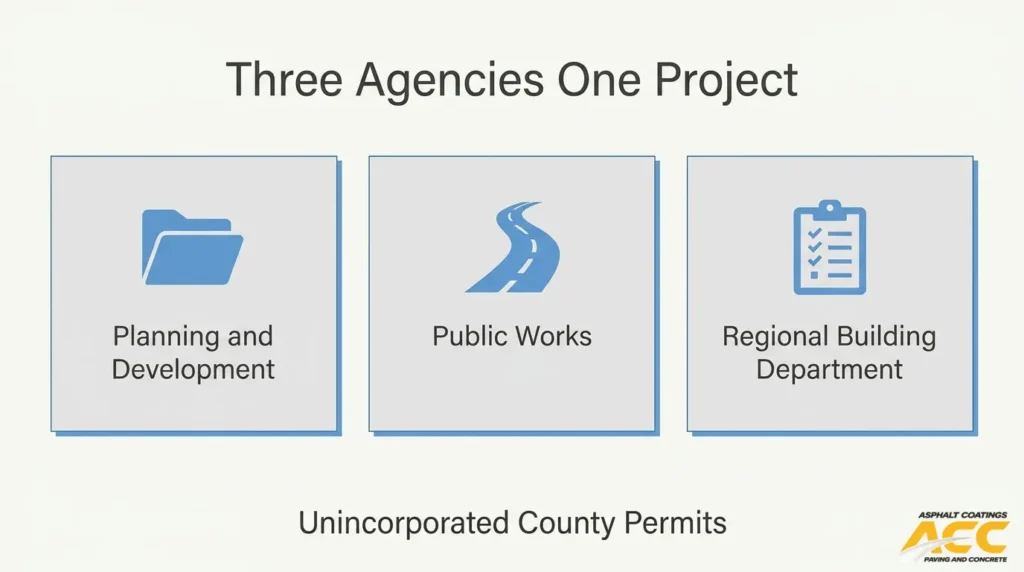
Commercial paving permits in unincorporated El Paso County are issued by multiple county departments and one regional agency, depending on the scope of work. The key permitting authorities are the Planning and Community Development department, the Department of Public Works, and the Pikes Peak Regional Building Department.
The El Paso County Planning and Community Development department and the Department of Public Works (Engineering) manage development applications and right-of-way permits, including access and construction permits for commercial paving projects in unincorporated areas. These departments handle site-level approvals such as grading plans, driveway access, and any work affecting county roadways.
The Pikes Peak Regional Building Department (PPRBD) performs plan reviews, issues building permits, and conducts inspections for all jurisdictions within El Paso County, including unincorporated areas. According to El Paso County, PPRBD serves as the shared building authority across the region, covering structural and code compliance reviews that apply to commercial construction.
This split-authority structure means a single commercial paving project may require coordination across two or three agencies simultaneously. Understanding which department controls each permit type prevents application delays and keeps projects on schedule.
What Types of Commercial Paving Projects Require Permits in Colorado Springs?
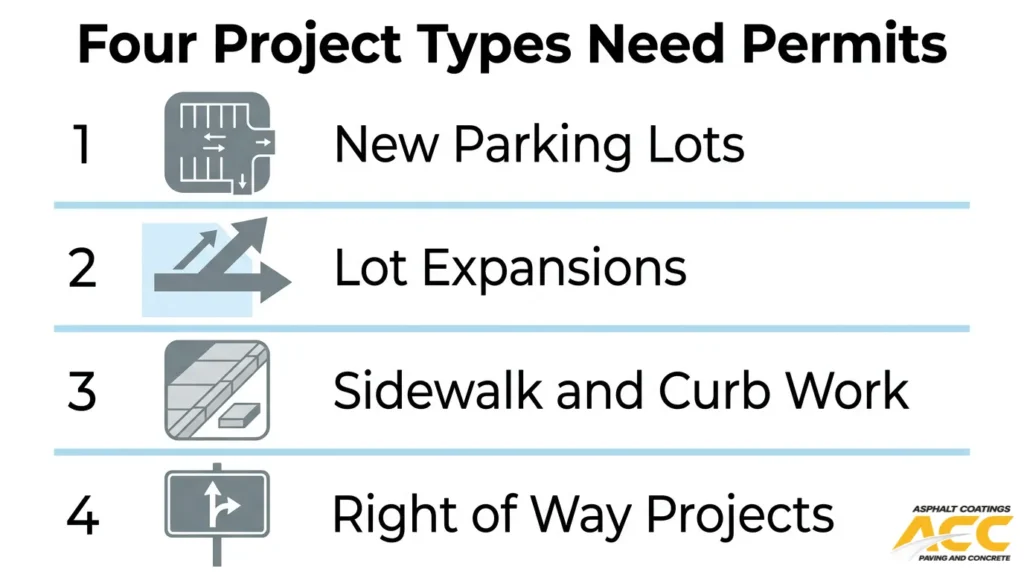
The types of commercial paving projects that require permits in Colorado Springs include new parking lot construction, lot expansions, sidewalk and curb replacements, and any work within the public right-of-way. Each project type triggers different permit categories.
What Permits Does a New Parking Lot Construction Require?
New parking lot construction requires a paving permit issued through the City of Colorado Springs Public Works department. Building a commercial lot from the ground up typically triggers multiple overlapping permits, including grading, stormwater management, and potentially traffic control approvals. Site plan review through the Pikes Peak Regional Building Department is also necessary to confirm ADA compliance, drainage design, and proper subgrade preparation. Because CDOT requires hot mix asphalt placement only when air and surface temperatures meet minimum thresholds defined in Table 401-3 of the Standard Specifications, permit timing should align with seasonal paving windows.
What Permits Does a Parking Lot Expansion or Reconfiguration Require?
A parking lot expansion or reconfiguration requires permits when the project changes the site’s impervious surface area, drainage patterns, or traffic circulation. Even adding a few rows of parking spaces can trigger stormwater permit updates because increased pavement alters runoff volumes. Reconfiguring traffic flow or entry points often requires traffic control permits and updated site plan approval. The Pikes Peak Regional Building Department reviews these modifications to verify continued ADA compliance and code conformance. Property managers often underestimate reconfiguration permitting; it is rarely as simple as repaving what already exists.
What Permits Do Sidewalk and Curb Replacements Require?
Sidewalk and curb replacements require permits and inspections through the Colorado Springs Public Works department. This applies to both new installations and repairs of existing sidewalks, curbs, and gutters. Concrete permits cover the scope of work, while inspections verify proper thickness, grading, and ADA-compliant slope requirements. Projects adjacent to public roadways may also need traffic control permits to manage pedestrian and vehicle safety during construction. Skipping this step risks failed inspections and costly rework, so securing permits before mobilization is always the smarter approach.
What Permits Does Work in the Public Right-of-Way Require?
Work in the public right-of-way requires dedicated right-of-way permits from the jurisdiction where the project is located. Within Colorado Springs city limits, the City Engineering Hub issues excavation, paving, and traffic control permits for any construction activity that encroaches on public roadways, medians, or utility corridors. For projects in unincorporated El Paso County, the Department of Public Works manages right-of-way permits, including access and construction permits. Right-of-way work carries heightened liability, so permit conditions typically include traffic management plans and restoration requirements to return the public space to its original condition.
Understanding which permits apply to your project is the first step; knowing how the application process differs between jurisdictions determines your timeline.
What Types of Commercial Paving Projects Require Permits in Unincorporated El Paso County?
The types of commercial paving projects that require permits in unincorporated El Paso County include new site grading and paving, access and driveway construction, and stormwater or drainage modifications. The El Paso County Land Development Code governs all development across unincorporated areas.
What Permits Does New Commercial Site Grading and Paving Require?
New commercial site grading and paving requires a grading permit, a building permit through the Pikes Peak Regional Building Department, and compliance with the El Paso County Land Development Code. All development applications must be submitted online via the Electronic Development Application Review Program (EDARP) at epcdevplanreview.com.
Commercial sites also require ADA compliance review. The Pikes Peak Regional Building Department enforces accessibility standards through Chapter 6 of the Engineering Criteria Manual, which outlines requirements for commercial project accessibility. Seasonal timing matters as well; Colorado’s freeze-thaw cycles can compromise freshly graded surfaces, so scheduling grading work during stable weather windows reduces rework risk.
What Permits Does Access and Driveway Construction Require?
Access and driveway construction requires an Access Permit from El Paso County’s Department of Public Works. According to the El Paso County Engineering Criteria Manual, an Access Permit is required to construct, reconstruct, pave, alter, enlarge, or change the use of any driveway connecting to a county road.
This permit ensures new access points meet sight-distance requirements, traffic safety standards, and drainage specifications. For commercial properties generating significant traffic, the county may also require a traffic impact study before approving the access point. Overlooking this permit is one of the most common compliance mistakes on commercial projects in unincorporated areas, and it can stall construction timelines significantly.
What Permits Do Stormwater and Drainage Modifications Require?
Stormwater and drainage modifications require permits tied to El Paso County’s Municipal Separate Storm Sewer System (MS4) requirements. Any commercial paving project that alters existing drainage patterns, increases impervious surface area, or redirects stormwater runoff must demonstrate compliance with county stormwater criteria before construction begins.
Key permit requirements include:
- A stormwater management plan showing pre- and post-development drainage conditions.
- Erosion and sediment control measures during construction.
- Detention or water quality facilities if the project exceeds disturbance thresholds.
Because paving inherently increases impervious coverage, nearly every commercial project in unincorporated El Paso County triggers some level of stormwater review. Understanding these requirements early prevents costly redesigns during the approval process.
How Does the Permit Application Process Differ Between the Two Jurisdictions?
The permit application process differs between Colorado Springs and unincorporated El Paso County in the portals used, the issuing departments, and the specific submission requirements. Below, each jurisdiction’s process is outlined separately.
How Do You Apply for a Commercial Paving Permit in Colorado Springs?
You apply for a commercial paving permit in Colorado Springs through the City Engineering Hub, which falls under the Public Works department. This office issues paving, concrete, excavation, traffic control, and storm drain permits within city limits.
The application steps include:
- Submit your application through the Accela Citizen Access (ACA) portal, which handles online permit applications, payments, and inspection scheduling.
- Include stormwater compliance documentation per the Stormwater Construction Manual (SCM), covering grading, sediment control, and erosion control criteria.
- Confirm compliance with MS4 Permit COS000004 stormwater requirements.
- Once approved, engineering permits are typically ready for payment within 3 to 5 business days, according to the City of Colorado Springs.
- Schedule all required inspections through the Online Permitting System after purchasing the permit.
Skipping this process carries real consequences: unpermitted commercial construction in Colorado Springs can result in financial penalties, stop-work orders, and potentially demolition of unauthorized structures.
How Do You Apply for a Commercial Paving Permit in Unincorporated El Paso County?
You apply for a commercial paving permit in unincorporated El Paso County through a different set of portals and departments than those used in Colorado Springs. Right-of-way permits are submitted through a dedicated online portal at epc-rowpermit.com, managed by El Paso County’s Department of Public Works.
Key steps in the county process include:
- Submit right-of-way permit applications through the El Paso County ROW portal.
- Follow the Engineering Criteria Manual for design and construction standards.
- Comply with the El Paso County Land Development Code for all zoning and use requirements.
- Budget for road impact fees, which as of January 2025 are set at $421.46 per trip for commercial developments.
Because the county uses separate portals and criteria from the city, confirming your project’s exact jurisdictional location before applying prevents costly resubmissions and delays.
What Are the Key Zoning and Land Use Requirements for Each Jurisdiction?
The key zoning and land use requirements for each jurisdiction are defined by separate regulatory codes. Colorado Springs enforces zoning through its City Code, while unincorporated El Paso County applies the El Paso County Land Development Code. Both frameworks govern how commercial properties can be developed, paved, and modified, but each imposes distinct compliance standards that affect project scope, permitted land uses, and site design before any paving permit is issued.
Colorado Springs regulates commercial paving projects through its municipal zoning ordinances, which dictate allowable land uses, setback requirements, lot coverage limits, and parking ratios for each zoning district. Any proposed parking lot, driveway expansion, or site reconfiguration must conform to the applicable zoning classification before engineering permits are approved. Stormwater compliance, covered under City Code 7.4.701, is also tied directly to land use approvals. Projects that increase impervious surface area often trigger additional review.
According to El Paso County Municode, development projects in unincorporated El Paso County are governed by the El Paso County Land Development Code, which applies to buildings, structures, and land uses throughout the unincorporated areas. This code establishes its own zoning districts, density standards, and site plan requirements independent of Colorado Springs regulations. Commercial paving projects in unincorporated areas must satisfy county-specific landscaping buffers, access spacing standards, and drainage criteria before receiving approval.
For property managers planning commercial paving in the greater Colorado Springs area, confirming which jurisdiction governs the parcel is the essential first step. A site located just outside city limits falls under entirely different land use rules, and assuming city standards apply to a county parcel can result in rejected applications and costly delays. Understanding how stormwater rules layer on top of these zoning requirements adds another critical dimension to project planning.
How Do Stormwater Management Rules Compare for Commercial Paving?
Stormwater management rules for commercial paving differ between Colorado Springs and unincorporated El Paso County in regulatory framework and enforcement authority. The following subsections cover the specific standards each jurisdiction applies.
What Stormwater Standards Apply in Colorado Springs?
The stormwater standards that apply in Colorado Springs are defined by City Code 7.4.701 and the city’s Drainage Criteria Manual. The City of Colorado Springs requires all property owners and developers to comply with stormwater requirements and policies set forth in these criteria, as documented by the city’s Stormwater Enterprise. Commercial paving projects must address grading, sediment control, and erosion prevention through the city’s MS4 permit framework. Because impervious surfaces like asphalt directly increase runoff volume, these standards carry real weight for parking lot construction and site paving. Overlooking stormwater compliance is one of the costliest mistakes a commercial property owner can make during project planning.
What Stormwater Standards Apply in Unincorporated El Paso County?
The stormwater standards that apply in unincorporated El Paso County are governed by the county’s Engineering Criteria Manual and the El Paso County Land Development Code. Commercial paving projects in unincorporated areas must meet drainage and grading requirements administered by the county’s Department of Public Works. While the county operates under state-level stormwater regulations rather than a city-specific MS4 permit, developers are still responsible for controlling runoff, preventing erosion, and managing post-construction drainage from new impervious surfaces. For projects near jurisdictional boundaries, confirming which stormwater authority applies before design begins saves significant time during permitting.
Understanding stormwater obligations in both jurisdictions helps commercial property owners plan for ADA and accessibility requirements that often accompany paving permits.
How Do ADA Compliance Requirements Factor Into Paving Permits?
ADA compliance requirements factor into paving permits by mandating that all commercial paving projects meet federal accessibility standards as a condition of permit approval. Both Colorado Springs and unincorporated El Paso County enforce these standards through the Pikes Peak Regional Building Department during plan review and inspection.
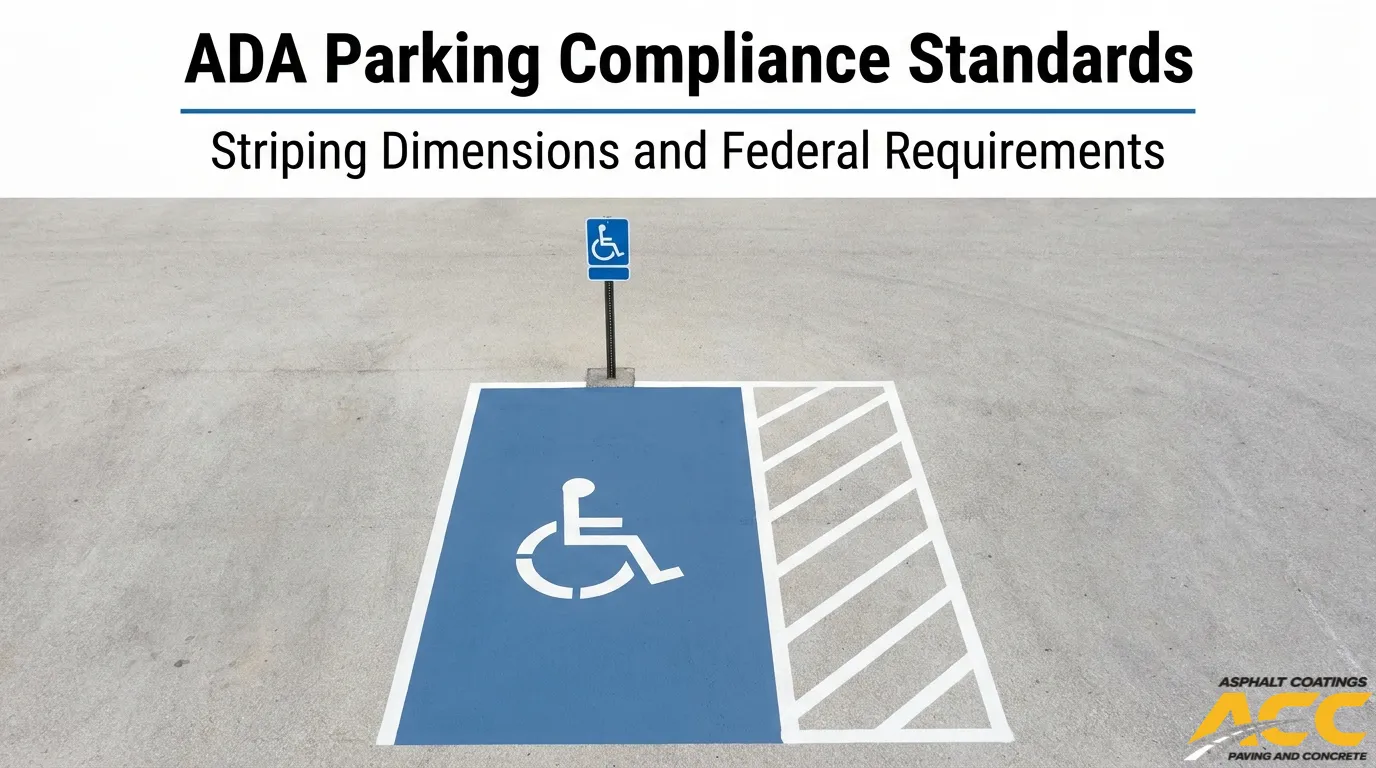
Any commercial paving project that includes parking lots, sidewalks, curb ramps, or pedestrian routes must demonstrate ADA compliance before a permit is issued. Requirements include proper slope gradients for accessible routes, detectable warning surfaces at curb ramps, correctly sized and marked accessible parking spaces, and compliant signage. The Pikes Peak Regional Building Department enforces accessibility standards through the Engineering Criteria Manual, which outlines requirements for commercial project accessibility.
Projects that alter existing surfaces often trigger what is known as a “path of travel” obligation, meaning accessibility upgrades may extend beyond the immediate paving scope. A parking lot resurfacing project, for example, could require new curb ramp installations or re-striped accessible spaces if the existing layout falls short of current ADA standards. This is one of the most commonly overlooked permit requirements in commercial paving, and failing to address it upfront can stall approvals and increase project costs significantly.
Understanding how ADA obligations interact with permit fees and timelines helps property owners budget accurately from the start.
What Are the Typical Permit Fees and Timelines in Each Jurisdiction?
The typical permit fees and timelines vary between Colorado Springs and unincorporated El Paso County based on project valuation and agency processing speeds. Both jurisdictions fall under the Pikes Peak Regional Building Department fee schedule for building permits.
What Are the Permit Fees and Timelines in Colorado Springs?
The permit fees and timelines in Colorado Springs are among the most competitive in the state. According to El Paso County, the Pikes Peak Regional Building Department reports that its permit fees have remained unchanged for 11 years, maintaining some of the lowest fee structures in Colorado. Engineering permits are typically ready for payment within 3 to 5 business days after approval.
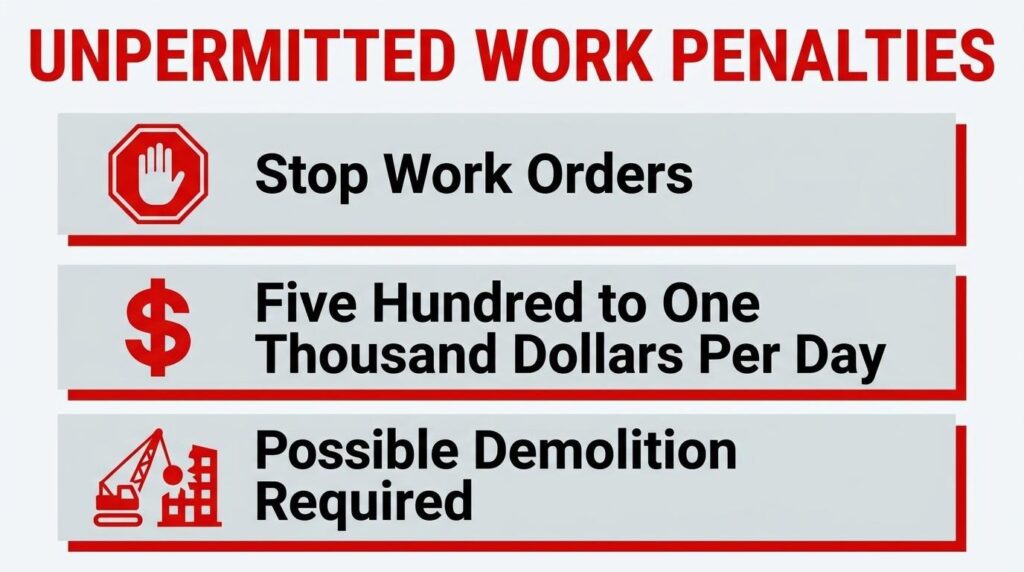
For commercial projects valued at $1,000,000 or more, PPRBD charges $4,064.00 for the first $1,000,000 plus $3.00 for each additional $1,000. Skipping the permit process carries steep consequences; investigation fees for unpermitted work are double the standard permit fee, with daily fines ranging from $500 to $1,000 per violation.
Given the relatively fast turnaround and stable fee structure, budgeting for permits in Colorado Springs is straightforward when project scope is well-defined upfront.
What Are the Permit Fees and Timelines in Unincorporated El Paso County?
The permit fees and timelines in unincorporated El Paso County follow the same PPRBD fee schedule for building-related permits since the regional building department serves both jurisdictions. The primary cost difference involves road impact fees. As of January 2025, El Paso County charges a road impact fee of $421.46 per trip for commercial developments, which can add significantly to total project costs depending on anticipated traffic volume.
Review timelines for county development applications may differ from city engineering permits because submissions go through the Electronic Development Application Review Program. Planning for longer lead times on county projects is wise, particularly when multiple departments must coordinate reviews.
Understanding fee structures in both jurisdictions helps commercial property owners budget accurately before breaking ground.
What Inspections Are Required During and After Commercial Paving?
Inspections required during and after commercial paving include subgrade verification, compaction testing, grade and drainage checks, and final surface evaluation. Both Colorado Springs and unincorporated El Paso County mandate scheduled inspections at key construction milestones.
In Colorado Springs, inspection requests must be scheduled through the Online Permitting System after purchasing a permit, according to the City of Colorado Springs engineering and permitting guidelines. Inspectors typically verify subgrade preparation, base course compaction, proper asphalt thickness, drainage compliance, and ADA accessibility at curb ramps and pedestrian areas. Each inspection must be passed before the next construction phase proceeds.
The Pikes Peak Regional Building Department performs inspections for all jurisdictions within El Paso County, including both Colorado Springs and unincorporated areas. This shared oversight means inspection standards remain consistent across the region, though scheduling procedures differ between the city’s Accela portal and the county’s permitting system.
Common commercial paving inspection checkpoints include:
- Subgrade compaction and soil stability before base material placement.
- Aggregate base thickness and density verification.
- Asphalt lift thickness, temperature at delivery, and rolling compaction.
- Stormwater drainage grading to confirm proper flow direction.
- ADA-compliant slopes at accessible routes, ramps, and parking areas.
- Final surface smoothness and pavement marking placement.
Failing any inspection typically results in corrective work before the project can advance, which adds time and cost. For commercial property owners, proactive coordination with inspectors at each milestone prevents costly rework. Experienced contractors familiar with local inspection sequences tend to move through these stages more efficiently, reducing the risk of delays that come from failed checkpoints.
Understanding inspection requirements sets the stage for recognizing the consequences of bypassing the permit process entirely.
What Happens if You Start a Commercial Paving Project Without a Permit?
Starting a commercial paving project without a permit in Colorado Springs triggers financial penalties, stop-work orders, and potential demolition of unauthorized work. The consequences escalate quickly and cost far more than the original permit fees.
Unpermitted commercial construction work in Colorado Springs leads to immediate enforcement action. The city can issue stop-work orders that halt all site activity until compliance is achieved. According to Shyft, financial penalties for building without a permit in Colorado Springs typically include investigation fees that are double the standard permit fee, along with daily fines ranging from $500 to $1,000 per violation.
Beyond fines, the most severe consequence involves mandatory removal. Structures or paving installed without proper authorization may require complete demolition at the property owner’s expense. This risk applies to parking lots, sidewalks, curb work, and any improvements within the public right-of-way.
The financial math makes compliance non-negotiable. A permit that might cost a few hundred dollars upfront can balloon into thousands in doubled investigation fees, daily violation fines, and potential tear-out costs when work proceeds without approval. For commercial property owners managing budgets and timelines, an unpermitted project creates exactly the kind of unpredictable liability that proper planning is designed to prevent.
Understanding how seasonal factors influence permit timing helps avoid additional scheduling complications.
How Do Seasonal Conditions in Colorado Affect Permit Timing and Paving Schedules?
Seasonal conditions in Colorado affect permit timing and paving schedules by compressing viable construction windows into warmer months and creating material placement restrictions during colder periods. Temperature thresholds, freeze-thaw cycles, and weather unpredictability all influence when permits should be filed and when asphalt can be installed.
The Colorado Department of Transportation (CDOT) requires that hot mix asphalt only be placed when both air and surface temperatures meet or exceed specific minimum thresholds defined in Table 401-3 of the Standard Specifications. This requirement directly shapes scheduling for commercial paving projects in Colorado Springs and unincorporated El Paso County, since temperatures at elevation can drop below these thresholds well into spring and again by early fall.
Winter weather in the Colorado Springs area also necessitates addressing minor sidewalk issues before they worsen due to the region’s freeze-thaw cycles. Water infiltrates small cracks, freezes, expands, and breaks the pavement apart from within. For property managers planning permitted commercial work, this means scheduling paving during summer months while using the permit approval window in late winter or early spring to prepare documentation. Filing permit applications before the construction season begins helps avoid delays once temperatures become favorable. Aligning permit submissions with the region’s short paving season is one of the most practical steps commercial property owners can take to keep projects on schedule and within budget.
How Can a Commercial Paving Contractor Help You Navigate Permits in Colorado Springs and El Paso County?
An experienced commercial paving contractor can help streamline projects by coordinating construction schedules with required inspections and ensuring work meets MS4 stormwater permit compliance standards. The following sections cover Asphalt Coatings Company’s permit-ready capabilities and the key takeaways from this guide.
Can Asphalt Coatings Company Handle Permit-Ready Commercial Paving Projects?
Yes, Asphalt Coatings Company can handle permit-ready commercial paving projects throughout Colorado Springs and El Paso County. With a Colorado Springs office at 4740 Forge Rd STE 110B and 39 years of Front Range experience, Asphalt Coatings Company brings deep familiarity with local permitting requirements across both jurisdictions. Asphalt Coatings Company performs all work with in-house crews, which streamlines coordination between permit milestones, required inspections, and construction phases. Services span every permit-triggering scope covered in this guide:
- Parking lot construction, expansion, and repaving
- Sidewalk, curb, and gutter installation
- Subgrade preparation and grading
- ADA-compliant concrete work
- Sealcoating and crack sealing
For commercial property managers navigating unfamiliar permit processes, having a single contractor who understands both city and county requirements eliminates costly missteps and scheduling delays.
What Are the Key Takeaways About Commercial Paving Permits in Colorado Springs vs. Unincorporated El Paso County?
The key takeaways about commercial paving permits in Colorado Springs vs. unincorporated El Paso County center on jurisdictional differences in issuing agencies, application portals, and regulatory codes. According to El Paso County, the Pikes Peak Regional Building Department performs plan reviews, issues permits, and conducts inspections for all cities and towns within El Paso County, including Colorado Springs and unincorporated areas. Despite that shared oversight, critical differences remain:
- Colorado Springs routes paving permits through its City Engineering Hub and Accela portal, while the county uses EDARP and a separate right-of-way portal.
- Stormwater, zoning, and fee structures differ between city limits and unincorporated areas.
- Penalties for unpermitted work apply in both jurisdictions and can be severe.
Confirming your project’s exact jurisdiction before submitting any application is the single most important step to avoiding delays and compliance issues.