Commercial asphalt resurfacing is the process of applying a new hot mix asphalt layer over an existing pavement surface to restore structural integrity and appearance without full reconstruction. Costs typically range from $1.25 to $4.00 per square foot depending on project scope.
This guide covers per-square-foot pricing by lot size, overlay thickness specifications, pavement condition impacts, property type variations, and additional line items that shape total project cost.
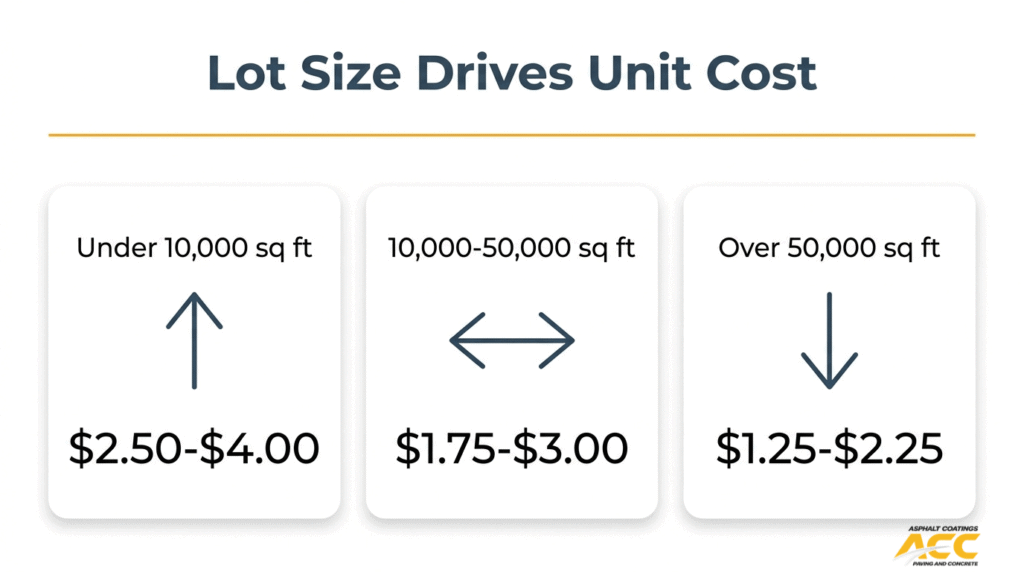
Small commercial lots under 10,000 square feet pay the highest rates ($2.50 to $4.00 per square foot) because mobilization and equipment costs spread across fewer square yards, while large properties exceeding 50,000 square feet achieve the lowest unit costs ($1.25 to $2.25) through economies of scale.
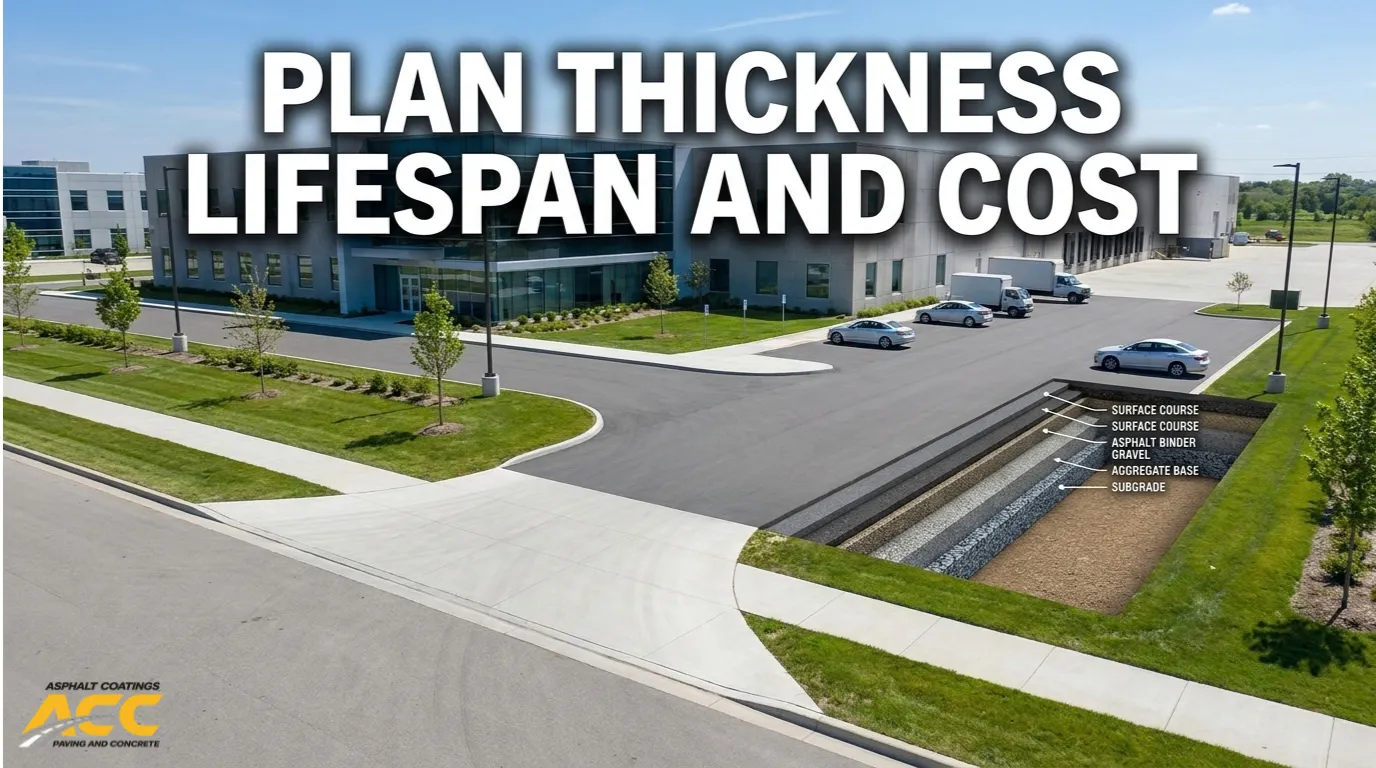
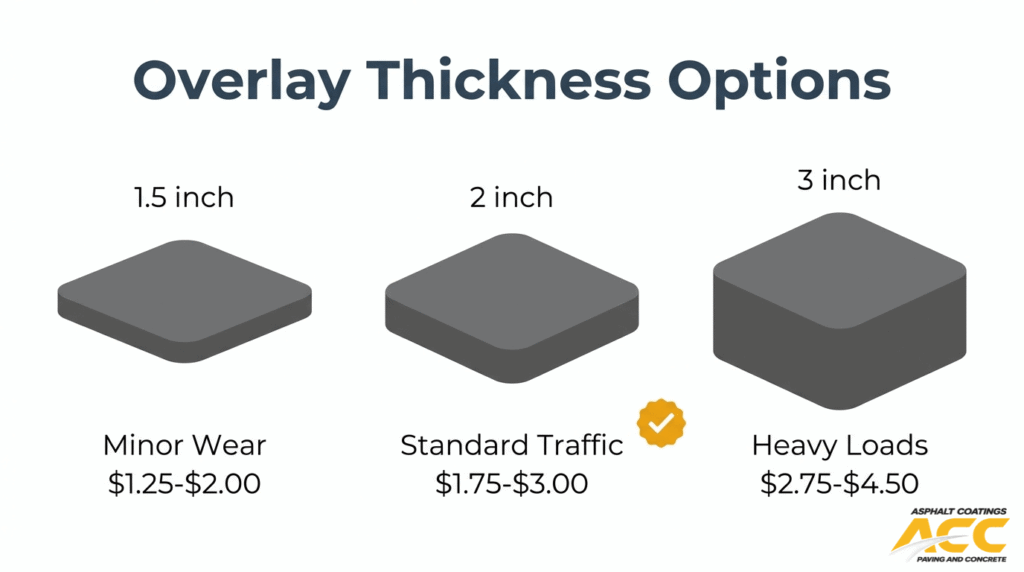
Overlay thickness drives material volume and longevity; a 1.5-inch overlay serves surfaces with minor wear at the lowest cost entry point, a 2-inch overlay provides the most common balance of structural improvement and value for standard traffic, and 3-inch or thicker applications handle heavy-axle industrial loads at premium pricing.
Existing pavement condition determines prep work scope. Surfaces with only cosmetic cracking qualify for straightforward mill-and-overlay, while base failures require excavation and rebuilding before paving. Drainage corrections represent the highest-cost preparation tier.
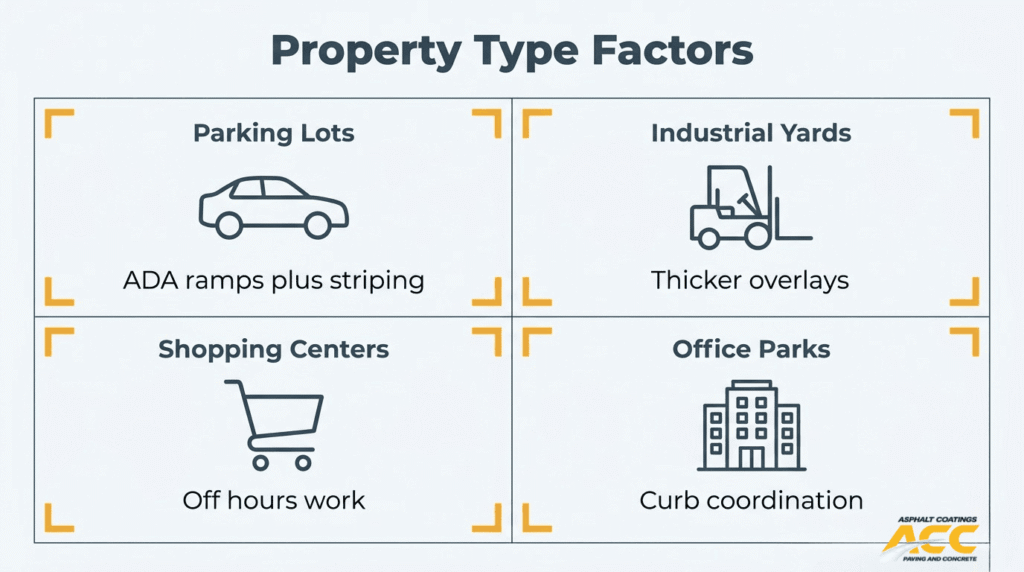
Property type introduces distinct variables: parking lots require ADA ramp compliance and restriping, industrial yards demand thicker overlays for concentrated wheel loads, shopping centers need off-hours scheduling, and office park roads involve curb work and utility coordination.
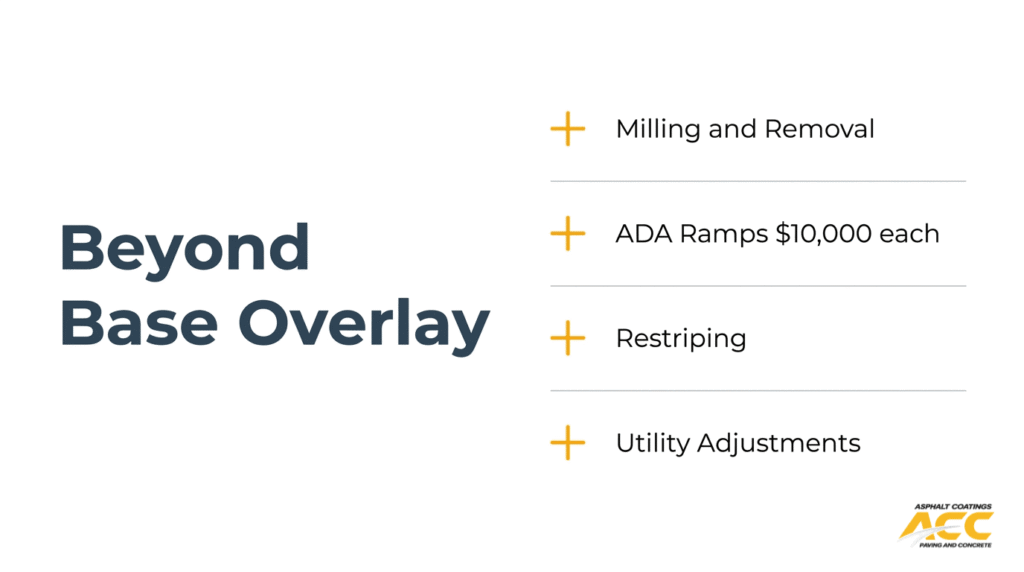
Line items beyond the overlay itself (milling, ADA ramps at $10,000 each, restriping, utility adjustments) can shift total cost substantially. Seasonal timing and climate also influence pricing, with peak-season premiums reaching 10 to 20% above shoulder-season rates.
What Is Commercial Asphalt Resurfacing?
Commercial asphalt resurfacing is the process of applying a new layer of hot mix asphalt over an existing pavement surface to restore its structural integrity and appearance. This procedure addresses surface deterioration without removing the entire pavement structure.
Hot Mix Asphalt (HMA) consists of approximately 95% stone, sand, or gravel bound together by asphalt cement, a product of crude oil, according to the National Asphalt Pavement Association. Before the new overlay is placed, contractors apply a tack coat, which is a thin layer of asphalt emulsion that promotes bonding between the existing surface and the fresh material. The process typically involves milling, which removes at least part of the deteriorated surface to create a uniform substrate for the overlay.
For commercial properties such as parking lots, industrial yards, and office park roads, resurfacing extends pavement life at a fraction of full reconstruction cost. According to a study by the National Center for Asphalt Technology, flexible pavements can be rehabilitated multiple times by milling and replacing the upper asphalt layers, provided the base or subgrade layers have not failed. This makes resurfacing particularly valuable for property managers seeking to maintain functional surfaces without the disruption and expense of complete removal.
Understanding what resurfacing involves sets the stage for comparing it against full-depth replacement and evaluating per-square-foot pricing.
How Does Resurfacing Differ From Full-Depth Replacement?
Resurfacing differs from full-depth replacement in scope, cost, and structural intervention. Resurfacing mills and overlays the top asphalt layers, while full-depth replacement removes the entire pavement structure down to the subgrade.
- Resurfacing removes 1.5 to 3 inches of surface material, then applies a new hot mix asphalt overlay over the existing base.
- Full-depth replacement demolishes all asphalt layers, inspects and regrads the subgrade, installs new aggregate base, and paves from scratch.
- Cost difference: resurfacing typically costs 30–50% less than full replacement because it preserves the structural base.
- Timeline: resurfacing completes faster with less disruption to commercial operations.
- Candidacy: resurfacing requires a structurally sound base; replacement is necessary when subgrade failure, severe alligator cracking, or widespread base deterioration exists.
According to the National Center for Asphalt Technology, flexible pavements can be rehabilitated multiple times by milling and replacing the upper asphalt layers, provided the base or subgrade layers have not failed. This distinction is the core decision point: if your base is intact, resurfacing delivers comparable performance at a fraction of replacement cost. When base integrity is compromised, no overlay thickness can compensate for structural deficiency underneath.
Understanding this threshold helps property managers avoid overspending on unnecessary replacement or underspending on a resurface that fails prematurely.
What Is the Average Cost Per Square Foot for Commercial Asphalt Resurfacing?
The average cost per square foot for commercial asphalt resurfacing typically ranges from $1.25 to $4.00, depending on lot size, overlay thickness, and material pricing. Below, costs are broken down by small, mid-size, and large commercial properties.
How Much Does Resurfacing a Small Commercial Lot Cost Per Sq Ft?
Resurfacing a small commercial lot costs approximately $2.50 to $4.00 per square foot. Small lots, generally under 10,000 square feet, carry higher per-unit costs because mobilization expenses, equipment setup, and minimum material orders are distributed across fewer square yards. For context, the Texas Department of Transportation recorded average low bid unit prices for asphalt binder (PG 64-22) at $395.00 per ton as of August 2024, and raw material costs represent only a fraction of the total installed price. Labor, milling, and striping each add proportionally more on smaller projects where economies of scale cannot offset fixed overhead.
How Much Does Resurfacing a Mid-Size Parking Lot Cost Per Sq Ft?
Resurfacing a mid-size parking lot costs approximately $1.75 to $3.00 per square foot. Mid-size lots, typically between 10,000 and 50,000 square feet, benefit from better material pricing and more efficient crew deployment. Equipment runs longer before repositioning, and bulk asphalt orders reduce the per-ton delivered cost. According to Federal Lands Highway data, average monthly asphalt prices in the Fort Lauderdale, Florida region were recorded at $585.00 per ton in January 2025, decreasing to $562.50 by December. While regional pricing varies, mid-size projects consistently achieve lower unit costs than small lots because fixed mobilization charges spread across greater square footage.
How Much Does Resurfacing a Large Commercial Property Cost Per Sq Ft?
Resurfacing a large commercial property costs approximately $1.25 to $2.25 per square foot. Properties exceeding 50,000 square feet, such as distribution centers, shopping plazas, and industrial yards, achieve the lowest per-square-foot rates due to maximum economies of scale. Paving crews operate continuously with fewer interruptions, and contractors can negotiate volume discounts on hot mix asphalt. However, large projects often require phased scheduling to keep portions of the lot open for business operations, which can partially offset material savings with extended labor timelines. For most property managers, these large-scale projects still represent the best cost efficiency per square foot across all commercial categories.
Understanding how lot size influences pricing sets the stage for examining how overlay thickness further affects your per-square-foot investment.
How Does Overlay Thickness Affect Resurfacing Cost Per Square Foot?
Overlay thickness directly affects resurfacing cost per square foot by increasing material volume, equipment time, and labor. Thicker overlays require more hot mix asphalt per square foot, which raises the total project price proportionally. The subsections below break down costs for 1.5-inch, 2-inch, and 3-inch overlay specifications.
How Much Does a 1.5-Inch Asphalt Overlay Cost Per Sq Ft?
A 1.5-inch asphalt overlay typically costs between $1.25 and $2.00 per square foot for commercial projects. This thin overlay works best for surfaces with minor wear and no structural deficiency. According to Federal Highway Administration data, the cost for a 1.5-inch asphalt treatment is estimated at $536 per mile based on a representative hot-mix asphalt price of $75 per ton.
Proper bonding between the existing surface and new material is critical at this thickness. Tack coat, a thin layer of asphalt emulsion, is applied to promote adhesion between the old pavement and new overlay. For parking lots with only surface-level deterioration, this thickness delivers the lowest cost entry point while extending pavement life by 8 to 12 years.
How Much Does a 2-Inch Asphalt Overlay Cost Per Sq Ft?
A 2-inch asphalt overlay costs approximately $1.75 to $3.00 per square foot for commercial applications. This thickness represents the most common specification for parking lot resurfacing because it balances structural improvement with cost efficiency.
The additional half-inch of material compared to a 1.5-inch overlay adds roughly 33% more hot mix asphalt by volume. That increase covers:
- Greater load-bearing capacity for heavy vehicle traffic.
- Improved resistance to rutting in high-turnover areas.
- Longer service life, typically 12 to 15 years with proper maintenance.
For most commercial properties handling standard passenger and delivery vehicle loads, a 2-inch overlay provides the optimal cost-to-performance ratio without overbuilding the section.
How Much Does a 3-Inch or Thicker Overlay Cost Per Sq Ft?
A 3-inch or thicker overlay costs between $2.75 and $4.50 per square foot for commercial resurfacing projects. This specification is reserved for high-traffic industrial yards, distribution centers, and properties supporting heavy-axle vehicles. Federal Highway Administration estimates show a 3.0-inch treatment costs approximately $2,145 per mile, nearly four times the cost of a 1.5-inch application at the same material price per ton.
Thicker overlays are warranted when:
- Existing pavement shows moderate structural distress but the base remains sound.
- Traffic loads exceed standard passenger vehicle weights.
- The property owner requires a 15-to-20-year service life before the next intervention.
The material cost increase is significant, but avoiding premature failure on heavily loaded surfaces makes this thickness a better long-term investment for industrial applications.
Understanding how thickness drives cost helps property managers right-size their overlay specification before evaluating how existing pavement condition adds further pricing variables.
How Does Pavement Condition Influence Resurfacing Price?
Pavement condition influences resurfacing price by determining how much preparatory work is needed before new asphalt can be placed. The following subsections cover costs for surface-only distress, base failures, and drainage-related corrections.
What Does Resurfacing Cost When Only Surface Cracks Are Present?
Resurfacing costs when only surface cracks are present typically fall at the lower end of the pricing spectrum because the pavement structure remains sound. Crack sealing and minor patching add modest prep costs before the overlay. Pavements scoring above 70 on the Pavement Condition Index generally qualify for a straightforward mill-and-overlay approach without structural intervention. According to ScienceDirect, pavement distress indices such as the Surface Distress Index and Pavement Condition Index assess the structural and functional health of road networks, helping contractors determine whether simple resurfacing is sufficient. For properties with only cosmetic cracking, this represents the most cost-efficient resurfacing scenario.
What Does Resurfacing Cost When Base Repairs Are Needed?
Resurfacing costs when base repairs are needed increase significantly because failed subgrade sections must be excavated and rebuilt before any overlay is placed. Full-depth patching, sometimes called digouts, involves removing deteriorated asphalt and aggregate base, recompacting the subgrade, and installing new base material. According to a Mineta Transportation Institute report, timely repairs of pavement defects such as crack sealing and patching protect public agency investments and serve as essential resurfacing preparation. When base failure is localized, spot repairs keep costs manageable; however, widespread structural distress can push total project costs considerably higher than surface-only scenarios.
What Does Resurfacing Cost When Drainage Corrections Are Required?
Resurfacing costs when drainage corrections are required represent the highest price tier because grading adjustments, inlet installations, or subsurface drain systems must be completed before paving. Standing water accelerates base deterioration, so ignoring drainage issues during resurfacing leads to premature failure of the new surface. Corrections may include:
- Regrading low spots to establish proper slope
- Installing or replacing catch basins and storm drains
- Adding French drains or underdrains beneath the pavement section
These additions can increase total project cost well beyond a standard overlay, yet they protect the long-term investment by preventing recurring water damage.
With drainage strategies in place, property type becomes the next factor shaping per-square-foot pricing.
How Does Property Type Change the Cost Per Square Foot?
Property type changes the cost per square foot based on traffic load, layout complexity, and surface preparation requirements. The sections below cover pricing differences for parking lots, industrial yards, shopping centers, and office park roads.
How Much Does Parking Lot Resurfacing Cost Per Sq Ft?
Parking lot resurfacing typically costs between $1.50 and $3.50 per square foot. Several factors push parking lot pricing toward the middle or upper end of the commercial resurfacing range:
- Tight turning radii around islands and medians require more precise milling.
- Striping, ADA ramp upgrades, and signage must be restored after overlay.
- Stormwater drainage structures need adjustment to match the new surface grade.
- High pedestrian traffic zones demand smoother finish tolerances.
Smaller lots under 10,000 square feet generally cost more per square foot because mobilization expenses are spread across less area. For properties with heavy daily vehicle counts, investing in a thicker overlay often reduces long-term per-square-foot maintenance costs.
How Much Does Industrial Yard Resurfacing Cost Per Sq Ft?
Industrial yard resurfacing costs roughly $2.00 to $4.50 per square foot. Industrial properties face heavier loads from forklifts, semi-trucks, and loaded trailers, which demand thicker overlays and sometimes base stabilization before new asphalt is placed.
Key cost drivers for industrial yards include:
- Thicker overlays (often 3 inches or more) to withstand concentrated wheel loads.
- Subgrade repairs caused by oil, chemical spills, or prolonged heavy equipment use.
- Phased scheduling to keep warehouse operations running during paving.
These factors make industrial yard resurfacing one of the more expensive property categories on a per-square-foot basis, though the larger contiguous areas can partially offset mobilization costs.
How Much Does Shopping Center Resurfacing Cost Per Sq Ft?
Shopping center resurfacing costs approximately $1.75 to $3.75 per square foot. Shopping centers introduce complexity through their mix of high-traffic drive lanes, lower-traffic parking stalls, pedestrian crossings, and loading dock areas, each requiring different preparation levels.
Cost-influencing factors specific to shopping centers include:
- Night or off-hours scheduling to avoid disrupting retail business.
- Multiple ADA-compliant ramp installations at storefronts and crosswalks.
- Extensive restriping for parking stalls, fire lanes, and directional arrows.
- Drainage modifications around building perimeters and cart corrals.
Because shopping center projects often exceed 50,000 square feet, economies of scale tend to bring the per-square-foot rate below what smaller commercial properties pay.
How Much Does Office Park Road Resurfacing Cost Per Sq Ft?
Office park road resurfacing costs approximately $2.00 to $4.00 per square foot. Office park roads resemble municipal streets more than standard parking lots, requiring asphalt milling of the existing surface before a new overlay is placed. Asphalt milling removes at least part of the paved surface to prepare it for resurfacing, and this step adds both labor and disposal costs.
According to a 2025 road program cost estimate for Caln Township, furnishing and installing 3-inch asphalt rolled curb is priced at $3.00 per linear foot, illustrating how curb work alongside road resurfacing increases total project expense. Office parks also require coordination around utility access points, landscaped medians, and entry monuments that complicate equipment routing.
With property-specific variables clarified, understanding the additional line items beyond the overlay itself reveals the full picture of total project cost.
What Additional Line Items Increase Total Resurfacing Cost?
Additional line items that increase total resurfacing cost include milling, ADA ramp upgrades, restriping, and utility adjustments. Each adds a distinct per-unit charge on top of base asphalt pricing.
How Much Does Milling the Existing Surface Add to Cost?
Milling the existing surface adds cost for equipment mobilization, material removal, and haul-off disposal. Cold milling machines grind the deteriorated asphalt layer to a specified depth, creating a clean bonding surface for the new overlay. Costs vary based on milling depth, total square footage, and distance to the recycling facility. Thicker milling passes require more machine time and generate heavier loads, which raises hauling expenses. Projects that skip milling risk poor overlay adhesion and premature failure, making this line item essential for long-term performance rather than an optional add-on.
How Much Do ADA-Compliant Ramp Upgrades Add to Cost?
ADA-compliant ramp upgrades add a significant per-unit cost to any resurfacing project. According to a 2025 road program cost estimate for Caln Township, ADA curb ramp upgrades are priced at $10,000.00 each, while 3-inch asphalt rolled curb costs $3.00 per linear foot. Commercial properties with multiple access points can accumulate tens of thousands in ramp compliance costs alone.
Federal accessibility standards require ramp upgrades whenever resurfacing alters the road or parking lot surface. Budgeting for these upgrades early prevents costly change orders mid-project. For properties with aging curb infrastructure, combining ramp work with resurfacing keeps mobilization costs lower than phasing them separately.
How Much Does Restriping and Pavement Marking Add to Cost?
Restriping and pavement marking add a recurring cost that compounds over the pavement’s service life. A proactive maintenance program involving scheduled crack sealing, sealcoating, and striping costs approximately $0.50 to $0.75 per square foot per year over the pavement’s lifecycle, according to FHWA data. Fresh striping after resurfacing is not optional for commercial lots; it restores traffic flow, ADA-compliant stall widths, fire lane markings, and directional arrows.
Thermoplastic markings cost more upfront than standard latex paint but last significantly longer under heavy traffic. Factoring restriping into the resurfacing bid rather than rebidding it separately typically reduces total project cost.
How Much Do Utility Adjustments Add to Resurfacing Cost?
Utility adjustments add variable cost depending on the number of manholes, valve boxes, and drain inlets within the paving area. Each structure must be raised or lowered to match the new surface elevation. Failing to adjust utilities creates trip hazards, drainage pooling, and accelerated cracking around the structure. According to North Dakota Department of Transportation data, a 10% increase in resurfacing costs was applied for the 2024-2025 biennium partly to account for rising aggregate and hauling costs tied to such ancillary work.
Coordinating with utility providers early in the planning phase prevents schedule delays that inflate labor costs. Properly adjusted utilities protect pavement integrity and extend overlay life across the entire surface.
How Does Climate and Season Affect Resurfacing Pricing?
Climate and season affect resurfacing pricing by influencing material availability, plant production schedules, and the length of viable paving windows. Seasonal demand surges and weather-related delays both drive per-square-foot costs higher.
Hot mix asphalt requires ambient temperatures above approximately 50°F for proper compaction and bonding. In regions with short warm seasons, contractors compress more work into fewer months, which increases crew demand and equipment competition. This compressed schedule often translates to peak-season premiums of 10–20% compared to shoulder-season pricing.
Cold climates introduce additional cost factors:
- Freeze-thaw cycling damages existing pavement faster, potentially increasing prep work before overlay.
- Asphalt plants shut down during winter months, limiting material supply.
- Emergency or off-season paving requires heated transport and rapid placement, raising labor costs.
Conversely, warmer climates allow year-round production but face their own pricing pressures. According to Federal Lands Highway data, average monthly asphalt prices in the Fort Lauderdale, Florida region ranged from $585.00 per ton in January 2025 down to $562.50 by December, showing that even in warm markets, seasonal price fluctuations exist.
Humidity and rain also matter. Wet conditions halt paving operations entirely, extending project timelines and increasing mobilization charges. Properties in high-precipitation zones should budget for weather-delay contingencies when planning resurfacing projects.
For property managers seeking the best value, scheduling resurfacing during shoulder seasons (early spring or late fall in temperate climates) often captures lower material costs and greater contractor availability before peak-season backlogs develop.
How Does Commercial Resurfacing Cost Compare to Other Repair Methods?
Commercial resurfacing cost compares favorably to full replacement while exceeding the longevity of surface-only treatments. The comparison depends on repair scope, pavement condition, and long-term performance expectations.
Resurfacing occupies a middle tier between preventive maintenance and complete reconstruction. Crack sealing and sealcoating address surface-level deterioration at lower per-square-foot rates, but these methods cannot restore structural integrity once distress penetrates beyond the wearing course. Full-depth replacement removes and rebuilds the entire pavement section, costing significantly more per square foot due to excavation, hauling, subgrade preparation, and new material installation.
According to a 1997 American Public Works Association report cited by Metro Nashville, “the issues surrounding the management of utility cuts are as varied as the cuts are numerous,” highlighting the need for higher accountability in selecting durable, cost-efficient repair methods. This principle applies broadly: choosing the wrong repair tier wastes budget either through premature failure of insufficient treatments or overspending on unnecessary reconstruction.
For most commercial properties with moderate surface distress and an intact base layer, resurfacing delivers the strongest cost-to-lifespan ratio. It restores ride quality, structural capacity, and appearance at a fraction of full replacement cost while lasting far longer than topical sealants alone. The key decision factor is whether the existing base can support a new surface layer without additional structural work beneath it.
When Is Resurfacing More Cost-Effective Than Full Replacement?
Resurfacing is more cost-effective than full replacement when the existing base and subgrade remain structurally sound and surface distress is limited to the upper asphalt layers. The decision depends on damage extent, base integrity, and long-term lifecycle costs.
When localized failures affect less than 20% of the total surface area, targeted repairs combined with an overlay deliver strong results at a fraction of replacement cost. According to the Mineta Transportation Institute, digouts for pavement repair may be less cost-effective than full-depth reclamation or partial-depth reclamation once the repair area exceeds 20% of the total surface. That threshold is where resurfacing economics break down; beyond it, removing and rebuilding the entire pavement section often proves more economical over the asset’s lifecycle.
Conditions that favor resurfacing over replacement include:
- Surface cracking, minor rutting, or oxidation without base failure.
- Adequate drainage with no subgrade saturation or erosion.
- Pavement age within the first half of its expected service life.
- Consistent structural support confirmed through coring or deflection testing.
Conditions that favor full replacement include:
- Widespread alligator cracking or potholes indicating base deterioration.
- Subgrade failure from poor drainage or soil instability.
- Repair areas exceeding 20% of the total paved surface.
- Pavement that has already been resurfaced multiple times, leaving insufficient elevation clearance for another overlay.
For most commercial properties, resurfacing at the right time costs roughly 30% to 50% of what full replacement demands. Delaying resurfacing until base damage develops eliminates that savings advantage entirely. The most cost-effective strategy treats resurfacing as a proactive investment, not a last resort, preserving both the pavement structure and the budget.
Understanding when resurfacing makes financial sense helps property managers request more accurate project estimates.
How Can You Get an Accurate Resurfacing Estimate for Your Property?
You can get an accurate resurfacing estimate by requesting a site-specific assessment that accounts for pavement condition, square footage, overlay thickness, and current material costs.
Can Asphalt Coatings Company Handle Your Commercial Resurfacing Project?
Yes, Asphalt Coatings Company can handle your commercial resurfacing project. With 39 years of experience serving Colorado’s Front Range, Asphalt Coatings Company performs mill and pave services, asphalt repair, sealcoating, and full parking lot construction using in-house crews. This single-source approach streamlines scheduling and cost control for property managers, industrial complexes, and shopping centers.
Commercial resurfacing projects vary widely in scope. A 2025 paving bid for the Town of Westminster, Vermont, estimated 27,896 square yards of asphalt milling and 1,590 tons of asphalt pavement for a single municipal project. Asphalt Coatings Company provides transparent estimates that account for Colorado-specific challenges, including freeze-thaw cycles and high-altitude UV exposure, so property owners understand exactly what their investment covers.
What Are the Key Takeaways About Commercial Asphalt Resurfacing Cost Per Square Foot?
The key takeaways about commercial asphalt resurfacing cost per square foot are:
- Resurfacing costs depend on overlay thickness, pavement condition, property type, and regional material pricing.
- Labor rates vary significantly by region; the Washington State Department of Labor & Industries set 2025 asphalt paving rates at $2.2903 per square foot.
- A proactive maintenance program combining crack sealing, sealcoating, and striping costs approximately $0.50 to $0.75 per square foot annually over the pavement’s lifecycle.
- Requesting a site-specific estimate remains the most reliable way to determine actual project costs.
Investing in timely resurfacing rather than deferring maintenance consistently proves more economical over a pavement’s full lifespan. Asphalt Coatings Company partners with commercial property owners to deliver precise estimates tailored to each site’s unique conditions.