Commercial paving cost in Denver is the total expense of installing or replacing asphalt or concrete surfaces on commercial properties, including base material, labor, permits, drainage, and ADA compliance. Asphalt ranges from $4.00 to $10.00 per square foot for new installations, while concrete slabs run $6.00 to $12.00 per square foot.
This guide covers asphalt and concrete pricing by project type, site and climate factors that shift estimates, Denver permits and regulations, permitting timeline impacts, regional cost comparisons, hidden costs, and budgeting strategy.
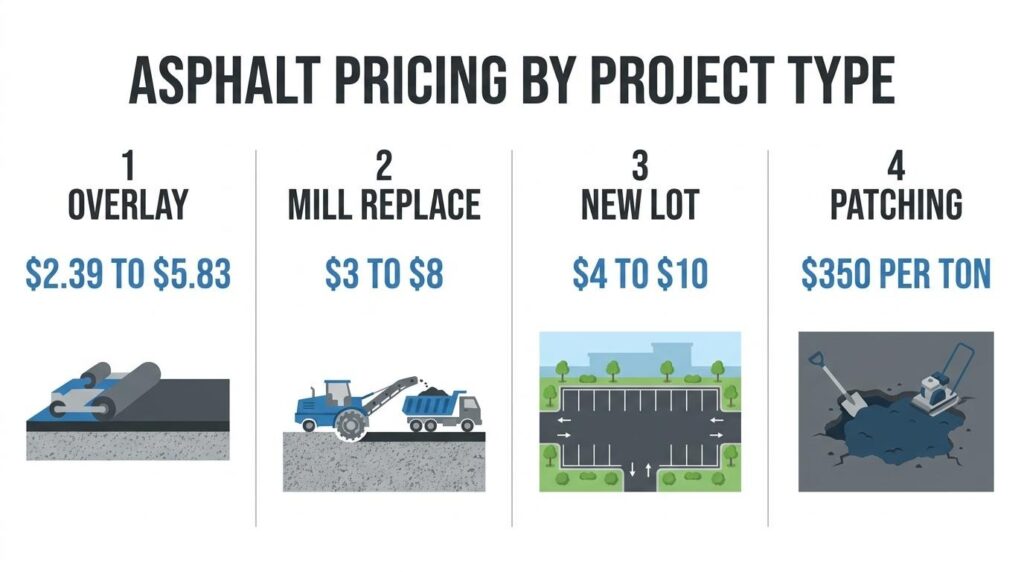
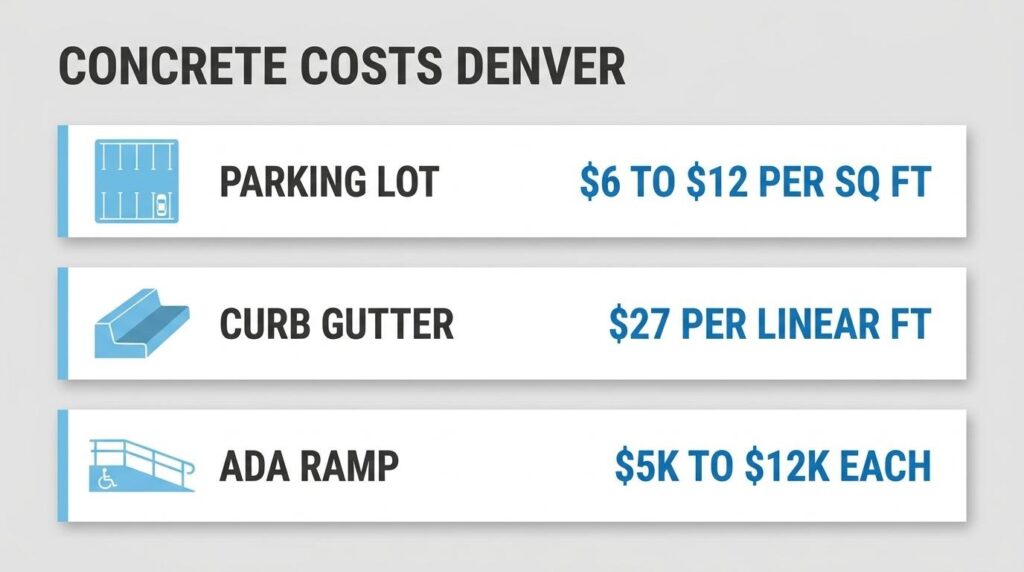
Asphalt pricing varies significantly by scope. New parking lot construction, overlays, mill and replace, and small-scale patching each carry distinct per-square-foot ranges, with overlays starting as low as $2.39 and patching commanding premium rates due to fixed mobilization charges. Concrete costs run higher upfront but apply to parking lots, curb and gutter work at roughly $27.00 per linear foot, and ADA ramp installations between $5,000 and $12,000 per location.
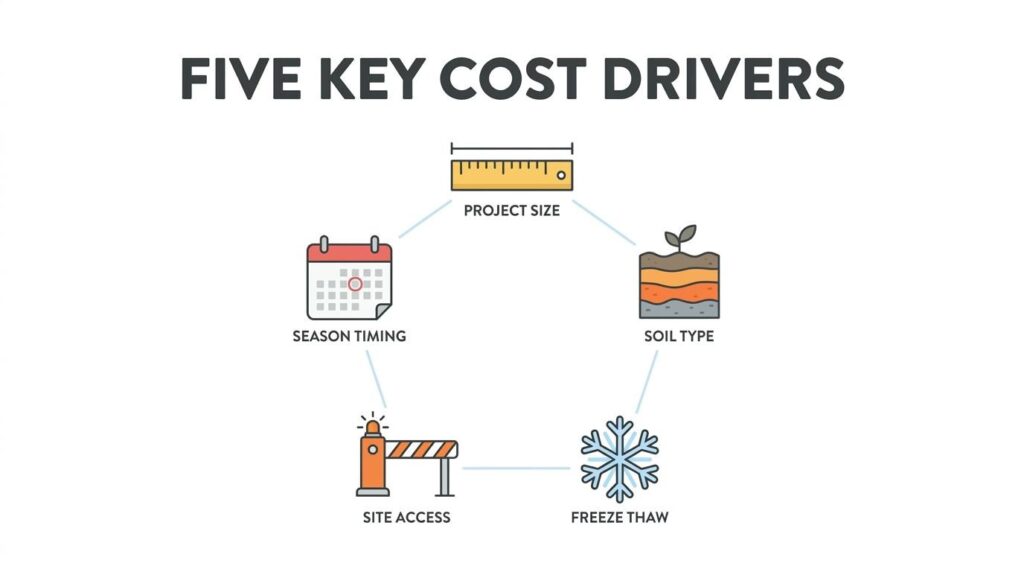
Several Denver-specific conditions push prices up or down. Expansive clay soils across the metro area demand specialized subgrade stabilization. Freeze-thaw cycles at 5,280 feet require thicker bases and performance-graded binders. Project size, site accessibility, demolition needs, and seasonal timing all influence the final number.
Permits and regulations add layers of cost that many property managers underestimate. Right-of-way fees, excavation permits, stormwater discharge requirements under Denver’s MS4 permit, and ADA mandates each carry their own fees and review periods. Commercial permit approvals have averaged 256 days, and that delay alone can escalate budgets through carrying costs, material price shifts, and lost seasonal paving windows.
Hidden costs from utility conflicts, traffic control, and drainage upgrades can push base paving totals from $3.50 up to $12.00 per square foot. Accurate budgeting requires separating these line items and planning for long-term maintenance reserves alongside the initial investment.
How Much Does Asphalt Paving Cost Per Square Foot in Denver?
Asphalt paving in Denver costs $2.39 to $10.00 per square foot, depending on whether the project involves an overlay, mill and replace, full new construction, or small-scale patching. The sections below break down pricing for each scope.
How Much Does a New Asphalt Parking Lot Cost in Denver?
A new asphalt parking lot in Denver costs between $4.00 and $10.00 per square foot for basic installation. According to Wins Parking, new asphalt parking lot construction in 2026 averages $3.50 to $8.00 per square foot for basic paving, but increases to $4.50 to $12.00 when incorporating drainage, lighting, and ADA compliance.
Larger lots benefit from scale efficiencies that lower the per-square-foot rate, while smaller properties absorb higher mobilization costs for equipment and crew transport. Drainage infrastructure alone typically adds 15% to 30% to the base paving cost. For most commercial property managers, budgeting at the mid-range of $5.00 to $8.00 per square foot provides a realistic starting point before site-specific variables are factored in.
How Much Does Asphalt Overlay Cost in Denver?
Asphalt overlay in Denver costs $2.39 to $5.83 per square foot for commercial projects. According to Wins Parking, this pricing applies to overlay or new mat installations and runs approximately 6% above the national average.
An overlay works best when the existing pavement is structurally sound but showing surface deterioration. Because it skips full-depth removal, the process requires less material and labor than new construction. However, if the subgrade has failed or significant cracking extends below the surface, an overlay will not resolve the underlying problem. Denver’s expansive clay soils make this assessment especially critical; skipping a proper evaluation often leads to premature failure and costly rework.
How Much Does Asphalt Mill and Replace Cost in Denver?
Asphalt mill and replace in Denver typically falls between $3.00 and $8.00 per square foot for commercial parking lots, depending on milling depth and project scale. The U.S. Bureau of Labor Statistics reported that the Producer Price Index for asphalt paving mixtures rose from 250.599 in December 2024 to 269.546 in December 2025, which continues to push material costs upward.
Mill and replace removes the damaged surface layer, reprofiles the grade, and installs fresh Hot Mix Asphalt. This approach addresses structural issues that a simple overlay cannot fix. It is the most cost-effective option when 30% or more of the existing surface shows alligator cracking, rutting, or base failure. Milling depth, haul-off fees, and Denver’s temperature requirements all influence the final price.
How Much Does Small-Scale Asphalt Patching Cost in Denver?
Small-scale asphalt patching in Denver costs significantly more per unit than full-lot projects due to minimum mobilization charges. According to City and County of Denver 2024 municipal bid tabulations, Hot Mix Asphalt for patching is quoted at $350.00 per ton.
Patching is appropriate for isolated potholes, utility cuts, or localized base failures that do not warrant a full overlay or mill and replace. Because equipment mobilization, crew transport, and material minimums are fixed costs spread across a smaller area, the effective per-square-foot rate can be two to three times higher than large-scale paving. Prioritizing patches before damage spreads remains one of the most practical ways to extend the life of an existing parking lot.
Understanding per-square-foot costs for asphalt sets the foundation for comparing concrete pricing across similar Denver projects.
How Much Does Concrete Paving Cost Per Square Foot in Denver?
Concrete paving in Denver costs $6.00 to $12.00 per square foot for basic commercial slabs. Final pricing depends on the specific application, whether it is a parking lot, curb and gutter work, or ADA-compliant ramp construction.
How Much Does a Concrete Parking Lot Cost in Denver?
A concrete parking lot in Denver costs $6.00 to $12.00 per square foot for a basic commercial slab. This range covers standard flatwork with proper subgrade preparation, though Denver’s expansive clay soils often require additional stabilization that can push costs higher.
When drainage, lighting, and ADA compliance are factored in, total project costs can climb to $4.50 to $12.00 per square foot according to Wins Parking. Concrete parking lots carry a higher upfront cost than asphalt, but their longer service life and lower maintenance requirements often make them more cost-effective for high-traffic commercial properties over a 20- to 30-year horizon.
How Much Does Concrete Curb and Gutter Installation Cost in Denver?
Concrete curb and gutter installation in Denver costs approximately $27.00 per linear foot for Type IIB construction with a 9-inch curbhead. According to 2024 City and County of Denver municipal bid tabulations (Bid Tabulation 202472432), this unit price reflects competitive contractor pricing on public infrastructure projects.
Several factors influence the final per-foot cost:
- Curbhead height and gutter pan width specifications
- Subgrade condition and whether expansive clay remediation is needed
- Demolition of existing curb, which adds removal and disposal fees
- Right-of-way permit requirements from the Denver Department of Transportation and Infrastructure (DOTI)
For commercial properties, curb and gutter work is rarely a standalone expense. It typically accompanies parking lot construction or site redevelopment, so bundling this scope into a larger paving contract tends to reduce the effective per-foot rate.
How Much Does ADA-Compliant Concrete Ramp Work Cost in Denver?
ADA-compliant concrete ramp work in Denver costs between $5,000 and $12,000 per ramp installation on street corners, excluding permit and inspection fees. Permit costs vary by jurisdiction; in Arvada, for example, the 2025 ADA ramp permit fee is $79.00 per unit.
Removal of existing non-compliant curb ramps adds to the total. Municipal contract data from the City and County of Denver prices concrete ADA curb ramp removal at approximately $21.00 per square yard. Because ADA ramp geometry must meet strict slope, landing, and detectable warning surface requirements, the labor intensity per square foot significantly exceeds standard flatwork. For commercial property owners, budgeting for both new ramp construction and existing ramp demolition prevents unexpected change orders during the project.
With concrete pricing established, several site-specific factors can raise or lower these costs significantly.
What Factors Raise or Lower Commercial Paving Prices in Denver?
Commercial paving prices in Denver fluctuate based on project scale, soil conditions, climate demands, site complexity, and seasonal timing. The following sections break down how each factor shifts your estimate.
How Does Project Size Affect Paving Cost Per Square Foot?
Project size affects paving cost per square foot primarily through mobilization expenses. Trucks, pavers, rollers, and crew transport represent fixed costs that get distributed across total square footage. On a small lot, those costs concentrate into a higher per-unit price. According to TruTec, mobilization costs increase the per-square-foot price of smaller projects compared to larger commercial lots. When scale efficiencies are realized on large surfaces like parking lots, asphalt paving generally falls in the $3.00 to $8.00 per square foot range. For property managers budgeting a sizable commercial lot, this economy of scale is one of the most controllable ways to lower your effective rate.
How Do Denver Soil and Subgrade Conditions Change the Price?
Denver soil and subgrade conditions change the price because much of the metro area sits on expansive clay that swells and shrinks with moisture fluctuations. According to Alpine Building Performance, these expansive clay soils require specialized subgrade preparation to prevent foundation and pavement movement. Without proper stabilization, the finished surface cracks prematurely, turning a paving project into a recurring repair expense.
Subgrade work that addresses clay instability may include:
- Lime or cement stabilization of existing soils
- Over-excavation and replacement with engineered fill
- Moisture barriers or drainage layers beneath the aggregate base
This preparation adds cost upfront but prevents far more expensive failures later. For any commercial site in Denver, a geotechnical assessment before paving is not optional; it is essential.
How Do Freeze-Thaw Cycles Influence Material and Base Costs?
Freeze-thaw cycles influence material and base costs by demanding thicker aggregate bases and higher-grade asphalt mixes. According to Wins Parking, Denver’s high-altitude climate at 5,280 feet produces frequent freeze-thaw cycles and intense UV radiation that accelerate asphalt wear and dictate specific material specifications. Water infiltrates pavement cracks, freezes overnight, expands, and widens the damage with each cycle.
To counteract this, commercial projects in Denver typically require:
- Thicker crushed aggregate base courses for improved drainage
- Polymer-modified or performance-graded asphalt binders
- Proper crown and slope design to shed water quickly
Skipping these specifications to save money upfront is a costly mistake in Denver’s climate.
How Does Site Accessibility or Demolition Add to the Estimate?
Site accessibility and demolition add to the estimate through removal labor, hauling fees, traffic control, and logistical constraints. Removal of concrete driveway paving in Denver is estimated at $5.00 to $10.00 per square foot based on City and County of Denver contract records (Bid Tabulation 202055847). Hidden costs in paving projects also include utility conflicts and traffic control requirements, both of which increase the final budget.
Common access-related cost factors include:
- Demolition and haul-off of existing pavement
- Temporary traffic control or lane closures
- Limited staging area for equipment and materials
- Underground utility relocation or protection
Tight urban sites in Denver’s core often carry higher per-square-foot costs than open suburban parcels simply because crews work less efficiently in constrained spaces.
How Does the Time of Year Affect Paving Prices in Denver?
The time of year affects paving prices in Denver because asphalt installation requires minimum ambient temperatures of 55°F for the surface course and 50°F for the binder course. These temperature thresholds compress Denver’s primary paving season into roughly April through October, creating peak-season demand that drives prices higher.
Scheduling during shoulder months, such as late March or early November, can sometimes yield lower bids when crews have openings. However, weather risk increases, and cold-day shutdowns may extend timelines. For most commercial projects, booking early in the season locks in competitive pricing while ensuring reliable installation conditions.
Understanding seasonal timing alongside the permitting process helps property managers avoid costly delays.
What Denver Permits and Regulations Affect Commercial Paving Costs?
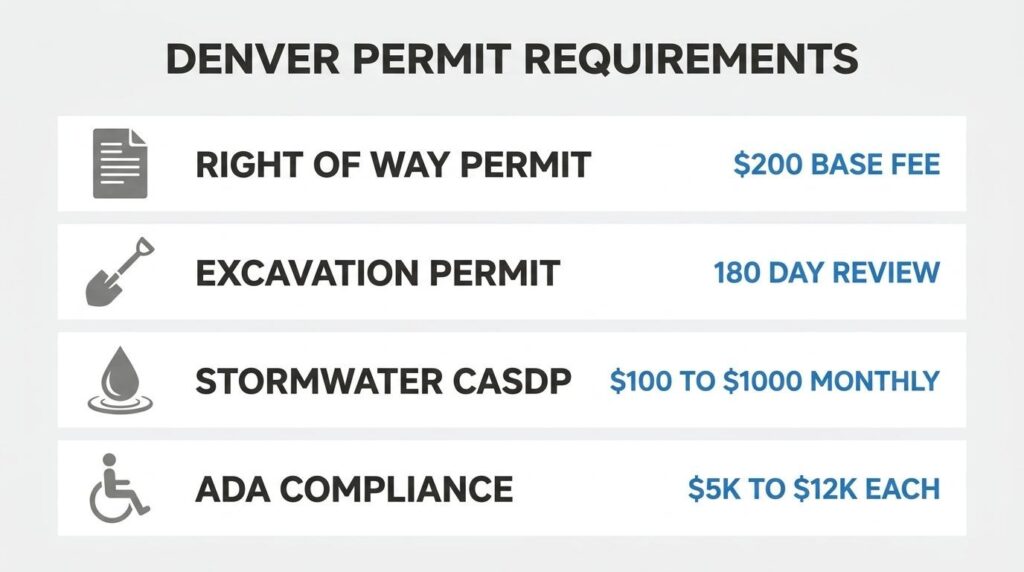
Denver permits and regulations that affect commercial paving costs include right-of-way permits, excavation and grading permits, stormwater discharge requirements, and ADA compliance mandates. Each adds fees, review time, and design requirements to the project budget.
What Does a Right-of-Way Permit Cost for Paving in Denver?
A right-of-way permit for paving in Denver costs a base development-related user fee of $200 for commercial permits, as established by Denver Community Planning and Development. Additional charges apply depending on the scope of work within the public right-of-way.
Nearby municipalities offer useful comparison points. The City of Englewood charges $3.50 per linear foot per day for parking lane occupancy in the right-of-way, while Lakewood charges $440.00 for use of the public right-of-way where no excavation is required. Denver’s fees follow a similar tiered structure, with costs scaling based on the duration and footprint of the encroachment. Factoring these fees into initial estimates prevents budget surprises once work begins.
What Does a Denver Excavation or Grading Permit Require?
A Denver excavation or grading permit requires submission of site development plans to the Denver Department of Transportation and Infrastructure (DOTI), along with applicable review fees. According to a Downtown Denver Partnership report, Denver Executive Order 151 requires that site development plans and associated permits be reviewed within 180 days or less of city review time.
Once a permit is issued, construction must commence within 180 days to prevent expiration. For commercial paving projects involving soil disturbance, DOTI may also require a Construction Activities Stormwater Discharge Permit (CASDP) as part of the grading approval. Given that commercial building permits in Denver have averaged 256 days for approval, building permit lead time into your project schedule is essential to avoid costly idle periods.
How Do Denver Stormwater and Drainage Rules Add to Paving Costs?
Denver stormwater and drainage rules add to paving costs through permit fees, infrastructure requirements, and ongoing utility charges. Denver’s MS4 permit (CDPS Permit No. COS-000001) regulates stormwater discharges and requires a CASDP for soil-disturbing commercial paving projects.
Beyond permit fees, the physical drainage infrastructure itself represents a significant line item. Drainage systems typically add 15% to 30% to the base paving cost of a commercial parking lot project. Commercial properties also face recurring stormwater utility fees ranging from $100 to over $1,000 per month, according to Rainplan, based on total impervious surface area. Reducing impervious coverage through permeable design elements can lower both upfront drainage costs and long-term monthly fees.
What ADA Compliance Costs Apply to Denver Paving Projects?
ADA compliance costs that apply to Denver paving projects include accessible ramp construction, curb ramp modifications, and associated permit fees. ADA-compliant ramp installation on street corners costs between $5,000 and $12,000 per location, excluding permit and inspection fees.
Permit costs for ADA-specific work vary across the metro area. In Arvada, the 2025 fee for an ADA ramp permit is $79.00 per unit, and Denver’s fees follow a comparable structure. Removal of existing concrete ADA curb ramps, often necessary before rebuilding to current standards, is priced at approximately $21.00 per square yard based on recent Denver municipal contract data. When drainage, lighting, and ADA compliance are combined, the total project cost can increase from a base of $3.50 to $8.00 per square foot up to $4.50 to $12.00 per square foot. Budgeting for ADA work as a separate line item, rather than folding it into general paving, helps ensure accurate cost projections.
Understanding permit and regulatory costs positions property managers to plan more accurate project timelines and budgets.
How Does the Denver Permitting Timeline Affect Project Budgets?
The Denver permitting timeline affects project budgets by extending carrying costs, forcing seasonal scheduling conflicts, and risking permit expiration. Below are the specific ways review delays translate into real dollar increases.
Denver’s commercial building permit approvals have averaged 256 days, according to reporting by The Denver Post. That timeline far exceeds the 180-day review target established by Denver Executive Order 151, and the gap between policy and practice creates significant financial exposure for property managers planning paving work.
Several budget impacts stem directly from prolonged review periods:
- Carrying costs accumulate. Extended approvals mean months of additional insurance, financing charges, and project management overhead before construction begins.
- Seasonal windows narrow. Because asphalt paving in Denver requires a minimum ambient temperature of 55°F for the surface course, a permit approved in late fall may push work to the following spring, adding six or more months of delay.
- Material prices shift. The BLS Producer Price Index for asphalt paving mixtures rose from 250.599 to 269.546 between December 2024 and December 2025, meaning a quote locked in during application may no longer hold at approval.
- Permit expiration creates urgency. Once issued, a Denver building permit expires if construction does not commence within 180 days, potentially requiring resubmission fees and a new review cycle.
- Multi-department coordination compounds delays. As Block Renovation notes, “Each department runs on its own clock, and a delay in one can cascade through the rest,” turning a single bottleneck into a project-wide cost escalation.
From a practical standpoint, the most controllable budget lever is submission timing. Filing permits in winter positions approvals to land during Denver’s optimal paving season, between May and October, so construction can start immediately. Contractors who align their permitting strategy with seasonal constraints avoid the most common cost overrun in Denver commercial paving.
Understanding how Denver’s permitting delays inflate budgets makes it easier to anticipate the hidden costs that often surface during construction itself.
How Do Denver Commercial Paving Costs Compare to Nearby Cities?
Denver commercial paving costs run approximately 6% above the national average, while nearby Colorado cities often come in lower on base paving rates. Differences in permit fees, material availability, and local regulations account for most of the price variation.
Denver’s commercial asphalt paving ranges from $2.39 to $5.83 per square foot for overlay or new mat work. According to ProMatcher, asphalt paving installation in Colorado Springs averages $3.09 per square foot, with a range of $2.41 to $3.76. Fort Collins trends higher for specialty materials; brick or concrete paver installation there averages $9.67 to $12.40 per square foot.
Permit fees also shift the total budget from city to city:
- Denver charges a $200 development-related user fee for commercial permits.
- Arvada sets ADA ramp permits at $79.00 per unit.
- Englewood charges $3.50 per linear foot per day for parking lane occupancy in the right-of-way.
- Lakewood requires a $440.00 fee for public right-of-way use where no excavation is needed.
Beyond permit costs, Denver’s expansive clay soils and altitude-driven freeze-thaw cycles demand heavier subgrade preparation than what many neighboring cities require. These site conditions narrow the apparent savings of choosing a contractor outside the metro area, since mobilization costs rise with distance and specialized soil work remains necessary regardless of location.
For property managers comparing bids across the Front Range, the lowest per-square-foot rate rarely tells the full story. Factoring in permit timelines, soil remediation, and drainage requirements gives a far more accurate picture of total project cost.
What Are Common Hidden Costs in Denver Commercial Paving Projects?
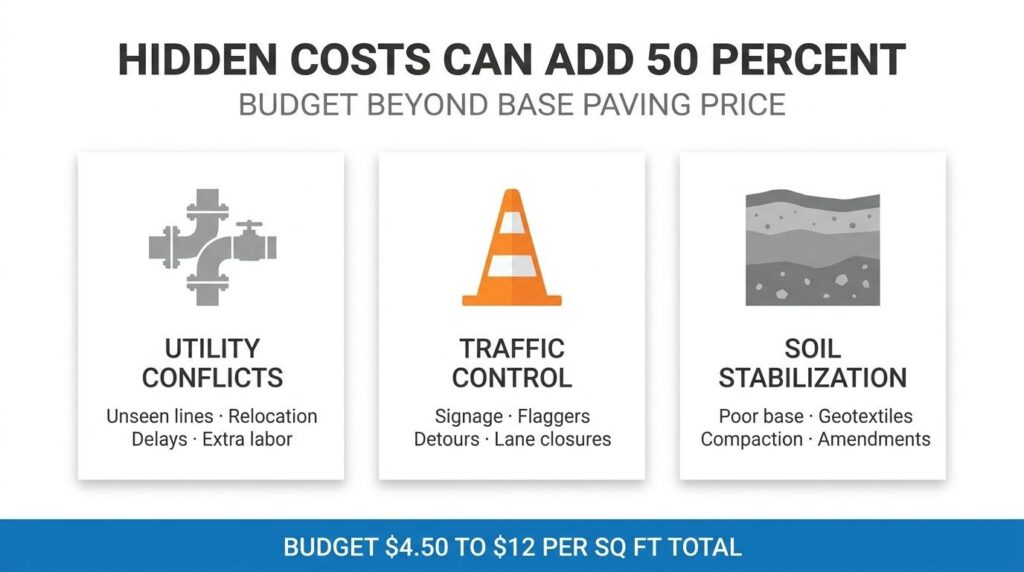
Common hidden costs in Denver commercial paving projects include utility conflicts, subgrade failure from expansive clay soils, traffic control requirements, drainage upgrades, ADA compliance additions, and permit-related delays. These expenses can push a basic paving budget well beyond initial estimates.
According to Wins Parking, large commercial parking lots that start at $3.50 to $8.00 per square foot for basic paving can climb to $4.50 to $12.00 per square foot once drainage, lighting, and ADA compliance are factored in. That potential increase of nearly 50% illustrates why line-item visibility matters before any contract is signed.
The most common hidden costs fall into several categories:
- Utility conflicts require rerouting or protecting underground lines, adding unplanned excavation and coordination fees.
- Subgrade failure from Denver’s expansive clay soils demands stabilization work that was not part of the original scope.
- Traffic control for projects near active roads or parking areas introduces flagging crews, signage, and lane closure permits.
- Stormwater compliance under Denver’s MS4 permit can require Construction Activities Stormwater Discharge Permits for soil-disturbing work, adding both fees and engineering costs.
- ADA upgrades triggered during repaving, such as curb ramp installations estimated at $5,000 to $12,000 per ramp, frequently surprise property managers who assumed existing infrastructure would suffice.
- Permit cascading delays, where one department’s review stalls another’s approval, extend project timelines and increase carrying costs for equipment and crews on standby.
As Block Renovation noted regarding Denver’s permitting environment, “Each department runs on its own clock, and a delay in one can cascade through the rest.” Commercial properties also face ongoing stormwater utility fees ranging from $100 to over $1,000 per month based on total impervious surface area, a recurring cost that many owners overlook during the initial paving budget.
From a practical standpoint, the single most effective way to control hidden costs is a thorough pre-construction site assessment that includes geotechnical boring, utility locating, and a permit timeline review. Projects that skip this step consistently encounter the largest budget overruns. Requesting a detailed scope of work that separates base paving from drainage, ADA, and permitting line items gives property managers the clearest picture of true project cost.
With hidden costs identified upfront, the next step is building a realistic overall budget for your Denver paving project.
How Should You Budget for Commercial Paving in Denver?
You should budget for commercial paving in Denver by accounting for base paving costs, permit fees, drainage additions, and maintenance reserves. The sections below cover how Asphalt Coatings Company can help plan your project and the key cost takeaways from this guide.
Can Asphalt Coatings Company Help Plan Your Denver Paving Project?
Yes, Asphalt Coatings Company can help plan your Denver paving project. With 39 years of experience across Colorado’s Front Range, Asphalt Coatings Company specializes in commercial asphalt paving, concrete flatwork, sealcoating, crack sealing with CDOT-approved materials, ADA-compliant concrete work, and parking lot construction.Asphalt Coatings Company uses in-house crews rather than subcontractors, providing single-source convenience and accountability from initial estimate through final completion. This approach simplifies budgeting because one team manages subgrade preparation, paving, striping, and drainage coordination under a single scope.
For property managers and commercial owners navigating Denver’s permitting requirements and expansive clay soil challenges, that level of local expertise makes a measurable difference in cost control. Asphalt Coatings Company offers free project consultations to help scope your budget accurately before work begins.
What Are the Key Takeaways About Commercial Paving Costs in Denver?
The key takeaways about commercial paving costs in Denver are:
- New commercial asphalt paving ranges from $4.00 to $10.00 per square foot, while concrete slabs cost $6.00 to $12.00 per square foot.
- Drainage infrastructure adds 15% to 30% to the base paving cost on most commercial projects.
- Denver permit timelines have averaged 256 days for commercial approvals, making early application essential to protecting budgets.
- Expansive clay soils across the metro area require specialized subgrade preparation that raises site work costs.
- Maintenance items like commercial parking lot sealcoating ($0.15 to $0.25 per square foot) and crack sealing ($0.50 to $1.00 per linear foot) should be budgeted from day one.
- Hidden costs from utility conflicts, traffic control, and ADA compliance can push totals from $3.50 to $12.00 per square foot.
Budgeting accurately for Denver commercial paving means planning beyond the per-square-foot price. Factor in permits, soil remediation, seasonal timing, and a long-term maintenance schedule to protect your pavement investment across its full lifecycle.