Choosing a commercial asphalt contractor in Denver is a structured vetting process that evaluates credentials, local experience, bid transparency, and reputation before signing any agreement. This guide covers Denver-specific climate and licensing demands, the credentials and experience a qualified contractor must demonstrate, essential vetting questions and reputation checks, bid evaluation and comparison methods, and red flags that should eliminate a candidate entirely.
Denver’s freeze-thaw cycles, high-altitude UV exposure, and warming annual temperatures accelerate pavement deterioration faster than in most U.S. markets. Contractors working here must engineer base layers, mix designs, and compaction schedules specifically for Front Range conditions; otherwise, surfaces crack and fail within years rather than decades.
A qualified contractor holds a valid City and County of Denver Paving Contractor license, carries both general liability and workers’ compensation insurance, and maintains a surety bond for commercial projects. Documented experience at your project’s scale and property type separates contractors who can anticipate drainage, grading, and ADA compliance requirements from those who treat every lot the same.
Itemized bids that specify pavement thickness, base preparation, material specifications, labor, equipment, timelines, and warranty terms give property managers a verifiable benchmark for accountability. Normalizing competing proposals against a common scope reveals where low bids cut corners on structural layers or omit critical line items.
Online reviews, BBB ratings, local commercial references, and repeat-client retention rates confirm whether a contractor’s promises hold up across real projects. Warning signs such as large upfront deposit demands, missing proof of insurance, or verbal-only estimates should disqualify a candidate immediately, regardless of price.
Why Does Choosing the Right Commercial Asphalt Contractor Matter in Denver?
Choosing the right commercial asphalt contractor matters in Denver because the city’s extreme climate, high elevation, and strict licensing requirements demand specialized expertise. The sections below cover freeze-thaw impacts, high-altitude paving challenges, and the consequences of hiring an unqualified contractor.
How Do Denver’s Freeze-Thaw Cycles Affect Contractor Selection?
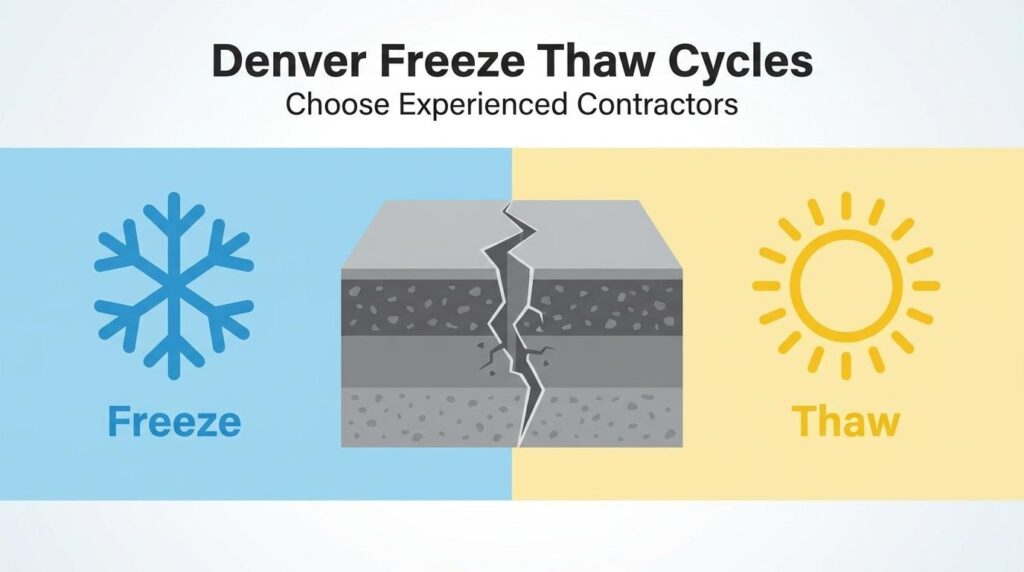
Denver’s freeze-thaw cycles affect contractor selection because improperly installed asphalt fails rapidly under repeated temperature swings. Water seeps into small cracks, freezes overnight, expands, and then thaws during the day. This cycle can repeat dozens of times each winter along the Front Range. A contractor unfamiliar with these conditions may skip critical steps such as proper base compaction, adequate drainage grading, or selecting the right asphalt mix design for cold-weather performance. Experienced commercial asphalt contractors in Denver engineer every layer of a pavement system to resist moisture infiltration and thermal stress. Prioritizing freeze-thaw expertise during vetting is one of the most effective ways to protect a long-term paving investment.
Why Does High-Altitude Paving Require Specialized Experience?
High-altitude paving requires specialized experience because Denver sits at approximately 5,280 feet, where environmental conditions differ significantly from lower elevations. Intensified UV radiation at altitude accelerates asphalt binder oxidation, causing surfaces to become brittle faster. According to Colorado State University, Colorado annual average temperatures warmed by 2.3°F from 1980 to 2022, compounding the thermal stress pavement already absorbs at elevation. Contractors without high-altitude knowledge may use mix designs and compaction methods suited to sea-level conditions, which underperform in Denver’s environment. The right contractor adjusts material specifications, compaction timing, and sealcoat schedules to account for these altitude-driven variables.
What Can Go Wrong When You Hire the Wrong Asphalt Contractor?
Hiring the wrong asphalt contractor can lead to premature pavement failure, code violations, and costly rework. Common problems include:
- Insufficient base preparation that causes settling and surface cracking within the first year.
- Improper drainage grading that allows water to pool and penetrate the asphalt structure.
- Use of substandard materials or incorrect mix designs for Colorado’s climate.
- Missing required permits or failing to hold a valid Paving Contractor license, which the City and County of Denver defines as authorization to perform work including laying gravel base course, asphalt, or concrete paving.
Unlicensed work can expose property owners to liability and void any warranty protections. For commercial properties, these failures translate directly into safety hazards, ADA compliance risks, and unplanned capital expenditures.
Understanding these stakes sets the foundation for evaluating a contractor’s credentials.
What Credentials Should a Denver Asphalt Contractor Have?
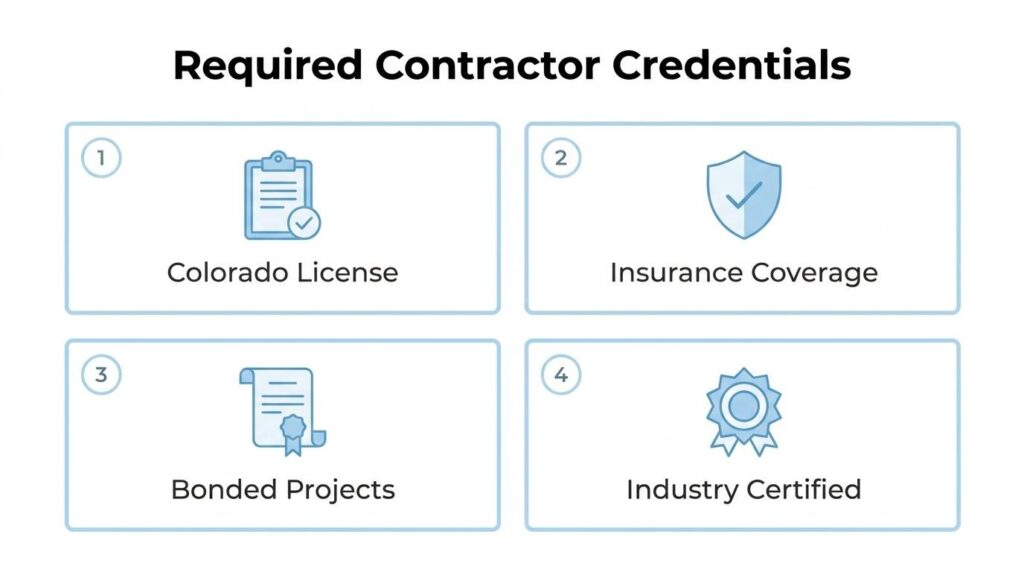
A Denver asphalt contractor should have a valid Colorado license, general liability and workers’ compensation insurance, a surety bond for commercial projects, and relevant industry certifications. The following subsections break down each credential.
Is the Contractor Licensed to Operate in Colorado?
The contractor must be licensed to operate in Colorado before performing any commercial asphalt work. The City and County of Denver requires a specific Paving Contractor license for work relating to street or alley paving, including laying gravel base course, asphalt, or concrete. This license confirms the contractor meets local competency and safety standards.
Beyond municipal licensing, Colorado’s labor framework matters. According to the Colorado Department of Labor and Employment, workers are presumed to be employees unless proven otherwise. This distinction affects how a contractor’s crew is classified, which directly impacts insurance obligations and legal liability on your project. Always verify that the contractor holds a current, active license by checking Denver’s Community Planning and Development records before signing any agreement.
Does the Contractor Carry General Liability and Workers Comp Insurance?
The contractor should carry both general liability insurance and workers’ compensation coverage. General liability protects your property against damage caused during construction, while workers’ comp covers injuries sustained by crew members on your job site.
Without these policies, the property owner may absorb financial responsibility for accidents or damage. Key verification steps include:
- Requesting a current Certificate of Insurance naming your property as an additional insured.
- Confirming the policy is active, not expired or lapsed.
- Verifying coverage limits meet your project’s contract requirements.
- Contacting the insurer directly to confirm the certificate is legitimate.
For commercial projects involving heavy equipment and hot asphalt, skipping this step creates significant financial exposure that no bid savings can justify.
Is the Contractor Bonded for Commercial Projects in Denver?
The contractor should be bonded for commercial projects in Denver. A surety bond provides a financial guarantee that the contractor will complete the project according to the contract terms. If the contractor defaults or fails to meet obligations, the bond compensates the property owner.
Bonding is especially relevant for large-scale commercial work, such as parking lot construction for shopping centers, industrial complexes, or apartment communities. A bonded contractor has undergone financial vetting by the surety company, which signals stability and accountability. When evaluating bids, request the bond number and verify it with the issuing surety. Unbonded contractors may lack the financial backing to see complex projects through to completion.
Does the Contractor Hold Any Industry Certifications?
The contractor should hold industry certifications that demonstrate specialized knowledge beyond basic licensing. Certifications relevant to commercial asphalt work in Denver include:
- National Asphalt Pavement Association (NAPA) quality certification programs.
- Colorado Asphalt Pavement Association (CAPA) membership, indicating alignment with state-specific mix design and thickness standards.
- Occupational Safety and Health Administration (OSHA) safety training for crew members.
- ADA compliance training for accessible parking lot construction.
These credentials indicate the contractor invests in ongoing education and adheres to recognized industry benchmarks. In a market where altitude, UV intensity, and freeze-thaw cycles demand precise material selection, certified contractors are better equipped to specify mixes that perform under Colorado’s conditions.
With credentials verified, evaluating the contractor’s hands-on experience becomes the next priority.
How Much Experience Should a Commercial Asphalt Contractor Have?
A commercial asphalt contractor should have enough experience to demonstrate proven competence with your specific project type, scale, and local conditions. The following subsections cover regional tenure, project scale, and property type familiarity.
How Many Years Has the Contractor Worked in the Denver Metro Area?
The contractor should have worked in the Denver metro area long enough to understand its unique paving challenges, including freeze-thaw cycles, high-altitude UV degradation, and seasonal temperature swings. According to Colorado State University, Colorado annual average temperatures warmed by 2.3°F from 1980 to 2022, intensifying thermal stress on pavement surfaces. A contractor with a decade or more of local work history has likely adapted mix designs and installation methods to these shifting conditions. Regional tenure also signals familiarity with Denver permitting requirements, local material suppliers, and subgrade soil behavior along the Front Range. Prioritize contractors who can point to a sustained track record in this specific market rather than generalized experience elsewhere.
Has the Contractor Completed Projects Similar to Yours in Scale?
The contractor should have completed projects similar to yours in scale before you sign a contract. A company experienced with small parking lot patches may lack the equipment fleet, crew depth, and project management systems required for a 200,000-square-foot distribution center lot. Ask for a project portfolio that includes jobs matching your approximate square footage, tonnage, and phasing complexity. Large-scale commercial paving demands coordinated staging, traffic control planning, and material logistics that smaller jobs never test. If the contractor cannot provide examples at or above your project size, that gap represents real risk to your timeline and budget.
Does the Contractor Have Experience With Your Property Type?
The contractor should have experience with your property type because each commercial category presents distinct paving demands. Retail centers require ADA-compliant accessible routes and heavy cart traffic durability. Industrial facilities need thicker pavement sections to withstand loaded truck traffic. Healthcare campuses demand minimal downtime during overlays to maintain emergency access. When evaluating candidates, ask for references from properties that mirror your use case. A contractor familiar with your property type will anticipate drainage requirements, traffic patterns, and compliance obligations specific to that environment. This targeted experience often separates adequate results from long-lasting, well-engineered pavement.
With experience verified, the next step is knowing which questions to ask during vetting.
What Questions Should You Ask During the Vetting Process?
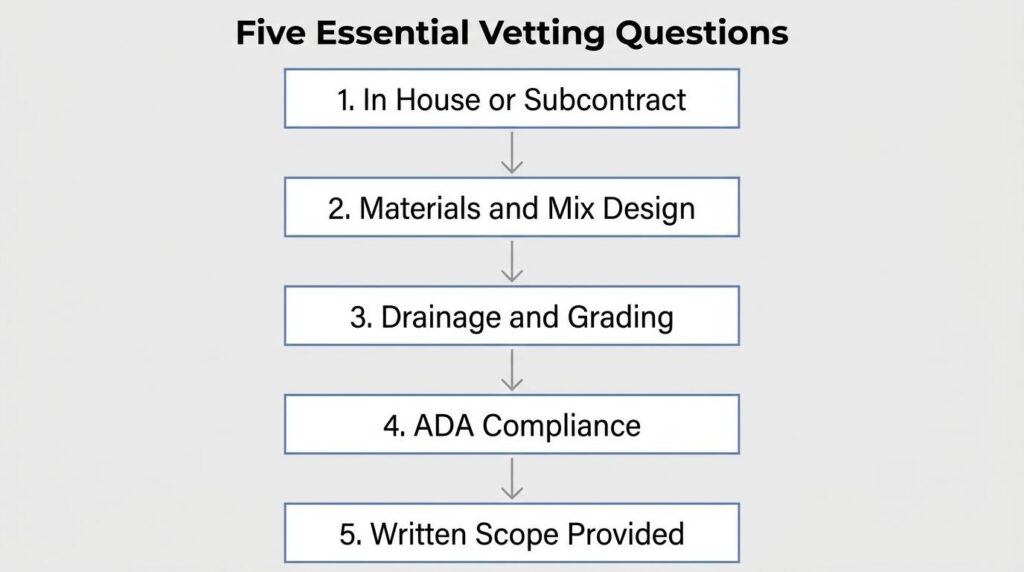
You should ask questions that reveal a contractor’s workforce model, material expertise, site engineering capabilities, ADA knowledge, and documentation standards. The sections below cover five essential questions.
Do They Use In-House Crews or Subcontract the Work?
You should ask whether the contractor uses in-house crews or subcontracts the work because workforce control directly affects quality, accountability, and scheduling. Contractors who rely on subcontractors introduce a layer of separation between you and the people performing the work, which complicates communication and dispute resolution.
According to the Colorado Department of Labor and Employment, workers are presumed to be employees unless proven otherwise in Colorado. This legal framework means contractors using subcontractors must demonstrate proper classification, and misclassification can expose property owners to liability. In-house crews simplify the chain of responsibility. When the same company employs the workers, manages equipment, and oversees quality control, accountability stays consolidated under one roof.
What Materials and Mix Designs Do They Specify for Colorado?
The materials and mix designs a contractor specifies for Colorado should reflect the state’s extreme temperature swings, UV intensity, and freeze-thaw cycling. A qualified contractor selects asphalt mix formulations engineered for high-altitude conditions, where thermal stress accelerates pavement deterioration faster than at lower elevations.
According to research from the National Center for Asphalt Technology, a 10 percent improvement in durability results from each percentage reduction in air voids. This finding underscores why compaction standards and mix design matter. Ask whether the contractor uses polymer-modified binders, specifies appropriate aggregate gradations, and adjusts mix temperatures for Denver’s elevation. Vague answers about materials suggest the contractor applies a one-size-fits-all approach rather than engineering for Colorado’s climate. Understanding how freeze-thaw asphalt mix design is engineered for Denver's unique climate is crucial for long-lasting pavement performance.
How Do They Handle Drainage and Grading on Commercial Sites?
A contractor handles drainage and grading on commercial sites by designing slope profiles that direct stormwater away from pavement surfaces and building foundations. Poor drainage is one of the fastest paths to pavement failure in Denver, where heavy afternoon thunderstorms and snowmelt generate significant water volumes across large commercial lots.
Ask the contractor to explain their grading plan, including:
- Minimum cross-slopes they design for parking areas.
- How they integrate catch basins, trench drains, or swales.
- Whether they coordinate with civil engineers on stormwater management plans.
- How they address low spots that could pond water and accelerate freeze-thaw damage.
Contractors who treat drainage as an afterthought rather than a design priority consistently produce pavements that deteriorate prematurely.
What Is Their Approach to ADA Compliance?
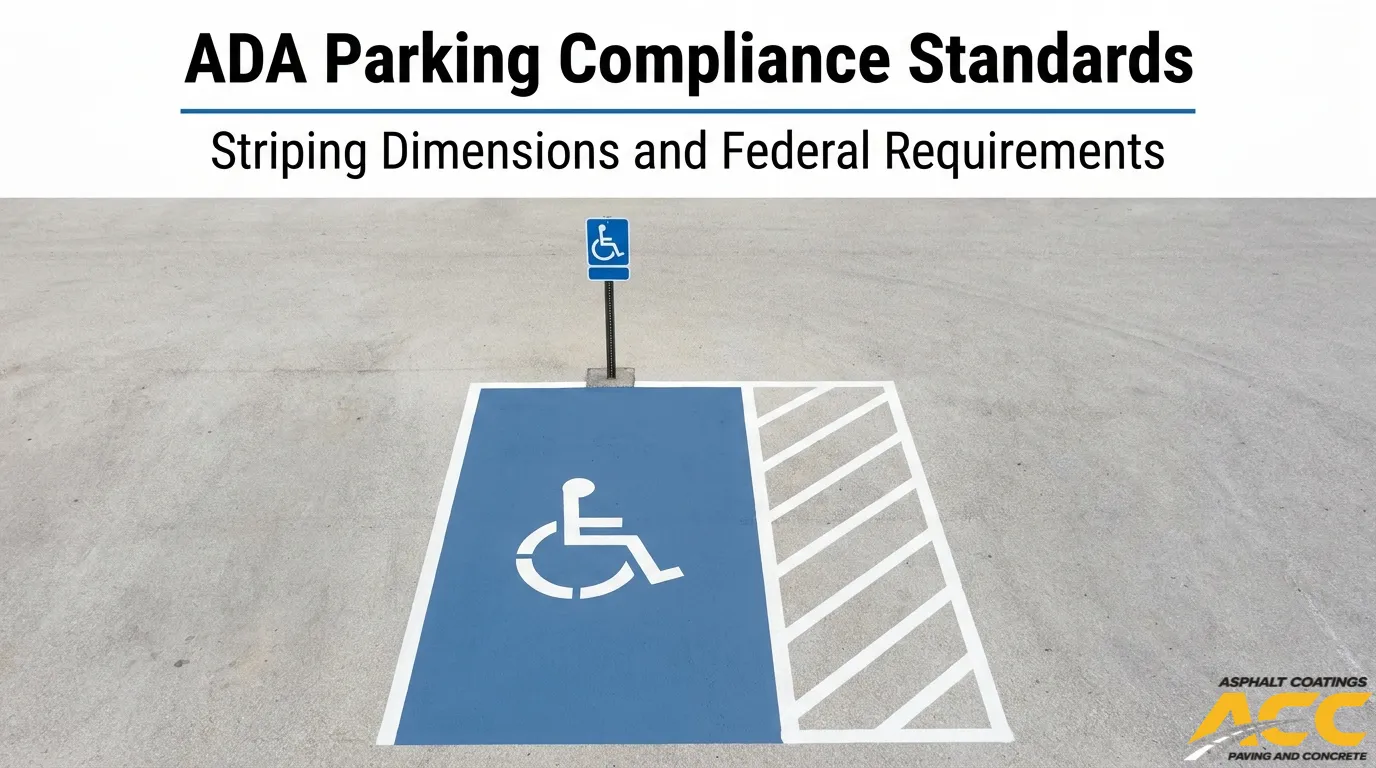
Their approach to ADA compliance should demonstrate detailed knowledge of current federal accessibility standards and how those standards apply to parking lots, access aisles, and pedestrian routes. ADA violations on commercial properties carry legal exposure and create barriers for people with disabilities.
According to the U.S. Access Board, accessible parking spaces must be at least 8 feet (96 inches) wide, and van-accessible spaces must be at least 11 feet (132 inches) wide. Maximum slope in all directions is 1:48. Ask whether the contractor designs compliant curb ramps, maintains proper running slopes on accessible routes, and verifies measurements during construction. A contractor who cannot cite specific dimensional requirements likely lacks the precision ADA work demands.
Do They Provide a Detailed Written Scope of Work?
Yes, a qualified contractor provides a detailed written scope of work before any project begins. This document protects both parties by defining exactly what will be performed, what materials will be used, and what standards will be met.
A thorough written scope should include:
- Pavement thickness, base preparation methods, and material specifications.
- Drainage and grading details with slope requirements.
- ADA compliance elements, including ramp locations and parking dimensions.
- Project timeline, phasing plan, and traffic management provisions.
- Warranty terms and conditions for materials and workmanship.
Any contractor who resists putting commitments in writing introduces unnecessary risk. The scope of work becomes your benchmark for holding the contractor accountable throughout the project.
With your vetting questions answered, evaluating the contractor’s local reputation confirms whether their promises match real-world results.
How Should You Evaluate a Contractor’s Reputation in Denver?
You should evaluate a contractor’s reputation in Denver by examining online reviews, requesting local commercial references, and assessing long-term client retention. These three indicators reveal consistency, accountability, and trustworthiness.
What Do Their Online Reviews and BBB Rating Reveal?
Online reviews and a contractor’s BBB rating reveal patterns of reliability, workmanship quality, and responsiveness to problems. Google reviews offer unfiltered feedback from property managers and facility directors who have managed real commercial paving projects. Look for recurring themes across dozens of reviews rather than focusing on individual outliers.
A strong BBB rating signals that a contractor resolves disputes professionally and maintains ethical business practices. Check whether complaints were addressed or left unresolved, since that distinction matters more than the complaint count itself. For commercial asphalt work in Denver, prioritize reviews that specifically mention project scale, timeline adherence, and post-completion follow-through.
Can They Provide Local Commercial References You Can Contact?
Yes, a reputable commercial asphalt contractor can provide local commercial references you can contact directly. Any contractor hesitant to share references for Denver-area projects should raise immediate concern.
When contacting references, ask targeted questions:
- Did the contractor complete the project on schedule and within the agreed budget?
- How did the crew handle unexpected issues such as subgrade problems or weather delays?
- Was the final pavement quality consistent with the written scope of work?
- Would you hire this contractor again for your next commercial project?
References from properties similar to yours, whether shopping centers, industrial complexes, or apartment communities, carry the most weight because they demonstrate relevant experience.
How Long Have They Retained Repeat Clients?
Long-term client retention indicates that a commercial asphalt contractor delivers consistent quality across multiple projects and maintenance cycles. A contractor who retains repeat clients over five or more years has demonstrated accountability beyond a single job.
Ask the contractor what percentage of annual revenue comes from returning clients. High repeat-business rates suggest that property managers trust both the workmanship and the working relationship enough to bypass competitive bidding. This is particularly telling in Denver’s commercial market, where freeze-thaw damage creates recurring maintenance needs that test a contractor’s long-term reliability. A pattern of one-time clients, by contrast, often signals unresolved quality or communication issues.
Understanding reputation sets the foundation for comparing what each contractor actually includes in their bid.
What Should a Commercial Asphalt Bid Include?
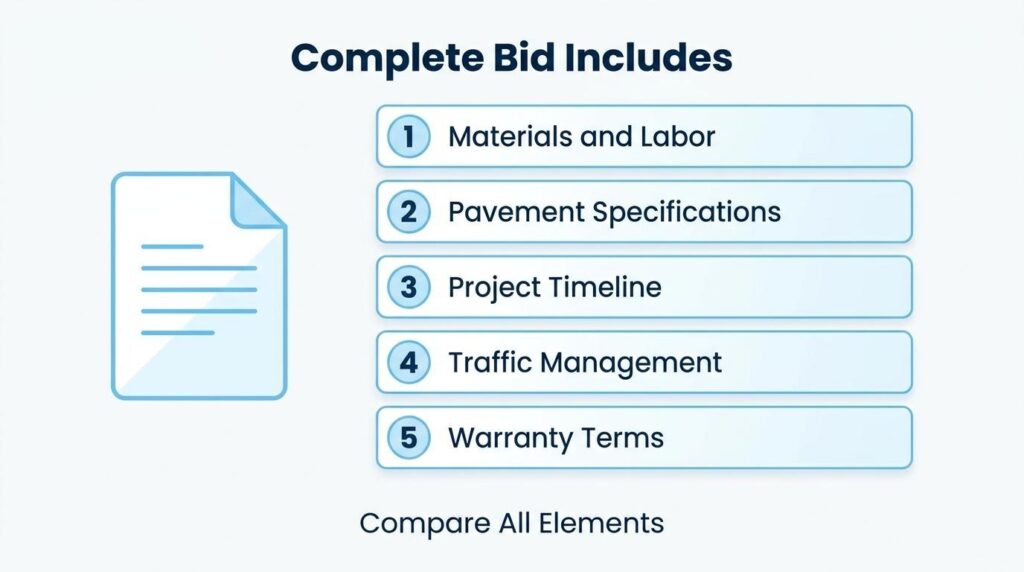
A commercial asphalt bid should include itemized costs, pavement specifications, project timelines, traffic management plans, and warranty terms. The following subsections break down each component.
Does the Bid Itemize Materials, Labor, and Equipment Costs?
The bid should itemize materials, labor, and equipment costs as separate line items. Itemization allows property managers to compare proposals on equal terms and identify where costs differ between contractors. Materials should list asphalt mix type, tonnage, and unit pricing. Labor costs should specify crew size and estimated hours. Equipment charges should name each machine, such as pavers, rollers, and milling equipment, along with daily or project rates. Without this breakdown, a lump-sum figure makes it nearly impossible to determine whether you are overpaying for materials or receiving inadequate labor coverage. Insisting on full itemization is one of the simplest ways to protect your project budget.
Does the Bid Specify Pavement Thickness and Base Preparation?
The bid should specify pavement thickness and base preparation details in writing. These specifications directly determine how long the pavement will perform under commercial traffic loads. According to the Colorado Asphalt Pavement Association, MGPEC Item 20 states that pavement thickness cores must equal or exceed the required thickness shown on the approved plans. A thorough bid defines:
- Total asphalt lift thickness in inches, including individual lift depths.
- Aggregate base course type, depth, and compaction requirements.
- Subgrade preparation methods, such as proof-rolling and moisture conditioning.
Any bid that omits these details leaves room for a contractor to cut corners on the structural layers beneath the surface.
Does the Bid Address a Project Timeline and Traffic Management?
The bid should address a project timeline and traffic management plan with specific dates and phasing details. Commercial properties in Denver cannot afford unplanned closures that disrupt tenants, customers, or deliveries. The timeline should include mobilization dates, milestone benchmarks for each phase, and a projected completion date. Traffic management should outline lane closures, detour routing, signage placement, and coordination with adjacent businesses. For multi-phase projects, the bid should clarify which areas remain accessible during active paving. A contractor who includes this level of detail demonstrates the operational planning that large commercial sites require.
What Warranty Terms Are Included in the Bid?
Warranty terms included in the bid should cover both workmanship and materials for clearly defined durations. A workmanship warranty protects against installation defects, such as improper compaction or joint failures. A materials warranty covers premature surface deterioration unrelated to installation. Key warranty details to verify include:
- Duration of coverage for workmanship and materials separately.
- Exclusions, such as damage from utility cuts or snowplow operations.
- Response time commitments for warranty claims.
- Whether the warranty is transferable to a new property owner.
Vague warranty language often signals that a contractor intends to limit accountability after project completion. Comparing bids on durability and scope of coverage helps ensure long-term value.
How Do You Compare Multiple Asphalt Bids in Denver?
You compare multiple asphalt bids in Denver by normalizing each proposal to a common scope, then evaluating materials, warranties, and contractor qualifications alongside price. The sections below explain why the cheapest number can mislead and how to align bids that describe the work differently.
Why Is the Lowest Bid Not Always the Best Value?
The lowest bid is not always the best value because it often omits critical line items that higher-priced proposals include. A bid that looks affordable on paper may exclude base preparation, proper drainage grading, or adequate pavement thickness, all of which directly affect how long the surface lasts.
Common cost-cutting tactics behind low bids include:
- Thinner asphalt lifts than the project actually requires.
- Skipping subgrade compaction or geotextile fabric.
- Using lower-grade mix designs unsuited to Denver’s freeze-thaw cycles.
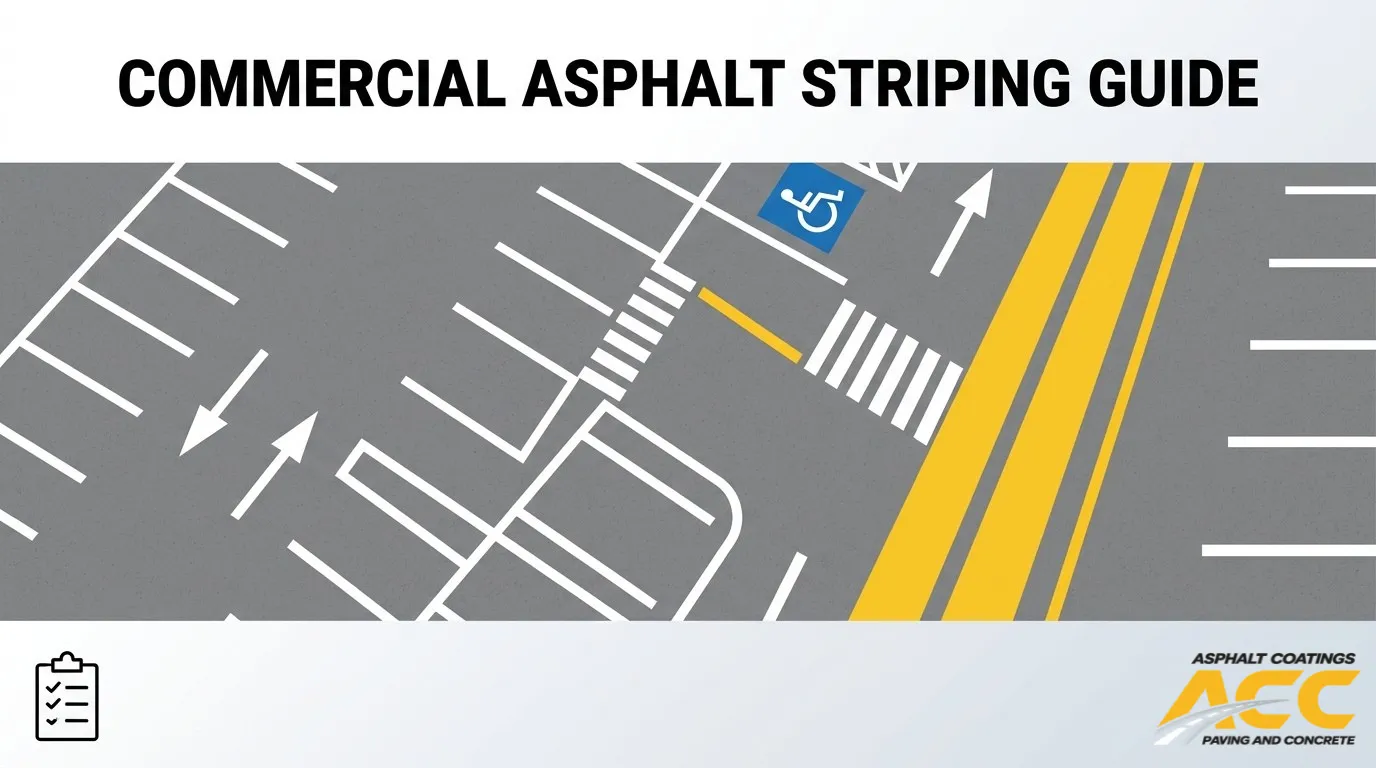
- Omitting traffic management, mobilization, or ADA-compliant work.
When those shortcuts surface mid-project as change orders, the “cheapest” contractor often becomes the most expensive. A slightly higher bid that itemizes every phase of work, specifies CAPA-aligned thickness standards, and includes a meaningful warranty typically delivers far greater long-term return for commercial property owners.
How Do You Normalize Bids With Different Scopes of Work?
You normalize bids with different scopes of work by building a comparison matrix that maps each proposal against the same set of line items. When one contractor bundles labor and materials into a lump sum while another itemizes every phase, a direct dollar-to-dollar comparison is misleading without this step.
A practical normalization process involves:
- List every required scope element: demolition, subgrade prep, base course, asphalt lifts, parking lot striping, drainage, and ADA work.
- Check each bid against that list and flag any missing items.
- Request clarification or supplemental pricing for omitted scope elements.
- Compare unit costs (cost per square foot or per ton) rather than lump-sum totals.
- Weight non-price factors such as warranty length, crew experience, and project timeline.
According to CAPA, MGPEC Item 20 requires that pavement thickness cores equal or exceed the thickness shown on approved plans. Any bid that fails to specify pavement depth should raise immediate concern, because thickness directly governs durability and code compliance. For most commercial projects, the strongest bid is the one you can verify line by line against your project specifications.
With bids properly compared, knowing which warning signs should eliminate a contractor entirely protects the investment further.
What Red Flags Should Disqualify a Denver Asphalt Contractor?
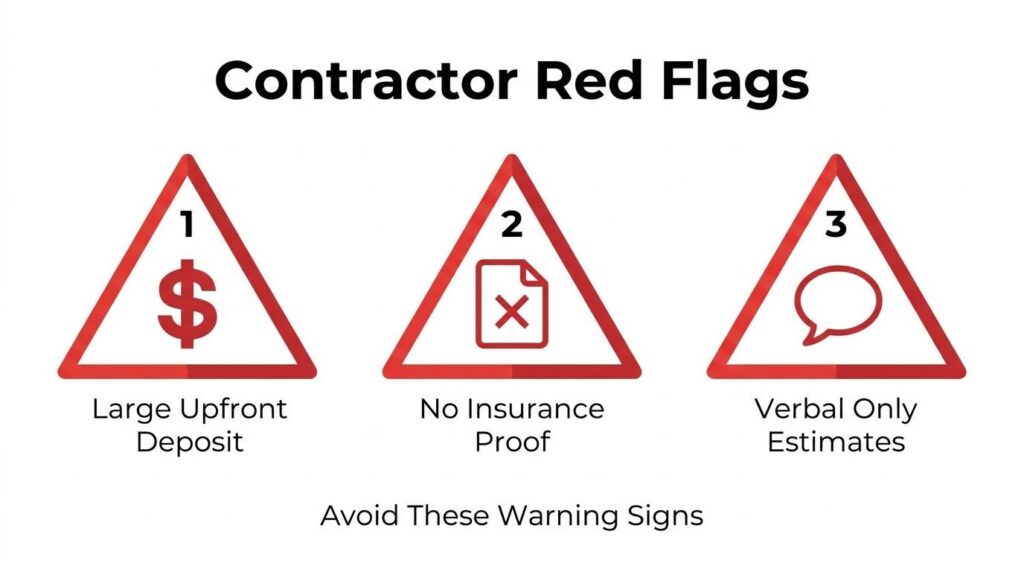
Red flags that should disqualify a Denver asphalt contractor include demanding large upfront deposits, lacking proof of insurance, and providing only vague or verbal estimates. Each warning sign signals financial, legal, or quality risks.
Why Should You Avoid Contractors Who Demand Large Upfront Deposits?
You should avoid contractors who demand large upfront deposits because this practice often signals cash flow problems or potential fraud. Legitimate commercial asphalt contractors in Denver typically structure payments around project milestones, collecting partial amounts as work progresses rather than requiring 50% or more before breaking ground. A contractor who insists on a large sum before mobilizing equipment may lack the financial stability to purchase materials on standard terms. For commercial property managers, this creates significant exposure; if the contractor abandons the project or files for bankruptcy, recovering those funds becomes difficult and costly. Progress-based payment schedules protect both parties and keep accountability tied to completed work.
What Does It Mean If a Contractor Cannot Show Proof of Insurance?
If a contractor cannot show proof of insurance, it means your property and business face direct financial liability for any on-site accidents, injuries, or property damage. Colorado presumes workers are employees unless proven otherwise, according to the Colorado Department of Labor and Employment. This classification means an uninsured contractor’s injured crew member could generate a workers’ compensation claim against your business. General liability coverage and workers’ compensation insurance are non-negotiable for commercial asphalt projects. Always request a current certificate of insurance naming your property as an additional insured, and verify coverage directly with the carrier before signing any contract.
Why Is a Vague or Verbal-Only Estimate a Warning Sign?
A vague or verbal-only estimate is a warning sign because it eliminates accountability and makes scope disputes nearly impossible to resolve. Professional commercial asphalt contractors provide written bids that itemize materials, pavement thickness, base preparation, labor, equipment, and project timelines. Without these specifics, there is no benchmark for evaluating whether the finished work meets agreed standards. Verbal agreements also carry weaker legal standing if disputes arise. In an industry where material specifications and compaction standards directly determine pavement longevity, accepting an estimate that lacks measurable detail is one of the clearest indicators of an unqualified contractor.
Understanding these warning signs makes it easier to identify the right time to begin your contractor search.
When Is the Best Time to Hire an Asphalt Contractor in Denver?
The best time to hire an asphalt contractor in Denver is late spring through early fall, typically May through October. Denver’s high-altitude climate creates a narrow paving season because asphalt requires ambient temperatures consistently above 50°F for proper compaction and curing. Scheduling during this window ensures optimal material performance and reduces weather-related delays.
Starting the vetting process in late winter or early spring gives you a critical advantage. Reputable commercial contractors book their schedules months ahead, and waiting until summer often means limited availability or rushed timelines. Colorado annual average temperatures warmed by 2.3°F from 1980 to 2022, according to Colorado State University, which has extended some seasonal windows slightly but has not eliminated the risk of early freeze events that compromise fresh asphalt.
Planning ahead also matters because Denver’s freeze-thaw cycles punish poorly timed installations. Asphalt laid too late in the season may not fully cure before overnight temperatures drop below freezing, leading to premature cracking and reduced pavement life. For commercial properties with high traffic demands, this timing decision directly affects long-term durability and maintenance costs.
The most practical approach is to begin contractor interviews and bid comparisons by February or March, finalize contracts by April, and schedule construction for the warm-weather months. This timeline allows thorough vetting without the pressure of a shrinking season.
With timing established, the next step is evaluating how a proven local contractor handles every phase of commercial paving.
How Does Asphalt Coatings Company Approach Commercial Paving in Denver?
Asphalt Coatings Company approaches commercial paving in Denver by combining 39 years of Front Range expertise with in-house crews, Colorado-specific material knowledge, and a partnership-driven process. The sections below cover how that experience simplifies vetting and the key takeaways for selecting the right contractor.
Can a Contractor With 39 Years on the Front Range Simplify Your Vetting Process?
Yes, a contractor with 39 years on the Front Range can simplify your vetting process significantly. Asphalt Coatings Company has operated across Denver and the surrounding metro area since 1986, serving Colorado’s Front Range with 39 years of commercial paving expertise. That track record eliminates guesswork around credentials, local licensing, and climate-specific expertise. Asphalt Coatings Company uses in-house crews rather than subcontractors, providing single-source accountability for every phase of a project. The company provides a comprehensive range of services including subgrade preparation, grading, ADA-compliant concrete work, and parking lot striping through their in-house crews. They also offer commercial parking lot sealcoating to protect asphalt surfaces from Denver's harsh weather and extend pavement lifespan. For property managers evaluating contractors against the checklist criteria covered throughout this article, a firm with nearly four decades of verifiable Colorado work compresses the vetting timeline considerably.
What Are the Key Takeaways for Choosing a Commercial Asphalt Contractor in Denver?
The key takeaways for choosing a commercial asphalt contractor in Denver are:
- Verify Colorado licensing, general liability insurance, workers’ compensation coverage, and bonding before signing any agreement.
- Prioritize contractors with documented experience handling Denver’s freeze-thaw cycles and high-altitude UV exposure.
- Demand itemized bids that specify pavement thickness, base preparation, materials, labor, equipment, timeline, and warranty terms.
- Ask whether crews are in-house or subcontracted, and confirm the contractor’s approach to drainage, grading, and ADA compliance.
- Check online reviews, BBB ratings, and local commercial references to validate reputation and client retention.
- Reject contractors who request large upfront deposits, cannot show proof of insurance, or provide only verbal estimates.
Selecting a commercial paving partner is ultimately a risk-management decision. The contractor you choose will influence pavement longevity, liability exposure, and property value for years, making regular inspections a key part of long-term care. Asphalt Coatings Company welcomes the vetting process outlined in this guide and invites Denver property managers to request a detailed consultation.