Colorado Springs’ MS4 stormwater permit is a regulatory authorization governing how stormwater runoff is managed and discharged through the city’s Municipal Separate Storm Sewer System, and it directly shapes the scope, cost, and compliance requirements of commercial repaving projects.
This guide covers the MS4 permit framework and its triggers for repaving, construction-phase and post-construction BMP requirements, compliance impacts across commercial property types, enforcement risks and liability, climate-driven design considerations, and budgeting for a compliant project.
The MS4 permit is issued by the Colorado Department of Public Health and Environment under permit number COS000004 and enforced locally by the City of Colorado Springs Stormwater Enterprise. Repaving projects that involve full-depth removal, subgrade work, or expanded impervious coverage can trigger mandatory stormwater management plans and erosion controls.
During construction, required BMPs include silt fencing, inlet protection, material containment, and spill prevention measures. After paving is complete, permanent drainage features like bioretention cells, sediment forebays, and oil-water separators must be incorporated, with annual inspections and maintenance reports due to the city each year.
Shopping centers, industrial facilities, and healthcare campuses each face distinct compliance demands based on their pollutant profiles and operational constraints. Violations carry fines, stop work orders, and potential civil court action, with liability falling primarily on the property owner as the permit holder.
Colorado Springs’ freeze-thaw cycles and high-altitude storm intensity add further complexity to infrastructure design and runoff calculations. Budgeting for MS4 compliance as an integrated project component (rather than an afterthought) reduces total cost and risk. We also break down how an experienced local paving contractor consolidates these obligations into a single, manageable scope.
What Is an MS4 Stormwater Permit in Colorado Springs?
An MS4 stormwater permit in Colorado Springs is a regulatory authorization that governs how stormwater runoff is managed and discharged through the city’s Municipal Separate Storm Sewer System. Below, we cover who enforces this permit and which pollutants it targets on paved surfaces.
Who Issues and Enforces the MS4 Permit Locally?
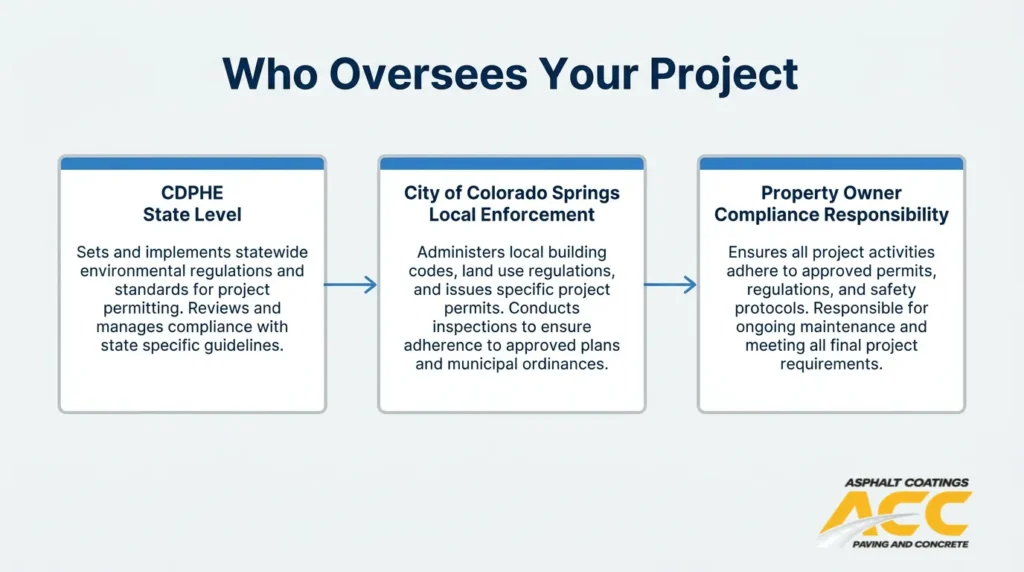
The MS4 permit is issued and enforced through a layered regulatory structure involving both state and local authorities. The Colorado Department of Public Health and Environment (CDPHE) administers the permit at the state level under permit number COS000004, while the City of Colorado Springs Stormwater Enterprise enforces local compliance.
The city’s stormwater criteria fulfill requirements tied to both the MS4 permit and a federal stormwater Consent Decree (ECF #181, Case 1:16-cv-02745-JLK). According to the CDPHE, the agency issues penalty orders imposing civil penalties for violations of discharge permits or the Water Quality Control Act. Property owners must submit annual inspection reports and maintenance forms by May 31st each year to remain in good standing. For repaving projects, this dual oversight means both state discharge standards and local stormwater criteria apply simultaneously.
What Pollutants Does the MS4 Permit Target on Paved Surfaces?
The pollutants the MS4 permit targets on paved surfaces include sediment, heavy metals, petroleum hydrocarbons, and other contaminants carried by stormwater runoff. The city’s MS4 permit specifically addresses impaired stream segments in the Fountain Creek Watershed, making pollutant control on hard surfaces a central priority.
Parking lots and roadways are significant contributors because rainfall washes accumulated contaminants directly into storm drains. Key pollutants of concern include:
- Sediment and total suspended solids (TSS) from construction debris, loose aggregate, and soil erosion during repaving.
- Heavy metals such as zinc, copper, and lead deposited by vehicle traffic and brake dust.
- Petroleum-based compounds from oil leaks, fuel spills, and fresh asphalt materials.
- Thermal pollution from heated runoff flowing across dark pavement surfaces.
The National Pollutant Discharge Elimination System (NPDES) permit program, which underpins the MS4 framework, regulates these point-source discharges to protect waters of the United States. For property owners planning a repaving project, understanding which pollutants trigger compliance obligations helps determine the scope of required best management practices.
Understanding these pollutant categories clarifies why repaving projects often trigger MS4 requirements.
Why Does the MS4 Permit Apply to Parking Lot Repaving Projects?
The MS4 permit applies to parking lot repaving projects because these sites generate pollutant-laden runoff that drains into the municipal storm sewer system. Trigger points and disturbance thresholds determine when compliance kicks in.
When Does a Repaving Project Trigger MS4 Permit Requirements?
A repaving project triggers MS4 permit requirements when it qualifies as a significant redevelopment under Colorado Springs’ stormwater criteria. Full-depth removal, subgrade regrading, or expanding the paved footprint typically cross this threshold. Simple overlay or sealcoating projects that do not alter drainage patterns or expose underlying soils generally fall below the trigger. The distinction matters: once a project is classified as significant redevelopment, post-construction stormwater management plans and construction-phase erosion controls become mandatory. Property owners should confirm classification with the city’s Stormwater Enterprise before work begins, since misclassifying a project does not shield against enforcement. For commercial sites in Colorado Springs, early permit verification prevents costly mid-project shutdowns.
What Site Disturbance Thresholds Activate Compliance Obligations?
The site disturbance thresholds that activate compliance obligations center on total disturbed acreage and impervious surface changes. Projects disturbing one acre or more of land require a COR400000 Construction Stormwater Discharge Permit from the Colorado Department of Public Health and Environment. According to CDPHE, a complete application signed by both the owner and operator results in certification within 10 days for these permits. Smaller projects may still trigger local MS4 requirements if they alter existing drainage or increase impervious coverage. Heavy metal runoff concentrations from parking lots, evaluated in research published in Science of the Total Environment, further justify these thresholds. Property owners must also submit annual inspection and maintenance forms by May 31st to the City of Colorado Springs for any permanent BMPs installed on site.
Understanding these thresholds helps property owners plan repaving timelines around the stormwater controls required during construction.
What Stormwater BMPs Are Required During Repaving Construction?
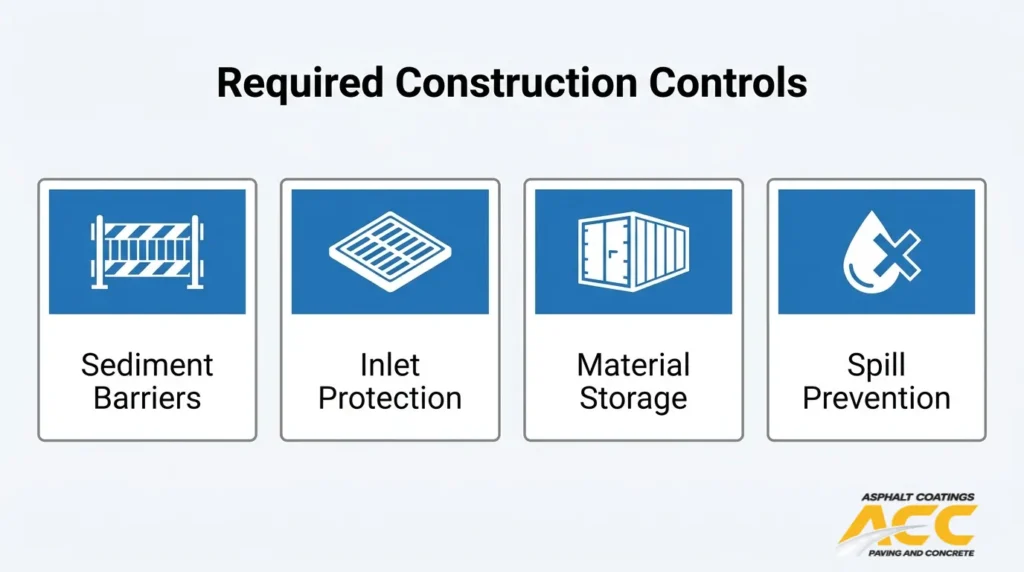
Stormwater BMPs required during repaving construction include sediment and erosion controls, material storage and spill prevention measures, and stormwater inlet protection near fresh asphalt.
What Sediment and Erosion Controls Must Be Installed On-Site?
Sediment and erosion controls that must be installed on-site include measures that prevent disturbed soil and construction debris from reaching storm drains or waterways. These essential measures are often outlined as part of a comprehensive grading and erosion control permit required for many Colorado Springs parking lot projects. Typical requirements for repaving projects involve:
- Silt fencing along the downslope perimeter of the work zone to intercept sediment-laden runoff.
- Stabilized construction entrances using crushed stone tracking pads to prevent material from migrating onto public roads.
- Temporary seeding or mulching on any exposed soil areas that will remain idle for more than 14 days.
- Fiber rolls or wattles placed along curb lines and slope transitions to slow sheet flow and trap fine particles.
These controls must remain in place and functional until final stabilization is achieved. For Colorado Springs projects, the semi-arid climate means even brief, intense storm events can mobilize significant sediment if controls are absent or poorly maintained.
What Material Storage and Spill Prevention Measures Apply?
Material storage and spill prevention measures that apply during repaving construction focus on keeping asphalt binders, sealcoat emulsions, petroleum products, and chemical additives from contacting stormwater. Key requirements include:
- Secondary containment for all liquid storage containers, including tack coat drums and fuel tanks.
- Covered storage areas for stockpiled materials such as aggregate, cold patch, and reclaimed asphalt pavement.
- Spill kits staged within immediate reach of equipment fueling zones and material transfer points.
- Designated fueling and maintenance areas located at least 50 feet from any storm drain or drainage channel.
According to the U.S. EPA, the NPDES permit program regulates point sources that discharge pollutants to waters of the United States, making on-site spill prevention a direct compliance obligation. Proper containment is one of the most cost-effective ways to avoid violations during active paving operations.
What Stormwater Inlet Protection Is Required Near Fresh Asphalt?
Stormwater inlet protection required near fresh asphalt prevents construction-related pollutants from entering the municipal separate storm sewer system during and immediately after paving. Standard inlet protection measures include:
- Filter fabric inserts or drop-inlet guards placed over every catch basin and curb inlet within the project limits.
- Gravel or sand bag barriers around inlet openings to slow flow velocity and trap sediment before it enters the pipe network.
- Temporary berms or diversion channels that redirect runoff away from freshly placed asphalt surfaces during the curing period.
Fresh asphalt can release fine particles, petroleum-based residues, and elevated temperatures into runoff if stormwater reaches uncured surfaces. Inlet protection must stay in place until the pavement has fully cured and all loose material has been swept from the site.
Understanding these construction-phase BMPs sets the stage for permanent post-construction stormwater requirements.
What Post-Construction Stormwater Requirements Affect Repaved Sites?
Post-construction stormwater requirements affect repaved sites through permanent drainage design standards, water quality treatment features, and ongoing BMP maintenance obligations.
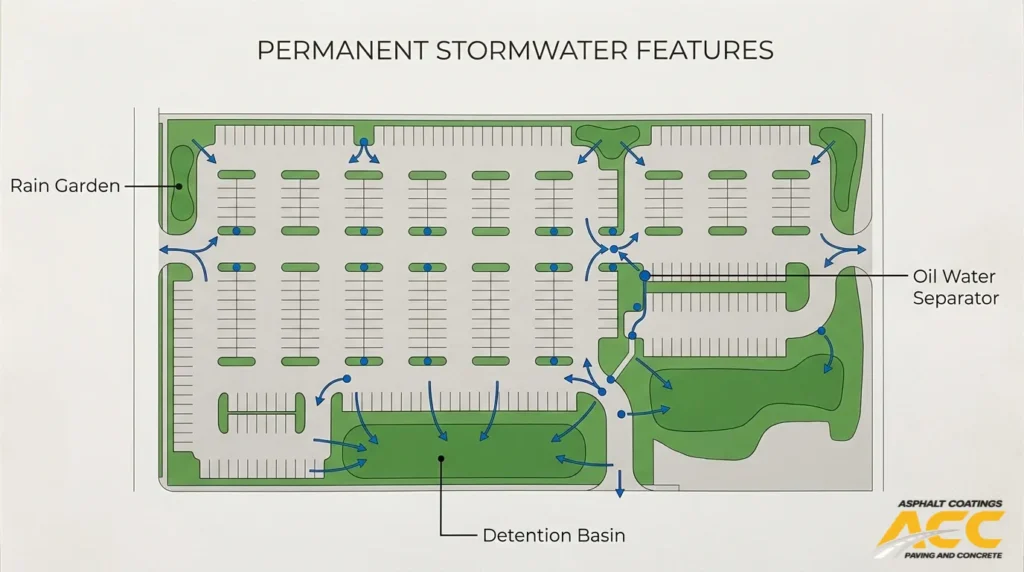
What Permanent Drainage Design Standards Apply to Parking Lots?
Permanent drainage design standards that apply to parking lots address both runoff volume control and pollutant capture. Parking lots generate concentrated contaminant loads; a study published in Science of the Total Environment evaluated heavy metal runoff concentrations in parking lots, bridges, and roads to characterize heavy metal pollution from traffic area runoff.
To manage these pollutant loads, Colorado Springs requires engineered drainage systems that slow, filter, and infiltrate stormwater before it enters the municipal storm sewer. Common permanent design elements include:
- Graded surfaces with proper cross-slopes directing flow to collection points.
- Curb cuts and flow-through planters sized to the lot’s impervious area.
- Detention or retention basins calibrated to local storm event volumes.
Designing drainage into the repaving scope from the start is far more cost-effective than retrofitting after project completion.
What Water Quality Treatment Features Must Be Incorporated?
Water quality treatment features that must be incorporated into repaved sites target pollutant removal before stormwater reaches Fountain Creek or other receiving waters. According to the U.S. EPA, bioretention practices such as rain gardens are landscaped depressions that treat on-site stormwater discharge from impervious surfaces including parking lots and compacted lawns.
Typical required treatment features include:
- Bioretention cells or rain gardens positioned at drainage collection points.
- Sediment forebays that capture coarse particulates upstream of primary BMPs.
- Oil-water separators for sites with high vehicle traffic or fueling areas.
Non-compliance can trigger enforcement from the Colorado Department of Public Health and Environment, which issues penalty orders for violations of discharge permits. Selecting the right combination depends on site layout, pollutant profile, and available space.
What Ongoing Maintenance Obligations Come with Post-Construction BMPs?
Ongoing maintenance obligations that come with post-construction BMPs require property owners to inspect, document, and service installed stormwater controls on a recurring schedule. The City of Colorado Springs requires owners to submit annual inspection reports and copies of all inspection and maintenance forms by May 31st of each year.
Key maintenance tasks typically include:
- Removing accumulated sediment from bioretention cells and forebays.
- Clearing debris from inlet grates, outlet structures, and overflow channels.
- Repairing erosion damage to vegetated swales and stabilized slopes.
- Documenting each inspection with photographs, dates, and corrective actions taken.
Neglecting these obligations does not just risk fines; it degrades BMP performance over time, increasing the pollutant load reaching local waterways. For property managers overseeing large commercial sites, building maintenance schedules into annual operations budgets ensures consistent compliance long after the repaving crew leaves.
With post-construction requirements established, understanding how MS4 rules reshape project scope for specific commercial property types adds further clarity.
How Does the MS4 Permit Change Repaving Scope for Commercial Properties?
The MS4 permit changes repaving scope for commercial properties by requiring stormwater controls tailored to each site’s use, pollutant profile, and impervious coverage. Shopping centers, industrial facilities, and healthcare campuses each face distinct compliance demands.
How Does MS4 Compliance Affect Shopping Center Repaving?
MS4 compliance affects shopping center repaving by requiring stormwater treatment systems scaled to large, continuous impervious surfaces. Shopping centers typically feature expansive parking fields that generate significant runoff volumes carrying sediment, oils, and heavy metals from constant vehicle traffic.
Repaving projects at these properties often trigger post-construction BMP requirements, such as bioretention areas integrated into landscape islands or permeable pavement sections in low-traffic zones. According to the EPA, bioretention practices are landscaped depressions that treat on-site stormwater discharge from impervious surfaces, including parking lots and compacted lawns.
Shopping center owners should expect repaving budgets to include drainage redesign alongside surface work. Failing to account for these stormwater elements at the project planning stage often leads to costly mid-project scope changes.
How Does MS4 Compliance Affect Industrial Facility Repaving?
MS4 compliance affects industrial facility repaving by adding pollutant-specific controls beyond standard drainage requirements. Industrial sites handle materials, chemicals, and heavy equipment that introduce unique contaminants into stormwater runoff.
Key compliance considerations for industrial repaving include:
- Containment grading around loading docks and material storage areas to prevent pollutant migration.
- Oil-water separators or filtration systems integrated into drainage infrastructure.
- Designated wash-down areas with isolated drainage that prevents discharge into the MS4 system.
The EPA requires NPDES permits for certain industrial facilities, which in Colorado are issued through the CDPHE and regulate stormwater discharges. This means industrial property owners may need both construction-phase and facility-specific stormwater permits during repaving. For most industrial sites, coordinating these overlapping permit requirements early prevents project delays.
How Does MS4 Compliance Affect Healthcare Campus Repaving?
MS4 compliance affects healthcare campus repaving by demanding stormwater solutions that accommodate high-traffic emergency access, patient drop-off zones, and strict operational continuity requirements. Healthcare facilities cannot shut down large parking areas simultaneously, which directly shapes phasing plans.
Compliance-driven design elements for healthcare repaving include:
- Curb-and-gutter modifications to direct runoff toward water quality treatment features.
- Phased construction sequencing that maintains emergency vehicle access while installing BMPs.
- Enhanced inlet protection near ambulance bays where fluid spills pose elevated contamination risk.
Healthcare campuses also generate runoff from frequent surface cleaning and de-icing. These operational realities make post-construction maintenance obligations particularly important, since BMP performance must remain consistent year-round despite heavy site activity.
Understanding site-specific MS4 requirements helps property owners anticipate the true scope of compliance before repaving begins.
What Happens If a Repaving Project Violates MS4 Permit Conditions?
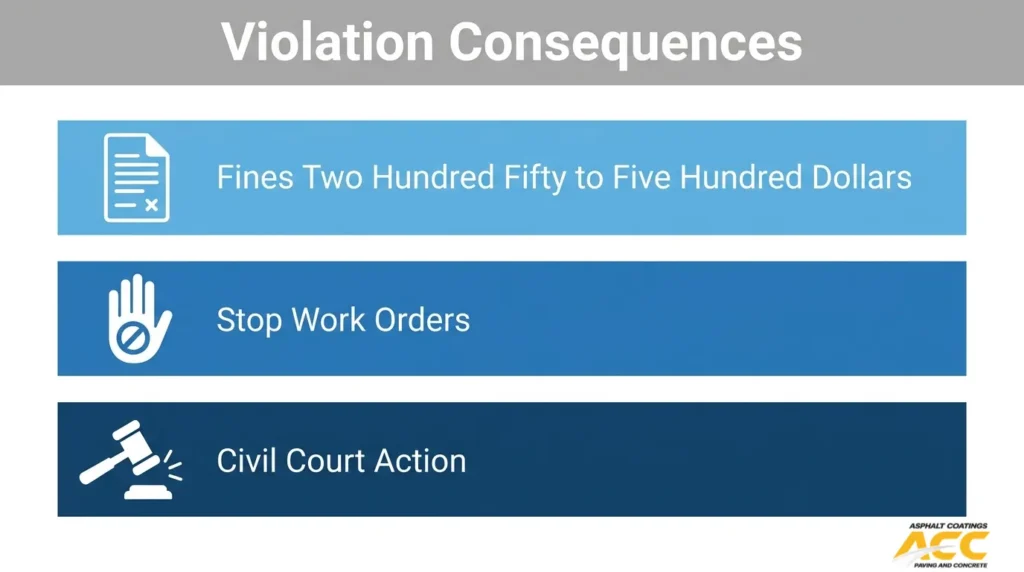
A repaving project that violates MS4 permit conditions can trigger fines, stop work orders, and even civil court action. Liability may fall on the property owner, the contractor, or both depending on permit structure and contractual terms.
What Fines and Enforcement Actions Can Property Owners Face?
Property owners can face fines ranging from $250 to $500 per violation, up to 90 days in jail, or both under Colorado Springs City Code for failing to comply with a notice and order or stop work order. According to the American Legal Publishing Code Library, any failure, neglect, or refusal to obey such orders constitutes a City Code violation punishable by these penalties.
Beyond municipal enforcement, the Colorado Department of Public Health and Environment issues civil penalty orders for violations of commercial paving permits or the Water Quality Control Act. These state-level actions can compound local fines significantly. The Stormwater Enterprise Manager may also request the City Attorney to initiate civil action in District Court for injunctive relief to abate ongoing violations.
For commercial property owners in Colorado Springs, the financial risk extends well beyond the fine itself. Project delays from stop work orders, remediation costs, and potential litigation expenses can dwarf the original penalty amount.
Who Is Liable — the Property Owner or the Paving Contractor?
Liability typically falls on the property owner as the permit holder, since MS4 compliance obligations attach to the site rather than the contractor performing the work. The property owner signs the stormwater permit application and bears ultimate responsibility for ensuring all discharge requirements are met.
However, contractors share operational liability for BMP implementation during active construction. If a paving contractor fails to install required sediment controls or mishandles materials on-site, both parties may face enforcement action. Contractual allocation of stormwater compliance duties becomes critical; without clear terms specifying who installs, monitors, and maintains BMPs, disputes over responsibility are common.
This is precisely why working with a contractor experienced in MS4 requirements matters more than most property owners realize. A well-structured contract should explicitly assign stormwater compliance roles, reducing exposure for both parties when regulators inspect the site.
With enforcement risks clarified, understanding how Colorado Springs’ climate shapes stormwater planning adds another layer to project preparation.
How Does Colorado Springs’ Climate Affect MS4 Stormwater Planning?
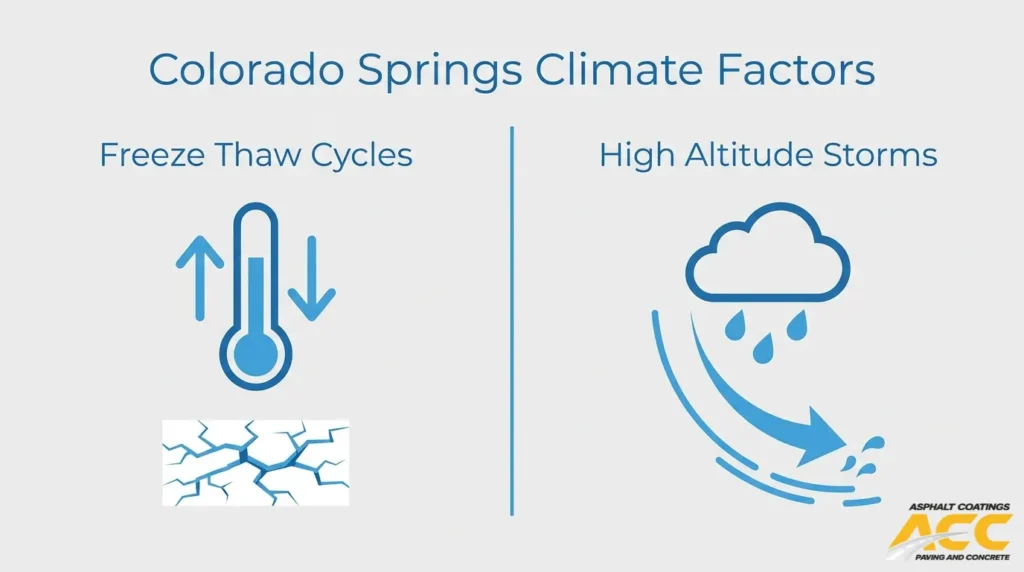
Colorado Springs’ climate affects MS4 stormwater planning by introducing freeze-thaw damage risks and intense high-altitude storm events that demand specialized infrastructure design. These factors shape material selection and runoff calculations.
How Do Freeze-Thaw Cycles Impact Stormwater Infrastructure Design?
Freeze-thaw cycles impact stormwater infrastructure design by accelerating cracking in drainage structures, curbing, and pavement surfaces that manage runoff. Colorado Springs experiences frequent temperature swings across the freezing threshold, particularly from late fall through early spring. Water trapped in joints and sub-base layers expands when frozen, then contracts during thaws, weakening structural integrity over a single season, making regular asphalt crack sealing essential to prevent ongoing damage.
Permeable pavements offer one solution. According to the U.S. Environmental Protection Agency, permeable pavements are a stormwater control that allows stormwater to infiltrate through the surface to the ground below, serving as a green infrastructure alternative to traditional impervious surfaces. However, permeable systems in freeze-thaw zones require careful sub-base design with adequate drainage depth to prevent ice lensing beneath the surface. Specifying frost-resistant materials and proper aggregate gradation during the design phase helps stormwater BMPs survive Colorado Springs winters without premature failure.
How Do High-Altitude Storm Events Change Runoff Calculations?
High-altitude storm events change runoff calculations by producing intense, short-duration rainfall that generates higher peak flows than lower-elevation storms of equal total precipitation. At approximately 6,800 feet, Colorado Springs sits where orographic lift and afternoon convective buildup create localized downpours that overwhelm standard drainage assumptions.
These conditions raise total suspended solids concentrations in stormwater discharge. According to the Minnesota Pollution Control Agency, the median TSS concentration across studied sites is 93 mg/L, a benchmark that high-intensity mountain storms can easily exceed on freshly disturbed pavement sites. A Post Construction Stormwater Management Plan applies to new land development and significant redevelopment projects with the potential to add pollutants to stormwater runoff, making accurate peak-flow modeling essential for compliance. For repaving projects in Colorado Springs, using localized intensity-duration-frequency data rather than generic regional curves is critical to sizing inlet structures and detention features correctly.
With climate factors accounted for, budgeting accurately becomes the next step in planning a compliant repaving project.
What Should You Budget for MS4 Compliance on a Repaving Project?
You should budget for MS4 compliance on a repaving project by accounting for construction-phase BMPs, post-construction stormwater features, permit fees, and ongoing maintenance costs. Each category adds a distinct layer to your overall project investment.
Construction-phase costs cover temporary erosion and sediment controls, such as silt fences, inlet protection, and stabilized construction entrances. These measures are typically the smallest line item but are mandatory from day one of site disturbance.
Post-construction stormwater features represent the largest compliance expense. Bioretention areas, permeable pavement zones, and water quality treatment devices all require engineering design, materials, and installation labor. According to the Virginia Association of Soil and Water Conservation Districts, permeable pavement installation can cost up to $14.00 per square foot, with reimbursement programs capping at $20,000.
Permit application and engineering review fees add another budget layer. Colorado Springs requires SWMP documentation, drainage reports, and plan reviews, all of which carry administrative and professional service costs.
Ongoing maintenance is a cost many property owners underestimate. Annual BMP inspections, sediment removal, and reporting obligations create recurring expenses that extend well beyond project completion. Budgeting for these long-term costs upfront prevents unexpected financial strain in subsequent years. Regular commercial parking lot sealcoating services are a key component of preventative maintenance, extending pavement life and protecting against pollutant infiltration.
For most commercial repaving projects in Colorado Springs, MS4 compliance costs are best understood not as a standalone expense but as an integrated component of responsible site design. Factoring compliance into the initial scope, rather than treating it as an afterthought, almost always reduces total project cost by avoiding redesign, delays, and potential fines.
An experienced paving contractor can help consolidate these budget items into a single, transparent estimate.
How Can an Experienced Paving Contractor Simplify MS4 Compliance?
An experienced paving contractor can simplify MS4 compliance by managing permit documentation, installing required BMPs, and coordinating post-construction stormwater features as part of a single repaving scope. Beyond full repaving, our expertise extends to essential commercial asphalt repair services, addressing specific issues like cracks and potholes to maintain compliance and pavement longevity.
Can Asphalt Coatings Company Handle Stormwater-Compliant Repaving?
Yes, Asphalt Coatings Company can handle stormwater-compliant repaving for commercial properties across Colorado Springs.With operations since 1986, Asphalt Coatings Company brings decades of Colorado-specific paving expertise to every project. Asphalt Coatings Company performs all work with in-house crews, which means sediment controls, grading adjustments, drainage design, and final paving stay under one management team. This single-source approach eliminates the coordination gaps between separate grading, drainage, and paving subcontractors that often lead to permit violations. Asphalt Coatings Company serves commercial clients including shopping centers, industrial complexes, healthcare campuses, and office parks throughout the Colorado Springs area. For property managers navigating MS4 requirements, having one contractor accountable for both construction-phase BMPs and finished surface quality reduces compliance risk significantly. This comprehensive approach includes specialized offerings like asphalt mill and pave services, ensuring a complete solution from initial permits to final surfacing.
What Are the Key Takeaways About Colorado Springs’ MS4 Permit and Your Repaving Project?
The key takeaways about Colorado Springs’ MS4 permit and your repaving project center on proactive planning, proper BMP installation, and ongoing maintenance accountability. Colorado Springs operates under an individual MS4 permit (COS000004) administered by the Colorado Department of Public Health and Environment, making stormwater compliance a non-negotiable element of commercial repaving. According to ClimateCheck, annual precipitation in Colorado Springs is projected to increase from about 17.3 inches to about 17.8 inches, which means stormwater infrastructure designed today must account for higher future runoff volumes. At roughly 6,800 feet elevation, intense storm events and freeze-thaw cycles add further complexity. Choosing a qualified local paving contractor who understands these regulatory and environmental demands is the most practical step toward a compliant, durable repaving outcome. This expertise is also vital for ensuring that new construction asphalt paving projects adhere to all initial stormwater design and permitting requirements from the outset.