A Grading and Erosion Control (GEC) Permit is a city-issued authorization required before any clearing, grading, excavation, or filling begins on a property in Colorado Springs. The permit ensures land-disturbing activities comply with municipal stormwater regulations and protect surrounding properties and waterways.
This guide covers permit definitions and triggers, the application process, required erosion control measures, enforcement consequences, and how commercial paving expertise streamlines compliance.
Colorado Springs requires a GEC Permit for nearly all land-disturbing activities, with specific thresholds based on disturbed area, soil volume, and proximity to buried utilities. Commercial parking lot grading, regrading beneath existing pavement, and soil import or export all trigger the requirement. Exemptions exist but are narrow and evaluated on actual site impact rather than project size.
The application process involves submitting grading plans, erosion control plans, topographic surveys, and a stormwater management plan through the city’s review system. Approval typically takes two to four weeks for straightforward projects, though incomplete submissions or utility coordination needs can extend that timeline.
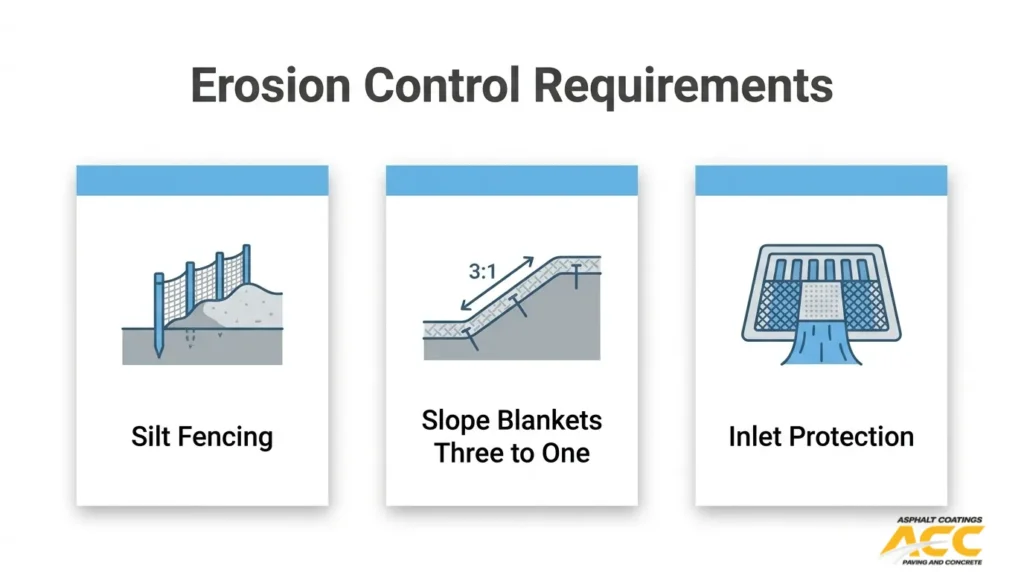
Colorado Springs mandates sediment barriers such as silt fencing and inlet protection during construction, plus erosion control blankets on slopes at a 3:1 ratio and steeper. Freeze-thaw cycles across the region’s cold months add complexity, requiring reinforced barriers and properly anchored installations that withstand repeated temperature swings.
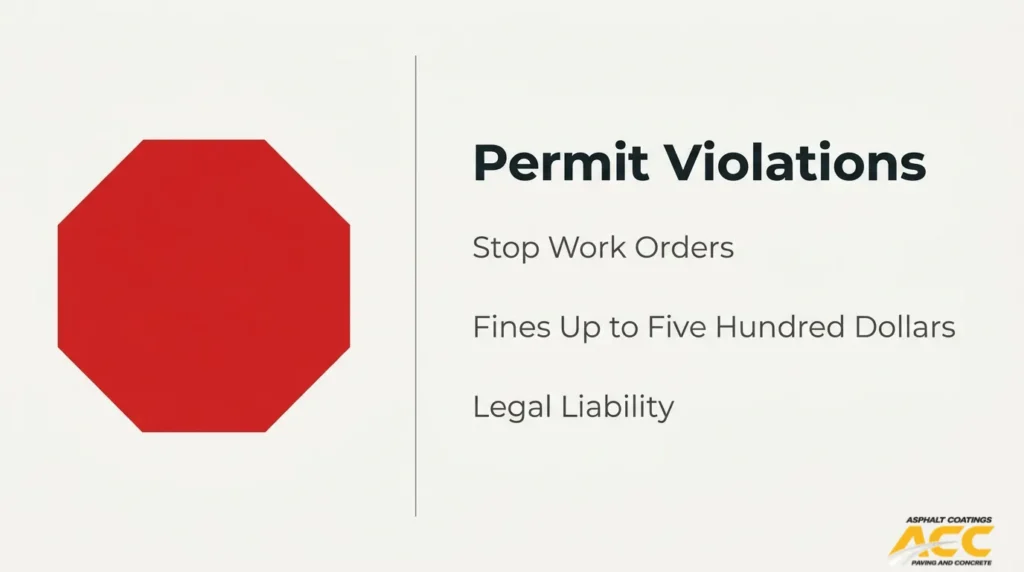
Grading without a permit exposes property owners to stop-work orders, fines up to $500 per violation, potential jail time, and civil liability for damage to neighboring parcels or buried infrastructure. Working with an experienced contractor who manages grading, stormwater documentation, and city inspections as standard practice keeps commercial lot projects compliant and on schedule.
What Is a Grading and Erosion Control Permit in Colorado Springs?
A Grading and Erosion Control Permit is a city-issued authorization required before any clearing, grading, excavation, or filling begins on a property in Colorado Springs. Below, we cover what the city requires before work starts and which department manages the permitting process.
What Does the City of Colorado Springs Require Before Grading Begins?
The City of Colorado Springs requires property owners and contractors to obtain an approved Grading and Erosion Control (GEC) Permit before any land-disturbing activity begins. This requirement covers clearing, excavation, filling, and grading on both new construction and redevelopment sites.
Before a permit is issued, applicants must demonstrate compliance with several key standards:
- Best Management Practices (BMPs) must be planned to treat stormwater runoff from the site.
- Projects disturbing more than 500 cubic yards require a SEPA checklist.
- Any grade changes over buried utility infrastructure must be reviewed and approved by Colorado Springs Utilities.
According to the City of Colorado Springs Stormwater Enterprise, the city’s stormwater criteria fulfill regulatory requirements under the Municipal Separate Storm Sewer System (MS4) Permit (COS000004). Given Colorado Springs’ annual rainfall of just over 14 inches, even moderate storms can cause significant erosion on unprepared sites, making pre-grading compliance essential rather than optional.
Which City Department Issues Grading and Erosion Control Permits?
The City of Colorado Springs Stormwater Enterprise issues Grading and Erosion Control Permits. This department operates under Public Works and oversees all construction-phase stormwater compliance, including sediment control and site stabilization requirements. The Stormwater Enterprise Manager holds enforcement authority; if site activity creates a public health, safety, or welfare nuisance, that manager can issue stop-work orders.
Per the City of Colorado Springs Code Library, an erosion control blanket shall be installed on all graded slopes with a ratio of three to one and greater. For commercial lot projects, understanding which department holds authority over your permit helps avoid delays during plan review and inspections.
Understanding these permitting basics prepares you to determine whether your specific project triggers the requirement.
When Is a Grading and Erosion Control Permit Required?
A Grading and Erosion Control Permit is required prior to clearing, grading, excavation, filling, and other land disturbing activities in Colorado Springs. The specific triggers depend on project scope, surface type, and soil volume.
Is a Permit Required for Disturbing More Than 500 Square Feet?
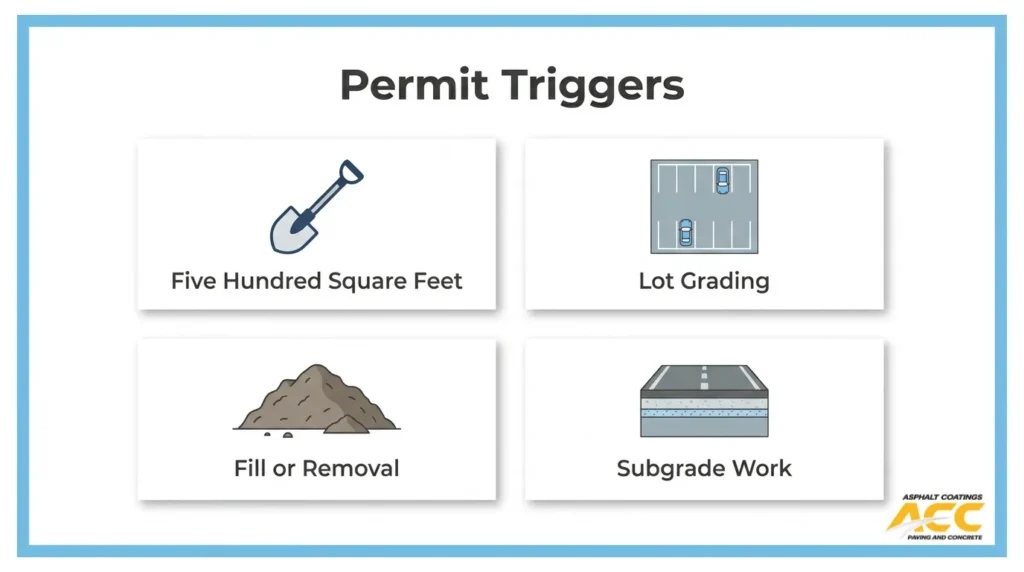
Yes, a permit is required for disturbing more than 500 square feet in most cases. According to the City of Colorado Springs Code Library, a grading permit is required before grading and clearing a property, and if more than 500 cubic yards is to be disturbed, a SEPA checklist is also required. The threshold applies to both area and volume, so even modest commercial lot projects can trigger the requirement quickly. Failing to comply carries real consequences: violations of a notice, order, or stop work order are punishable by up to 90 days in jail, fines between $250 and $500, or both.
Do You Need a Permit for Commercial Parking Lot Grading?
Yes, you need a permit for commercial parking lot grading in Colorado Springs. Parking lot construction involves clearing, excavation, and reshaping of the subgrade, all of which qualify as land disturbing activities under the city’s grading ordinance. Commercial projects typically exceed the minimum disturbance thresholds due to the scale of the work involved. Property managers and facility owners should secure a GEC Permit before any earthwork begins to avoid enforcement actions. For most commercial lots, additional stormwater management documentation will also be required alongside the grading permit.
Is a Permit Needed for Regrading an Existing Paved Surface?
Yes, a permit is needed for regrading an existing paved surface when the work involves removing or altering the subgrade beneath. Simply resurfacing or overlaying existing pavement typically does not trigger a GEC Permit. However, once the work involves stripping pavement and regrading the base material underneath, it becomes a land disturbing activity. Erosion control on paved surfaces also requires specific measures; as noted by the Mile High Flood District, area inlets in sump settings can be protected through silt fence, concrete block, and rock socks on paved surfaces. The distinction between resurfacing and regrading is one many property owners overlook, and clarifying it early prevents costly project delays.
Does Adding Fill or Removing Soil Trigger a Permit Requirement?
Yes, adding fill or removing soil triggers a permit requirement in Colorado Springs. The city’s GEC Permit applies to filling activities alongside clearing, grading, and excavation. Whether you are importing material to raise a lot’s elevation or hauling soil off-site to lower it, both actions alter the land surface and affect drainage patterns. Projects that change grade over buried utility infrastructure face an additional review requirement from Colorado Springs Utilities. For commercial lot owners, even seemingly small fill or cut operations can exceed the city’s disturbance thresholds, making early permit consultation essential before any soil is moved.
Understanding when permits apply is the first step; knowing whether your project qualifies for an exemption is equally important.
Are There Exemptions From the Grading Permit Requirement?
Yes, there are exemptions from the grading permit requirement in Colorado Springs, but they are narrow and situation-specific. Most land-disturbing activities on commercial lots still trigger the permit process. The following scenarios outline where exemptions may apply and where property owners commonly misjudge their obligations.
Minor maintenance activities that do not alter existing drainage patterns or disturb new ground typically fall outside the permit requirement. Examples include routine surface repairs, small landscaping adjustments within already-graded areas, and patching work on established paved surfaces. However, even these activities can cross the permit threshold if they change how stormwater flows across the property or involve soil import and export.
Emergency work ordered by a public agency to protect life, property, or water resources may proceed without a standard permit, though documentation and follow-up compliance are still expected. The Stormwater Enterprise Manager retains authority to require corrective action on any land-disturbing activity that creates a nuisance to public health, safety, and welfare, according to the City of Colorado Springs Code Library.
Property owners frequently assume small-scale projects are automatically exempt. That assumption is risky. The city evaluates exemptions based on actual site impact, not just project size. Activities that seem minor, such as regrading a drainage swale or adding fill near a property boundary, can trigger full permit requirements if they affect stormwater conveyance or neighboring parcels.
For commercial lot owners in Colorado Springs, the safest approach is to confirm exemption status directly with the Stormwater Enterprise before breaking ground. Misreading an exemption can result in stop-work orders, fines, and costly remediation. Understanding the full application process helps property owners avoid these risks entirely.
What Are the Steps to Apply for a Grading Permit in Colorado Springs?
The steps to apply for a grading permit in Colorado Springs include preparing site plans, submitting required documents, and obtaining stormwater approvals. The sections below cover required submissions, stormwater management plans, and typical approval timelines.
What Site Plans and Documents Must You Submit?
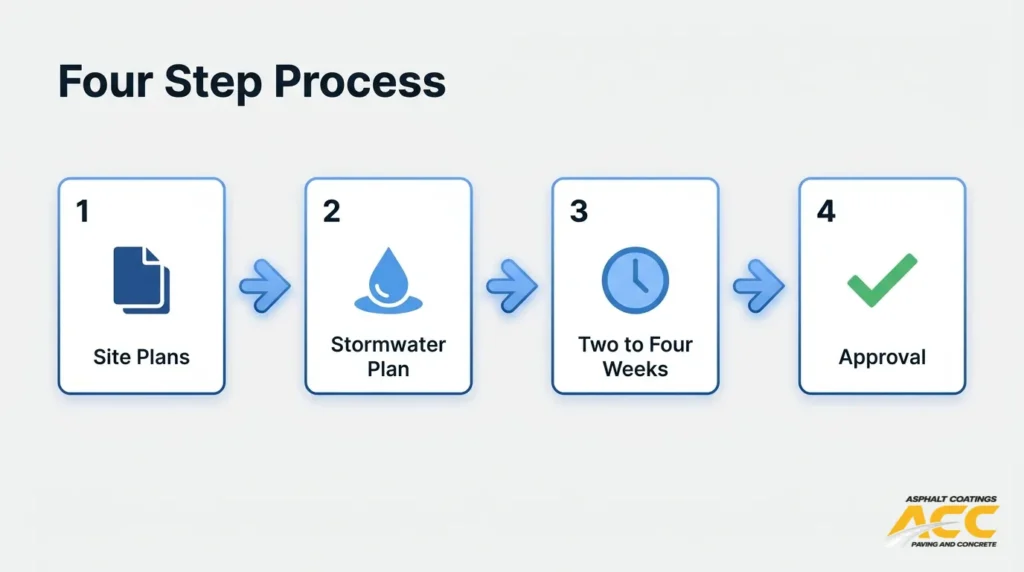
The site plans and documents you must submit include a grading plan, an erosion control plan, and detailed topographic surveys showing existing and proposed contours. Colorado Springs also requires a drainage report when grade changes affect runoff patterns.
Applicants should prepare:
- A grading plan showing cut-and-fill volumes, finished grades, and slope ratios.
- An erosion control plan with Best Management Practice locations.
- Topographic survey data for existing and proposed site conditions.
- A drainage study addressing post-construction stormwater flow.
- Proof of utility coordination if grading occurs near buried infrastructure.
Assembling these documents before submission reduces the risk of delays during the city’s review cycle.
Do You Need a Stormwater Management Plan With Your Application?
Yes, you need a stormwater management plan (SWMP) with your grading permit application in most cases. Colorado Springs ties grading approval directly to stormwater compliance because land disturbance alters runoff patterns and can degrade water quality.
The city’s Stormwater Criteria Manual (SCM) contains all criteria related to grading, sediment control, and erosion control permitting. According to the Colorado Department of Public Health and Environment, all permittees must log into the CEOS electronic application portal for new construction stormwater permits, modifications, transfers, and terminations.
Failing to include an adequate SWMP can trigger enforcement. The Stormwater Enterprise Manager has authority to issue stop-work orders when an activity creates a nuisance to public health, safety, or welfare.
How Long Does the Permit Approval Process Typically Take?
The permit approval process typically takes two to four weeks for straightforward residential or small commercial projects in Colorado Springs, though larger or more complex sites may require additional review time. Several factors influence the timeline:
- Completeness of submitted documents at initial filing.
- Whether stormwater and drainage plans require revisions.
- Coordination review by Colorado Springs Utilities for projects near buried infrastructure.
- Current volume of applications at the Stormwater Enterprise office.
Submitting a complete application with all required plans, drainage reports, and utility approvals significantly shortens the review period. Incomplete submissions often cycle back for corrections, adding weeks to the process.
With permit requirements clarified, understanding associated costs helps you budget accurately for your lot project.
How Much Does a Grading and Erosion Control Permit Cost?
A grading and erosion control permit cost in Colorado Springs varies based on project scope, disturbed area, and plan review complexity. The City of Colorado Springs Stormwater Enterprise sets fee schedules that reflect the scale of land disturbance and the level of engineering review required. Smaller lot projects generally incur lower fees, while large commercial sites involving thousands of cubic yards of earthwork face higher permit and plan review charges. Because fee schedules can be updated periodically, contacting the Stormwater Enterprise directly or checking the city’s online portal provides the most current pricing. For commercial property managers planning parking lot construction or regrading, factoring commercial paving permit costs into the project budget early prevents unexpected delays and ensures full compliance before any land disturbance begins.
What Erosion Control Measures Does Colorado Springs Require?
Colorado Springs requires sediment barriers, slope stabilization practices, and climate-adapted planning as erosion control measures for grading projects. The following subsections cover specific barrier types, post-grading stabilization requirements, and how freeze-thaw cycles shape local erosion control strategies.
What Sediment Barriers Must Be Installed During Construction?
The sediment barriers that must be installed during construction include silt fencing, reinforced silt fencing, and inlet protection devices. According to a City of Colorado Springs Public Works detail sheet, reinforced silt fence is a heavy-duty sediment barrier option that can withstand higher flows or pressures at construction sites. Standard silt fence works for lower-flow perimeter areas, while reinforced versions suit locations with steeper grades or concentrated runoff.
Inlet protection is also mandatory. Area inlets in sump settings can be protected using silt fence, concrete block, or rock socks on paved surfaces. These barriers prevent sediment-laden runoff from entering the municipal storm sewer system during active construction.
What Stabilization Practices Are Required After Grading?
The stabilization practices required after grading include erosion control blanket installation and revegetation of disturbed areas. The City of Colorado Springs Code Library specifies that an erosion control blanket shall be installed on all graded slopes at a 3:1 ratio and steeper. This requirement prevents exposed soil from washing downslope during rain events.
Beyond blanket installation, disturbed areas typically require seeding or sodding within a set timeframe to establish permanent vegetative cover. Temporary stabilization measures must remain in place until vegetation reaches sufficient density. For commercial lot projects, getting stabilization right the first time avoids costly rework and potential enforcement action.
How Do Freeze-Thaw Cycles Affect Erosion Control Planning?
Freeze-thaw cycles affect erosion control planning by accelerating soil movement and degrading temporary barriers throughout Colorado Springs’ cold-season months. When moisture trapped in exposed soil freezes, it expands and loosens the surface layer. Thawing then releases that loosened material as sediment-rich runoff.
Colorado Springs receives a little over 14 inches of normal annual rainfall, according to a Transportation Research Board report, but much of that moisture arrives alongside rapid temperature swings. This means erosion control installations must withstand repeated freezing and thawing without failure. Reinforced barriers and properly anchored erosion blankets perform better under these conditions than standard-weight alternatives.
Accounting for freeze-thaw cycles during the planning stage prevents mid-project failures that trigger code violations and project delays.
What Happens If You Grade a Lot Without a Permit?
Grading a lot without a permit in Colorado Springs can trigger fines, stop-work orders, and significant legal exposure. The consequences range from criminal penalties to civil liability for property damage.
What Fines or Stop-Work Orders Can the City Issue?
The city can issue both fines and immediate stop-work orders for unpermitted grading activity. If the Stormwater Enterprise Manager determines that grading creates an imminent hazard to public safety, property, or water resources, an immediate stop-work order can halt all site activity without prior warning.
Defying that order carries serious consequences. According to the City of Colorado Springs Code Library, any failure to comply with a stop-work order is a City Code violation punishable by up to 90 days in jail, a fine between $250 and $500, or both. These penalties apply per violation, so continued noncompliance can compound quickly.
Beyond municipal fines, unpermitted grading that contaminates stormwater can escalate to state and federal enforcement. For most commercial property owners, the stop-work order alone creates costly project delays that far exceed what permitting would have cost upfront.
Can Unpermitted Grading Create Liability for Property Owners?
Yes, unpermitted grading can create substantial liability for property owners. When grading alters drainage patterns or sends sediment onto neighboring properties, the owner who authorized the work bears legal responsibility for resulting damage.
Erosion from an uncontrolled site can clog stormwater inlets, flood adjacent parcels, and degrade water quality in downstream waterways. Without an approved erosion control plan and required Best Management Practices, there is no documented compliance to defend against negligence claims. Property owners may face civil lawsuits from affected neighbors, remediation costs imposed by the city, and potential environmental penalties from state regulators.
Liability also extends to grade changes over buried utilities. If unpermitted work damages underground infrastructure, the property owner assumes full financial responsibility for repairs. Securing the proper permit before breaking ground protects against each of these exposure points.
With enforcement risks clearly outlined, understanding how stormwater and drainage regulations shape your overall lot project adds another critical compliance layer.
How Do Stormwater and Drainage Regulations Affect Your Lot Project?
Stormwater and drainage regulations affect your lot project by requiring specific site design controls, permit compliance, and ongoing management practices that govern how water moves across and off your property during and after construction.
Colorado Springs enforces these requirements through its Municipal Separate Storm Sewer System (MS4) Permit and the Stormwater Criteria Manual (SCM). According to the City of Colorado Springs Stormwater Enterprise, the city’s stormwater criteria is written to fulfill regulatory requirements under the MS4 Permit (COS000004), which means every lot project must demonstrate how it will manage runoff before receiving approval.
The city requires Best Management Practices (BMPs) for new construction and redevelopment to treat stormwater runoff from a site. These BMPs influence nearly every grading and paving decision, including:
- Slope direction and grade percentages that control drainage flow paths
- Inlet protection using silt fence, concrete block, or rock socks on paved surfaces
- Detention or retention features sized to handle site-specific runoff volumes
- Permanent drainage infrastructure connecting to the municipal storm sewer system
For commercial lot projects in Colorado Springs, where annual rainfall averages a little over 14 inches but localized storm events can be intense, even modest grading changes alter drainage patterns enough to trigger compliance obligations. Projects that propose grade changes over buried utility infrastructure must also be reviewed and approved by Colorado Springs Utilities, adding another regulatory layer.
Failing to account for stormwater regulations early in project planning often leads to costly redesigns, permit delays, or enforcement actions. The Stormwater Enterprise Manager holds authority to issue stop-work orders when an activity creates a nuisance to public health, safety, and welfare or falls out of compliance with the Unified Development Code.
Property managers and commercial owners who integrate drainage planning into the initial grading scope, rather than treating it as an afterthought, typically move through the permitting process faster and avoid unexpected project costs. Working with a single-source commercial contractor like Asphalt Coatings Company, which handles both subgrade preparation and paving in-house, can streamline coordination between grading compliance and final surface installation.
What Inspections Are Required During and After Grading Work?
The inspections required during and after grading work in Colorado Springs include an initial site inspection before ground disturbance begins, periodic compliance checks throughout construction, and a final stabilization inspection after grading is complete.
When Is the Initial Site Inspection Scheduled?
The initial site inspection is scheduled after the City conditionally approves your Grading and Erosion Control (GEC) Permit. According to El Paso County documentation, an initial site inspection will not be scheduled until a City GEC Permit has been conditionally approved, and applicants must call City Stormwater Inspections at 385-5980 at least 48 hours in advance to schedule.
No ground disturbance, clearing, or earthwork may begin before this inspection confirms that required erosion control measures are properly installed on site.
What Do Inspectors Check During Active Grading?
Inspectors check that all Best Management Practices remain functional and compliant throughout active grading. Key items reviewed during construction-phase inspections include:
- Silt fences, erosion control blankets, and inlet protections are intact and positioned correctly.
- Sediment has not migrated off-site or into stormwater infrastructure.
- Grading activities match the approved site plan and permitted scope.
- Drainage patterns align with the submitted Stormwater Management Plan.
If the Stormwater Enterprise Manager determines that site activity is creating a nuisance to public health, safety, or water quality, the City can issue an immediate stop-work order. Staying ahead of inspection requirements is far more cost-effective than responding to enforcement actions.
What Happens During the Final Stabilization Inspection?
The final stabilization inspection verifies that all disturbed areas have been permanently stabilized and that the completed grading matches approved plans. Inspectors confirm vegetation establishment, proper drainage function, and removal of temporary erosion controls.
Only after passing this inspection can the GEC Permit be formally closed. Permit closure matters because ongoing liability remains with the property owner until the City confirms full compliance. For commercial lot projects in Colorado Springs, building final inspection readiness into the project timeline prevents costly delays between grading completion and paving.
With inspections addressed, working with the right contractor can streamline this entire process.
How Can Commercial Paving Expertise Simplify Your Grading Project?
Commercial paving expertise simplifies your grading project by combining site preparation knowledge with permit compliance experience. The sections below cover how an experienced contractor handles grading regulations and what to remember about Colorado Springs lot permitting.
Can an Experienced Asphalt and Concrete Contractor Handle Grading Compliance?
Yes, an experienced asphalt and concrete contractor can handle grading compliance. Asphalt Coatings Company has provided subgrade preparation and grading as part of commercial paving projects since 1986. Experienced commercial paving contractors typically understand slope requirements, drainage design, and the erosion control measures Colorado Springs enforces during construction.Experienced contractors who routinely manage commercial parking lot construction, including parking lot striping, coordinate site plans and city inspections as part of their project scope. Working with a single-source contractor that performs grading, asphalt paving, and concrete flatwork in-house reduces miscommunication between trades and keeps permit timelines on track. For commercial property managers, that coordination is often where projects either stay on schedule or stall.
What Should You Remember About Grading Permits for Colorado Springs Lot Projects?
You should remember that grading permits are mandatory before any land-disturbing activity begins on a Colorado Springs lot project. Permit requirements apply to clearing, excavation, filling, and regrading, with specific thresholds and erosion control standards enforced by the Stormwater Enterprise. According to the City of Colorado Springs Code Library, all projects that propose grade changes over buried utility infrastructure must be reviewed and approved by Colorado Springs Utilities. Key takeaways for commercial lot projects include:
- Secure a Grading and Erosion Control Permit before any site work starts.
- Submit complete site plans and stormwater management documentation with your application.
- Install required sediment barriers and stabilization measures throughout construction.
- Schedule city inspections at least 48 hours in advance once the permit is conditionally approved.
Partnering with a contractor that understands these steps from the outset, like Asphalt Coatings Company, helps keep your Colorado Springs project compliant and moving forward. Beyond initial grading, a comprehensive approach to site longevity often includes routine commercial parking lot sealcoating as part of ongoing asphalt maintenance.