Scheduling commercial sealcoating around Colorado Springs’ summer hail season means timing your project within narrow weather windows that fall before or after the region’s peak storm activity, which runs from mid-April through mid-September.
This guide covers hail season timing and its threat to fresh sealcoat, pre-season and post-season scheduling windows, cure requirements and application-day conditions, pre-project damage repair and tenant disruption planning, and contingency strategies for mid-project storms.
Colorado Springs sits within “hail alley,” where peak activity concentrates in June and early July. Uncured sealcoat is physically soft and vulnerable to hailstone impact, which punctures the emulsion and embeds debris that prevents proper bonding.
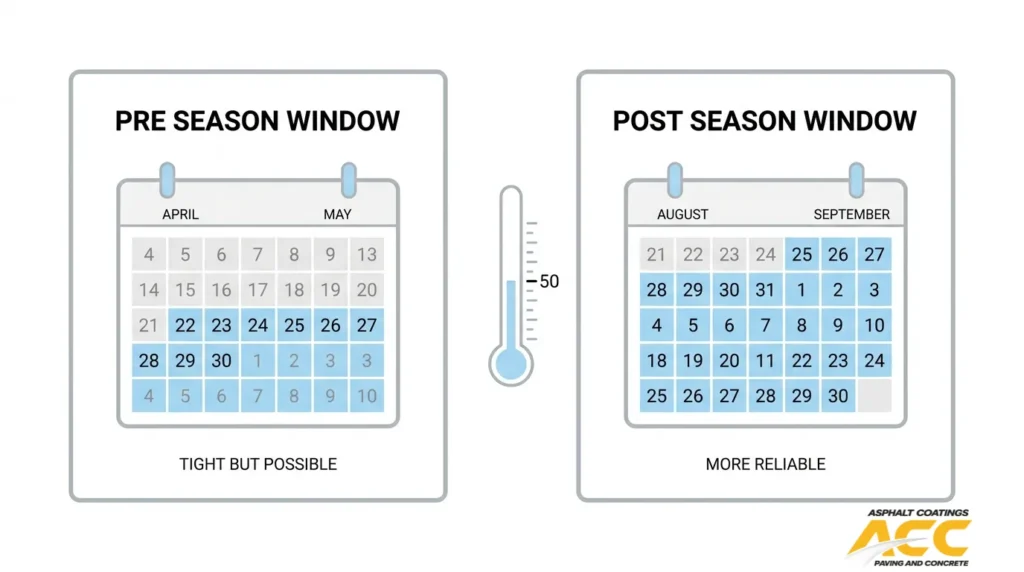
The pre-hail window falls in late April through early May, though Colorado Springs’ mean last freeze date of May 8 makes it tight. Post-season scheduling from late August through late September offers more predictable dry conditions before the mean first autumn freeze arrives on October 1.
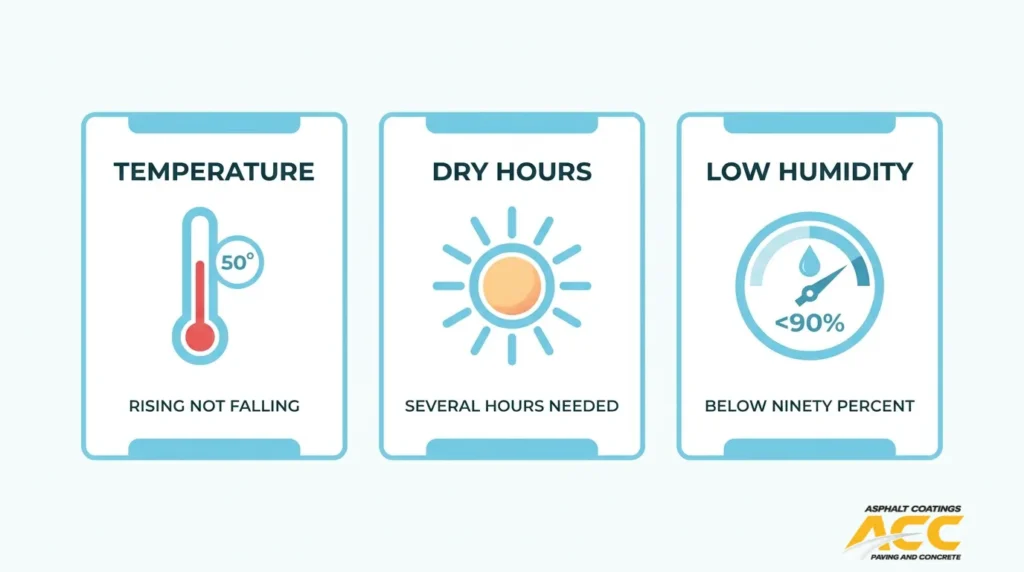
Sealcoat emulsions cure through water evaporation, requiring air temperatures at 50°F and rising, humidity below 90%, and several consecutive dry hours after application. Colorado Springs’ altitude and monsoon-season humidity both influence how quickly that cure develops.
Property managers should complete all crack repairs and patching before any sealer goes down, then phase lot closures across overnight windows to protect tenant operations. Weather delay clauses naming hail as a qualifying event belong in every contract, and crews with local staging can remobilize within 24 to 72 hours after a storm passes.
When Does Hail Season Peak in Colorado Springs?
Hail season in Colorado Springs peaks during the late spring and summer months, creating a narrow but critical scheduling challenge for commercial sealcoating. The sections below cover which months carry the highest hail frequency and how daily storm patterns shape usable work windows.
What Months See the Highest Hail Frequency Along the Front Range?
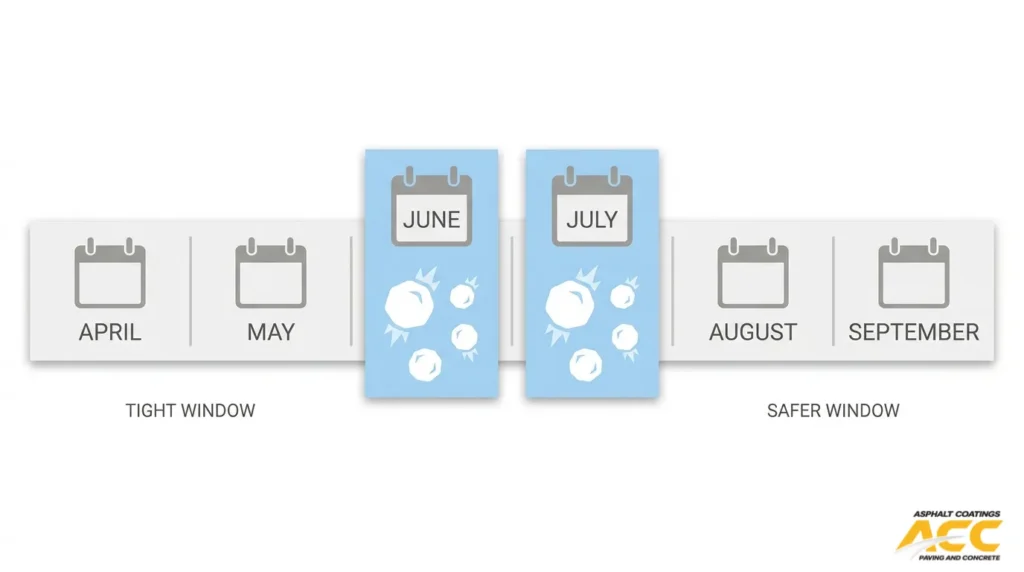
The months that see the highest hail frequency along the Front Range are May, June, and July. According to the Rocky Mountain Insurance Association, Colorado’s damaging hail season runs from mid-April to mid-September. Activity concentrates most heavily in June and early July, when atmospheric instability peaks across the region.
For commercial property managers planning sealcoating projects, this timeline creates two practical scheduling windows: one before mid-May and another after mid-August. Since the mean date of the last freeze in Colorado Springs is May 8th (per National Weather Service Pueblo data), the pre-hail window is especially tight.
How Do Afternoon Storm Patterns Affect Daily Scheduling Windows?
Afternoon storm patterns affect daily scheduling windows by compressing usable sealcoating hours into the morning. Along the Front Range, convective thunderstorms typically develop between 1:00 PM and 5:00 PM during hail season as solar heating drives moisture upslope from the plains.
This pattern means crews should target early-morning application, ideally starting once temperatures reach 50°F and rising. Finishing before midday allows several hours of uninterrupted curing before storm risk climbs. Given that 42 of Colorado’s 76 billion-dollar weather disasters from 1980 to 2024 were severe storm events, according to the National Centers for Environmental Information, the financial stakes of ignoring these patterns are significant.
Understanding these daily rhythms helps determine the right temperature and moisture conditions on application day.
Why Does Hail Damage Threaten Fresh Sealcoating Applications?
Hail damage threatens fresh sealcoating applications because uncured sealant is physically soft and chemically vulnerable to impact, moisture, and debris. The following subsections cover what hail does to wet sealcoat and how airborne debris undermines long-term adhesion.
What Happens When Hail Strikes Uncured Sealcoat?
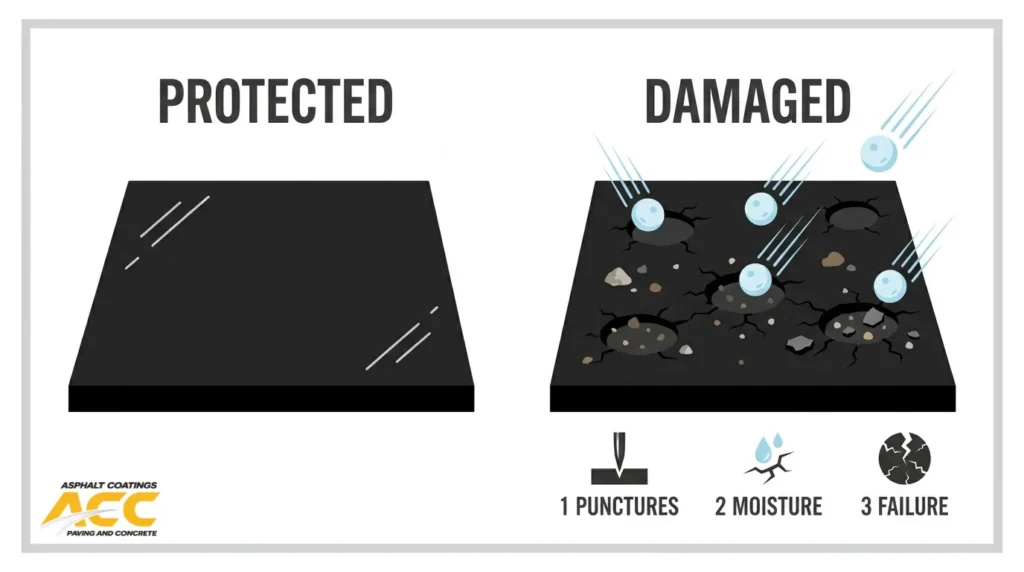
When hail strikes uncured sealcoat, it punctures, dents, and displaces the emulsion before it has developed mechanical strength. Asphalt emulsion cures through water evaporation; until that process completes, the coating remains pliable and defenseless against physical impact. Hailstones, even pea-sized, create craters that expose the underlying pavement to moisture infiltration. A common concern among property managers mirrors a frequently asked question in the industry: what happens if precipitation hits a sealed surface within hours of application? The answer is significant coating failure. Each impact site becomes a failure point where water penetrates, preventing proper bonding and accelerating deterioration across the treated surface. For Colorado Springs commercial lots, this risk is not hypothetical; it is a seasonal certainty that demands careful scheduling.
How Does Hail-Driven Debris Compromise Sealcoat Adhesion?
Hail-driven debris compromises sealcoat adhesion by embedding foreign material into the uncured surface and contaminating the bond between emulsion and pavement. Severe storms carry gravel, leaf litter, and grit at high velocity, and these particles lodge into soft sealant. Once trapped, debris creates weak points where the coating cannot form a continuous, sealed membrane. Moisture intrusion follows, because each embedded particle acts as a channel for water to reach the asphalt substrate. Given that crack sealing on a dry, clean surface is often more critical to treatment success than temperature alone, contamination from storm debris effectively negates the protective purpose of the application. For commercial properties in Colorado Springs, scheduling around peak hail risk is the most reliable way to protect the investment in fresh sealcoating.
What Is the Ideal Scheduling Window Before Hail Season?
The ideal scheduling window before hail season in Colorado Springs falls in late April through early May, when temperatures consistently reach application thresholds but before peak storm activity intensifies. Timing and surface conditions determine whether this window works for your lot.
Can You Sealcoat Commercial Lots in Late April or Early May?
Yes, you can sealcoat commercial lots in late April or early May if daytime temperatures hold at 50°F and rising. According to the Colorado Department of Transportation, emulsified asphalt shall not be applied when the atmospheric temperature is 50°F and falling. Colorado Springs’ mean last freeze date of May 8 makes late April applications a calculated risk; overnight lows can still dip below the curing threshold. Early May offers more reliable conditions, though it overlaps with the start of Colorado’s damaging hail season in mid-April. For most commercial property managers, the first two weeks of May represent the tightest balance between adequate warmth and pre-storm completion.
How Does Late Spring Soil Temperature Affect Cure Times?
Late spring soil temperature affects cure times by influencing how quickly the pavement surface releases moisture and reaches the warmth needed for proper water evaporation from the emulsion. Cool ground holds residual moisture from snowmelt, and that moisture directly undermines performance. According to Pavement Maintenance & Reconstruction, moisture adversely affects adhesion, and sealing on a dry road is often more integral to treatment success than pavement or air temperature alone. In Colorado Springs, late April soils at 6,000+ feet elevation warm slower than lower-altitude Front Range locations. Waiting until pavement surfaces are visibly dry and warm to the touch gives the sealcoat emulsion the best conditions to cure fully before afternoon storm risk climbs.
Understanding pre-season timing lays the groundwork for evaluating the post-hail scheduling window.
What Is the Ideal Scheduling Window After Hail Season?
The ideal scheduling window after hail season in Colorado Springs runs from late August through late September. Late summer provides reliable dry conditions, while early fall still offers temperatures warm enough for proper sealcoat curing before freeze risk arrives.
When Does Late Summer Offer Reliable Dry Conditions?
Late summer offers reliable dry conditions in Colorado Springs starting in mid-to-late August, as monsoonal moisture patterns taper off and afternoon storm frequency drops significantly. By this point, Colorado’s damaging hail season, which the Rocky Mountain Insurance Association defines as mid-April to mid-September, is winding down. Pavement surfaces stay drier for longer stretches, giving sealcoat emulsions the sustained evaporation window they need. For commercial property managers, this period balances two priorities: reduced storm interruption risk and enough warm daylight hours to complete large lot applications. Scheduling in this late-summer window consistently delivers the most predictable working conditions along the Front Range.
How Far Into Fall Can You Safely Sealcoat Before Freeze Risk?
You can safely sealcoat into fall in Colorado Springs until approximately late September, though the margin narrows quickly after that. According to National Weather Service data from Pueblo, the mean date for the first 32-degree-or-lower day in autumn for Colorado Springs is October 1st. Because sealcoat requires ambient temperatures of 50°F and rising at application time, plus several hours of sunlight to cure, crews should start later in the morning and stop earlier in the afternoon as days shorten. Pushing projects into early October introduces significant freeze risk that can ruin uncured material overnight, making late September the practical cutoff for most commercial sealcoating work.
With the post-hail scheduling window defined, understanding cure time requirements at Colorado Springs’ altitude ensures each application sets properly.
How Long Does Commercial Sealcoating Need to Cure?
Commercial sealcoating typically needs 24 to 48 hours to cure enough for traffic, though full cure can take longer depending on conditions. Colorado Springs’ altitude and summer humidity both influence this timeline.
What Cure Time Should You Expect in Colorado Springs’ Altitude?
The cure time you should expect in Colorado Springs’ altitude is generally longer than at lower elevations, despite some offsetting factors. Asphalt emulsion cures through the evaporation of water, as documented in research from Purdue University. At 6,035 feet, Colorado Springs’ lower atmospheric pressure accelerates initial surface evaporation. However, cooler overnight temperatures at altitude slow the deeper chemical curing that builds long-term durability.
For most commercial lots, plan on these general timelines:
- Light foot traffic: 12 to 24 hours minimum.
- Vehicle traffic: 24 to 48 hours under favorable conditions.
- Full mechanical cure: Up to 30 days for maximum hardness.
Property managers should avoid rushing lot reopenings, especially on large commercial surfaces where shaded areas cure more slowly than sun-exposed zones.
How Does Humidity From Monsoon Season Slow Curing?
Humidity from monsoon season slows curing by saturating the air with moisture, which reduces the evaporation rate that drives the curing process. According to Pavement Maintenance & Reconstruction, sealer or paint should not be applied when humidity exceeds 90% because the air is too saturated for water to escape the emulsion.
Colorado Springs’ North American Monsoon pattern, typically active from mid-July through early September, brings afternoon moisture surges that can stall a cure mid-process. Since sealcoat depends on water leaving the emulsion to develop mechanical strength, high humidity traps that moisture in the film.
Morning applications before monsoon-driven humidity peaks offer the best results. Scheduling around this pattern is one of the most overlooked factors in achieving a durable commercial sealcoat during summer months.
With cure timelines established, the next step is confirming conditions on application day.
What Weather Conditions Must Be Met on Application Day?
The weather conditions that must be met on application day include minimum temperature thresholds, dry skies, and manageable wind levels. Each factor directly influences sealcoat bonding, cure speed, and final durability.
What Temperature Range Is Required for Proper Sealcoat Bonding?
The temperature range required for proper sealcoat bonding is a minimum of 50°F and rising at the time of application. According to the Colorado Department of Transportation, emulsified asphalt shall not be applied when the atmospheric temperature is 50°F (10°C) and falling. This distinction matters: a reading of 52°F at 7 a.m. on a warming morning is acceptable, while that same reading at 4 p.m. as temperatures drop is not.
In Colorado Springs, where morning lows can sit in the 40s even during summer, crews should delay start times until pavement surface temperatures climb reliably above this threshold. Scheduling later morning starts gives both air and pavement time to absorb solar heat before application begins.
How Many Consecutive Dry Hours Are Needed After Application?
The number of consecutive dry hours needed after application depends on conditions, but a general minimum of several sunlight hours is essential for proper curing. According to Pavement Maintenance & Reconstruction, “ambient temperature needs to be 50°F and rising at the time of application for sealer to be applied successfully, so start sealcoating later in the morning and stop earlier in the afternoon to give the sealer hours of sunlight to dry.”
This guidance means stopping application by mid-afternoon in Colorado Springs, where summer thunderstorms frequently develop between 2 p.m. and 5 p.m. Humidity above 90% also prevents proper water evaporation from the emulsion. Monitoring hourly forecasts for both precipitation probability and humidity levels is non-negotiable for commercial projects with large surface areas that take longer to seal.
Why Does Wind Speed Matter for Commercial Sealcoat Projects?
Wind speed matters for commercial sealcoat projects because it directly affects both application uniformity and evaporation rate. Light to moderate wind accelerates water evaporation from the asphalt emulsion, which supports faster curing. However, excessive wind creates uneven spray patterns in large-scale applications, leading to inconsistent film thickness across parking lots and access roads.
For commercial properties in Colorado Springs, where afternoon gusts regularly accompany storm development along the Front Range, this variable is especially relevant. High winds also carry dust and debris onto wet sealcoat, compromising adhesion and surface finish. Crews should target calm morning windows and monitor real-time wind data to maintain spray consistency across the full project area.
With application-day conditions confirmed, property managers should next assess how to address any existing hail damage before sealcoating begins.
How Should Property Managers Handle Hail Damage Before Sealcoating?
Property managers should handle hail damage before sealcoating by completing all necessary crack repairs and patching first. The subsections below cover when crack filling suffices and when full asphalt patching is required.
Should You Repair Cracks and Potholes Before Sealcoating?
Yes, you should repair cracks and potholes before sealcoating. Sealcoat is a protective surface layer, not a structural fix; applying it over damaged pavement traps moisture underneath and accelerates deterioration. Hail impacts often open new cracks or widen existing ones, making post-storm inspection essential.
A thorough pre-sealcoat repair sequence includes:
- Cleaning debris and vegetation from all cracks.
- Completing crack sealing with hot-pour or cold-pour sealant on completely dry pavement.
- Patching potholes with hot-mix asphalt and compacting to grade.
- Allowing all repairs to cure fully before the sealcoat application.
Skipping this step is one of the most common mistakes property managers make, because it locks damage beneath a cosmetic layer that will fail prematurely. Asphalt Coatings Company uses in-house crews to complete all crack sealing and patching work with CDOT-approved materials before any sealcoat application, ensuring structural repairs are done right the first time.
When Does Storm Damage Require Full Asphalt Patching First?
Storm damage requires full asphalt patching first when surface distress extends beyond isolated cracks into structural failure. According to The Asphalt Pro, pavement with crack density greater than 20 percent or signs of fatigue cracking may not be strong enough to sustain routing, let alone hold a sealcoat. In those cases, saw-cut removal and hot-mix replacement restore structural integrity before any sealer is applied.
Property managers should also note that emulsified asphalt patching materials cannot be applied when temperatures are at 50°F and falling, or during foggy or rainy conditions. Scheduling repairs during stable, warm weather ensures proper compaction and bonding before the sealcoat layer goes down.
With pre-existing damage addressed, property managers can coordinate lot closures to minimize tenant disruption during the sealcoating phase.
How Do You Minimize Tenant and Business Disruption During Scheduling?
You minimize tenant and business disruption during scheduling by phasing work into overnight windows and coordinating lot closures around peak traffic periods. The following subsections cover overnight phasing strategies and retail traffic coordination.
Can You Phase Sealcoating Across Multiple Overnight Windows?
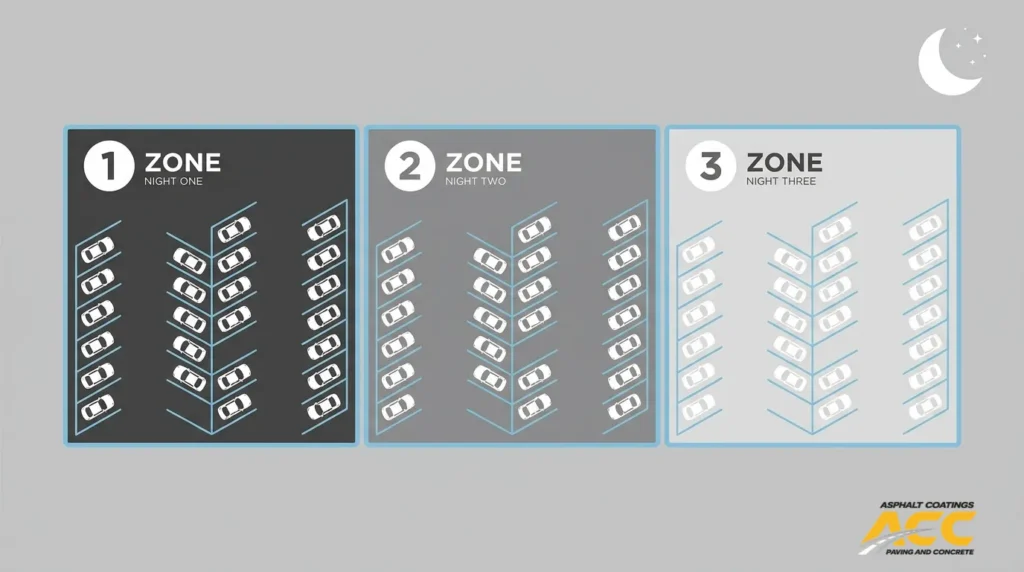
Yes, you can phase sealcoating across multiple overnight windows to keep commercial lots operational during business hours. This approach divides a parking lot into zones, with crews completing one section per night while tenants and customers use the remaining areas normally. Overnight phasing works especially well for shopping centers, office parks, and apartment complexes in Colorado Springs where daytime closures would directly impact revenue or resident access. Each phase needs enough cure time before morning traffic returns, so crews typically begin after 8 PM and finish by early morning. Property managers should confirm that each overnight phase allows sufficient drying hours given Colorado Springs’ lower humidity and altitude conditions.
How Do You Coordinate Lot Closures With Peak Retail Traffic?
You coordinate lot closures with peak retail traffic by scheduling sealcoating work during a property’s lowest-volume periods. For retail centers, this typically means avoiding Friday through Sunday closures entirely and targeting Tuesday or Wednesday nights instead. Property managers should share tenant lease requirements and delivery schedules with the sealcoating contractor well before the project start date. Key coordination steps include:
- Notify all tenants and building occupants at least two weeks before any scheduled closure.
- Post visible signage with alternative parking directions and project timelines.
- Stagger zone closures so no single business loses full parking access on the same day.
- Align phased work with tenant operating hours, protecting early-morning and lunch-rush accessibility.
Clear communication between property managers and the contractor prevents costly surprises and keeps businesses running smoothly throughout the project. With disruption strategies defined, contingency plans address what happens when unexpected hail interrupts the work.
What Contingency Plans Protect Against Mid-Project Hail Events?
Contingency plans that protect against mid-project hail events include weather delay clauses in contracts and crew remobilization protocols. These measures limit financial exposure and project downtime when storms interrupt active sealcoating work.
Should Contracts Include Weather Delay Clauses for Hail Risk?
Yes, contracts should include weather delay clauses for hail risk. Colorado Springs sits within one of the most active hail corridors in the country, making storm interruptions a realistic scheduling threat during any summer project. A well-drafted clause defines what qualifies as a covered delay and protects both the property manager and the contractor from disputes over timeline extensions.
According to industry contract standards referenced in the Rowland Unified School District Bid No. 2024-25, adverse weather is defined as weather that satisfies unusually severe precipitation, sleet, snow, hail, heat, or cold. Contracts for commercial sealcoating in Colorado Springs should adopt similar language, specifying hail by name as a qualifying event.
Key elements to include in a weather delay clause:
- A clear definition of adverse weather that explicitly lists hail alongside rain, snow, and extreme temperatures.
- A notification procedure requiring the contractor to document the event within 24 to 48 hours.
- An automatic timeline extension tied to documented weather days, with no penalty to either party.
- A provision for re-inspection of any curing sealcoat damaged by the storm before work resumes.
For commercial property managers in Colorado Springs, skipping this clause is a gamble that rarely pays off. The cost of renegotiating mid-project is almost always higher than building flexibility into the original agreement.
How Quickly Can Crews Remobilize After an Unexpected Storm?
Crews can remobilize after an unexpected storm within 24 to 72 hours, depending on surface conditions and storm severity. The primary factor controlling remobilization speed is not crew availability; it is whether the pavement has dried sufficiently and whether previously applied sealcoat requires repair before new material goes down.
After a hail event, crews must verify several conditions before resuming work:
- Surface moisture has fully evaporated and the pavement is dry to the touch.
- Air temperature has returned to 50°F or above and is rising.
- Any sealcoat applied before the storm is inspected for pitting, delamination, or debris contamination.
- Damaged sections are flagged for recoating or patching before adjacent areas receive fresh material.
Contractors with in-house crews and local staging areas can respond faster than firms that rely on subcontractors traveling from outside the region. This is one area where a Colorado Springs-based operation with dedicated equipment holds a clear advantage over larger, less agile competitors.
With remobilization timelines established, the next step is partnering with a contractor whose local experience turns these contingency plans into reliable execution.
How Does Asphalt Coatings Company Approach Commercial Sealcoating in Colorado Springs?
Asphalt Coatings Company approaches commercial sealcoating in Colorado Springs by combining 39 years of Front Range expertise with weather-aware scheduling built for hail season. The sections below cover regional experience and key scheduling takeaways.
Can 39 Years of Front Range Expertise Help You Navigate Hail Season Scheduling?
Yes, 39 years of Front Range expertise can help you navigate commercial sealcoating season scheduling. Asphalt Coatings Company has operated across Colorado’s Front Range since 1986, developing project timelines specifically around the region’s severe storm patterns, freeze-thaw cycles, and high-altitude curing conditions. That depth of local knowledge translates into scheduling precision that newer contractors simply cannot replicate.
Asphalt Coatings Company uses in-house crews rather than subcontractors, which allows faster remobilization when storms delay a project. For property managers coordinating lot closures around tenant operations, this single-source approach reduces the communication gaps that cause costly scheduling conflicts. When hail season narrows the available workdays, experience reading Front Range weather windows becomes the difference between a successful cure and a failed application.
What Are the Key Takeaways About Scheduling Commercial Sealcoating Around Colorado Springs’ Summer Hail Season?
The key takeaways about scheduling commercial sealcoating around Colorado Springs’ summer hail season are:
- Colorado’s damaging hail season runs from mid-April to mid-September, according to the Rocky Mountain Insurance Association, so the safest application windows fall just outside those boundaries.
- The Front Range sits within “hail alley,” where Nebraska, Colorado, and Wyoming converge, averaging seven to nine hail days per year.
- Successful scheduling requires monitoring daily storm patterns, confirming dry cure windows, and building weather delay contingencies into every contract.
- Pre-season applications in late April or early May and post-season work from mid-September through late September offer the most reliable conditions.
- Pavement must be assessed for hail damage, cracks, and moisture before any sealcoat application proceeds.
For property managers seeking a partner who understands these variables, Asphalt Coatings Company brings nearly four decades of Colorado-specific scheduling expertise to every commercial project.
Our Comprehensive Commercial Asphalt Paving Services
While this guide focuses on the nuances of sealcoating, Asphalt Coatings Company’s expertise extends across the full spectrum of commercial pavement needs. With over 39 years serving the Front Range, our in-house teams are equally proficient in delivering high-quality asphalt paving services, from new construction and resurfacing to complex repairs. We understand that effective pavement management for Colorado Springs properties requires a holistic approach, addressing not just surface protection but also structural integrity. Our comprehensive services ensure that every aspect of your commercial asphalt, from initial installation to long-term maintenance, is handled with the same local insight and precision, regardless of the project’s scale or complexity.