Asphalt paving for retail properties differs from industrial properties in structural design, material selection, and maintenance strategy because each property type faces distinct traffic loads, environmental exposures, and regulatory requirements.
This guide covers traffic demands and load profiles, asphalt thickness and mix design, subbase and drainage engineering, striping and layout standards, maintenance scheduling, freeze-thaw performance, cost planning, and the balance between curb appeal and structural functionality.
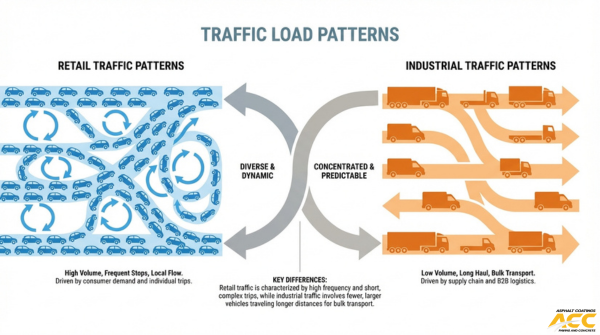
Retail lots absorb thousands of lightweight vehicle passes daily, generating cumulative surface fatigue that produces rutting and alligator cracking. Industrial yards handle far fewer vehicles, but concentrated axle loads exceeding 80,000 pounds demand thicker pavement sections and stiffer binder grades to prevent deep structural failure.
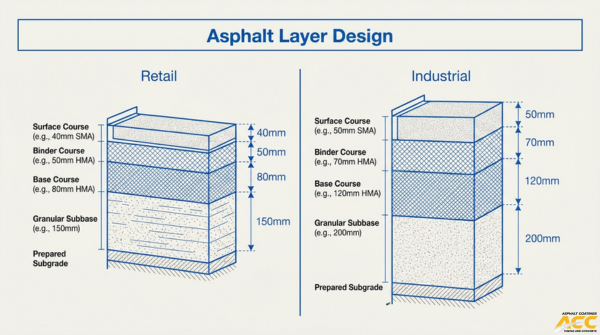
Retail applications typically call for 2.5 to 4 inches of hot mix asphalt using fine-to-medium 9.5-mm or 12.5-mm aggregate mixes, while industrial pavements require 4 to 6 inches or more with coarser 19.0-mm mixes and polymer-modified binders. Subbase depths follow the same pattern, ranging from 6 to 8 inches for retail and 8 to 12 inches for industrial sites.
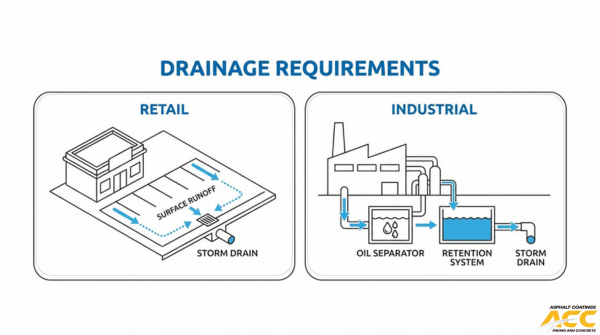
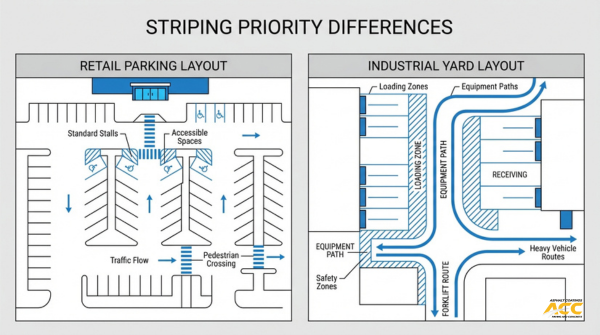
Drainage and regulatory obligations diverge sharply. Industrial facilities must often implement Stormwater Pollution Prevention Plans with oil/water separators, while retail drainage focuses on efficient surface runoff conveyance. Striping priorities also split: retail lots maximize parking efficiency and ADA compliance, whereas industrial markings separate heavy equipment corridors from pedestrian pathways.
Maintenance cycles differ in both frequency and urgency. Retail sealcoating runs every two to three years to preserve appearance and surface integrity, while industrial schedules extend to three to five years with greater emphasis on structural crack repair. Colorado’s freeze-thaw cycles compound these differences, attacking retail surfaces cosmetically and industrial structures from within.
Why Do Retail and Industrial Properties Need Different Paving Approaches?
Retail and industrial properties need different paving approaches because they face fundamentally different loads, traffic patterns, and environmental exposures. A shopping center parking lot absorbs thousands of lightweight vehicle passes daily, while an industrial yard must withstand concentrated heavy-equipment loads that can exceed 80,000 pounds. These differences dictate every design decision, from asphalt mix selection and thickness to drainage engineering and maintenance intervals. Understanding where retail and industrial demands diverge is the first step toward specifying pavement that performs under real-world conditions rather than failing prematurely.
What Traffic Demands Differ Between Retail and Industrial Lots?
Traffic demands differ between retail and industrial lots primarily in vehicle type, load weight, and circulation frequency. Retail lots handle high volumes of lighter passenger vehicles, while industrial lots endure fewer but far heavier trucks and equipment. The following sections break down how each traffic profile shapes pavement design.
How Does High-Volume Customer Traffic Affect Retail Pavement Design?
High-volume customer traffic affects retail pavement design by creating constant, repetitive stress across the entire surface. Big-box retail parking lots experience continuous daily loading that accelerates rutting compared to low-use roads, according to The Pavement Group. This repeated traffic cycling produces alligator cracking, a series of small, jagged, interconnecting cracks caused by fatigue failure under repeated loading.
Retail pavement must also satisfy regulatory demands that compound design complexity:
- Fire apparatus access roads require support for loads of at least 75,000 pounds.
- ADA-compliant parking spaces must be at least 96 inches wide with a maximum 2.08% slope.
High surface temperatures combined with aging asphalt binder intensify top-down cracking in these high-traffic zones. Even though individual passenger vehicles are light, thousands of daily passes create cumulative fatigue that thinner retail sections cannot absorb without proper mix selection and structural design.
How Do Heavy Trucks and Equipment Impact Industrial Pavement Design?
Heavy trucks and equipment impact industrial pavement design by concentrating extreme loads on small contact areas. A standard heavy vehicle places 12,000 pounds on the steering axle and distributes the remaining 36,000 pounds across two rear axles at 18,000 pounds each. Specialized equipment pushes those figures much higher; according to the Colorado Asphalt Pavement Association, aerial ladders can reach a maximum Gross Axle Weight Rating of 86,000 pounds total, with 62,000 pounds on the rear axle alone.
Modern radial truck tires inflated to at least 100 psi further concentrate contact stress, a significant increase over the 70 psi pressures common in past decades. This combination of extreme axle weights and elevated tire pressures demands thicker asphalt sections, stiffer binder grades, and reinforced subbase layers that would be unnecessary in a retail setting.
What Role Do Turning Movements and Circulation Patterns Play in Retail Lots?
Turning movements and circulation patterns play a critical role in retail lots because slow-speed maneuvers generate localized shear forces that deform asphalt surfaces. Vehicles braking into parking stalls, turning at aisle intersections, and idling in drive-through lanes apply horizontal stress that differs substantially from straight-line rolling loads. Slippage cracking frequently occurs at these points, caused by low-strength surface mixes or poor interlayer bonding under braking and turning wheels.
Retail lot designers must account for this by specifying tack coats that ensure strong layer adhesion and selecting surface mixes resistant to shoving. Intersection radii, drive aisle widths, and one-way circulation loops all influence where concentrated turning stress occurs, making layout and pavement engineering inseparable in retail applications.
How Do Loading Docks and Staging Areas Shape Industrial Pavement Needs?
Loading docks and staging areas shape industrial pavement needs by creating zones of extreme static and slow-roll loading. Trucks idling at dock aprons, trailers parked on kickstands, and forklifts cycling between staging lanes apply sustained point loads that standard paving cannot withstand. These concentrated pressures cause deep rutting and subsurface deformation over relatively small areas.
Pavement sections at loading docks typically require thicker lifts, polymer-modified binders, or concrete pads to resist indentation. Staging areas where heavy vehicles turn at low speed also face the same shear forces seen in retail lots, but amplified by far greater vehicle weights. Designing these zones separately from general industrial travel lanes is essential for preventing premature failure across the entire facility.
Understanding these distinct traffic demands helps property managers specify the right pavement structure from the start.
How Does Asphalt Thickness and Mix Design Vary by Property Type?
Asphalt thickness and mix design vary by property type based on traffic volume, vehicle weight, and turning stress. Retail lots and industrial yards each demand distinct structural sections and aggregate sizes, covered below.
What Asphalt Thickness Is Recommended for Retail Parking Lots?
The recommended asphalt thickness for retail parking lots typically ranges from 2.5 to 4 inches of hot mix asphalt over a properly prepared aggregate base. This range accounts for the steady stream of passenger vehicles, delivery trucks, and occasional fire apparatus that retail sites must support.
According to The Pavement Group, areas with high daily traffic, such as big-box retail parking lots, experience continuous stress that accelerates rutting compared to low-use roads. Slippage cracking compounds this problem when low-strength surface mixes or poor layer bonding fail under braking and turning wheels. Retail lots should prioritize a dense-graded surface course with strong interlayer bonding to resist these forces, especially in drive lanes and entrance aprons where turning stress concentrates.
What Asphalt Thickness Is Recommended for Industrial Yards and Roads?
The recommended asphalt thickness for industrial yards and roads is typically 4 to 6 inches or more of hot mix asphalt, depending on expected axle loads. Industrial pavements must support forklifts, loaded semi-trucks, and heavy equipment that generate far greater stress per square foot than retail traffic.
According to the FHWA’s HMA Pavement Mix Type Selection Guide, the damaging effect of vehicle loads is expressed as 18-kip equivalent single axle loads (ESALs), and industrial areas may require a 19.0-mm dense-graded mix to handle heavier loads, compared to the 9.5-mm or 12.5-mm mixes sufficient for city streets. Thicker structural sections paired with coarser aggregate gradations give industrial pavements the load-bearing capacity needed to prevent premature rutting and fatigue cracking under repeated heavy axle passes.
Which Hot Mix Asphalt Grades Work Best for Retail Applications?
The hot mix asphalt grades that work best for retail applications are fine-to-medium dense-graded mixes, typically using 9.5-mm or 12.5-mm nominal maximum aggregate sizes. These smaller aggregate gradations produce a smooth, tight surface that handles passenger vehicle traffic comfortably while providing good skid resistance for shoppers and pedestrians.
Performance-graded binders should match local climate conditions. A mid-range PG binder, such as PG 64-22, balances rut resistance in summer heat with flexibility during cold weather. Retail surfaces also benefit from a finer surface texture because it supports clean striping lines for parking stalls and ADA-compliant markings. For most retail parking lots, prioritizing surface quality and ride smoothness over maximum load capacity delivers the best long-term value.
Which Hot Mix Asphalt Grades Work Best for Industrial Applications?
The hot mix asphalt grades that work best for industrial applications are coarse dense-graded mixes using 19.0-mm or larger nominal maximum aggregate sizes. Coarser aggregate interlocks more effectively under heavy loads, creating a stiffer pavement structure that resists rutting from slow-moving trucks and stationary equipment.
Industrial sites with concentrated heavy traffic often benefit from polymer-modified binders, such as PG 76-28, which provide enhanced high-temperature stiffness without sacrificing low-temperature crack resistance. These stiffer binders hold up under the sustained contact pressures of loaded trailers and the slow turning movements common at loading docks. Selecting the right combination of aggregate size and binder grade is one of the most cost-effective decisions an industrial property manager can make, because under-specifying the mix leads to premature failure that costs far more than the upfront material difference.
With thickness and mix design established, the subbase and drainage layers beneath the asphalt determine how well each pavement structure performs over time.
How Do Subbase and Drainage Requirements Compare?
Subbase and drainage requirements differ significantly between retail and industrial properties due to load capacity needs and stormwater management obligations. The sections below cover typical subbase depths for each property type and how drainage designs diverge.
What Subbase Depth Does a Retail Property Typically Require?
A retail property typically requires a subbase depth of 6 to 8 inches of compacted aggregate base. Standard customer vehicles, delivery trucks, and occasional fire apparatus generate moderate loads that a well-graded crushed stone base at this depth can distribute effectively across the subgrade. Soil conditions matter: expansive clay soils common in Colorado may push that minimum toward the higher end. Proper compaction to at least 95% Standard Proctor density is essential, since even a well-designed asphalt surface will fail prematurely if the subbase settles unevenly beneath parking stalls and drive aisles. For most retail lots, investing in thorough subgrade preparation upfront prevents costly structural repairs later.
What Subbase Depth Does an Industrial Property Typically Require?
An industrial property typically requires a subbase depth of 8 to 12 inches, and sometimes more, depending on expected axle loads and soil bearing capacity. Heavy trucks, forklifts, and loaded trailers concentrate force over smaller contact areas, demanding thicker aggregate layers to prevent subgrade deformation. Staging zones near loading docks often warrant the deepest sections. Beyond structural demands, industrial sites face stricter environmental controls. According to the U.S. Environmental Protection Agency, common requirements for industrial stormwater permits include development of a written Stormwater Pollution Prevention Plan (SWPPP) and implementation of control measures like oil/water separators to reduce pollutant discharge. These permit obligations directly influence how subbases are engineered, often requiring permeable or stabilized layers that support both structural load distribution and water quality compliance.
How Do Stormwater Drainage Designs Differ Between the Two?
Stormwater drainage designs differ between retail and industrial properties in complexity, regulatory scope, and pollutant management. Retail lots primarily manage surface runoff volume through sloped pavement, catch basins, and retention ponds sized for impervious area coverage. The goal is efficient water conveyance away from storefronts and pedestrian zones.
Industrial sites face a more demanding standard. Runoff from yards and staging areas often carries oil, heavy metals, and chemical residues, requiring treatment infrastructure such as:
- Oil/water separators at discharge points
- Sediment traps in high-traffic loading zones
- Containment berms around fuel storage and chemical handling areas
- Engineered swales or detention basins designed for pollutant settling
Industrial drainage systems must also satisfy SWPPP documentation and monitoring requirements that most retail properties never encounter. Failing to align drainage design with the correct property classification creates both structural and regulatory risk, making accurate planning from the start essential.
How Do Striping and Layout Priorities Differ?
Striping and layout priorities differ based on whether the property serves retail customers or industrial operations. Retail layouts focus on parking efficiency and wayfinding, while industrial layouts prioritize safety markings and vehicle separation.
What Striping Standards Apply to Retail Customer Parking Areas?
Striping standards that apply to retail customer parking areas focus on maximizing space efficiency, guiding pedestrian flow, and ensuring clear directional movement. Standard stall widths of 9 feet accommodate most passenger vehicles, with wider stalls near entrances for accessibility. Angled parking configurations at 60 or 90 degrees optimize lot capacity while maintaining safe circulation.
Crosswalk markings, stop bars, and directional arrows guide both drivers and pedestrians through high-turnover zones. Fire lane striping with red curbing and “No Parking” designations is also mandatory. Faded or poorly maintained striping creates confusion and liability exposure, making regular restriping essential for any retail property.
What Pavement Markings Do Industrial Sites Require for Safety?
Pavement markings that industrial sites require for safety center on separating heavy equipment zones from pedestrian pathways. Loading dock approach lanes, truck staging boundaries, and forklift travel corridors need bold, high-visibility markings to prevent collisions and streamline logistics.
Key industrial pavement markings include:
- Designated truck routes with directional arrows for semi-trailer circulation.
- Forklift and pedestrian separation lines, often in contrasting yellow and white.
- Hazard zones around loading docks, fuel storage areas, and waste enclosures.
- Speed limit stencils and stop bars at high-risk intersections within the facility.
OSHA-referenced visibility standards often dictate marking color and width. For properties that experience heavy equipment traffic, durable thermoplastic markings outlast standard paint significantly.
How Do ADA Compliance Needs Differ Across Property Types?
ADA compliance needs differ across property types primarily in scale, placement, and the volume of accessible features required. According to ADA.gov, retail car-accessible parking spaces must measure at least 96 inches wide with a maximum slope of 1:48 (2.08%). Retail properties generally need more total accessible spaces because customer parking counts are higher, and access aisles must connect directly to building entrances via compliant routes.
Industrial properties require fewer accessible customer spaces but must still provide compliant parking for employee lots and visitor areas. Accessible routes to office entrances, break rooms, and administrative buildings are mandatory regardless of the property’s primary function.
Overlooking ADA requirements on either property type carries real legal and financial risk, making compliance a baseline priority rather than an afterthought. With layout standards defined, maintenance scheduling determines how long these markings remain effective.
How Does Maintenance Scheduling Differ for Each Property Type?
Maintenance scheduling differs for each property type based on traffic intensity, load severity, and the rate of surface deterioration. Retail lots, industrial pavements, and their crack repair timelines each follow distinct intervals.
How Often Should Retail Lot Sealcoating Be Scheduled?
Retail lot sealcoating should be scheduled every two to three years. High customer traffic volume, constant turning movements, and UV exposure degrade the surface binder faster than on lower-use properties. Shopping centers and big-box retail parking lots experience continuous wear from daily vehicle circulation, which accelerates oxidation and fine cracking in the top layer.
Because retail lots prioritize curb appeal alongside protection, staying on a shorter sealcoating cycle preserves both appearance and structural integrity. Delaying sealcoat beyond three years on a busy retail surface often leads to moisture infiltration that compounds repair costs quickly.
How Often Should Industrial Pavement Sealcoating Be Scheduled?
Industrial pavement sealcoating should be scheduled every three to five years, depending on load severity and chemical exposure. Pairing sealcoating with routine crack sealing treatment on a coordinated schedule delivers the strongest return on pavement investment for heavy-use sites. Heavier axle loads and slower-moving equipment cause deeper structural stress, so industrial sealcoating programs must coordinate with crack sealing to remain effective. According to a cost-benefit analysis by Pave It Forward LLC, preventive maintenance for commercial asphalt typically costs three times less than reactive repairs, with crack sealing treatment extending asphalt service life by up to 3.6 years.
Industrial facilities that handle fuel, hydraulic fluid, or solvents may need spot treatments between full sealcoat applications. Pairing sealcoating with routine crack sealing on a coordinated schedule delivers the strongest return on pavement investment for heavy-use sites.
What Crack Repair Urgency Differences Exist Between the Two?
Crack repair urgency differences between retail and industrial properties stem from how quickly damage escalates under each traffic profile. Key distinctions include:
- Retail lots require faster cosmetic crack repair because even minor surface cracks collect debris, create trip hazards for pedestrians, and reduce curb appeal that directly affects customer perception.
- Industrial sites demand urgent structural crack repair when cracks appear near loading docks, staging areas, or heavy-vehicle lanes, since concentrated axle loads widen cracks rapidly into alligator cracking or potholes.
- Retail cracks spread gradually across broad surface areas under lighter, distributed traffic loads.
- Industrial cracks deepen quickly under point loads and repetitive heavy equipment passes, risking subbase compromise.
For both property types, sealing cracks before Colorado’s freeze-thaw season is essential to preventing water infiltration and costly structural failures.
With maintenance intervals defined, understanding how freeze-thaw cycles affect each property type sharpens seasonal planning.
How Do Colorado Freeze-Thaw Cycles Affect Each Property Type?
Colorado freeze-thaw cycles affect retail and industrial properties differently based on surface exposure and structural load conditions. Retail lots face cosmetic and surface-level frost damage, while industrial pavements endure deeper structural deterioration.
Why Are Retail Lots More Vulnerable to Frost-Related Surface Damage?
Retail lots are more vulnerable to frost-related surface damage because their large, open expanses of thin-section asphalt experience direct solar heating and rapid overnight cooling. This constant temperature cycling accelerates surface-level distress in several ways:
- Water pools in shallow depressions and parking stall areas where vehicle traffic is lighter.
- Repeated freezing expands trapped moisture, popping out aggregate and creating potholes.
- Sealcoat layers crack and peel when ice forms beneath the surface film.
- Snowplow blades catch frost-heaved edges, worsening existing damage.
Because retail lots prioritize smooth, visually appealing surfaces for customer traffic, even minor frost damage becomes noticeable quickly. Pairing regular sealcoating with professional striping that enhances nighttime visibility and security helps offset the cosmetic impact of freeze-thaw cycles on retail surfaces. Proactive sealcoating before Colorado’s winter months remains one of the most effective defenses against this surface-level freeze-thaw deterioration.
Why Do Industrial Pavements Face Greater Structural Freeze-Thaw Risk?
Industrial pavements face greater structural freeze-thaw risk because heavy loads compound the damage that moisture expansion causes within the pavement structure. According to Tensar, freeze-thaw cycles reduce stiffness, compressive strength, and fatigue performance, particularly in northern climates with high water infiltration. When saturated subbase layers freeze beneath industrial slabs already bearing concentrated axle loads, the resulting heave and settlement crack the pavement from within.
Engine oil spills common at loading docks and staging areas make this worse. Corroded asphalt binder loses adhesion capacity, which means freeze-thaw moisture penetrates deeper into already-weakened sections. For industrial properties, addressing both chemical exposure and drainage before winter is essential to preventing structural failures that surface treatments alone cannot fix.
With freeze-thaw impacts understood, evaluating cost factors helps property managers budget accurately for each property type.
What Cost Factors Should Property Managers Weigh for Each Type?
The cost factors property managers should weigh for each type include upfront material and thickness requirements, long-term maintenance frequency, and the financial consequences of reactive versus preventive repair strategies. Retail properties prioritize surface quality and appearance-driven maintenance, while industrial sites demand heavier structural investment that raises initial installation costs but changes the maintenance calculus entirely.
According to a cost-benefit analysis by Pave It Forward LLC, preventive maintenance for commercial asphalt typically costs three times less than reactive repairs, with crack sealing and sealcoating ranking as the most cost-effective methods to extend pavement life. This principle applies to both property types, yet the specific budget allocation shifts considerably.
Retail lots generally require thinner asphalt sections and standard-grade binders, which lowers initial paving costs. However, the high daily traffic volume from customer vehicles accelerates surface wear, meaning sealcoating and crack sealing cycles must be scheduled more frequently to maintain both curb appeal and structural integrity. Understanding proper sealcoating curing time is essential for retail properties, since parking areas must be reopened quickly to avoid disrupting customer traffic. Deferred maintenance on a retail lot quickly compounds into costlier repairs because surface distress discourages foot traffic and affects revenue.
Industrial properties carry higher upfront costs due to thicker pavement sections, coarser aggregate mixes, and reinforced subbase layers engineered for heavy axle loads. These deeper structural investments reduce the frequency of major repairs, but when failures do occur, the scale and cost of rehabilitation are significantly greater. Oil and chemical exposure at industrial sites also degrades binder adhesion over time, adding containment and remediation expenses that retail managers rarely face.
The most overlooked cost factor is timing. For retail properties, scheduling repairs during off-peak hours or between seasonal rushes adds logistical expense. For industrial sites, downtime in loading areas or haul roads can halt operations entirely, making the indirect cost of pavement failure far exceed the repair bill itself. Property managers who budget for preventive maintenance on a fixed cycle, rather than waiting for visible distress, consistently spend less over the pavement’s full lifecycle.
Understanding these cost dynamics helps property managers plan realistic capital budgets for either property type.
How Does Curb Appeal and Functionality Balance Shift by Property Type?
The curb appeal and functionality balance shifts by property type because retail properties prioritize visual appearance to attract customers, while industrial properties prioritize structural performance to support operations.
Retail lots must look clean, freshly striped, and well-maintained because surface condition directly influences customer perception and foot traffic. Smooth, dark-toned asphalt with crisp pavement markings signals professionalism and safety to shoppers. When surface distress like alligator cracking or rutting appears on a retail lot, the damage to brand perception can be just as costly as the structural damage itself.
Industrial properties, by contrast, tolerate cosmetic imperfections as long as the pavement performs under load. Warehouse yards and loading zones need surfaces engineered for heavy axle weights, chemical exposure, and repetitive turning movements. According to the National Asphalt Pavement Association, top-down cracks in asphalt pavements are primarily caused by high tire pressures and excessive tire loads combined with high surface temperatures and binder aging. For industrial operators, investing in thicker sections and chemical-resistant mixes matters far more than a pristine appearance.
The practical takeaway is straightforward: retail paving budgets should allocate more toward sealcoating frequency, striping refreshes, and surface-level aesthetics. Industrial paving budgets should weight structural depth, material selection, and load-rated subbase design. Misallocating these priorities, such as over-engineering a retail lot or under-building an industrial yard, wastes capital and shortens pavement life. Site features like adjacent landscaping require coordinated tree root mitigation to prevent long-term uplift and cracking at both retail and industrial properties. Understanding which side of the balance your property falls on shapes every decision from mix design to maintenance scheduling.
How Can Commercial Paving Expertise Address Both Property Types?
Commercial paving expertise addresses both property types by combining site-specific engineering with a full range of installation and maintenance services. The following sections cover Asphalt Coatings Company’s capabilities and the key takeaways for retail versus industrial paving decisions.
Can Asphalt Coatings Company Handle Retail and Industrial Projects?
Yes, Asphalt Coatings Company can handle retail and industrial projects. Since 1986, Asphalt Coatings Company has served Colorado’s Front Range with in-house crews specializing in commercial asphalt paving, concrete flatwork, sealcoating, crack sealing, striping, and ADA-compliant construction. For sites requiring major surface restoration, the company also offers mill and pave services to remove deteriorated asphalt and install a fresh, structurally sound overlay. Asphalt Coatings Company designs each project around the property’s specific load demands, traffic patterns, and drainage requirements, whether that means a customer-facing shopping center lot or a heavy-duty industrial yard. With subgrade preparation, mill-and-pave services, and CDOT-approved materials all managed under one roof, Asphalt Coatings Company provides single-source convenience for property managers who need both property types maintained to the same professional standard.
What Should You Remember About Paving for Retail vs Industrial Sites?
The key things you should remember about paving for retail vs industrial sites center on how traffic type, load intensity, and maintenance timing shape every design decision:
- Retail lots prioritize smooth surfaces, ADA-compliant striping, and curb appeal to support high-volume customer traffic and frequent turning movements.
- Industrial pavements require thicker asphalt sections, coarser aggregate mixes, and reinforced bases to withstand heavy axle loads and concentrated point stresses.
- Preventive maintenance, including sealcoating and crack sealing, costs roughly three times less than reactive repairs for both property types, according to Pave It Forward LLC.
- Colorado’s freeze-thaw cycles demand proper drainage design and climate-appropriate binder selection regardless of property use.
Choosing the right paving partner means finding one contractor equipped to engineer solutions for both ends of the commercial spectrum.